There’s an aura of dustiness at the opening of Institute. The edges of the stage, shrouded in a crepuscular gloom, are crowded with filing cabinets. Towering, oppressive, rusty brown. This space, designed by Rhys Jarman and Amit Lahav, is somewhere between a workplace, an archive and a Kafkaesque labyrinth of endless documentation. It looks at once humdrum and dystopian.
Gecko’s show, though, is anything but dusty. It might be crammed into this dingy, almost deathly setting, but its movement hums with life. Bodies leap, spin and fall through the space, limbs propelled with joy one moment and despair the next. The storytelling might be puzzling and opaque, but Institute‘s glimpses of the human condition – its ecstasy, its agony – are crystal clear.
It’s hard to say what precisely Institute is “about”. The title, perhaps, is a good place to start. The word “institute” suggests an organisation, a state body or company, somewhere strait-jacketed by rules and leaden with bureaucracy. But “institute” is also a verb: to introduce, to establish, to begin.
At first, we appear to be in a workplace – an unspecified institute of commerce. Its employees are two men: Martin (Lahav) and Daniel (Chris Evans). They make cheery colleagues, dancing around their desks while they carry out meaningless tasks and answer incessant telephone queries from their absent bosses. Yet there’s also a sinister undertow. At odd intervals, bright lights flash and sirens intervene. These men seem to be under surveillance, their office acquiring a tinge of the Orwellian. And those cabinets, which store far more than just files, seem to hold a perpetual, ominous allure for the men who organise them…
The longer the piece goes on, the more I begin to wonder whether we’re in another kind of institute: a hospital, perhaps a bizarre and unconventional psychiatric ward. The two protagonists, who at first simply seem to be grinding through the 9-to-5, are each troubled in their own way. Daniel, a (wannabe? one-time?) architect, is both driven and crippled by ambition. Proud, expectant voices echo from the filing cabinets, while he contorts his resistant body into desk-bound poses of industry. Martin, meanwhile, is driven wild by thwarted love, seemingly doomed to relive the same humiliating restaurant scene over and over and over.
It’s never entirely clear, though, what these haunting scenes represent. Are we seeing dreams, memories, or stunted desires? There are hints of group therapy, as Martin and Daniel link hands with their bosses-turned-carers (Ryen Perkins‐Gangnes and
François Testory) and move in a circle. But the two men who seem to be in charge here – speaking different languages, to amplify the confusion – have traumas of their own. One is increasingly ill and frail, stubbornly pushing away his pills in denial. The other is repeatedly dragged back to a startling nightmare – or perhaps a memory – in which a figure falls away into nothingness.
The sum of these different scenes is fragmented and sometimes bewildering, but never less than compelling. Both design and choreography offer endless surprises. Whole rooms – the desks of the workplace, a restaurant table and chairs for two – spring, fully formed, from the cabinets that line the stage. Jaunty sequences of movement quickly give way to the strange or unsettling. In the most striking of these tonal jolts, Lahav suddenly appears with long contraptions attached to his arms and legs, manipulated by the other performers like a gruesome human puppet. The recurring nightmare in which an unknown man falls suddenly backwards and out of sight, meanwhile, has something of real horror in it.
The invitation explicitly offered by Gecko in its marketing material is to “consider what it means to care”. This suggests one way to join the dots between the company’s disparate but captivating series of images. Sometimes care is physical support – arms to catch and hold up. Sometimes it is a struggle, a case of being cruel to be kind, as Martin and Daniel are forced to confront their demons. Sometimes it is love, which appears in the show under multiple guises. Sometimes it is simply being together, being there.
There’s also a question of what it means to care in a distinctly uncaring corporate environment, where individual human beings are little more than cogs and lives are filed away like inert documents. And then, later in the piece, Gecko raises the spectre of medical care – more relevant than ever in the light of NHS reform and privatisation. Institute is, unquestionably, more visceral than cerebral, but the thoughts and questions it prompts are vital nonetheless.
“Our sense of time is an arrow, moving in a pitiless, irreversible, horizontal motion towards oblivion, but in truth we don’t really know what time is.” Marcus du Sautoy
—
Louis Darget took photographs of thoughts. At the turn of the twentieth century, Darget pressed unexposed plates to the foreheads of his subjects, hoping to capture some fleeting substance of consciousness in visual form. James Roberts suggests that the resulting images – abstract, murky, inconclusive – are “articles of faith – expressions of a desire for the existence of another dimension”.
Darget’s photographs, like most of the items in the Wellcome Collection’s States of Mindexhibition, are art and science and faith and philosophy all at once. You need imagination, after all, to push at the boundaries of the known. There are intricate, spidery drawings of neural pathways; a visual representation of Nabokov’s synaesthetic alphabet; artists’ vivid impressions of nightmares and altered states. From the concept of the soul to the boundaries of sleep and memory, it’s a fascinating and occasionally terrifying meditation on what we know – or, in most cases, don’t know – about the workings of our own minds.
Because thoughts, as Darget found, are slippery things. They evade the fixity of photographer’s film or scientist’s lab. At once clinging to and unmoored from our own individual senses of self, we all know and yet don’t know what it really means to be conscious, to form thoughts, to move through time.
—
The Encounter is a mind-altering piece of theatre. It’s hallucinatory, disorientating, synapse-fizzing stuff. Yet Simon McBurney gives away its game right at the beginning. Engaging in deceptively simple ‘pre-show’ chitchat, he tells us that everything is a fiction. Certainly everything we’re about to see and hear is, even if it’s based on real events. The solid certainties of our existence, the things we live and die and kill for, are all just collective fictions. Stories. As present and yet as intangible as the wisps of thought snatched at by Darget.
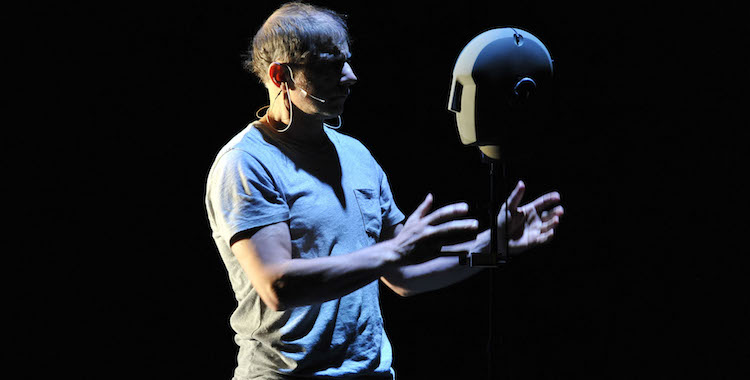
McBurney’s show prods at those shared fictions: time, perception, faith. It is, first of all, a stunning piece of storytelling. Using sense-tricking binaural technology, McBurney and sound designer Gareth Fry build a rich, multi-layered soundscape, transporting us to a rainforest that is patently absent from the wide, sparse, yawning stage at the Barbican. The trickery is right there in front of us, exposed with no apology, but our ears say otherwise. We see a microphone, bottles of water, a box full of recording tape; we hear the chirping and humming and rustling of an entire ecosystem.
The rainforest is in the Amazon. The year is 1969 and our protagonist is Loren McIntyre, an explorer in search of the Mayoruna people. He finds them, but loses his fragile grasp on modern civilisation in the very same moment. Excitedly following the tribe, he forgets to mark the route back to his camp. Plunged into the depths of the jungle and soon stripped of both his camera and his watch, he becomes entirely dependent on the Mayoruna, a people with whom he shares no means of verbal communication. McIntyre is cut off from both time and language – two of the compasses by which we navigate our sense of ourselves and the world around us.
The Encounter is, at one level, “about” McIntyre’s experiences with the Mayoruna and his brief dislodging from the passage of time as most of us know it. But it operates on multiple other levels simultaneously. At the same time as The Encounter is a show about McIntyre and the Mayoruna, it is also a show about McBurney making a show about McIntyre and the Mayoruna (got it?). And it’s a show, too, about time, sensation and consciousness – the very fabric of human experience. McBurney, like the Wellcome Collection, is interested in states of mind.
—
One section of the Wellcome Collection exhibition that (ironically) lodged itself in my mind and niggled away there was artist A. R. Hopwood’s False Memory Archive. For the last four years, Hopwood has been collecting false memories from members of the public. He says that submissions to the archive tend to follow a pattern: “a memory is described, only to be undone by evidence that the recollection is faulty or by a suspicion that the experience never actually happened”. The memories themselves are usually vivid, despite being known to be impossible.
The memories in the archive range from the hilarious (“I remember running away from the hospital as a newborn baby”) to the faintly disturbing (“I always think I have a little sister that I love so much. And I can feel her presence”). But what’s terrifying, even reading the funnier submissions, is how flimsy our grip on our own past is. Memories are all that root us to time (we can only conceive of a present and a future if we possess a past) and to our sense of self (we are, clichéd though the saying may be, the sum of our experiences). So if our memories so frequently fail us, what do we have left?
—
Memory and time are both in flux in The Encounter. For McIntyre, his experiences with the Mayoruna lift him out of time, or perhaps just into a different relationship with it. The people of the tribe, who recognise the growing threat to their way of life from the destruction wreaked by oil giants, seek to return to “the beginning”: a time before the white man, before the deforestation, before what we call modernity.
McBurney is also tussling with time. Speaking to us, he is both now and not now. We hear his voice speaking to us from stage and speaking to us from the past in a series of recordings. These recordings overlap with other voices from the past: experts on time, people who knew McIntyre, and – most strikingly – McBurney’s (then) five-year-old daughter, who keeps interrupting him during a sleepless night while making the show. By layering those voices on top of one another, like the sounds of the rainforest, they become an indistinguishable hubbub, evoking the way in which we often experience memories. Just the odd thing jumps out: a sentence here, an idea there.
Listening to Tim Bano’s brilliant audio review of the show, there was one thing that struck me – or one thing that protrudes, several days later, from my unreliable memory of it. The podcast is framed as a conversation between two selves: his present (now, of course, past) self two weeks after seeing The Encounter, and his past self sitting in the auditorium watching the show. Reflecting on this situation, Tim describes all the past versions of himself as distant and inaccessible – as separate from who he is now as any stranger.
It’s that impossibility of really knowing ourselves, our minds, our memories that resonates in both the States of Mind exhibition and The Encounter. I’m also reminded during The Encounter of Greg Wohead’s exquisite, dizzying Hurtling, which meditates on the impossibility of ever truly being in the present. There’s something in that piece about our minds connecting, catching up, so that we can never be truly present to ourselves. In The Encounter, that feeling is amplified (quite literally, in the case of the sound): we have to connect moments in time and disparate voices; we are always coping with the incommensurability of the sounds in our ears, the images forming in our minds, and the contrasting bareness of the stage in front of us. We are – like McBurney, like everyone all the time – all forming our own fictions.
—
“I am convinced that great works of art tell us about shape-shifting, about both the world and ourselves as more mobile, more misperceived, more dimensional beings, than science or our senses would have us believe.” Arnold Weinstein
—
If everything is fiction, there’s still a question of whose fictions get told. Just a couple of days after seeing The Encounter, still vibrating with its sensations and ideas, I was stopped in my tracks by Stewart Pringle’s review on Exeunt. He describes the show as “an absolutely spectacular and absolutely state-of-the-art framework for one of the oldest colonial narratives – the white man’s journey into the unknown”. Oof. Am I so inured to the white male perspective, so adept at translating the “universal”, “neutral” narratives of white masculinity into my own experience, that the more troubling aspects of McBurney’s show just passed me by?
Writing this, I’m thinking about the awards fuss around The Revenant, and about how little of a shit I give about it. Hearing about the film – even hearing glowing reports of it – I just keep thinking about how done I am with stories of heroic white men on quests for survival, asserting their masculinity along the way. Even Leonardo DiCaprio’s performance is framed in those terms: as an act of endurance. As Mark Kermode put it, discussing Leo’s chances in the (of course) overwhelmingly white-and-male ceremony of self-congratulation that is the Oscars, “Academy voters like to see their actors suffer”.
But then, I fretfully ask myself, is The Encounter really all that different? Do I just ignore its reproduction of a dominant white, male perspective because I’m blinded by its art? I’m still not entirely sure. Annegret Maerten, though, makes an interesting counter-argument to Stewart’s. She argues that, thanks to the use of technology and the multi-layered, many-times-mediated storytelling, The Encounter in fact makes a point of and problematises the positioning of the (white, male) artist. She concludes that “it’s stunning and exhausting and baffling but it’s most definitely not unexamined privilege or racist (if well-meant) stereotyping”.
I still wonder about the voices of the Mayoruna in this show; about the fact that it is first McIntyre and then McBurney – powerful white men venturing boldly into the unknown – who carry and relay those voices. Whether or not McBurney’s storytelling needs reexamining, though, The Encounter does at least make us alert to the importance of the fictions we tell and the ways in which we tell them. The show closes (spoiler alert!) with McBurney reading to his daughter from Petru Popescu’s Amazon Beaming, the book about McIntyre’s journey on which The Encounter is based. The story he reads aloud is the story of the Mayoruna’s origins, passed down from generation to generation, and then passed from the Mayoruna to McIntyre to Popescu to McBurney. And now McBurney is telling it, in the fashion of a bedtime story, to a new generation. They may be fictions, as fragile as the foundations of our thoughts, but the stories we tell still matter.
There’s a moment in Greg Wohead’s show The Ted Bundy Project when the whole audience holds its breath. We’re watching a video – a video that Wohead has already described at (horrifying) length – and we’re wondering if Wohead – lovely, affable, smiling Wohead – is really about to show us this. He wouldn’t, would he? I stare at the screen, feeling slightly sick, yet unable to wrench my gaze away. I can’t stop watching.
“It’s hard to watch,” writes Natasha Tripney of Katie Mitchell’s production of Cleansed. “Yet here we are, watching.” There’s a similar sense of suspended breath in the Dorfman auditorium. I suspect that many of us know, or at least half know, what to expect from Sarah Kane’s play, first staged at the Royal Court in 1998. We have chosen to be here. And we choose to remain in our seats, looking on as horrible things happen to the bodies on stage. What makes us watch? And how, as we watch, do we make sense of what we see?
The first question, perhaps, is what are we seeing? Both Kane’s play and Mitchell’s production make that a difficult question to answer. In both, very specific scenes of torture and tenderness sit within a strange, abstract world. Tom Mothersdale’s Tinker, sadistic and self-loathing, rules over an institution of some kind, where he torments and experiments on a series of subjects: siblings Graham (Graham Butler) and Grace (Michelle Terry), lovers Carl (Peter Hobday) and Rod (George Taylor), and an illiterate boy named Robin (Matthew Tennyson, bringing extraordinary gentleness to this cruel world). What we as an audience experience is more a series of brutal and beautiful impressions than a linear, coherent narrative.
Several reviews of Cleansed (both negative and positive) have listed the violence: litanies of horrors laid out for the reader like a catalogue of cruelty. Quentin Letts even offers the exact timings of each instance of torture. But violence is more than just the blows of a fight or the blast of a gun. It’s more than the blood and gore which have dominated press coverage of this revival (along with the depressingly predictable headlines reporting audience members fainting and walking out – presumably not at the same time) – and which, in any case, I was braced for as I tentatively took my seat.
Yes, it’s often difficult to watch. Yes, certain scenes of torture and mutilation – described in (sometimes problematic) detail elsewhere, so I won’t repeat the fetishisation of that represented violence again here – make me curl my hands into fists or send them flying to my mouth. But there’s also violence in the constant ringing of bells and the smooth wheeling in of gurneys. It’s the casual, precise, institutionalised horror of it all that strikes me as most violent. It’s the plastic sheets and pristine black suits.
Perhaps the cruelest moment of the production is when, having force-fed Robin a box of chocolates, Tinker gleefully peels away a sheet of cardboard to reveal another sickly layer beneath. He picks up each individual chocolate with a long pair of tongs, careful not to get his hands dirty. Rooted to my seat – eyes held open, muscles clenched – I shiver.
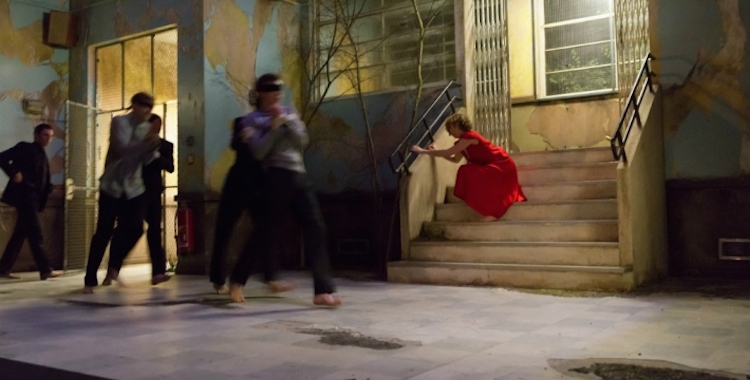
I could write about Cleansed purely in images. Grace trapped in dreamlike incomprehension on the stairs, her red dress a vivid splash of colour against her grubby, washed-out surroundings. Rod and Carl frozen in a kiss as Grace’s arm slowly snakes between them. A slow-motion mockery of a funeral, as faceless figures glide across the stage clutching lilies and umbrellas. The daffodils that sprout, suddenly, through the floor. A series of embraces: tender, fierce, bodies briefly moving as one. Carl’s silent scream as he’s wheeled backwards on a gurney. Grace dancing to Suicide’s “Ghost Rider”, at first a mirror image of Graham, later alone and compulsively, limbs animated with a mixture of horror and joy.
My use of the word “dreamlike” feels apt, as Mitchell’s production is more like a dream than anything else. It’s a nightmare, often, with its shadowy figures and soundless howls. But it also has the vivid strangeness of all dreams, that sense of a world slightly off-kilter. Mitchell (supported by Joseph Alford’s brilliantly controlled movement direction) has slowed everything down to a pace that feels almost outside of time, punctuated with moments of frenetic activity. Nothing quite operates as we expect it to here. Bodies slow and quicken. Plants burst through floor tiles. The seamless combination of Paul Clark’s music and Melanie Wilson’s sound design, meanwhile, generates a constant, queasy anxiety.
Dan Rebellato is one of the few writers to have commented on the theatricality of Cleansed as much as on its naturalism. Many have argued that this version of Cleansed is too realistic, its rendering of violence too convincing. But it’s the hyper-naturalism of Mitchell’s approach to certain moments that creates the production’s uncanniness, its nightmarish blend of (literally) razor-sharp precision and blurry abstraction. As Rebellato puts it, “This production is both fiercely real and achingly theatrical. It’s what it is and it’s humming with metaphor.” It’s haunted by an uneasy doubleness, common to both theatre and dreams. Everything is two things at once. Dreaming and waking. Real and not real. What are we watching?
Mitchell’s production foregrounds the act of watching, of bearing witness. Throughout, we watch Grace watching; she is a constant presence, hovering on the edges of every scene. While the performances are uniformly excellent, it’s Terry as Grace who is utterly unforgettable. Perhaps it’s because we repeatedly see her, rooted to the spot, watching as we watch. In the very first scene she appears frozen to the staircase in the centre of the stage, unable to wrench her feet from where they’re planted, paralysed as if in a nightmare. And it makes you wonder – this constant, almost invisible presence – whether we should indeed read it all as a horrific dream.
There’s more to Grace’s watchful presence, though, than a straightforward framing of the events as a nightmare. By adding an observer, Mitchell throws light on the process of observing. Tinker, too, is often looking on, but his is a different kind of watching. He’s the sinister voyeur – never more so than when watching a peep show, whose performer seems to both attract and repel him. Terry’s Grace, meanwhile, often looks on with tormented compassion, yet able only to helplessly witness. These are our models for watching, making us aware of our own, far from passive involvement as audience members.
“Picture this,” sings a child’s voice in an unsettling rendition of Blondie’s song (just one in a series of inspired musical choices). It’s an invitation to our imaginations, as is Mitchell’s production, even with all its naturalistic touches. There is still, for all the realistic gore, a mental leap. There’s also a choice: a choice to keep watching, like Grace, or to avert our eyes. Why can’t we look away?
At home I have a book full of photographs of abandoned spaces. Barren post-industrial landscapes. Forsaken monuments to forgotten powers. Paint peeling from walls and weeds nudging through cracks. The beauty of their decay is breathtaking. I feel uncomfortably drawn to these ruins, perhaps in the same way I feel drawn to post-apocalyptic fiction. There’s something morbidly fascinating about visions of a world that has left us behind. I also think, as I devour image after crumbling image, how brilliant these would be as stage designs.
Alex Eales’ design for Cleansed could be right out of that book. Kane’s script famously specifies a university – a place of learning become a place of torture – but Mitchell and Eales make this institution much more vague. It could just as easily be a hospital – another ironic reversal that finds its echo in the repeated description of Tinker as a ‘doctor’. There are signs on the walls, but these are the only vestiges of its previous use, relics from another era. Time and nature are gnawing away at this place; the walls are shedding their skin of paint, while bare, spindly trees thrust up through the rotting floor. Dirt and rust and mould are creeping in.
Yet it’s beautiful. And as with those photographs, that’s where the difficulty lies. I’m troubled less by the violence in Cleansed (though it is troubling) than by the extreme beauty I find in it. To what end do we aestheticise acts of cruelty and sites of decay? The question of violence on stage is one that persistently nags at me, and one to which I have no easy answer. Even when cloaked in metaphor, the problem doesn’t disappear. Because those metaphors – Ellen McDougall’s bursting balloons in Henry the Fifth, or the oozing bags of ink in Dan Hutton’s take on The Spanish Tragedy – are beautiful too.
As a challenge, though, Cleansed is vivid and confronting and hauntingly memorable. Kane’s play is known for its series of audacious images – flowers bursting from nowhere, rats carrying off severed body parts – that throw down a gauntlet for any director. It seems to me that Mitchell picks up that gauntlet and then chucks it right at us as an audience. Her images leave us feeling deeply, almost painfully, and they leave us asking the questions that keep punctuating my writing. What are we seeing? What makes us watch? Why can’t we look away? And what is it about what we are seeing that is still, in spite of everything, disturbingly beautiful?
I was ready to give up on A Midsummer Night’s Dream. In fact, I pretty much had; after the last uninspiring production, I made a personal vow not to see it again for at least five years. It’s just too familiar, its contours too well-trodden. I studied it multiple times, acted in it at school, saw production after gimmicky production try to put a new sheen on it. I was done, I decided, with fairies and mechanicals.
So I surprised myself slightly by going to Filter’s version at the Lyric Hammersmith. I think it was the words “riotous” and “irreverent” that appealed. And never has marketing copy been so spot on. Filter don’t just rip up the text – they douse it in beer and pelt it with food. It’s Shakespeare meets panto meets Secret Theatre.
Filter, together with directors Sean Holmes and Stef O’Driscoll, have latched onto the play-within-a-play conceit, playfully multiplying the meta-theatrical frames. At the start of the show, Ed Gaughan’s Peter Quince steps out between the curtains to say a few words – a prologue, if you will. There’s a special guest playing Bottom tonight, he excitedly tells us after some hurried preliminaries. But when said special guest gets stuck backstage shortly after, it’s up to a game audience member to step up and save the day.
So this Dream is a play within a play within a play, and Bottom is actually an unprepossessing (if enthusiastic) amateur, jumping up on stage with shopping bags in tow. Except, of course, he’s not. This is scripted chaos. Yet the extraordinary thing about Filter’s production is that, for all the knowing meta-theatrics (and despite being a remount of a production first staged in 2011), it manages to retain a feeling of real seat-of-the-pants improvisation. As performers crash through walls or tumble down holes, there’s a constant feeling that this could all go horribly wrong.
In that sense, then, it’s absolutely in keeping with the clumsy craft of the mechanicals, who here become Gaughan, his backing band and their last-minute Bottom (Andrew Buckley). They’re just about holding together both the fiction of the show as a whole and the play within a play that exists inside it, easily flipping between Shakespearean dialogue and twenty-first-century colloquialisms. Elsewhere, there’s a lycra-clad, cape wielding Oberon (Jonathan Broadbent), a poutily unimpressed Titania (Cat Simmons), and four of the most demonstratively lustful lovers the play has ever seen (special mentions to John Lightbody’s hip-thrusting Lysander and Hammed Animashaun’s soulful, Marvin Gaye-style wooing as Demetrius).
Filter also have a unique take on Puck, played here by the company’s co-artistic director Ferdy Roberts. No airy sprite, Roberts is instead a scruffy, sardonic handyman, keeping the wheels of Oberon’s enterprise rolling through elbow-grease more than magic. It’s a nod to the hard work for some that usually sits beneath the fun of others, though this Puck also gets his fair share of mischief. Cracking open cans of Fosters, he lets the lovers’ quarrels unfold like a soap opera, watching on with a grin and only reluctantly intervening to undo the mess he has made.
Like Dmitry Krymov’s A Midsummer Night’s Dream (As You Like It) – another twist on Shakespeare’s play that has little interest in the text – Filter reveal to us the magic, the trickery and the silliness of theatre. Sound plays an important role here: the supporting fairies are nothing more that zooming, zipping sound effects, yet still you want to follow the noise in spite of yourself in hope of snatching a fleeting glimpse. Everything is mixed and produced on stage, but the absence of illusion only makes it all the more theatrical. Look, Filter say, this is how it all works – and still we as an audience want to be taken in by it.
The stalls are full of teenagers on the night I attend, and I find myself wishing I’d been taken to Shakespeare like this as a schoolkid. It’s full of joyous, ridiculous moments: spontaneous bursts of song, Oberon descending from above on a wire, a rapidly escalating food fight. And unlike any of those other productions I’d seen, this Dream feels full of life. Filter are irreverent when it comes to following the letter of the text, perhaps, but they create a theatrical experience with all the fun, mischief and pandemonium that the cheekiest of Shakespeare’s plays seems to demand.
This year I was lucky enough to be one of the professional critics taking part in the Resolution Review programme alongside Resolution, The Place’s annual showcase of new choreography. See below my reviews, originally published here.
12 January
Subhash Viman Dance Company Shan Wayward Thread Finding Words MAZPOD Rhythmic Stories Mad Meg
Under a single light bulb, Subhash Viman writhes restlessly on the floor. Limbs trembling, contorted, he is like a man learning to inhabit his own body. It’s a sense of searching that knits together the otherwise disparate triple-bill on the third night of Resolution 2016. Drawing on the ancient Chinese poem San Zi Jhing, Shan contrasts these jerking, shuddering movements with the fluidity and control of learnt gestures, suggesting the forces that society exerts on the body. Though the progression of the piece fails to match its startling opening, it’s a showcase for an astonishing talent in the form of Viman.
The evening’s second offering, to borrow its title, is Finding Words – or, rather, struggling to track them down. The programme note promises an exploration of ‘the urgency of language’, but there’s little that is urgent about Wayward Thread’s muddled piece. In a disjointed series of sequences, break tussles with contemporary dance, as the red-swathed company of seven creates shapes and images that struggle to speak to one another. There are occasional, tantalising hints of the epic, but the work as a whole never quite discovers what it’s looking for.
Closing the night in riotous style, Mad Meg is a search for its eponymous protagonist. Fragmenting and subverting the fairytale genre, this marriage of dance, narration and live folk music reclaims the story of a woman serially ignored. Defiant, joyous and often brilliantly grotesque in its use of movement, MAZPOD’s feminist fable is also bags of fun. It helps that performers and choreographers Marianne Tuckman and Phoebe Ophelia Douthwaite have a fizzing onstage chemistry, reminiscent of sparky physical theatre duo RashDash. The structure needs some work and the storytelling lacks clarity at times, but with energy and wit like MAZPOD’s such flaws are easy to forgive.
26 January
aKa Dance Theatre Company Next Door Poekert & Bysheim oh, and one more thing… BAMBULAproject Building the Route Between Me and You
As the lights come up on Next Door, a sofa sits centre stage. It’s an item of furniture that suggests staid living room dramas, but aKa Dance Theatre Company transforms it into a third player in this compelling study of one couple’s relationship. It pirouettes, tips on its side, embraces or ejects the two lovers who clamber over it. Throughout, Jennifer Grant’s playful and often surprising choreography tiptoes the fine line between flirtation and frustration. Curling their bodies around one another, Joe Garbett and Sally Smithson are teasing one moment, stony serious the next. Without words or even music, they suggest all the ways in which love can both make you soar and tug you painfully back down to earth.
In the second duet of the evening, Poekert & Bysheim’s oh, and one more thing…, the two dancers are held apart by rigid external structures. Stark shafts of light carve up the stage, restricting Sarah Poekert and Lisa Colette Bysheim to their own small portions of space. Beginning with micro-movements that gradually expand outwards, the two performers push at these boundaries, seeking fleeting moments of connection. The central idea, though, is more interesting than its stiffly repetitive execution.
Connection and disconnection are also key themes in Building the Route Between Me and You. BAMBULAproject are interested in how we piece together fragmented societies, a process represented visually on stage by a series of interlocking tiles. Sliding these tiles around the space and slotting them into different formations, the four dancers explore both isolation and togetherness. In one absorbing sequence, two of the performers create winding paths for their fellow dancers, slowly bridging the distance between them. While the dramaturgy of the piece as a whole would benefit from more clarity, at its best it speaks powerfully to how individuals connect and collide in the modern world.
12 February
Christopher Owen The Creative Act Dillon Dance That’s Not How He Wants It The Rebirth Network Behind Me
“The creative act,” as Marcel Duchamp famously asserted, “is not performed by the artist alone.” Art – and performance particularly – needs audiences to come to life. Opening the evening in baffling style, Christopher Owen’s new piece has taken Duchamp’s mantra to heart. Choreographing music, sound, video and text, as well as the movements of his own body, Owen creates an assault on the senses. The burden of meaning lies entirely with the audience. This, strange, puzzling piece acts as an association machine, its fleeting flashes of video and text daring us to make mental connections between disparate images and ideas.
Disparate is a word that jumps to mind again watching That’s Not How He Wants It. Individual sequences in Dillon Dance’s offering are all beauty and control. The female performers assume poses of fixed elegance, locked in place like ballerinas in jewellery boxes. In other scenes, they break free, their movements implying both strength and frustration. The title is suggestive of women’s roles in society and the extent to which these are still determined by men, but this theme is hinted at rather than fully realised, while the scenes themselves feel only loosely connected.
The clarity that’s wanting elsewhere is finally found in the night’s concluding piece, The Rebirth Network’s Behind me. This fusion of hip-hop, dance theatre and spoken word vividly evokes an inner world of competing voices and personal demons. There’s a rare dynamism and chemistry to this ensemble, who work brilliantly together to command the stage. Bodies convulsing to distorted beats, the performers create a haunting and compelling vision of hidden turmoil, all building to an urgent final message. Unlike the Rubik’s Cube that various company members grasp in their hands, dance is not there to be solved, but The Rebirth Network welcome audiences into the puzzle rather than locking them, bewildered, outside it.
16 February
Muti Musafiri ReFractions on Attachments Richard OsbornerEd Alula Cyr Hyena
There’s a lot going on in Muti Musafiri’s ReFractions on Attachments. Perhaps too much. Four dancers enter, eating oranges and reciting juice-distorted lines of poetry, before segueing into a series of movement sequences. One performer emerges, limb by limb, from between the legs of another. Bodies move fluidly in and out of frozen poses, limbs seemingly manipulated by external forces. The dancers race – flailing as though dragged – towards the audience, stopping at the last second. Such moments are individually stunning, and the talent and control of the quartet of performers is indisputable, but the connections between these scenes remain stubbornly opaque.
In contrast with Musafiri’s soup of ideas, Richard Osborne’s rEd is all simplicity. Billed as a duet about identity, it’s just that. Performers Brita Grov and Pola Krawczuk repeatedly come together and tear apart, fiercely tussling for a sense of individuality. Red and white hazard tape ties them together like an umbilical cord, pulled taut in striking images of struggle. “This is me,” Grov insists, mantra-like, trying to break free. The piece’s simplicity, though, is its weakness as well as its strength. Ambition has been sacrificed for the sake of clarity, never allowing this investigation of identity to go more than skin deep.
The individual and the group are also two of the central concerns of Hyena, Alula Cyr’s blend of circus and contemporary dance. The three female performers, like the animal of the title, move in a pack. As they execute a series of gasp-inducing acrobatics, the women also playfully explore group dynamics, as different individuals pair off or compete for one another’s attention and approval. This aspect of the piece, while intriguing, is not yet fully developed, and the skilful trio are at their best when rotating in wheels or turning unlikely somersaults. Ultimately, spectacle wins out over storytelling.







 Catherine Love