The Light Princess, Tobacco Factory

1800

Originally written for the Guardian.

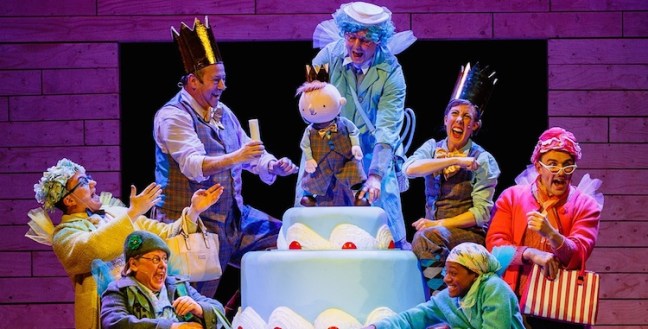
The Light Princess is having a moment. George MacDonald’s 19th-century story has been something of a footnote in the fairytale canon, but now – just two years on from the ambitious Tori Amos musical at the National Theatre – it’s receiving a second, deliciously silly staging courtesy of Tobacco Factory Theatres and Peepolykus.

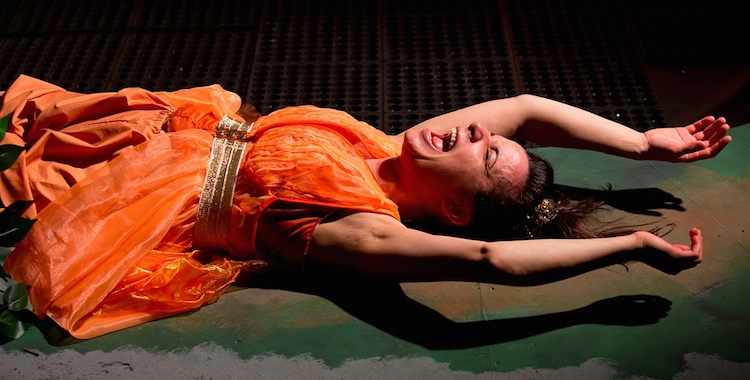
Where Amos and co padded out the plot of MacDonald’s tale, this version sticks to the basics. As an act of revenge by her snubbed aunt, the princess of the title (an infectiously joyful Suzanne Ahmet) is cursed with levity of body and mind. She can’t keep her feet or her mind rooted to the earth, and laughs up among the clouds instead. When a gloomy, gravity-bound prince (Richard Holt) arrives searching for a wife, it’s the perfect match.

A weightless heroine presents obvious staging challenges, which John Nicholson’s production meets with knowingly shambolic solutions. Some wobbly shadow puppetry and a heavy dose of make-believe compensate for the lack of aerial stunts, deliberately exposing the mechanics of the show.

This yields some fantastic gags, especially from a scene-stealing Amalia Vitale in various supporting roles, though the company could ease up on the arch nods and winks.

So intent is The Light Princess on being funny that often clarity of plot is sacrificed for levity of tone. Luckily, Verity Standen’s songs – all characteristic wit and gorgeous vocal texture – are there to steer the story back on track. Standenorchestrates the show in more ways than one, her court conductor marshalling the chaotic action with a flick of her baton.

This take on MacDonald’s fairytale might be anarchic and disordered, but its messiness is all part of its joy. Like its floating, lighthearted heroine, it unabashedly celebrates the amusing and the absurd – two aspects of life that we could all do with being reminded of from time to time.

Photo: Farrows Creative.

Penelope Skinner

Penelope-Skinner-Photo-by-Bronwen-Sharp-2015-700x455

Originally written for The Stage.

Penelope Skinner asks me: “Do we believe that women in general are hungry for stories about them?” The writer, whose plays have all hinged on complex female characters, quickly answers her own question: “I believe that they are.” These are the stories that Skinner often sets out to tell, countering a theatrical establishment that is still largely interested in male-centred narratives. “It happily coincides that I’m also most interested in telling those stories,” she continues. “I don’t think I could do anything else. I feel driven to tell those stories.”

Like many theatremakers, Skinner was first drawn to the art form as a child, when she was taken to see a stage adaptation of The Hobbit by JRR Tolkien. “It was really amazing,” she says, “and kind of life-changing in how magical it was and how transported I felt to a completely different world.” It was not writing that she initially aspired to, though, but acting: “I think I just assumed I wanted to be an actor.”

While acting “didn’t really work out” for Skinner, it did introduce her to new plays. “I moved to London to try to be an actor and that was when I became aware that people were writing new plays,” she remembers. Enthused by this fresh wave of drama, Skinner started regularly attending shows at new writing venues such as the Royal Court Theatre and the Bush Theatre, where she had a memorable encounter with Jack Thorne’s play When You Cure Me.

“I found it a very meaningful experience watching the play,” Skinner tells me, “but something about it made me want to write something myself.” Ten years on, she struggles to put her finger on quite what it was about the show that inspired her, but she suggests that it was “something about that experience, something about feeling that the audience had responded a certain way and feeling that something more needed to be said”.

Read the rest of the interview.

Photo: Bronwen Sharp.


Sleeping Beauty, Bristol Old Vic

2036

Originally written for the Guardian.

Fairytales have long been fair game for transformation. Even the best loved of our childhood stories have gone through multiple versions, from Brothers Grimm to Disney animation. There’s a precedent, then, for Sally Cookson’s playful, gender-switched reworking of Sleeping Beauty, which tells a familiar story in unfamiliar style.

Instead of the princess catching Zs, at the Bristol Old Vic it’s a prince. Prince Percy (David Emmings) – after a childhood wrapped (quite literally) in cotton wool – has been cursed to snooze for a hundred years, awaiting the kiss of his one true love. The hero, meanwhile, has been imported from Welsh folk tale The Leaves That Hung But Never Grew. Deilen (Kezrena James) is a resourceful but lonely adventurer, who stumbles across the unresponsive Percy while on her own quest and sensibly administers mouth-to-mouth.

It might not be Sleeping Beauty as we know it, but Cookson’s version – devised with the multi-role-playing company of eight – is all the more charming for the reinvention. Tongue-in-cheek irreverence is balanced with true fairytale magic, reimagining rather than bulldozing long Christmas show traditions. Nowhere is this more evident than in the supporting cast of fairy godmothers, spells intact but gleefully transformed into a lineup of cake-baking, knitting-needle-wielding WI members.

There’s also more than a hint of panto to Cookson’s joyful production. Cross-dressing aplenty – often with brilliantly ridiculous wigs – meets the demands of the large cast of characters, while Stuart Goodwin’s deliciously evil baddie anticipates the hisses from the audience. Where Sleeping Beauty differs from the glitter and garishness of other festive offerings, though, is in its relative simplicity. Michael Vale’s elegant and versatile wooden design transforms instantly from climbing frame to castle, while the songs are all courtesy of an onstage, ad-libbing trio of musicians.

Though much is gained from mashing up two separate stories – not least a dynamic, complicated female lead who has more to do than lie around – the plot can occasionally feel cluttered as a result, especially in the second half. Unfailingly enthusiastic performances from the whole cast keep the show driving forwards, but like the overgrown trees encircling the palace, it could benefit from a little pruning.

That said, it’s a gorgeous piece of storytelling – and not without a message. As theatres wheel out the same stories year after year, the Bristol Old Vic’s novel approach is a reminder that we always have a choice about how to tell them. If any persuasion were needed, Sleeping Beauty makes the case that stories this old are ripe for retelling.

The Night that Autumn Turned to Winter, Bristol Old Vic

2820

Originally written for the Guardian.

If you go down to the woods today, Little Bulb have a big surprise. Set on the last day of autumn as winter creeps ever closer, the company is bringing the wildlife of the forest to the heart of the city in a series of charming sketches. Following 2013’s Antarctica, they once again take intrepid young explorers on a charming, idiosyncratic tour of the animal world.

With trademark Little Bulb energy, performers Clare Beresford, Dominic Conway and Miriam Gould rapidly transform from excitable woodland wardens into the various animals they conscientiously watch over. Hyperactive squirrels, a sly but suave fox and a hungry, shortsighted owl all make memorable appearances, evoked by homespun, makeshift costumes. That’s without even mentioning the rare, much-anticipated winter unicorn.

They have their audience of under-sevens sussed, getting them noisily involved one moment before holding them quietly rapt the next. The key is in variety and ingenuity, as their motley cast of creatures – from rabbits to badgers to frogs – constantly changes.

And the music – central, as ever, to the company’s work – ensures that this is no ordinary woodland. Brandishing banjos and violins, Little Bulb’s endearingly goofy rock stars turn forest into gig, while kids excitedly clap along. The multitalented trio swap instruments as readily as costumes, deftly matching musical genre to animal.

As with all of Little Bulb’s work, the DIY aesthetic belies the craft and detail of a show that considers parents as much as kids. There are plenty of grinning asides for the grownups, along with some entertainingly wry, mock-David Attenborough commentary. But really the joy lies in the silliness and wonder, both of which Little Bulb offer in bumper Christmas-size portions.

Photo: Jack Offord/Handout.

Licensed to Ill, Camden People’s Theatre

3779

Originally written for the Guardian.

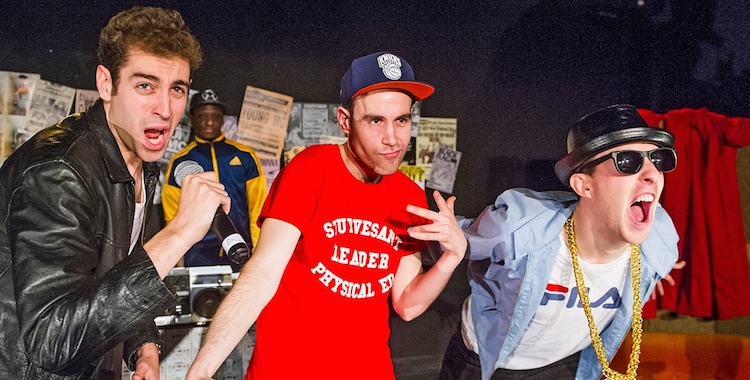
Rolling Stone famously reviewed it with the headline “Three Idiots Create a Masterpiece”. Simon Maeder and Adam El Hagar’s unofficial history of the band, which revels in the haphazard brilliance of these unlikely New York rappers, underlines both their idiocy and their intelligence. The show has all the anarchy and DIY spirit of a fanzine: it’s scrappy, colourful and bursting with unapologetic enthusiasm.

This telling of the Beastie Boys’ rise to fame has the same chaotic, hyperactive energy as the video of Fight for Your Right (which gets its own lo-fi stage re-creation). Licensed to Ill follows the band from wannabe punk rockers to hip-hop superstars, as Michael “Mike D” Diamond, Adam “MCA” Yauch and Adam “Ad-Rock” Horovitz find their way to the top of the charts through a combination of talent, accident and arrogance.

Much like its troublemaking protagonists, Licensed to Ill never takes itself too seriously. Brainstorming names, the band reject one suggestion because “it’s not stupid enough”. A similar logic drives the show, which never accepts a simple staging solution if there’s a sillier one to be found. So there are sequences of physical comedy, relentless one-liners and an extended gag involving a puppet.

But it’s not all laughs. Lurking forever on the periphery of the Beastie Boys’ meteoric rise is the nagging discomfort of misogynistic lyrics and cultural appropriation.

Ultimately, Licensed to Ill is more celebration than critique. Having established such speed in the storytelling, there’s a loss of momentum in the final third, which begins to drag. But what never disappears is an evident love for these three “idiots” and the masterpieces they produced.

Photo: Tristram Kenton.