Fake It ‘Til You Make It, Soho Theatre

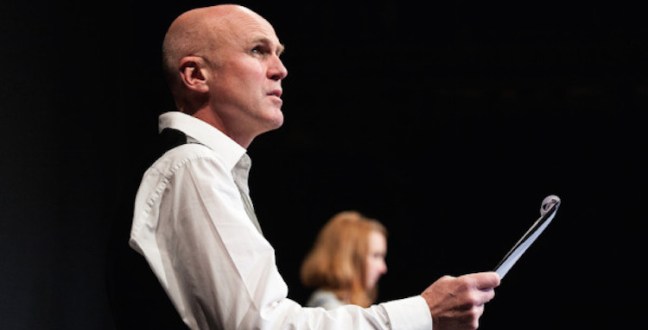
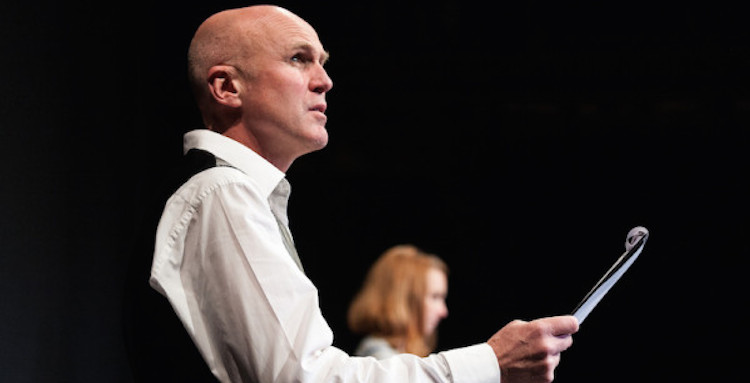
Fake-it-Til-You-Make-it-2015-by-Richard-Davenport.JPG-700x455

During the conversation I was lucky enough to host with Tim Crouch the other weekend, there was a question from the audience about care in his shows. Particularly with a show like The Author, which made the audience disturbingly complicit in the violence and abuse it described, the idea of care becomes crucial. Tim replied that it’s about a relationship of openness with an audience, about inviting them into a contract. That, perhaps, is why it was so important for audiences in that show to know that they could leave, that part of that contract was the option to walk out and refuse to be complicit.

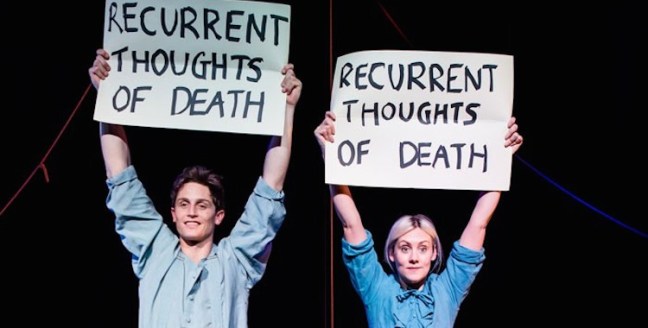
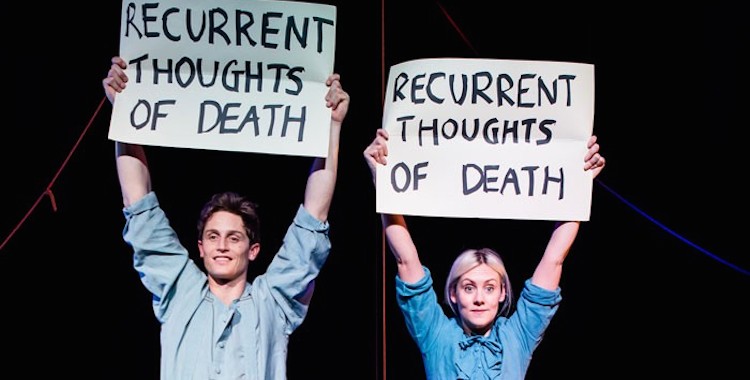
I was reminded of a (rich and brilliant) conversation I listened to about a year ago between Alex Swift and Chris Goode, which also grappled with this notion of caring for an audience within a piece of theatre and what that really means. It also reminded me of Fake It ‘Til You Make It, the show Bryony Kimmings has made with her partner Tim Grayburn, which I’d seen at Soho Theatre just a few days earlier. In that show, care is everything. There’s the very visible care that Bryony and Tim take of one another on stage throughout the show, there in little looks and fleeting touches, but also the care they show towards their audience. This is their story, but they’re telling it for us.

Like Bryony’s last show, the brilliantly galvanising Credible Likeable Superstar Role Model, Fake It ‘Til You Make It is a potent blend of autobiography and activism. Also like that show, made with Bryony’s young niece Taylor, this new piece features a non-professional performer in the shape of Tim. And just as Taylor was the catalyst for Credible Likeable, it’s Tim and his experience of clinical depression that form the starting point for Fake It ‘Til You Make It, opening out into a wider look at men and mental health. The personal is always political.

Care starts with the tone. After a gloriously silly opening dance, Bryony steps up to the microphone to explain to us what’s happening here – to set out the contract. “This is a love story,” she warns us. “I know. Gross.” She elaborates: this is a story about men with clinical depression (like Tim) and the women who love them (like Bryony). It’s going to get dark, Bryony admits. But she also wants to look after us, hence the good luck dolls scattered around the stage and the purposeful silliness of the aesthetic. Sometimes, the only way to seriousness is through humour.

And every silly touch is there for a reason. Tim’s face is kept covered by ridiculous headgear – binoculars, paper bag, fluffy cotton-wool clouds – because one of his conditions for appearing on stage was that he wouldn’t have to look at the audience. When he comes out with a tangle of ropes atop his shoulders, this initially whimsical device has transformed into a simple but affecting metaphor for Tim’s mental turmoil, making it all the more emotional when he is finally revealed to us and speaks, exposed, directly to the audience.

The love story itself is also silly in the telling, cute and self-mocking in equal measure. Bryony and Tim collide, literally and metaphorically, their lives unexpectedly smashing into each other. Their early romance is almost childlike in its sweetness, played out in cartoonish smiles and dorky dance moves, and when the couple move in together they drape a tent across the stage like a kids’ den. When Bryony discovers Tim’s anti-depressants, then, it’s with a rude jolt. The illness that he has kept secret for years disrupts the bliss of their shared life, injecting the romance with darkness but also with honesty.

Honesty – always startling, sometimes embarrassing – is a recurring trait of Bryony’s work and right at the heart of what she’s doing here. What is as damaging as the depression itself for Tim and other men like him is the shame that has needlessly become attached to it. When he does eventually speak to us, Tim confesses one of his greatest fears: that suffering from mental health issues would somehow make him less of a man. There’s a tangible release in banishing that shame, in forcing it out with frankness.

In lots of ways it’s also an illustration of the same blunt but necessary point I made in writing about Violence and Son: patriarchy shits on everyone. Masculinity is oppressive to men as well as to women, its demands to “toughen up” and “grow a pair” stifling the possibility for many men to even acknowledge their feelings, let alone talk about them. Having seen this social pressure inflict its scars on men in my own life, the bold openness of Fake It ‘Til You Make It is a deep sigh of relief.

That’s not to say that Fake It ‘Til You Make It can’t also be difficult. When I saw an early scratch of the show, at Forest Fringe in Edinburgh last summer, I was an emotional mess by the end. Returning to it over a year later (and minus the deadly cocktail of stress and sleep deprivation), I found it less tear-jerking, but there are still some really black moments. When Bryony searches blindly through the streets of London for a floundering Tim, it’s painful to watch, like an icy fist grasping through the ribs, and the more exposing moments of the performance feel just as raw as in that charged room in Leith last year. Talking about reality or truth on stage is always problematic, but when Bryony and Tim laugh and cry together it’s real laughter, real tears.

It’s important, then, for our laughter and tears – our presence in the room with them – to also be acknowledged. Fake It ‘Til You Make It cares for its audience by never pretending that we’re not there and always keeping our responses in mind, right up to the invitation to speak to or email Bryony and Tim after the show itself has finished. In many ways, the piece they have created is one long, generous act of making visible – and that includes us.

Photo: Richard Davenport.

Fuck the Polar Bears, Bush Theatre

image12-600x337

Originally written for Exeunt.

Humans are terrible at heeding warning signs. In Pompeii, people saw the smoke spewing from Vesuvius for days before it erupted. Few ran. Today, the alarm bells of climate crisis are ringing all around us, yet still we carry on as normal, exploiting the environment for every last penny. What’s future destruction compared to a few extra quid in your pocket today?

At least that’s the starting point for Tanya Ronder’s new play, which pits climate change against straightforward, self-destructive human selfishness. Her protagonist, Gordon (Andrew Whipp), has just been offered the job of CEO with one of the energy giants, a position that comes with dirty money – and lots of it. His wife, Serena (Susan Stanley), has her sights set on an exclusive riverside pad and London’s best prep school for their young daughter Rachel. The price? Only the planet they live on.

“I just want us to enjoy our lives,” says a stress-frazzled Gordon to his unfulfilled, fitness-obsessed wife. Money clearly hasn’t bought happiness for this couple, but still they grasp desperately at the climate-destroying possessions they feel they’ve earned. Their high-energy lifestyle, meanwhile, finds its contrast in their frantically recycling Icelandic au pair Blundhilde (Salóme R. Gunnarsdóttir) and in Gordon’s recovering drug addict brother Clarence (the ever-excellent Jon Foster), who has found refuge in a simpler life. Around them all, things start to fall apart.

Fuck the Polar Bears’ bludgeoning symbolism is about as blunt as its title. Lights flicker. Rubbish mounts. There’s a problem with the water. And Rachel’s toy polar bear is missing, nowhere to be found. In Caroline Byrne’s production, the building chaos of Gordon and Serena’s home is climate crisis in microcosm, everything spinning (literally, thanks to Chiara Stephenson’s sleek revolving stage) out of control. It’s not hard to see where this is going, or what it’s none-too-subtly pointing to.

As an idea, folding the predicament of the planet into a tightly focused family drama is a promising one. It’s often the small-scale that drives home the impact of the large. Here, though, everything is made unnecessarily explicit, while the tone teeters awkwardly between comic, surreal and earnest. Some sharp images jump out from Ronder’s text – Blundhilde’s description of Gordon as a necrophiliac “screwing a dying world” is one hell of an insult – but it does far too much explaining and debating, especially in later scenes. As so often with climate change plays, it all begins to sound a lot like a Guardian editorial.

These are vital discussions to be airing, especially as this winter’s climate change summit in Paris fast approaches. Humanity is on a deadline – if indeed the deadline has not already passed. But I wonder, as I wondered when watching 2071 last year, if this is really the forum for it. As with 2071, Fuck the Polar Bearsis hardly carbon neutral, and also as with 2071 it’s likely to attract a crowd who are already concerned about the issues it addresses. It’s hard not to ask, as Ronder’s characters fruitlessly circle her subject matter, “what’s the point?”

Are We On The Same Page?

3.-Tim-Crouch-and-Amy-Griffiths-in-An-Oak-Tree_credit-Greg-Veit_-600x399

Originally written for Exeunt.

Back in 2009, Andy Field argued in a post on the Guardian Theatre Blog that “all theatre is devised and all theatre is text-based”. Cutting through arguments about “new writing” and “new work”, he reasoned that “to devise is simply to invent”, whether that inventing is done with words or bodies or any combination of the two. Job done, surely?

Yet the disingenuous “text-based versus non-text-based” debate has rumbled on. It flared up yet again at the beginning of this year, when David Edgar was announced as Humanitas Visiting Professor in Drama at the University of Oxford and raised familiar concerns about the threatened position of playwriting and the playwright, met with retorts from the likes of Lyn Gardner and Andrew Haydon. While Edgar persisted in pitting other forms of contemporary theatre practice against playwriting, others agreed with Gardner that what we need now is “a far wider and looser definition around what we mean by new writing”. Alex Chisholm, writing in these pages over three years ago, argued much the same thing.

But it’s not just about changing industry terminology. Current binaries are based in long-seated assumptions about the nature of the theatre text and the privileged place of the solo-authored play within British theatre tradition. Unsettling assumptions – and by extension the structures and processes that have congealed around those assumptions – is no easy task. It is happening, with the publication of books like Duska Radosavljevic’s excellent Theatre-Making: Interplay Between Text and Performance in the 21st Century and shifts in programming and commissioning at theatres such as the Bush and the Royal Court, but there’s still a way to go.

Shifting understandings around text and performance means shifting the possibilities open to theatre-makers. Writing in the immediate aftermath of this year’s Edinburgh Fringe, where categories like “new writing” and “new work” seem more and more irrelevant each year, Matt Trueman suggested that “a new kind of fusion theatre is emerging”. He pointed to young companies like Barrel Organ and Breach Theatre, who seemingly don’t discriminate between new writing, devising and documentary theatre. He concluded that this slamming of one set of techniques into another creates a healthy and experimental theatrical landscape, in which “the possibilities are endless”.

The picture sketched by Trueman is an exhilarating one, but there are still questions to be asked. Often, the supposed binary between “text-based” and “non-text-based” theatre has rested on larger ideological stakes; “non-text-based” work has frequently been seen as alternative, radical, progressive. But to what extent is that still true? Mightn’t real ideological interrogation, as Liz Tomlin suggests in Acts and Apparitions, lie in looking beyond superficialities of form? And in order to rethink the relationship between text and performance, we also need to think again about what it is the theatre text actually does. Is it a blueprint for performance? A set of tools? Is there really a difference between “open” and “closed” texts, and if not then is there anything that the theatre text makes impossible in performance?

These are some of the ideas that I’m hoping we can address at Are We On The Same Page? Approaches to Text and Performance, a one-day symposium at Royal Holloway on 26th September. Bringing together academics, critics and practitioners, the aim is to erode old binaries and open up genuine, searching discussions, rather than re-igniting old antagonisms.

The day will open with a Q&A with Tim Crouch, whose work as a theatre-maker has repeatedly confounded distinctions between “new writing” and “new work” and challenged our collective understandings of theatre’s representational mechanisms. Field, Radosavljevic and Haydon are all among the panellists who will be speaking later in the day, alongside a range of other theatre-makers and academics whose practice and scholarship has in various ways engaged with some of the questions identified above.

What we hope to generate throughout the day is dialogue in place of dichotomies. It’s about time we ended what Chris Goode calls “the phoney ‘writers versus devisors’ war” and started to interrogate some of the bigger, knottier issues that old battle has served to hide.

HighTide Festival 2015

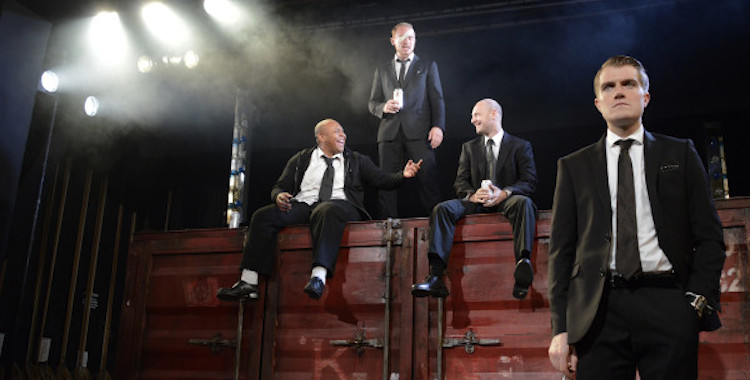
HighTide Festival Aldeburgh Suffolk Sept 2015 So Here We Are by Luke Norris Director/Steven Atkinson Designer/Lily Arnold Lighting Designer/Katharine Williams Kirsty / Jade Anouka Frankie / Daniel Kendrick Dan / Ciaran Owens Smudge / Dorian Jerome Simpson Pugh / Mark Weinman Pidge / Sam Melvin ©NOBBY CLARK +44(0)7941-515770 +44(0)20-7274-2105 nobby@nobbyclark.co.uk

Originally written for Exeunt.

What happens when the person you are turns out not to be the person you want to be – or the person you feel you should be? The three new plays premiering as part of this year’s relocated HighTide Festival all grapple with versions of this same question. Desire, identity and ambition are recurring themes, as is the very idea of performance: the selves we perform for others, and what might lie beneath.

The shingle and seagull cries of HighTide’s new home in Aldeburgh are an apt backdrop for Luke Norris’s latest play So Here We Are, a portrait of grief and disappointment beneath the slate skies and glaring coloured bulbs of Southend. Steven Atkinson’s production opens with four men staring out at the audience, cans of Stella in hand, their long silence as hard-edged as Lily Arnold’s pointedly masculine design of concrete and shipping containers. They don’t know what to say.

They’re mourning the death of Frankie, childhood friend and missing member of their five-a-side team. When they do find words, they talk awkwardly around the gaping black hole of their grief, gags and insults thrown around as aggressive tokens of affection. Norris’s dialogue is brilliant at capturing the everyday rhythms and evasions of speech, particularly between men who would rather crack jokes than confront their emotions. “People need a laugh,” reasons laddish Pidge, but not all of his mates agree. Then there’s a question, tentatively aired, about the nature of Frankie’s death. Was it really an accident?

In the second half, flashing back to the last hours of Frankie’s life, the clues and doubts planted in the first begin to take seed. We see Frankie stuck, restricted to a path he never meant to set out on. “What’s the point?” he asks. There’s no answer. It’s a very ordinary tragedy, of a life confined by wrong decisions and the inflexible expectations of what makes up a “normal” life: wife, mortgage, kids. As the future ghosts the present, watching becomes an exercise in connecting dots. The picture that emerges, though, is disappointingly neat, going needlessly far in its explanations and losing some of the simple impact of the first act. Resolution blunts loss and rage.

Up the road and away from the beach, the eponymous protagonist of BRENDA is also questioning the point of it all. Created by writer E V Crowe and director Caitlin McLeod, this is a real curiosity of a show, as frustrating as it is intriguing. Cannily staged in a local church hall, the piece finds down on their luck couple Brenda (Alison O’Donnell) and Robert (Jack Tarlton) about to make a plea to their community for help. Only before she can introduce herself to others, Brenda needs convincing that she’s even a person at all.

It’s a strange, offbeat watch. Crowe and McLeod stretch insistently at pauses, testing how long it’s possible to stage silent entrances, exits and absences. As they haphazardly rehearse their presentation, O’Donnell and Tarlton move among the audience, talking repeatedly about community while very deliberately ignoring the community of spectators right there in front of them. The fourth wall isn’t exactly broken, but these theatre-makers know how to prod it. Theatricality and the art of performance are central and persistent concerns.

But it’s never quite clear to what ends. With her repeated, insistent statement “I’m not a person”, Brenda’s unnervingly extreme position hints at the rather more ordinary ways in which we all perform coherent selves. There are also distant echoes of government and media rhetoric, insidiously undermining the personhood of those who don’t fit into the “aspiration nation”, but this is never more than a faint resonance. The disturbing final moments suggest something dark yet undiagnosed underneath the play’s slippery surface; what it might be is anyone’s guess.

Even more unsettling than the closing image of BRENDA is the final and most impressive premiere of the festival, Al Smith’s haunting Harrogate. As staged by Richard Twyman, it’s nightmarishly uncanny, its triptych of scenes worming their way further and further into the mind and remaining there in a stubborn tangle. It’s a play of jolts, each the theatrical equivalent of that feeling of missing a step in the moments between waking and sleeping. A scenario suddenly flips, leaving us queasily reeling.

Put simply, Harrogate is an exploration of a father’s uneasy infatuation with his teenage daughter, but with none of the sensation you might expect. Nick Sidi as the middle-aged man struggling with his daughter’s nascent sexuality is a complex and conflicted character, torn agonisingly between nostalgia and desire. He longs for the partner he once had in his youth, rather than the spouse he now shares his life with, while beginning to see the child they have created together from a new and disturbing perspective.

The excellent Sarah Ridgeway is wife, daughter and fantasy – sometimes in separate scenes, sometimes not. In each of the play’s three sections, she appears in a slightly different guise, but casting, text and staging all encourage slippages. From the moment the show first catches us off balance, we can never be entirely sure what we’re watching, while echoes and repetitions reverberate between scenes. It’s disquieting, but never wilfully taboo-busting – quite a feat, given the subject matter.

“What if we’re all paper thin and painted over?” asks the daughter at one point in Harrogate. It’s a description that might fit any of the fragile characters in these three plays, from the men dodging their emotions in So Here We Are to the non-person at the centre of BRENDA. And it’s a fitting coincidence that in the year HighTide reinvents itself, creating a real festival atmosphere as it spreads across the ridiculously picturesque seaside town of Aldeburgh, its programme is also interrogating notions of identity.

Photo: Nobby Clark.

The Win Bin, Old Red Lion

image

I have several friends who’ve recently graduated and are currently in the soul-destroying process of trying to get into the arts. We have a lot of conversations that go a bit like this:

“How’s it all going?”
“Oh it’s OK, I’ve just been doing this internship with [insert arts organisation].”
“That sounds like a great opportunity. Is it paid?”
“No, it’s not. Well, they pay travel, but …”
“That’s a bit shit. But it could open some doors I guess.”
“Yeah. I’m also doing this show at [insert theatre]. It’s only profit-share, and it’s costing me a fortune to get there and back – plus I’m knackered from the day job – but maybe it will lead to something else …”

You get the idea.

This is the culture that The Win Bin skewers. Set in a future dystopia, but taking aim at present day problems, Kate Kennedy and Sara Joyce’s show imagines a Britain in which there is just one remaining arts job. Competition, as you’d expect, is fierce. In a cross between The X Factor and The Apprentice, six shortlisted candidates fight it out for the prize: not a recording contract or six-figure salary, but a toe in the fast-closing door of the arts sector. Oh, and it’s not even paid.

Switching rapidly between roles as the six desperate would-be artists, Kennedy and fellow performer Wilf Scolding (both real comic talents) stand in for a whole army of desperate job-hunters, willing to do anything for a break. They sing. They dance. They screw each other over. Because in this constantly surveilled nightmare of ruthless individualism, there can only be one winner. And if you can manufacture a sob story along the way, then all the better.

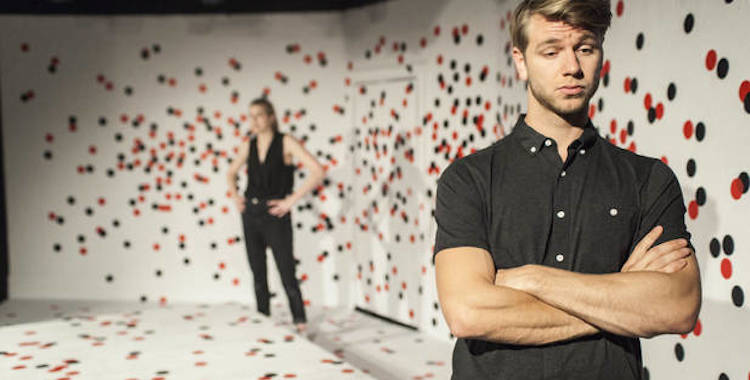
It sounds brutal, but there’s a surreal, comic edge to these frantically competing characters, most of whom are as dotty as Bethany Wells’ spare but striking set design. Two of the candidates are exes, torn between revenge and lingering affection, and each with a dizzying range of foibles. One hopeful specialises in live taxidermy; another claims that his calves are his secret weapon. In a series of short, sometimes skit-like scenes, they make increasingly ridiculous attempts to outdo one another, responding to the cryptic, impossible demands of an unseen judging panel. It’s occasionally clunky, but mostly hilarious.

As entertaining as all the wackiness is, though, it’s the more subdued opening and closing moments of the show that really stick in the memory. Bash (played by Kennedy), the awkward and anxious protagonist of the piece, is in interview mode, blinking nervously into the single bright shaft of light that falls across the stage as she clumsily reaches for the elusive “right” answers. The desperation is tangible. And it’s in this situation, so depressingly recognisable to a generation of young people, that the laughter begins to die away.

Photo: Alex D Fine.