The challenges of using video in live theatre

golem-old-vic-cr-bernhard-muller-700x455

Originally written for The Stage.

Paul Barritt, animator and co-artistic director of theatre company 1927, is frank about the challenges of using projection onstage. “Ask anyone who’s worked with video in theatre and they will say that it is a nightmare,” he says. It’s perhaps surprising, then, that video has remained such an integral ingredient in 1927’s work ever since its Edinburgh Fringe breakthrough with Between the Devil and the Deep Blue Sea in 2007. As Barritt puts it: “It’s core to the very idea of what we do.”

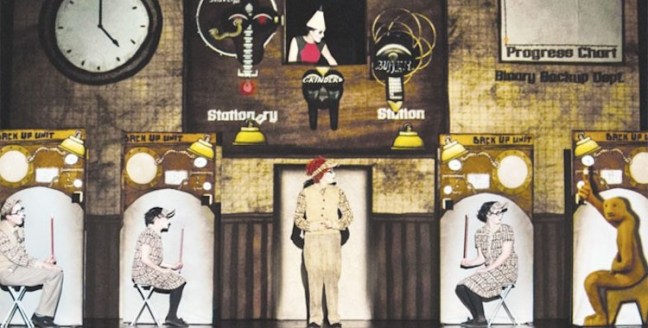
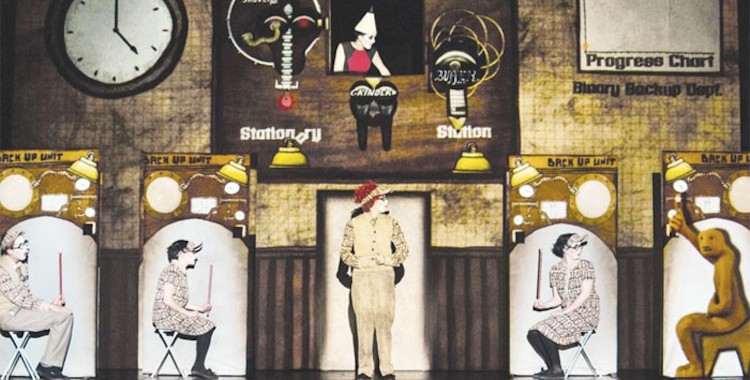
Live performance is put in front of an animated backdrop in 1927’s shows, using projections in novel and surprising ways. The two-dimensional and three-dimensional layer on top of one another form one unique texture. Their debut, Between the Devil and the Deep Blue Sea, drew on silent film techniques to integrate a monochrome film with performers on stage, while hit show The Animals and Children Took to the Streets exploded the same technique into vibrant colour.

The key to 1927’s successful use of projected animations, providing the company’s distinctive style, is collab-oration. “It’s never really just me sitting there making my own animations,” says Barritt. “It’s a very collaborative way of working, and that’s the only way that it really works.”

Barritt offers the example of Golem, which the company is currently taking on tour after its premiere last year at the Young Vic. The show draws on the centuries-old myth of the golem, drawn from Jewish folklore, to create a satire of 21st-century capitalism and technology, with the clay servant of the title fast becoming a must-have, life-ruling accessory. The concept came jointly from Barritt and fellow artistic director Suzanne Andrade, who worked together from the very beginning on both the ideas and aesthetics of the show.

“We knew we wanted to set it in a city and we knew that part of the journey was going to be going from a chaotic, exciting metropolis into this homogenised, Westfield-type city,” Barritt explains. “Aesthetically, we talked about lots of different things.” Inspired by the “hodgepodge” quality of downtown Los Angeles, the city has a collage quality that then flattens out into an “almost pop art aesthetic” as the world of the show becomes increasingly neat and uniform.

The company’s shows are known and celebrated for their almost seamless integration between animation and performances, making an often clunky marriage of live and filmed elements appear effortless. Barritt tells me that this, too, comes from that close collaboration on the overall aesthetic of the show, which extends to performance style.

“Suzanne’s style of direction is very much focused towards bringing out the best in the animation,” he says. “You have to make the actors as large as the animation and they have to behave a bit like the animation behaves, so they have to act in a very gestural way and it has to be slightly heightened because we’re in a big, illustrated, heightened world.”

And it’s not just the performances that have to marry up with the images. Music is also essential to 1927’s shows and helps to hold all the other elements together. “Everything’s timed to the music,” Barritt explains. “It’s when you’ve got this synchronicity of everything, that’s what makes it all work.”

Although the animated worlds that Barritt creates for 1927’s shows would seem to have much in common with film, he warns that “you can’t go too cinema-tographic on it”. He continues: “The film elements that I’m making, I’m doing them in a very theatrical way and they’re actually much more like moveable, animated bits of set than they are film. For example, we’ve never really been able to do close-ups, we’ve never worked out how to do close-ups properly or in a good way. You can’t do it, because your actors are there on stage and it’s all to do with the scale.”

While this means limitations, Barritt sees such constraints as creative rather than frustrating. “You might start off with an idea and it’s this giant thing, this massive idea that you’ve had, but the actual logistics force it into becoming something different and often something better,” he suggests. “Limitations are really good things to work within; it’s much better to have them.”

The process has, however, got easier over the years, both as 1927 has increased in reputation and capacity and as the technology it is working with has improved. After starting out working with DVDs – which Barritt says are now “virtually obsolete” – the company has more recently begun working with a media server that allows Barritt to break the show’s animations down into individual chunks.

“All the animated events are cued,” he says, “so this has made it easier for timing purposes and it has also made it easier to reshape the film. We used to use just one film that played through, so if there was one tiny element in the film that didn’t work, I’d have to go into one massive film and just change one element, and then that can throw a spanner in the works.” He adds that the media server “loosens things up”, allowing more flexibility both in rehearsal and in performance.

New, more sophisticated technology has also eased the often painful process of transferring the company’s shows from venue to venue.

“With the media server it’s much better,” says Barritt, though he admits that there can still be problems. “Every projector is different: it’s really one of the more imprecise technological arts, setting up a projector, because each distance on each angle is always different and that affects how the projection is on the screen.”

Apart from moving to a media server, Barritt insists that technological developments have altered very little about 1927’s ways of working over the past eight years. “The way we’re using [the technology] is quite simplistic, really, in comparison with how some people use it,” he says. “The essential nature of what we’re doing hasn’t changed since we were using DVDs. Our actual process hasn’t really changed according to the technology at all. There are hundreds of things you can do with the technology, but that doesn’t mean you should do them.”

While the technology now allows the likes of motion sensor triggering and live feeds, 1927 hasn’t yet been tempted by such tricks. “People can get seduced by technology a bit and use it just because they can, which is ridiculous”. He says that 1927, on the other hand, would “only use it if we really thought the idea warranted it”.

For now, though, the company is happy to continue within the niche it has carved out for itself. “I think our process is still giving,” says Barritt, “and we’re still finding new ways of doing stuff within it.” The company is unlikely to be doing Shakespeare or kitchen-sink realism any time soon, Barritt adds, but that’s not where its interests lie.

“We’re ploughing our furrow and we’re quite excited about it still,” he says.

Photo: Bernhard Muller.

Shock Treatment, The King’s Head Theatre

68ac6d4e-e9d2-11e4-_893736c

I’m suspicious of sequels. And prequels. Any attempt, really, to spin out a film’s appeal for more bucks – often to the eternal damage of the adoration nurtured for the original – sets my teeth on edge. Let’s call it the Phantom Menace effect.

So while I’m a big fan of The Rocky Horror Picture Show, I’d never seen Shock Treatment, its much maligned 1981 follow-up. For a start, what could top Tim Curry in fishnets? But maybe I was wrong to avoid this cult offering from Richard Crystal Maze O’Brien (warning: click on that link at your own procrastinating peril). Shrunk down and tarted up at the tiny King’s Head Theatre, with a newly adapted (and apparently more coherent) book from Tom Crowley, Shock Treatment is a jolt (sorry) of ridiculous, kitschy joy.

There’s no Frank N. Furter (boo), but Brad and Janet are back in this sequel, now (un)happily married and living in a suburban landscape of picket fences and anti-depressants. Denton is a waking nightmare of toothy grins and repressed desires, as well as being at the forefront of a now eerily prescient experiment in embryonic reality TV. So instead of working out their marital problems at home, Brad and Janet are dragged in front of the cameras, where they soon fall prey to the exploitation and aspirational hokum of the mass media.

Looked at now, the satire – if a little wonky – is astonishingly ahead of its time. When we arrive, Denton has fallen under the sway of Farley Flavours, a larger-than-life media mogul who uses the town’s television network as an advertising platform for the many other pies he has fingers in. In Brad and Janet, he sees an opportunity to up the ante – and the viewing numbers. Handed over to creepy brother-and-sister doctor duo Cosmo and Nation McKinley, Janet undergoes an X-Factor style makeover, while her unfortunate spouse prepares to fry for the sake of ratings.

The plot still isn’t entirely watertight, but then the appeal of Rocky Horror was never exactly its narrative prowess. Instead, what charms about Shock Treatment is the unapologetic kitsch, the facial acrobatics of the performances, the slightly-shit-but-owning-it quality of the whole gloriously tacky endeavour. Squeezed onto the snug stage of the King’s Head, the action of Benji Sperring’s production is confined to Denton’s television studio, a sterilised world of dazzling white against which the TV stars’ neon outfits and inane smiles are all the more lurid. The aesthetic is Stepford Wives suburbia meets reality television excess.

And it’s the sharp precision of the style – swapping B-movie schlock-horror for uncanny small screen sheen – that lets Shock Treatment hold its own alongside Rocky Horror, if never quite matching up to it. There’s more than a hint of Riff Raff and Magenta to the Doctors McKinley, given just the right edge of the surreal by Nic Lamont and Adam Rhys-Davies, while Mateo Oxley’s closeted TV host Ralph Hapschatt has perfected the stretched grin of the would-be celebrity. Julie Atherton, meanwhile, is brilliant as ever in the role of easily duped Janet, taking to new found fame with just a tad too much relish. Plus, there’s a score of murderously catchy tunes, including the Time Warp-esque “Little Black Dress” – complete (naturally) with dance moves.

It is, oddly, as though Shock Treatment has suddenly found its time. Back in the early eighties, over a decade before The Truman Show, the film’s vision of real lives played out on screen must have seemed as outlandish as the outfits. Now, as Celebrity Big Brother stubbornly trundles on and media giants like Rupert Murdoch tighten their grip on every aspect of our lives, O’Brien’s concept looks chillingly prophetic. Sophisticated social critique it ain’t, but beneath the songs and jokes and slapped on smiles, there’s something altogether more sinister.

Wolf’s Child, Felbrigg Hall

Steve-Jacobs-And-Sophie-E-007

Originally written for the Guardian.

It’s hard to imagine a more atmospheric setting for WildWorks’s latest outdoor show. Stepping inside the grounds of Felbrigg Hall, sun hovering just above the horizon, the woods whisper with promises of magic and transformation. As we depart into the dusk, there’s a warning: we must, like Little Red Riding Hood, stick to the middle of the path. There are wolves here.

Before long, though, WildWorks lead us off the well-worn track. Inspired by the Greek myth of nymph turned bear Callisto and by the extraordinary experiences of Shaun Ellis, who spent two and a half years living with a wolf pack, Wolf’s Child takes its audience deeper and deeper into the wild. Beginning at the hall, the orderly preserve of wolf-hating Mother and her collection of orphan girls, the show follows young ward Rowan as she ventures beyond the neatly manicured garden and into the territory of the beasts. As tends to happen in the woods, she is soon transformed.

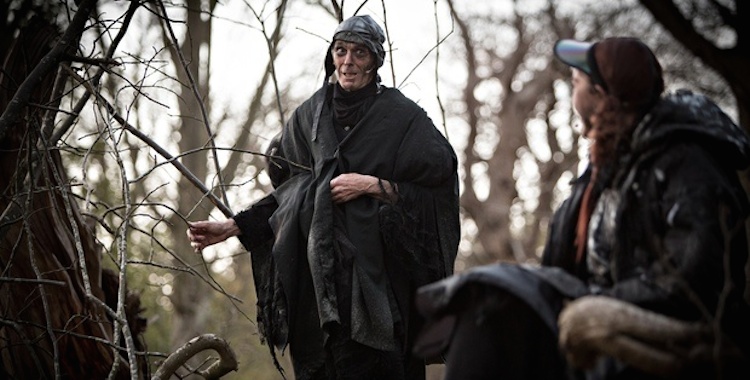
We’re led through the twilight by performers in dark, tattered crow costumes, forming the squawking chorus of the show’s large cast. Narrated by our guides, the fable is told in a fairytale fashion, with simple statements and occasionally clunky rhymes. But Wolf’s Child is an exercise in enchantment more than it is in storytelling. Lit evocatively and unobtrusively, nature’s stage – from a platform of tangled branches to an imposing cathedral of trees – is the real star of Bill Mitchell’s production. The performers’ wordless movement offers the most powerful transition from wild to tame and back again, while Victoria Abbott’s soundtrack reverberates hauntingly through the forest. Flames flicker in the distance and lupine howls shred the air.

It’s only in the stomping and shuffling from scene to scene that the spell threatens to be broken. The crows are a smart touch, tending the tale at the same time as marshalling the audience, but there are only so many ways to chivvy people through the trees. In the tussle between civilisation and wilderness, Wolf’s Child can’t quite throw off its human shackles.

Photo: Steve Tanner.

Walter Meierjohann

Originally written for The Stage.

Britain and Germany have never felt closer. At least, British and German theatre cultures – often defined as polar opposites – are increasingly moving towards one another. Spurred on by regular visits from German directors such as Thomas Ostermeier and productions including Sebastian Nubling’s Three Kingdoms, young British theatre-makers are increasingly fascinated by working practices and aesthetics borrowed from the continent, while there’s evidence of German theatres hankering after Britain’s talent for developing new plays.

Walter Meierjohann represents this collision of cultures. Born in Amsterdam to German parents, the director trained in Berlin and established his career in Germany, but for the last few years he has been gradually establishing himself on the British theatre scene. “Obviously they are very different,” he says of British and German theatre cultures. “The playwright in this country is completely number one, whereas in Germany it’s the director who is more in the lead.”

It was this director-led theatre on which Meierjohann was raised. Training for four years at the Ernst Busch Academy of Dramatic Art in Berlin, his teachers were heavily inspired by Brecht and the course was theoretical in its underpinning. “We had to write concepts,” Meierjohann explains. “Constantly from year one we had to do something with a text.” His understanding of theatre, as a result, was as “a political tool for talking about the time we live in” – a tool wielded by the director.

“I was very lucky to have that training,” Meierjohann says, describing it as “really thorough”, but he always felt that there was “something lacking” in this approach. “Sometimes I got a bit wary of the word ‘concept’,” he continues. “When I started really properly directing I thought, I’ve got my concept, but actually I want to work with actors on the text. You have to leave space.”

Starting his career in a small town in the east of the country, Meierjohann went on to direct classics by the likes of Friedrich Schiller and Arthur Miller at theatres across Germany, as well as working on devised commissions at the Sophiensaele and the Maxim Gorki Theatre in Berlin. He was invited to direct Peter Stein’s ensemble in 2002, and between 2004 and 2005 he worked with the State Theatre of Dresden as the founder and artistic director of international new writing theatre Neubau.

After moving to London, Meierjohann wrote to five theatres in the city introducing himself and requesting a meeting. He received just one reply, from David Lan at the Young Vic. A meeting over coffee turned into “a two-hour conversation about plays and projects” and quickly led to Meierjohann being offered the role of associate director at the Young Vic. This was in 2007, and for the next seven years Meierjohann split his time and work between London and Germany, with inevitable effects on his approach as a director.

“Over the years I haven’t dropped the conceptual approach, but I’ve tried to be much more flexible,” Meierjohann tells me. This shift has been influenced by working with British actors, whose approach is appealing to the director. “There is more of an openness in the UK,” he explains, “both from actors and also from directors, to try things out without being judgemental about it.”

Equally, though, Meierjohann was interested in bringing a continental influence to the Young Vic. Noting both the absence of formal training for directors and less of an emphasis on the visual, he spent much of his time running workshops for young directors and bringing in designers from mainland Europe.

“My dream was to create a fusion between English theatre and continental or German theatre,” he says. “What I mean by that is a strong emphasis on great actors here – who move you, which is very different to German actors – but then also make it a bit more director-led, a bit more visual.”

Meierjohann has also observed the closing of the gap between British and German theatre in recent years. “It seems to me like England is moving more into the German way of more emphasis on directors,” he suggests, “and I think in Germany now actually people are saying ‘we want to get the playwrights in again’.” Change, however, comes down to more than creative appetite. “You can’t change the culture overnight,” Meierjohann cautions. “The UK has fantastic writers and that’s a cultural thing. The whole emphasis on language will always remain.”

Things are shifting, though, especially at theatres such as the Young Vic, where Meierjohann quickly felt at home. “I trained academically in Berlin, but I felt like my theatre school in the UK was the Young Vic,” he says. He calls Lan “a hugely inspirational man” and found that, as outsiders to British theatre, they had an immediate affinity. “Maybe that was a meeting point: we weren’t part of the British culture originally.”

Meierjohann hopes to bring some of the international spirit of the Young Vic to his latest role as artistic director of theatre at Manchester venue Home. Formed from the merger of Cornerhouse and Manchester’s Library Theatre Company, Home is a new international arts centre in the city that will be a home for contemporary visual art, film and theatre. After a site-specific season last year, which included Meierjohann’s promenade production of Romeo and Juliet at Manchester’s Victoria Baths, the director is now preparing to open his first season in the new, purpose-built venue.

Meierjohann offers the example of The Funfair, opening at the theatre this month, as an ideal example of his approach to programming. The play, which will be directed by Meierjohann, is a modern European classic written by Hungarian playwright Odon von Horvath and adapted by Simon Stephens, who has shifted the drama to Manchester. “What I’m trying to introduce here is plays which have a great message, are very bold, but also talk about Manchester,” Meierjohann explains. “We’re not doing kitchen sink; it’s moving away from naturalism and realism. It’s bold, it’s classical, and it sends out a clear message that we’re working with one of the greatest UK writers at the moment, but with a strong director’s emphasis as well.”

Similar thinking can be seen throughout Meierjohann’s first season. Before The Funfair, the arrival of Hofesh Shechter in the building blurs the boundaries between theatre and dance, while visiting productions from the likes of Kneehigh and 1927 showcase different forms of storytelling on stage, often with continental influences. There’s also a revival of Meierjohann’s world-touring production of Kafka’s Monkey, starring Kathryn Hunter, and the UK premiere of Philippe Quesne’s La Melancolie des Dragons. On the whole, the programme sends “a clear signal that we’re doing things differently here”.

Meierjohann is particularly keen to throw off the “regional theatre” label. “Of course we are a regional theatre because we’re in Manchester, we’re not in London, but I think we can create something here which has that international appeal as well.” While insisting that “a theatre is for the community which you work in”, he is keen for Manchester to become a “second London”, with Home at the forefront of a burgeoning cultural scene.

“The aim is basically to say we’ve got stories from all around the world in our building and we want to talk to an audience who are interested in this,” says Meierjohann, putting an emphasis once again on the international, as well as on making the venue a welcoming – and exciting – place for Manchester audiences. “I think Home, if it all works out, could be a really sexy place.”

Ponyboy Curtis at The Yard

514x3823

Originally written for Exeunt.

I can’t get the music loud enough.

Huddled on the train, freshly hurled out of Ponyboy Curtis at The Yard and into the cold, jagged, rain-flecked world, I want the music coursing through my headphones to fill me up, to vibrate through my pores. Nothing is loud enough, bright enough, vivid enough, tender enough.

The post-Ponyboy world feels like a grey but – slightly, almost imperceptibly – changed place.

So what is Ponyboy Curtis?

It’s a party.
It’s an intervention.
It’s an ensemble.
It’s a call to revolution.
It’s a fleeting alternative space, precariously carved out of the worlds of late capitalism.
It’s an invitation to intimacy.

It’s sexy.
It’s dangerous.
It’s tender.

It’s a shot to the heart.
It’s a kick to the gut.
It’s a blast to the eardrums.

It’s not quite like anything else.

“The naked actor is often the most powerful person in the room, partly because they’ve got nothing left to hide.” – Chris Goode

Let’s start with the nudity. Because there’s a lot of nudity. In its repeated acts of dressing and undressing, edges of the stage littered with clothes, this piece – show? experience? space? – feels like a thinking through of nakedness on stage. What does it do? How can that unclothedness be both extraordinary and natural at once? What dynamic does it create with an audience – dressed, distant, looking on?

On the clothed side of that divide, it’s not so much the erotic charge of all those naked bodies that I notice. It’s the astonishing expanse of bared skin: the gentle curve of a collarbone, the pulsing movement of a calf muscle. The brush of a finger against a palm, or the sweep of a hand along the small of a back. Small intimacies, not necessarily sexual, but aching with care.

There’s an ease to this near-perpetual nakedness, but also a provocation. Look at me, the performers dare, occasionally meeting our gaze with a challenge in their eyes. At moments, they appear vulnerable; at others, they are diamond-hard, invincible. Stripped to their skin, the shedding of clothes clads them in a different kind of power.

Looking on, it suddenly occurs to me that nearly all of the most heart-stealing, chest-tightening moments I’ve experienced in the theatre in recent months have circled around nudity – around bodies, tender and exposed. Peter McMaster and Nick Anderson struggling and embracing in 27. Jonah Russell and Oliver Coopersmith tentatively reaching out to one another and then drawing apart in The Mikvah Project. These beautiful, ravishingly brave boys at The Yard falling and jumping and kissing and dancing.

The texture of Ponyboy Curtis is one of nakedness and intimacy and radical energy, but also one of boybands and dance music and buddy movies. Like The Ramones, each of the performers has taken on the temporary surname ‘Ponyboy’, but huddled around a microphone, caps slanted at angles on their heads, they’re more like Take That. The polish of the manufactured pop band, but without the perfect, plastic, stage-managed sheen of One Direction.

Boyband. Gang of mates. Lovers. Men embracing to pumping music. Men strutting, naked and clothed and partly clothed. All these different masculinities. It’s hard not to think of all the characters in Men in the Cities – those broken, contorted boys and men. There’s hurt here too, in the bodies that crumple to the ground and the voices that howl, but in so many ways Ponyboy Curtis is a celebration of all the masculinities that the glass and concrete prisons of Men in the Cities disallow. Masculinities that are gentle, fragile, questioning, joyful. Masculinities founded on care rather than aggression.

Very little is said. This is a theatre of bodies and noise and feeling, not a theatre of words. Quotes, read aloud from pieces of paper tacked to the wall, occasionally slice through the pounding soundtrack but quickly become swallowed up by everything else around them, their traces dissolving. The only words that really stay with me are those of the evening’s guest, Hannah Nicklin, whose letter to her big little brother makes me think of my own three big little brothers and all the harm I worry about patriarchy inflicting on them, all the attitudes they easily absorb and reproduce. Her words make me think again about the world outside this flickering, captivating space and the sort of masculinity that is permissible there.

Then I’m out in that world again, the bright lights of Ponyboy Curtis glittering on my retinas and its music humming faintly in my ears. I don’t yet have words – let alone sentences – to describe or respond to it. Even now, I’m only fumbling towards something like that space and what it made me feel. This is a thinking through of how to write about Ponyboy Curtis, just as the performance I saw – sat alongside? inside? – last Thursday night felt like a thinking through of what this collection of people and ideas might or could be.

Thinking through. Feeling at the edges. Pushing at the walls. Starting something.