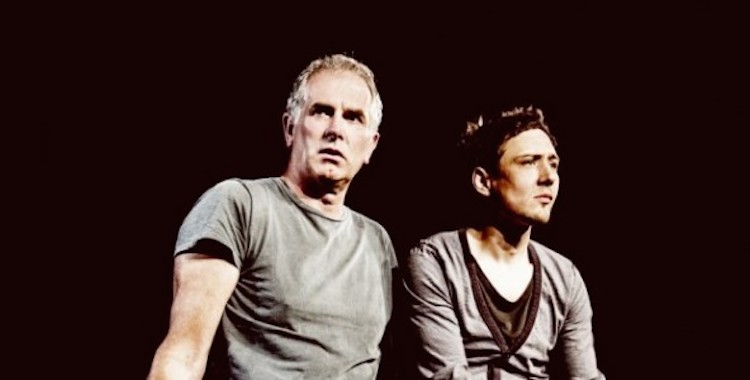
Common Ground

common_ground1_3985-600x337

Originally written for Exeunt.

Berlin is a city of remembering. Its streets are scarred, marked, tiled with notes from the past. Bullet holes and metal plaques; imposing monuments and gaping voids.

As the eponymous common ground of Yael Ronen’s show, then, Berlin as a place offers countless echoes. In this city inscribed with conflict, Ronen has found and gathered various survivors of another set of conflicts: the break-up of Yugoslavia in the 1990s. All of her performers – save Israeli Orit Nahmias and German Niels Bormann, mirroring the nationalities and backgrounds of Ronen and her dramaturg Irina Szodruch – came to Berlin from various shards of this splintering nation. From Belgrade, Sarajevo, Novi Sad and Prijedor, they have met in Berlin rehearsal rooms to confront their collective pasts, navigating between the oscillating poles of victim and aggressor.

From the shrapnel of guilt, blame and conflicting narratives emerges one repeated truth: it’s complicated. As one performer demonstrates with an attempt to explain his tangled family history, this is a region of Europe that is criss-crossed with different allegiances and antagonisms. Rather than resolving that complication, though, Common Ground slams it centre stage. In its hands it holds two opposing impulses: we want to understand; we can’t understand.

Drawing on a mixture of research and autobiography, Common Ground begins in 1991, racing from there through the chaotic and devastating collapse of Yugoslavia in subsequent years. After a playfully self-aware introduction from Nahmias and Bormann – the two onlookers – the show immediately hits warp speed. Attack follows natural disaster follows hit pop song. The company have created an unruly, overlapping collage of the 1990s, setting civil war in the Balkans against a backdrop of global shifts. In one part of the world people are being slaughtered; in another, Bryan Adams reigns the charts. Atrocity knocks up against banality.

If it’s fevered and anarchic, that’s the point. Scrambling to keep up, we’re left breathless and disorientated, this speeded up chronology feeling more like an assault than a history lesson. Like the conflicts themselves, it’s difficult to piece together. Surrounded by the debris of Magda Willi’s design – all boxes and clutter – the performers then begin the slow and arduous process of rebuilding. Portions of the set are stacked and slotted together, tried in new combinations, as the show itself mirrors the process of these individuals coming together and sharing their experiences.

Common Ground is, explicitly and unapologetically, the combined narrative of its company. Everything here has been generated and shaped by the performers, who press hard on personal bruises. Through this approach, the show deftly dodges many of the pitfalls of the documentary play. Instead of claiming veracity, it presents complexity and the elusiveness of understanding, apportioning and then complicating blame. These are, of course, political stories, but they are personal stories first; there’s never any attempt at a complete history or a diagnosis of where it all fell apart.

Politically, it feels vital to reflect on how we process and package the past. Walking around Berlin for six days, I’m struck by the difference in how cultural memory is constructed here. There’s a rawness to these wounds, whose healing is an ongoing process. In the UK, meanwhile, we have an insidious, poppy-garlanded triumphalism, slyly manoeuvred for political gain. We have “Blitz spirit”, tarted up into austerity and stamped with a “Keep Calm and Carry On” logo. War is, perversely, almost something to be nostalgic about.

If Berlin’s wounds are raw, then those exposed by Common Ground are still dripping with blood. When the company visits Bosnia, the people they meet struggle to talk about what happened two decades ago. As one Sarajevo resident puts it, the war never really ended: it continued within people, poisonously unresolved. Another woman is trapped in a cycle of remembering, retelling and retelling her trauma until the words dry up. These narratives – dropped by the rest of the world as a new conflict pierced the horizon – have never achieved closure, but still they keep being repeated.

So it’s surprising to find humour and optimism here as well as pain and anguish. There’s a respectful lightness of touch to Ronen and Szodruch’s production, which manages to salvage both the hopeful and the ridiculous. It comes down, ultimately, to the relationships among the company, in which the show locates a tentative note of positivity. Difficulty never disappears, but tenderness challenges it, as the common ground of the title gradually multiplies. In that shared territory, that shifting ground beneath the feet of these seven people, there might just be a fragile foundation for hope.

Olivia Poulet

Olivia-Poulet-in-Product-by-Mark-Ravenhill-Arcola-27-April-24-May-courtesy-of-Richard-Davenport-9-700x455

Originally written for The Stage.

Olivia Poulet has a good line in peddling the unpalatable. The actor and writer is best known for her role as pragmatic,  fast-thinking Tory policy adviser Emma Messenger in television satire The Thick of It and is currently starring as a hard-nosed Hollywood producer in Mark Ravenhill’s monologue Product at the Arcola Theatre. Both characters are always desperately putting a positive spin on the catastrophic – or, as Poulet bluntly puts it, “trying to polish a turd”.

“That’s what was appealing in the writing for me,” she says of her first impressions of Ravenhill’s script. In the play, Poulet’s character is pitching an audaciously offensive romantic thriller about a relationship between a 9/11 widow and an  Al Qaeda terrorist, skewering the ways  in which Hollywood glosses over tragedy and complexity. “It’s just very, very witty, and when I first read it I thought ‘I know how I’d want to play this part’.”

In her teens and early 20s, Poulet developed her skills as a performer in  the National Youth Theatre and at the University of Manchester, where she was involved in the student drama scene. “You get much more scope at uni; people take risks because they have less to lose,” she says. “Also having no money and rehearsing in a cupboard upstairs enables you to justmuck in and get on with it wherever you are.”

Straight out of university, Poulet landed a role in a production of The School for Scandal at Derby Playhouse, but she describes the job as “fairly diabolical” looking back. “I learnt a lot,” she reflects on the experience, describing herself as “wide-eyed and innocent” going into it.

“You have to learn how to put your foot down, without being a pain in the arse. I think sometimes people can…” She pauses. “Manipulate is maybe too strong a word, but when you’re young and starting out there are some people who slightly take advantage of that.”

Thanks to more recent meaty roles in plays such as How I Learned to Drive at Southwark Playhouse and Out of Joint’s production of Caryl Churchill’s Top Girls, which she describes as “a really magical experience”, Poulet now stresses the importance of holding out for the right parts. “Yes, the money’s not great, and sometimes you’re a bit hand to mouth for a bit, but the challenge of doing a part that is really exciting and fulfilling is just so worth it,” she says of her work in theatre. “Of course you’ve got to make money, but I think as I’ve got older I’m definitely very much about the part and I feel less desperation to just be working for the sake of it.”

She adds that her parallel career as  a writer keeps her going during lean  periods. “It’s incredibly important to  have something else you love, otherwise you can go a bit doolally if you put everything on to acting.”

Poulet had always written alongside acting, but it was only when she paired up with friend and fellow performer Sarah Solemani to write The Bird Flu Diaries, a comedy that the duo took to the Edinburgh Fringe in 2006, that she thought about pursuing it further. Similarly to acting, though, Poulet has found that writing for stage and screen can be a tough profession to break into. “It’s hard,” she admits. “Everyone gives writing a bit of a crack – why not? It’s very highly populated; there’s a lot of people sending in scripts and drafts. But I think there’s probably quite a lot ofpeople who aren’t very good at it as well. Now I think I’ve finally got to a place whereby it’s been recognised that I can write.”

Although her focus has moved to the stage in recent years, Poulet still acknowledges the huge impact of The Thick of It. The programme’s makers threw her and the rest of the cast in the deep end by demanding regular on-camera improvisation, a challenge that was both terrifying and exhilarating. “I love structure,” says Poulet, “but my brain thrives under pressure and always has.” This process chimes with the frequent behind-the-scenes crises depicted by the series, which Poulet suggests “opened up people’s eyes to the lunacy”  of much of modern politics.

As well as both turning around media disasters, there’s a strain of frantic,  suppressed despair that long-suffering Emma Messenger shares with the superficially confident speaker in Product. “I think it smacks of desperation, the whole pitch,” says Poulet, explaining that she has seized on the character’s “fragility and vulnerability” in her performance.

“There are a lot of swans,” she  suggests, offering a neat metaphor for both British politics and the “undercurrent of desperation” in Product.  “A lot of people who are trying to look smooth on the surface and scrabbling around like nutters underneath.”

Photo: Richard Davenport.

Why we can’t stop watching violence

a3aa32e2-d7db-4a97-8f8a-b0f24e8ff393-2060x1236

Originally written for the Guardian.

Greg Wohead’s theatre show about the crimes of serial killer Ted Bundy opens innocuously enough. He welcomes his audience, shares some facts and tells a few jokes. Then he gets to the point: “I guess you want to know the juicy stuff.”

The Ted Bundy Project was provoked by Wohead’s experience of stumbling across Bundy’s confession tapes online and finding himself compulsively listening for the “juicy stuff”. “This was the spark of interest,” he says, “feeling at once disgusted and horrified but also really interested and intrigued.”

The same could be said of our own relationship with violence both on and off stage. Today, violence is ubiquitous, beamed worldwide on 24-hour news channels and freely available at the click of a mouse. Society has never been more saturated with images of brutality.

Another new piece of theatre, Image of an Unknown Young Woman, starts with one such instance of violence that goes viral. A woman in a yellow dress is shot by the police and the video footage sparks a popular uprising. Writer Elinor Cook was inspired by events during recent revolutions, but did not specifically set out to address any particular political situation. She explains that she was interested in exploring “how the extinguishing of something bright and beautiful galvanises people”, as well as interrogating “this idea of some violence being, in a sense, titillating”.

Theatre has a complicated relationship with violence. “It goes back to the Greeks, doesn’t it?” suggests Christopher Haydon, who will be directing Image of an Unknown Young Woman at the Gate theatre, London. Greek tragedy kept violent events out of sight, leaving the grisly details to the imagination of the audience. Since then, though, plenty of violence has erupted on stage, from the bloodbath of Titus Andronicus to the shock and gore of the in-yer-face theatre of the 1990s. More recently, Tim Crouch’s in-yer-head show The Author both skewered and questioned the provocative violence of its theatrical forebears at the Royal Court, while directors such as Ellen McDougall have used striking visual metaphors – balloons, water, chalk – to stand in for physical blows.

Nothing, the debut show from the young company Barrel Organ, which is currently on tour, is of the Crouch school. Rather than putting anything shocking on stage, the casual violence that permeates its series of alienated monologues is all described, making the audience complicit in imagining it.

Barrel Organ’s new piece, a work-in-progress entitled Some People Talk About Violence, is upending the concept altogether. “I wanted to write a play about quite insidious, inherent forms of violence that occur within a capitalist system,” says writer Lulu Raczka, who is in the process of collaboratively devising the show with the rest of the company. The violence she refers to is the hidden and often internalised violence of zero-hours contracts and unemployment legislation. “It’s about renaming violence,” says Raczka.

“Theatre permits and enables us to contemplate violence,” argues Lucy Nevitt in her book Theatre & Violence. It’s an arena in which violence can confront us with its reality and provoke us to question the structures that enable it. But its representation also throws up ethical question marks. When does the staging of violence challenge what it shows, and when does it just reiterate it?

“My feeling is that if it’s done in the right way, representation of violence is totally legitimate,” says Haydon. But in his staging of Image of an Unknown Young Woman, torture and abuse will be shown metaphorically rather than literally. This chimes with the non-specificity of Cook’s narrative; rather than “trying to depict a real country in a specific way”, Haydon explains that “it asks you to look at the underlying processes of a revolution” and the ways in which power can “warp reality”.

Wohead, meanwhile, insists that “there’s a blurry line between represented and real”, challenging any clear-cut binary between real and fictional violence. The violence that we see on television, for instance, is “framed in a certain way, it’s filmed by someone”. In researching The Ted Bundy Project, Wohead came across whole online communities built around the sharing of violent images, on the basis that “it’s stuff that is happening in the world and by confronting that we can take steps towards confronting the reality”. But Wohead has his doubts; he’s more interested in prodding at the less savoury motivations behind such voyeurism.

“I think there’s a lot of theatre out there that is pointing a finger at something or someone,” he says. “And sometimes that’s useful, but the way I work … is about pointing the finger back at myself and at all of us. Lots of these structures that we have problems with, we are all complicit in.” Audiences can expect to leave The Ted Bundy Project feeling just as uncomfortable with their own reactions as with the subject matter itself.

For Raczka, the use of violence on stage is complicated. “In order to take it on I think you have to take it on absolutely fully,” she says. “When we’re talking about using violence to shock and to move a plot line along, that’s when I think it becomes very exploitative.” This is the sort of exploitation that Barrel Organ aim to eschew and subvert in Some People Talk About Violence. The company also hopes that the very deliberate use of the word violence in the show’s title will “set up an expectation that can then be dismantled”, allowing a discussion to take place afterwards.

“It’s quite aggressive to actively say that you want someone to leave a theatre and discuss the issues you’ve brought up,” says Raczka, casting the idea of a “violent play” in a new light. “That’s surely what all theatre is about, but this is going at that full pelt.”

Photo: Alex Brenner.

Mother Figures

gods-2-600x300

Originally written for Exeunt.

Selma Dimitrijevic and I first began talking about her play Gods Are Fallen and All Safety Gone almost three years ago. It’s been a long, meandering, stop-and-start conversation, via sitting in on rehearsals, watching performances and dress runs, chatting over coffee in various cafes in various cities. Aptly enough, Gods is also about those conversations that stretch over years: the well-worn family routines that regularly pause, rewind and restart.

The play’s history is even longer. Selma’s delicate depiction of one mother-daughter relationship was originally written as a commission for Oran Mor’s A Play, A Pie and A Pint series back in 2008. Across just four scenes, Gods Are Fallen and All Safety Gone (the title borrowed from John Steinbeck) suggests a lifetime’s worth of love and resentment between thirty-something Annie and her mother, their repeated small talk increasingly charged. It’s a small story, but one that reaches far beyond its two characters.

When it was produced at Oran Mor, Gods got what Selma describes as a “very naturalistic” treatment. Watching it, she felt that something was missing. “It was one of those things when you see a piece of work that you have made and there’s nothing you can say that is wrong with it,” Selma explains, “but the product wasn’t necessarily the kind of thetare that excites me. So I was looking at it and thinking ‘how did I help make this piece of theatre that I wouldn’t be that excited about as a theatregoer?’”

But it was only after encountering a Russian version of the play directed by Viktor Ryzhakov in 2011 that Selma thought of having a stab at it herself. Despite failing to get into the country to see it, Selma later got hold of a recording of the performance and found herself incredibly moved by it. “I saw a video of it and it just made me cry,” she remembers. “It went straight to the heart of what I was trying to do.” Ryzhakov cast two women of the same age as mother and daughter and contained them inside a pen for the length of the play, delivering the dialogue at high speed. Selma saw something in her play that went beyond domestic realism.

But it was only after encountering a Russian version of the play directed by Viktor Ryzhakov in 2011 that Selma thought of having a stab at it herself. Despite failing to get into the country to see it, Selma later got hold of a recording of the performance and found herself incredibly moved by it. “I saw a video of it and it just made me cry,” she remembers. “It went straight to the heart of what I was trying to do.” Ryzhakov cast two women of the same age as mother and daughter and contained them inside a pen for the length of the play, delivering the dialogue at high speed. Selma saw something in her play that went beyond domestic realism.

“Once I saw that, I thought actually I want to do my own attempt,” says Selma, explaining that her intention was to approach it “just as a piece of writing”. She got this opportunity through her company Greyscale, who were offered a spot in the 2012 Almeida Festival. Now, eight years after first writing the play, she tells me that the text of Gods feels oddly distant. “I kind of keep forgetting that I wrote it,” she laughs.

What’s most distinctive about Selma’s version of Gods – at least at first glance – is her decision to cast male actors Sean Campion and Scott Turnbull as mother and daughter. At the time when the Almeida Festival opportunity arose, Selma was working with the pair on Greyscale’s Theatre Brothel and something about their relationship resonated with the relationship in the play. It was, as she puts it, an artistic choice that came from the gut rather than the head.

“I’m a big believer, as a writer, that my subconscious is a better writer than I am,” Selma says by way of explanation. “So when things just come out, they’re usually much better than when I think about it. And the same thing as a director: I bring a lot of things into the rehearsal room that are instinctive. I can’t explain why.”

She’s been reluctant, therefore, to identify any intention behind the cross-gender casting, preferring to keep readings open. And while on the page this casting choice is what grabs attention, in performance it becomes almost irrelevant. Once accepted, the fact that these two female characters are being played by men seems perfectly natural. After all, theatre is always asking us to believe that one thing stands for something else. There’s no attempt by Sean and Scott to ape femininity; these are demonstrably two men, but also two women.

As I put it to Selma during that initial rehearsal period, the production’s non-naturalistic casting somehow frees it from the burden of specificity. Because these two men are clearly not attempting to represent two “real” women, the piece is allowed to speak through and with them, elevating it to something far more wide-reaching than the bare bones of the script might suggest. Discussing the casting now, Selma’s stance is simple and equivocal: “It just feels right, and as long as it feels right and interesting and exciting, and people react to it in an interesting way, we’ll keep doing it.”

Looking back on audience’s reactions to the casting during their latest tour, Selma draws attention to one response in particular. “This really interesting thing happened: there were a couple of men who mentioned that they don’t know if they would come and see it if it was just a show about a mother and daughter, and that they might not have connected with it personally if it was just a real mother and daughter and two actresses on stage. I don’t know how to feel about that.” It points to how, culturally, we still see narratives of female relationships as being aimed primarily at women, whereas narratives of male relationships are read as universal. As Selma puts it, “if it’s one, it’s a minority narrative, and if it’s the other then it’s for everyone”.

Other responses to Selma’s casting choice were more indignant. “A lot of people asked me how did the writer feel about me messing with their play,” she says, “which always makes me laugh.” For Selma, this complaint has a familiar ring, revealing much about the differing attitudes towards writers and directors in British theatre. “It feels a little bit like yes, you can do things to my play, but only if you do them well,” she continues. “Well of course, I wouldn’t be suggesting things otherwise. My intention is to do it well; I can’t promise I will.”

Selma’s other intriguing creative choice in directing Gods was to put a real mother and daughter on stage with Sean and Scott, quietly looking on from the back of the stage. Selma describes the pair as a kind of “amplifier” for the performance: “We’ve never had mother and daughter react in any emotional way if either audience or actors weren’t genuinely vibrating with emotion. But if it it is an emotional show, they make it a bit more emotional, and if it’s a funny one then them laughing on stage makes it even funnier.”

And although Selma insists that she doesn’t make “theatre with an agenda”, she has noticed over the life span of the show that it is also capable of making small changes in the lives of the mothers and daughters who take part. “They get to spend an hour looking at each other, talking to each other afterwards, as two adults, and see each other slightly differently after the show,” says Selma. Having lost her own mother before directing the play – “I’ve completely missed that opportunity” – these small moments of connection are particularly precious.

As much as Selma insists on the importance of instinct and chance in her work, with Greyscale she has been working hard over the last few years to give those instincts as much breathing space as possible. “It’s a combination of us being lucky,” she says of choices like the casting in Gods, “but also being good at creating circumstances in which things like that can happen.”

That means spending time together, sharing creative experiences, seeing other theatre. Selma explains that she, Sean and Scott have seen and talked about several shows together and have participated in a range of different workshops, giving them a shared toolkit and vocabulary. “We’ve filled the last twelve months with things for us to do together that have to do with art but don’t need a result and just allow space to be together and to talk about things,” she says. It is, she adds, “the poor man’s way of trying to do the ensemble thing”.

After three years of working on the play on and off, it’s now “properly like family”. Like the mother and daughter in her play, Selma and her team have a shared history, shared conversations and shared irritations – so much so that she suggests it’s barely acting for Sean and Scott anymore. “They’ve been repeating it for three years, so now when mother or daughter gets annoyed about things happening over and over again, they have it in their core, because they’ve done it so many times – they don’t have to pretend that they’re annoyed.”

Theatre goes wild in the country

Wolf's Child Ö WildWorks' show for the Norfolk & Norwich festival.

Originally written for the Guardian.

Across the South Downs, on Brighton beach and deep in the woods in Norfolk, theatre-makers are redefining the relationship between art and nature this spring and summer. For a number of outdoor shows and installations that are exposed to the elements and at the mercy of the unpredictable, the environment is far more than just a backdrop. The recent rise of site-specific performance means that the “where” is becoming almost as important as the “what”.

In the promenade performance Nightingale Walk, audiences will venture across the South Downs late at night in search of the elusive song of the nightingale – “the romantic heartbeat of England”, according to the musician and artist Sam Lee. During the performance, Lee and his musicians play songs that both speak to and celebrate the bird. “We’re not trying to disturb or interfere,” he says of the piece, which is about respecting as much as exploring the surroundings. Audiences might return without actually hearing any nightingales, but Lee suggests that “the sense of the unknown is what makes it so exquisite”.

Birds are also the inspiration for And Now’s Brighton beach installation, Fleeting. Using fire and sound, the artist Mandy Dike hopes to create something that is “in feeling with the landscape”, evoking the starlings that flock around the collapsing West Pier. The installation is also concerned with the place of humans within the landscape. “The pier is a standing symbol of impermanence and change,” Dike says. “It’s not a natural feature, it wasn’t there 200 years ago; it’s something that has been built by man and has gone through an evolution and is now dissolving back into the water.”

Both Nightingale Walk and Fleeting are part of the Brighton festival, which starts on 2 May and offers a range of genre-defying work. Guest director Ali Smith is inviting visitors to “imagine the world seen from the eye of a bird. Migrating birds are born naturally equipped with maps that even newborn birds know how to follow. Imagine maps of landscapes with no border, and birds with nothing but the urge to flock together.”

Other performances at the festival delve further into the wild. The forest has frequently been imagined by artists as a place of transformation – consider the woodland escapes of plays such as A Midsummer Night’s Dream. Burn the Curtain’s adaptation of Angela Carter’s The Company of Wolves immerses audiences in “an edgeland where you feel surrounded by danger all the time”. The performance will transform Stanmer Park into a fairytale landscape of beasts and hunters.

The director Joe Hancock explains that the company wanted to create “a very visceral experience of the outdoors”, something they have achieved by getting audiences on their feet in groups of runners and walkers. Hancock hopes to give theatregoers, as physically active participants, a different point of access to the story. “Antonin Artaud talks about creating a theatre that isn’t a theatre of the intellect, but where instinct is as important as intellect,” he says. “Promenade [theatre] does that very well.”

In The Lone Pine Club, Pentabus theatre company’s new children’s show adapted by Alice Birch from the series of books by Malcolm Saville, young protagonists roam across the landscape with a freedom that few British children now enjoy. The show will tour five National Trust properties this summer, starting at Carding Mill Valley in Church Stretton, Shropshire, in July. Director Elizabeth Freestone describes the original books as “proper Bond-style adventure stories in the countryside”, and hopes the show will rekindle children’s relationship “with being feral and being wild”. In her books Wanderlust and A Field Guide to Getting Lost, Rebecca Solnit likens the human mind to a landscape: thought is a kind of wandering, and musing takes place in “meadowlands of the imagination”. Likewise, for Freestone, “there’s a really direct link between being outside and imagining stuff”.

For WildWorks’ new show, Wolf’s Child, which is part of this month’s Norfolk & Norwich festival, the company’s artistic director, Bill Mitchell, started with a question: “Is it possible to get an audience to look through the eyes of an animal?” Drawing on myth, fairytale and folklore, the show takes audiences into the woods around Felbrigg Hall, exploring a natural landscape that we so often ignore or abuse. “We’re losing our connection with the wild,” Mitchell says. Felbrigg Hall is one of those dreamlike places. Sun-dappled clearings narrow into tree-crowded paths; overhead, branches twist and curl in fantastical formations. In one part of the woods, cedar trees rise up like columns, creating a backdrop more evocative than many a stage set. “We’re trying to honour the space,” he continues. “There’s a phrase: ‘What do you get for free?’ Actually, here you get a hell of a lot that is just given to you.”

Reflecting on the impact of outdoor performances and installations on these landscapes, Dike says: “You leave an energy there, but you’re not leaving big structures or marks or scars.” All of these artworks are about working with what is already there. As Mitchell puts it: “There’s a big difference between doing A Midsummer Night’s Dream in Regent’s Park and actually using the landscape, trying to understand the landscape, and letting the landscape shape the story.”