Operation Magic Carpet, Polka Theatre

Screen Shot 2015-04-13 at 11.57.34

Stories matter. So often they form the very substance of human communication, allowing us to define who we are both for others and for ourselves. They are our window onto what has come before and what lies ahead. They are how we see the world, how we shape it, sometimes even how we change it. And they’re certainly not just for children.

In Operation Magic Carpet, inherited stories are not just told, but retold. Samantha Ellis’s play is about where we come from and where we are now; about roots, journeys and destinations. It’s a story about stories and it’s a story written for children, though the ideas it’s gently tussling with are far from childish.

It’s a story with a heroine: curious, imaginative, no-nonsense Nomi. The British child of Iraqi immigrants, what Nomi wants more than anything is a story of her own. She’s stranded in a second generation no man’s land, struggling to lay claim to the narratives of Iraq and reluctant to accept those of Britain. Her father urges her to embrace their new home – “you’re lucky to be born in this country with its moderate climate, moderate people and moderate politics” – while her mother and uncle yearn for the country they have left behind, their wistful remembrances shutting Nomi out. Where does she fit in?

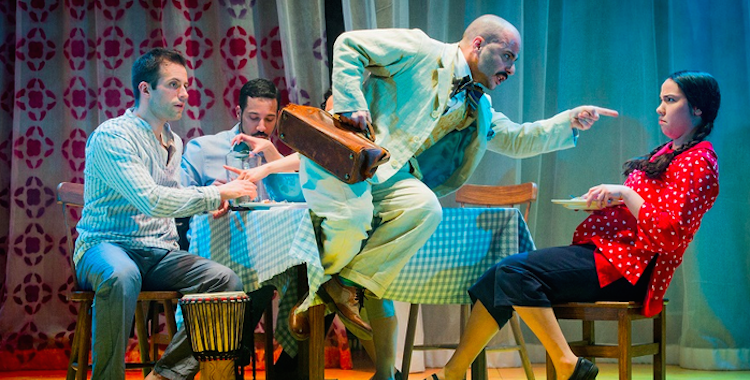
Her answer comes via a genie in a bottle, a ride on a magic carpet, and a daring adventure through the streets of Baghdad. When an unlikely sidekick pops out of her parents’ mango pickle jar, Nomi is granted her wish of going to Iraq, but the country she finds is one more familiar from the Thousand and One Nights than from television news reports. Once there, she encounters shooting stars, a proverb-spewing caliph and Sinbad the, erm, Merchant (he doesn’t like it when he’s called Sailor). She goes in search of her mother’s lost heart but, as in all good old-fashioned adventure stories, things get a little complicated along the way.

Sadly, the magic of the story doesn’t always translate to Rosamunde Hutt’s well-behaved production. Mischief, rather than being unbottled, too often feels controlled. Some pleasingly boisterous post-interval audience interaction aside, the performance hovers just short of the playfulness really needed to captivate its target audience of six to eleven year olds. Even in a climactic fight sequence, the action lacks the verve to fully transport its young spectators, its audacious series of magical transformations somehow failing to enchant.

As a piece of theatre, though, its real value lies in its reframing of familiar narratives. Without being overtly political, Operation Magic Carpet is a challenge of sorts. Its strong female protagonist challenges the insidious gender stereotypes of so many stories for children, which quietly influence how both girls and boys see their place in the world. It challenges media narratives of Iraq, refusing to ignore the nation’s turbulent recent history but at the same time recovering its thrilling, magical past. And at a time when immigration is at the top of the political agenda, it celebrates the condition of belonging to two places at once, exposing the shallowness and lack of imagination of an insistence on “British values”.

Like I said, stories matter. And so does this one.
The Father, Trafalgar Studios

95088

Originally written for Exeunt.

For August Strindberg, love is war. It’s apt then, that the protagonist of The Father is an army Captain, a man who can only see marriage in military terms. His wife – all women, in fact – is the enemy, and married life is a series of conflicts, long campaigns broken up with sudden assaults. The Captain and his spouse Laura are “natural antagonists”, locked in a brutal Darwinian battle. Only the fittest can be allowed to survive.

In Abbey Wright’s swift and taut new production at Trafalgar Studios, we get an action close-up of this battleground. Crowded around three sides of the small studio space – sparsely populated in James Turner’s design other than the mocking Christmas tree – the audience is claustrophobically close to a play more usually seen on bigger stages, lending extra spark to the dramatic pyrotechnics. When the Captain explodes, we can taste his rage and see the gleaming whites of his eyes.

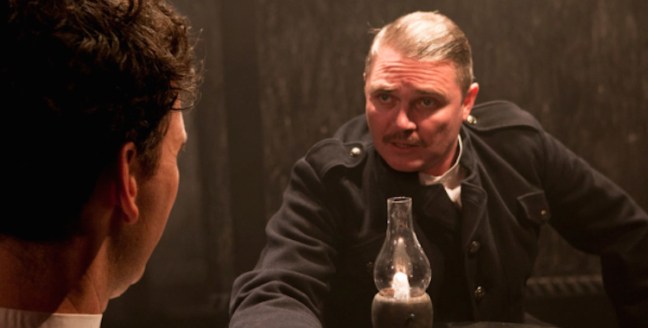
Strindberg’s play captures a family in breakdown. The Captain and Laura’s marriage, under strain for years, finally splinters apart around a pre-paternity test dilemma. How, the Captain begins to ask himself, can he be sure that he is the father of his daughter? With no Jeremy Kyle to solve the mystery, this doubt begins to sour, and Alex Ferns’ bullish, shouty Captain – face dredging up nasty memories of his run as EastEnders baddie Trevor – slowly falls apart, his straight-backed military arrogance gradually unravelling over the course of the action.

While the Captain is at the black heart of the tragedy, there’s a tougher task for Emily Dobbs as slippery, scheming Laura. Although the programme notes are keen to absolve Strindberg of out-and-out misogyny, it’s definitely Laura who comes out of this worse. The Captain might attempt to keep his wife on a tight leash, but it is Laura who intercepts his mail, convinces their new doctor that he is going mad and plants insidious doubts in his mind about the paternity of her daughter Bertha, the helpless bargaining chip shunted between the two. Both partners might be unpleasant, but it seems clear whose side the play is ultimately on.

Dobbs plays Laura as manipulative but frustrated, a caged creature who will do anything to get out. There are moments when she lends the role real bite, as when she furiously retorts “I’m not supposed to want anything, am I?”, but more often she appears as the snake her husband paints her as. It’s problematic, no doubt, and though Wright’s direction, together with Laurie Slade’s new version, creates a certain tension around Strindberg’s often misogynistic portrayals of his female characters, it shies away from confronting these difficulties head on.

Trouble is, to complain that it’s ugly is to miss the point. Strindberg’s players aremeant to be ugly, and no one escapes with an unstained character. Still, though, it’s painful to watch. Wright’s production lightens the mood by drawing out some of the plot’s more ridiculous aspects, with the action even feeling faintly farcical at moments, but it’s hard going nonetheless. Like so many of Strindberg’s characters, these aren’t people you feel inclined to spend much time in the company of, and when the curtain call arrives – as at the end of a wearying battle – it brings with it a slight exhalation of relief.

WINK, Theatre503

WINK-Theatre503-10-March-4-April-courtesy-of-Savannah-Photographic-6-600x399

Originally written for Exeunt.

What if you could become somebody else? As part of Battersea Arts Centre’s Scratch Online programme, artist Deborah Pearson is currently working on a digital project called Another You, which asks just that question. For one participant, the artwork offers a glimpse into an alternate life; a digital collage of paths not taken and things that might have been.

WINK explores a similar possibility. Phoebe Eclair-Powell’s debut play incorporates two generations of digital natives: the twenty-something teacher, who measures his life through his Facebook profile, and the teenage student whose after-school existence is lived almost entirely online. John is already discontented and nostalgic, indulging in a miserable affair and clicking through photographs from his university days. Mark just wants to get away, away from school and family and the grief that seeps poisonously through his home life.

These two characters’ lives, connected only in the most superficial of ways, come crashing together online. Jealous of what he believes to be his teacher’s perfect lifestyle – job, girlfriend, holidays – Mark invents a toned and loaded Facebook alter-ego: the brilliantly (and perhaps knowingly) named Tim Walker, lover of cat memes, Banksy and The Inbetweeners. Believing the fabricated Tim to be everything he isn’t, John accepts him as a friend on his girlfriend’s Facebook account and proceeds to pose as the woman Mark fantasises about. Without knowing it, both men are talking to lies.

Eclair-Powell and director Jamie Jackson have John and Mark tell their stories directly to the audience, only occasionally acknowledging one another’s presence on the small stage. Each is alienated from the other and from the outside world, to a dangerous and unpleasant degree in the case of Leon Williams’ laddish and frequently unlikeable John, while the disconnection of Sam Clemmett’s Mark has a lonely, mournful edge. For both of them, the online world is becoming more real than its physical counterpart. Their desire for intimacy is palpable but frustrated.

As ever, the internet proves difficult to represent on stage. Plenty have tried to engage theatrically with this shaping force of 21st-century life, but too often these attempts are strained and quickly dated, while those that do succeed tend to eschew technology altogether and rely on theatre’s analogue qualities – think Chris Goode’s Hippo World Guest Book. Jackson’s production turns to choreography, recruiting movement director Isla Jackson-Ritchie to conjure an abstract virtual environment with just the bodies of the two performers. Inside Bethany Wells’ sleek, white, Apple-esque design, Williams and Clemmett twist and turn, arms swiping through an online cornucopia of content.

At times, this device is striking. In a moment of online confrontation, each character concealed inside an internet alias, the choreography pulses with aggression; later, as Mark encounters the internet’s uglier side, Clemmett reels from imaginary punches, the online world delivering invisible body blows. More often, though, the movement feels separate from the rest of the production, tacked on rather than integral. There’s occasionally a similar feeling of effort in the text’s allusions to the online world, as though Eclair-Powell were racking up points for each social network or internet craze given a fleeting mention – Twitter, Facebook, Instagram, Tinder, Snapchat.

In the end, it’s all just a little too contrived, neglecting both character and plausibility in order to make its points. The play’s climax, instead of providing the high drama it’s so clearly aiming at, feels overblown and unlikely. In trying so hard to be about the internet, WINK – like John and Mark – loses its way in the online labyrinth.

Everything I Bought and How it Made Me Feel

"Es patērētājs" simpozijs.

Item: Entertainment (Ticket to Everything I Bought and How it Made Me Feel)
Cost: One review/response/blog/whatever the fuck we’re calling these now
Needs: 20% Esteem, 80% Self-actualisation
Affect: Excellent / +7

There’s no star rating but already this feels like a judgement; this decision to value in stark terms an exchange that is both work and not work. I’m not paying to be here and nor am I being paid, but it’s still a transaction. I think, not for the first time, about Megan Vaughan’s three reasons why she doesn’t accept free tickets for reviews and feel a twinge of something like guilt or discomfort or anxiety. How do you reconcile something that you love with an exchange that you hate?

Our lives can be measured out in transactions. The rent, the bills, the grocery shops – all the money we shell out just to keep going. The self-medicating coffees, chocolate bars and glasses of wine. The books and albums and theatre tickets and works of art that offer us identity and fulfilment at a price. The gifts that aren’t about how much money we spent, but sort of are. The building deficit of guilt.

Our lives can be measured out in transactions, and for twelve months artist Harry Giles did just that. On an excruciatingly exhaustive blog, he recorded every last purchase and how it made him feel. As he explains, it was an experiment in asking how consumer capitalism affects us on an emotional level. How does living inside capitalism actually feel? And is it possible to change that through what we buy?

Each purchase, as Giles explains in the show that has now emerged from the project, was logged along with its cost, what it fulfilled according to Maslow’s hierarchy of needs, and the emotion it elicited on a scale of -10 to +10. A picture gradually emerges: of money grudgingly handed over for the essentials, of an ongoing battle between ethical principles and guilty pleasures, of the hundred different ways in which our buying habits affect our wellbeing.

For the data junkies, Giles has put together a detailed annual report of his findings, but the numbers – as so often – are misleading. When he first strides across to the microphone on stage at Camden People’s Theatre, in his slightly-too-big suit and backed by his powerpoint presentation, Giles has the air of a bottom-rung sales rep about to break down some figures for us. Slides flash up on the screen as Giles explains them slightly-too-loudly and slightly-too-enthusiastically. As the piece goes on, though, the initial parodic tone becomes splintered by anxiety and the promised simplicity – “it all adds up,” Giles repeatedly assures us – unravels into more and more complication.

As the administrative litter of capitalism accumulates around him on the stage – receipts upon receipts upon receipts – Giles gives voice to the inner dialogue that underscores so much of our buying activity. That woozy cocktail of guilt, denial, principle and compromise, all delivered with jittering, ever-mounting anxiety, is so familiar at times that it hurts. I think of all the times I’ve shopped at the supermarket chain I hate and all the takeaway coffees I’ve convinced myself I need despite the waste. Giles also sharply captures the dilemma of ethical consuming: it seems necessary, in a harmful system, to make the least harmful choices, but expressing your politics through consumption feels like both a contradiction and a cop-out. In the end, of course, every decision is a sort of defeat.

But Giles also recognises the intense emotional attachments we can form for the things we choose to spend our money on. As I write this, I’m glancing occasionally across the room to my bookshelves. Of everything in our flat, it’s the sight I find most comforting, the collection of things that most roots me in this place. I can feel the glow of all those little, individual purchases: bribes to get myself through a hard day’s work, rewards for miniature achievements, satisfyingly impulsive buys. Unlike pretty much everything else, books are almost guilt-free purchases for me, which begins to explain why I own so many. I know that that erasure of guilt is false in many ways, but I allow myself to feel good about these objects. Money well spent.

So where does that leave us? Ultimately, there are no answers in Giles’ data, and the punishing year he spent tallying up every last penny has not helped him on his way to happiness – be that through frugality or extravagance. If anything, it seems like an oddly masochistic exercise, as does Giles’ intense and exhausting performance. As playful as it often is, Everything I Bought and How it Made Me Feel is difficult to laugh at, its chuckles leaving behind a bitter taste and its restless anxiety spreading from stage to audience.

Watching, though, I feel just the right kind of queasy. The discomfort that Giles has consciously documented is not one that can tell us how to assuage our spending guilt, but by cultivating the same discomfort in his audience he begins to push past the numbers and through to the feeling of money and politics (the two sometimes seeming indistinguishable from one another). And as I’ve reflected before, I think there’s something in how politics feels, something that – when it denies us easy, sentimental catharsis – holds within it a sort of hope. Beyond immediate guilt or gratification, we can’t really change how we feel through what we buy, but perhaps we can start demanding the kind of emotions that aren’t easily bought and sold.

Doing Things with Bodies

Forest-Fringe-photo-by-Jemima-Yong-600x337

Originally written for Exeunt.

Bodies on stage constantly surprise me. The ways in which they tumble, contort and embrace; their capacity to startle and to move – in all senses of the word. The way they both betray and are betrayed. The small movements that become saturated with meaning. Watching contemporary dance – an art form I don’t see nearly enough of – I’m just as likely to be struck by the odd twist of a hand or flick of a head than by the overall execution of the choreography, about which I’m almost entirely ignorant. I find myself drawn instead to gesture and interaction; to the way that bodies meet, part and respond to one another in the space.

So how does a writer with a love for but embarrassing ignorance of dance respond to a programme of performance that is flirting with dance vocabularies in a venue usually dedicated to contemporary dance?

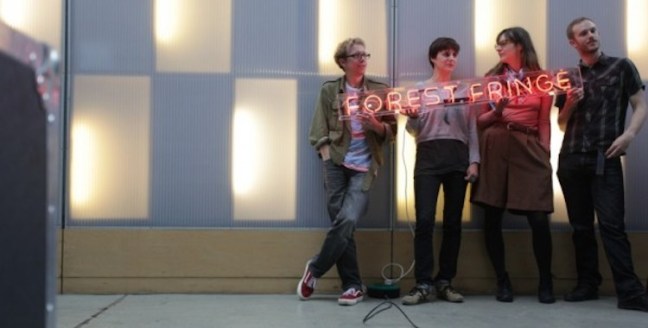
Forest Fringe’s fleeting residency at The Place is an intriguing meeting of performance practices, an inter-disciplinary experiment in curation and audience engagement. Over two nights, the organisations have co-curated a range of performances and installations that dance delicately around genre distinctions, standing at the intersection(s) between theatre, live art, contemporary dance, performance and participation. It’s both dance and not-dance.

In watching, I can only react to the bodies. I’m reminded, aptly, of the words of Forest Fringe’s Andy Field: “Theatre is a space in which we can ask questions that only our bodies can answer.” Theatre does thingswith bodies just as much as it does things with words. And the same goes for the performances I see at The Place: they do things with bodies.

In Gillie Kleiman’s DANCE CLASS: a performance, our bodies as audience members form the material of the piece. After being ushered into the room in darkness, we close our eyes and are invited to inhabit our own bodies more fully – specifically, our hands: their connection with the floor, their movement, the bones and muscles that form them. It feels part meditation, part piss-take, Kleiman delivering everything with her tongue more or less firmly in her cheek. Despite the lightly mocking flavour, though, it’s oddly relaxing. I find my fingers tingling as they press down into the ground or flex in the air.

Before long, though, our bodies are found to be wanting. Leading her strange, ever-shifting dance class, Kleiman is brisk and occasionally bullying, leaving no doubt as to who is in control here. She teaches; we try, we fail. Reflexes are too slow, muscles reluctant to mimic the moves demonstrated by Kleiman. Whose bodies are really important in this space? the piece begins to ask between laughs. Whose show is this? Lightly, playfully, tongue still planted in cheek, Kleiman prods at interaction and its often obscured power dynamics. Our bodies might be the raw material, but who in the end is sculpting them?

If 27 is also (intermittently) playful, that’s where its similarities with DANCE CLASS: a performance end. The relationship with dance in Peter McMaster’s tender, bruising show is less explicit, but nonetheless it is overwhelmingly about bodies – bodies that live and love and die. This is all wrapped up in a structure that resembles nothing so much as ritual, from its slowly burning incense sticks to its ceremonial scatterings of ash. The two bodies on stage in front of us – McMaster’s and fellow performer Nick Anderson’s – are here, visibly and thrillingly alive, in order to think together about death.

The title refers to the “27 club”, that morbidly romanticised group of musicians – including Jim Morrison, Janis Joplin, Jimi Hendrix, Brian Jones, Kurt Cobain and Amy Winehouse – who all died at the same age McMaster is now coming to terms with. Death, then, is a constant and in some ways alluring presence in 27, but so too is life in all its joy and heartbreak and messiness. In contrast to all the unthinkingly mythologising responses to those “live-fast-die-young” icons, 27 is complex and personal and humane, acknowledging the appeal of the myth while fusing it to material that is at once autobiographical and outward looking.

It’s the second time I’ve seen the show and the same moments knock the breath out of me all over again. They all have to do, I realise, not with design or words or even fully articulable ideas, but with just these two performing bodies. There’s a sequence in which McMaster struggles again and again to escape from Anderson’s half-embracing, half-smothering grasp, straining out of his arms over and over, all underscored by the devastating soundtrack of Janis Joplin’s “Cry Baby”. Both men are naked by now – a nakedness that feels as gentle and generous as it is exposing – and their bare skin is lightly coated in the ash that clouds the air. Death hangs on them, yet they are so so alive.

Later, in one of the most powerfully simple gestures I’ve seen on a stage, the two men fall repeatedly into one another, stepping gradually further and further apart as they do so. Shoulder smacks into chest; arms grip arms. You can almost see the bruises blossoming in real time. There’s such trust in it, a trust and cooperation tinged at the same time with pain and a kind of heavy, unspoken grief. Each time their bodies slam into one another, it’s all I can do not to gasp with the bruising beauty of it. Bodies, at once sturdy and fragile, embracing, catching, supporting one another.

To talk about embodiment is often to be misleading. We aren’t brains in jars, we’re blood and muscle and sinew, and so everything is embodied – from sitting and reading a book to me typing these words, the smooth surface of the keys sliding under my fingertips. Still, there’s something about live performance that almost imperceptibly changes how we see and understand both the bodies on stage and, perhaps, our own, whether in our seats or up on our feet. And time and again, as at Forest Fringe, I find myself surprised.

Photo: Jemima Yong.