Closer, Donmar Warehouse

DWcloser2015JP-03922-Edit-600x400

Originally written for Exeunt.

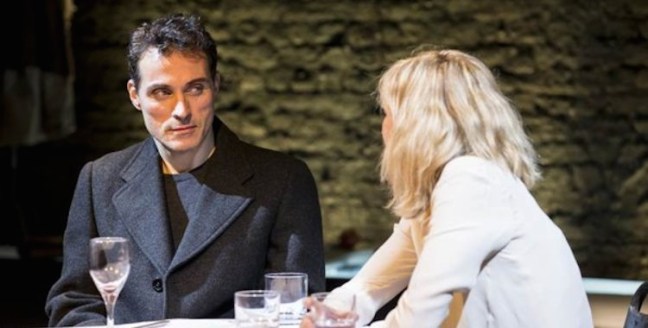
There’s one image that jumps out from the text of Closer, punching me right in the same organ it describes. Surprisingly, it comes from the mouth not of posturing writer Dan but of the dermatologist with whom he repeatedly crosses swords in pursuit of passion. “Have you ever seen a human heart?” Rufus Sewell’s Larry snarls, furiously eyeballing his rival across his desk. “It’s like a fist wrapped in blood.”  

This is love as Patrick Marber paints it: fierce, aggressive, violent. And selfish. Watching the four characters circle around and collide with one another, I’m oddly reminded of the ruthless corporate matadors in Mike Bartlett’s play Bull. Here, though, the prize is not a job but the equally fragile promise of love, of companionship, of The One.

But romcom happy endings are in short supply here. People are as likely to fall out of love as in it, twisting the knife on their way out of the door. First, Dan falls in love with Alice, a self-styled free spirit just returned from the States. After chewing Alice up and spitting her life out into a novel, Dan switches his affections to photographer Anna. Spurning him, Anna meets and dates Larry before finding her way to Dan’s bed all the same. Partners change and change again, cheating and lying along the way. Swap, hurt, repeat.

Again, like in Bull, appearances are important. Manipulation, Marber realises, is all about surface; it’s not what you do, but how you do it. Oliver Chris’s whining, wheedling Dan exemplifies this, clothing his selfishness and malice in a mixture of charm and feebleness. For all that he seems a bit wet, you get the impression that beneath his Hugh Grant-style dithering he possesses a steely, unforgiving determination to get what he wants. If Larry’s ugly side sits closer to the surface in Sewell’s grimly compelling performance, he’s no less schooled in getting his own way, while Nancy Carroll’s deceptively warm Anna has the talent of making manipulation look blameless. It’s just a shame that this version lets Rachel Redford’s Alice off the hook, going heavy on her vulnerability and light on the ways in which she uses her sexuality and air of mystery to her advantage.

Meanwhile, the world these characters move within – unfussily though not quite seamlessly shifted from the late nineties to the present day – is an all-encompassing advert for instant gratification. Love and sex might as well be consumer products, picked off the shelf or, as in the famous chatroom scene, ordered on the internet. It’s astonishing now how prescient Marber’s 1997, pre-Tinder play looks, anticipating the ways in which romance was to become packaged and monetised in the digital age.

This is a thread that David Leveaux’s production pulls on to the point of unravelling. Bunny Christie’s swish set, with its column of coloured lights and its large screen periodically adorned with Finn Ross’s busy video projections, all feels a bit much. The point may be that we live in an information saturated, image obsessed world, but by straining to apply this gloss the production paints over some of the raw brutality that makes the play lodge uncomfortably like a bur in the mind. What lingers is the very human capacity to hurt and be hurt.

The title, of course, is just another of the play’s cruel deceptions. No one really gets close to anyone else here; these characters are as allergic to intimacy as they are addicted to it, only able to reveal one part of themselves by concealing something else. Secrets are divulged not out of love but as a way of scoring points. Sex is as much a weapon as it is an act of passion. And even the most seemingly naive of the quartet turns out to be an elaborate fiction of her own making.

More than sex or lies or cruelty, though, Closer is obsessed with death, a fixation that is brought to the fore here. Marber’s is a play that fully subscribes to fellow playwright Simon Stephens’s description of dramatic action’s driving force: “Because we know we die, we want stuff”. The memorial stones that Christie keeps fixed to the back wall throughout are as stark a reminder of mortality as the obituaries that Dan writes for a living, a threat that sends each of the characters seeking that promised greener grass. In the spectre of death, though, perhaps lies the play’s one minuscule scrap of optimism. Because we know we die, we want stuff, but we also stubbornly keep searching and keep hoping. For all the characters’ brutality, maybe next time they’ll get it right.

Theatre as Argument

590x494.fitandcrop

There’s a lot to be said about Nicholas Hytner’s tenure at the National Theatre. Hell, there are probably people already working on books about it. There’s the introduction of NT Live and the use of new spaces in and around the building; there’s the commercial success of shows such as War Horse, One Man, Two Guvnors and The Curious Incident of the Dog in the Night-Time; there’s the NT’s growing association with, for want of a better word, more “experimental” companies creating work beyond its walls. And then there’s the uncomfortable, lingering question about the imbalance of male to female artists, something I’ve written about in the past, which forms part of a much broader set of issues around representation and accessibility – issues of vital importance for a theatre that purports to be “national”.

As fascinated as I am by the narratives that establish themselves around certain theatre institutions and artistic directors, though, I don’t want to go into any of that right now. But what I was struck by yet again reading Michael Billington‘s assessment of the Hytner era (as well as the astonishing statement that the lack of Sheridan revivals is a bigger problem than the under-representation of female writers) was the extent to which theatres in this country are judged by their ability to address “the big issues of the day”. Billington approvingly frames Hytner’s NT as a “forum for debate”, a triumphant statement that is quickly followed by a staggeringly generalised blow to the political credentials of all continental European theatre (“I don’t know of any comparable theatre on the continent […] that feels a need to tackle the crises affecting our daily lives”).

This interests me not just because I instinctively disagree with the narrowness of Billington’s definition of political theatre (more on that later), though I do. It also brings me back to what turned out to be the central question of my MA thesis, which looked at the cultural narratives that have been built around another major, frequently mythologised British theatre: the Royal Court. In that thesis, I suggested that a certain understanding of theatre’s purpose in the world as a (text-based) platform for discussion and debate intersects interestingly with the traditional purpose of theatre criticism, an institution whose history in this country is inextricably tied up, for better or worse, with that of journalism. I wrote that “there is a generally accepted model of writing about new plays, in which the playtext itself is the principal focus of attention and the success of the production rests on the perceived effectiveness of the play’s central ‘argument'”.

I won’t rehearse that whole argument (yes, argument – the irony) again here; it’s in the thesis, for anyone who’s interested, and I’m very open to challenges to my reasoning, as these are ideas that will most likely come into play again later in my PhD. To return to Billington’s article, though, there are two points which are particularly revealing of the role he sees for theatre and for himself as a critic. First is the scepticism and light disdain implicit in his overview of “Hytner’s attempt to redefine what we mean by ‘theatre’,” an endeavour that Billington sums up with the vague, yet also vaguely dismissive, verdict of “artistically mixed”. This is then followed by the observation that two of Hytner’s biggest hits – War Horse and Curious Incident – “have been shows in which text is only one feature of a total theatrical experience”. Erm, doesn’t that essentially describe all theatre?

Secondly, Billington paints the NT’s relationship to the world around it as akin to that of the newspaper or news broadcaster. We have, in line with this idea of the theatre’s role, had shows “about” (I’ll only stop linking to that blog when it stops being relevant) a range of appropriately newsworthy topics: the Iraq War, the financial crisis, climate change, immigration, press corruption. And it’s doubly telling that Billington’s NT article was published by the Guardian just days after Charlotte Higgins‘ long, sprawling piece about political theatre, which departs from some strikingly similar assumptions: “Unlike music, dance and visual art it is theatre’s wordiness – the fact that it likes to place people in a room and have them talk, and disagree – that makes it the artform most closely allied to politics”. Higgins’ article also demonstrates that familiar formulation of theatre as a civic space, pointing back to Athens (where else?) and the central place of theatre in the city-state.

This all points to something that I feel is quite particular to the framing of theatre and its role in the UK. Tom Cornford (who, as an aside, was one of the people I was talking to recently about exactly the kind of narrative-forming that Billington’s article represents) has suggested that most mainstream critics in this country go into shows with “an unthinking expectation of pseudo-realistic form”. I think there’s some truth in that, certainly for some critics, but I’d suggest that it’s even more common for us (and, hands up, I include myself in this) to have the expectation that a piece of theatre will say something; that, explicitly or implicitly, it will articulate some sort of argument, which we will then assess. That’s what we’ve been taught to expect. Those are the terms on which critical discourse has established itself. And if theatre has an argument, that argument is usually expected to spring from the text. It both starts and ends with words.

But performance itself troubles that neat equation. In my current research, which is roughly speaking attempting to theorise the theatre text (emphasis on attempting), I keep encountering this idea of something in performance that is “in excess” of any text. Michael Goldman in On Drama: Boundaries of Genre, Borders of Self, for example, writes that “in drama one finds inevitably an element in excess of what can be semiotically extracted – something that is also neither irrelevant to nor […] completely independent of the text”. Benjamin Bennett, meanwhile, uses the example of Beckett’s famously precise plays in All Theater is Revolutionary Theater to demonstrate that the meaning of the text and the performance – no matter how detailed and prescriptive the former – can never be identical. Unpredictable human bodies and the evident materiality of the stage will always get in the way of that possibility.

This is a much knottier idea than the above paragraph acknowledges, but I won’t attempt to untangle it here. Instead, a pair of examples serve to begin prodding at and problematising that idea of theatre as argument. In my MA thesis, I turned to Katie Mitchell’s production of Ten Billion at the Royal Court in 2012 – an intriguing example, because it’s about as argument-like as theatre gets. After I’d finished writing that thesis, of course, Ten Billion was followed up by 2071, another show about climate change that was seemingly resolute in its lack of theatricality. Billington unsurprisingly offered high praise to both, but I find the terms of that praise really fascinating.

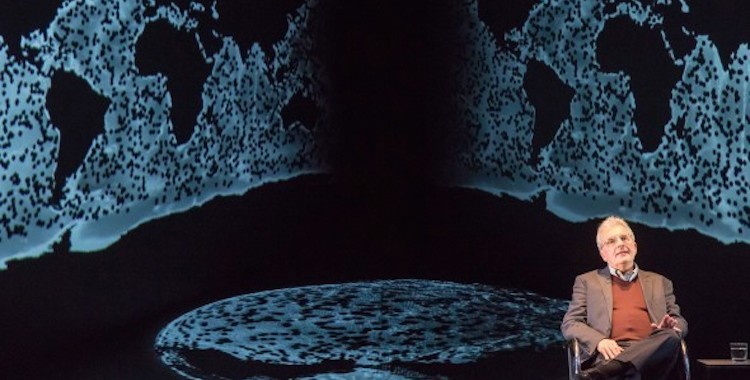
Both Ten Billion and 2071 are explicitly “about” climate change, delivered by scientists (Stephen Emmott and Chris Ripley respectively) and more or less following the format of the lecture. Writing about both shows, Billington acknowledges their questionable relation to theatre in almost identical terms. Reviewing Ten Billion, he writes: “Some will argue this is a lecture, not theatre. But the distinction seems to me nonsensical”. In his review of 2071, he repeats the same point with slightly more force: “Some will argue that this is not really theatre. But the idea that theatre should be exclusively reserved for fiction has been knocked on the head by a surge of documentary dramas and verbatim plays”. He adds, in relation to Ten Billion, that “Theatre is whatever we want it to be and gains immeasurably from engaging with momentous political, social or scientific issues”.

While this tells us a lot about what Billington believes theatre’s purpose to be, there’s little in either review that refers to the theatricality of these events. Most of the space is taken up by relaying and assessing the persuasiveness of the argument in question, with only fleeting mentions of its staging. Going by Billington’s analysis, the facts, figures and conclusions provided by Emmott and Rapley might as well be read in a book. Concluding his five-star review of 2071, Billington surmises that “if we look to theatre to increase our awareness of the human condition” – which he clearly does – “the evening succeeds on all counts”. But in what distinct ways does it succeed (or fail, depending on your opinion) as theatre?

Two other views, each more focused on what Ten Billion and 2071 gain or lose as theatre rather than as pure argument, offer an interesting comparison. Contrary to Billington’s entirely text-focused assessment of Ten Billion, Matt Trueman suggests that Katie Mitchell’s production complicates and problematises Emmott’s argument. “What we watch is 100% lecture and 100% theatre at the same time, and it absolutely thrives on the duality,” Trueman argues. He points to the tension between the naturalism of the staging – a form usually associated with illusion – and the hard facts of Emmott’s lecture, concluding that “we are set in a mode of doubting” as an audience. This built-in doubt, according to Trueman, mirrors the doubt we so often express in response to climate change, burying our heads in the sand when confronted with the stark reality of our planet’s plight. Mitchell, in this view, is doing something extremely sophisticated with her staging; “anyone that dismisses Ten Billion as ‘just a lecture’ is ‘just plain wrong'”.

Stewart Pringle‘s review of 2071 similarly concludes that theatre transforms the argument in question, but to wildly differing effect. Despite acknowledging that what Rapley tells us is all important information and that its presence in the Royal Court Downstairs “is itself a vital political statement”, Pringle argues that placing this lecture in a theatre context “has fatally undermined its utility as anything else”. He writes: “2071 brings something unusual to theatre (the monotonal tedium of a lecture), but theatre has brought next to nothing to it”. Having seen 2071 (I missed Ten Billion), I can agree that it was decidedly untheatrical in its presentation and distinctly dull as a result. As Pringle points out, it’s even less theatrical than most lectures.

In different ways, then, the status of Ten Billion and 2071 as theatre undermines – or at least alters – the arguments they present. The unpredictable “excess” of performance complicates matters. In the case of Ten Billion – if we go with Trueman’s opinion, anyway – the conflicting vocabularies of lecture and stage naturalism create a certain tension in our reception of Emmott’s evidence that would not be present were we reading it from the pages of a book. 2071, meanwhile, suffers from its framing as theatre, making a poor case for the necessity of its place on a stage at the same time as thrusting the theatre’s awkward materiality between audience and content. By actually putting arguments on stage, free from the clothing of narrative and metaphor, these two shows (intentionally or not) point up some of the difficulties around that prevalent “theatre as argument” view.

I want to turn again to a point I made in my MA thesis which feels relevant here: “If theatre – rather than any other public forum – is a uniquely powerful civic space, then surely there must be something it offers in its gathering of bodies that cannot be found in text alone; something in its very theatricality which challenges a critical interpretation of it as the straightforward thesis of the playwright.”

In other words, if there is something uniquely political about theatre – the nation’s “debating chamber”, as Higgins’ article has it – then it has to go beyond text. That’s not necessarily to say that only theatrical form, rather than content, can be political, as that can lead to similarly unthinking reproductions of an existing and supposedly radical set of assumptions. (I’m thinking here about certain formal gestures that were genuinely experimental and radical when they first emerged but have since congealed into their own set of tropes.) But if we limit our understanding of argument or politics to the text, then we ignore something vital about what theatre is and what it can do. After all, as Billington himself puts it, “Theatre is whatever we want it to be”.

P.S. As well as itching an intellectual scratch, this blog is something of a tentative experiment in how to connect my academic research with my thinking and writing elsewhere. In practice, of course, my dual existences often overlap, and everything tends to get thrown into a soupy (if frantically colour-coded) mixture of thoughts. But I’m interested in how to share more of my research process with a wider audience, so let me know what aspects of my PhD research you want to hear more about (“none of them” being a completely acceptable answer to that question).

Phoenix from the flames

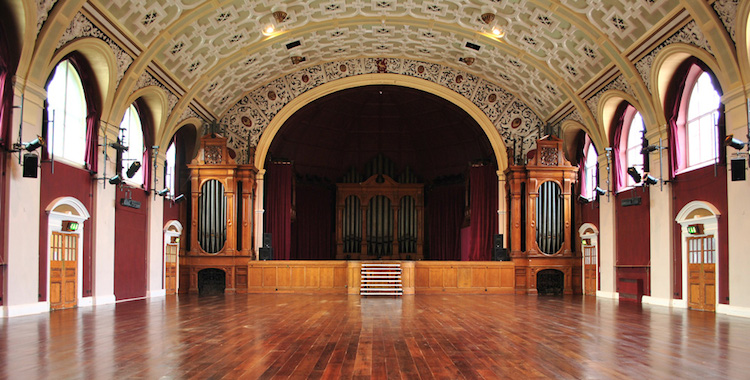
Grand-Hall-and-Foyer-035

It’s quite astonishing how much of your heart you can give to a place.

A memory. I’m holding hands with a stranger on a sunny afternoon in East London. We’re here as part of Walking:Holding, Rosana Cade’s generous and thoughtful walking tour through the city. As we look up at a church, its spire sharply outlined against the blue sky, this particular stranger tells me that this is where she’d like to get married. Then she turns to me. Where would I like to get married? I still don’t really know how I feel about marriage; as an idea, it feels abstract and far away. But somehow, in spite of my ambivalence, I find myself offering an answer. Battersea Arts Centre.

Perhaps it’s because part of me already feels wedded to BAC. Of all the theatres in London, it’s probably the one I spend most time at. There’s not just one thing I love about it. I love the work and the ethos and the people and the beautiful, beautiful building. I love its history as an old town hall and the way it’s built right into the community. And I love all the memories, big and small, that have seeped into its brick and stone over the years.

It’s where friends of mine have been convinced for the very first time that theatre might be something they could love. It’s where I first saw Forced Entertainment and Caroline Horton and Kate Tempest and Little Bulb. It’s the theatre in London where I’ve always felt most at home, whether visiting for a show, a cup of coffee or an evening in the bar. At times, I wanted to become an artist just so I could run away and hide in the bowels of that building for a few weeks.

Yesterday afternoon, a fire broke out at BAC. The extent of the damage still seems to be unclear, but it started in the roof of the Grand Hall, which has been destroyed. When I first saw the news on Twitter, I couldn’t quite breathe. It took about an hour of scrolling through updates, messages of support and devastating images (along with an awful lot of swearing) for it to really sink in.

I feel sure that BAC will carry on, but not alone. If the organisation means even half as much to you as it does to me, please give what you can, be it a fiver, a tenner, or simply a helping hand. Here’s a link to donate, and no doubt in the next few days it will start to become clear how all of us can pitch in to get BAC up and running again.

If there’s any scrap of a silver lining to take from this, it’s how much our theatre and arts spaces really matter, as powerfully demonstrated by the steady outpouring of love and support since yesterday afternoon. And we can continue to offer that support. BAC has captured so many of our imaginations; let’s reimagine its future together.

The Coming Storm

10959678_897667936943924_3104337664882259698_n-600x400

Originally written for Exeunt.

Droplets of rain hammering the floor, at first light and then deafening.

Clouds of mist rising, obscuring, shifting the landscape.

Bodies finding shelter in one another.

Enter the storm.

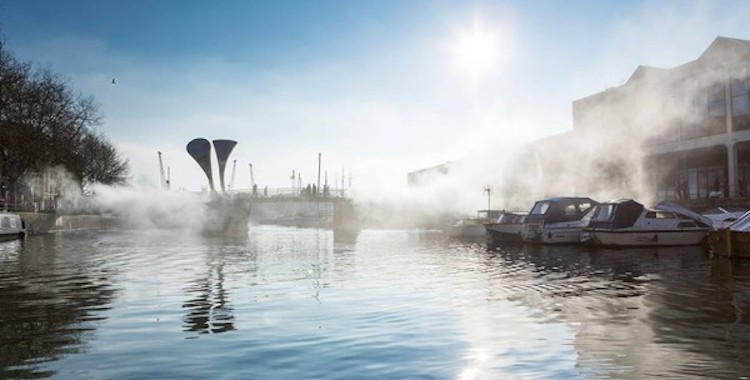
It begins on Pero’s Bridge, a slender strip of metal suspended over the water at Bristol’s harbourside. At intervals, Fujiko Nakaya’s fog sculpture envelops the bridge and the surrounding water, billowing in whichever direction the wind catches it. From a distance, figures hover insubstantially, as though walking on clouds; stepping across feels like a small act of trust, as the mist blurs the view ahead.

Mostly it’s an interruption in the architecture of the city, an instance of surprising, unexpected public art. Passersby pause to take photographs, while others linger in the fog that clings to hair and clothes. It’s a novelty, an attraction, an invitation.

Placed in the context of Bristol’s status as European Green Capital, however, it acquires more significance. Considered alongside the potentially catastrophic changes occurring to our climate, Fog Bridge feels anticipatory, its delicate beauty foreboding. It might be fog today, but what will it be tomorrow?

This is just the calm before the storm.

Teenagers are often seen as something of a gathering storm themselves, anarchically brewing trouble. But Canadian company Mammalian Diving Reflex ask us to see them – and ourselves – differently. On Saturday evening, following a coach journey into the dark, a group of teens lead us on a sprawling and chaotic roam through streets and fields, powerless to do anything but follow them. The usual power dynamic is flipped.

As with Fog Bridge, there’s a sense of event. Our large group of walkers swells through the streets, observed by curious figures through parted curtains. It’s an unruly disruption, but not of the kind we’re used to associating with urban teenagers. Nightwalks with Teenagers is rebellious but gentle, riotous yet tender. We are instructed to hold hands, to hug one another, to gather close. From the beginning, a fragile sense of community is created.

This begins to break apart as we trundle through suburban streets and along treacherously muddy paths. The audience is large and spread out, inhibiting the intimacy that the event seems to be reaching for. It’s full of individual moments, though, that are both striking and bizarre: a panoramic view of the city laid out below us, lights twinkling in the gloom; an invitation to dance; a rowdily improvised bit of storytelling; and, perhaps strangest of all, a detour to a house with a Mini Cheddar-loving pet duck. Our adolescent guides revel in it all, taking up the reins with glee.

If this generation are the coming storm, then bring on the downpour. 

Rumblings of thunder shudder through True West, Lone Twin’s unique take on and around Sam Shepard’s domestic play. Gregg Whelan and Gary Winters are Shepard’s pair of brothers, locked in bitter and often absurd rivalry, while a chorus sat around a table stand in for all the other roles. It’s small and low-fi, but somehow oddly explosive.

There are gloriously naff sound-effects, showers of multi-coloured confetti, overflowing cans of beer and a brilliant moment with a golf club and an ill-fated toaster. For all the stuff, though, it feels more like a story about stories: how we tell them, who tells them, how our culture has encouraged us to shape them. Delivered deadpan by Whelan and Winters, lines from the “authentic” Western one brother is writing leap out in all their ridiculous beauty.

In their programme note, Lone Twin describe True West as a “cover version” of Shepard’s play. It’s an appealing way of describing their relationship with the text, which is as irreverent as it is admiring, riffing playfully on Shepard’s lines. It’s also apt, as music – country pop specifically – threads its way through the piece. It’s there throughout the festival too, right down to the listening recommended in the programmes, offering space to think and feel and explore. The curious are welcome here.

Music also throbs throughout O, as lightning repeatedly threatens to strike. There’s a suspended feeling of discomfort all the way through Project O’s show, leaving us braced for the storm to break even as we laugh in our seats. Performers Alexandrina Hemsley and Jamila Johnson-Small ask us to watch and to notice ourselves watching, unsettling us with the anticipation of how our responses might be turned back around. It’s our collective gaze that really feels under the spotlight.

The two Os most in question here seem to be objectification and othering, both of which are obliquely referenced by Hemsley and Johnson-Small’s alternately playful and aggressive dance moves, which in turn reflect the reductive presentation of black female bodies in popular culture. It’s often funny, very funny, but laughs escape only uncertainly and in the knowledge that the whole thing could flip on its head any moment. With small gestures, the mood suddenly changes; the weather shifts.

The storm clouds converge on Saturday night over The Old Fire Station. A tornado of pulsing music and flashing lights rages at the heart of the festival, along with showers of glitter and the occasional crash of thunder. 

The festival party, framed as an immersive club night, sits alongside Fog Bridge as one of the most public-facing aspects of this year’s In Between Time. Festival regulars are joined by hundreds of fabulously dressed party-goers, decked out as clouds, lightning bolts, poncho-clad stormchasers. It’s a real event. Peppering partying with art, it shows how this kind of work can connect with a wider local audience, who seem to be largely absent from the festival’s daytime offerings.

How can that invitation be extended even further?

After the storm, the flood. There’s a post-apocalyptic flavour to Jo Hellier’s Flood Plans, which hints at an all too probable weather-ravaged future. Rather than narrative, though, it relies on feeling and evocation. Submerged in darkness, we’re pelted with deluges of sound: rain falling, waves crashing, wind howling. The volume rises and rises until the noise rattles through each last sinew of the body.

The aural onslaughts are punctuated with moments of human fragility, survival and connection. Isolated on the bare, black stage, Hellier and fellow performer Yas Clarke appear brittle and insubstantial, voices whistling weakly into the void. It is those bodies, though, that offer the most memorable and affecting moments. Hellier and Clarke first struggle and then embrace, their limbs surprising us with all the new ways two people can fit around one another. Against the force of storm and flood, they wrap themselves together.

There’s a different sense of aftermath to Ishimwa’s Niyizi, which takes on the character of searching. History, culture and identity both intertwine and clash, as the performance tests out ways of reconciling self and heritage. Through the separation of video and live performance, Ishimwa suggests both dislocation and simultaneity, his movements in the room frequently mirroring those on the screen, but always just the tiniest fraction of a second out of time.

In the first filmed dance sequence, blown up on the big screen at the back of the stage, Ishimwa sits in profile, twisting and turning. He writhes as if in an effort to crawl out of his own skin, a skin that he then – like the series of dresses he wears – gets more and more comfortable in. There’s a sense of struggle to it, but also of ritual and finally of celebration.

Peter McMaster’s 27 is ritual too, at times morbid and at times joyous. It offers two visions of the post-storm world: one of death and one of hope. These two forces tussle throughout the performance, as the experience of getting older and finding one’s place in the world veers between destructive despair and a liberating gesture of letting go.

The title is a reference both to McMaster’s age and the age at which Jim Morrison, Janis Joplin, Jimi Hendrix, Brian Jones, Kurt Cobain and Amy Winehouse – whose music weaves its way through the show – all died. Death, whether in the skeleton bodysuits that McMaster and Nick Anderson open the show wearing or the ash that is scattered ceremonially over floor and bodies, is thus a constant presence.

While there are moments when it stutters, the whole piece is so open and tender that it begs forgiveness for any flaws. If anything, the flaws feel necessary, colouring its heart-aching sincerity and vulnerability. Stripped bare, both literally and figuratively, McMaster and Anderson share with us their bruises. And as in Flood Plans, bodies interact in unexpected ways, resisting, embracing, leaning against and catching one another.

There is a storm coming, no doubt about it. But perhaps the response, as 27 begins to intimate, lies in the connections we are able to forge.

Photo: Max McClure.

Finding The Words

©Richard Davenport 2012. London UK. Chris Goode Publicity Images

Originally written for Exeunt and the Bruntwood Prize for Playwriting.

I’m sat on the edge of my bed, postponing the moment when I need to leave for work, staring with feverish intensity at the glowing rectangle of my phone. In these stolen minutes at the start of the day I’m reading every last word I can about Three Kingdoms, the new production at the Lyric Hammersmith that has sparked a long, sprawling critical debate. My own words are also out there, somewhere in the tangle of online criticism, and for the first time since releasing my opinions into the virtual world I feel as though I’m part of a real conversation.

I walk out of This Is How We Die at Ovalhouse with ears ringing and skin prickling. I don’t have the words to describe what I just experienced, and I’m not sure I ever will, but the search for them feels like the most important thing in the world in this moment. On the bus home, hands still shaking a little, I type an inadequate, sweary tweet on my phone and wonder if a piece of theatre will ever leave me this exhilarated again.

It’s late. Far too late. Far too late – or rather too early – to still be tapping away at my laptop with a full day’s work waiting for me in the morning. But I just can’t stop. I’m writing about Chris Goode’s The Forest and the Field, a gently mind-stretching essay of a show, and wrestling at the same time with some of the really big, essential questions about this art form that I love. What is theatre for? Why do we make it or see it? What really happens when we all gather in a room together to experience a show?

Who knew theatre could be so epic, so thrilling, so sexy? It takes about five minutes for The TEAM to steal my heart and squeeze it tight with the gorgeous, adrenaline-fuelled juggernaut that is Mission Drift, their warp-speed race through 400 years of American capitalism. Later, catching my breath and staring at a blank Word document, my only thought is: how do I possibly write something even a fraction as exciting as what I just saw?

These experiences are rare. In a lifetime of faithful theatregoing, they appear as sporadic, fleeting flashes on an otherwise calm horizon. It’s the promise of such moments, however, that keeps me going through all the boredom and mediocrity. It keeps me hopeful and it keeps me questioning, two vital qualities for anyone who wants to write about theatre with any kind of passion. No matter how many awful shows I’ve seen, the words constantly on my lips – like a much less glamorous version of Liza Minnelli in Cabaret – are “maybe this time”.

I find it hard to think of any one piece of theatre that set me on a course towards criticism. Writing about theatre, like so many other things in life, was essentially a bit of an accident. As an undergraduate student I kind of liked theatre, I kind of liked writing and I kind of wanted to start a blog – it wasn’t any more interesting or exciting than the serendipitous alchemy of those three things combined. Instead, what I find easier to pin down are the shows that subsequently kept me on that strange, coincidental path.

When first writing about Three Kingdoms and still feeling a little dazed, I suggested that “we need new ways of seeing, of experiencing, of expressing”. This is what the best theatre provokes. There’s a line that I love in Irving Wardle’s book Theatre Criticism: “In the midst of an earthquake, the critic is no better a guide than anyone else”. It’s a slightly embarrassing thought for critics, but an inspiring one for theatre-makers. They trace new contours in the world; we scrabble around to redraw the map.

Or, to put it another way, the theatre that I most want to write about is the theatre I don’t yet have the words for.