Bull, Young Vic

“Yes, they say nothing comes easy. But if it was easy, it wouldn’t feel this good.”

Bull6web

Forget Patrick Bateman. Housing developer Redrow has reinvented the cold-blooded, psychopathic city hotshot for a rapidly gentrifying London. Their latest advert (scrapped after a hail of online criticism and ridicule) promises the ambitious City boy everything he could want – including one of Redrow’s perfectly proportioned luxury apartments – provided he’s happy to crush the competition. “Make the impossible possible,” the male (naturally) voiceover seductively intones. “To rise and rise.”

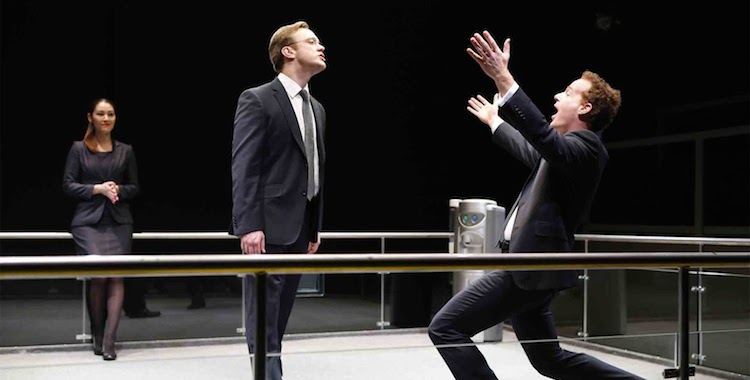
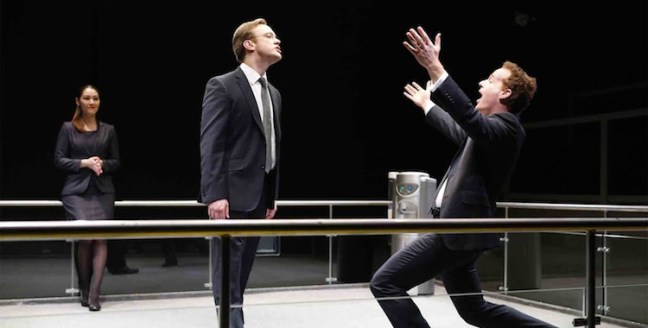
Redrow’s ad is the sleek, aspirational face of a cutthroat post-credit crunch Britain. Mike Bartlett‘s short but bracing play Bull is its grubby underside. The title is a reference to the bullfight: an intricate and bloody display of power. Bartlett’s corporate equivalent, staged by Clare Lizzimore and Soutra Gilmour in a spare, claustrophobic arena formation, is the desperate grapple for jobs in the face of downsizing. Three employees are waiting to meet the boss; only two can return to their desks. It’s the Hunger Games of office politics.

Bleak as it sounds, Bartlett’s play is viciously entertaining, just in the grim, guilty way that The Apprentice is entertaining. Tony, Isobel and Thomas circle one another like animals, sniffing for weaknesses and lashing out with language. The insults are often bitterly funny (“stop shuffling around like an autistic penguin,” Isobel snaps at Thomas), but Bull‘s laughs are just as likely to sour in the mouth. It’s hilarious until it’s not.

As the nervous one-upmanship escalates, it soon becomes clear which employee is primed for the chop. Thomas, ridiculed for everything from his suit to his receding hairline, is the weak one in the pack, and the Darwinian logic of the workplace – like that of the schoolyard – dictates that he has to be brought down. It’s playground bullying, pure and simple, but with higher stakes and sharper uniforms.

In the Young Vic’s taut production, this all unfolds in swift but tense fashion. Lizzimore directs the cruel back-and-forth at a machine-gun rattle, occasionally punctuating the rapid dialogue with precise, painful silences. The verbal equivalent of a staring contest, it’s all about who snaps first. That person is, inevitably, Sam Troughton’s tightly wound, helplessly jittering Thomas, a man on the verge of eruption. As his opponents, Adam Jones and Eleanor Matsuura are hard and shiny as glass, the former doing battle with superficial mateyness, the latter with icy manipulation.

Gilmour’s minimal, antiseptic design is as deliberately impersonal and unspecific as Bartlett’s office setting. The precise nature of the job these three individuals are fighting for doesn’t really matter; what’s important is the lengths they’re prepared to go to. As an audience, meanwhile, we are positioned uncomfortably close to the action, with those standing at the front placed near enough to see the perspiration. We could intervene, but crucially we don’t.

Anything and everything – family, trauma, physical appearance – can be used as a weapon in the armoury of advancement. Make no mistake, Bartlett’s characters are fucking brutal. But worst of all, it’s not just a simple tale of office bullying. Bull is a whole ideology in microcosm; a waking nightmare of ruthless individualism. Scrap that – it’s beyond individualism. This is a world in which, like the hero of Redrow’s video, you need to be “more than individual”.

Bartlett’s play depicts this world in nasty, close-up detail, but the savagery is only ever presented. In a reversal of usual dramatic logic, there is no twist; the inevitable simply ensues, swiftly and excruciatingly. Formally, the production – like the master matadors it places centre stage – doesn’t put a foot wrong. But in its calculated perfection, in its vicious portrayal of a game it leaves unchallenged, it’s both enraging and devastating.

The corporate dystopia of Bull represents the real “aspiration nation”. And those who do rise and rise will find at their feet not the world, as Redrow promises, but the crumpled bodies of the countless Thomases who have to be crushed on the way up. That’s the choice: heel poised to trample those below, or face down by the water cooler.

Well fuck that.

Photo: Carol Rosegg.

Destruction and Renewal

manuel-harlan

Originally written for Exeunt.

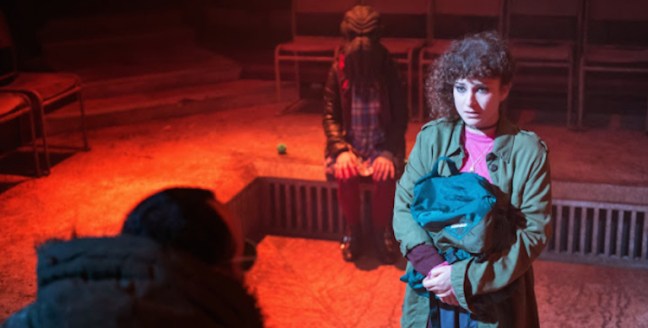
A cacophony of voices drowning each other out. A pulverised culture retelling its stories. An ear-splitting scream of sound. A beautiful howl of despair. A giant subterranean drain. A devastating downpour of blood. Oddly, sounds and images of destruction dominate a year that has been characterised – theatrically if not otherwise – by reinvigoration and renewal. Often the most thrilling theatre I’ve happened to experience has also been the bleakest in its take on where we are right now.

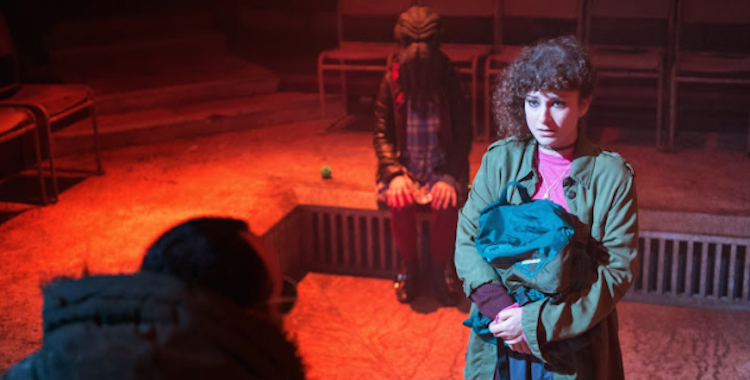
Pomona, with its stark diagnosis that “everything bad is real”, epitomises this strand of shows. Alistair McDowall’s Escher staircase of a play was exhilarating, it was intelligent, and it was pitch black in its outlook on the modern world. Sending a violent jolt through the Orange Tree Theatre, it dazzled with both its ambition and its swirling mind-fuck of a plot, tangling up fiction and reality in a way that was at once disorientating and unsettlingly familiar. Here was a dystopia of a distinctly uncanny flavour.

The dark undertones of Pomona echoed a mood that had already established its hold on the year’s theatre. In The Body of an American – an early highlight of my theatregoing year at the Gate – the devastation was found in faraway warzones and much closer to home. Alice Birch’s blistering Revolt. She said. Revolt again. ripped up both patriarchy and the rulebook, suggesting flawed and angry responses to a broken world. And two parts of the great “Chris Trilogy” (completed by Chris Thorpe’s knotty Confirmation), the beautifully furious Men in the Cities by Chris Goode and Chris Brett Bailey’s mind-blowing, eardrum-destroying This Is How We Die, offered two different but equally excoriating critiques of late capitalism.

Then there’s master of bleakness Beckett, whose swirling, cyclical monologue Not I – most famously performed by the late great Billie Whitelaw – was given a mesmerising (and astonishingly speedy) new rendition by Lisa Dwan at the Royal Court at the beginning of the year.

While much of the new work I saw in the last 12 months was unsurprisingly shadowed by dismal visions of the world, the attitude also stretched into some of the year’s best revivals. Ivo van Hove’s production of A View From The Bridge scratched decades of dust and school assignments off Arthur Miller’s 20th-century classic, transforming it into a muscle-clenchingly tense tragedy, Jan Versweyveld’s black and grey design matching the gloom of its dramatic atmosphere. Katie Mitchell’s version of The Cherry Orchard – paired with a scrape-your-jaw-off-the-floor gorgeous design by Vicki Mortimer – was exquisite in its quickening decay. And two Ibsen productions at the Barbican – Thomas Ostermeier’s An Enemy of the People and Simon Stone’s The Wild Duck – wrenched the playwright’s work devastatingly into the 21st-century.

Another of 2014′s great revivals was Our Town at the Almeida, in a US-imported production from David Cromer. It arrived billed as a bold reimagining, but much of what made it work was – apart from the stunning final reveal – determinedly ordinary. Thornton Wilder’s characters appeared to us as unremarkable yet remarkably real, making their everyday sufferings all the more heartbreaking. There was a similar sort of quality to Robert Holman’s Jonah and Otto, a play that made a quiet art out of conversation. Both productions gently asked us to pay attention.

Other shows demanded the attention of their audiences rather more forcefully. Dmitry Krymov’s Opus No 7, visiting the Barbican as part of this year’s LIFT, had me from the first of its giddying procession of images. The same director’s wonky take on A Midsummer Night’s Dream was perhaps not as beautiful to look at, but just as enchanting, capturing something of the strange alchemy of theatre. In the National Theatre’s newly reopened Dorfman (i.e. the theatre formerly known as the Cottesloe), meanwhile, glittering new musical Here Lies Love relentlessly swept me along with it even in its naffest moments. Most recently – and in spite of its flaws – the dazzling to look at Golem made me understand all the fuss around 1927′s wittily precise animation.

One of the aesthetic offspring of 1927 is Kill the Beast, a company who marry visual detail with grotesque narrative flair. This year their latest show, He Had Hairy Hands, had me roaring along twice to its tale of werewolves, cops and arse-kicking monster hunters, as well as offering hands down the best gag of the Edinburgh Fringe. It’s also up there grappling for most jofyul theatregoing experience of the year, in a close-fought tussle with Secret Theatre’s A Series of Increasingly Impossible Acts. The latter just about snags the prize, stealing my heart over and over with its flailing hopefulness – and its joy-drenched rendition of “Proud Mary”.

A Series of Increasingly Impossible Acts is also, in part, about how we tell stories. There were lots of stories about stories this year. Coincidentally running at the same time, Mr Burns at the Almeida imagined how our culture might be passed on after a future apocalypse, while Ellen McDougall’s production of Idomeneus playfully traced the same process of narration and mutation over previous centuries. The dangers of narrative appropriation were disturbingly outlined in Tim Crouch’s multi-layered, head-scratching Adler & Gibb; in Wot? No Fish!!, storytelling was a simple source of charm and love.

Along with all the theatre that filled me with joy, plenty that I saw this year also left me filled with tears. Spine‘s double-whammy of the personally and politically emotive forced those tears to spill over, as did James “the vacuum cleaner” Leadbitter’s overwhelmingly intimate Mental. After the small but exquisite experience of Greg Wohead’s headphone piece Hurtling, I walked the streets of Edinburgh with heart thumping and eyes stinging; ditto Hug, Verity Standen’s “immersive choral sound bath” (there’s really no better way to describe it than she does). Then there was Kim Noble’s brash but bruised You’re Not Alone, which took a long time to relinquish its haunting hold.

Elsewhere it was the lulz that stayed with me. That giant ballpond and the IRL memes in Teh Internet is Serious Business. The smart silliness of funny women Sh!t Theatre and Figs in Wigs, turning their humour to Big Pharma and online narcissism respectively. The funny-sad sequence of cheesy song lyrics in RashDash’s Oh, I Can’t Be Bothered. The sheer joy of watching Jamie Wood and Tom Lyall clown around with what appeared to be an alien haggis in Chris Goode’s remounted Longwave. Chris Thorpe and Jon Spooner being punk rockers in their pants in Am I Dead Yet? (the most funny-yet-thoughtful show you’re likely to see about kicking the bucket).

With the requisite predictability of the end-of-year round-up, no survey of 2014′s theatre can seem to get away without a mention of King Charles III. Mike Bartlett’s concept – a future history play in iambic pentameter – sounded like a potential disaster, but turned out to be a slice of genius. It was thoughtful, it was witty, and it was as much about our theatrical heritage as it was about the traditions of monarchy. And to top it all off, it was designed by the brilliant Tom Scutt, who once again came up with one of the designs of the year with his dizzying visual concept for the Nuffield Theatre’s excellent revival of A Number.

Now from the big to the small. I’m still unapologetically head over heels for one of the most intimate shows I saw this year: Andy Field and Ira Brand’s fragile, heart-fluttering put your sweet hand in mine. Seating its audience in almost uncomfortable proximity to one another and to the two performers, it gently prodded at closeness and distance and love in all its different forms. Just gorgeous.

Also small – in staging if not in ideas – was Barrel Organ’s debut show Nothing. This series of intertwined monologues, performed in a newly improvised order each night with no set or props, was just as bleak in its way as some of the year’s more explicitly dark offerings. For a confused 20-something, it also terrifyingly captured the anger, uncertainty and disconnection of a whole generation. It feels like one of the real discoveries of the year, as does Chewing the Fat, Selina Thompson’s glittery but difficult look at weight and body image.

After opening with destruction, I want to end on a slightly more hopeful note. For all the darkness and devastation, few pieces of theatre have stayed with me quite so insistently as Duncan Macmillan’s not-quite-monologue Every Brilliant Thing, which was indeed brilliant. For once, cliched claims of “it’ll make you laugh, it’ll make you laugh” were entirely justified, as I giggled and sobbed – sometimes at the same time – throughout.

Quite how a show about suicidal depression can be so life-affirming I’m still trying to fathom. It probably has a lot to do with the irresistible warmth of performer Jonny Donahoe, without whom I suspect it wouldn’t be half as good. But it also plays, as many of the best shows of the year have done, to theatre’s strengths: the unpredictability of live performance, the thrill of proximity, the possibilities of all being together, now, in the same space. Here’s to more of the same in 2015.

Photo: Manuel Harlan.
Nicobobinus

Screen-Shot-2014-12-22-at-15.02.59-600x393

Originally written for Exeunt.

’Tis the season for baddies, goodies, magic, adventure, fantasy, mythical creatures, song and dance … DumbWise and Red Ladder’s musical version of Terry Jones’s children’s book has them all, minus a chorus of “he’s behind you” but plus a whole host of narrative ingredients. Few family Christmas shows are quite so packed with plot.

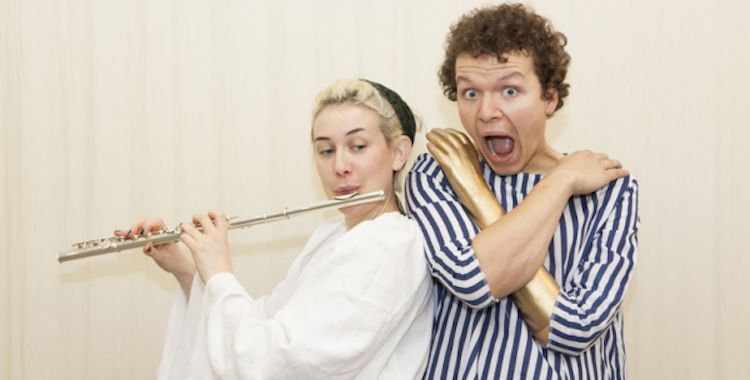
Our mouthful of a hero is Nicobobinus (Nico for short), a Venetian boy who can do anything – or at least so his best mate Rosie believes. These abilities are put to the test when his arm is turned to gold and he and Rosie set out on a quest to find the cure, following in the good old tradition of the magical voyage. Jones’s plot, though, is a whole lot more meandering than your average fairytale. Along the way, Nico and Rosie encounter pirates, gardeners, monks, kings, dragons, magical ships, moving mountains – the list goes on.

As in the fictional worlds of Roald Dahl, the adults we encounter are invariably greedy and vile, while it’s the kids who have the last laugh. From kidnapping pirates to hypocritical monks, everyone wants their share of Nicobobinus’s valuable limb, the covetous glint in their eyes rivalling its golden glimmer. These baddies are most definitely bad, but in a fashion that seems much closer to our own greed-led world than to that of cackling, crackpot villains. Think fantasy meets social critique.

The counterpoint to these grasping grown-ups is found in the friendship between Nicobobinus and Rosie, which is equal, guileless and loyal – and, of course, wins out in the end. Rosie (full of playful energy in Samantha Sutherland’s performance) is a gift of a female protagonist, given most of the guts and nearly all of the mischief in the pairing, while Nico (an equally enthusiastic Max Runham) cheerfully bounds headlong into the madcap adventures she sets them off on. And brilliantly, they both rescue each other; there are no damsels in distress here.

There is, however, almost every other fairytale element you can think of. While the page might be able to accommodate these many jostling characters, on stage it all feels a bit too busy, with a relentless “and then, and then” quality to the racing narrative. The songs inserted by Eilidh deBonnaire and performed by the cast of actor musicians, though often charming, only add to the cacophony.

If John Ward’s adaptation hesitates to bring out the scissors, it does capture something of the storybook in bringing Jones’s novel to the stage. The show is at its best when fiddling with the mechanics of storytelling, its performers doubling up as both narrators and characters. At moments, it is deliciously playful in its sly acknowledgement of the narrative tradition it slots into, offering plenty of arch looks to the audience and implicitly asking even the youngest of its viewers to think about how we share stories.

Kate Unwin’s simple but flexible set, meanwhile, contributes to the improvisatory feel of the performance, quickly being adapted – like the ragtag contents of a dressing-up box – for new uses in the twisting and turning narrative. Little is added, though, by ropey projections, which offer visual elaboration of what could more effectively be left to the imagination. Again, DumbWise and Red Ladder’s show suffers from a surfeit. And it’s here, despite its gleeful subversion of many tired tropes, that Nicobobinus might learn something from the fairytales it borrows from: sometimes simple is best.

Photo: Ellie Kurttz.

Divorced, Beheaded, Died

wolf-hall-news-reviews-mainimage-537x291

Originally written for the RSC’s Bring Up the Bodies programme.

Henry VIII remains one of the most compelling leaders that history has to offer us. The charismatic monarch can lay many claims to fame: his break with the authority of the Pope and the Catholic Church, the Dissolution of the Monasteries, his passion for eating and drinking. But what Henry VIII is perhaps best remembered for is his fickle matrimonial record and the six women he infamously wed.

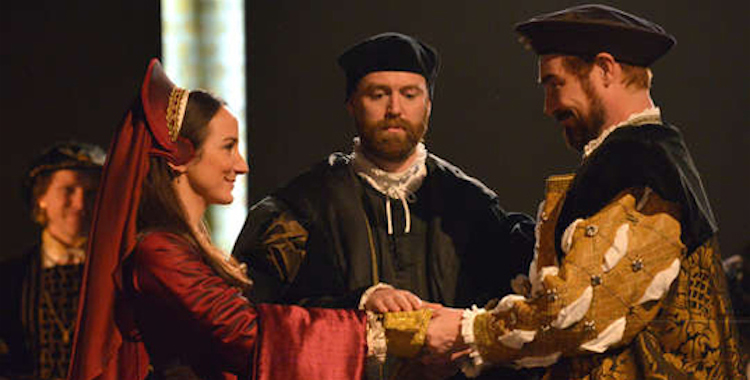
Hilary Mantel’s Man Booker Prize-winning novels Wolf Hall and Bring Up the Bodies only feature the first three of the King’s unlucky spouses: divorced, beheaded, died, as the mnemonic reminds us. According to actors Lucy Briers, Lydia Leonard and Leah Brotherhead, playing Katherine of Aragon, Anne Boleyn and Jane Seymour respectively, you would struggle to find three more different women. “If Anne was someone who was going to make a grand entrance through the front door, Jane would be the person who came through the back door,” says Brotherhead, contrasting the fatal arrogance of Henry’s second wife with the quiet diffidence of his third. Continuing the metaphor, Briers suggests that Katherine, a politically powerful Queen who was unwaveringly assured of the divine right of her position, “would be flown in by helicopter”. Whatever their differences, however, there is little doubt that these were three extraordinary historical figures.

Katherine of Aragon, often relegated to a prologue in the juicy tale of Anne Boleyn’s rise and downfall, was a fascinating figure in her own right. Born into royalty and power, the daughter of Queen Isabella I of Castile and King Ferdinand II of Aragon was assured of her place in the world and knew from a young age that she was destined to be Queen of England – first as the wife of Henry VIII’s short-lived older brother Arthur and then as Henry’s first spouse. “She has absolutely no qualms about her status and her predestined right to be where she is,” explains Briers, “which is why what happens to her is so horrific to her and so appalling. It not only breaks laws of the land and religious laws, but it’s her entire moral framework being taken down in front of her.”

Katherine was married to Henry for over 20 years – more than the King’s five subsequent marriages put together. Their union was put to an end by a combination of Katherine’s inability to offer Henry the male heir he so desperately desired and the King’s infatuation with Anne Boleyn. Anne, meanwhile, has had her fair share of infamy in the history books – “every lurid accusation in Europe was flung at her,” Leonard points out – making her a “gift of a role”. This was a woman who held Henry’s interest for six years before he was finally able to marry her, but who was executed within three years of their wedding day. “It’s interesting watching her lose control,” says Leonard. “She starts off very much in control, and as that grip loosens it’s sort of like watching a car crash.”

Jane Seymour, in contrast to her two predecessors, is careful, quiet and modest. “I’ve not quite made up my mind on how ambitious Jane is or how much of a pawn she is,” Brotherhead reflects on her role. “A lot of historians made the decision that because Jane was so quiet and mild-mannered, she was meek and a bit stupid, whereas Hilary doesn’t think that’s what Jane’s like at all; she’s quiet and incredibly observant.”

It would be easy to assume, given the precariousness of their position, that the three Queens were helpless to their fates. Briers, Leonard and Brotherhead, however, suggest that each of these women was powerful in her way. “Katherine is incredibly manipulative in terms of power playing because she was born into it and she understands it,” says Briers. “She understands the theatricality of power.” This political power is lacking in Anne, but Leonard points out that “she has an incredible power over Henry”. Jane, meanwhile, has a “quiet kind of power about her” according to Brotherhead: “she is incredibly brave, but in a very stoic and subdued way”.

In the process of getting to know the three Queens, each of the actors has forged a powerful connection with their role. “They’re amazing women, all three of them, and you can really connect with all of their decisions,” says Brotherhead. Faced with the pressure of not only doing justice to Mantel’s novels, but also capturing three of the most famous women in history, all three actors are dealing with this in different ways. “I feel more of a responsibility to the person I’m playing than anybody else,” says Briers. “I want to honour her.” Leonard, on the other hand, feels the weight of the books more keenly: “I personally feel more of a commitment to playing Hilary Mantel’s Anne Boleyn, because that’s what’s going to make this whole story turn.”

Mantel herself has been involved throughout the rehearsal process, offering extensive character notes and answering detailed questions about the period. “It was like having somebody from Tudor times time travelling to our rehearsal room,” Leonard laughs, acknowledging the meticulous research that went into the novels and has provided much of the material for shaping these three roles. “Rarely do you work with such amazing novels,” she adds. “Everything’s there.”

The Tudor era, as Mantel has demonstrated, is itself the source of continued fascination. Discussing the time in which these historical narratives are set, all three actors suggest that it is the heightened, theatrical quality of this period that captures the imagination. “There’s so much game playing and with so much at stake,” says Brotherhead. “I think that’s what’s so intriguing.” Considering Anne’s fate, Leonard adds that “the way that sex and politics are so totally linked together is juicy and powerful”. For Briers, however, and clearly for Mantel as well, it is the personalities who hold the greatest interest.

“It’s these people who just create ripples of change and revolutions, good or bad, that people want to keep re-examining.”

Photo: Keith Pattison.

The Dragon, Southwark Playhouse

The-Dragon-Tangram-Theatre-@-Southwark-Playhouse-c-Alex-Brenner

Ever wondered what happens in the fairytale after the dragon has been slain and everyone has been handed their “happily ever after”? In Yevgeny Schwartz’s 1943 satirical play The Dragon – and now in Tangram Theatre Company’s clowning adaptation – villains aren’t quite so easily deposed and the victims of oppression aren’t all that eager to be rescued. Sound at all familiar?

Knight errant Lancelot is in the business of slaying dragons. In one of those many once upon a times, he stumbles into a small town which is – surprise surprise – being terrorised by one of the fire breathing monsters he specialises in. What he finds, however, is something he’s never encountered before: a population who are willing – no, positively delighted – to be ruled over by this reptilian tyrant. After all, they reason, what other monsters might move in if this one were to leave?

But our scantily clad, testosterone dripping hero isn’t one to back down. After promptly falling for resident damsel in distress Elsa (fairytale archetypes, our storytellers warn us at the outset, are all present and correct), who is due to be sacrificed to Dragon the next day, Lancelot insists on a fight to the death. What he fails to anticipate is that, in the absence of one source of power, others will be all too quick to grab the reins.

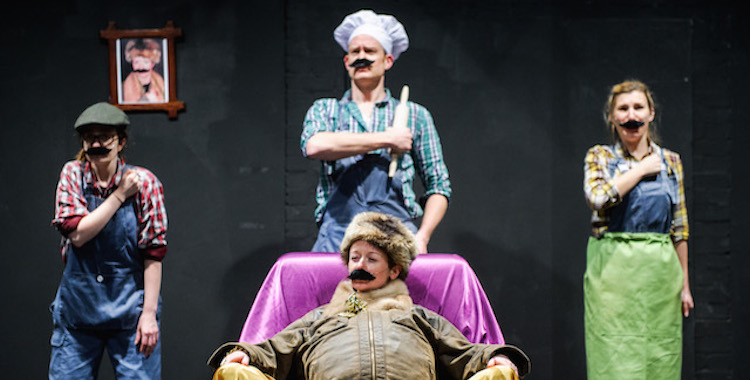
This is cartoonish satire, and Tangram revel in it. There’s cross-dressing, dodgy costumes and caricatures galore, perhaps the most entertaining coming in the form of Hannah Boyde’s nutty, power-hungry mayor, who swiftly steps into the void left by Dragon. James Rowland’s Lancelot is half-lad, half-superhero, leaping boyishly around the stage, while Justin Butcher makes a brilliantly hammy villain. And it’s all presided over by talking cat narrator Rob Witcomb, archly acknowledging that this is all really just fooling around on a stage.

Warming everyone up for panto (all together now: “he’s behind you!”), The Dragon has more than a healthy dose of silliness, villainy and audience participation. But smuggled in under the cover of cape-wearing knights, fake moustaches and bad Russian accents is a much more serious point – or rather points. Because the targets of Tangram’s satire are multiple, extending the show’s aim well beyond Schwartz’s original attack on Stalinist totalitarianism. Now we have extra shots at political apathy and the current political landscape, culminating in an earnest but awkward plea for us all to get off our arses and actually do something.

The problem is, Tangram’s sudden call to action just doesn’t feel earned. There’s definitely something to be said for sneaking in political content, clothing provocative points in madcap comedy and forcing laughs that sour in the mouth. But in its climactic political speech, as Elsa (Jo Hartland) berates us all for failing to act, The Dragon becomes more hectoring than galvanising. This sequence breaks abruptly with everything that precedes and follows it – and not in a useful way. Its jolt is that of a clunky gear change rather than of a sudden, rousing revelation.

That old adage of “show, don’t tell” shouldn’t always necessarily be obeyed. I’ve encountered plenty of theatre that makes an art out of telling. But here, the telling is just too explicit, dissolving a previously fun yet thoughtful piece of theatre into pure (if passionate) lecture. It would be enough to present us with the narrative’s cheerfully submissive townspeople, who already accusingly reflect back our own complacencies. My sympathies are absolutely with the message, but I don’t go to the theatre to be told outright what to think. There’s a line, if a fine and blurry one, between that which energises and that which preaches. Make me want to act, don’t tell me to act.

Photo: Alex Brenner.