Longwave, Shoreditch Town Hall

3673-600x400

Originally written for Exeunt.

For the last week, in just about every snatched moment I can grasp hold of, I’ve had my head buried in the first book of Karl Ove Knausgaard’s Min Kamp series. It’s utterly gripping, with the intensity that I forget novels can possess until I tumble headlong into another one. And yet it’s so ordinary. Described as an “autobiographical novel”, it charts little more than the day to day fluctuations of its author’s life, from youth through adolescence to adulthood, all in meticulous, banal detail. Whole pages are devoted to cleaning or eating; one long section laboriously outlines a clumsy teenage attempt to smuggle beer into a party.

In a very different way, Chris Goode and Company’s Longwave achieves a similar sort of compelling simplicity. As with the Knausgaard, it’s hard to pin down just what captures the attention and refuses to let it go. The show, first made in 2006 and now reincarnated for a new tour, consists of two men, one radio and no dialogue. There are plenty of words, but none of them are shared between the pair of living, breathing characters. Instead, they belong to the inanimate (or perhaps not as inanimate as the men might hope) third protagonist, humming away menacingly in the corner of the room.

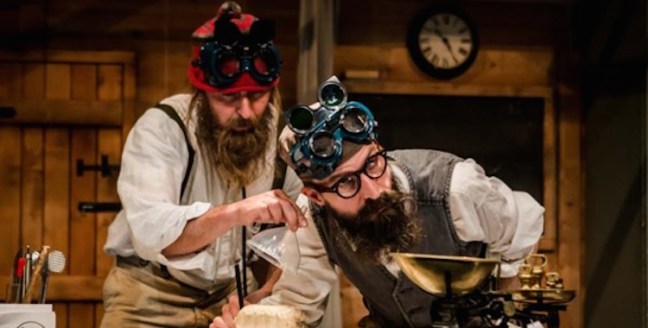
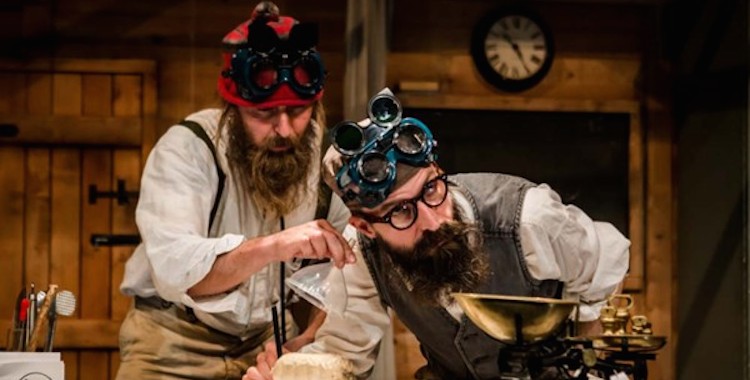
For reasons never made clear, the two men are away from home, holed up together in a shed in what appears to be a cruelly inhospitable landscape. We first see them in bright yellow protective gear, retrieving and proceeding to conduct experiments on an unresponsive, haggis-shaped object. We are instantly in the realm of physical comedy, with performers Jamie Wood and Tom Lyall making a sublimely silly double act. They poke, they prod, they throw. The subject of their experiment is rolled, jabbed, sent into the air with a mini parachute – Lyall even tentatively licks it. The lab isn’t all that different from the playground.

But Longwave is about much more than straightforward tomfoolery. As the piece goes on, we witness the regular rhythm of the men’s shared life, from the lucky dip of each evening’s tinned dinner – Lyall invariably ends up with the raw deal – to the little rituals they indulge in either side of the curtain that provides their only privacy. Lyall sketches delicate outlines of birds; Wood clumsily unfolds a massive map of the world. Both long for elsewhere.

And it’s that silent sense of longing, along with the wacky but utterly charming companionship they find in one another, that really makes the piece sing – or crackle, as the mood of the wireless dictates. As the radio takes on a life of its own and this little isolated world the pair have made for themselves begins to collapse in on itself, forcing them to either step into the unknown or stay behind, Goode and his collaborators reveal themselves to be expert manipulators of the stage’s affective technologies. We know little about these men beyond the small routines of their daily life, yet our hearts begin to crack open for them.

The whole thing is gorgeously offbeat, from the shed’s ragtag array of objects to the strange and ambiguous scenario in which the two central characters find themselves, but actually it’s the ordinariness that turns our emotional machinery. It’s the human bond, it’s the moments of hidden yearning and loss, it’s the way in which a shared routine establishes itself even in the oddest of circumstances. And it’s how even the most hackneyed and familiar of cheesy love songs can suddenly kick us full in the guts.

Pomona, Orange Tree Theatre

Pomona- Zeppo (Guy Rhys) and Keaton (Sarah Middleton)

Alistair McDowall has written an Escher staircase of a play. Or perhaps a spiral, looping around to almost but not quite the same point. Or perhaps it’s the M60 ring road at night, circling the city under the orange glow of the streetlights. Round and round.

Pomona is a nightmare. A thriller. A game. A mystery. A trip down the rabbit hole. A journey into the desert of the real.

Ollie is looking for her sister. She hopes to find her in Pomona – a desolate concrete wasteland just minutes from the centre of Manchester, a yawning void at the heart of the city. This place is also at the heart of McDowall’s tangled plot, the shadowy secret it hides offering the answer – or at least an answer – to his characters’ fearful questioning. Whether they want to see it, however, is another matter.

Layered on top of and bleeding into the real Pomona and the horrors it contains is another world, one of imagination and gameplay. Somewhere else in the city, sweetly enthusiastic nerd Charlie has found an unlikely friend in Keaton, the mysterious girl who joins in with the game of his own invention. Only the game has terrifying echoes of reality. Or is it the other way round?

Both McDowall’s writing and Ned Bennett’s adrenalin-pumped production are soaked in popular culture, further blurring the lines between fiction and reality. Indiana Jones. H. P. Lovecraft. Dungeons and Dragons. Horror movies and internet detritus. Chicken nuggets. It’s all distraction, all surface, as fleeting as the flash of the lights that flicker on and off between scenes.

This is theatre that worms its way inside the 21st-century state of mind, nestling itself amid internet memes and junk food. Pomona depicts a world where we can find out anything at the swipe of a finger. Information is endless, as one character articulates, so we have to choose. And if we choose what to know, then we also choose what not to know.

Pomona is about what we choose not to know. It is a play populated by all the things that lurk beneath: the monsters under the bed, the ghosts hiding in the shadows, and the murky, underground world that we all wilfully ignore. The dark, rising tide of urban myths. 

Everything about Bennett’s production heightens the lingering sense of unease. In designer Georgia Lowe’s sunken playing space, transforming (together with Elliot Grigg’s eerie lighting) the Orange Tree Theatre into a grimy subterranean landscape, the inhabitants of McDowall’s play scrabble around in the gutter, sucked inexorably towards the drain at its centre. There is no escape.

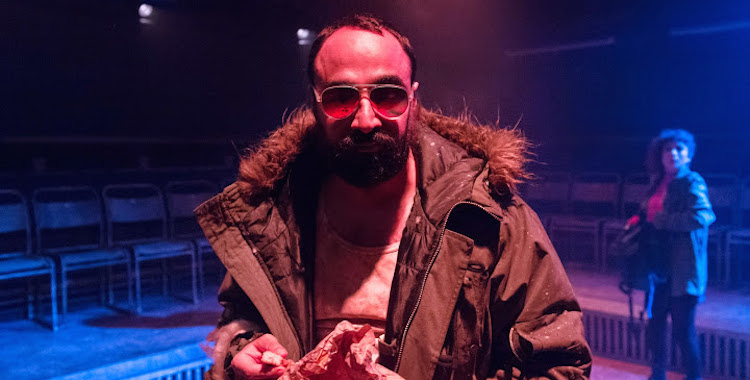
The characters, meanwhile, all have hints of the uncanny. Guy Rhys’ Zeppo, a man with an approach of studied ignorance towards the shady figures he deals with, leaps out of the show with cartoon-like detail, stealing the first scene with his lengthy, animated retelling of Raiders of the Lost Ark. Ollie, played by the shape-shifting Nadia Clifford, seems not to be what she first appears. Even endearing, innocuous Charlie, getting most of the laughs in the capable hands of Sam Swann, has a murkier aspect. And most unsettling of all is Sarah Middleton’s precise, controlled Keaton – sometime girl, sometime monster.

But the terrifying thing is not the fiction, not the squid-headed creatures from the deep. The truly monstrous side of Pomona is to be found in the ugly, urgent truth its many tentacles prod at. As Zeppo puts it, “you go deep enough, you’ll find all this stuff, the detritus of our lives, it’s all built on this foundation of pain and shit and suffering”. That foundation usually sits, festering, at the edges of our consciousness; McDowall drags it to the centre. And when we find ourselves inside the game once again, there is a queasy feeling that this is a container for the all the things we can’t quite look in the eye. We need places to dump all the nastiness, places like Pomona.

We’re back to where we began. But wait – not quite. Is this game or reality now? Where are we? Haven’t we been here before?

Round and round. Round and round.

Photo: Manuel Harlan.

A Midsummer Night’s Dream (As You Like It)

02

In Stage Fright, Animals and Other Theatrical Problems, Nicholas Ridout writes about the moments when theatre breaks down. His book investigates all those glitches – the stutter, the laugh, the unexpected interruption of a creature on stage – when the theatrical machinery temporarily halts and we see the true nature of the event unfolding before us. In Ridout’s words, “something of our relationship to labour and to leisure is felt every time the theatre undoes itself around the encounter between worker and consumer”.

Dmitry Krymov’s take on A Midsummer Night’s Dream – or more accurately, on its play within a play, Pyramus and Thisbe – looks a lot like Ridout’s thesis writ large. This is not really about love or fairies or Shakespeare; this is about theatre. Theatre in all its pretending, its failure, its illusion, its beauty, its exquisite silliness.

It is also theatre as work. It is more than just comedy that has drawn Krymov and his company to the Mechanicals in Shakespeare’s play; they also represent, as their collective title suggests, the labour that goes into stage illusion. In a programme note, Krymov says that he couldn’t see himself in either the courtly or the magical worlds of A Midsummer Night’s Dream. “I am not a fairy,” he explains, “I am a craftsman.” Theatre is not magic conjured from thin air – it is craft.

And yet …

Recently, while interviewing playwright Alistair McDowall, we talked about the idea of theatre as magic trick. We agreed that the reason this particular analogy works so well is that it suggests both the thrill of illusion and the strings that make everything work. As audience members, we at once want to see the workings – the workings that we know to be there in the background – and to be taken in by what we see before us. To contradict myself, theatre is magical, but magical in the sense of a magic trick; we know that skill and work goes into it.

As in the usual staging of the play within a play in A Midsummer Night’s Dream, Krymov’s production positions us both as the audience of Pyramus and Thisbe and as external observers of another audience: the courtiers the Mechanicals have been charged with entertaining. In this imagining they are haughty and distracted, checking messages on their smartphones and interjecting with their derision, disapproval and occasional outrage. If we see a picture of ourselves, it’s not a flattering one.

As for the players, they’re a suitably ragtag bunch, trussed up in scruffy black tie like children playing dress-up. Their set and props, meanwhile, are crudely thrown together, even down to the sawdust coated scaffold on which their audience are directed to sit. There’s no forgetting that these are labourers and that the show they (eventually) present is as much a construction as their wonky, makeshift auditorium.

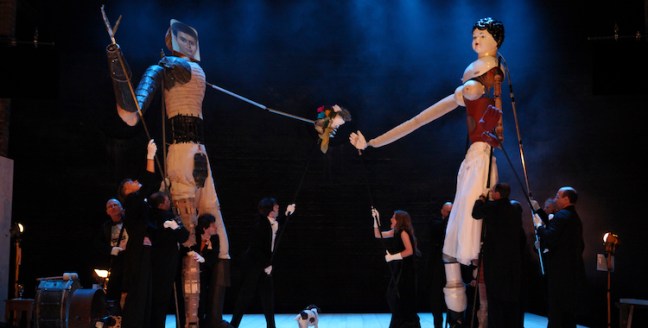
So it’s all the more extraordinary when we do, by some strange theatrical alchemy, get drawn into the tale being told. After a lengthy introduction, lightly touching on ideas of art, entertainment and intention, Krymov’s Mechanicals finally get around to the story of Pyramus and Thisbe, who take the form of two towering, mismatched puppets. Pyramus has a portrait for a head; Thisbe balances precariously on one ballet shoe and one boot. They are fragile and ridiculous – not all that different from their human operators, then, or the theatrical event itself.

At first, what charm us are the tricks. Acrobats balance and somersault; the Mechanicals’ dog – the indisputable star of the show – even turns a backflip. We are at the circus, operating in an economy of gasps and giggles, occasionally ruptured by an interjection that causes a stumble, a mistake. Then something unexpected happens. Under just the right light, with just the right musical accompaniment, there is something incredibly tender about this pair of ungainly figures, and something happens that pretty much never happens in other Dreams: we feel for these star-crossed lovers. But these moments are brittle – easily snapped.

One sequence from a long procession of images stands out. In the glow of their initial ardour, Pyramus and Thisbe dance. This is no effortless waltz; the meeting of the two puppets’ bodies is a frenetic feat of manoeuvring, requiring a large team of performers. Watching the rickety figures spin around the stage, two opposing things become simultaneously true: the moment is both beautiful and oddly moving, and at the same time conspicuous in its feverish craft. Labour and illusion at once – the magic trick.

“This is the nature of theatre,” Krymov states elsewhere in the programme, “this is how theatre is created.” Precisely.

Photo: Ellie Kurttz.

Jonah and Otto, Park Theatre

Jonah-and-Otto-by-Robert-Holman.-Peter-Egan-Otto-and-Alex-Waldmann-Jonah.-Photo-by-Jack-Sain-2-600x400

Originally written for Exeunt.

– Robert Holman’s plays are conversations.

– That’s an obvious thing to say. Aren’t all plays conversations?

– Well, yes; they’re a conversation between characters, between the artist and the audience, between sets of ideas. But in Holman’s plays you get the sense that people – often strangers – are reallytalking to one another. So often we don’t really talk to other people; we speak, but we don’t communicate. Holman’s plays, or at least the ones I’ve encountered, tend to put individuals on a journey towards genuine communication.

– And as you say, they’re usually individuals who have no pre-existing relationship, people who simply encounter one another and discover, often via antagonism, an incredible shared intimacy and honesty. At the beginning ofJonah and Otto it certainly feels like it could go somewhere else, somewhere more aggressive – there’s a definite taste of danger there – and what’s so startling is the dissolving of all that aggression into tenderness.

– It feels significant as well that the relationship in this play is between two men, two men of different ages. The play offers these men a space to be vulnerable, their toughened edges sanded down, while at the same time constantly switching the power dynamic between this ageing, lonely clergyman (Otto) and the spiky but bruised not-quite-boy-not-quite-man he runs into on the street (Jonah). Both haunted; one overwhelmed by what has passed, the other by what is ahead. And somehow, in just 24 hours, they come to truly know one another. It’s easy to feel that Holman’s characters exist in a bubble of ideas and emotions, sealed off from the world, but there’s a sort of insistent politics to the presentation of this surprising and ultimately gentle male friendship. Particularly at this moment in time, the simple foregrounding of care, of taking notice of the human beings around you, can’t help but be political.

– You talk about how gentle the relationship between the two men is, but there’s also something slightly strange about it. Not strange bad, just … odd. But odd in a compelling way.

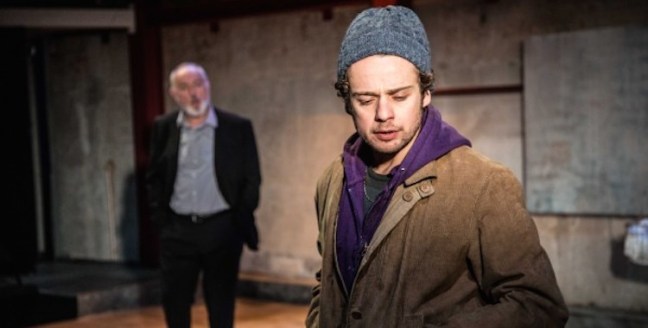
– I think that compelling quality has a lot to do with the performances. Peter Egan brings a sort of comforting gravity to Otto, an appropriately priestlike – vicar-like? – quality, with a wounded, desperate energy writhing just under that composed outer skin. But it’s Alex Waldmann as Jonah who claws at the heart, bringing both unpredictable danger and trembling anxiety to the role. The simple restlessness of his performance reveals so much about this character, the world that has shaped him and the relationship that quietly transforms him.

– But it’s just talking, isn’t it? Gentle, thoughtful, expansive talking, but talking nonetheless. Nothing really happens.

– What do you want, a fucking firework show?

– Well, maybe. Or something, something to make us all sit up and pay attention.

– “Love is paying attention”.

– Huh?

– That’s what Otto says: “love is paying attention”. And Holman asks us to do the same, doesn’t he? We have to slow down, listen, tune in. Pay attention. The whole point is that it’s quiet. No fireworks.

– Like that other one they did at the Donmar a couple of years ago, Making Noise Quietly.

– Yes. That seems to me what Holman’s plays specialise in: making noise quietly. There’s something muted and tender about them, something unobtrusive, yet they have this cumulative emotional volume. They deal in what Otto calls the “drip, drip” of life, in people and relationships, but with an injection of something else – magic, maybe?

– Well Jonah is a magician. In some ways his whole presence in the play, the way in which he interrupts the deadening loneliness of Otto’s existence, feels like a sort of conjuring act. There Otto is, feeling the bricks in the wall – grasping not for real warmth, but the residue it leaves after the sun has already disappeared – and this man materialises like a genie from a bottle.

– And isn’t theatre itself something of a magic trick? A collective conjuring, making something from nothing. It’s one of my favourite ways of thinking about performance, because it suggests that same paradox that theatre entertains. We’re desperate to know how the trick works, to see the strings, but at the same time we want to be taken in and enchanted by the magic. Tim Stark’s production begins to touch lightly on that tension, occasionally reminding us that we are experiencing this together in the space of the theatre, but it allows the two men at the centre of the show to be its simple, singular focus.

– If it is just about these two people and their encounter with one another, then couldn’t the staging be even more spare?

– I thought you wanted fireworks?

– OK, but forget that. If there’s something strange about this space, something isolated from the rest of the world, something almost quietly fantastical, then why do they need all those objects? There’s a hint of the abstract to this world, but then it’s full of these all too solid things. Are the accessories of life really important? 

– Maybe they’re a reminder, a vestige of the real world they’re escaping, the real world they have to return to. I just think that if it’s really about this relationship and about the possibility of revealing yourself more fully to a stranger than to those closest to you, then surely all we need is them. We don’t need the stuff.

– Except the apple. The apple’s good.

– That’s true. And the clothes feel important – as well as allowing for perhaps the most playfully elaborate undressing ever staged. But really, what matters is the two of them.

– Absolutely. There’s something else Otto says that struck me: “If you weren’t here, I’d have to invent you”. It’s a line that speaks so simply to our need for contact and also to our capacity for imagination. Is that why we invent things to believe in? The conversations of Holman’s plays, like that between Jonah and Otto, allow human beings to believe in one another and to speak aloud those fears, anxieties, dreams, guilts that we bury under layers of small talk and distraction. People truly come together. And the coming together has to be followed by a pulling apart; the characters are ultimately left, transformed, hopeful yet sad, to confront the world alone. What do you think?

– Hello?

– Are you still there?

Photo: Jack Sain.

The Hidden Participants

unnamed1-600x400

Originally written for Exeunt.

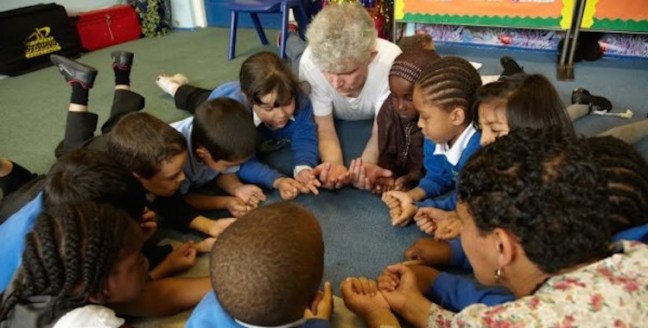
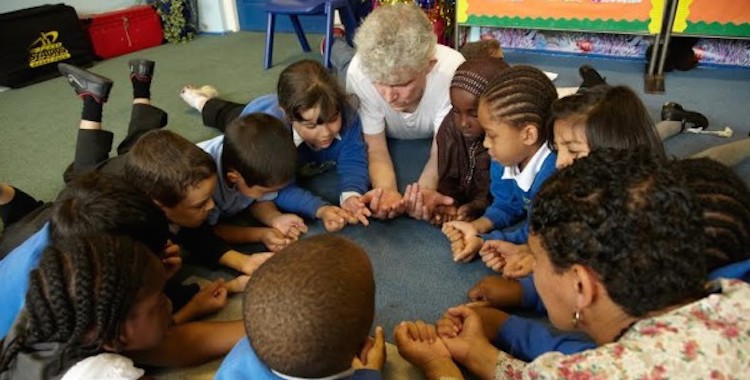
Somehow, on a rainy Monday afternoon, I find myself crawling around on the floor of a primary school classroom, pretending to be a lion. I’m taking part in Speech Bubbles, London Bubble Theatre Company’s Key Stage 1 schools programme. I came along with the intention of watching quietly from the sidelines, but the only real way to get a feel for this kind of work is to get stuck in. So over the course of an hour I’m a tree, an adventurer, a monkey, a dragon and, yes, a lion.

It might not sound all that different from games usually found in the playground, but the silliness and role-play is part of a structure that is all about storytelling and, crucially, theatre. From an educational perspective, Speech Bubbles has a proven track record of improving communication skills, helping children to listen to others and to express themselves. But at the same time, this is theatre on the most small-scale, everyday of levels, happening quietly and without fuss at schools across the city.

As arts funding continues to be threatened, the argument is regularly put forward that theatres need to embed themselves at the heart of their communities. If those buildings and companies really mean something to local people, then their audiences will fight for them. It’s an argument I agree with. But I wonder whether theatre is already built into more people’s lives than the theatre community itself recognises. Theatre isn’t just what’s on in the West End or at the Royal Court or even in tiny, alternative venues like Camden People’s Theatre. It’s happening in village halls and community centres, in parks and in schools. So why aren’t we claiming all of this work?

A while back, playwright and campaigner Fin Kennedy suggested an idea that he dubbed “I Am British Theatre”. As a way of tackling the public perception that everyone who works in theatre is a privileged, air-kissing luvvie, he proposed that ordinary theatre-makers talk about the reality of the industry in a series of blog posts or short films, stripping away the gloss of showbiz glamour. The message was to be that it’s not all champagne and red carpets.

It was a great idea in lots of ways, but it cut out a whole swathe of British theatre practice. If we’re talking numbers, the people who really represent British theatre are probably those participating in amateur dramatics groups, those watching their kids in the school show, those going along to a weekly drama class, and those crawling around pretending to be lions at 2pm on a Monday. This is how theatre really enters and animates people’s lives. It’s less showy, less exciting, less overtly theatrical, but it’s completely embedded in the rhythms of life.

To return to Speech Bubbles, this simple process of sharing, telling and acting out stories offers children the opportunity to engage in theatre as author, performer and audience member – sometimes all three at once. It also positions these roles as fluid, creating a relationship with theatre that is active and curious from the beginning. Perhaps most importantly, it tells its participants that they have stories that are worth listening to, something they might not be used to hearing in a world in which, as theatre-maker Hannah Nicklin puts it, capitalism has stolen our stories and sold them back to us.

This is just one example, but it points towards a huge, largely invisible section of this country’s complex theatre ecology. While it’s not often talked or written about, and in many cases doesn’t even carry the label “theatre” for its participants, it’s a vital entry point to the art form. And often it goes on to feed the system that it’s an unobtrusive part of, igniting the first spark that inspires those kids in primary school classrooms to continue making theatre in one form or another. The important thing to recognise is that it is all theatre.

Theatre isn’t necessarily for everyone, in the same way that football or knitting or heavy metal music isn’t necessarily for everyone. It can be easy to forget that in the zeal that surrounds audience development initiatives. Not everyone wants to be an audience member, and that’s OK. But plenty of the people who are supposedly so difficult to reach are already engaged in theatre, whether they recognise it as theatre or not. And maybe those of us so invested in doing the reaching out could try a little harder to see those hidden participants.