The Wild Duck, Barbican

01.-Belvoir-Sydney-The-Wild-Duck-Anita-Hegh-credit-Heidrun-Löhr-600x419

Originally written for Exeunt.

Confession time. Two Friday evenings in a row now I’ve seen “radical”, 21st-century takes on classic plays. These are plays by well-known writers, plays that get studied in school. And on both occasions, I had no idea what was going to happen. 

First up was David Cromer’s absorbing, stripped back version of Thornton Wilder’s Our Town, a familiar text in the States but one that is performed less frequently over here. This was followed seven days later by Belvoir Sydney’s production of The Wild Duck, in a contemporary reimagining by Simon Stone and Chris Ryan “after Henrik Ibsen”. Both – in different ways – were utterly compelling.

When approaching classics, it’s easy to forget that these were once pieces crafted to surprise and delight audiences rather than to numb them with their familiarity. It’s also easy to forget that for many theatregoers these well-worn texts are a complete novelty at the point of stepping into the auditorium. It is still possible to arrive at Hamlet not knowing the fate of the famous Dane, or to sit through A Doll’s House without queasily anticipating that final, shuddering door slam. And if Our Town and The Wild Duck are anything to go by, they’re probably all the more thrilling for the lack of foresight.

In the case of The Wild Duck, the experience of watching is set at another remove from the classic status of the text, which has essentially been adapted by Stone and Ryan. Were it not for Ibsen’s name plastered over the poster, it would be easy to come away from their production with the impression of having just seen a piece of new Australian writing – a fact likely to irk some theatregoers, but one that points to the mutable nature of theatre’s written components. Times change and texts inevitably change with them, even if not streamlined and modernised as thoroughly as Stone and Ryan’s version.

The other thing to know about this Wild Duck is that it does, in fact, contain a duck. A real, living, breathing, wing-flapping duck. Belvoir’s production opens with said creature alone on the stage, spreading its wings to a joyful chorus of cooing delight; there are few more unifying audience experiences than collectively ‘awww’-ing over an animal.

With that out of the way, the show can begin to move relentlessly towards the domestic tragedy that clouds it from the beginning, blotting out its initial, duck-shaped image of freedom and innocence. This is a dark piece in every way, from Ralph Myers’ spare, pitch black design to the shadows steadily collecting around the characters. Scenes too are bookended with deep plunges into darkness, often at the height of their dramatic action. Part of what makes the production so horribly compelling is that the svelte slices of narrative we are given seem to be hacked out of the middle of conversations, leaving just enough unsaid on either side.

The duck who so confidently opens the show belongs to the Ekdal family, a group of fragile yet content individuals who find an escape from the hostile world in the home they have made together. Simple domestic happiness has a particularly warm glow here, as Hjalmar, his wife Gina and their teenage daughter Hedvig all affectionately nag and tease one another. Their precarious bliss is soon toppled, however, by the malign truth-telling of Hjalmar’s old friend Gregars, who produces one hell of a skeleton from the Ekdals’ cupboard. The subsequent fall is swift and shattering.

Not content with the invisible fourth wall of Ibsen’s naturalistic drama, Myers’ design translates that into a perspex box inside which the increasingly devastating scenes play out, each signalled by its date and time on a screen above the performers. Stage time acquires that compressed and dizzying quality that tends to follow disaster, as scenes start to overlap and dramatic logic, like the family, splinters apart. We in the audience peer down all the while – emotionally pummelled voyeurs made witness to a family’s rapid breakdown.

Perhaps it fails to do justice to Ibsen’s original. Perhaps by sanding that play down to its exposed raw materials it loses some of the texture that had been layered on top. I don’t know. What I do know is that this version is mercilessly affecting, tuning the emotional response of its audience as expertly as it modulates the music between scenes, from ominous strings to a furious snarl of electric guitar. It’s at once heartbreaking and breathlessly exciting.

There is, of course, a different kind of satisfaction to be had from seeing a new take on a familiar text. Each time I see a fresh interpretation of a Chekhov play, for instance, new facets are revealed, new meanings endlessly unfolded. But there is a particular pleasure tied up in the frisson of not-knowing, especially when feeling is deployed with such precision and force. This, I can’t help but suspect, is how such theatre is made to be experienced. Or, as one of my companions put it after the show, “who wants to fucking read a play?”
Jay Miller

jay miller the yard publicity shots-273

Originally written for The Stage.

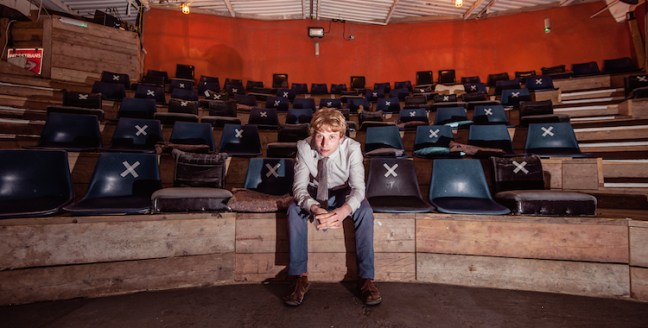
There are few directors who, when faced with a lack of opportunities in their mid twenties, would start their own theatre from scratch. Jay Miller, however, is one of them. In 2011, in the midst of recession, the young director founded a theatre in a draughty warehouse in Hackney Wick. The Yard, built on a shoestring and constructed from reclaimed and recycled materials, was something of a conjuring act: bold, improbable and summoned almost from thin air.

Miller identifies three impulses behind the founding of The Yard: boredom, frustration and anger. “The boredom was with the theatre that I was seeing. The frustration was with an industry and a world that felt quite closed. And an anger because it was the time of the economic crash and I just felt angry that I’d been sold a dream by Tony Blair and graduated and entered into a world that felt like it was a trap.” When combined, this cocktail of emotions generated a determination to “just do something”.

For Miller, doing something meant creating his own alternative. So what was it that he was failing to see elsewhere in London theatre? “I wasn’t seeing a system that developed new artists in theatre,” Miller says. “I was seeing a fringe system that sought to replicate a larger subsidised model of theatre, and when it wasn’t seeking to replicate a larger subsidised model of theatre it was replicating a commercial aspect of the West End.”

Instead, the aim of The Yard was to nurture new work and to focus on the role of space in audience experience. No black box here. Building on a personal interest in architecture and roping in a few friends, Miller designed a theatre that was part warehouse, part Greek amphitheatre.

He explains that the desire was to marry something of the booming immersive theatre scene with a self-consciously theatrical design. “We wanted a space which felt like an experience, which felt inclusive and which felt very live. But we also wanted to in some way acknowledge that it was theatre.” Miller adds that “the friction between that design and its context goes some way to releasing this energy that I was seeking to find in a space”.

Right from the start of his career, Miller knew that he wanted to run theatres, which begins to explain the genesis of The Yard. “I was always really interested in spaces and the effect of spaces on people,” he says. Despite a stint at Lecoq in Paris and a range of acting and directing experience prior to setting up The Yard, he insists that his real training has been on the job. “I didn’t know what I was doing when I started The Yard, so I’ve learned as I’ve gone.”

The Yard started out, Miller admits, with “a worrying lack of planning” and no real business model. “The biggest punt that I ever took in the moment when I thought ‘let’s make this happen’ was gambling that other people would be feeling similar things to what I was feeling, that people would be thinking similar things to what I was thinking,” he recalls.

Since then, both the space and the theatre it presents have evolved, scooping two Empty Space Awards and an Off West End Award in the process. “The programme at The Yard is organic,” says Miller, explaining that each new season has developed out of the previous one. Shows that have been presented as works in progress often return for longer runs, while themes emerge and reappear.

The latest development is a shift towards a mixed programme of four to five week runs interspersed with seasons such as this year’s NOW 14, which offer an opportunity for artists to show work in shorter bursts. The current autumn season, for instance, consists of two four week runs for These are your lives and The Hundred We Are, while submissions are for next year’s NOW 15 are opening later in the month.

Miller confesses, however, that the support The Yard is able to offer artists is restricted by the limited resources that they have to work with. While he insists on the importance of paying artists whenever possible, he adds that “we don’t have huge wads of cash to give out”. Instead, the theatre supports artists in a range of different ways, which often includes taking on a producing role.

The ultimate goal for Miller is “to achieve a real balance between opening our doors, developing and investing our resources in artists, and then putting on what we think is the best work in the UK”. It’s an ambitious set of aims, but one that Miller is confident of the need and desire for among the London theatre community.

“That punt, that gamble that other people must be thinking and feeling similar ways to me, paid off.”

Here Lies Love, National Theatre

image5-600x336

Originally written for Exeunt.

There are two revolutions currently taking place in the National’s refurbished and newly rechristened Dorfman Theatre (previously the Cottesloe). One is the peaceful People Power protest that ousted the Marcos regime in the Philippines in an astonishing four days in 1986. The other is a small revolution in mainstream musical form, as David Byrne and Fatboy Slim’s pounding, glitter-encrusted take on the life of Imelda Marcos puts audiences right at its pulsating heart.

Or perhaps revolution is too strong. More accurately, what Here Lies Love does is marry elements of immersive performance and gig-as-theatre to the more usually conventional form of the musical. What that means as an audience member – unless you choose to hide away up in the circle – is being thrust under the disco ball and into the action. Inspired by Imelda’s taste for the New York nightlife, Alex Timbers’ staging and David Korins’ design transform the Dorfman into a club of sorts, in which the dramatic action happens not in front of us but around us.

Taking place on stages, platforms and catwalks on all sides, the show breathlessly – and entirely in song – tells the story of Imelda’s rise and fall. We first see her as a simple country girl, singing dreamily about love, but within the swirl of a skirt she is winning beauty contests and setting her sights on Manila, where she meets and quickly weds rising political star Ferdinand Marcos. The whole thing is swift and relentless, its soundtrack beating out plot point after plot point in a series of murderously catchy songs. There’s no time for the attention to waver, let alone to reflect. This is a noisy, glittering juggernaut of a musical, pausing for no one.

As a result, anyone hoping for political insight or analysis of the Marcos era will inevitably be disappointed. The creative team do an impressive job of speedy storytelling, but the rhythm of the show doesn’t allow for the more intricate nuances of power and influence. There are plenty of unanswered questions, both about the Marcoses themselves and the people they ruled. Poverty, corruption and the tangled international threads woven between the Philippines, the US and a number of dubious world leaders all get mentions and little more.

But neither is Here Lies Love built for this kind of political complexity. This is a show about the excitement and intoxication of power rather than about its particular mechanisms. And in this it undoubtedly succeeds, sweeping us up in its heady, irresistible outpouring of booty-shaking joy. It’s loud, brash and occasionally downright ludicrous, but no less giddily enjoyable for any of its flaws.

Participation is key here. (For me, as it turned out, more participation than I’d bargained for.) Part of what makes Here Lies Love so intensely, well, loveable is the experience of moving and dancing with it, helplessly seduced by the glamour and the music. Like the initially adoring public of the Philippines and the leaders all over the globe who fell in love with this Asian answer to the Kennedys, we are utterly taken in, before our involvement later takes on a more uncomfortable and complicit edge.

There’s a clear parallel too between the allure of a glamorous leader and the adoration heaped on the stars of stage and screen. In the lead role, Natalie Mendoza lightly plays with this analogy, making it easy to imagine how she might inspire such hysterical levels of devotion. Much more than a charismatic stage presence and an impressive set of lungs, Mendoza also visibly toughens as the show lurches forward, transforming from the soft Rose of Tacloban to a diamond-hard politician. In her steely gaze and stiff, proud shoulders, we can begin to understand some of Imelda’s motivations.

Perhaps appropriately, however, the woman at the centre of Here Lies Loveremains somewhat elusive. This is not really about offering a new perspective on Imelda’s experience; this is about shining, seductive symbols of power more than it is about those powerful individuals themselves. Instead of seeing Imelda, we see the outfits, the smile, the endless glamour and extravagance, the continued pretence – or maybe a persistent self-delusion – that everything is done out of love. The show’s strapline declares “power to the party” and that’s exactly it. Here Lies Love invites us all to the sparkling, exhilarating, superficial party of the Marcoses rule, and guiltily we – like Imelda – don’t want the party to stop.

War Correspondents, Stratford Circus

warcorrespondents-600x386

Originally written for Exeunt.

Helen Chadwick and her team have been keen to avoid the word “musical” in talking about their latest piece. You can see why. The grim realities of war don’t really lend themselves to toe-tapping and jazz hands. Of course, the musical form is capable of much more than silliness and schmaltz, but there is an atmosphere of meticulous care that surrounds this project, right down to the precision of the language used to describe it. As the journalists at its centre know, words are important.

Six years in the making, War Correspondents is an ambitious, wide-ranging piece of work. The performance consists of 29 songs, all crafted from the words of correspondents interviewed by Chadwick and from various poems on the subject of war. Taking in numerous conflicts, its focus is war in general rather than any one war in particular, while the subject of war reporters allows an examination both of conflict itself and its impacts locally and globally. We see the devastation and casualties on the ground, as well as the headlines around the world and the lasting psychological damage on those who bear witness.

But how do you represent something as destructive, as relentless and as complex as war? War Correspondents’ answer to that question is to highlight all of those qualities, refusing to make neat sense out of the material it is working with. Rather than following an elegant narrative arc, the action rises and falls. Hostilities escalate and melt away. Attempts to impose logic are confounded by often seemingly meaningless flashes of violence and brutality. And like war – to adopt one of the phrases used by war correspondent and interviewee Chris Stephen in the post-show Q&A – it slowly bleeds out, refusing the closure of a clear, conclusive end point.

This can make it occasionally difficult to watch. With little but the central thematic thread to tie the succession of songs together, the show has a tendency to meander – aptly, of course, but in a way that challenges the concentration of viewers. Chadwick’s music, meanwhile, is as slippery as her subject matter. While beautiful and haunting, it offers little to grasp onto, with melodies that swell and dissolve like the dramatic action. This all takes place against the virtually unchanging backdrop of Miriam Nabarro’s simple yet evocative design, suggestive of the constant cycle of conflict, as are Steven Hoggett’s understated, repetitive movements.

Though they might require a certain quality of concentration, the songs themselves grapple with an impressive array of issues, from the morally uncertain position of the bystander to the consequences of what is and isn’t said. There is not just one shade of grey here but many. What we get less of is what compels these journalists to do what they do in the first place. In the post-show discussion, Stephen guiltily confesses that part of it is the thrill of being in a warzone, an aspect of this picture that it would have been interesting to see explored further.

But perhaps that is an unreasonable criticism. The point is that a piece like this can never encompass the full, terrifying scope of war – or even one single facet of it. And Chadwick and her team are well aware of that. Instead, War Correspondents offers a rich texture of overlapping voices, a cacophony that echoes the noisy, complex, multi-layered nature of war itself.

Phenomenal People

Fuel_Phenomenal_People__2__by_Sheila_Burnett_512c9ec5c6e34

Originally written for Exeunt.

We need to tell different stories. It’s a need that I’m reminded of every day, as I flick past the same narratives written and dominated by the same people, usually attempting to sell readers something in the process. Most of the stories that have been handed down to us represent only a tiny proportion of those who encounter them, or where we are represented it is in pale, limited colours – a faded watercolour version of who we really are.

Phenomenal People is, in a small but important way, attempting to shift that. The project from theatre producers Fuel is aimed at celebrating the stories of women in a world crowded with male narratives. And by women they mean all women, from Emily Davidson to your nan. It primarily exists online as a collection of profiles, uploaded by Fuel and by anyone who chooses to nominate their own phenomenal person, but it is also appearing in a series of live incarnations around the country, including at Camden People’s Theatre over the weekend.

This live version of the project sits somewhere between installation, performance and immersive experience. Immersive because designer Lizzie Clachan has created a gorgeous, enveloping indoor garden in the basement of Camden People’s Theatre, entirely transforming the space. Real grass – or so host Nic Green assures me – lines the floor, while trees appear at every turn. This lush, comforting cocoon in the middle of the city is completed by soothing lighting from Natasha Chivers and a sound design by Melanie Wilson that blends music (by women, of course) with snippets of female voices, all burbling away in the background like a distant brook.

At tables dotted around the space, visitors can browse the growing online catalogue of extraordinary women on iPad screens, as well as adding their own. And punctuating the green tranquillity are performances from a range of women, each celebrating their own phenomenal person through the medium of art. We get poetry from Malika Booker, an entertaining, breakneck Powerpoint presentation from Rachel Mars and a puppet show from Akiya Henry. Melanie Pappenheim lends her voice to the latest women to be nominated, curling her improvised sounds around their names, while Jenny Sealey joyously closes the afternoon with a signed rendition of “I Will Survive”.

In the spaces between performances, I find myself thinking about all the phenomenal women who have inspired me. The teachers who insisted that I had something to say. The incredible writers – Angela Carter, Virginia Woolf, Rebecca Solnit – who fed and continue to feed my imagination. The voices that help to define the soundtrack of my life: Patti Smith, PJ Harvey, Kate Bush, Stevie Nicks, Regina Spektor, Debbie Harry, Nina Simone. My mum. My grandmothers. My astonishing great aunt, who just jumped out of a plane aged 80 to raise money for charity. Countless others whose art and words and acts comfort and motivate me.

It is this continuing proliferation of narratives that feels more important than the live event itself. In this form, Phenomenal People is a celebration and a spur, allowing us to toast the women who have been nominated so far and offering fuel (pardon the pun) for visitors to go away and celebrate the women who have inspired them. As an event it’s not perfect – the digital and sound elements don’t feel as smoothly integrated into the whole as they might be, and some performances are more fully formed than others – but as a project it is intensely hopeful and galvanising. And I challenge anyone to find a better way of ending the week than attempting to sign and dance along to “I Will Survive” with a room full of generous, talented and helplessly laughing women.

Nominate your own phenomenal person at www.phenomenalpeople.org.uk.