Edinburgh 2014

6063489676_ac7fbb4508_b (2)

To save inundating this site with new posts, I’ve collected below links to all of the many pieces of writing I’ve produced over the last month at the Edinburgh Fringe. Happy reading!

Fest:

Radical Stories (feature)
The Initiate
The World Mouse Plague
Unfaithful
Notoriously Yours
My Uncle’s Shoes
My Luxurious 50 Square Feet Life
Dear Mister Kaiser
Prelude to a Number
Red Riding Hood
Great Artists Steal
Guess Who: Meinzeye or Cold Corner?
Somebody I Used to Know
Mush and Me
The God Box: A Daughter’s Story
Conflict in Court
Land of Smiles
Symphony
Domestic Labour: A Study in Love
The Future for Beginners
The Eradication of Schizophrenia in Western Lapland
Jamaica Farewell
#MyWay
Early Doors
The Time of Our Lies: The Life and Times of Howard Zinn
The Ruby Dolls: Fabulous Creatures
Janis Joplin: Full Tilt
On the Upside Down of the World
Crazy Glue
Watching You (feature)

Exeunt:

True Brits
Every Brilliant Thing
Sister
Guinea Pigs on Trial
The Hive
Are You Lonesome Tonight?
Mmm Hmmm/Hug
Show Off
Return to the Voice
I Promise You Sex and Violence
Forest Fringe: You Must Sing (group article)
A Series of Increasingly Impossible Acts (group review)
More Fringe Things (group article)
Men in the Cities (group review)
Fringe Things (group article)

WhatsOnStage:

Edinburgh Fringe highlights
Beats North
Pioneer
Lungs
merry christmas, Ms Meadows
Wingman
Standby for Tape Back-Up
Kim Noble: You’re Not Alone
Our Teacher’s a Troll
No Guts, No Heart, No Glory
Blind Hamlet
Edinburgh Fringe Diary #3
Lippy
Hiraeth
Sirens
Silk Road
Freak
Dead to Me
Edinburgh Fringe Diary #2
Broke
He Had Hairy Hands
Spine
Chewing the Fat
Britannia Waves the Rules
Play Dough
Edinburgh Fringe Diary #1
The Fair Intellectual Club
Confirmation

Blog:

SmallWar
Light

Photo: Laura Suarez.

Light, Pleasance Dome

Theatre-Ad-Infinitum-Light-c-Alex-Brenner-please-credit-_DSC4592-dimmer-dresses

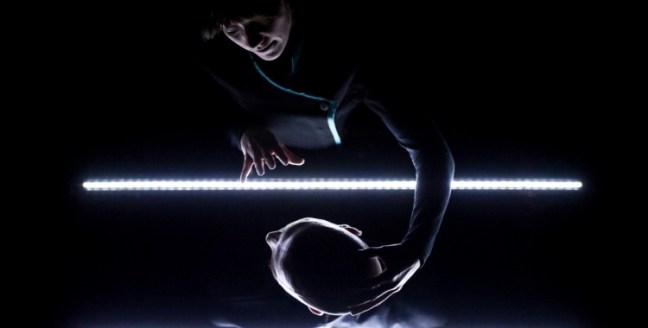
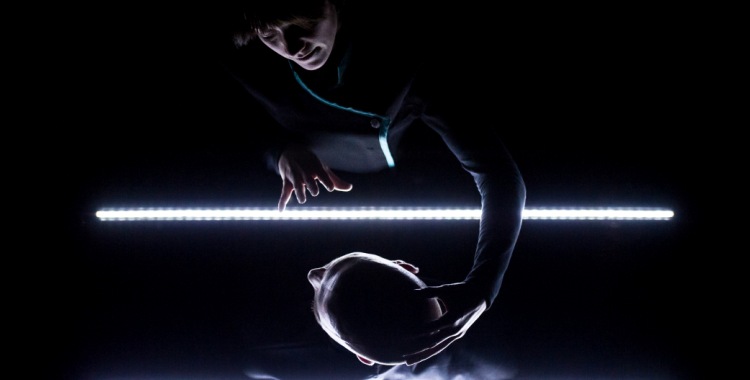
If the Thought Police are an uncertain, shadowy presence in Nineteen Eighty Four, somewhere between self-regulating myth and chilling reality, then in Theatre ad Infinitum’s new show they are a constant presence. Light imagines a world in which, thanks to new technology, not just our actions but the workings of our minds are under surveillance. In light of Edward Snowden’s revelations about the extent to which we are routinely monitored, it doesn’t seem miles from plausibility.

Given what we have learned about surveillance, there is no doubting the necessity of discussing its dangers – especially considering the astonishing lack of outcry about the current situation. Theatre ad Infinitum do so through the means of sci-fi and dystopia, genres which often have more to say about the present than the future. This particular future is a grim one, where fears of terrorism have been harnessed as a means of robbing citizens of their basic right to privacy. And there is something chillingly uncanny about the rhetoric with which these imaginary politicians put a positive spin on the ability to see into the minds of others.

Light is over reliant, however, on the metaphor that gives the show its title. Light is used by GCHQ as a codeword for meta-data, but it also has the advantage of creating some rather striking images on stage. Theatre ad Infinitum take this connection and run with it – so far that it almost pulls the show off its intended course.

The company’s central visual device is the use of LED torches, which only illuminate limited segments of the stage at any one time, leaving everything else in the dark. This allows for several startling, nightmarish moments, as well as some slick manipulation of our perceptions. But it is also limiting to the scope of the piece. Where in Translunar Paradise and Ballad of the Burning Star the formal constraints imposed by Theatre ad Infinitum were what made the shows focused and distinct, here it begins to feel like an unwieldy albatross flung across the company’s shoulders.

The story, of a citizen who eventually attempts to break the state’s control over the mind and defy his own tyrannical father in the process, is vital to the show. But thanks to the formal limitation, its telling is not always clear. The action is wordless save a few short projected sentences, underscored instead with an impressive – and often impressively thumping – soundtrack. It is often more cinematic than theatrical and it is not helped by the restrictive space and limited sightlines found in the Pleasance Dome.

One of Theatre ad Infinitum’s greatest strengths as a company is their ability to reinvent themselves with each new production. Light is another audacious transformation, but one that sadly falls short of the high standards set in previous years.

Photo: Alex Brenner.

SmallWaR, Traverse Theatre

SmallWar-brochure-_2995274b

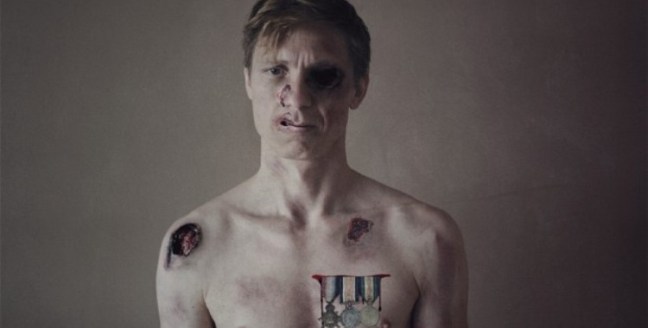
BigMouth, the powerhouse show that Valentijn Dhaenens premiered at the 2012 Fringe, was all about oratorical sway. Now SmallWaR offers a bleak snapshot of what those speeches really mean for ordinary men and women. Joining the rash of World War I centenary productions, the show discusses both the First World War and conflict in general through the voices of those who experienced it firsthand.

Inspired by a collection of war testimony and owing a heavy debt to the likes of Johnny Got His Gun, SmallWaR offers up various fragments of conflict and its aftermath. These are expressed by Dhaenens in the guise of a nurse, sitting or standing at the front of the Traverse’s wide stage, and by the shadowy soldier figures (all recorded copies of Dhaenens) who appear as projections on the screen that slices across the playing space.

In this ghostly hospital ward, voices rise and fall; reflections, letters home, quiet howls of despair. These scraps of found text are knitted together by the nurse, commenting calmly on the horror she witnesses around her, and by the thoughts and dreams of a man who has lost all means of movement and communication, barely remaining alive in his hospital bed – a medical “miracle”.

As a companion piece to BigMouth, immediately linked by the same unsettling rendition of “Nature Boy”, SmallWaR makes a chilling follow-up. Here lies the result of all that rhetoric: broken bodies and tortured minds. And all that talk of democracy and honour and glory means nothing when staring death in the face. As Dhaenens dully intones, “nobody dies for something”.

Yet this all feels surprisingly distant. There is certainly rage in SmallWaR’s sentiment, but not in its cool execution. Dhaenens’ sleek, controlled delivery is pitch perfect as a series of persuasive leaders in BigMouth or a slippery politician in Ontroerend Goed’s Fight Night, but here it jars with the intent of his words. There are moments of quiet, haunting impact, but Dhaenens never reaches across the gulf between stage and audience to infect us with the fury that radiates from his text.

“If I had a mouth, I would scream,” a disembodied voice tells us through the speakers. Dhaenens has the means to speak, but his is a resigned sigh rather than a yell of anger.

A Streetcar Named Desire, Young Vic

ben-foster-and-gillian-anderson-in-a-streetcar-named-desire-89975

“I don’t want realism. I want magic.”

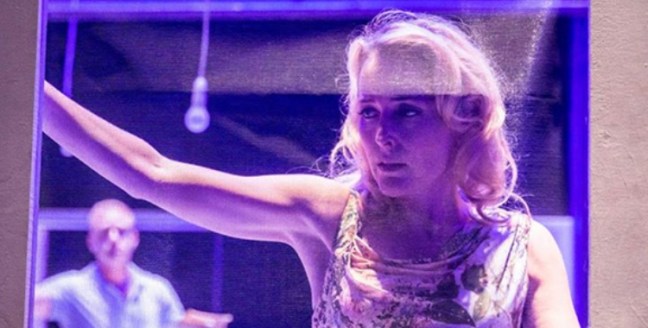
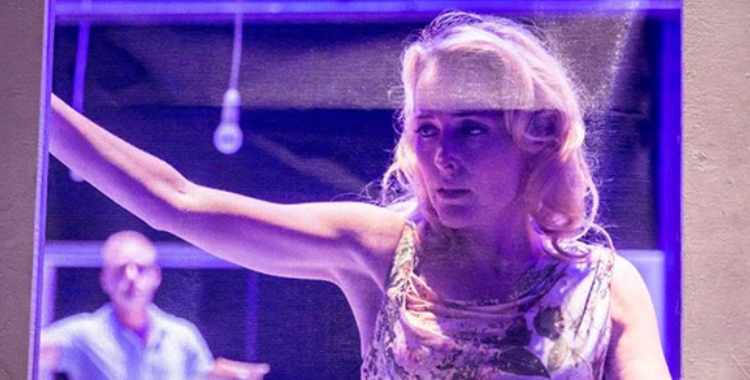
In Secret Theatre’s version of A Streetcar Named Desire, Blanche’s famous line raised a light, knowing chuckle from the audience. The character might have been referring to her inclination towards fantasy and illusion, but her words could well have been a mantra for the production, which turned Tennessee Williams’ play and all its well-worn visual tropes inside out. Those words, spoken in that context, also posed an implicit question. Why, on the stage, do we settle for realism when we could have magic?

I’m reminded of the frustrated words of Eugene Ionesco: “I personally would like to bring a tortoise onto the stage, turn it into a racehorse, then into a hat, a song, a dragoon and a fountain of water. One can dare anything in the theatre and it is the place where one dares the least”. In theatre, where one thing always stands for another – when the relationship is one of metaphor – why do we still insist that those two things look alike?

Partly liberated by the secrecy bound up in the project (show titles are not released in advance), Secret Theatre’s Streetcar somehow freed the play of all its – and particularly Blanche’s – baggage, presenting us instead with its exposed innards. It understood theatrical representation as metaphor in its most playful sense; chunks of watermelon stood in for poker chips, and Blanche’s endless glasses of liquor became liberal drenchings of water. It was not quite magic, but it certainly wasn’t realism.

By comparison, Benedict Andrews’ new production feels sort of drab, dull even. First, let’s be clear: Andrews’ take on Streetcar isn’t exactly realism. There’s a stylishly skeletal revolving set, garish washes of coloured light, scene changes underscored with Swans and Chris Isaak. But in between the vivid flashes of colour and music, it’s naturalism by another name. Matt Trueman has coined the perfect term for it: “realishism”.

That “ish” is apt. This Streetcar is interesting-ish, elegant-ish. It puts a slight spin – both literal and figurative – on Williams’ play, but never enough to leave us giddy. Or put it this way: if you were expecting another classic done in the same vein as Andrews’ storming, vodka-fuelled Three Sisters, prepare to be disappointed.

On the main stage of the Young Vic, Stella and Stanley’s cramped, claustrophobic apartment is a metal husk of a building. Magda Willi’s set strips out walls, leaving only the framework of the rooms through which an audience can peer. The characters are at one level exposed and at another trapped. This is the cage that Blanche knocks against, that Stella has no desire to get out of.

Andrews’ production sets this space in almost perpetual motion, turning it clockwise, anti-clockwise and back again on the wide revolve. It’s slightly reminiscent of Ian MacNeil’s smoothly spinning set for A Doll’s House on the same stage, but while that design offered fleeting, cinematic tableaux between scenes, this keeps everyone queasily turning throughout. The sensation is one of constant shifts, but the only direction in which any of it can go is round in dizzy circles.

Like any repetitive cycle, however, this one begins to get boring. In the first half, the pace is swift and the tension tight, coiled like Stanley’s unpredictable temper. But the momentum drops away after the interval as the production follows increasingly familiar tracks. Andrews might half-heartedly update Williams’ play, kitting it out with Ikea furniture and skinny jeans, but Gillian Anderson’s Blanche is just as we expect her: flirtatious, fragile Southern belle, all carefully composed but rapidly cracking mask. Her downfall is competently conveyed, but never quite tragic.

While Anderson fails to break the mould as Blanche, Ben Foster’s war-damaged Stanley is an intriguing take on the role. Rather than picking up the obvious cues from Williams’ descriptions of the character as primitively animalistic, Andrews and Foster seize on Stanley’s military history, suggesting a man broken by conflict. When his first major outburst arrives, it is truly explosive because it seems to come unbidden; this is not a man of naturally violent passions, but one shot through with an anger he is unable to control.

Stanley’s reconciliation with Vanessa Kirby’s Stella, immediately following this scene, is another of Andrews’ successes. Their bodies meet in a rush of passion, their movements adopting a tango-like quality under the hot red glow of Blanche’s Chinese lampshade. The production is studded with little moments like this, small scenelets that elevate the quality of the rest. They are too sparsely positioned, however, to entirely rescue the bland expanses in between.

It’s unclear, meanwhile, just what Andrews’ updating achieves. His Three Sisters wrenched Chekhov’s play out of any specific temporal context, brilliantly locating it on a timeless, abstract plane. The setting for Streetcar, on the other hand, is recognisably modern, but with few concessions to that modernity in Anderson’s performance. What the time shift does highlight, however, is the play’s gender politics. Watching, I’m more aware than ever of the limited borders of Blanche’s horizon. As she says at one point, her role as a woman is to entertain, to be beautiful. And the beer-drenched masculinity of Stanley’s poker games is not much of an alternative, trapping men within a system of rules and expectations that is just as restrictive, if endowed with a bit more power.

These hints at an implicit gender critique, however, dissolve into obvious and borderline offensive imagery. To leave us in no doubt of either Blanche’s troubled mental state or the pressures of femininity heaped onto her, Andrews puts Anderson into a candy pink dress and wonky tiara, hair ruffled and face smeared with make-up. Southern belle transformed into dishevelled Barbie princess. It’s the crashingly unsubtle culmination of a dismayingly uninventive telling of this character’s trajectory, casting little light on its themes of mental health and sexual politics. From a director whose interpretation of Three Sisters was so bursting with invention, it’s a bitter disappointment.

Photo: Johan Persson.
Beyond Caring, The Yard

Beyond Care

Originally written for Exeunt.

We all know the basic facts about zero hours contracts: the headlines, the numbers, the controversy. Wisely, Alexander Zeldin and his cast don’t attempt to repeat any of this. Instead, this knowledge flickers in the background of the piece they have devised together, its political intent very much implicit but no less furious for it.

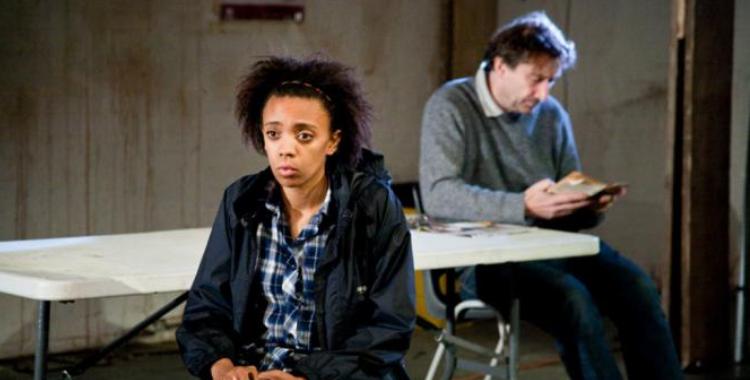
Beyond Caring depicts just five individuals caught in the ruthless cycle of modern employment and unemployment. Three women arrive for a fixed term cleaning contract at a factory, carelessly dispatched by temp agencies. One has been forced into work by Atos; it is hinted that another might be homeless. Working alongside them each night as they scrub down floors, walls and machinery is full-time cleaner Phil and boss Ian, who compensates for the disappointment of his job with small and occasionally cruel displays of power.

In presenting us with these determinedly ordinary characters, Zeldin asks us not to watch as audience members, but to look on as fellow human beings. It’s a subtle but crucial distinction. It’s also a form of spectatorship that takes a while to settle into. The punishing night shifts of the play unfold in uncompromising hyper-naturalism; silences, stutters and stumbles are all preserved, presenting us with human interaction in all its awkwardness and inarticulacy. Harsh, anaemic fluorescent strip lighting illuminates both audience and stage, thrusting us into the same drab and unforgiving world as that inhabited by these workers.

Falling into step with this sluggish, unpolished delivery demands an initial outlay of concentration, but it’s an approach that cumulatively builds in its power. By stripping away theatricality as we are accustomed to it, Zeldin focuses an audience’s attention; deprived of the dramatic conventions of naturalism, we are temporarily disorientated and made to look – really look – at these seemingly undramatic scenarios. While most stage realism aspires to a tidied up version of reality, this aspires to reality itself, jolting it out of its usual trappings and slamming it down in front of an audience.

As the piece goes on, repeating the relentless routine of shift after shift, the fine, accumulating detail becomes quietly devastating. Each performance is minutely textured, slowly amplifying the nuance of every last shrug and smile. A single gesture becomes infused with tragedy, while the corporate absurdities of a staff appraisal (“I am absorbed with ideas – agree or disagree?”) are as crushing as they are comic. Layered with Josh Grigg’s excellent sound design, which like the performances builds to an almost shattering intensity, the effect is one of blackening despair.

And yet. Somewhere in amongst the desperation and the drudgery and the alienation, there are still traces of tenderness. The title – at least in one sense – turns out to be something of a red herring; far from being beyond caring, these are individuals longing to care. The state might not give a shit, but they painfully, heartbreakingly do. And perhaps it’s there, in the foolish optimism and fleeting moments of connection, that we begin to glimpse just the tiniest splinter of possibility.