Wolf Hall / Bring Up the Bodies, Aldwych Theatre

WOLF HALL. Ben Miles (Thomas Cromwell).  Photographer Keith Pattison.

Originally written for Exeunt.

Hilary Mantel begins her literary study of Thomas Cromwell with her protagonist on the ground, his face in the mud. The Royal Shakespeare Company open their version with a dance. On stage, Wolf Hall and Bring Up the Bodies are all delicate political manoeuvring; sly sidesteps covered with graceful flourishes, punctuated by frequent changes of partner. Condensed into six hours of scheming and seducing, what emerges most powerfully from Mantel’s historical narratives is the relentless tension of a world in which putting a foot out of place can mean the end. Murderous games clothed in courtly manners.

What is lost with the jettisoning of Mantel’s potent opening scene is a tangible grasp of Cromwell’s cruel, murky past, and with it the spur for his tireless social climbing. Inevitably, the transfer to the stage has sacrificed an element of the novels’ subjectivity, instead allowing us both inside and outside the protagonist’s mind at once. As he survives the downfall of his patron Cardinal Wolsey to rise steadily to Henry VIII’s side, eventually becoming the King’s most powerful advisor, Cromwell’s position is ever ambiguous. Is he the ultimate working class boy done good, using his influence to do what he can to ensure England’s stability, or just a ruthlessly ambitious bully?

The intricate deals and intrigues of Mantel’s novels, unfolding over some 1,000 pages, are played out with astonishing speed and dexterity by adaptor Mike Poulton and director Jeremy Herrin. The backdrop of Cromwell’s rise inWolf Hall – and arguably his window of opportunity – is the King’s long mission to annul his first marriage to Katherine of Aragon and wed Anne Boleyn; Bring Up the Bodies, no less tumultuously, charts the bloody decline of Henry’s second wife. In both, we see Cromwell clinging onto power with the dirtied tips of his fingers, doing what he must to both satisfy Henry’s fickle desires and secure his own position.

The narrative economy of Poulton and Herrin’s adaptation intensifies the teetering delicacy of Cromwell’s political balance. Solutions must be manufactured in the space of a breath, remedies administered in the sweep of a cloak that divides one scene from the next. Remarkably, however, the action rarely feels rushed. The storytelling of several pages becomes the work of a moment: Cromwell’s wife poignantly slips from his grasp, her death told in a single image; elsewhere, the sight of a row of squabbling advisors stopping to cross themselves at the appearance of a statue of the Virgin Mary succinctly captures the fearful hypocrisy of the age.

While story translates smoothly – some unavoidable streamlining aside – the rich, immersive world of Mantel’s novels is not so easily adapted. For anyone who has read them, the memory of the books’ sumptuous prose colours the gaps left by the narrative juggernauts of the plays, which motor steadily forward. David Plater’s sculpting shafts of light do their best to offer some of the atmosphere that is so vivid in the novels, as does the evocative music and sound design of Stephen Warbeck and Nick Powell respectively. The minimal stone and fire of Christopher Oram’s imposing set design, meanwhile, provides a fitting crucible for the passions of Henry VIII and his courtiers, loomed over at all times by the ghostly presence of the cross.

It is not only religion that haunts in this pair of plays. Poulton and Herrin offer us supernatural visitings of all kinds, rendering the ghosts of Cromwell’s mind visible on the stage. The return of the dead in this way, their figures occupying the same space as the living, hints at the accumulating layers of history – history that, by Cromwell’s hand, can be easily swept aside or manipulated. Often, however, their arrival jars with the action, heralding awkwardness rather than ill omens. If the opening scenes of Hamlet should have taught us anything by now, it’s that ghosts on stage are perilously difficult to pull off.

Although the adaptors have done well in preserving much of Mantel’s narrative and wit, the same cannot always be said for her nuance. Several of the lesser characters are little more than ciphers here, while a complex awareness of the historical debates surrounding the Tudor era is swapped for classroom fact-dropping and occasionally laboured exposition. At times, thanks to the continuing cultural ubiquity of the Tudors, it feels as though an audience are being offered bonus points for historical knowledge and the smug advantage of hindsight. The bleated “I’m nobody, just Jane Seymour” is greeted with a collective, self-congratulatory chuckle, while Wolsey’s confident pronouncement that he has seen the last of Anne Boleyn raises one of the biggest laughs of the afternoon (surpassed only by a comment about the fresh country air in Stoke Newington).

But ultimately, whatever its other strengths and flaws, any version of Mantel’s novels was always going to rise and fall on the shoulders of its Cromwell. Fortunately, Ben Miles is an inspired choice. While we might not get the full picture of his humble origins (repeated cries of “blacksmith’s son” do not a back story make), Miles’ Cromwell is a brilliantly realised charmer, as compelling as he is shrewd. Intelligence, humour and cold calculation all glitter behind his dark eyes, which also occasionally flash with the instinctive violence bred of his days as a soldier. But just as we find our sympathies helplessly aligning with this smoothly pragmatic politician, Miles sharply pivots, unsettling any easy interpretations of Cromwell’s motives.

The rest of the cast shape-shift around him, the majority of performers confidently taking on a collection of different roles. As the King’s successive queens, Lucy Briers, Lydia Leonard and Leah Brotherhead are suitably stubborn, seductive and shy respectively, while adding touches of complexity to the archetypes that history has moulded these women into. Leonard in particular underlines Anne’s sharpness and fatal arrogance with a shade of insecurity, while Brotherhead’s initial, squeaking nervousness gradually mutates into meek but assured grace. And if Nathaniel Parker’s Henry VIII is not quite as dangerously charismatic as history has taught us to expect, his mercurial personality certainly drives those who circle cautiously around him, hoping to keep their place in the precarious dance of power.

Photo: Keith Pattison.

Nick Payne

WJK_2888 (2)

Originally written for The Stage.

“I don’t really see this,” says Nick Payne, tapping the sturdy wooden table we are sitting at. “My brain just tells me that that’s what it is to steady me, because otherwise I’d freak out if I was really able to take in all the information around me.”

With a slight grin, the writer is explaining the research behind his new play Incognito, a cerebral interrogation of the mind’s inner workings. If it sounds like meaty material, it’s little surprise. Payne’s debut play If There Is I Haven’t Found It Yet, which won him the George Devine Award in 2009, collided domestic drama and climate science, while subsequent work has tackled bereavement, quantum physics and contemporary gender politics.

“I suppose it tends to start with something I read about,” Payne reflects. Thoughtful, unassuming and frequently apologetic, the playwright is quietly frustrated by his struggle to remember the genesis of specific projects. He admits that ideas emerge “mostly by chance” rather than through any desire to address a particular topic. “With Constellations, it was a conscious decision to try and find a form that was non-naturalistic,” he recalls as an example, adding that he “stumbled on that whole thing about the multiverse”.

Constellations, which imagined one relationship playing out in countless variations across multiple universes, was the play that convincingly cemented Payne’s career as a playwright. The show quickly transferred from the Royal Court to the West End and won Payne the Evening Standard Award for Best Play in 2012, as well as attracting an Olivier nomination. This followed a steady stream of new plays, including Wanderlust at the Royal Court and One Day When We Were Young for Paines Plough, but Constellations raised him to a new level.

“Only for the last year and a half has it started to feel like a career rather than something I’m doing with the hope that one day …” Payne trails off, as if afraid of tempting fate by acknowledging his recent success. For a number of years after moving to London from university, Payne subsidised his writing with shifts at the National Theatre bookshop and as a theatre usher, eventually committing to playwriting full-time in 2010 after his breakthrough with If There Is I Haven’t Found It Yet.

Central to Payne’s development as a writer during this time was his participation in the Royal Court’s Young Writers’ Programme. “The Writers’ Programme made you feel a bit like you could be a writer,” he says, “because you’d go to a theatre every week and you’d see all the shows.” It was also while at the Royal Court that the first seed of an idea for Constellations was planted, Payne remembers, by a talk about physics given by former literary manager Ruth Little.

Incognito, which recently opened at the Hightide Festival ahead of a run at the Bush Theatre, continues some of the ideas about free will that emerged during the process of writing Constellations, returning Payne to his recurring preoccupation with science. Borrowing from the latest developments in neuroscience, the play questions the extent to which we are really in control of our own identities, exploring the complex and delicate mechanisms of the brain. Like much of the playwright’s work, it has involved extensive research.

“It’s not research in an academic way,” Payne is quick to add, admitting that the science in Constellations was flawed – and scientists had no problem telling him so. Instead, it is about knowing his characters and their motivations; his priority is to “make sure it’s dramatic above anything else”. For this reason, perhaps, Payne prefers talking to people over reading books: “I enjoy meeting people who do those jobs, and having my naive illusions of what they do and how exciting it must be shattered.”

As is often the case with Payne’s writing, it was the research behind Incognito that has moulded the shape of the play. “I thought there’s a form here that can hopefully feel like a brain solving everything for us,” he explains. The play begins as a confusing, fast-moving assault of information, switching rapidly between three different narratives situated at different points in time, before the various pieces of the puzzle gradually slot into place. “The idea that the brain is a sort of storytelling machine that keeps us going by building a narrative is partly what the play does.”

Although he first broke through with astutely observed naturalism, Payne is increasingly interested in experimenting with dramatic form. Incognito cleverly meshes form and content; Constellations, with its swift, snapshot scenes and complete absence of naturalistic staging, was born from a desire to temporarily ditch social realism and create “something that you couldn’t do in any other medium”. Recent project Blurred Lines, meanwhile, cast Payne in the role of collaborative creator, working closely with director Carrie Cracknell and a devising company of actors.

“That form thing, the question of how and why are you going to give your play a particular shape or structure or architecture, was not something we addressed until right at the very end,” Payne explains the process, admitting that this uncertainty made him “twitchy”. Blurred Lines was created over the space of two week-long workshops at the National Theatre Studio and four weeks of rehearsals directly prior to the show’s run in The Shed. It was a tight development period: at the beginning of week two of rehearsals, the team decided to scrap most of what they had produced so far, going on to devise almost the whole show in just three weeks.

Payne is eager to challenge himself in this way, insisting that he’s interested in “working in as many different ways as there are”. It would be a waste, he suggests, not to use the creative resources on hand in the rehearsal room. “There’s always a point in rehearsals where the performers start to know the play much better than you do. I think at that point you’re mad if you’re not listening to them going ‘I’ve got an idea’, or ‘can we try this’, or ‘I’m really stuck on this’.”

As a result, the playwright is less and less protective of his own work and is very open to making changes – even major ones – during the rehearsal process. Refreshingly, he is not particularly concerned with the idea of rigid fidelity to his vision. “That thing of serve the writing, I find a bit …” Payne pauses, making a face. “I don’t really get it.”

Payne’s most recent challenge has been a foray into television, but he quickly found himself pining for the thrill of the rehearsal room. “The development process was pretty similar, and I enjoyed that, but then you’re much less involved,” he explains. For him, the rehearsal process is the “fun bit of the job”, when all the most illuminating questions are asked about the play. And this, he suggests, is just as vital for him as the process of gathering the research or sitting at his desk writing.

“A film is made three times: it’s written and then shot and then edited. I sort of think it’s true of a play too. I enjoy being around for all of that.”

Photo: Bill Knight.

Ben Miles

Ben-Miles-Thomas-Cromwell-002

Originally written for The Guardian.

When Hilary Mantel first introduces us to Thomas Cromwell, the wily social climber at the centre of her award-winning historical novels, he’s face down in a pool of his own blood. It’s possible to view the entire narrative that follows in Wolf Hall and Bring up the Bodies as Cromwell’s defiant rise, as he scrapes himself off the floor and ascends to the zenith of 16th-century politics.

“These plays are about how this man gets up on his feet having been on his knees and how far he goes,” says Ben Miles – the actor shrugging on Cromwell’s robes – of the Royal Shakespeare Company’s pair of stage adaptations, now transferred to London’s West End. Cromwell – “the original working-class hero, the original self-made man” according to Miles – is the scheming heart of the two stories, determinedly throwing off his humble origins and charming himself all the way to Henry VIII’s side. He’s a compelling figure, but one with a hard, ruthless streak.

“Morally, it’s very ambiguous,” says Miles, identifying this ambiguity as one of the attractions for him as an actor. “People are intrigued, they’re drawn in by this charismatic figure who drags himself up, but the means by which he does that are often dubious. There are lots of themes in these stories, but one of them is this idea of vengeance or retribution – how far do you carry that? When you’re finally in a position of power, what do you do with that power? Do you use it to settle old scores, or do you use it for the common good? Or do you do both? I think that’s what Cromwell finds himself doing. It’s an endlessly fascinating study of human character.”


Also fascinating is the wider Tudor context, and the fierce debates that still surround figures such as Cromwell, Henry VIII and Anne Boleyn. “I think these plays and these books have really held a light up to that period,” says Miles, who confesses to having been a huge fan of Mantel’s novels even before the RSC project arose. “Hilary’s rewritten the book as far as opinion about Thomas Cromwell is concerned,” he adds, describing the experience of bringing this reimagined character to life as “a great thrill”.

While Mike Poulton’s stage versions of Wolf Hall and Bring Up the Bodiesare necessarily “streamlined”, stripping out a number of peripheral characters and subplots, Miles insists they remain faithful to the vivid character portraits in the books. “What the plays keep, I think, are the main arteries of the story,” he says. And, like Mantel’s novels, the plays succeed in marrying historical narratives with a very modern set of concerns and sensibilities.

“Politics, nationhood, religious fervour, extremism, European political machinations, the threat of war, how to get on in the world, the trials and tribulations of the self-made man – all these things, they’re things that concern us now and will always concern us,” he says. “It’s these things that make the plays contemporary, as well as period.”
Photo: Tristram Kenton.

Thebans, London Coliseum

6208-600x397

Originally written for Exeunt.

Sophocles’ trilogy of Theban plays, charting the fall of Oedipus and his doomed offspring, carry their fair share of cultural baggage. They are now more historical documents than dramas, presenting a challenge to modern adapters seeking to inject them with new life, yet the turmoil and tragedy of Oedipus’s famous fate continues to fascinate and inspire.

Julian Anderson’s first opera seizes on this material and gives it a shake, achieving an impressively fresh rendering of this trio of tragedies. Anderson and librettist Frank McGuiness have condensed and reshuffled Sophocles’ three plays, transforming them into three swift acts and disrupting their chronology. First, under the subtitle “Past”, we see the familiar revelations of Oedipus the King, before being catapulted into the “Future” in the second act to witness Antigone’s destruction at the hands of Creon. Finally, the action rewinds to the “Present” and Oedipus’s death at Colonus, closing on an anguished note of lamentation from the daughter soon destined to come to her own bitter end.

Dramaturgically, the episode at Colonus offers a much more satisfying conclusion than that of Antigone, allowing the action to end on a shattering howl of grief. But beyond this dramatic effect, Anderson and McGuiness’s rearrangement of chronology offers an intriguing examination of fate, at times enhancing and at others unsettling the inexorability of events. Themes and emotions periodically resurface, creating the impression less of a tragic slide to destruction than of a viciously repeating cycle. Score and libretto also contain interesting internal tensions, the tussle of voice and music reflecting a struggle throughout between will and destiny.

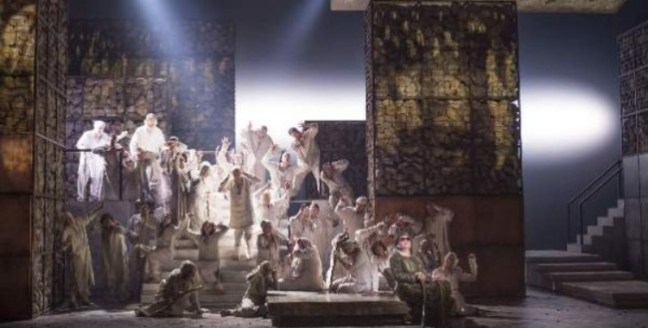
Despite distinct resonances across the acts, Pierre Audi’s production strikingly shifts mood for each episode of the trilogy. The curtain first rises on a classical scene, the white-draped bodies of the chorus held still like statues against Tom Pye’s simple but imposing stone-grey design. White gives way to black in the tense second act, as a militaristic state has been established under Peter Hoare’s Creon (as smoothly persuasive in voice as in politics), its discipline outlined in the sharply uniform movements of its subjects. Colonus, in the final scene, is an other-worldly wasteland, eerily echoing with the disembodied voices of the chorus – for whom Anderson has written by far the strongest part.

It is in its narrative economy, however, that Thebans disappoints. Anderson and McGuiness have hacked away plenty of dead wood from Sophocles’ tragedies, but with it too has gone some of the essential foliage. Shorn down to its bare essentials, the plot loses any prelude to tragedy, failing to forge a connection with the protagonists before their fortunes violently plummet. In the succinct second act especially, character is sacrificed to atmosphere, with Antigone dead before we are offered any opportunity to feel her misfortunes. McGuiness’s libretto, meanwhile, is direct to the point of bluntness in its trimming of Sophocles.

Anderson’s score cannot quite compensate for these gaps in character, rarely communicating the full tragedy and despair of Oedipus’s downfall. It is better instead at conveying unease, be it through the disquieting bass tone of Tiresias’s prophecies or the mounting tension of the second act. Only in the closing moments, as Julia Sporsén’s bereft Antigone devastatingly grieves for her father, does the impact of events finally land its punch – by which time, it is too late.

Hitting the Right Note

82138

Originally written for The Stage.

For Danielle Tarento and Thom Southerland, it’s all about location. The producing and directing duo, who have found a rich seam in small-scale, stripped back musicals at fringe venue Southwark Playhouse, are always conscious of making the right match between show and theatre. “We’re very much about being respectful of the space you’re putting something in,” Tarento explains, “not just whacking it in because we happen to have a slot.”

We are chatting in the freshly refurbished bar of the Southwark Playhouse’s new home in Elephant and Castle, recently named The Stage’s Fringe Theatre of the Year, where Tarento and Southerland have found the perfect partner for their shows. The vast warehouse space has been utterly transformed since the theatre moved in, offering a main stage space that the pair find particularly inspiring. “To be in a 220-seat theatre that feels like a 600-seat theatre, yet to be no more than five rows away from the action, is extraordinary,” says Tarento.

The theatre’s strong track record with musicals, however, stretches back to its previous venue under the arches of London Bridge Station. Southwark Playhouse is now readily associated with musical theatre, but it was only three years ago that Tarento, armed with experience from fringe musical powerhouse the Menier Chocolate Factory, convinced artistic director Chris Smyrnios to put on the theatre’s first musical: a new version of Stephen Sondheim’s Company. Although he needed some persuading, in the end Smyrnios “couldn’t resist programming it”.

It was during the run of Company that the seeds of Tarento and Southerland’s working relationship were sown. Having previously encountered one another while Tarento was working at the King’s Head, Southerland “accosted” the producer in the bar after the show to discuss a new potential project. “I’ve sort of not been able to get rid of him since,” Tarento jokes, quickly adding, “thank God.”

Their first production together at the Southwark Playhouse in 2011 was Jason Robert Brown’s Parade, an unlikely musical rendering of a famous American legal case from 1913, which Southerland staged in traverse in the theatre’s Vault space. Unlike the sumptuous production that had been seen at the Donmar Warehouse just four years previously, this new version emphasised the grit of the story by working with its surroundings. “There’s nothing comfortable about sitting in the Vaults at Southwark Playhouse and watching an injustice happen right in front of your eyes,” says Southerland.

A damp, dingy railway arch is hardly the most auspicious setting for musical theatre, but the Southwark Playhouse’s atmospheric venue offered rich inspiration for Tarento and Southerland. Reflecting on Company, Smyrnios suggests that “the juxtaposition between the show and the space seemed to enhance the work rather than detract from it”. For subsequent shows such as Parade and Mack and Mabel, meanwhile, the Vault theatre was central to the aesthetic.

In the case of Mack and Mabel, which had been a famous flop in the past, Southerland is convinced that their version worked precisely because of its gloomy environs. “It doesn’t belong in a proscenium,” he insists. “This show is about being dirty and people not having any money, and scrounging to make a buck but wanting to create art, and it’s set mostly in a disused film lot. It needs to be vast, but it needs to feel uncomfortable and claustrophobic as well.”

Despite the gains, working on this scale also brings its challenges. “Every challenge is a benefit,” Southerland insists, but Tarento quickly breaks in with “that’s the director speaking – the producer will say something quite different”. She concedes, however, that the difficulties of producing a musical on the fringe do open up new creative possibilities: “the minute I say no, they have to find another way, and sometimes those other ways end up being far more interesting”.

“If there were too many challenges, we’d just go ‘let’s find somewhere else’,” Tarento adds. She suggests that the secret of their continuing partnership is that Southerland “creates the sort of theatre that I want to create”, which is heavy on story and light on “stuff”. “The stuff is lovely, some shows need a bit of stuff, but I think if you’re talking about things that are true, or things that require the audience to actively engage and have an opinion, just tell the story, don’t cover it up with stuff.”

So why is it important that this kind of work exists on the fringe? Firstly, as both Tarento and Smyrnios point out, it makes musical theatre affordable to those who might not be able to access it in the West End. But beyond that, Tarento says, they “give people the opportunity to see a different kind of theatre”. Smyrnios adds that venues like the Southwark Playhouse “provide the opportunity to revisit noted musicals, try out new ones and explore established ones in new ways”.

It is the implicitly trusting partnership between venue and producer that has enabled these kinds of risks to be taken. “They give us ownership of the building,” says Tarento. “They take ownership of the show. It feels like it’s an in-house producing house and we’re just working here and we’re doing the next show. That is unbelievably rare.”

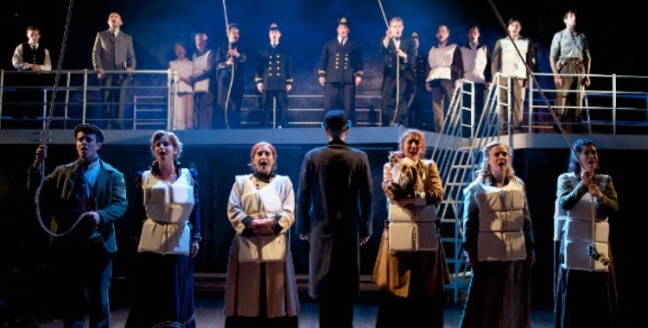
The new building in Elephant and Castle, which the Southwark Playhouse moved into in May of last year, demands a new approach. Southerland raves about the new theatre’s “height and scale”, explaining that “you can do epic without losing any intimacy”. It was this mixture of the epic and the intimate that allowed the director to stage his version of Maury Yeston and Peter Stone’s Titanic, which he is preparing to transfer to New York when we speak.

Thanks to Tarento and Southerland’s success, the doors at the Southwark Playhouse are now open to musicals from other producers, such as Floyd Collins, The A-Z of Mrs P and upcoming show In the Heights. “There is now an audience who will come and see the next thing regardless of what it is or who has produced it, because they trust,” says Tarento. “That’s every venue’s dream, to have an audience who will come and see everything.”

For Smyrnios, although plays are still the Southwark Playhouse’s priority, musicals are becoming an increasingly important ingredient of the theatre’s programme, with space regularly set aside for them. As for the relationship with Tarento and Southerland, it has “gone from strength to strength”. “From the start there seemed to be a naturally productive working balance between producer and venue,” he says. “It’s been a relationship that has been fruitful for both of us and one we hope to continue.”

Tarento and Southerland have similar hopes, already mapping out future plans for the venue. Despite pursuing projects elsewhere, Tarento is confident that the relationship with Southwark Playhouse is one that the pair will keep returning to. “I think wherever we go and whatever we do, we’ll always end up coming back here.”

Photo: Annabel Vere.