Each of Us, Tristan Bates Theatre

Ben-Moor-Each-of-Us-2-600x400

Originally written for Exeunt.

Why do we tell stories? Perhaps, as the narrator of Ben Moor’s monologue suggests, we simply don’t have a choice. Reaching for ways to explain human connection, Moor invents the “narrative gene”, a newly discovered strand of our DNA that compels us to create. Storytelling, then, is a reflex. A way of making sense of the world that is coded into our very being.

It is this process of making sense and of constructing an identity that sits underneath the meandering narrative of Each of Us. When we first meet Moor’s narrator, he is bruised from a recent marriage breakup – “paralysed from the heart forward”. Talking us through parties and therapy sessions, wit and heartbreak going hand in hand, he slowly navigates the emotional wreckage, mining it for meaning or maybe even treasure. While still deciding what to erase from his own story, a chance encounter leads him careering into an enigmatic group of memory collectors, all of them convinced of the purpose held in the fragments of self that they choose to hold on to.

The strange, familiar yet unfamiliar fictional world that Moor (who also performs the piece) crafts with his words is one in which the everyday rubs shoulders with the absurd. Like so many stories, it borrows magpie fashion, snatching snippets of pop culture and sci-fi. This is a London in which David Lynch directs live sports game footage and car bombs explode in slow motion. And it is all underscored with a faint, uncanny sense of wrongness; something in this world is catastrophically out of place, but no one wants to look directly at it.

The linguistic landscape of this universe is rich, perhaps too rich for performance. On the page, Moor’s writing is dense with detail, each paragraph an avalanche of description. Performed, however, that avalanche hits an audience at a devastating pace, leaving only a few twisted fragments of debris in its wake. Odd words and phrases snag on their way down, but the vast majority is lost, sliding past before it can be taken in. It is only reading it back later that it is possible to luxuriate in the vivid images and razor-sharp quips.

There is, if you can catch it, much to be savoured in Moor’s poetic, intricately detailed text. An aching emptiness is contained in the image of “air spooning”, tracing absence by the gaps that it leaves in a life. Elsewhere, a character is likened to a semi-colon – “rare, occasionally in the wrong place, but when you saw her confidence, you knew more would follow”. The show is also frequently funny, though it can be hard to tell if there is any purpose behind the conspicuously clever jokes. Moor knowingly riffs on the ubiquity of postmodern irony, but what he ends up with feels a little like a pastiche of a pastiche; postmodernism squared. And, like all the best postmodernism, it manages to wriggle out of making many sincere, meaningful statements.

The one unifying idea of Each of Us is this notion of connection, both as something we seek and something we construct. In this sense, theatre is the perfect medium for Moor’s subject matter, as it is a space in which we can be both alone and together at the same time. As directed here by Erica Whyman, however, the piece does not fully convince that it is better off on the stage than the page. It’s entertaining, to be sure, but the tone of gentle stand-up-meets-storytelling rarely engages with its own liveness in a way that might kick it up a gear, instead leaving Moor’s anecdotes ambling around in circles. It is, like the cinematic masterpiece of one of Moor’s periphery characters, “a montage of montages”; each beautiful in its own right, but never fully assembling into a whole.

Photo: Mae Voogd.

We Are Proud to Present …, Bush Theatre

??????????????????????????????????????????????????????????????????????????????????????????????????????????

For as long as art has sought to represent, the limits of that representation have been pushed and questioned. From Plato’s concerns that representing something betrays its essential truth, to Adorno’s famous claim that to write poetry after Auschwitz is barbaric, it is a debate that has preoccupied artists and thinkers down the ages. Where does one draw the line between what can and can’t be represented? And without representation, how are we to share human experience and history?

In Jackie Sibblies Drury’s sharp, unsettling play, the impulses to represent and to remember repeatedly butt up against one another. Contained within their conflict is an implicit, knotty, unanswered question: is it better to attempt to represent history and risk misrepresentation in the process, or to remain respectfully silent and allow that history to be forgotten?

It is the question, rather than its resolution, that We Are Proud to Present a Presentation About the Herero of Namibia, Formerly Known as Southwest Africa, From the German Sudwestafrika, Between the Years 1884-1915 (titles don’t get much more belligerently unwieldy than that) stages. Drury’s play centres on a group of naive actors, engaged in an ill-judged attempt to address the subject matter of the title. As we are informed in a problematically pithy “overview” at the start, the German settlers in Southwest Africa carried out a brutal genocide against the people of the Herero tribe during the period in question, exterminating 80% of the population. Using the evidence that has been passed down to them – the vast majority of which comes from the German perspective – the six actors (three white, three black) spend the remainder of the show fumbling, arguing and improvising their way through this horrific chapter of colonial history.

The performers stage improvisations around letters home from German soldiers, bicker about how to represent the Herero, and increasingly slide into uncomfortable racial stereotypes. There is much debate about who can represent what – can a white actor portray a black character? and vice versa? – and about what does and does not need to be told. The action reveals as much about theatre as it does about history, lightly mocking popular acting technique (“I don’t know what my active verb is!” cries one character) and the pitfalls of collaborative creation. Through this, however, it approaches the difficult questions at its heart, becoming more and more preoccupied with heritage, identity, race and representation. Whose story is being told? Who has the right to tell it? And where do we draw the line between pretending to do something and actually meaning it?

There is, when discussing a play such as this, a danger of latching onto what it is superficially “about”. Michael Billington’s review in The Guardian, for instance, laments the fact that the show ends up focusing more on the theatrical process than on the genocide that is supposedly its subject matter. But I would tentatively argue that the only way this play can even begin to approach the topic it is nominally about is through a frame which acknowledges the impossibility of ever simply creating a piece of art “about” such subject matter. We Are Proud to Present … is not “about” the Herero, or the German settlers, or the genocide, or the impossibility of representation, or cultural appropriation, or the constructing of history, or the process of theatremaking, or notions of truth, or modern identity politics. It is about all of the above, none of which are easily extricable from one another.

Another issue that rears its head is that of relevance, that quality so beloved of theatre programmers, marketers and critics. There is a nagging desire on the part of the actors involved to relate to the story they are telling and to enhance its relevance for modern viewers – an impulse that many adapters will be familiar with. What this production cleverly manages to do, however, is to problematise that process, implicitly critiquing the drawing of parallels. In one sequence, an improvised encounter between a German soldier and a Herero man segues into a series of different accents, highlighting the similarities between this and other conflicts, at the same time as its distinct edge of discomfort reminds us of the dangers of eliding the historical specificity of each invoked parallel. The homogenising of history, to which Drury’s characters all too often fall prey (“they’re all the same – the names aren’t important”), is cast as a constant, dangerous spectre.

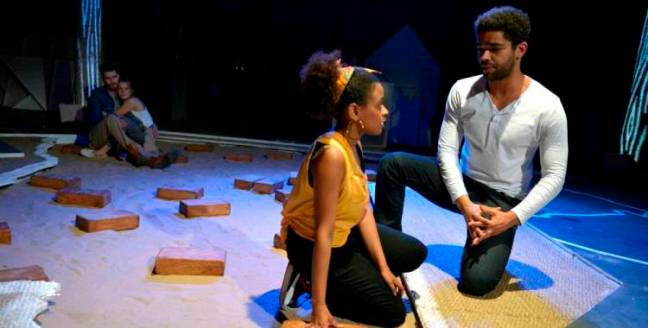
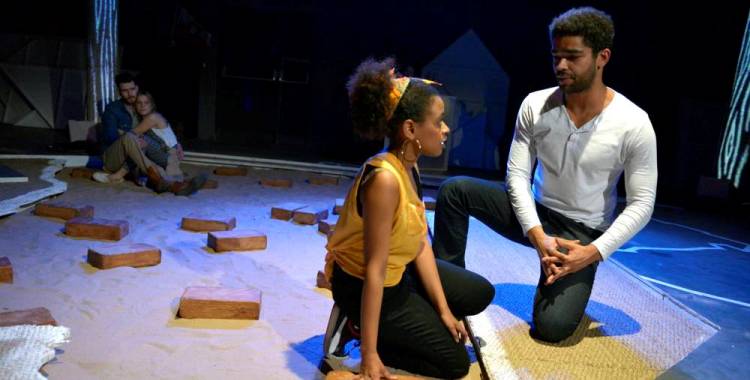
This particular production at the Bush adds an unsettling proximity to Drury’s play, particularly as it reaches its conclusion and we are made increasingly aware of our presence as an audience. Although the majority of the action is carefully scripted and (interestingly) does not stray far from Drury’s text, Gbolahan Obisesan’s direction and the performances of the uniformly strong ensemble manage to effectively evoke the unpredictable spirit of rehearsal room improvisation. Lisa Marie Hall’s set, meanwhile, is a versatile playground for the performers – emphasis on playground. With its movable pieces and gradually revealed sandpit, there is something distinctly childlike about the design, bringing in an aesthetic that jars interestingly with the content. Beyond the design, the playfulness of the whole production is at once wickedly entertaining and decidedly queasy.

But it is only in the final, quiet moments, after the action has reached an overblown, feverish pitch of excitement, that We Are Proud to Present … achieves the impact that justifies its early impishness. While the show’s climax is overdone, its wordless aftermath is a swift, unforgiving punch to the gut, leaving its questions hanging troublingly in the air.

Photo: Keith Pattison.

Victoria Melody

Victoria-Melody-Major-Tom-008

Originally written for The Guardian.

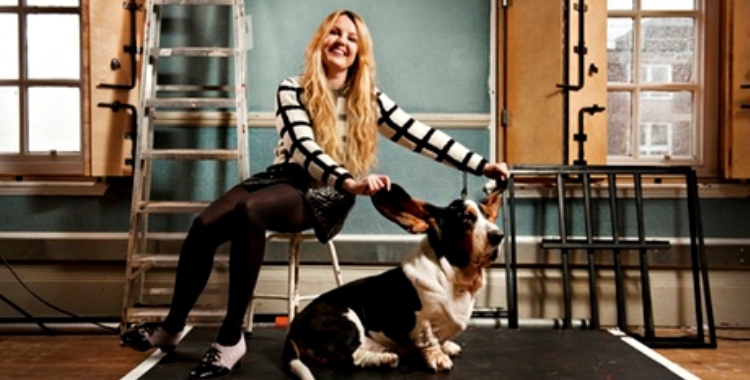
Major Tom, the long-eared, irresistibly endearing basset hound lying in the corner of the room, lets out a low disapproving howl. Awwww, is someone not happy? Is someone not getting enough attention? Oh well, I did come here to talk to Major’s owner, the performance artist Victoria Melody. But Major is clearly keen to get in on the action. He is, after all, a born performer. He even has a show named after him.

Using live performance and film footage, Major Tom follows the attempts of both dog and owner to prove their beauty: Major in championship dog shows, Melody in national beauty pageants. The piece is an attempt to show “the beauty world from a woman’s eyes and a dog’s eyes”. And its conclusion is that the two are “not that dissimilar”. Major was told by judges that his ribcage was too big, while Melody was advised to lose weight.

It might seem like an odd premise for a theatre piece, but Melody’s performance work has always been rooted in real – and often idiosyncratic – people and situations, her primary interest being “the funny things we do as humans”. Trained as a fine artist, she crossed over into theatre with Northern Soul, a one-woman show recounting her adventures in pigeon fancying and northern soul dancing. What is it that makes her embed herself among such clusters of idiosyncrasy, throwing herself headlong into their worlds and then shining a light on them? “Curiosity,” she says. “Which is quite a nice word for being nosy.”

Major Tom, which opens in London next month, is a bit of a departure for Melody, though, thanks to the element of competition. Whereas in the past she was a participant, with everyone on the same side, both the dog shows and the beauty pageants pitted her (and Major) against the individuals whose world she was exploring. The show was initially going to be just about all the dog contests Major was entered in – including the one where he wins biggest ears in a show in south-east England – until Melody started to feel a growing sense of guilt. If she was going to force him to compete, and subject him to a judging panel, shouldn’t she put herself through a similar experience? So, somewhat reluctantly, she entered Mrs UK and found that her discomfort didn’t last long. She won Mrs Brighton with relative ease in 2012, before moving on to the bigger challenge of Mrs UK. “Soon I just wanted to win everything,” she says.

And so did everyone else. Melody often found the dog shows surprisingly hostile: following a string of losses, one judge told her she’d be better off investing in a new dog. By contrast, she was pleasantly surprised by the warmth shown by her fellow beauty contestants, contradicting stereotypes. “There was no bitchiness, no backstabbing, no dresses going missing – none of that.”

Major Tom performs alongside her in the show and, apparently, isn’t very good at doing what he’s supposed to do. This means he often steals the limelight from Victoria at precisely the wrong moment. “His comic timing is genius,” she says. “He always ruins my stories.”

Melody likes to embed herself as fully as possible in the worlds she investigates, developing real and meaningful relationships along the way. Humour is a vital tool. “I’m able to make the work that I do because I’m quite funny and down to earth,” she says. “I think I endear myself to people. I put them at their ease: they believe I won’t exploit them.”

Although Melody and Major were there to be judged, she is determined not to pass judgment herself. She describes Major Tom as being about “the beauty myth and the oppressive function of that”. But she is quick to qualify this, saying: “My shows are only about direct experience. I’m talking about these worlds from the inner sanctum, seen through my eyes.” In the show, although she is frequently – and hilariously – critical of herself, she does not directly criticise those around her. “I don’t tell people what to think. I leave it to the audience to form their own opinions, because audiences are clever and can decide for themselves. They don’t need to be fed something on a plate.”

Melody’s shows often leave the audience wondering about the extent to which they are authentic. Although she insists that the stories she tells in Major Tom are all “absolutely true”, she does also seem to welcome the ambiguity that surrounds the show, the blurring of art and reality.

The process is demanding and frequently takes over her life. But when it does so, Melody sees it as a good sign: it suggests that she’s on the path to something promising. “When it gets to the stage of me not knowing if I’m doing this for my research or for my life, that’s when I know a project’s progressing. One of the interesting things, for me, is that intersection between art and real life.”

She reaches for a comparison and plumps for Fountain, the famous conceptual work by Marcel Duchamp that challenged how we define art. “I see Major Tom as my urinal,” she says.

Photo: Linda Nylind.

put your sweet hand in mine, Battersea Arts Centre

put-your-sweet-hand-in-mine-wings-600x475

Originally written for Exeunt.

There is something both seductive and unsettling about eye contact. That flicker of glances across a busy train carriage; embarrassed yet oddly conspiratorial sidelong looks while standing in a queue; the jolt of meeting a performer’s gaze from the darkened safety of the audience. It is these awkward glimpses of one another, and the awkward bodies that accompany them, that are at the fluttering heart of Andy Field and Ira Brand’s new show. In their fragmentary, dreamlike journey through the landscape of love, the desire to look is always tied up with the impossibility of really seeing one another.

At the end of Nicholas Ridout’s book Passionate Amateurs, there is a sentence that struck me with the quiet sadness of its truth: “The theatre protects us from full communication”. And I wonder if therein lies its appeal. The theatre is a space in which we are forever straining towards those moments of connection and intimacy, safe in the knowledge – loathe as we may be to admit it – that genuine intimacy, the kind of intimacy that leaves us raw and exposed and vulnerable, is always deferred. We can get tantalisingly close to it, but it is ultimately closed off to us. Unlike love, which involves a breathless moment of letting go, in the theatre we can remain teetering on the precipice.

But this isn’t the whole story. Ridout goes on to suggest that this shielding from communication is perhaps why the theatre “is one of those odd places outside the most intimate of personal relations where it is possible to attempt such communication”. put your sweet hand in mine, in its delicate collision of bodies and gazes, feels like one such attempt. Inscribing intimacy in its staging, the piece sits audience members in two rows facing one another, separated by a distance similar to that down the middle of a tube train. We are invited, from the very beginning, to contemplate the face of the individual opposite, in much the same way as commuters snatch occasional looks at one another. But it is as much about our awkward failure to meet eyes, our failure to connect. It is surely not for nothing that Field and Brand’s pair of lovers are seated at different ends of their respective rows, only ever coming face to face when separated by an insurmountable distance.

The strange, startling discomfort of direct eye contact, a possibility that is played with throughout, is enhanced for me by finding myself sat opposite Field, who determinedly locks eyes with me as he delivers his lines. I am reminded of the long, stretched-out moments in Uninvited Guests’ Love Letters Straight From Your Heart in which audience members are instructed to gaze into the eyes of the stranger opposite for the duration of the song “First Time Ever I Saw Your Face”. As then, the performative situation highlights for me the revealing nature of this simple act; despite myself, my eyes occasionally drop, a small, embarrassed smile stealing across my face.

Seated in this uncomfortably close, immediately charged formation, we are treated to fleeting snippets of a love story, or many love stories, depending on how you take it. Looks are exchanged in the anticipatory moments before a show; shy sentences are traded in a Metro carriage in Paris; bodies hold each other close in the dark and cold. I am tempted to say that there is more to put your sweet hand in mine than romantic love – because there is – but its gentle interrogation of everything love might be tangles these different possibilities together. The giddy, pulse-quickening head rush of infatuation, for instance, is evoked by a barrage of sensory information, part of which invites us to imagine a city torn apart by riots, bleeding together revolutionary passion and romantic desire.

For all the uneasiness and the determined stares at floor and ceiling, Field and Brand cradle their audience within the piece, making any discomfort productive rather than distressing. And the show they have crafted is playful as well as reflective, setting us at ease with gentle humour. Even as we laugh, however, it is underscored with a subtle hint of loss. The most affecting of the show’s metaphors – which are also invariably the simplest – are all to do with a sense of slipping away, a diminishing of possibilities. Melting ice is held tenderly in cupped hands, water dripping to the floor with the steady inexorability of tears.

In another of the show’s most dazzling moments, in which it is held unnervingly taut between playfulness and desolation, Foreigner’s “I Want to Know What Love Is” begins to play, greeted by a ripple of soft chuckles from the audience. On one level it’s a joke, one that trades on the groaning familiarity of the power ballad and its inflated packaging of emotion. But at the same time it feels overwhelmingly apt. Those well known lines, as overblown as they are packed with yearning, represent the unresolved, reaching note on which the show inevitably departs. I want to know what love is. I want you to show me.

The One, Soho Theatre

600x600.fitdown

“It’s kind of funny. And it’s kind of sad.” These are the words of Harry, one half of the nightmarish pairing at the centre of Vicky Jones’ prickly debut play, but they might as well act as a strapline for this story of vicious lovers. That blend of the bitter and the hilarious, along with its uneasy ambivalence, neatly characterises Jones’ narrative of two individuals who are terrifyingly adept at pushing one another’s buttons. It’s equal parts side-splitting and jaw-dropping (not necessarily in a good way) to watch, repeatedly juxtaposing giggles and winces, all the while underscored with the sense of something queasily problematic.

It’s clear from the start that the piece – particularly as directed here by Steve Marmion – is out to ruthlessly skewer romantic cliches. After sitting through a medley of cheesy love songs while the rest of the audience file into the space, the lights go down to reveal a star-studded backdrop at the rear of Anthony Lamble’s minimal living room set, and the opening strains of “Music of the Night” from Phantom of the Opera (a show with a dubious romantic hero if ever there was one) usher on Phoebe Waller-Bridge and Rufus Wright as couple Jo and Harry. The pair embrace, only for the Hollywood romance to abruptly give way to a perfunctory, joyless fuck. Porn plays in the background and Jo throws Wotsits into her mouth.

Given the scenario and the distinctive, charismatic presence of Waller-Bridge, comparisons with Fleabag – the performer’s fearlessly filthy solo show, directed by Jones – immediately invite themselves. This might as well be one of the countless sexual encounters described in that show, where the addition of Wotsits would be one of the least surprising aspects of its catalogue of promiscuity. And like Fleabag, The One insistently pushes at the boundaries of acceptability. It has a “did they really just say that?” quality about it, not to mention the same razor-sharp comedy, impeccably delivered by the ever-extraordinary Waller-Bridge. Yet, while Fleabag also traded on discomfort and fired out laughs that quickly soured in the mouth, there is something altogether more knotty and unsettling about The One.

The action of the piece is claustrophobically confined to the one room, in what could be seen as a jaded, ironic take on the drawing-room comedy. Waiting up for news of the impending birth of Jo’s niece, the bored couple tease, taunt and torment one another, occasionally including Harry’s friend, colleague and old flame Kerry in their sparring. Both Harry and Jo are fiercely intelligent, each using their frustrated intellect and intimate knowledge of the other to push at their limits. The gender politics are complicated by the knotty student/teacher relationship between the pair: English professor Harry is ten years Jo’s senior and taught her at university, suggesting that something lightly exploitative – or at the very least illicit – was in play right from the beginning.

Harry and Jo’s interactions throughout the play, which takes place across the one night, explore varying levels of transgression within relationships. How far would you go to hurt the other person? And how far is too far? There are repeated, rapid descents from playfulness into something far less savoury, testing that delicate tipping point between OK and not OK. It is clear that they both derive a perverse pleasure from abusing one another; at one point Kerry asks “who wants to live like this?”, but evidently they do. Their relationship is a constant competition, in which both of them are desperate to win.

Too often, however, the effect of all this back and forth – no matter how witty – is the sense of a series of rehearsed arguments and provocations. There is a flavour of the thought experiment to certain scenes, with the characters acting merely as ciphers. This is not to say that the theatre is not a place for thought experiments, but when conversation progresses onto a troubling preoccupation with rape – replete with the sort of rape jokes that abound in lad culture – the emptiness of its musings becomes seriously problematic. The play, like its characters, is interested in button-pushing, but I wonder if ultimately it takes its tactics a little too far without offering anything to justify them.

I suspect that a good portion of this ambivalence and discomfort is as much a product of Marmion’s production as it is of the play that Jones has written (although that suspicion, of course, depends on a potentially disingenuous separation of the two). Other than standing it up on stage, Marmion does little to engage with or interrogate the stickier aspects of the piece, and the interventions he does make feel odd and uneven. The aforementioned skewering of romance (the stars, the music, the low lighting between scenes) is an obvious choice, but one that is increasingly out of step with the play. This is clearly about far more than simply unmasking the sham of a particular idea of romantic love. The half-heartedly choreographed movement between scenes is painfully awkward in its sort-of-abstract suggestions of erotic game-playing and sexual violence, while some unnecessary pouring away of wine and fiddling with clock hands seems calculated to do little more than inform us that time has passed.

Meanwhile, as unfailingly brilliant as Waller-Bridge may be, I’m not sure that casting her in this play – which, even without seeing the note in the script, we might quickly deduce has been written for her – is entirely helpful. For a start, it makes that connection with Fleabag, through the lens of which Jones’ play is then inevitably viewed. And then, because of that unbearable yet electric quality that she brings to the role, the character of Jo dominates the stage; it becomes her show. Of course this is partly down to the fact that Jones has written the piece with Waller-Bridge in mind, but it would be fascinating to see what a different actress might bring to that central dynamic. Along with different direction, it might also allow the play to breathe a little more.

Seeing as comparisons with Fleabag are unavoidable, there is one more that feels worth drawing. The real kick in the guts of that piece was the way in which its humour attacked the audience. We laughed – great big guffaws of laughter – and then caught ourselves in the act of laughing, made suddenly aware of just what it was we were laughing at. We were made to feel complicit. The One reaches for the same reaction, but comes up a little short. There’s still unease, certainly, and the laughter is still barbed, but it feels as though we are let off the hook slightly. If that sharp humour and thorny complicity is the aim of the game, it needs to be executed a little more cleverly than it is here.

Yet despite all my uncertainty about – and in some cases anger towards – the play, I can’t just go ahead and dismiss it. The One has, for better or worse, lodged itself in my brain, still picking away two days later. It certainly has something to say, or some provocation to make, even if I can’t quite pin it down. Perhaps its slipperiness, its very resistance to being pinned down, is preciously the point.

I also find myself wondering if it’s trying to do something smarter than I’ve given it credit for. One of the most striking things about its resolutely unpleasant characters is the extent to which they are fixated on individual desires. Which makes me reflect that the title might refer not so much to “The One” in the mystical sense of one’s soulmate (though this is clearly one inference), but to the isolated number, the atomised modern individual. I’m reminded, via Andy Field, of the quote from writer and director René Pollesch: “I would like to talk to the capitalists about money, but they only wanted to tell love stories”. The One is not a love story – not in any traditional sense, anyway – but it is a damning display of the way in which the constant pursuit of and obsession with love and sex are intimately tied up with a society which places focus firmly on the self. Jo and Harry, locked into their hermetically sealed relationship, are perfect portraits of apathy; they barely leave the house, they don’t know where their lives are going, they are so bored that all they can think to do is tear strips off one another. This, perhaps, is where an obsession with “The One” – in both senses of that phrase – ultimately leads.