Happy Days, Young Vic

image1

“The function of utopia is a critique of what is present.” – Ernst Bloch

I find myself thinking a lot about utopia, optimism, hope and idealism, as well as theatre’s place in that matrix of positivity. Perhaps it’s because, at heart, I think I’m an essentially optimistic person. As an optimist (most of the time) and as a theatre lover, it’s unsurprising that I invest the theatre I see with the possibility of hope, however small. Whether it’s Jill Dolan’s infectiously passionate Utopia in Performance, which greeted me like an embrace after weeks of burying myself in theory which all seemed to disavow theatre’s radical and optimistic potential, or the hopeful striking of a match at the end of Lucy Ellinson’s border ballad, it’s those slivers of optimism which always catch my attention.

Predictably, then, I was struck by that opening quotation from Ernst Bloch. It dragged my mind back to a discussion that Dan Hutton and I had on Exeunt a few months ago, in which we jumped off from Andrew Haydon’s (slightly disingenuous) positing of hope and critique as two sides of a dichotomy, opening into a consideration of hope in the theatre we were seeing at last year’s Edinburgh Fringe. One of our shared conclusions was that there can in fact be critique within a hopeful narrative, a point that Bloch’s statement succinctly nails. The same, I think, might be said of discourses steeped in optimism. Just as utopian thought can function as critique, so too perhaps can optimism.

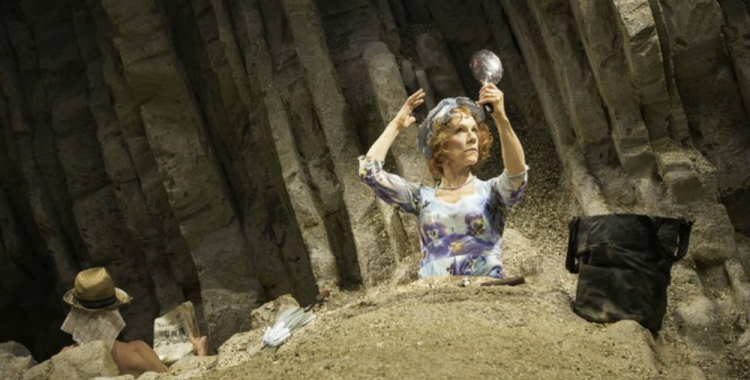
The scorched world of Samuel Beckett’s Happy Days is clearly not a utopia of any description. Indeed, it would not be much of a stretch to describe it as a dystopia. In Natalie Abrahami’s new production at the Young Vic, the striking prison of earth in which Winnie is trapped is less a mound of sand and more an inhospitable, rapidly eroding rock face, sloping sharply down towards the audience. Within Beckett’s demanded limitations, Vicki Mortimer’s design draws out both the precarious nature of Winnie’s predicament and the yearning, upwards movement that pulls in vain against her cruel, unexplained confinement. Add to this sound designer Tom Gibbons’ chillingly discordant “bell”, slicing Winnie’s time into regimented portions of waking and sleeping – not to mention the encroaching possibility that the sand will soon completely bury her – and it looks like a fairly hopeless situation. So what are we to make of Winnie’s stubborn optimism?

Optimism, according to the Oxford English Dictionary, can be defined in two distinct ways. The first, more commonly used definition is hopefulness in a forward-looking sense; the placing of hope in a future outcome. The second definition, however, is the belief that “this world is the best of all possible worlds” – optimism grounded in the here and now. By this definition, as I look around at the grim state of the world we presently live in, I would class as a pessimist. Winnie, however, with her repeated, irrationally cheery “this will have been a happy day”, is an optimist by any definition.

Or is she? Her refrain, significantly, is “this will have been a happy day”, not “this is a happy day”. The happiness is always contingent, always deferred. This statement is often followed, after a pause, by the qualification “so far”, again haunting her contentment with the spectre of future calamities (unsurprisingly, one might argue, given the ever-present threat of suffocation by sand). Time itself is manipulated throughout the play, as in much of Beckett’s work, further complicating matters. Winnie seems, at certain points, to have destroyed the notion of change and the passage of time as a sort of coping mechanism. She insists, illogically, that “nothing has occurred”; even when her umbrella bursts into flame, she calmly observes that it will be back in its old place by tomorrow. Yet there is a definite routine to the way she lives out her days, and a habitual gesturing to both past and future. Her experience of time is less a stretched out, purgatorial present as it is a fluid, mutable marker of existence, and thus her brittle optimism cannot find a firm foundation in any tense.

Juliet Stevenson’s remarkable performance in the Young Vic’s production highlights every last nuance of Winnie’s complex, ambivalent relationship with optimism. Her first expression is an almost grotesque grimace of joy, her face stretching to form a strained mask. There is, proceeding from this moment, a certain deliberateness to Stevenson’s movements, at times becoming an almost mechanical precision. Held static, the thwarted physicality of the rest of her body is channelled through her arms, which she holds like those of a dancer. Each calculated flick of a finger seems invested with some unspoken emotion.

There is something similarly deliberate about Stevenson’s speech – appropriately, for a woman whose existence balances hazardously on words. There is always an effortful edge to her insistent pronouncement of the word “wonderful”, while another of her stock phrases, “the old style”, veers in delivery from cheery to wistful to mournful, eventually becoming stained with desperation. One of Stevenson’s great skills is her ability to load words with heavy yet never overstated meaning; “wife”, rolling laboriously from her lips, is invested with multiple accusations, sighs and hopes. At other times, by contrast, there is an ironic relish to her sentences and a wry ring to her laugh. Out of the bleak, Beckettian gloom, Stevenson’s humour glints brightly.

The overwhelming impression created by Stevenson’s performance is of a woman assaulted by feeling yet grimly determined to remain in control. Her delicate, virtuosic hopping from emotion to emotion is always wrenched back to a dogged cheerfulness, as she fixes her smile with the same care that she fixes her hat. Even her crying is contained, her hands pressing tears back into her eyes. Winnie’s optimism, at least in this production, is not blind or ignorant, nor is it the babbling of a woman who has lost her mind. Optimism emerges as a choice, but it is an unstable one. It has to be worked at.

The more I think about it, the more Winnie’s optimism (if indeed optimism the right word) feels like an apt comment on the situation we find ourselves caught in, particularly at this present moment. Returning to those two definitions, the optimism that many of us feel right now is firmly future tense. We believe, or at least we hope, that things will one day be better; therein lies the critique, as for the situation to improve it must first be flawed in some way. Yet to get by from day to day we, like Winnie, must find some optimism in the present. The system thereby bends us towards the second definition of optimism and the acceptance that ours is “the best of all possible worlds”. Unable to fully resign ourselves to this, perhaps we also hover somewhere between the two, determinedly injecting our lives with cheer and deferring, along with conflicted Winnie, our own happy days.

For another consideration of optimism in Happy Days, see Dan Hutton’s essay

Photo: Johan Persson.

Blurred Lines, National Theatre

blurred-lines-600x374

Originally written for Exeunt.

Back in November of last year, myself and others were questioning the underrepresentation of female playwrights in the National Theatre’s 50th anniversary gala – and in its programming more broadly. Now, only a couple of months later, the fierce final scene of a new show with an all-female cast and a majority female creative team boldly critiques the venue’s gender inequalities from within its very walls. It’s nowhere near a solution, and one self-reflexive show in the theatre’s smallest, most risk-friendly space is no reason to get complacent, but it feels like a start.

The context for Carrie Cracknell and Nick Payne’s new show is right there in the title. Robin Thicke’s misogynistic song and accompanying video were just the most visible tip of the iceberg in a year that outdid itself in terms of casual sexism and media objectification of women. But 2013 was also a year in which feminism was very much part of the public discourse, a discourse that Blurred Lines continues. It is less a play than a theatrical conversation; an ongoing discussion about insidious, background sexism in its many mutating forms.

The show, devised by the company with Cracknell and Payne, promises to interrogate all areas of gender politics, from the media to the workplace to the home. It’s a big ask. To tackle these myriad forms of sexism, the piece deploys what are perhaps best described as a series of sketches. We see, for instance, a conversation between a married couple about the husband’s visits to prostitutes; the repeated shooting of a television scene in which a woman is assaulted; an office confrontation in which it is made clear that success for a few individuals does not translate into equality for the many. Given the force with which that latter point was made in Top Girls in 1982, it’s telling that it still needs to be reiterated.

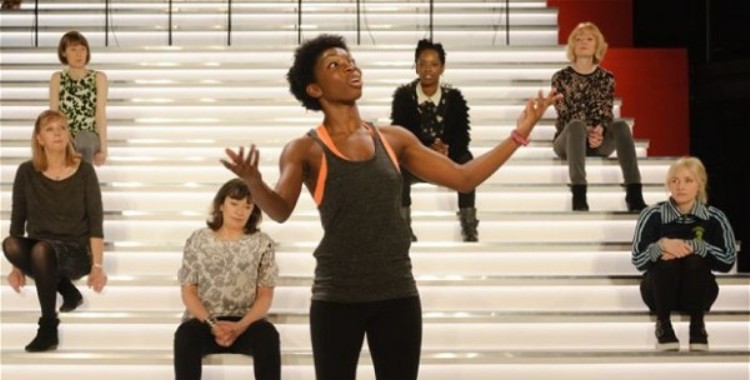
These swift, punchy scenes, punctuated with performances of songs that cheekily and sometimes explosively critique the depiction of women in popular music, are all played out on the huge white staircase of Bunny Christie’s design. This installation, complete with colour-changing lights, boldly thrusts out into the Shed’s modest performance space, itself acting as a sort of intervention. It frames the female performers in ways that at times reflect the objectifying aesthetics of music videos and advertisements, but at others set up an uncomfortably close confrontation with the audience, while the steps themselves are suggestive of the distance that we still have to climb.

But what Blurred Lines is perhaps most successful at exposing is the sexism that remains rife within theatre itself. The piece opens with a series of statements spoken in turn by the performers: “girl next door”, “single mum”, “Northern blonde, bubbly”. It soon becomes clear that these are roles, referring at once to casting types, dominant cultural perceptions and the desperately restrictive boxes that women are expected to fit into in everyday life. This critique of what roles women are allowed to play remains implicit throughout, coming to a head in the final scene. While this powerful conclusion risks being something of a theatrical in-joke, alienating those who might not catch its shrewd self-referential nods, it is an important move towards theatre owning up to its own failings when it comes to gender (in)equality.

Representation is also at stake in other ways. Throwing together a cacophony of female voices, the piece is careful never to directly speak for or represent any one woman. When an individual’s story is told, as in the narrative of a teenage girl who is sexually assaulted by her partner, it is transmitted through multiple voices and in a fragmented structure. Straightforward portrayal of anyone who might be construed as a victim – perhaps most prominent among the roles available to women – is deliberately avoided. This also points, though obliquely, at the persistent tendency to take one woman as a representative for her entire sex, a tendency that the company stubbornly refuse.

On another, simpler level, the very fact of an all-female cast does interesting things to the staging of sexism. Every male character in the piece is, necessarily, played by a woman. This inversion makes an intriguing contrast with, say, Three Kingdoms, which despite sharply skewering misogyny, still placed it – potentially problematically – in the mouths of men. In this production, the exchange of misogynistic expressions between an all-female cast furiously underlines them, while managing to subtly subvert these views at the same time as reproducing them.

Yet women are still, with unsettling frequency, seen as victims here. That ranges from victims of violence to victims of workplace prejudice, but time and again they are rendered voiceless and frustrated. The intention is understandable; like the Everyday Sexism project, the piece attempts to unmask the latent sexism that pervades our society, often going unnoticed and unremarked upon. The bitter familiarity of many of these scenes provokes both recognition and discomfort, but it leaves us mired in our current situation rather than looking towards any solutions.

Of course, the very existence of this production and its team of talented women is a form of action in itself, and perhaps it is apt that we are left to continue the conversation and fight ongoing injustices. To downplay the scale of inequality and let the audience off the hook would be irresponsible. Nonetheless, there is something a little disheartening about a piece of theatre with such fire in its belly that insists on simply presenting and representing all too familiar portraits of sexism and victimhood.

The Body of an American, Gate Theatre

body1-600x399

At the time I saw Chimerica last year, I found myself preoccupied with the idea of the photographic image. A play that promised – in its very title, no less – to be about the relationship between China and America struck me as having many more interesting things to say about the nature of the image and the knotty ethics of photojournalism. Not long after, I read both Susan Sontag’s essays on photography and Vivienne Franzmann’s 2012 play The Witness, which also folds its dramatic possibilities outwards from an image taken in the midst of violence. All ask interconnected questions. What is the currency – both economic and political – of images? What does it mean to bear witness? And is to observe to also and inevitably turn away from intervention?

Repeating those questions, The Body of an American might now be added to Chimerica and The Witness to form a fascinating trio of twenty-first-century plays with photojournalists at their hearts. Like the other two shows, Dan O’Brien’s tense, muscular play is concerned with the haunting legacy of a famous image – as well as much else besides. Taking as its starting point the long email correspondence between the playwright and his subject, Canadian photojournalist Paul Watson, the play painfully dissects the psychological damage of Watson’s work and the personal demons of both men. While there’s certainly something to be written about the relationship between this, Chimerica and The Witness (and indeed the renewed interest that might have provoked all three plays), The Body of an American alone offers so much to process that it feels necessary to narrow the lens for the time being. So where to start?

There is, first of all, an intriguing relationship with authenticity that is persistently pointed to by the Gate’s production. Even before the performance begins, The Body of an American prompts us to engage with questions of veracity. On filing into the claustrophobic, snow-lined bunker that designer Alex Lowde has constructed inside the Gate’s already intimate theatre, our attention is immediately drawn to the two screens bookending the space, both projected with the same statement that everything we are about to see and hear was produced or captured by O’Brien or Watson. At the outset, the show very deliberately announces both its truth and the vantage points from which that truth is to be told.

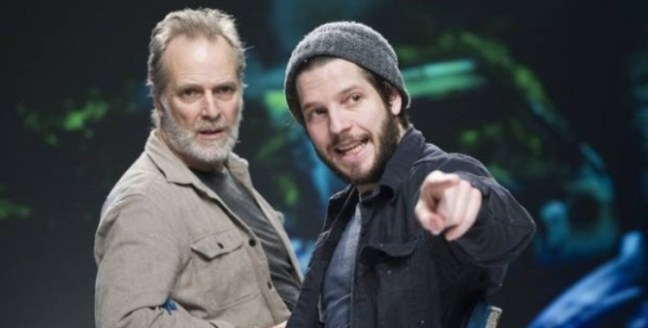
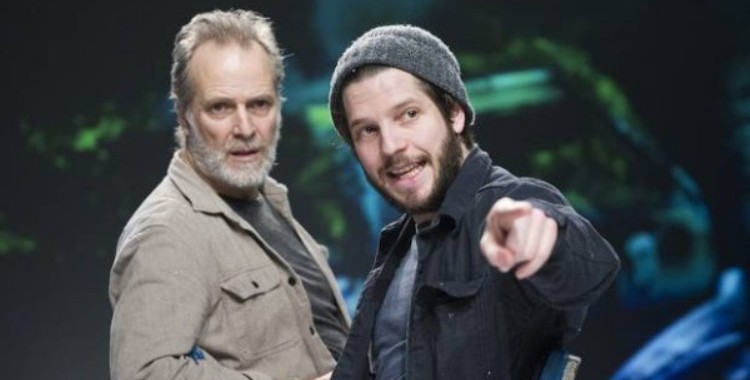
What becomes clear as the piece unfolds is that the play has been constructed from a combination of the two men’s words, drawing on their long email correspondence, their eventual meeting in the Arctic, and other documentary materials. This is all compellingly delivered by just two performers: William Gaminara as “Paul” and Damien Molony as “Dan”, with both also standing in as the large cast of supporting characters (although Gaminara and Molony effectively portray Watson and O’Brien respectively, they are of course distanced representations of real people, so let’s just assume the quotation marks from here on in). The Body of an American is, essentially, a verbatim show.

And yet O’Brien has sculpted his own form of documentary theatre from these many fragments. The story he originally wanted to tell was that of Watson, the Pulitzer Prize-winning photojournalist who has documented atrocities across the world. O’Brien was drawn to Watson while attempting to write a play about ghosts; Watson, the haunted man, became his new subject. What The Body of an American has turned into, however, is a play documenting the process of documentary theatre, jumping frenetically between emails, conversations, recordings and reflections. The text is lyrical but dense, its restless movement demanding total concentration from an audience.

As well as continually hopping about, the whole thing constantly gestures to its own construction, telling its audience as much about O’Brien’s efforts to write it as it does about the life of the man he has attempted to put on stage. In this way, The Body of an American deftly sidesteps the more problematic elements of verbatim theatre. Despite that initial declaration of authenticity – which I suspect is as much to train the audience’s minds on the idea of authenticity as it is to reassure us of the show’s truth – there is no question of obscuring the process of editing in an effort to pretend to absolute, unmediated truth. The play is, unapologetically, just one version of reality.

The same might be said, rather aptly, of a photograph. Photographic images purport to be snapshots of the truth, images of reality, but someone always has to frame them, to isolate that particular moment in time and decide that it is worth capturing. Paul’s words even refer to this. The most important photograph in the play is the one that sealed his success and his torment, both winning him the Pulitzer Prize and haunting him for life. In the moment of taking the infamous image, which shows a US soldier’s battered corpse on a street in Mogadishu, he talks about framing it better, about getting the right shot. Part of what tortures Paul throughout, perhaps, is the disconnect between the truth he endlessly seeks and the artificiality of how he tries to capture it.

For all that the show’s content is dark, disturbing and infected with a pervasive sense of melancholy, James Dacre’s production delivers this difficult material with a sharp kick of adrenaline. The pace rattles furiously along, sweeping its audience up in the same addictive thrill that keeps Paul doing what he does. In this way, the production is very good at complicatedly recognising both the compulsive excitement of Paul’s work and the gnawing depression that is, the piece implies, both a symptom and a cause of his chosen career. As the show goes on, it becomes increasingly clear that the same deadening sorrow eats away at Dan; there are moments when a chilling, identical look of desolation pours out of both Gaminara’s and Molony’s eyes.

As much as anything, it occurs to me about halfway through, The Body of an American is about relationships between men. The strange yet moving central friendship between Dan and Paul is the most obvious of these, but their respective relationships with the men in their families loom large, as does Paul’s unbreakable link with the ghost of the man he ironically immortalised. It is often the damage of these male relationships that binds Dan and Paul closer together, linked by their common losses and their struggle with normative ideas of masculinity. In their depression, their loneliness and their retreat from society, the two men seem more and more alike; two broken individuals in a broken world.

On reflection, it strikes me that the photojournalists in Chimerica and The Witness are also male – perhaps not without reason. All three photojournalists, real and fictional, are observing from a position of white male privilege; their gaze is especially problematic because of the troubling power balance between watcher and watched. In his review, Andrew Haydon brilliantly articulates the significance of choice in the situations depicted by the play, which he argues is a central characteristic of privilege itself. The privileged choose to look on wars and atrocities, to seek them out and capture them for the eyes of people living on the other side of the world. Those caught up in the midst of conflict or disaster simply have nowhere else to look.

The tight, intelligent layout of Dacre’s production also makes an audience’s gaze loaded. Those all-important screens at either end of the performance space play host to projections throughout the show, showing harrowing selections from Paul’s back catalogue of warzone horrors. Because of their positioning, these images never directly confront us, meaning that – like Paul – we have to very deliberately look if we want to comprehend the images in question. Though, actually, this isn’t quite true. There is a choice involved in looking at the photographs full-on, in all their horror, but the haunting fact of their presence is unavoidable, flickering away at the peripheries of our vision. Like the tightly packed ideas in the play, they dance around the edges, framing the electrifying action at the centre of the piece.

As well as the obvious comparisons to be made with Chimerica and The Witness, Andrew links The Body of an American with Grounded, another Gate show that was equally electric, equally intelligent and equally concerned with America. I’d argue that it also demands to be considered alongside No Place to Go, the third production in a season that the theatre pointedly framed with ideas of work and modern American identity. Despite their differences (and No Place to Go is in most respects very different to the other two productions), what I found myself taking away from all three shows was their deep sense of loss – a loss often stained with bitter disillusionment. Which, taken as a collective statement, seems to say a lot about the USA, our external perspective on it and the modern world more widely. A grim image indeed.

P.S. I will, one day, write the essay I have simmering away about photography, photojournalism and the ethics of the image in The Body of an American, Chimerica and The Witness …

Photo: Tristram Kenton.

The Reimagined Flâneur

I wrote the below a few months ago to enter into the Observer/Anthony Burgess Prize for Arts Journalism. Needless to say, it didn’t get shortlisted, but I thought I might as well post it here.

48840006

Framing his iconic portrait of the flâneur, that emblematic figure of urban life, Charles Baudelaire described him as a “passionate spectator” – an individual of feeling, but one who remains detached from the crowd even as he moves within it. For Baudelaire, it is the fate of the flâneur “to be at the centre of the world, and yet to remain hidden from the world”. Today, fighting one’s way through swarming city streets where every last move is inscribed on CCTV footage, it is a struggle to conjure up Baudelaire’s leisured man of the crowd, or even Walter Benjamin’s alienated urban onlooker. For 21st-century would-be flâneurs, walking is less an activity than an obstacle course.

In the midst of this relentless urban clamour, Rosana Cade’s Walking:Holding extends a fresh invitation to stroll and observe. In joining Cade’s journey, however, we are denied the cool, detached voyeurism of the flâneur. In common with the demands of Baudelaire, this is a piece that asks us to pause, to walk without purpose, to consider our surroundings. But at the heart of Walking:Holding, on the opposite side of its central pairing, is a provocation to engage.

Cade’s premise is simple: her one-to-one, site-responsive performance pairs each individual audience member with a series of strangers, with whom they are asked to hold hands as they walk through the streets. The piece has been mounted in various different towns and cities – most recently London – with different local performers, reconfigured each time to slot into its new urban context. In this sense, more so than much other work that masquerades under the same label, it truly is responding to its surroundings, moulding itself around the new city it finds itself in.

Simple though Walking:Holding may be, however, it is also a knot of contradictions. It offers up intimacy, but within safe boundaries; it demands engagement, yet in the same movement disengages its hand-holding couples from the city around them; it suggests common experience, while simultaneously acknowledging difference. It is as complex and paradoxical as the city itself, with its ever-growing crowds and ever-increasing atomisation. The bright lights of the urban playground promise countless possible encounters, but frequently offer nothing but loneliness.

In contrast with this idea of loneliness, it is the act of hand-holding itself that becomes the first object of attention in my own lingering stroll around sun-drenched East London. The conversations that unfold with each of my partners are gently, almost imperceptibly guided, steering me towards my own attitudes to intimacy. “When did you last hold hands?” one performer asks, his fingers reassuringly entwined with mine. As I offer my answer, another contradiction occurs, between the physical act of holding hands and the emotional closeness it represents. For such a basic form of contact, it can be taken to mean a hell of a lot.

Despite all this personal reflection, the performance casts its gaze outward as well as inward. Cade asks us to look and be looked at; to open our eyes to the visual richness of the city and imagine how we are painted within it. The first hand-holder of the performance is Cade herself, who shares her experience of coming out in her small hometown and the discomfort she felt when holding hands publicly with her first girlfriend. From this anecdote onwards, considerations of sexuality and its perception are implicit within the walk, which places participants in a variety of different gender pairings. Holding hands variously with a woman, a man, a transvestite, I am silently invited to consider how my image is altered by being physically linked to these individuals, and how this in turn might shift my own perspective on familiar city scenes.

To this end, the route that Cade has meticulously crafted incorporates a number of reflective surfaces, from shimmering office block windows to smudged pub mirrors. Our manufactured couples blink back at us, challenging the way we see both ourselves and those around us by making our own reflection somehow other. It feels contrived, sometimes nigglingly so, but to powerful effect. With a slightly transformed view of oneself, the wider view also mutates, like turning the dial on a kaleidoscope. The streets and its inhabitants come under new, more imaginative scrutiny, extended with empathy rather than suspicion.

Remapping cityscapes is hardly a new concern for artists; urban audio tours and promenade performances have been doing it for years, often hand in hand with the fashion for psychogeography. Here, however, this strategy of urban re-landscaping functions with fresh effect because it works at the level of the personal, rippling outwards from the two clasped hands at its centre. With each new partner and turning onto each new street, we encounter a different version of ourselves and – as a consequence – of the world we construct around us.

Theatre that demands its audience members to take a more active role, from the immersive landscapes of Punchdrunk or Shunt to the startling intimacy of one-to-one performance, has become somewhat ubiquitous. Often the objective of these shows is to activate theatregoers, to make them a vital part of the performance in a way that recruits more than just their imaginations. Walking:Holding, however, is less an invitation to perform than it is an invitation to recognise that we are always already performing, always presenting edited versions of ourselves to the world. The only person Cade asks us to perform is ourselves, at which we are all practiced masters.

And here, perhaps, is where we return to the flâneur. Baudelaire’s detached artist-poet, his invisible man of the crowd, paints the heaving metropolis while erasing himself from the picture. His own performance is one of obscurity – though, admittedly, the stereotypical image of the aloof flâneur leading his tortoise on a leash through the arcades of Paris is about as theatrical as they come.

Cade, however, does not allow participants this self-erasure. The flâneur – who is, after all, a figure of the 19th and early 20th century rather than a contemporary reference point – is never an explicit influence for the performance, but the enduring intellectual fascination with this figure sits somewhere beneath its quiet contemplation of intimacy, sexuality and public space. By revealing us as a performer in the city, our new variation on the flâneur is allowed to be at once an observer and an actor, carrying with it the possibility of action as well as engagement.

This recalls another performance artist, Jenna Watt, whose Edinburgh Fringe show last year made deliberate use of Baudelaire via Benjamin. Flâneurs reflected on modern street violence and the bystander effect, appropriating the image of the flâneur as a route into an examination of what stops us from intervening. We are all guilty of crossing the road to avoid trouble, of failing to step in when perhaps we should have done, but why?

As Watt recognised, the danger of Baudelaire’s or Benjamin’s flâneur is that his required distance removes his ability to engage with, intervene in and therefore change the world he observes. He is painted over, allowing his brush only to reflect the outlines he sees. Walking:Holding, by placing human contact and self-performance at its heart, returns us to the picture.

The Pass, Royal Court

pass-600x398

Originally written for Exeunt.

Following Thomas Hitzlsperger’s decision to publicly come out, renewed focus has fallen on the prejudice still faced by gay footballers, bestowing something of a mixed blessing on the Royal Court’s latest offering. On the surface of it, John Donnelly’s play is “about” a premiership footballer struggling with his sexuality, which he stubbornly refuses to define or discuss. But it also touches on lots of other things – fame, money, friendship, competition –which get slightly elided in the wake of its sudden topicality.

The play, following a familiar trajectory, traces the journey of footballer Jason (the ever-excellent Russell Tovey) from early promise through to the giddy zenith of fame, plotted out via three pivotal moments in three different hotel rooms. Its first scene, while slow to develop, offers plenty to relish. Jason and best mate Ade (Gary Carr) are killing time on the night before the biggest match of their lives – two tensely coiled springs in close proximity. Their relationship and its silent undercurrent of mutual attraction are believably and wittily sketched, as laddish banter gradually gives way to compelling tenderness.

Cut to seven years later, when Jason has gained fame and fortune but lost the puppylike glimmer of mischief that so animated him on his first appearance. This is where the piece begins to slacken its initially confident grip, taking a long time to get anywhere. The scene’s encounter between Jason and table dancer Lyndsey (Lisa McGrillis), though enjoyable, feels convoluted and contrived for the sake of a plot point that could be achieved with much less meandering. The swagger returns after the interval, as Jason and Ade are reunited for a hedonistic night that crackles with danger and desire, but it’s hard to shake the suspicion that this is a script in need of some tightening.

Alongside the main thrust of the plot, there are also some more ambitious shots which – though on target – rarely hit the back of the net. Buried within the classic tale of fame’s empty promises is an implicit critique of the parameters of success in modern society, most of which rest on money. Competition, in life as in sport, also receives a bit of a battering; the sense is that this, more than anything else, is what drives a wedge between Jason and Ade, while Jason’s desire to win leaves him cripplingly lonely. But these avenues are left frustratingly underexplored.

Despite its weaknesses, however, Tovey holds the piece together in a remarkable central performance. From his first youthful grimaces of self-congratulation, furiously skipping to the imagined roars of the crowd, to the hunched husk of a form that he becomes in the final scene as he bends determinedly over his exercise bike, Tovey’s every last muscle is employed in fleshing out the character of Jason. Astonishingly, he seems to age physically as well as emotionally, subtly transfiguring himself before our eyes as he progresses from enthusiastic newcomer to hardened veteran. One imagines that he behaves on the football pitch as he does in life – dodging, sprinting, pulling off slick manoeuvres without breaking a sweat, yet all underscored with a faint attitude of desperation.

This is reflected in John Tiffany’s production, which marries polish with uncertainty, machismo with vulnerability. There are also brilliant outbursts of playfulness, Jason and Ade’s gleeful trashing of the hotel room in the final scene being one of the most entertaining, though these do not always sit comfortably with the rest of the action. More could perhaps be made of Laura Hopkins’ clean, slick design, capturing both the attraction and the cold impersonality of the hotel room setting. It’s a canny choice of location, at once encapsulating glamour, escape and loneliness. I’m particularly struck by Lyndsey’s loaded observation that “tomorrow someone will come in and clean this all away”; a simple factual statement that resonates deeply with Jason’s transitory, unfulfilled existence.

As the piece closes, however, it leaves the nagging sense of something lacking. Ultimately, the main disappointment of The Pass is that it fails to add anything significantly new to the discussion it engages with, leaving my opinions on its subject matter little altered or challenged at the end of two and a bit hours, in spite of many intriguing turns along the way. But this is, perhaps, less a failure on its own terms than on the terms of the media discourse surrounding it. Timeliness, it seems, is something of a double-edged sword.