Rosie Wyatt

BLINK_3_Rosie Wyatt as Sophie_Photo Sheila Burnet (2)

Originally written for The Stage.

Rosie Wyatt loves to look audience members right in the eye. In Bunny, a solo show about a teenage girl increasingly out of her depth, she offered an intense portrait of adolescent swagger and anxiety, breathlessly delivering Jack Thorne’s narrative directly to the audience. In the absence of connection and intimacy available to her character in Blink, she instead gazed outwards, finding points of contact with spectators; even delivering a script-in-hand reading, her stare can penetrate right through a play.

“It’s just about being really honest and genuinely telling a story,” Wyatt explains when we speak, quickly adding, “not acting talking to the audience, but actually talking to the audience. That sounds like something really simple but it is very different.” With care, she discusses the unique demands of direct audience address, in which “the audience are your other character”.

“If you act a traditional scene with dialogue, you’re always looking at how you’re affecting that other person and what you want to do to that other person in the scene. When you’re talking right out to the audience it’s the same thing: it’s what do I want to do to the audience, what am I trying to tell the audience?”

This way of relating to an audience was initially developed while performing in Bunny, Wyatt’s first job out of drama school. Thorne’s blistering monlogue went to the Edinburgh Fringe in 2010 – where it won a Fringe First – travelled down to London for a run at Soho Theatre, and eventually ended up in New York as part of the Brits Off Broadway season. “It couldn’t have been a better start for me really,” says Wyatt, describing herself as “incredibly lucky”. “You can’t ask for more from a first job: for it to be able to give you your debut, your London debut and then your New York debut.”

But it must have been intimidating to take on a one-woman show straight out of drama school? “Yes, petrifying,” Wyatt says with a laugh. “It was an amazing experience because I got this showcase that was just me, but it was also incredibly exposing and scary.”

This showcase certainly opened doors; “it got me in front of people and got me to meet a lot of people,” Wyatt says. The play’s success quickly led to her second job in the Paines Plough tour of Love, Love, Love, and she says that even her casting in this year’s national and international tour of One Man, Two Guvnors can be traced back to that first job. Other gigs to follow the acclaim of Bunny have included roles in Mogadishu, Blink and most recently Virgin – all new plays.

Despite this impressive track record with new writing, Wyatt reveals that her passion for acting has much more traditional roots. “I sort of fell in love with the theatre because of Shakespeare,” she tells me, recalling the regular trips she used to make to RSC productions while she was a sixth form student in Stratford-Upon-Avon. “I hadn’t really known about the world of new writing until I stepped into it doing Bunny,” Wyatt admits. Now, however, she describes working on new plays and originating roles as “the biggest joy” of what she does, adding, “I feel very happily placed in the world of new writing”.

The other notable feature of Wyatt’s career to date is the amount of touring work she has taken on. As well as the tour of One Man, Two Guvnors, which visited destinations such as Australia, New Zealand and Hong Kong, Wyatt has taken to the road with Bunny, Love, Love, Love and Mogadishu. “I don’t think it gets any easier,” she says of the touring lifestyle, “but I think what you do is learn your way of doing it that keeps you sane.”

What she relishes, however, is the opportunity to constantly perform in front of new audiences. “Every play I’ve done, you find that you get different responses in each city,” Wyatt says. “That’s so interesting and that’s something that I feel like I’ve been really lucky to get to do.” While these regional and cultural differences can sometimes be challenging – particularly when elements of the humour in One Man, Two Guvnors got lost in translation – Wyatt explains that “you just learn to always bring to it the same energy and always give that best version of the performance that you would want to give”.

Wyatt will soon have the opportunity to travel again as she returns to Blink, which is going out to India before opening for a second time at the Soho Theatre in December. Phil Porter’s off-kilter romance, which Wyatt first performed in at the Edinburgh Fringe last year, tells the story of an unusual relationship between two shy outsiders – not the most obvious export. Wyatt confesses that she’s got “no idea how they’re going to engage with our little love story”, but she is excited to return to the play.

“I think actually the experience of re-rehearsing something having had some distance and some time away from it is really quite valuable,” she reflects. “Returning to a script you already know but with fresh eyes is really useful and makes for an interesting production. In a script as good as the one Phil has written, there’s always more to be found and more to get to know about these two characters.”

Photo: Sheila Burnet

The Lady’s Not for Walking Like an Egyptian, Ovalhouse

lady-ovalhouse-600x374

Originally written for Exeunt.

“Can we finally be post-Thatcher?” asks nat tarrab, arms flung out in a gesture of frustration. The performer, one half of Mars.tarrab, doesn’t want to make a show about the Iron Lady; the duo already made that show earlier this year for Ovalhouse’s Counterculture 50 season. Then, just six weeks after the run, Margaret Thatcher died. But, contrary to tarrab’s hopes, Maggie’s legacy is far from departed.

This simultaneous presence and absence persistently haunts Mars.tarrab’s reworked version of The Lady’s Not for Walking Like an Egyptian, which – like the country itself – can never quite shake off the ghost of Thatcher. Bounding onto the stage in neon lycra and legwarmers, Rachel Mars and nat tarrab promise to transport us back to the 1980s, the decade of Madonna, monetarism and the mega musical. But these are not the “plastic fantastic” 80s, tarrab insists; this is a decade of monumental political struggles and shifts. As Mars.tarrab go on to demonstrate, however, the two are not necessarily distinct.

The driving tension at the centre of the piece stems from the two women and their very different experiences of the decade they are attempting to evoke. For Mars, who was a child of ten at the close of the 80s, it represents the era of Cats, lycra cycling shorts and Jennifer Rush’s “The Power of Love”. Tarrab, on the other hand, was eighteen by the end of the decade and actively protesting against the destruction wreaked by Thatcher’s policies. At the outset of the show, their experiences of the 80s are mapped out on their bodies with coloured tape, a playful but knowingly inadequate visual representation of the dramatically different but equally lasting impressions left on them by the decade. They are both, in contrasting ways, Thatcher’s children.

This tension, established early on, remains taut throughout the show. Mars.tarrab have the appealing, combative chemistry of a double act: Mars short, playful and frenetic, tarrab tall and full of righteous rage. Their competitive dynamic and apparently incompatible views of the 80s act as a motor, powering the piece forwards at a furious pace through the Faulklands, the free market economy and Section 28. The inspired framing device of the show, meanwhile, is also born through a kind of conflict, as Thatcher’s speeches are spliced up with lyrics from songs by female artists of the decade. Monetarism meets “Material Girl”, while homophobic rhetoric enters a head-on collision with Whitney Houston.

Out of this structure of conflict and juxtaposition emerges a show that is equal parts hilarious and heartbreaking. The utterly bonkers joy of the two performers on space hoppers jars painfully with the sinking of the Belgrano; tarrab’s deeply felt objections to representing Thatcher are silenced with a showering of milk. There is, both in the positions represented by each of the artists and the string of contrasts throughout, a duality that reflects the problematic legacy of Thatcher and the decade she dominated. One is given the impression, despite the resistance to this idea, that there is no going back to before – before Thatcher, before the free market, before everything that is now so embedded in our society – and that Mars and tarrab’s opposed experiences will never quite be reconciled. Even at the show’s beautifully judged climax, which recognises and seemingly relents to the seductive power of nostalgia and sentimentality that 80s pop culture understood so well, tarrab stubbornly reminds us that this is no straightforward resolution.

The troubling ambivalence of the decade as seen through the eyes of Mars.tarrab is perhaps best summed up in one moment: Mars as a riotously zealous Thatcher announcing Section 28, while tarrab perches precariously on a teetering pile of chairs, speaking the words of “I Wanna Dance With Somebody” as an anguished appeal to the audience. Like the show itself, it’s a simultaneous punch to the gut and the funny bone, with a queasy aftertaste of discomfort.

The Anatomy of Melancholy, Ovalhouse

melancholy3-small_460_575_95_s

Anyone remember that Russell Howard skit about everything the Daily Mail has reported as increasing your chances of getting cancer? It lands a fairly easy punch, reeling off the ridiculous and frequently contradictory list of factors that have been warned against in the paper over the years. You’re more likely to get cancer if you’re a man, if you’re a woman, if you don’t eat a certain food, if you do eat a certain food – you get the picture. Unexpectedly, it was this video that I found myself thinking of while watching Stan’s Cafe’s The Anatomy of Melancholy.

The book of the same name by Richard Burton on which the show is based is essentially a litany along the same lines as that issued by the Daily Mail, multiplied a few times over. First published in 1621, this 1,424-page tome attempted to comprehensively outline understandings of melancholy and its causes, symptoms and cures at the time. The problem, of course, is that not everyone agrees. One philosopher or scientist recommends one course of action, while another flatly contradicts this. We are recommended exercise, but not too much exercise; study might be a cure, unless our melancholy is born of “overmuch study”.

From this description alone, it hardly sounds like a text that is begging for a stage adaptation. It’s interesting to discover, therefore, that this production is the result of a challenge by a fellow theatremaker to stage a text that would be considered by many as unstageable. And, though The Anatomy of Melancholy is an undeniably unwieldy text, the premise is promising. Both the marketing material and the initial set-up suggest that Stan’s Cafe will be engaging not so much with an adaptation itself but, far more interestingly, with the whole idea of adaptation. How does one even begin to stage a book this long and intricate? How can it possibly be faithful to the sheer volume of information in the original? What does it even mean to be faithful when transforming a work for the stage?

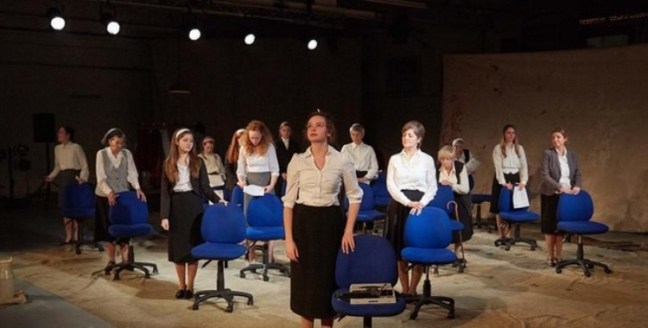
This, however, turns out to be a red herring. There are certainly gestures towards a meta-theatrical framing; the four performers, who don’t seem to have fully agreed on how they are going about the staging, hold scripts in hand, occasionally debating over digressions and scribbling out lines. There is also something intriguing about the decision to distribute Burton’s reflections between more than one performer and emphatically employ the collective pronoun “we”, suggesting the internal discord that is perhaps the source of Burton’s own melancholy. But this device never goes anywhere, taunting us with the unfulfilled promise of flipping the whole piece on its head.

Instead, what we get is a fairly straightforward walk-through of Burton’s text, progressing from causes to symptoms to cures, with particular examples, such as love, highlighted along the way. The whole thing is littered with paper, from the seemingly never-ending flipcharts that line the back of the stage – amusingly recalling both the school and the conference presentation – to the many quotations that are displayed to the audience. This crowded, untidy knowledge is mirrored in Harry Trow’s set, which is, like the studies of most academics I know, a book-filled portrait of ordered chaos. It’s a fitting representation of the mind itself, and Burton’s mind in particular: messy, cluttered, jammed full with competing ideas.

In the process of sorting its way through this jumble of information, the central problem of Stan’s Cafe’s adaptation is that it cleaves too closely to the content of Burton’s book rather than to its spirit. There are plenty of oddities among Burton’s outdated theories, some of which are treated with a light touch of silliness, but it strikes me that there is far more interest to be found in the figure of Burton himself, his compulsion to write of melancholy to escape the melancholy that he himself felt, and the challenges inherent in bringing this work to the stage. By largely ignoring all of this and faithfully conveying Burton’s arguments, Stan’s Cafe assault the audience with a deadening barrage of information, delivered with little variation in pace or tone. The programme warns us that it is natural to drift off, but the show offers little to wake us up again.

The one angle that Stan’s Cafe do seem to take on this material is an attempt to draw attention to certain contemporary resonances. While we can laugh at Burton’s description of the humours, his observations about the prevalence of melancholy and the desperate human desire for a quick fix are equally relevant to us today. In a society where rates of depression are rising and the government is obsessed with “happiness indexes”, there is certainly a case for the prescience of Burton’s text. Money, food and thwarted love are all causes of distress that have persisted down the centuries, while Burton’s description of life as a prison could have been plucked right out of Discipline and Punish.

Rather than shedding any significant light on our present day maladies of the mind, however, The Anatomy of Melancholy seems to shrug its shoulders with an attitude of “twas ever thus”. What we leave with is the same knowledge that we brought in, that unhappiness is an unfortunate but unavoidable fact of human existence. I did find myself contemplating, as I shifted restlessly in my seat, whether it might all be an ironic demonstration of its subject, inducing in its audience the same melancholy that it monotonously dissects. If so, then it unquestionably succeeds.

From Docks to Desktops

Untitled7

What do you know about where you live? The people, the places, the history? My answer to that question would have to be, shamefully, very little. I know the local park where I like to take walks, the cafe that sells the best cakes, the places where you can get your art and your coffee in one revitalising shot. Beyond that, though, I’m fairly detached from any true sense of place, as I suspect many of us are today. In fluid urban landscapes, where home takes on a shifting and provisional character, it’s hard to form meaningful roots.

I open by asking this because it’s a question that implicitly underlies the intergenerational work of London Bubble Theatre Company. Their last show, Blackbirds, collected and told stories about how London Bubble’s local area was affected during the Blitz. Now From Docks to Desktops, which was itself born out of the Blackbirds project, reveals another facet of this community through an exploration of working life and how it has changed over the years. London Bubble’s home in Rotherhithe is at the heart of an area of the city that has seen some of the most dramatic changes to both its landscape and its structures of employment in the last few decades; where once thrived docks and factories is now the home of lucrative property developments and shopping centres. This is the transformation that From Docks to Desktops traces.

Director Jonathan Petherbridge has a particular language for discussing London Bubble’s intergenerational work and it’s a helpful one to adopt. In explaining the process of collecting and curating stories from the local community, he uses the vocabulary of food: ingredients are foraged through a long process of interviews and the findings are prepped by workshop groups before being passed over to professional artists to create a recipe, which will then in turn be tasted and tweaked by everyone involved. It all ends, of course, in a great feast. While this is neat as an analogy, it’s also particularly apt. Preparing and eating a meal together involves an unspoken act of community, one that is also present in this kind of work. It’s a community built on the telling of its own stories.

Untitled3

I recently gave some thought to value judgements and how one goes about critiquing work like this. I should explain at this point that I have a desk in the London Bubble office and have been involved on and off with discussions about From Docks to Desktops since the workshop phase. I’ve attended a couple of rehearsals and a scratch performance, read various drafts of the script and had several conversations about the work. This all constitutes a fairly light and often quite distanced involvement with the show, but nonetheless I’ve been exposed to the process, which is so clearly a huge part of what this piece is doing. Lots of people might only enjoy the feast, but the preparation is just as important – if not more so. Which raises the question, voiced in that earlier piece, of whether it is possible to consider the work without also considering how it was made.

The beauty of From Docks to Desktops, though, is that its process is folded into its product – that’s if the two can even really be separated. The structure of the piece is such that it is framed with its own making, recreating on stage the interview process that yielded all its raw material. The show begins not, as one might expect, in the workplace, but in the home. More specifically, the home of the interviewees, whose words we also hear directly via audio recordings. It is their memories that form the vast majority of the show, but these are presented as a multi-stranded tapestry rather than a flat, straightforward landscape. At some moments we hear their voices, while at others their words come to us through the performers, then at others still their experiences are transformed into poetic abstractions. Unlike many verbatim shows, whose truth claims I nearly always find problematic, here those niggling questions of accuracy and artificiality feel almost irrelevant. Everything is lived experience, passed through more than one subjective filter and viewed through the film of memory. And that’s OK.

It’s in this way that the show recalls ancient oral storytelling traditions, in which the identical reproduction of a tale as it was passed from mouth to mouth was less important than its truthfulness in the moment of telling. There is, of course, a much broader picture also being painted of socio-economic shifts that completely transformed the nature of work in this area, but the piece is as much about the individual and entirely subjective stories it tells as it is about the community they collectively form; in fact, that in itself feels like a false statement, because that community is of course made up of individuals. The other individuals in question here are the performers, many of whom also conducted the interviews that uncovered these stories and whose own working lives are equally given room on stage, binding them in a close relationship with previous generations of workers.

Untitled5

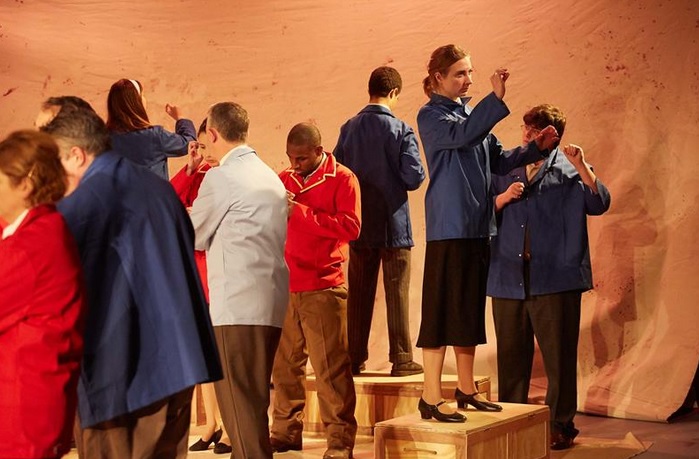
The overarching narrative that can be glimpsed behind the show’s swift succession of anecdotes and workplace scenes is one of change, for better and for worse. The closing of the docks is bitterly mourned in a moving funeral sequence, but we are also asked to witness the hardship of poor working conditions, pay disputes and inequality between men and women. There’s some biting political content (a personal favourite is a scene in which children wearing masks of world leaders play hopscotch, recalling a similar, brilliant moment with a Margaret Thatcher mask in Squally Showers), though this is never at the expense of the stories being told. No place of work is simple; whether dock, factory or office, each is a source of both freedom and confinement, possibility and restriction. It is through this multiplicity of views that the show gains its quiet power, always respecting the place of work in our lives even while questioning it.

The idea of labour is explored at every level of the show, whose stripped back staging makes visible the usually hidden work of making theatre. Scene changes, often involving the conspicuous dragging on and off of materials, are deliberately highlighted rather than concealed with embarrassment. The aesthetic, rather than attempting to polish away its rough edges, instead makes these part of the very fabric of the piece; yes, it can at times be messy or chaotic, but this feels oddly appropriate.

The old, vanished workplace, meanwhile, haunts the senses. London Bubble have not particularly attached From Docks to Desktops to the now fashionable “site-specific” label, but it can lay claim to the true meaning of that phrase more justifiably than many other productions that masquerade under its banner. The show is performed in the old Peek Freans factory, once a major employer in this area and now functioning as a series of offices and studios. Pip Nash’s simple design allows enough of this space to remain visible for audiences to appreciate the history of the site, while also bringing in traces of other workplaces, such as a shipping container that dominates one corner of the stage. The other simple but brilliant touch is to have biscuits baking next door throughout the performance, sending the smells mentioned in the stories wafting evocatively over the audience. (Plus, we’re invited to have a taste at the end of the show – what’s not to love?)

Untitled8

There are, undoubtedly, some flaws. While the rhythm of labour is integral to the piece, this busy hum of activity occasionally threatens to obscure the stories being told, with simply too much happening on stage at once. The most successful moments are often the simplest; in one powerful image of female figures slowly walking into the shadows, for instance, the devastating loss of work and independence for married women is wordlessly conveyed. There is also at times a desire to impress certain messages too strongly upon the audience, demonstrated in particular by a chorus of sorts that threads its way through the piece with mixed success, which seems to be at odds with the subjective plurality and balance exhibited elsewhere.

Whether or not you approve of all the show’s artistic choices, however, it’s difficult to argue with the purpose it has found as both process and product. Through the journey it has taken on its way to the stage and the stories it now shares with its audiences, From Docks to Desktops forms a community that crosses barriers of age and embeds itself firmly within an often neglected sense of place. Petherbridge has coined the term “vernacular theatre” to describe this work; like vernacular architecture, it is “hewn from local material and shaped by local knowledge”. It serves a specific use for a specific community, and its very material is drawn from within that community. Which makes me wonder, as I turn my thoughts again to the question of value judgements: what might vernacular criticism look like?

Images all taken from the gallery on the project’s website.