HAG, Soho Theatre

600x600.fitdown2

Originally written for Exeunt.

It’s not all that often you hear the witch’s side of the story. Wicked aside, fairytale baddies rarely get a chance to set the record straight – a chance that forms the promising premise for The Wrong Crowd’s creative upending of traditional narratives. The company have set their sights on Baba Yaga, the fearsome child-eating woman who pops up throughout Slavic folklore, at times a villain and at others a helping hand. In HAG, however, it is Baba Yaga herself who is in control of the narrative.

In reimagining this folkloric figure, however, The Wrong Crowd are careful not to fall into the trap of replacing one archetype with another and trading evil villain for misunderstood saint. Instead, their version of Baba Yaga offers a complexity not often found in fairytales, where there is little room for grey between the stark extremes of black and white. She might still gobble up children – often with lip-smacking glee – but there’s more to this hag than simple bloodlust.

Writer and director Hannah Mulder’s tale weaves a colourful new tapestry from the many threads of Baba Yaga’s appearances throughout the stories of the Eastern Slavic world, lightly hinting at never fully revealed depths beneath the witch’s terror-inducing exterior. In the hands of performer Laura Cairns, Baba Yaga is predictably, enjoyably cantankerous, but Cairns also allows for moments of quiet stillness, in which an implicit sadness creeps into her portrayal of this formidable figure. The decision to hand Baba Yaga the narrative reins, meanwhile, immediately colours an audience’s perception of the character, as she speaks out to us from her fireside and invites us into her dark but strangely appealing world.

As in their first show, The Girl with the Iron Claws, The Wrong Crowd also provide a refreshingly tough and resourceful heroine, who might not steer entirely clear of common fantasy tropes, but at least offers a welcome alternative to the Disneyfied princess or helpless damsel in distress. Sarah Hoare’s spirited Lisa is lumbered with all the misfortunes that tend to befall fairytale protagonists: a dead mother, an absent father, an evil stepmother complete with two suitably vile daughters. Unlike Cinderella, however, Lisa doesn’t wait around for a fairy godmother to decide her fate; instead, angry and alone, she runs to meet it, walking right up to the doorstep of the universally feared Baba Yaga.

From Lisa’s fairytale heroine credentials to the three tasks that she is subsequently set by a curious Baba Yaga, HAG follows many of the narrative conventions that it simultaneously upturns, always acknowledging the tradition in which it places itself. It’s hard not to wish for something a little more subversive, but there is an indisputable charm to this simple and familiar mode of storytelling, one that the show is perhaps wiser to embrace than to deny. Mulder also takes the opportunity to insert slices of modern wit – Tom McCall’s fastidious underworld bureaucrat is a particular treat – although the desire to engineer gags is occasionally at the expense of narrative sophistication.

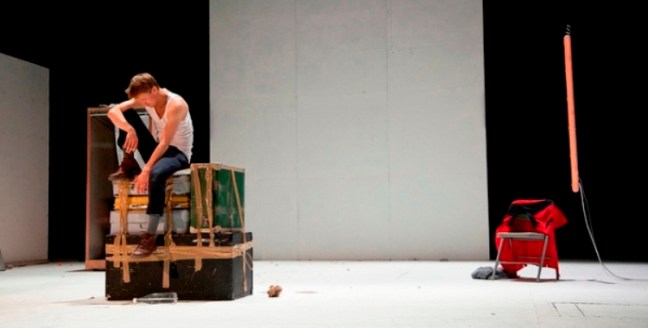
While the story has its flaws and ultimately leaves us wanting more from its intriguing narrator, the visual aesthetic – a clear priority for The Wrong Crowd – is undeniably enchanting. From Baba Yaga’s captivatingly strange appearance to the string of glowing skulls that encircle the stage, Rachael Canning’s design is deliciously dark, with more than a hint of Tim Burton. Gorgeous as it is to look at, however, HAG left me – like its protagonist – still hungry for something more.

Puffball, The Yard

PUFFBALL-11

Originally written for Exeunt.

Caroline Williams is inundated with owl paraphernalia. Bags, cushions, figurines stuffed with stale potpourri. Owl faces peer out from all corners of the stage, eyes wide and unblinking, feathers a variety of colours. All that’s missing is a link to a YouTube video and the hashtag “cute”.

But Williams’ show, unlike the twee figurines that she passes around the audience, only flirts with whimsy. The painted owls are the echoes of a real one, the eponymous Puffball, who Williams looked after and nursed back to health a few years ago. After she and Puffball finally parted company, Williams tells us, friends and family suddenly flooded her with owl themed items, from soft furnishings to pieces of jewellery. The problem is, she doesn’t really want them.

This flurry of well-meaning but unwanted gifts is an apt metaphor for the darker, fast-beating heart of the show, buried beneath the fluffy feathers. At the same time as Puffball was recovering from his injuries, Williams was also trying to get better, although her wounds were not visible ones. Somewhere between the laughter, the figurines and the charmingly simple Microsoft Paint illustrations that are projected onto the back wall of the Yard, Puffball obliquely but painfully conveys the experience of depression. The owl offerings – simplified and infantilising versions of the real thing – can be read in this context as misguided attempts to understand the tangled complexities of mental illness; given with the best of intentions, but unhelpful nonetheless.

This is never quite as simple, however, as a human story seen through that of an anthropomorphised animal. True, Williams offers Puffball an acute, troubled consciousness, evocatively narrating his emotions – from the paralysing terror of falling from the treetop canopy to the numb apathy of his slow recuperation. But this is countered with an insistence that what we are being told is purely the “truth” about owls, an insistence that is reiterated by punctuating the show with a series of “owl facts”, delivered in the forcefully exuberant style of a children’s nature documentary. Williams implicitly acknowledges the absurdity of projecting human experience onto an owl, an acknowledgement that gradually folds the narrative back onto her.

Despite the personal proximity of events, which seeps through in brief but heartbreaking moments of vulnerability, Williams is a warm and involving presence, effortlessly recruiting her audience to take part in some of the show’s sillier sequences. One such scene involves us all standing up and flapping our arms, feeling at once daft and oddly joyous. The participation can at times seem clumsy and slightly detached from the piece as a whole, but perhaps this dislocation is fitting. We are kept at arm’s length from the experience of depression, itself an isolating illness. The most powerful point in the narrative arrives when Puffball and his human carer look at one another, recognising what the other is, but neither can hear the other’s words. In one devastating moment, connection is suggested, attempted and cruelly denied.

Photo: Paul Blakemore.

Keeping the Secret

9802714633_caebd5356a_z

Originally written for Exeunt.

There has always been a certain tension at the heart of the Lyric Hammersmith’s new project. One manifestation of this tension emerged in the opening lines of Sean Holmes’launch speech, which was paradoxically required to contain both arrogance and humility – “Arrogance because there is definitely something provocative and cocky in the gesture we are making, and humility because we are aware of that arrogance and hope that it reflects a desire in our audience”. Secret Theatre is a project that strives to both explode and build, to create something new while drawing inspiration from past endeavours, to maintain secrecy at the same time as being inclusive, to challenge the supremacy of the text while not entirely departing from its spirit. It’s no easy task.

There is also something a little disingenuous about assessing this task now, after the first two shows have opened. Secret Theatre is taking place over a year, establishing a permanent company of ten actors and ten creatives to work on a series of shows in repertory, through a process that is continually adapting to the space, the people in it and the audiences coming through the doors. It is a structural shift over many months, and its real value lies in its impact as a whole endeavour rather than in the individual shows that are emerging from it. So the current view is necessarily a limited one – just the first glimpse of a much wider picture. This response, therefore, must also be a glimpse, an early set of impressions rather than a comprehensive critical overview.

The element of the project to receive most attention at this stage is embedded in its very name – the “secret” part of Secret Theatre. One of many risks the Lyric is taking with this season is the decision not to release the names of the shows, instead referring to them as Show 1, Show 2, etc. The stated aim of this decision is to “counter a prevailing culture saturated with information”, allowing theatregoers to experience work without the burden of expectation. Since its launch, however, the secrecy of the project has come to acquire lots of other connotations, many of them highlighting that central tension. It functions as a sexy marketing tool, but it is also in danger of implying exclusivity. It erodes at the notion of theatre as commodity, yet it is problematic in the risk it asks audiences to take in shelling out money on an unknown.

It remains uncertain just what effect this secrecy will have in the longer term, although it’s unfortunate – not to mention a little ironic – that this has so far overshadowed the shows themselves. To approach the work in the spirit of its creation, however, I’ll be keeping the secrecy intact as far as possible. Whatever the other implications of the “secret” tag, it feels churlish to deprive anyone of the heady thrill of sitting in an auditorium buzzing with the kind of anticipation that only comes from going in blind. Anything might happen.

And this spirit – this breathless sense of the unexpected – runs right through the metabolism of both productions, even once they reveal their titles. Show 2 does not remain a mystery for long, with an early line clearly determining the familiar classic text, but the revelation takes nothing from the vitality of this interpretation. It might not be quite the theatrical hand grenade that Holmes promised to lob in his interview with Matt Trueman, but it somehow manages to strip itself of the kind of baggage that its iconic female protagonist drags on in a towering collection of suitcases.

In common with the troublingly clinical, synthetic eroticism of Three KingdomsShow 2manages to be at once achingly sexy and stylishly cold. The plot is centred on two sisters (Nadia Albina and Adelle Leonce), both of whom find themselves far from their privileged rural upbringing in the cramped claustrophobia of the city, and both of whose lives are shaken by the impulsive violence of the younger woman’s husband (Sergo Vares). In this version, sexuality is repeatedly foregrounded, as performers undress at the front of the stage and Leonce suggestively licks ice-cream from a spoon. But any sensuality is underscored with a hard edge of menace. No one exemplifies this better than Vares, whose muscular presence hints at the animalistic traits attributed to his character, but who maintains a deeply unsettling aura of control even in the fiercest of his rages.

Alongside themes of sex, gender and violence, this production also draws out a thread of fragile hope and imagination. Hyemi Shin’s clean, pleasingly minimalist set is something of a blank canvas, onto which Albina’s delicate, damaged escapist can project her desires. Brightly coloured balloons are symbolic as well as celebratory: hopeful and captivating, but easily punctured and deflated. The aural landscape of the production, meanwhile, is filled with a series of intoxicating Motown tunes, each truncated as abruptly as the protagonist’s dreams. It all makes perfect sense, but as metaphor rather than literal representation. As Albina declares “I don’t want realism, I want magic”, it’s hard not to nod emphatically.

Show 1, while grappling with an equally revered play, has the benefit of reimagining a text that is already fragmented and incomplete. This is where the non-literal, symbolic approach of the Secret Theatre team really pays off, exposing an ugly, oozing wound right in the middle of a play whose implicit social critique is suddenly painfully explicit. Here, the central character (Billy Seymour) is stuck on a punishing treadmill, trapped in a life of unremitting poverty and toil. To eliminate any doubt about the impossibility of his situation, Seymour is tethered to the middle of the stage, able only to go round and round on a pre-determined path, always running but never getting anywhere. The only way to sever this tie is through violence, an answer that is really no answer at all.

The dark, desperate world presented on stage is one in which individuals like the protagonist have been mercilessly dehumanised by the system they exist within. This is clear right from the captivating animalistic struggle of the first scene – as startling an opening as you’re likely to witness – and is insistently compounded by the images that follow. In one of the rawest, messiest moments of the show, the cast pull on animal onesies and dance furiously under flickering strobe lights, flinging water across the stage. It’s a thrilling yet devastating stage image, capturing both the giddy intensity and the furious despair of this hedonistic release.

The real punch to the guts, however, is reserved for the conclusion. In the aftermath of the play’s climactic scene of violence, Albina – who has spent most of the show hovering above the action like a mocking angel – steps up to a microphone. In the most haunting of the show’s many striking music choices, she launches into a bitter rendition of a song that suddenly shifts the nature of what we have been watching for the past 75 minutes; something previously abstract is made uncomfortably specific. Through the insertion of these bile-coated lyrics into the text, a brilliant and disturbing new reading is revealed.

One of the great joys of both shows is to see unexpected ingredients of the text wrenched out and realised anew. In place of literalism, a rich symbolic language illuminates new facets of the plays. In Show 2, a repeated line about metaphorical “coloured lights” is visually translated into gorgeous, colour-shifting neon bulbs; the grim, relentless cycle that is implicit in the narrative of Show 1 finds expression through Seymour’s compulsion to walk in endless circles. Rarely does theatrical metaphor combine such careful thought with real visual excitement.

My initial thought, on emerging from Show 2, was that this is theatre that turns the text inside out. Theatre that grabs something from deep inside the guts of a play and holds it up for an audience to see; theatre that excavates from within rather than imposing from outside. But on reflection, perhaps even to distinguish between internal and external is a misguided project which continues to implicitly judge a production based on its relationship with the text. It might be more accurate to say that this is theatre in which the text is in dialogue with the rest of the stage vocabulary, neither raising its voice nor dwindling to a whimper.

And here is where the much discussed secrecy that surrounds the project suddenly seems vital. The first two shows are productions of famous, frequently revived texts, each carrying not just baggage but voluminous trunks of the stuff. Some have expressed surprise that Holmes has opted for two such behemoths of classic drama, but in the light of Secret Theatre’s aims, nothing could be more logical. How better to challenge the structures of literalism and “serving the text” than to reimagine a pair of plays with a long lineage in this tradition?

The names of these plays, however, inevitably conjure a whole range of associations and expectations, influencing their reception and perhaps even putting some people off entirely. In the case of such well-known plays, the decision to keep their titles under wraps is more than a mere gimmick; it allows for a viewing experience that does not immediately hold the production to the example of the text. Instead of measuring the show up to an imagined ideal, we are freed to watch what is actually happening on stage, in this moment, now. Whether we enjoy watching that or not, central to the gesture is a refreshing liberation from pinning the entire production down to one supposedly fixed element. All of a sudden, everything is up for grabs.

Of course, none of the work that has come out of Secret Theatre so far is perfect. Much of the emerging aesthetic remains in the swaggering shadow of Three Kingdoms, from the drenching of water to the abundance of suitcases, while the promised explosiveness could still do with a bit more of a bang. The secrecy is perhaps mishandled and the right vocabulary to discuss it is still being shaped. But this is theatre that is not afraid to be messy, theatre that refuses to be quiet and well behaved. It’s theatre that demands to be watched – really watched – and that respects its audience’s ability to think and interpret. It’s rough, it’s sexy, it’s interrogative, it’s thrilling. It’s theatre to make the heart beat a little faster. And that, surely, is something to get excited about.

Photo: Alexandra Davenport.

RIOT, National Theatre Shed

RIOT

Originally written for Exeunt.

On 10th February 2005, in the early hours of the morning, around 6,000 people pushed, kicked and shoved their way into a newly opened retail store. The reason? Cheap sofas and cut-price candles. The story of the riot at the Ikea store in Edmonton is a strange and disquieting one – a troubling illustration of just how far we’re willing to go for a bargain. As a critical lens on modern consumer culture, it makes a striking premise.

This is a starting point that the aptly named Wardrobe Ensemble attack with energy and wit, but also with indecisiveness. Their show, a vivid mash-up of physical theatre, music, comedy and critique, feels torn between two different – and not entirely compatible – stories. The first is that of the riot itself, shining a discount Swedish lamp on the insidious greed that drove the mounting chaos. Is it the bargains, the shoppers or the culture itself that is to blame? Wedged alongside this, like the ill-fitting joints of a flat-pack bookshelf, is a warm and witty comedy about the employees of the store, whose awkward romantic entanglements are rudely interrupted by the hordes of frenzied shoppers trampling through the show-rooms.

These two separate narratives are never quite slotted together; as so often with flat-pack furniture, a vital screw is missing. Despite this incongruity, however, The Wardrobe Ensemble offer much to delight in throughout this fast-paced hour long show. Their physical work is sharper than many other young companies in a similar vein, constructing precise and often hilarious stage images. The lighting – all Ikea lamps, naturally – offers an ingenious and surprisingly slick take on the DIY aesthetic, while the music provides a riotous soundtrack for both comedy and chaos.

It is only a shame that the intellectual muscles beneath are not as flexed as those of the tireless performers. There are many intriguing elements of this scenario that remain underexplored: the responsibility held by the Ikea store for its aggressive price-slashing, the sense of entitlement bred by a society that always promises newer and better, the invasiveness of 21st-century consumer culture, our increasing detachment from the production and value of the objects we buy, the contextual position of this event just a few years prior to the financial crisis. While they could do with further unpacking, however, the germs of these thoughts can be glimpsed, in some moments more clearly than others. The nuance might need work, but the ideas are definitely there.

And how brilliant that a young company like The Wardrobe Ensemble have the chance to showcase their work at the National Theatre – with flaws, yes, but also with energy and passion and invention. The current Limited Editions season offers a perfect demonstration of the advantages of The Shed as a temporary space and the freedom of its programming to support both young artists and young audiences. There’s a youthful excitement in the auditorium and in the bar afterwards that, if nothing else, is a fantastic thing to see. The real test will be if that can stretch into the main building after The Shed’s bright cladding is dismantled.

Cheese, 29-31 Oxford Street

Cheese-credit-Conrad-Blakemore-600x400 (2)

Originally written for Exeunt.

As fanSHEN’s creative director Rachel Briscoe commented in a blog for The Guardian, “starting points matter in theatre”. Unlike others, who may interrogate the damage done by our resource-hungry society through content and even form but leave the structures that support them unexamined, sustainability is at the very foundation of fanSHEN’s work. However powerfully it delivers its punch, it’s hard not to watch a technically accomplished show like Earthquakes in London and wonder cynically where the energy is coming from; in the case of Cheese, fanSHEN’s new site-specific look at the financial crisis, there’s no need to wonder.

Every last element of this production is influenced by its relationship to the company’s sustainability aims. Joshua Pharo’s unusual but striking lighting design is a necessity of limited energy, all of which is provided by electricity generated in local gyms and community centres; the DIY aesthetic and unmasked theatricality are a consequence of constraints set by the company on the materials it uses. Because these limitations are there from the beginning, embedded right in the heart of the company’s philosophy, they end up closely married to the work. As well as practising what they preach, fanSHEN’s dedication to sustainability is reflected off every facet of their work, both informing and supporting it. This is theatre that recognises its role in making as well as showing, enacting at the same time as it represents.

Unfortunately, however, the different strands of the show itself do not gel quite as cohesively. Nikki Schreiber’s play adopts an absurdist approach in order to take a sideways look at the financial crisis, creating an allegory that substitutes cash with cheese. Protagonists Joe and Freya seem pretty cosy in their Emmental house, but when their supply of cheddar, brie and gruyere suddenly dries up overnight, they are forced to reassess their existence – and their diet. Freya is quick to pursue a new life, while Joe stubbornly clings to the vestiges of the old one until disillusionment and hunger send him on a journey in search of fresh flavours.

The central story of Joe and Freya’s rise and fall is a cannily plotted exploration of the predicament we now find ourselves in, using a metaphor that functions both as a lucid explanation of the financial crisis and a means of highlighting the absurdity of the actions that caused it. The surrounding narrative, however, is not so tight. Joe’s journey, despite offering a series of entertaining encounters, takes a decidedly meandering route. At one point, for instance, he finds himself talked into participating in a psychological experiment, the outcome of which offers a telling and unsettling diagnosis of our response to perceived authority. While this sequence is sharp, disturbing and theatrically compelling, however, it serves as a distracting digression from the main trajectory of the piece, addressing a question that is fascinating but tangential.

The play proper is also framed by another reality, which is where the site-specific element of the piece comes in. The fictional setting of this very ordinary office space on Oxford Street is the London Mortgage Company, which is having its last post-liquidation hurrah by putting on this deeply apt bit of theatre for its departing employees. This device acts as an explanation for the potentially temperamental power – the company haven’t been able to pay their electricity bill – and for the deliberately shoddy props. With simple and often hilarious flourishes of ingenuity, elastic bands become pieces of cheese and bulldog clips stand in for tomatoes.

This framing is the source of much of the piece’s humour, as the cast get to relish in some of the worst excesses of am-dram and theatrical tricks are stripped back to their bare basics. But Rachel Donovan, Jon Foster and Jamie Zubairi are all far too good to consistently convince as awkward novice thesps, while the truly beautiful theatrical moments that emerge from the enforced simplicity are undermined by the implicit mockery. The relationship between frame and image also feels regrettably underexamined. Why are the employees choosing to put on this play? Are they aware of its shattering resonance with their own predicament? The dissolving layers of meaning would seem to suggest so, as distress and anxiety bleed both ways, but the interaction between the two concepts demands further scrutiny.

Despite these criticisms, however, there is much that the piece offers by way of obliquely insightful political comment. The impulses that invisibly motor our society are unveiled through the distance offered by metaphor, while the possibility of resolution is complicated by an astute critique of localism and a recognition of our continuing desire to protect our own interests first and foremost. But there is still hope. Alongside sustainability, central to fanSHEN’s work is a belief that imagination, not fear, is the pathway to change. So, despite the underpinning of self-interest and the ambivalent attitude towards the wider world, we are ultimately offered a chink of much needed optimism. This too is inherent in the very mechanisms of the work, which makes its own change. If fanSHEN can shift the way in which their structures operate, then why can’t we?

Photo: Conrad Blakemore.