Putting Hope on the Stage: Tim Crouch & a smith

Hope-23-Tim-Crouch-and-Andy-Smith-by-Mae-Li-Evans

Originally written for Exeunt.

“An engagement with a group of people sitting in a room together is an innately hopeful act,” argues Tim Crouch, leaning forward slightly in his chair. This statement is something of a starting point for what happens to the hope at the end of the evening, the new show that Crouch has co-written with his friend and long-time collaborator Andy Smith (who goes by the working name of a smith). When I ask about the impetus behind the work, the pair suggest that the title has been lingering in the background of their plays for a long time; Crouch mentions the character of Adrian in The Author and his comment that “there’s always hope, isn’t there?” Even in the work’s bleakest moments, hope is an integral part of its metabolism.

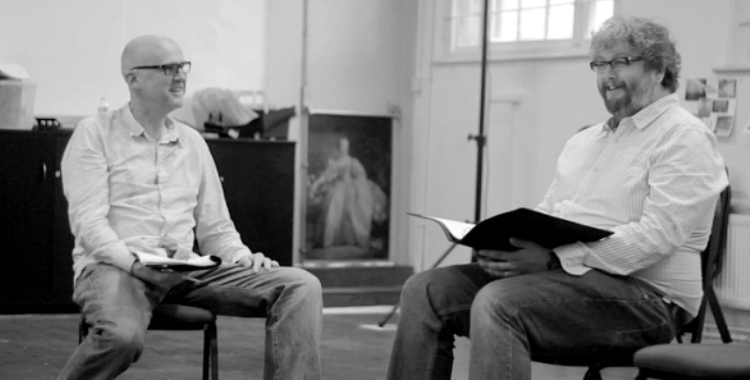
“I think that’s why we go into the theatre,” says Crouch, as Smith nods in agreement. “I think the fact that we are making art is a hopeful thing.” When I speak to the pair in the Almeida Theatre’s rehearsal space, there is definitely a taste of optimism in the air. Despite having only a week of rehearsal time before opening the Almeida Festival – a tight timescale that they find both terrifying and exciting – the mood in the room is distinctly positive. That same afternoon they are inviting the Almeida staff in for a full run-through, speaking eagerly about the opportunity to try the work out in front of an audience – an opportunity that is perhaps even more important for the development of this piece than for their previous work.

While Crouch and Smith have worked together repeatedly over the past few years, on productions including The Author and An Oak Tree, this new show marks something of a departure for them both. As well as co-writing the piece, they will be sharing the same stage for the first time, something that Crouch tells me has been “in the air” for some time: “I have long harboured the idea of working on stage with Andy”. The pair are the only performers in the piece and each occupy their own distinct space on the stage, in a show that Crouch describes as being “about two old friends and the complexity of an evening they spend together”.

After our chat over lunch, Crouch and Smith are joined by director and regular collaborator Karl James for the afternoon’s work and the three men quickly settle into a comfortable rhythm. There’s both ease and teasing in the trio’s rehearsal shorthand – the marks of friendship and long collaboration. Crouch explains that all three “inhabit the same concerns about an audience and a connection with an audience activating the work”, as well as sharing “an identification with some of the challenges that exist in theatre”. The shift in this new piece, however, has cast their collaboration in a new light.

“There’s familiarity – we’ve developed a shared language – but it feels like the language has been reinvigorated slightly by a change in the dynamic,” says Smith. He also discusses how the joint writing process has “illuminated” both his and Crouch’s separate artistic processes, revealing retrospectively the different ways in which they work. At the same time, Crouch is keen to stress that what happens to the hope at the end of the evening extends the concerns that have populated their previous collaborations, existing “on a continuum of conversation” with past work.

It is fitting, given the joint history of these collaborators and their shared fascination with the form of the theatrical event, that what happens to the hope at the end of the evening is an exploration of theatre seen through an exploration of friendship. Unlike many theatrical devices that function as mere vehicles or mouthpieces, here the two central themes are inextricable from one another. As Smith puts it, “the story of the friendship is mirrored in its form”, while the structure of live performance finds expression through the relationship between two old friends; both involve meeting together in a space and negotiating that space separately and together at the same time.

“Andy sits at the side of the stage and introduces himself and ostensibly he tells his own story,” Crouch explains the structure of the piece. “And playing opposite that is a fictionalised, identifiable other character, who kind of inhabits the other sort of form, the other sort of world. He’s a character who attempts to make sense of the world by being physically present in it rather than sitting at the side of it and watching it – by being physically present in a world that he is working very hard to generate on this stage. The push and the pull is between those two worlds.”

As well as this tension between two different understandings of theatre – one open and acknowledging of its audience, one frantically attempting to construct a form of realist representation – the piece explores another opposition, between movement and stasis. “Two channels of consideration in this play are around action and inaction,” says Crouch. “So my character is active – politically active, sexually active, physically active. Andy’s character in this play is inactive or reflective.” While the strain between these two positions powers the play, it is important for Crouch and Smith that “we don’t at any point resolve that”.

There is also another kind of action or inaction that this show implicitly, gently interrogates: that of the audience. Countering the discourse that would position theatre audiences as passive receivers, Smith firmly says, “I do consider going to the theatre and sitting in the stalls to be an action”. His reasoning recalls that of Jacques Rancière in The Emancipated Spectator, a text quoted at the front of Crouch’s collected plays. “There is space left for the audience,” Smith continues, “space for them to occupy mentally, physically. I talk about the space of the theatre and what we do here and what we can do here.” Although, as Crouch is quick to add, “that discourse is problematised as well”.

“The less we do, the more they do,” Crouch puts it simply. Similarly to The Author, this is “a piece that exists as much in the audience’s heads as it exists here”, asking its spectators to be active despite not leaving their seats. But both Crouch and Smith are careful with the language they use about audiences, balancing their hope in the space of the theatre with a healthy dose of scepticism. “It’s not a kind of love-in,” Crouch stresses. “We also want to understand that there is difficulty when people come together; there is difficulty when someone tries to organise community.”

For all these concerns about the theatrical event, however, Crouch and Smith are adamant that this is not just a show for people who regularly attend and think about theatre. “There’s so much language around theatre,” Crouch reflects. “We play with that language about theatre, but I don’t think this language is just for people who are thinking about theatre; I would be disappointed if it was.” Smith adds, “it is a discourse on theatre, but I hope it’s entertaining, I hope it’s a distraction, I hope it’s a good evening out”.

Alongside all these competing ideas – ideas that the piece “problematises and challenges and gets dirty with” – the work is also in dialogue with the particular festival context in which it finds itself, both at the Almeida Festival and in the Forest Fringe programme in Edinburgh next month. As a show about both the space of the theatre and what we do when we leave that space, what happens to the hope at the end of the evening is a perfect festival primer.

“What happens to you at the end of the show?” Crouch echoes the title of the piece. “At a festival, you’re going to go and see something else. It feels like there’s a very clear statement of intent or of questioning in this piece, and that is a really nice thing to have in relation to your theatregoing. To have something to reflect on, to refer back to, or to apply to other things.”

Photo: Mae-Li Evans.

Open Court, Royal Court Theatre

IMG_8404

Originally written for Exeunt.

In each week of the Open Court festival, the downstairs space at the Royal Court is dominated by a huge wooden crate. As the house lights go down on the latest weekly rep offering, Chloe Lamford’s design is a closed box, a sealed-off world within a world. But almost as soon as the action begins, this box tips open, its sides dramatically tumbling down. It’s hard to imagine any better visual metaphor for what is happening at the Royal Court under new artistic director Vicky Featherstone.

Lamford and her design team must also take the credit for much of the transformation elsewhere at the Court, where Featherstone’s giddy promises of playfulness are translated into bright splashes of colour. The bar, once gloomily sophisticated, is now a riot of yellows, blues and greens. One whole wall is given over to an image of a bright green hedge, while paper lanterns glow overhead and the childish mischief of the summer festival finds its expression in a big blackboard covered with multi-coloured magnetic letters. Burgers and chips are the order of the day.

The atmosphere being cultivated in the early weeks of Featherstone’s tenure, in which she has boldly handed the keys to the writers, is one of both opening up and discovery. No longer is the drama confined to the two auditoriums, as yellow and red tags offer up brilliant ‘found plays’ for curious passersby (which can also be discovered online, if you have a few hours to kill). Lost in Theatre, meanwhile, offers a truly new perspective on the Court, inviting audiences into its unexplored nooks and crannies. I have yet to find the time to get lost myself, but the bright circles on the floor enticingly beckon me every time I’m there, calling visitors into the unseen depths of the theatre.

In the work itself, the aesthetic is rough, raw and exciting – and, as a result, slapdash. With the need for polish stripped away, there is the room for both thrilling discovery and messy execution. What I’ve seen of the weekly rep shows is a decidedly mixed bag, unleashing a frighteningly skilled ensemble on a pair of underwhelming plays. Lasha Bugadze’s The President Has Come to See Youcertainly kicks off proceedings in the right spirit, with Featherstone’s production and the excellent cast lending a shambolic energy to this bonkers Georgian satire. It would probably help to be acquainted with the Georgian politics being skewered, but in this festival context the freshness and excitement of it all is just about enough to carry it – even if the references do fall a little flat.

The second rep show, Lucas Hnath’s Death Tax, fares less well. Hnath’s string of dense scenes asks big, uncomfortable questions about an ageing population, but the play as a whole feels uneven and full to the point of bursting. Everyone talks too much. There are important issues being chewed over here, such the consequences of life-extending medicine, the privileges money can buy and the selfishness of what motivates us – “no one does something for nothing”, we are repeatedly reminded – but this could almost be several different plays. The cast, however, do their best to inject some life into the lengthy scenes, and it remains extraordinary what everyone involved has managed to pull together in just a week.

One of the most exciting elements of Open Court is also mixed, but it makes up for its patchy variety with glorious unpredictability. Surprise Theatre is just what it says it is: it offers its viewers a genuine surprise. In an information-saturated age when we are used to going into the theatre armed with endless details, it’s novel and disarming to be confronted with the unknown in this way. The configuration of the Theatre Upstairs (once again, credit to Lamford) also plays with this novelty, continuing the colour that is splattered throughout the building and concealing each night’s surprise behind mocking red velvet curtains.

The first offering, Cakes and Finance, is a bold and exciting gesture, immediately asking questions about what a theatre building is and what it should be. In a verbatim piece of sorts, Mark Ravenhill reads from interviews with a number of playwrights about their ideal theatre – from plush red seats to a building without walls. While none of the subsequent surprises I’ve seen have quite met the brilliance of this opener, there are some genuinely startling moments; Lauren O’Neill’s delivery of the final, punishing monologue in Sarah Daniels’Masterpieces administers a bruising blow to the gut, while scenes of piercing poignancy and fierceness emerge from The Ship’s Name, put together by a collection of writers of Somali and Eritrean descent. As a viewer, there is also something particularly engaging about feeling one’s way through a piece without any props (the supporting kind, though the theatrical kind are also in short supply), demanding an active act of spectatorship.

Just in case the festival as a whole was not already engaging sufficiently with what the Royal Court as a theatre might mean and might be able to say, the weekly Big Idea pushes playwrights into addressing the important questions – sex, age, death. Alongside these timeless themes, a more obviously timely subject is found in PIIGS, the acronym referring to five of the countries hit hardest by the eurozone crisis: Portugal, Ireland, Italy, Greece and Spain. Pairing writers from each of these countries with their British counterparts, the five nights of theatre engage with the realities of everyday life for those living on the front line of austerity.

The offering from Ireland, penned by Deirdre Kinahan and Kieran Hurley, feels terrifyingly close to home – and not just in the geographical sense. While Ireland is suffering more than the UK, the plight and the conversations feel familiar, if heightened. Around two compassionate, funny but ultimately stark pieces by Kinahan and Hurley, about an attempted protest at an Irish school facing cuts and the erecting of fake shop fronts in Northern Ireland during the G8 respectively, the pair have made the powerful choice to incorporate a selection of verbatim interviews. Their interviewees range from a financial journalist who quotes debt figures to make the eyeballs bulge, to a woman reduced to selling everything and uprooting her family’s life to Canada. The numbers baffle, but the stories move.

Coming full circle to that gesture of opening up, it is also important to acknowledge how much of this work is being made available beyond the four walls of the Royal Court. Each of the Surprise Theatre shows is being broadcast live online on Mondays and Tuesdays and left on the website to view on demand, while the Royal Court Soap Opera collides theatre and television in a series of nightly episodes that can be streamed online – not to mention the treasure trove that is the Found Plays website. While such initiatives always carry the potential danger of eroding the live moment, Featherstone’s intention seems to have less to do with the theatrical event than with the building hosting it, a building that appears increasingly open. Perhaps because of her time operating a building without walls with the National Theatre of Scotland, under Featherstone the walls of the Court suddenly seem a lot less containing.

Photo: Helen Murray.

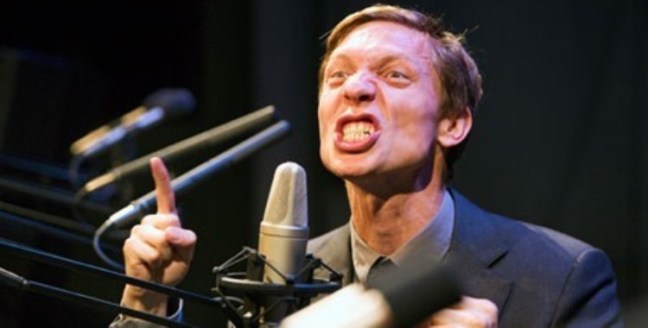
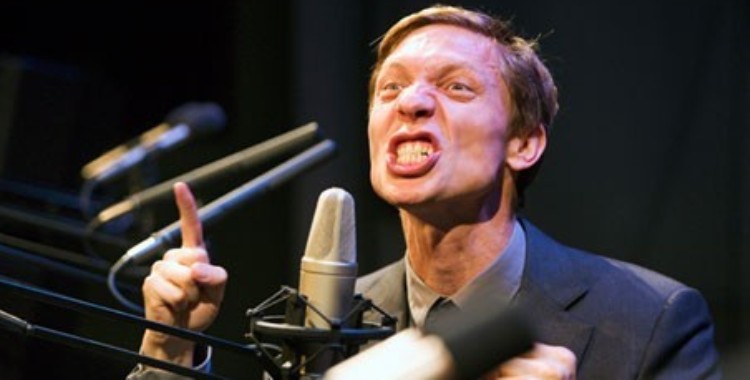
Bigmouth, Soho Theatre

600x600.fitdown

(Disclaimer: this was technically a preview, but to be honest it’s hard to imagine the performance being any more phenomenal than it already is)

About halfway through Bigmouth, with the tiny part of my brain not transfixed by Valentijn Dhaenens’ electrifying performance, I start to muse about framing and juxtaposition. As Dhaenens powers his way through speeches by Goebbels and Socrates, Bin Laden and Reagan, the obvious hits me: this is all just quotation. Bigmouth is essentially a patchwork history of political rhetoric, a series of stitched-together snippets from speeches stretching back thousands of years. The art, however, is in the curation.

In an astonishing hymn to the power of oration, Dhaenens’ extraordinary solo performance recreates extracts from a diverse range of speeches, from calls to arms to elegies to desperate pleas, all using just his own voice and a long table of microphones. Punctuating these speeches are various sequences of voice looping and snatches of song, by turns haunting and bewildering (the most vivid example being a slowed down rendition of ‘Smells Like Teen Spirit’, making it the second time that song has provided one of my favourite theatrical moments after Benedict Andrews’ Three Sisters last year). The combined effect is a dazzling assault of sound, a relentless machine-gun bombardment of words. Except for brief glugs of water, there’s no let up.

This is, first of all, a stunning display of one performer’s virtuosity and versatility. Flipping with lightning agility between accents, languages and physical mannerisms, Dhaenens is a shapeshifter, morphing seamlessly from orator to orator (or, if not always quite seamlessly, the seams themselves are as interesting as anything else). He is just as compelling when (literally) spitting with rage as when calmly – almost seductively – curling his mouth around some of the most dangerous political rhetoric in history.

And make no mistake, words are dangerous, even more so when tripping persuasively from the mouths of consummate public speakers. If Dhaenens’ wide line-up of public figures from across the years demonstrates that not much has changed when it comes to the art of verbal persuasion, another steady constant is the influence of the orator themselves. While styles of delivery vary wildly, it soon becomes clear that the success – or otherwise – of a speech lies largely in the hands (or mouth) of the speaker. The selection of speeches seen here might range from the inspiring to the morally repugnant, but it’s terrifying how much more blurred those lines can seem when rhetorical tricks come into play.

One particularly striking segment of the show interweaves two speeches by Joseph Goebbels and General Patton at the height of war in 1945, jumping deftly between the two sides. Goebbels is all creepy composure, while a shouty Patton drips with all-American testosterone, but the message of their speeches is essentially the same; both are calling for all-out war, asking their listeners to do whatever it takes to win. Sometimes it’s not the words you use, but the manner in which you clothe them.

Which brings me back to those ideas of framing, selection and juxtaposition. Why has Dhaenens chosen these particular parts of these particular speeches? Why has he placed this speech next to that speech? Why insert those specific songs? As demonstrated by the example above, quotation is not a neutral act, particularly when that act of quotation also involves sitting different snatches of borrowed speech alongside one another. On another occasion, by stringing together a series of short speeches from iconic US figures to the backing of ‘America’ from West Side Story, Dhaenens is instantly commenting on the American Dream and the supposed promise of the West without using a single word of his own. Aptly, this is also in a sense what politicians do, curating the facts and the rhetoric that make the point they are seeking to hammer home.

And there’s something that this process says not only about politics, but also about theatre and performance. I often think about how influential the framing of a piece of theatre is in guiding audiences’ reception of its political message (as a thought exercise, imaging putting a piece of fascist propaganda in a subsidised London theatre; it would almost certainly be read as a damning ironic comment on the material rather than an endorsement of the political view it portrays). The sheer force of Dhaenens’ performance, meanwhile, is a powerful demonstration of how words can be propelled by their delivery and how performance itself has the ability of transforming the fabric of the material it works with. Perhaps it really isn’t what you say, but how you say it.

Secrets and Surprises

Originally written for Exeunt.

As our huddled group of partygoers shudder upwards in an industrial lift, headed towards the Lyric Hammersmith’s secrecy-veiled launch, a woman behind me compares the experience to seeing a show by Shunt or Punchdrunk. There’s that same sense of an event, of the unexpected. Walking across Lyric Square, we’ve been directed around the side of the building, to its concealed, warehouse-like innards. While waiting in this space, we have an opportunity to see the building – and our relationship with it – from a different angle. The very walls seem to shift.

Artistic director Sean Holmes’ plans for the Lyric over the next few months, announced on Monday night, are about transforming the theatre from within as much as from without. At the same time as the building itself is completely renovated in a huge capital project, a group of theatremakers are occupying its heart. The auditorium, which will remain untouched for the duration of the building work, is to become the flexible home of Secret Theatre, which is exactly what its name suggests. In a bold and teasing move, the Lyric is not releasing any details of the plays it will be producing over the next year; instead, audiences will come to be surprised.

But this is not simply about returning a sense of the unexpected to the theatrical event in a society saturated with information. Mirroring the work that is taking place around them, the Secret Theatre company are engaged in challenging and changing structures. Resisting the rapid turnaround of an industry used to dishing up end products and swiftly moving on, the company of ten actors and ten creatives will be working together in the space throughout the year, collaboratively making and performing and sharing. As Holmes put it in his speech, “the company we have assembled is an attempt to create a new structure that might lead to a new type of work”.

There are a number of ways in which Secret Theatre is shifting the structures of how the Lyric – and many other institutions like it – make theatre. The ensemble of actors is evenly split between men and women and includes black and disabled performers. This immediately erodes the structure of literalism, which has become something of a straitjacket for much British theatre. The set-up is also designed to create a different conversation in the rehearsal room, allowing those involved more time to create work in true collaboration and for a specific space. One niggle is that everyone involved is still assigned a rigidly defined title – writer, director, actor – but one suspects that in rehearsal these roles will be much more fluid.

Surrounded by the vivid red of the Secret Theatre launch party, I’m reminded of the similar injection of colour that has just been administered to the Royal Court by new artistic director Vicky Featherstone. Even the bar is bursting with yellows, reds, blues and greens. The Court is another established building whose existing structures are being challenged, in this case thanks to a sharp burst of fresh air that Featherstone is blasting through the theatre over the summer. Open Court, while guided by different principles and very much organised around playwrights, cultivates a similar atmosphere of experimentation and surprise. The sense is that anything could happen.

As Andrew Haydon notes, it’s clear that, even without the kind of construction work taking place at the Lyric, Featherstone has given careful thought to the building she’s inherited. As well as the changes to the bar, which now feels like a place you might actually want to hang out in without worrying you aren’t wearing the right shoes, the season itself kicked off with a telling reflection on the theatre building. In the first “Surprise Theatre” offering, Cakes and Finance, Mark Ravenhill read from the transcripts of a series of playwrights talking about their ideal theatre, musing on everything from the idea of 24-hour theatre to the suggestion that cats should be incorporated into more performances (surely one of Chris Goode’s contributions).

Alongside the obvious similarities between Open Court’s surprise shows and the secrecy around the Lyric’s new season, there are other shared experiments. Like Secret Theatre, the main house plays during Open Court are operating using a rep system (which is as much a return to the past as a new innovation), with an ensemble of actors rehearsing next week’s show by day while performing this week’s show at night. In some ways this offers the complete opposite of the Lyric’s project, driving at energy and a quick turnover of plays rather than extended rehearsal periods, but it equally fosters that sense of the collective at the same time as bringing a vital roughness back to the stage. Also, while the gesture of Open Court honours the mythology of the Royal Court’s status as “the writers’ theatre” – a mythology that Featherstone’s launch announcement was drenched in – this has been done in such a way that it explodes in the same movement in which it preserves. Clever.

And it’s not just these two venues. While exciting developments have been pushing at the outside for years, it feels increasingly as though some change is beginning to seed itself on the inside. I think of the scarlet structure of the National Theatre Shed, shouting its presence on the South Bank – again, a dash of colour – and of the ongoing developments at Battersea Arts Centre, as it too undergoes building work that will open it and its brilliant work out even further to the surrounding community. It’s not everything, and there’s a definite danger of getting carried away and falling back into complacency, but it is a start. Perhaps most importantly, there’s a rare and much-needed whiff of optimism in the air.

To encapsulate some of that optimism, it feels right to conclude with Holmes’ galvanising words from Monday night. Speaking about the vision for Secret Theatre, he expressed his hope “that even if you hate it, you can’t ignore it. That even if you love it, it scares you. That you will believe it’s an honest attempt to change. To delight. To question.”

Thatcherwrite, Theatre503

thatcherwrite-600x374

Originally written for Exeunt.

As with its last attempt to address current affairs (emphasis on the current) in Hacked, Theatre503’s night of plays inspired by the legacy of Margaret Thatcher is both aided and hampered by its immediacy. These short pieces aren’t quite dancing on the grave of the Iron Lady, but her death and the potent set of feelings it brought to the surface remain fresh in the collective memory. This adds a certain charge to this range of theatrical responses, which often exploit the rawness of the issues they grapple with, but equally invites some rushed thinking. Arguments made overnight are often flawed ones.

The result, somewhat unsurprisingly, is a spirited but uneven night of political theatre. Despite setting their sights on a wide spectrum of issues thrown up by Thatcher’s death, few of these pieces achieve the same punch as Tim Etchells’ 55 Funerals, an immediate but searing deployment of political anger. The tone here is more often questioning, ironic or pointedly shrewd.

The evening opens in the crowded theatre foyer with Brian Walter’s Apples, a sharp three-part breakdown of neoliberalism that neatly nods to Thatcher’s greengrocer father and threads through the evening as an important if simplified reminder of the mark left on the UK economy by her government. It might lack a little in complexity, but its message remains depressingly relevant. It also offers some great work from Paul Cawley, Rachel De-lahay and James Cooney, including an unlikely but storming version of Will Smith’s ‘Summertime’ courtesy of De-lahay and Cooney.

Also in three parts, lending some structure to what might otherwise be an amorphous bunch of responses, is Kay Adshead’s I Am Sad You Are Dead Mrs T. This takes the form of a trio of eulogies to Thatcher, one from a bigoted ‘yoof’, one from a vile Tory-in-training and one from a resident of the underprivileged communities so neglected by Thatcher’s government. The first two monologues are packed with satirical barbs and the kind of “scroungers” rhetoric still nurtured by the current government, at times coming dangerously close to perpetuating the same stereotypes they seek to skewer, but it’s in the third that Adshead really brings out the fists. This final, deeply moving piece lands a devastating blow to the guts, leaving us in no doubt about just who has suffered and continues to suffer under Thatcher’s grim legacy.

Elsewhere, the responses are decidedly mixed. Dominic Cavendish’s dream-likeTrue Blue strands an unusually sympathetic Maggie on a desert island, clutching onto the departing tide of her deteriorating mind. It’s Thatcher’s individualism pushed to its isolated extreme, as the ultimate survivor finds herself completely alone, cast off from the society she insisted did not exist. Jimmy Osborne’s tight domestic focus on one couple turns the lens on the Falkland Islands, while My Dinnertimes With Clarence by Fraser Grace tackles education and supposed equality of opportunity through the tender friendship between a teacher and student. And never has the bonus culture of banking looked more repulsive than in Ben Worth’s testosterone-drenched Shirt and Tie, following two competitive city boys on a booze and cocaine-fuelled night out.

It’s canny programming to conclude this mixed bag of offerings with an absolute gem from Jon Brittain and Matthew Tedford. Margaret Thatcher Queen of Soho, led by a brilliant performance from Tedford dragged up in full wig and pearls, imagines a wrong turn in the 1980s leading to a glittering cabaret career and a brilliantly camp reconciliation with the gay community for a lady who suddenly is for turning. This is deliciously arch fun, cloaking its fangs in sequins and hotpants. And there should be some kind of prize for the line “where there are discos, may we bring harmonies”.

The overall impact of these collected responses, however, is uncertain. A question that often haunts fictional responses to recent events is the repeated chorus of “how soon is too soon?” In the case of a divisive public figure such as Thatcher, political legacy has to be available for discussion, but the question instead shifts to the quality of that debate. Immediacy is all very well, but there’s the risk that speaking too soon produces statements that aren’t worth hearing.

With a few incisive and provocative offerings, Theatre503 just about escapes that fate, but its impetus is worth pausing over. Is this simply a calculated attempt at topicality, or do these statements carry weight beyond the immediate aftermath of the event? Perhaps, even if most of these offerings will rapidly fade away, they have established a lively theatrical debate around a figure who continues to hold huge significance for politics today. In any case, it’s unlikely that theatre is done with the Iron Lady just yet.

Photo: Alistair Muir.