Can machines think? It’s a question that captivated mathematician and code-breaker Alan Turing, a life-long obsession with the mechanical that is signalled in the very title of this unlikely but intriguing new musical about his life. Here, the desire for a more machine-like existence – one without aging or change or any of the messy complications of being human – is a central and recurring if not fully excavated theme. The desire might be there, but its full implications resist exploration.
Turing’s life and particularly his complex, pioneering work are not easily reducible to a concise two hour show, making writer and director David Byrne’s careful process of pruning and selection an impressive achievement in itself. He has taken as his focus this wistful fascination with machinery, a fascination that is contrasted with Turing’s few valued human relationships; his mother, portrayed in a moving turn from Judith Paris, is a constant background presence, while a youthful infatuation with close friend Christopher Morcom is shown to haunt the rest of Turing’s life and all his intellectual endeavours. He yearns for the uncomplicated existence of the machine, yet he wrestles with emotion that is far from coldly mechanical. It’s significant that when Turing looks to the future, predicting the rise of artificial intelligence, he speaks of machines that will be capable of love.
Just like Turing, Byrne’s show can’t entirely shun the sentimental in favour of the mechanical, but for the most part this production avoids over-playing the tragic elements of its protagonist’s short life. Instead, attention is given to his extraordinary mind, its workings and its memories scrawled out on the stage of the New Diorama Theatre. Bare black walls, occasionally used to host projections, suggest the scholarly blackboard, while the near-constant presence of desks cements an atmosphere of sometimes feverish concentration. As Turing looks back over his life – a device of speaking across time that provides a useful if occasionally clumsy frame – a carefully selected range of props acquire the traces of memory, hooking the narrative into the next scene.
As so often with the musical form, there’s the danger of a complex narrative being stripped down to a series of neat plot points, significant moments that offer the opportunity to break out into song. Dominic Brennan’s music is at its best when reflecting the mechanical workings of Turing’s mind, clicking along with a rapid pace reminiscent of the turning cogs of both machinery and mind as the Bletchley Park cryptanalysts build the bombe, the machine Turing designed to help break the Enigma code during World War II. Elsewhere, however, its use is not entirely clear, sometimes serving a plot function, sometimes offering emotional illumination – as with Sara Turing’s heart-breaking attempt to come to terms first with her son’s homosexuality and then with his suicide – sometimes simply providing a few laughs. Early on there’s the suggestion that the musical genre could intelligently unpick Turing’s painful difficulty connecting with the world, the song of those around him highlighting his own alienation, but this possibility quickly fades away.
The production does, however, manage to convey a sense of a man out of place in his own time, a man who might well seek solace in machines when the human world disappointed and baffled him. In this central role, Richard Delaney is a quiet, awkward presence, still but for his habitual fidgeting, while the rest of the cast whirl chaotically around him. Turing might be at the centre, but he avoids the spotlight, remaining the fixed focal point of a narrative that becomes just as much about those around him. Fitting as the enigma of Turing’s personality might be, the fictionalised insight that the piece promises remains just out of reach. Turing’s story never fails to compel, but it leaves us frustratedly searching for more.
It seems appropriate that the first show in the National Theatre’s new, temporary performance space on the South Bank should announce itself just as plainly and unassumingly as its venue. Table, the world premiere christening The Shed, is about just that, using a tough wooden dining table as the focal point for a domestic tale that straddles the generations. Tanya Ronder’s play, tracing 115 years of one family’s tumultuous history, zooms in on the stains that can’t be scrubbed away, the grit that remains lodged in the grooves of the wood and the messages carved indelibly on its surface. Her eponymous piece of furniture is living history, speaking just as loudly as its human owners.
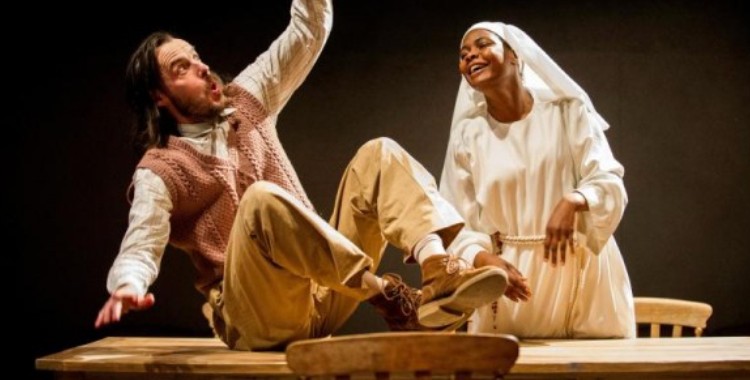
Katrina Lindsay’s design furnishes the intimate interior of The Shed with not one but two tables, the raised wooden space of the stage mirroring the sturdy domestic linchpin that sits upon it. Hewn with love and breathless hopes for the future, this stubbornly resilient item of furniture begins life as the creation of carpenter David Best, made to sit in the home he makes with his wife in late nineteenth-century Lichfield. From here, it is passed down from generation to generation, journeying first to a convent in Africa and then back to England and a hippy commune in Herefordshire, before finally ending up as the battered, beloved centrepiece of a family home in South London. Along the way it witnesses sex and betrayal, deaths and births, the grime and the mess and the joy of human life.
Ronder packs a lot into the play’s two hours and 20 minutes, at times resorting to the crowbar. From troubled nuclear families to a convent of missionary nuns, from a commune dedicated to alternative living to a gay couple with a half-Asian daughter born through a surrogate, there is a determination to portray as many different living arrangements as possible over the span of six generations. While this tactic provides colour and continual interest, the limits of plausibility are occasionally stretched, and some scenes – such as the painfully stereotypical commune, complete with goat’s milk and bed-swapping – seem inserted purely for laughs. The first half of the show is tight and cannily plotted, engaging the emotions with impressive rapidity, but as the narrative goes on the grip progressively slackens.
Although Ronder’s plot may run away from her, Norris’ sensitive, precise direction offers up some heart-catchingly beautiful moments: the presciently precarious, delicate image of David’s short-lived bride ascending a row of chairs in her wedding gown; the use of the table as a womb giving birth to the next generation, from which a protectively curled performer tumbles, Bambi-like, all helplessly flailing limbs; the gorgeous sequences of song that cradle the piece, smoothly linking scenes while nodding to ritual and familiarity. The production also benefits from a set of uniformly committed performances from its cast, who wring extraordinarily vivid characterisations from Ronder’s series of fleeting snapshots.
For all that this journey through the generations might be contrived – and, make no mistake, it is – the slightness of its meandering plot is balanced by a charm that begs forgiveness for its flaws. But when the smile fades, this production still leaves us wondering what it might be saying about the family, a unit of living that receives just as much of a bashing over the years as the table that unwaveringly anchors it. Are we damned by what we inherit, both in terms of the traits passed down to us and the upbringing we receive? Ronder’s generation game would seem to suggest so, as each successive member of the Best family kicks against what has come before but inevitably makes similar mistakes; generation upon generation of children knowingly or unknowingly wronged by their parents. And by the end, even our old friend the table is endangered, at threat of being replaced by a sleekly functional sliver of glass from Ikea. History might be deeply ingrained, but we are all too good at forgetting.
Let’s start at the beginning. Anthony Nielson’s latest work is, the Royal Court website tells us with succinct authority, “a new play about stories”. There’s also an image: a line with a break and the provocative words “form is dead”. And that’s it. The reason for the scant details is partly down to Nielson’s method – the play was written during rehearsals, building on a process of daily workshopping and improvisation with the cast – but it’s also sort of fitting. All the best stories know not to give too much away.
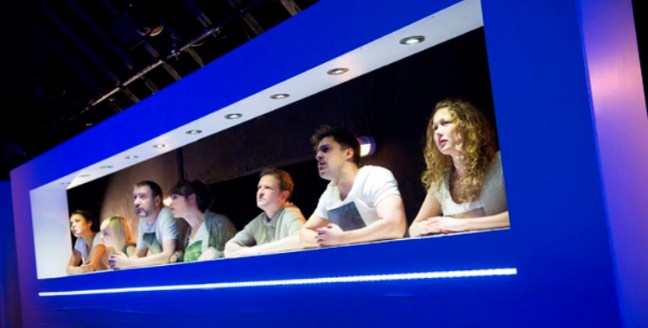
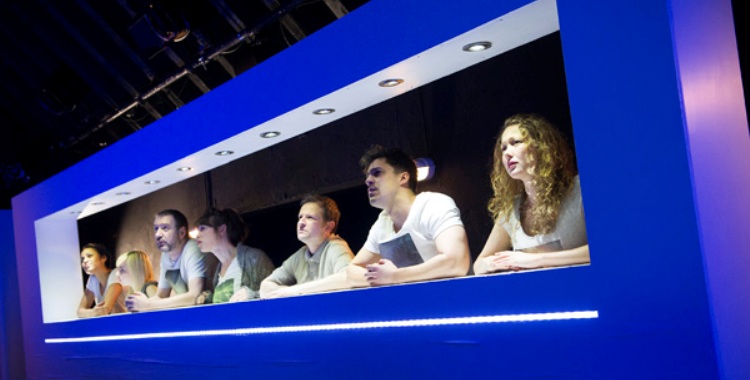
Another beginning. To one side of a sleek white design jewelled with blinking blue LEDs – Apple’s smooth, clean lines extended across an entire theatre set – a screen hosts a projected cave painting. If we’re to believe the authoritatively intoned description of the voiceover, this is the earliest example of human narrative: just a man, a bison and a spear. The implication is of a struggle, though whether man or bison or neither is killed is unclear. The presence or absence of death is important, the voiceover tells us. Without death, there’s no consequence. Without consequence, there’s no narrative; only suspended struggle.
Narrative plays out in that zone of suspended struggle. It’s a story – or, more accurately, a web of interconnecting, overlapping stories – that must continue at all costs, but the consequence it’s reaching towards is always just out of grasp. The spliced-up narratives themselves range from the banal to the bizarre, often in an almost soap opera vein. A paranoid actor keeps being slipped mysterious photos of arseholes; a grieving mother drags around a petition, pathetically begging passersby to sign; a young woman aggressively seeks out her soulmate, while another casually kills her best friend. Just as the opening voiceover is helplessly drawn to creating a story from a few marks on the wall of a cave, we as an audience are left to do what we do best: connect the dots.
As well as making connections, the audience is required to engage in a process of choice, picking out some elements and discarding others. While certain scenes are tightly focused, isolating a monologue or a video (of which there are many, bursting onto the screen throughout the piece), at other times the production relies on a technique of bombardment. The first “scene” proper, for example, works on a collage principle, pasting on layer after layer as one conversation overlaps with another, more and more performers entering the space until all we can make out is a fuzzy cacophony of noise, punctuated by the odd audible word or sentence. At which point, in a puff of dry ice, Zawe Ashton bursts into a sudden, off-key rendition of David Bowie’s ‘Where Are We Now?’ This pretty much sets the tone.
The crowded confusion sounds bewildering, but the ease with which we navigate this flood of theatrical stimuli is just as striking as its over-abundance. Essentially it’s just a staged manifestation of digital noise, noise that we’re now adept at filtering. If the formal experimentation of Caryl Churchill’s Love and Information riffed on one facet of modern experience – the quickfire onslaught of information in the digital age – then Narrative is its exploded, densely networked extension. At times it feels as though it’s occupying the internet; interruptions pop into view, scenes flip from window to window, ad-speak is constantly intruding – there’s even a cheeky nod to the ubiquity of the cat video. It’s theatre for the multi-tab generation.
And yet this is more than just a meditation on the ways that digital technology has rewired our thought and behaviour. As signalled by the opening lecture on cave art and the recurring motif of the bison throughout, these stories we tell are an integral part of our existence, stretching right back to our earliest origins. Narrative is wired into our cultural DNA. Looking not quite so far back, the play is also engaged in a tense dialogue with the particular way in which we tell stories on stage, demonstrating a deep understanding and cutting critique of the often shallow techniques of drama. The small, broken-off splinters of plot that we are given concern themselves with the sort of domestic scenes we are used to seeing represented on stage, particularly at the Royal Court, occasionally marked by the violent caesura of a “dramatic” incident. Often these vignettes are haunted by a kind of narrative dissatisfaction, or they simply don’t work, requiring another surreal interruption to rupture their bland surface. Our old stories are broken.
It’s worth pausing briefly here to also consider Nielson’s process. While he remains very much a writer, his writing happens alongside rehearsals; a new draft gets frantically written each night and brought in the next day to rehearse and improvise around with the actors, prompting yet more re-writes based on the outcome. As I understand it, any improvisation that takes place during this process is very much within the piece that Nielson is already writing, rather than a more free-form method of devising from scratch. It’s a process of generating, gathering and discarding that is particularly apt here, mirroring the way that we refine and retell our own stories, yet always within the narrative limits that our culture has schooled us in and always with reference to the narrative tropes that precede us – storytelling from the inside. In our postmodern, post-structuralist world, truly original narratives are no longer thinkable, but the linear stories we are accustomed to telling are no longer adequate. The answer, as Nielson proposes, is a structure that deconstructs from within, disruptively playing with the cultural material and narrative constructs that we can never quite get outside of.
Just say it and it will be true.
Much like Martin Crimp’s cutting attack on the cult of the personality in In the Republic of Happiness, the modern focus on the individual keeps rearing its head. Mirrors are everywhere, both in the text and dotted around Garance Marneur’s design, most strikingly as a scattering of reflective fragments in a shallow pool of water; in place of costume, the actors wear T-shirts adorned with photos of their younger selves, a statement of identity and personal narrative sitting against their skin. Just as Crimp’s characters stubbornly insist upon their narrative autonomy – “I write the script of my own life” – here the ability to tell one’s own story is depicted as central to contemporary experience. While the situations are often distorted into mad extremes, the very human impulses that drive them are wincingly familiar. We’re always spinning stories, always telling lies to others and ourselves, always making up shit.
The other purpose of telling stories, as Nielson reminds us, is to insulate ourselves from our own mortality. In a ridiculous attempt to divert a break-up – one of many amusing moments in what is often a viciously funny play – one character petitions her indifferent lover with the uncompromisingly bleak observation that “we’re going to die”. Spoken out loud, particularly in Ashton’s gloriously melodramatic tones, it sounds almost laughable, that truth that we all fight against. We will all die. But it also prompts the unsettling realisation that we’re all constantly pretending we won’t. That’s what all this noise really is: distraction.
Another distraction, another mirror, another classic narrative device, is romance. Neilson’s characters are unremittingly obsessed with love. Or, rather, an idea of love; “the big love thing that they fill our heads with”. They’re all looking for “The One”. They’re looking for “it”. They’re looking for their soulmate, the person they’re meant to be with – and when they know, they’ll know.
Whether we’re listening in on a lovers’ row – and they all sound the same – or a conversation between gossiping best friends, the dialogue trills to the echo of a hundred pulped Valentine’s Day cards, channelling the ghost of every second-rate romcom and soap opera romance. This is a world where idealised love is a consumer item, where our romantic relationships are snatched out of our grasp and sold back to us at a price. Stories are stolen and priced-up in the same way, co-opted into advertising (an industry to which the play makes repeated references). Much as Ashton’s soulmate-hunting young woman is resolute in her belief that there is an ideal love waiting for her, we are fed a feeling of entitlement to perfect happiness, but always at a cost.
It’s also no mistake that each of the individuals we encounter is, in their own way, in the business of selling us falsehoods. Whether perpetuating the Hollywood dream of overnight fame, battering us with empty advertising slogans, or telling a lie that they themselves believe in, the characters depend upon peddling untruths – just as the success of the performers beneath, the layers of real and fictional identity messily overlapping, is predicated on creating a fiction.
The last, dissolving vestiges of narrative are desperately clung to, much as the members of Forced Entertainment propel The Coming Storm stubbornly forward with story after story after story. Particularly with the 24-hour epic of Quizoola still seared on the collective memory, Forced Entertainment and their stretching and implosion of the narrative form feels like an apt reference point. There’s the same frenzied impulse to keep going no matter what, the conviction that the show – and the stories – must go on. This work also shares a certain sense of inbuilt failure. Alongside the stories that fall flat on their face or get rudely truncated, the theatrical event itself is deliberately balanced on the point of falling to pieces; as actors refer to one another by their actual names and occasionally read directly from hand-held scripts, the illusion of theatre is always brittle, if not completely smashed.
In negotiating these blurred lines and weaving between the many different fragments of narrative and identity, the cast work brilliantly with the material they’ve been given and had a hand in crafting. There’s a lot of fun to be had with the text that Nielson has produced and the atmosphere is consistently playful, stretching and pushing at its theatrical confines. Ashton, already mentioned, turns in a dazzling comic performance, at once awkward, manipulative and somehow endearing, while the increasingly zany bewilderment of Imogen Doel’s clumsy murderer and Barnaby Power’s despair-drenched audition provide some of the production’s most bleakly hilarious moments.
This bit coming up is the future.
Rather than finishing at the end, I want to conclude by looking both forwards and backwards. I wonder – and here I’m connecting the dots – whether Narrative might join Love and Information and In the Republic of Happiness in a sort of loose trilogy on modern life. As well as sharing many thematic preoccupations, all three attempt to answer the demand, repeatedly echoed by Nielson, for a new dramatic structure, a dramaturgy that responds to a rapidly changing world and digitally wired ways of thinking. As Nielson put it in a recent interview with Matt Trueman: “Plays don’t feel like they’re modern […] That idea of dramatic unity is becoming less relevant. People are sophisticated enough to make quite large leaps of cognition from small amounts of information.”
Interestingly, Dan Hutton suggests that Nielson’s attempt to write work that responds to this experience of modern life “throws into light questions of what we class as ‘written’ text”, occupying a space somewhere between writers’ theatre (the traditional preserve of the Royal Court) and directors’ theatre. Based on the production itself and Nielson’s distinctive workshop method of playwriting, it’s a perfectly reasonable suggestion, and one with exciting implications, hinting at the imminent breakdown of that pesky, persistent barrier between “text-based” and “non-text-based” theatre. At last week’s Royal Court press briefing, however, I was a little surprised to hear Nielson speak approvingly of the “strong authorial grip” and firmly position himself in the lineage of text-based theatre. His words were scribbled in my notebook with a “hmm” and a question mark.
But, aside from my own objections to the notion of authorship in theatre, there is perhaps something fitting about Nielson’s positioning within the lineage of which the Royal Court is so proud. As Narrative itself suggests, we can never fully dissociate ourselves from existing narrative structures. It’s also interesting – and promising for the future output of the Royal Court – that new artistic director Vicky Featherstone has immediately enlisted Nielson to work with a group of writers on new and unconventional methods of playwriting, encouraging ways of working that both continue in the vein of the Royal Court’s writer-led tradition and reach for those forms that speak more effectively to our current moment. Contrary to that sketch on the Royal Court website, there’s rarely – if ever – a complete break; there’s just playful, subverting, disrupting reinvention of what has come before. Making mischief from within.
P.S. Tangled in the knotty mess of trying to analyse what Narrative does with stories and theatrical form, I don’t think I gave a sufficient idea of quite how hilarious the play manages to be while wrestling with all of this material. So just to be clear, it’s bloody funny.
There’s a canny, twisting circularity to this bold new version of Chekhov’s gloomy masterpiece. In an early conversation between lovesick young writer Konstantin and his uncle Sorin, a throwaway reference is made to Escher – master of the impossible image. As the play progresses, this glancing allusion becomes something of a metaphor; as in the artist’s famous staircases, Chekhov’s melancholic characters climb only to descend, walking round in hopeless, navel-gazing circles until the paradox of existence itself becomes inconceivable. Here the beautiful is also entrapping, leading to a dead end or a sharp drop.
Headlong’s take on The Seagull was never going to be blandly traditional, but this new interpretation by playwright John Donnelly and director Blanch McIntyre injects Chekhov’s play with impressive vigour, achieving the often promised but rarely delivered feat of rendering a classic totally fresh. The production applies a new lens to the text by wisely resisting the urge to wrestle it into contemporary trappings – the troublesome horses are still firmly present, alongside vaguely modern dress – instead embracing its vaunted timelessness. Much as the Young Vic’s recent version of Ibsen’s A Doll’s House lightly played with temporality, displacing the narrative enough that it could seem somehow both period and contemporary, Chekhov’s characters are knocked out of their time.
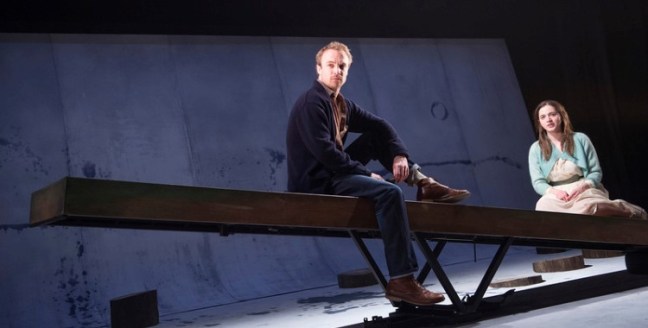
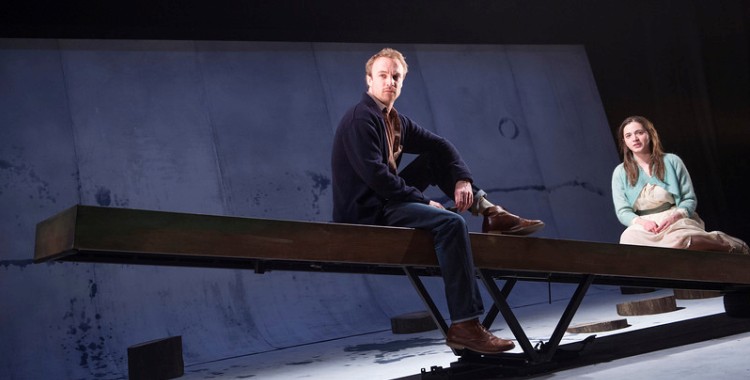
This temporal displacement works across direction and design; Laura Hopkins’ empty grey shell of a set, virtually robbed of visual reference points, could almost be the post-apocalyptic landscape described in Konstantin’s play, the occasion for which Chekhov’s cast of ennui-stricken bourgeois characters are initially gathered. Throughout the romantic entanglements and artistic trials that follow, a long seesaw becomes the striking centrepiece of the stage, visualising the delicate and ever-shifting balance between the various characters. As one individual ascends, another is dumped unceremoniously back to earth.
As well as drawing attention to its own fragile equilibrium, this production is self-aware in other ways. McIntyre’s approach is deeply concerned with the latent theatricality present within the metabolism of the play, making the characters – in particular the aspiring young artists Konstantin and Nina – sporadically conscious of their own appearance before others, turning to address spectators in sequences that raise the house lights on the audience. Writing, meanwhile, leaves its physical trace on the back wall of Hopkins’ set, vividly animating the act of invention that sits at the play’s core. Essentially, McIntyre reveals this as a play about art, about how the artist sees both themselves and the world.
These particular artists, however, are frequently unlikable in their existential angst, schizophrenically veering between egotistical vanity and brittle, crippling despair. In one pivotal scene featuring Gyuri Sarossy’s quietly self-absorbed Trigorin, the writer’s mental masturbation is strikingly paired with its physical counterpart – a wanker in every sense – as he brings himself to climax while Irina hails him with a verbal assault of praise. Alexander Cobb’s whining Konstantin is little better, weakly reaching for a transcendental ideal that is quickly overshadowed by jealousy, while the excellent Abigail Cruttenden as his narcissistic mother incessantly struts, preens and flirts, the consummate actress in love with her own performance.
For all that stultifying stasis is foregrounded – stillness is central to the make-up of the scenes, while McIntyre is a director unafraid of onstage silences – there remains a certain muscularity to this production, a momentum beneath the lethargy. This is largely down to the vital aggression of Donnelly’s text, fuelled with much the same expletive-laced energy as Benedict Andrews’ revelatory, vodka-drenched Three Sisters, yet equally capable of subdued introspection. Chekhov’s characters might be in love with talking, favouring philosophising over action, but here no words feel wasted. As one character sardonically puts it, “there’s an art to tedium”, and it’s one that this production masters with fresh, fierce, invigorating intelligence.
Little Bulb’s latest show, opening a season that will go on to celebrate the theatre’s prized Scratch format, is Battersea Arts Centre through and through. A product of Scratch itself, Orpheus was conceived following an approach from the theatre asking the company to create a piece in response to the building; a beautiful, sprawling, shabbily grand space, with as much rickety charm as Little Bulb themselves. Sharply propelling themselves from the small, delicately observed pieces they’ve crafted in the past, the company have chosen for inspiration not just the imposing Grand Hall, but also its vast organ, partially restored in time for this production. Rather than treating the room as a challenge, an obstacle to navigate, it embraces it.
Alongside the stunning space in which it is staged, the other key inspiration at the heart of this madly ambitious gypsy jazz opera is the music. The fusing of the Orpheus myth with the music of Django Reinhardt, while working extraordinarily well, gives the impression of resulting from the company’s giddy love of these songs rather than from any natural link between the two. Music has always been at the heart of Little Bulb’s work, and here they stage a passionate love song to the art form. The concept at the centre of this musical celebration is a story within a story: the tale of Orpheus’ descent into the underworld to reclaim his lover Eurydice mounted as a lavish entertainment in a 1930s Parisian music hall, with Reinhardt in the title role of the tragic poet.
Little Bulb’s multi-talented – and in many cases multi-instrument playing – performers find plenty to play with in this set-up. For all the epic, operatic glamour, the company still hold tight to elements of their homemade aesthetic, at their best when cheekily undermining their own creations and poking fun at the genres they simultaneously invoke. In a style that seems somehow spontaneous and precise all at once, the company use the meticulously observed conventions of the silent movie to wordlessly convey the narrative, engaging with and occasionally subverting the gestural and musical basics of how we share stories. There are sequences that threaten to become over-long and self-indulgent, but these are always rescued by a timely interjection of sheer charm – an archly clowning expression, a piece of dazzling invention, a gorgeously silly item of costume.
Extending this playful care and precision, the beautiful space of the Grand Hall and its adjoining bar space are used just as thoughtfully as the content. Cabaret tables cluster around the stage and spill over into the room next door, wrapping audience members in another era as Eugenie Pastor’s glorious, wine-swigging hostess weaves between chairs. The whole evening is crafted as an end-to-end experience, a joyous tumble head-first into the world of the jazz club and the music hall. I for one would happily install wine and cheese as a regular feature of the interval, even if there is something a tad cynical about bringing the bar right into the performance space (well, if Shunt can do it …)
The downside of thinking so big, however, is that it has stripped away some of the miniaturist ingenuity of the company’s smaller work. The ramshackle charm of shows like Operation Greenfield has been sacrificed in favour of something slicker but at times less compelling. The emotion, too, suffers slightly on this larger scale. If Operation Greenfield unabashedly wore its heart on its sleeve, Orpheus wears its bright red, centre stage and decked in fairy lights. This is a story about love, and God forbid we should forget it.
But as ever with Little Bulb, objections begin to feel churlish and after a time resistance is futile. Amidst the epic ambition, there are still some gorgeous little gems: in one hilarious scene the performers don cardboard noses and hooves, instantly transforming into a mad menagerie of gambolling animals; in another, a merry-go-round of appearances and disappearances conjures a vivid picture-book of Paris, sending up its clichés as it goes. And the music, honed through night after night performing together as a jazz band, holds the piece and its audience together, all singing to the same infectious tune. Once Little Bulb’s playing has you in its toe-tapping grasp, it’s increasingly hard to break free.




 Catherine Love