Pack, Finborough Theatre

pack

Originally written for Time Out.

The winner of last year’s Papatango New Writing Competition, Dawn King’s ‘Foxfinder’, conjured a haunting vision of a world built on the cultivation of fear. This year’s offering from Louise Monaghan explores fears and prejudices that lie much closer to home, bravely grappling with the thorny racial tensions that persist in modern Britain.

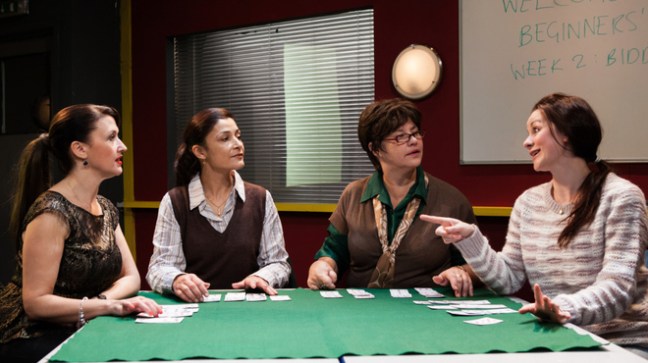
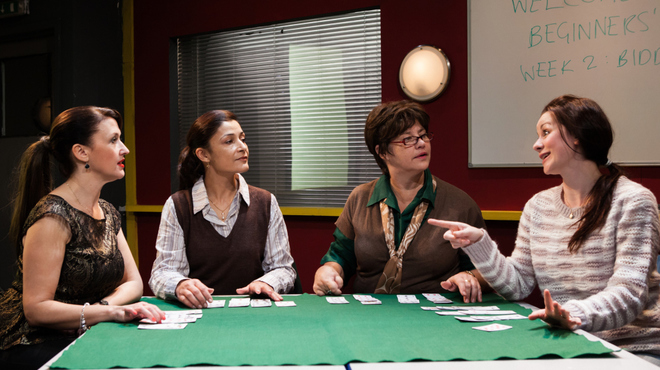
Monaghan’s quartet of female protagonists gather each week to master the rules of bridge, while beyond the walls of the community centre they are locked in a game in which the cards always seem to be dealt against them. Widow Deb struggles to raise her wayward teenage son, while her lifelong friend Stephie juggles a friendship with fellow bridge player Nasreen and her souring marriage to a bitter BNP supporter. As the bridge classes intensify, so too do the external strains.

Confined to the classroom, the piece wisely settles on an intimate setting in which to slowly rachet up the pressure, but Louise Hill’s direction visibly labours to bring the urgency of the outside world into this neutral space. As escalating events occur offstage, including the brutal racist beating of a young Pakistani boy, there is an inevitable atmosphere of reportage; someone is always running through the door slightly out of breath.

The evocative single syllable of Monaghan’s title suggests both a deck of playing cards and the gangs behind racist crime, but it also hints at a pack in the sense of a communal group. Appropriately, when the complexities of the play’s subject are most delicately handled, it is through the friendship that cuts across colour and creed.

Red, Like Our Room Used to Feel, Battersea Arts Centre

web_Red-Like-Our-Room-Used-To-Feel_jpg_442x294_crop_upscale_q85

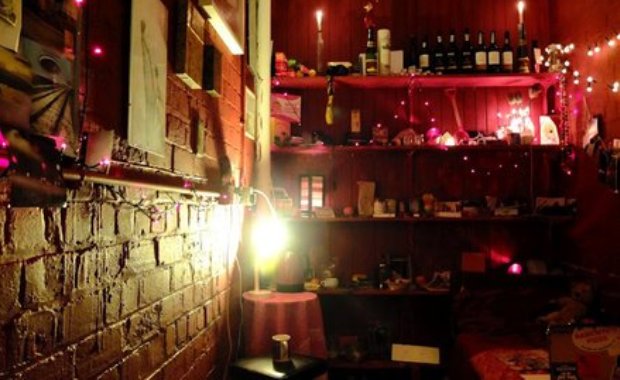
The intimate space of Ryan Van Winkle’s poetry performance, tucked away in a quiet corner of Battersea Arts Centre, is suffused with the warm glow of nostalgia. Photographs and souvenirs stud the walls and jostle on every surface, while a battered leather suitcase lies open on the floor, spilling keepsakes, and an old cassette player sits nestled at the back of a shelf. The taste of the past lies thick in the air, mingled with the faint aroma of woodsmoke from the fireplace. Memories breathe in the walls.

This is poetry given physical edges, an environment that seems to both birth and be born from the words. Van Winkle’s gentle, evocative piece is essentially a simple one-on-one poetry reading, yet to restrict it to that label feels inaccurate and dismissive. It begins unassumingly, as Ryan (it feels odd, given the intimacy, to keep referring to him by his last name) comes to greet me down in the BAC lobby, where I’m already settling into a state of mild bliss in my candy-striped armchair, grinning stupidly at the warmth and the hum of excited voices and the gorgeous neon sign left over from Tim Etchells’ last show. Ryan, a tad jittery with nervous energy, is attentively anxious to get my name right before he reels off a detailed description of how the show is going to work.

To condense and paraphrase Ryan’s charmingly precise account of the experience he has crafted, the sole audience member is led into the space (a cosy red bedroom draped in fairy lights and crammed with knick knacks), offered a cup of tea or a drop of port, and asked to pick one of four envelopes while Ryan switches on a CD soundtrack. In each of the envelopes is a selection of poems; Ryan then pulls a chair close and reads the poems from the chosen envelope, before quietly leaving to allow his guest to listen to the remainder of the CD and explore the room. The whole thing lasts a devastatingly brief, fleeting twenty minutes.

Oddly, given the state of heady captivation in which the performance held me, little of the content of Ryan’s poems stayed with me after leaving the room. Only torn-off scraps remain: geography, books, waves and sandcastles, love and loss. This is poetry made fluttering and ephemeral, rapidly dissipating into the warm air and attaching itself to objects and thoughts. Much of this is achieved by the gentle presence of Ryan himself, whose voice lulls and cradles, sending the mind on journeys.

Emerging from the gorgeous cocoon of the performance, I immediately wished that I had found the time during the feverish rush of Edinburgh to take a reviving step into Ryan’s room at Summerhall. In a ever faster spinning world, this space exhilaratingly offers us what we so frequently deny ourselves: the opportunity to stop, sit, absorb and dream. I was also struck by how the piece somehow manages to be both intensely personal and overwhelmingly generous. It as though, by indulging in this space of imagination and memory, Ryan offers us the room – in more than one way – to traverse our own imaginings and reminiscences.

When left alone, one object of the vast number collected around the room snatched particularly at my gaze: a postcard, emblazoned with the words “Nothing is not giving messages”. It is a statement that immediately invites multiple readings; it could mean that everything involuntarily emits messages, or that the definition of nothingness is the absence of messages, or even perhaps both. For me, it sits like a subtitle beneath the work, in which poetry and meaning live in more than just words, and which in its cluttered, soothing warmth seems firmly pitched against a void that is stripped of meaning, memories and messages.

One-on-one performances of Red, Like Our Room Used to Feel  are running at BAC between 18th-22nd December.

Everyday Maps for Everyday Use, Finborough Theatre

maps

Originally written for Time Out.

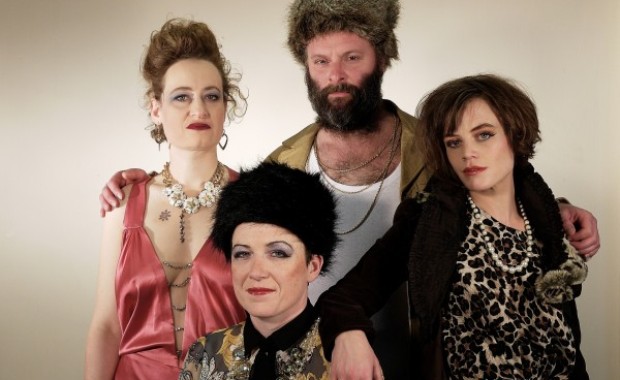
As cliché would have it, men are from Mars and women are from Venus. For Tom Morton-Smith, however, the alien is all relative. Tracing the cartography of modern sexual hang-ups, his new play asks where we draw the line between permissible fantasy and dangerous perversion – particularly in a hyper-sexualised culture in which, as one character puts it,’everyone has their kink’.

Through the central focus of Maggie, a teenage girl with an unhealthy fixation on tentacled Martians, Morton-Smith’s peculiar concoction throws together pornography and astronomy, HG Wells and explicit chatrooms. Just as Maggie’s best friend Kiph trusts that any fetish can be explained by Google, the point is made that almost every mutation of desire has a context in which it is normalised. Even Freud would have blushed.

But for all this airing of outlandish turn-ons, the play simultaneously recoils from the very taboos it is attempting to break. Despite an uncomfortable recurring fascination with schoolgirls, the issue of paedophilia is clumsily skated over, while the sexual acts themselves are often described with all the toe-curling awkwardness of the schoolyard.

Despite a compelling central performance from Skye Lourie as Maggie, Beckie Mills’s production struggles to tame this sprawling, confused tale. Like the aliens that have invaded Maggie’s sexual imagination, Morton-Smith is wrestling with too many limbs. As scene bleeds into scene and fantasy into fantasy, the overburdened end result is as numbing as the gratuitously sexualised media that lurks half-acknowledged in the background.

Going Dark, Young Vic Theatre

Website-1

How often do we peer out at complete blackness? This was one of the first thoughts to strike me as the low-level lighting dimmed and the audience was tightly swaddled in darkness at the beginning of Sound&Fury’s latest atmospheric piece. The extent to which the Young Vic’s Maria space has been insulated against external light is astonishing, producing an odd dissociation from surroundings and fellow audience members as we are all plunged into the impenetrable dark. Atomised, we blink out into nothingness, eyes stubbornly seeking shapes that refuse to emerge from the featureless gloom.

In a modern world saturated with light pollution, where we are rarely far from the glowing rectangles of our phones, the simplicity of this utter darkness takes on a startling, almost radical character. It allows the piece to immediately grip us in its inky fist, as well as powerfully propelling us into the interior world of its protagonist. For astronomer Max, the world around him is going dark in more than one way. As the universe steadily expands, the stars with which he has entertained a lifelong affair are gradually losing one another’s light across the vast expanse of the universe, while on a miniature scale his own life is beginning to slip away from him as his sight deteriorates. Physics collides with philosophy and science becomes enmeshed with emotion.

This story of cosmos and crisis is told through the quietly compelling presence of lone actor John Mackay and the evocative, precisely executed audio and visual effects employed by Sound&Fury. Detailed soundscapes flood the darkness, transporting us to bustling train station or rain-sieged garden; the space morphs into a planetarium, its ceiling studded with thousands of pinpricks of light; a developing photograph becomes a canvas for projected memories. Light, when it breaks through the surrounding darkness, has the power to continually surprise, seductively yet elusively snatching at the corners of our attention in the same way as the stars that distantly blink down from the night sky.

For all that Sound&Fury’s technical trickery dazzles, however, it never overwhelms with its own showmanship. Instead, it supports the attractive tension at play in the piece between the intimate and the unimaginably vast, impressing us with wide blankets of stars before the next moment enclosing Mackay in a tiny pool of light. Both narrative and design stage this constricting process, this drawing in of one’s own personal world against the inconceivably huge backdrop of the universe, a process equally conjured by our own individual, insulating cocoons of darkness. That impossible smallness that is felt when contemplating the seemingly endless reaches of space is replicated here, but without undermining the small-scale tragedy of Max’s encroaching blindness.

Like the processes by which stars produce the stuff of existence, every element in Sound&Fury’s production is inextricably wedded to those around it. While Hattie Naylor’s text, for instance, is tender, moving and often poetic in its charting of Max’s loss of sight and the impact this has on his relationship with his young son, it cannot be divorced from the other production elements with which it is intertwined. The father son relationship is lent added poignancy by the physical absence of the son from the stage, simply conjured by a recorded voice; the snatches of astronomy lectures that punctuate the piece rely upon Dick Straker’s projections to produce meaning; the distinct scenes and words of the script are structurally dependent on the wordless interludes that separate them.

As our usual ways of visually experiencing theatre are frustrated or challenged, the aesthetic of the piece forces us to adapt and sharpen our other senses, mirroring the struggle that Max is in the midst of. Seeing, he explains to us, is just a matter of electrical impulses being received by the eye. It is only through the brain that this is translated into understanding, creating a perception of the world that conforms to what we have evolved to need; what we “see” is just a grainy, limited snapshot. Through an intimate focus, Going Dark invites us to accept the limits of our own perception while at the same time asking questions that imagine the much wider picture. The implication is that we, like Max, might need new ways of seeing.

Agency or Entrapment? Audience Interaction & Shunt’s The Architects

2_TheArchitects_SDietz_1-600x433

In Shunt’s labyrinthine new show, the visible maze is just a warm-up. After navigating our way through a bewildering mass of MDF corridors, all chillingly kitted out with surveillance cameras and television monitors, we emerge into what appears to be the monochrome belly of a luxury cruise liner, where we obediently sit at tables and chairs while our bumbling Danish (0r are they?) guides jolt us through a disorientating litany of escalating crises. The heating is broken, someone’s taken a shit by the barbecue and a beast appears to be on the loose, as all the while the band plays frantically on. This ship is going down and there’s nothing we can do about it. But despite this sense of immobile powerlessness, this feeling that we are at the mercy of our none too trustworthy hosts, there is an atmosphere of consent. As one character acknowledges, “we’re all adults here”.

Meatier than it appears at first glance, there’s plenty to dissect in The Architects: the mutation of the central Minotaur myth, the structures and exercising of power, the very nature of spectacle. But as a spectator of Shunt’s latest offering, it was this positioning of the audience that I found myself repeatedly returning to – no doubt coloured by the preoccupations that I brought into the space. When speaking to company member David Rosenberg for Exeunt a few weeks ago, one frank admission of his intrigued me: “the audience don’t actually have a lot of choice in our shows”. He went on to describe spectators as being “imprisoned” within the world of Shunt’s creation, be it a conference, a tennis pitch or, in the case of The Architects, the cruise of a lifetime. We have little to no real agency and the company are not shy of acknowledging that fact.

This way of speaking about the work startled me because it was so divorced from the rhetoric surrounding the majority of theatre that falls within the broad brackets of “immersive” and “interactive” (two slippery, problematic and not necessarily interchangeable terms). This kind of work usually invokes a discourse of action, empowerment and choice; audiences are granted freedom, the accompanying material typically states, given a space in which to play and explore. Though, as one of my fellow MA students pointed out in a recent seminar discussing spectatorship and audiences, having to be told that you are free is something of a paradox. Surely audiences already are active and empowered – a starting assumption much like that suggested by Jacques Rancière in The Emancipated Spectator – and do not need to be granted agency.

Far from the patronising provision of a freedom that should not need to be “allowed”, the knowingly problematic role in which Shunt casts its spectators, particularly in The Architects, presents a far more fascinating, knotty proposition. Within the scenario created by Shunt, there are three hierarchical levels of power: the leering, TOWIE-esque overlords at the top, appearing as a distant video-projected presence that conjures and collides the fickle gods of myth and the grotesquely guzzling modern day elite; our slyly manoeuvring but essentially powerless hosts, positioned as an opportunistic political go-between; and us, the audience, on the bottom rung. Not for the first time, a ship comes to represent a nation, and our role within that sinking nation is all too clear. Seen as part of this rigidly structured and depressingly resonant power dynamic, the imposed powerlessness of spectators is integral to the theatrical metaphor.

While Shunt can to an extent trade on the desirably experiential nature of their performance events, which now inevitably have a currency born from reputation, their very calculated and inherently problematised form of audience restriction seems to present a contrast with the kind of falsely empowering interaction discussed in a recent essay on Culturebot. Discussing the work of Punchdrunk, whose brand of immersive theatre has now become a lucratively sought-after commodity, Agnès Silvestre analyses the hypocritical illusion of agency that the work cultivates, painting its model of spectatorship as one designed to maximise profit rather than to test the boundaries between performance and audience.

It’s hard to argue with the fact that many people find Punchdrunk’s shows an exhilarating experience, and there is not necessarily anything wrong with that in itself. What grates is the promise of freedom in which it is framed, with marketing material that speaks of “roaming audiences” who are free to explore. Audience members might be encouraged to move around more than in “traditional” theatre settings, but as Silvestre points out, they are only “free” so long as they play within Punchdrunk’s set of rules. Those who transgress are silenced or removed.

The Architects also has unspoken rules of engagement, ones subtly laid out by the structure of the piece from the off and obediently adhered to by the spectators around me. But this restrictive framework is engaged in an implicit dialogue with the piece itself, a dialogue that asks us to look at these power relationships from a critical perspective. As already identified, there is inherent consent, making us complicit in our own inactivity. Just as the cruise promises us the opportunity, should we so wish, for a romantic encounter with a dolphin (or other beast of our choice) on the basis that we are consenting adults, we have chosen to be here and it is our choice to get meekly tugged along by this spiralling disaster. And not just to passively endure it, but to actively enjoy the hilarity of the destruction that steadily engulfs us.

After playing along with this power game, the final big reveal – that element of surprise or unveiling that all Shunt fans are eagerly waiting for – has a tinge of disappointment. The concluding image, framed within a raised box, is painful to watch yet loudly demanding of our attention, cultivating the same kind of morbid fascination that compels passersby to crane their necks to look at car crashes. It is repulsive yet disappointing because it simply shows to us what was there all along and what we as good theatrical citizens decided to happily accept. The big reveal is not really a big reveal at all, in that it turns the mirror on something we already half knew about our place within this constructed scenario and within the wider world to which it metaphorically refers.

It’s all there in the name: Shunt build the accepted architectures of power and sculpt our place within those. The realisation, and perhaps from that the resistance, are down to us.