Voyager, New Diorama Theatre

Voyager-by-Idle-Motion-credit-Tom-Savage-7-600x401

Originally written for Exeunt.

What compels us to explore? It seems, at first, as thoughVoyager – its title a reference to the space probe launched by NASA in 1977, now the man-made object that has travelled furthest away from Earth – might attempt to answer this question. It follows Carrie, an English teacher who applies for a programme that is sending a teacher to Mars. It could be the opportunity of a lifetime. But she might not be able to come back.

Recently, space travel has provided a surprisingly rich theatrical seam. Alistair McDowall’s dizzying X has just finished its run at the Royal Court, while in 2014 Curious Directive addressed the possibility of a manned mission to Mars in the wide-ranging, ambitious Pioneer. The bar has been set high. Voyager, despite its promising premise, falls considerably short. It tantalisingly suggests a glimpse into the psychology of those who reach for the stars, but ultimately its story and its message are frustratingly earth-bound.

Carrie hears about the chance to go to Mars soon after losing her mother to Alzheimer’s. At first, she barely gives it a second thought, but then she discovers a tape left for her by her mother. Space exploration, as it turns out, might just be in her genes. She hears with excitement how her parents met while compiling the Golden Record – an audio-visual document of human life for any extra-terrestrials the probe might encounter – for the Voyager mission in the 1970s. A bit of her mother is still out there somewhere, propelled further and further away from Earth, and suddenly she feels the same pull.

The rest of the show is then a tug of war between Carrie’s impulse to leave and the commitments, especially to her partner Ben, which urge her to stay. This could offer a fascinating insight into the motivations of those who leave behind everything they know and love to explore new worlds, but it never digs quite that deep. We see Carrie’s anguished uncertainty, but not the mechanics behind her furiously whirring mental cogs. The Golden Record also feels like a missed opportunity, dropped into the narrative without being fully explored. And in the close yet shallow focus on Carrie, Idle Motion lose sight of the bigger picture of the complex desires and contradictions behind human space exploration. There’s not enough science for it to be science-driven and not enough character for it to be character-driven.

The plot, meanwhile, relies on some unlikely contrivances. The recorded voice of Carrie’s mother punctuates the story, providing timely revelations and reflections. But why wouldn’t Carrie listen to the whole tape to begin with? The stopping and starting message ends up feeling like a convenient narrative scaffold, diluting some of its emotional impact. The Mars mission likewise becomes little more than a catalyst for Carrie’s dilemma. Providing only the sketchiest of details about this NASA programme, the show leaves many questions maddeningly unanswered.

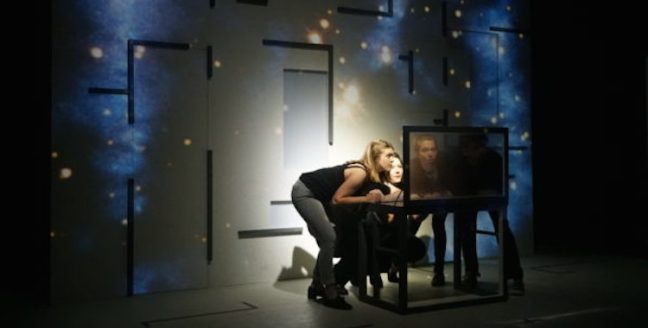
There is, though, a certain charm to Idle Motion’s storytelling that persists from earlier work. Ellen Nabarro’s versatile set, with its stylish geometric backdrop and collection of multi-purpose furniture, is smoothly and sometimes ingeniously used by the cast of five as they propel the story along. There are also some pleasing traces of the company’s physical work, though this movement is not deployed as strongly as it might be. Idle Motion do better with the small: beautifully observed little snatches of classroom conversation or tender moments of connection. Here, the vastness of space and the big ideas it invites about exploration, progress and human legacy elude the company’s delicate aesthetic.

Photo: Tom Savage.
Can I Start Again Please, Battersea Arts Centre

28032_StartAgainPrduction_©MatthewAndrews2015

This is a translation. An approximation of one language in another. A transformation from idiom to idiom. It’s important that you know that.

Translation is at the heart of Can I Start Again Please. Sue MacLaine’s show unfolds in two languages simultaneously: English and British Sign Language. MacLaine speaks aloud and her fellow performer Nadia Nadarajah translates, or vice versa. But meaning and language are slippery things. At times, the two different versions seem to slide away from one another. Ideas are lost in translation. Things are left unsaid.

This is no abstract meditation on the fallibility of language(s), though. This translation and mistranslation is a metaphor – a flawed one, because all metaphors (like all words) are imprecise – for an experience that tests the limits of the speakable. Subtly and painfully woven through the piece, in phrases with ugly submerged meanings, is MacLaine’s childhood experience of sexual abuse. Questioning what language can and can’t communicate, along with the consequences and costs of silence, abuse is a constant but rarely explicit presence, haunting the piece with quiet horror.

Throughout, both the limits and the power of language are made apparent. Certain phrases imply its legal force and manipulative violence, while others reveal it as insubstantial and insufficient. Echoes of trauma and interrogation resonate in seemingly innocuous sentences; the slipperiness of memory is reflected in the slipperiness of the words we use to retrieve it. MacLaine also reinforces the importance of context and patterns, reminding us that humans are ultimately meaning makers. How, though, to ensure that the meaning intended is the meaning received?

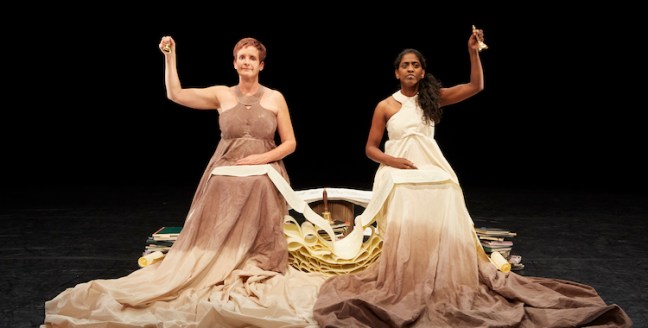
These are questions that also speak powerfully to theatre, and Can I Start Again Please is always aware of and sensitive to its medium. The two performers play with our quiet and sometimes complicit co-presence, asking the audience questions that we are not sure whether we should attempt to answer. And while it is largely a still, fairly static piece, there is nonetheless a certain theatricality to its staging. Both MacLaine and Nadarajah wear long, flowing dresses, suggestive of the epic or mythic, and repeat a series of ritualistic actions: the ringing of bells, the holding up of signs, the unfurling of paper. Gesture, meanwhile, becomes a doubled language: both the BSL translation and a form of wordless choreography.

The other thing that leaps out from the staging is the script or score that MacLaine and Nadarajah move smoothly across their laps as they perform. We can’t see its contents, but it acts as a further referent – suggestive perhaps of a legal transcript, as well as of a text for performance. It raises further questions of “truth” and “fidelity” (cautiously enclosed within quotation marks), as pages are seemingly skipped past or tossed aside. Which script is being followed (or not followed)?

Tim Crouch (with whom MacLaine has worked in the past) describes words as “the ultimate conceptual art form”. They are both labels pointing to different concepts and concepts in themselves. But words can be detached from the concepts and things they signify. As MacLaine discovers, lamps can be un-lamped, words unmoored from their meanings. Say any word enough times and it echoes with its own emptiness.

Threaded through it all is philosopher Ludwig Wittgenstein, and in particular his famous phrase “whereof one cannot speak, thereof one must be silent”. This idea, like everything else, is prodded and pummelled over the course of the show. In many circumstances, there is only silence, but silence – and this point is powerfully made – is not the same as consent. And words may fail, but still they remain the imperfect tools with which we attempt to make ourselves heard. Can I Start Again Please asks us, more than anything, to listen.

Photo: Matthew Andrews.

Ophelias Zimmer, Royal Court

780x400.fitandcrop

In Katie Mitchell’s bleak re-centring of Hamlet, Ophelia is sinking from the start. Before we even see her, projected text and a voiceover tell us about the first of five stages of drowning. And when we do see her, she’s dragged under the waters of misogyny, submerged beneath layer upon layer of clothing. Thrash as she might, there’s no way back to the surface.

There’s a brutal inexorability to Ophelias Zimmer. For a start, we know where this is heading. Mitchell’s piece, created in close collaboration with writer Alice Birch and designer Chloe Lamford, trades heavily on its audience’s knowledge of Shakespeare’s play. From the moment the house lights go down, we’re anticipating Ophelia’s madness and watery death. More than that, though, inexorability is built into the very structure of Ophelias Zimmer. It plods, slowly, deliberately and relentlessly, towards its inevitable conclusion.

As the title suggests, the entire action (or inaction) of the piece is confined to Ophelia’s bedroom. The events of Hamlet, plotted out meticulously according to the play, all occur around this peripheral point. Most of the time, though, we watch the deadening routine of Ophelia’s life. She gets up, goes for a walk, reads and sews. Flowers arrive every day, every day tossed straight into the bin. Letters – or, as they are reimagined here, cassette tapes – arrive from Hamlet and are listened to, fast-forwarded and rewinded. An occasional cry of “Ophelia” summons her out of the room.

rendition=original

This is choreographed boredom. Tedium distilled. Each scene change, each jump forwards in time, is signalled with a ping as horrible and relentless as the bells that heralded torture in Mitchell’s production of Cleansed. Through it all, Jenny Konig’s Ophelia stares out with a chilling blankness, movements as controlled as the routine that dictates her quiet, contained life. She seems to be obeying the instructions of the intermittent voiceover we assume to be her dead mother, making herself as invisible and inaudible as possible in this rigidly patriarchal world.

Ophelia might be moved to the centre of the narrative, then, but Mitchell pointedly does not offer her a voice within it. As in Hamlet itself, she barely utters a sound. And when she does speak, her words are more habit than expression. “The flowers again,” she dully intones each morning as the maid brings in a new vase. While Hamlet might be robbed of his soliloquies (in a rare touch of humour, Ophelia cuts off his “to be or not to be” by promptly pressing the fast-forward button on her cassette player), Ophelia gets none of her own. Instead, she is confined to a disturbing silence that speaks deafeningly of the misogynistic world of Shakespeare’s play.

But can Ophelias Zimmer really be thought of as a feminist re-framing of Hamlet? It certainly reveals what Mitchell sees as the horrific treatment of Ophelia, including by Hamlet, exposing the careless misogyny of a character who is enshrined at the heart of the dramatic canon and with whom we are so often asked to sympathise. Yet still it restricts Ophelia to quiet, helpless misery, giving her no more agency than she has in Shakespeare’s telling. The whole narrative of the show, meanwhile, is structured around Hamlet and its controlling cast of men. Shakespeare’s play is the scaffolding holding up this piece, its male characters dominating from offstage with their comings and goings and shouted demands.

Hamlet himself is imagined by Mitchell and co as a brooding, moody narcissist, clad in black and wrapped up in his own worries. His messages to Ophelia, progressing from romantic cliché to sexually explicit plea to expletive-filled abuse, are all ultimately about him – his desire, his pain. On one of the few occasions when we actually see him, he bursts into Ophelia’s room brandishing a Joy Division record. He then goes on to play and dance to the soundtrack of his own suffering, wilfully ignorant of Ophelia’s.

Wildly thrashing his limbs to “Love Will Tear Us Apart”, Renato Schuch’s Hamlet invites an immediate comparison with Ian Curtis, a man tragically obsessed with death and determined to inhabit his own myth, even to the extent of his own destruction. But every act of destruction has its accidental victims, its civilian casualties, of which Ophelia is one. This is Hamlet as careless egotist, focused on his own meandering path to revenge at the expense of all others around him. While he dances, lost in indulging his own emotions, Ophelia sits in a chair and sobs.

This is one of a series of characteristically stunning theatrical moments that break up the monotony of Ophelia’s daily existence. Just as my attention threatens to drift away entirely, I find myself dragged back by a brilliant sound effect or by the slow, terrible seeping of water into the space. As ever with Mitchell’s work, there is an austere precision that can be disengaging, but as soon as one of those moments interjects I’m brought back on board, that knot in my stomach tightening again.

Immediately after the show, Tom Cornford tweeted that Ophelias Zimmer is “about the katiemitchellest thing you can imagine”. I know what he means: the horrible beauty, the compelling boredom, the pin-point precision, the intellectual rigour, the underlying queasiness, even the foley booth at one side of the stage producing the sounds that underscore Ophelia’s existence. While watching, I was reminded in particular of two other Mitchell pieces: her Schaubühne production of The Yellow Wallpaper – the claustrophobia, the mounting unease, the strange combination of boredom and nauseous tension – and the haunting video installation Five Truths.

The latter was Mitchell’s first take on Ophelia, whose madness was seen through the lenses of five twentieth century theatre practitioners: Constantin Stanislavski, Antonin Artaud, Bertolt Brecht, Jerzy Grotowski and Peter Brook. Here, Mitchell adds her own interpretation, and it is utterly uncompromising in its starkness and tedium. I struggle with it in the moment of watching, but I am also completely convinced that this oscillation between detachment and uneasiness is exactly what I’m supposed to be feeling. This is a life and death that Mitchell is determined not to prettify or over-dramatise.

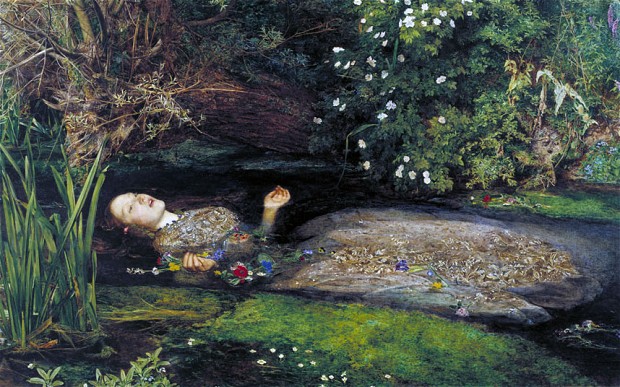
As in Five Truths, the climax of Ophelias Zimmer offers an echo of John Everett Millais’s famous painting, but with a bloody twist. In Mitchell’s version, death is not beautiful or romantic or even straightforwardly tragic; it is brutal and ugly, a violent and sudden last resort. No wonder it’s usually kept offstage.

ophelia_2999502b

Schönheitsabend, Northern Ballet

download (1)

Originally written for Exeunt.

Schönheitsabend roughly translates as “a beautiful evening”. A subtitle might be “make of that what you will”.

Beauty is just one of the ideas that is challenged and subverted and thoroughly pummelled by choreographer-performers Florentina Holzinger and Vincent Riebeek over the course of this show. The pair’s performances have a certain infamy in continental Europe, and it’s easy to see why. The warning note tacked to the door at Northern Ballet is already a catalogue of provocation, promising audiences nudity and scenes of a sexually explicit nature.

And the framing of the piece itself continues this arch dialogue with impropriety and expectation. At the start, Live Art Bistro’s Adam Young steps on stage, clipboard gripped between his hands. He is, he tells us, responsible for the venue this evening, a statement met with a flurry of nervous laughs. Just before walking in, a fellow audience member has joked that he expects the evening to end in some sort of orgy (cue more nervous laughter). This is exactly the kind of anticipation that Holzinger and Riebeek playfully stoke, wrapping their performance in both brash sensationalism and institutional concern. “You are about to see something outrageous,” they implicitly say.

The clipboard-clutching Young introduces each of Schönheitsabend’s three parts, carefully establishing expectations and acknowledging conventions. We are asked, for instance, to respect the artists, and told that what we are about to witness in one segment is an unrepeatable live experiment. The language is distinctly that of live art, the tone firmly tongue-in-cheek. In riffing on art-world discourses of seriousness, Holzinger and Riebeek never take themselves too seriously.

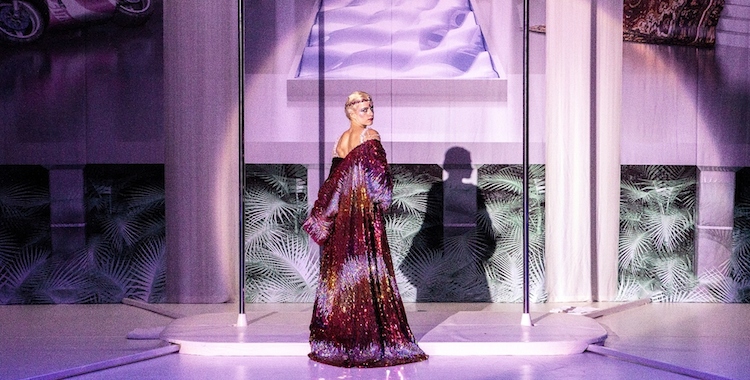
Each of the three parts, labelled as dances of vice, horror and ecstasy, leaps off from avant-garde dance tradition and injects this with some of the recognisable tropes of performance art. In part one, the 1910 ballet Shéhérazade gets added pole-dancing and strap-ons. In part two, hubristic myths of artistic inspiration meet an aesthetic of failure and embarrassment. And in part three, Holzinger and Riebeek fully embrace absurdity and fantasy, completing the performance’s gleeful descent into dreamlike incomprehensibility (complete with antlers, strobe lights and bondage).

The experience as a whole is disorientating and hallucinatory, a collection of images as vivid and strange and disturbing as half-remembered snatches of dreams. Looking back on it from the vantage point of a few days later, it feels like a dream itself. Did I really see that? Surely that didn’t happen on stage?

Reflecting on it now, I wonder how much Holzinger and Riebeek are toying with our fetishizing preconceptions of “European theatre”. I remember my first trip to Berlin, and the friend who nervously asked me if the theatre I was dragging him to was going to be all nudity and animal heads (I’d told him about Three Kingdoms). Schönheitsabend might as well be a caricature of everything that particular friend dreaded – with even more sex and silliness and spectacle.

Expectations, of whatever kind, are definitely important here. I’m no ballet expert, but the first part of the show is definitely the closest to what most people probably think of when they hear the word ‘dance’. Without knowing Shéhérazade, I could guess that Holzinger and Riebeek were to some extent imitating it. I was waiting, then, for these balletic moves to fall away and for something more contemporary and more bonkers to take its place. Knowing this, Holzinger and Riebeek stretch out that tense expectancy, constantly teasing us. This says something, at the same time, about what we expect from art of whatever kind.

The role of expectation is even more prominent in the second part of the evening, which unravels anticipation into an entire act. Primed by Young’s slightly ominous introduction, and by the outrageousness of what we’ve already witnessed, the breath of the audience is collectively held while Riebeek takes up his position on a chair centre stage. What is he going to do? The answer is, well, not a lot. Instead, we’re once again teased, while Holzinger and Riebeek also play around hilariously with their prickly dynamic as a pair – a sharp contrast to the choreographed eroticism of the previous scenes. By the unrestrainedly bizarre third part, then, the frame has shifted.

A further frame for the piece is the festival in which it appears. Transform this year is a teaser or, as it has styled itself, a trailblazer. The work it is showing is intended to offer a flavour of what the festival will be once it has fully expanded into a city-wide, international event next year. And as statements of intent go, Schönheitsabend is pretty fucking audacious.

The impact of that statement, however, is another question. If anyone had asked me, as I stumbled out of Northern Ballet, whether I liked what I had just seen, I’m not sure I could have answered them. As it turned out, everyone else was in their own personal daze, whether of disgust or awe or a bit of both. The show still leaves me in a bit of a daze when I try to think about it now. Giving a simple thumbs up or thumbs down seems both impossible and somehow inappropriate.

A beautiful evening? Perhaps not in any conventional way, but then that’s emphatically not the point.

Wanted, West Yorkshire Playhouse

Transform_Site_Wanted

What do you want to see on stage?

That’s the question that Chris Goode and Company asked the people of Leeds. And it seems like an apt question to kick off a weekend of looking ahead to the new, expanded incarnation of Transform, a reimagined theatre festival for the city. Transform will take its official first steps as an independent, international festival next year; over two days on 22nd-23rd April, it offered a taster of what’s to come. What better way to anticipate and develop a city-wide festival than to ask the people of that city what they actually want to see?

I was, then, immediately on board with the premise and intentions of Wanted. As invitations go, it’s full of possibility. Scrap that: it’s defined by possibility. The only limits, in theory, are the imaginations of participants and the resources of the festival. So I stepped into West Yorkshire Playhouse on the Friday night of Transform expecting to see gloriously wonky, DIY attempts to make people’s wildest dreams come true on stage. I had images in my head of papier-mâché dragons and confetti cannons and a riot of movement and colour. I was expecting, above all, something theatrical.

But what Wanted really seemed to ask (or what its participants seemed to answer) was a different question: what do you want to do/say on stage?

Though the individual three-minute segments were hugely varied, a pattern of statements emerged. Intriguingly – and somewhat surprisingly in the moment, if not so much on reflection – most of the people and organisations with whom Chris Goode and Company made the show treated this opportunity as a platform. The stage became a vehicle for causes, passions and beliefs, from world peace to the Yorkshire dialect. Wanted thus felt, in many ways, like a not-so-distant cousin of Stand, another Chris Goode and Company show about the idea of standing up for what you believe in.

So we in the audience are asked to check our privilege. We are told about the plight of Kurds in the Middle East. We learn about the work of local charities and community groups. We are urged to respect difference. Voices are given to young people with learning disabilities, to the LGBTQ community, to survivors of abuse and oppression. The theatre feels like a political chamber and the stage finally seems to boast that democracy that it so often aspires to.

Except, of course, it’s not entirely democratic. What we see in front of us has still been chosen, curated, squeezed into snug three-minute slots. It makes me want to know more about the process. How did Chris Goode and Company go about extending this invitation? Who else did they speak to? How did they decide who to include and exclude?

Then there’s the limit of those three minutes, another element (if an understandable one) of control on the part of the “professional” theatre-makers. How much can you really say or do or show in three minutes? How do you choose to use that time? And to what extent does that restriction impel or restrain the voices and creativity of those involved?

Before I misrepresent the experience, it’s not all preaching and protesting. There’s also a toddler being swung round in the air (and my God does it look fun) and a rabbit (with a case of stage fright on the night I attend) hopping around to the strains of “Bright Eyes”. There’s a woman gently, humorously remembering her trips with her late mother to the very theatre we’re sat in. There’s a David Bowie impersonator singing “Heroes”. There are kids dancing in superhero costumes. And it’s all as heart-melting and grin-making as it sounds.

But the most interesting thing about Wanted is, ultimately, the invitation issued to its participants and how they have chosen to interpret it. Does that make it any better or worse as theatre than the loveably over-ambitious, confetti-strewn extravaganza I’d constructed in my imagination? I still can’t decide.

I’ll close, instead, with some words from Chris Goode’s new book The Forest and the Field that feel particularly apt when thinking about Wanted. This passage seems, to me, to convey some of the thinking and feeling that feeds into Wanted, if not necessarily (again, for me) reflecting the reality of it as an experience. Maybe Wanted is best thought of as one inevitably flawed articulation of this understanding of theatre – one of the “pieces”, to borrow Goode’s words from elsewhere, that nod towards a whole.

“[…] at its best, you can live inside theatre, in the way that you might feel that you live inside a set of political or religious commitments: the feeling that you don’t contain such commitments – they contain you. Thus theatre becomes a way of looking at the world, a way of forming and deepening relationships, a way of connecting the intellectual and the romantic, the political and the sexual, the individual and the collective, the civic and the visionary, the present and the future. To borrow what the poet Roy Fisher said (of Birmingham): theatre’s what I think with. Seen always as a hybrid art and a social practice, theatre will expand to accommodate whatever you bring to it; everything can be taken to the work, nothing is necessarily excluded.”

https://www.youtube.com/watch?v=Tgcc5V9Hu3g