Dialogue, Associations and Unfinished Thoughts

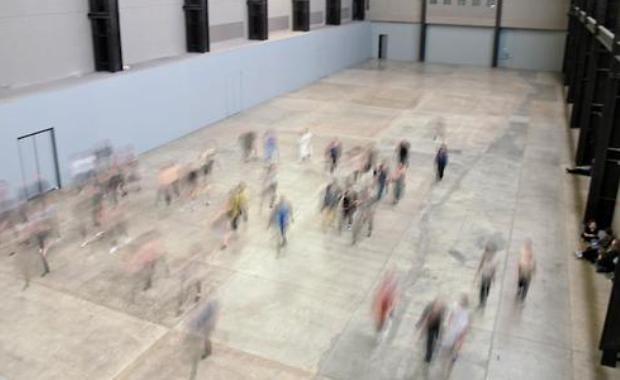
On Tuesday, after week upon week of mentally penciling it into my diary only for it to get scrubbed out by something else that seemed more pressing, I finally spent a bit of time with These Associations, Tino Sehgal’s current Turbine Hall piece at the Tate Modern. The associations that this performance-based artwork conjures, through playing and gentle encounters and the swarming and separating of human bodies, are many and varied. It hints at social associations, of our engagements with others, of their intimacy or conversely their lack of intimacy; it whispers of the parallels we feel compelled to draw between disparate objects or conversations, the chains we link together in our culture of constant game-playing.

The piece was, for me, a beautiful pause in a week that is threatening to swallow me whole. Starting my MA and reaching a startling recognition of the true extent of my ignorance, combined with keeping all my other various plates spinning, is beginning to overwhelm. As a departure from this jittery panic, These Associations offered a mode of contemplation that was somehow simultaneously active and passive, an invitation to play and to watch. Yet I was also intrigued by a thought that was voiced about the work in my seminar the next day: “the potential for engagement is more exciting than the engagement itself”.

I wonder if this uncomfortable observation, made by Hana Tait, might haunt much of the current work that hinges on interaction with its audience. The potential, tingling with possibilities and anticipation, always threatens to outdo the reality. This same observation might also be applied elsewhere; the not yet elucidated, slippery, anticipatory ghost of an idea, perhaps half-spoken or half-thought, is often more captivating than its concrete explication.

This is all a rather roundabout way, by route of a scenic tour around my current state of mind, of getting into some thoughts that I’ve been kicking around between brain, notebook and drafts folder ever since the recent Dialogue event at BAC. I’ve been holding onto those elusive half-thoughts in the belief of their potentiality, almost scared that, butterfly-like, their wings would tear as I attempted to pin them down. Which is a self-consciously poetic way of saying I was worried that the actual words I was managing to wrench out were a little bit shit. They weren’t in any way doing justice to the event, the discussions or the potentially exciting thoughts I’ve been prodding at concerning theatre criticism.

The event I’m talking about, chaired by Maddy Costa and Jake Orr, was an attempt to cultivate conversations around this topic. For a planned three hours that unravelled into four, a room full of people who make, write about or watch theatre – or any combination of the three – talked about theatre criticism, what it means and how it might be done better. Especially how it might be done better.

This session of conversations and provocations was a larger extension of the informal morning I spent discussing similar issues at St Stephen’s, a discussion that made me question the way I was reviewing theatre in Edinburgh at the time but that spat me out onto the cobbled streets buzzing with possibilities. This latest event, by contrast, was a lot more challenging for me. The conversations were no less interesting or urgent, but I walked down to the BAC bar feeling emptied out, exhausted.

Trying to write about it, I’ve also exhausted myself. I found myself attempting to cover too much ground and in summing up countless conversations I got lost in them. Instead I want to play and to watch, to flit between associations. To curate a highly subjective critical curation of discussions that are far too complex and knotty and far-reaching to crystallize here.

My way into this, like Maddy’s way into the afternoon’s discussions at BAC, is a one minute manifesto. Maddy’s manifesto spoke about love, something which she understood as involving respect, admiration and trust, ingredients that should arguably translate into how we write about theatre. My own manifesto, which first tapped me on the shoulder on a walk home from the station in the gathering, bonfire-scented dusk, says a lot about where I feel I am at the moment and goes some way towards explaining my reasons for being at BAC that afternoon.

~

The Power of “I Don’t Know”

I don’t know.

It’s not a phrase that often finds its way into public rhetoric. It is shunned by politicians and by all of those individuals in positions of any little authority. It says uncertainty, indecisiveness, perhaps even stupidity. The gormless refrain of the schoolboy staring listlessly out of the classroom window. An inadequate response.

But sometimes it’s the only reasonable response. Certainty, for all that it is prized, is a dangerous quality. Certainty makes blinkered decisions; certainty doesn’t dream of alternatives. Certainty can be entrenched.

It is uncertainty that often takes the biggest leaps, those bold steps into the unknown. It’s that unfashionable admission of “I don’t know” that prompts questions, that looks around at all the possibilities, that is open to discussion. “I don’t know” is the conversation starter; “I don’t know” is a beginning.

Granted, decisiveness has its place. Decisions do, after all, need to be made. But I’d also like to champion the power of “I don’t know”. I’d like people to look around, to challenge the way things are, to be able to answer the question of whether this is right with an expression of doubt. To examine the status quo with fresh, unblinking eyes and say, with crinkled brow, “I’m not sure about that”.

There are lots of things that I don’t know about. I don’t really know what I’m doing or what kind of person I want to be. I don’t entirely know where my life is going or where exactly I stand on lots of debates. While voices are shouting around me, I’m holding the arguments in either hand and shrugging my shoulders. It can be scary and intimidating and can make me feel small and stupid.

But it can also be exciting. It can hum with a thousand unuttered possibilities or present paths that I’d never have imagined treading. It can also be powerful.

The end. Question mark.

~

I frequently feel horrible about not knowing. It’s a position of ignorance that my age and the relatively brief amount of time I’ve actually spent interrogating theatre and performance make inevitable, but one that has been highlighted to me yet again in the last week or so. But I’d like to turn around that ignorance and uncertainty into a way of looking at criticism, as I pick out the splinters of discussion that had buried their way under my skin and start to think about ways of moving forwards.

I think that perhaps uncertainty and self-examination provide a useful starting point. At the very end of a largely optimistic piece written in response to these same discussions, Andrew Haydon raises the spectre that has recently been haunting me of the critic’s training. He puts forward the fascinating suggestion that the reimagined critic might have a role within the theatre landscape as an ecologist or curator, but questions what level of preparation that responsibility might entail. The problem is that there are no real qualifications as such for being a critic.

Which brings me onto the question of “professionalism”. To be a professional critic essentially involves being paid for criticism, in the sense that Michael Billington is a professional whereas I – at least most of the time – am not. As Andrew begins to go into, this professional status dictates the critic’s activities, as they become absorbed into the economic system under which theatre operates. They are required to pass judgment on productions that are considered “newsworthy”, either driving or dwindling ticket sales. Like it or not, they are a cog in the machine. This kind of criticism requires a certain kind of approach and experience which perhaps differs from the demands on the emergent “critic as curator” role, a role that seems to ask for the kind of knowledge that I’m rapidly trying to acquire at the moment.

For me, training and a different kind of professionalism, one that sits if not completely outside of then on the edge of economic relations, is all about context and connections. Fresh in my mind as I embark on a course that identifies itself as interdisciplinary is the arguably interdisciplinary nature of the way in which we study and understand theatre and performance. Theories borrow and feed from areas such as literature and visual art, as well as less obviously connected disciplines, in the same way that theatre is also flooded with outside influences. As Andrew suggests, there’s something to be said for breadth and for an appreciation of the fact that theatre exists within and is shaped by a wider cultural ecology. If the critic or curator is to undertake any kind of training, it should perhaps be in this. It’s a widening of scope that is also recognised by Daniel B. Yates in his call for theatre critics to engage with other forms of cultural criticism, itself the product of conversations had at Edinburgh and since.

Albeit in a very different way, I feel that the architecture of context could also house some of the “embedded” practices that are currently the subject of much discussion. While there is another function of this role from an artist’s perspective, which was discussed at BAC by Selma Dimitrijevic and which I’m personally very interested in exploring further (a more dramaturgical role is perhaps the best way to describe it), I think there is something to be said for simply gaining an understanding of process. This does not necessarily involve valuing process over end product, which can be dangerous and risks eliding an aesthetic judgment on the work, but rather informs a kind of criticism that is aware of and sensitive to process and which might as a result inspect the choices of a piece more deeply.

Alongside and in addition to this desire for context, in all its many forms, I want to reintroduce Maddy’s idea of love. Criticism is – or should be – an act of love, as Andy Horwitz defines it in his excellent essay on the 21st century critic (essential reading). Stewart Pringle said one of the most brilliant things of the whole afternoon at BAC right at the end when he explained that his relationship to theatre, be that making it or writing about it, is all about showing other people amazing things (I paraphrase, poorly). It was a pertinent link back to the title of the event: For the Love of Theatre. I’m interested in intricate analysis and interdisciplinary connections, but I’m also doing this because I love theatre and I feel compelled to communicate that love to others.

Which is what makes Megan Vaughan’s concept of bottling an aesthetic experience such an attractive idea to bring into this mix of what criticism could or should be. As she does, it’s helpful to bring in some Kant, and I think it’s worth quoting this element of his thinking on aesthetic judgment in full:

If we wish to decide whether something is beautiful or not, we do not use understanding to refer the presentation to the object so as to give rise to cognition; rather, we use imagination (perhaps in connection with understanding) to refer the presentation to the subject and his feeling of pleasure or displeasure. Hence a judgment of taste is not a cognitive judgment and so is not a logical judgment but an aesthetic one, by which we mean a judgement whose determining basis cannot be other than subjective
Critique of Judgment

As well as unveiling the fallacy of objectivity in a way that I find particularly appealing, there is a suggestion within this understanding of aesthetic judgment about how such aesthetic experiences might be communicated, as Megan goes on to explore. How do we share, nurture and sustain a passion for theatre as a whole and for particular pieces of work? A quality within criticism that captures the visceral thrill of seeing a truly stimulating piece (as Megan’s review of Three Kingdoms does better than any of the many, many words I wrote on that same production) is something valuable and vital. I also like Kant’s implication, inserted within parentheses, that this might be married with “understanding”, hinting at a kind of criticism that could conceivably combine the elements I have so far described.

Another way in which these different elements of criticism might be linked is through the idea of conversation that is at the heart of Dialogue’s project. Whether as a way of opening up a productive dialogue between critic and artist or as a starting point for post-show chats in the theatre bar, criticism should be able to get people talking, whatever form that conversation catalyst takes.

Mention of form finally transports me to the point that I made when my turn came at the end of the session at BAC. I didn’t put it particularly well at the time, but chewing over the myriad conversations that had made up the afternoon seemed to throw up a loose connecting thread of the form that criticism takes or could take. My feeling was that a lot of the discussions and indeed the disagreements revolved around different ideas of what criticism should do, who it’s for and what it should look like, three points that are all messily tangled up with one another.

If one thing is clear from the dialogues that have been opened up, it’s that it’s unlikely that we’re all going to agree on any of those three things in the foreseeable future. Which makes me think that the kind of criticism we’re attempting to reframe shouldn’t be a “model” at all (someone else, I can’t remember who, protested against the rigidity of this term) but something more flexible, more malleable, more open to the number of different purposes that criticism can serve. It needn’t even, as Andy Field suggested, take the form of writing at all. Why limit ourselves to just one form of critical expression? I’m not quite sure how, but it strikes me that we need to reconsider and open up our idea of what criticism entails and the many different guises that it might take, guises far more sophisticated and varied than the traditional designation of a “review”.

To attempt some kind of summing up, I suppose that there are four main strands to what I’m rather convolutedly saying: the requirement for the critic to question his/her position, the desire for a greater awareness of the context in which both theatre and theatre criticism sit, the need to express and share an inherent love for theatre in a way that starts conversations, and the suggestion of a more flexible and open idea of how that might be done.

My sketchy vision of the critic is of someone who collects beautiful and/or interesting things (note interesting – that could just as easily mean ugliness with a grain of curiosity), holds them up against other beautiful and interesting things by way of examination, and then communicates those things to others (be those others audiences or artists) in a way that is beautiful in its own right and that opens, channels and curates conversations, together with an awareness of the critic’s self-constructed identity within those conversations. (of course, this vision might just be down to the strange pleasure I take, both in theatre and in writing about theatre, in observing the creation of something beautiful that then turns itself inside out).

So what next? Moving forward involves asking questions, being able to accept the fact that there might not be ready answers and being willing, like Dan Hutton in his response, to set ourselves the task of trying out these new kinds of criticism and very possibly failing. So let’s say “I don’t know”. Let’s ask the questions, let’s look around, and let’s translate that electric current of potentiality into something actual. As Dan says, this could all go tits up, but I figure it’s worth a try.


Morning, Lyric Hammersmith

The auditorium is flooded with mangled, discordant screams. Pale fluorescent light creeps across the stage, illuminating a snapshot of horror with the clinical blandness of the hospital ward. And all around me, audience members stifle laughs.

This is the moment from Morning that is etched most vividly on my memory. Being seated in the middle of a group of teenagers, the demographic with which Simon Stephens’ latest, horribly compelling play concerns itself, offers a fascinating perspective on this piece – certainly not one likely to be found on press night (just one reason why it can be helpful to occasionally step out of the herd of ferociously scribbling critics, but that’s a subject for another time). Ripples of discomfort swell through the theatregoers around me as they drink in a cocktail of strangeness and recognition to which the only response is a nervous titter. As one boy put it on his way out, with a hint of awkward admiration, “that was bare weird”.

The “bare weird” show that Stephens and director Sean Holmes have created with the Lyric Young Company centres on Stephanie, a fiercely intelligent but disturbed teenage girl played with terrifying precision by Scarlet Billham. Sick with sadness yet unable to stop smiling, she dispenses viciousness without a flicker of concern. Stranded in an antiseptic suburbia where all the meticulously kept gardens look exactly the same, ennui is a permanent state for Stephanie and her friends – one of whom, Cat, is about to escape for university. Before she leaves, however, Stephanie has recruited unwitting boyfriend Stephen in a scheme for a savage send-off, an escalatingly brutal scene around which the play nauseatingly pivots.

I expect that numerous comparisons will have been made with Punk Rock, another unsettling Stephens play that takes modern youth as its subject. Not wanting to disappoint, I admit that such thoughts did strike me while watching Morning; in many ways these are quite different pieces, but a direct line can be drawn between William Carlisle and Stephanie. In each case, Stephens’ protagonist is startlingly intelligent, an intelligence that acts as an uncanny counterpoint to their respective brutality and apparent emotional detachment. Eschewing the hoodie-clad image that haunts portrayals of contemporary teenagers, Stephens’ portraits of this generation are all the more blackly horrifying.

What strikes me as being particularly important, perhaps for this play even more so than Punk Rock, is the teenage perspective. This is perhaps because my ears are still ringing with the words of Ontroerend Goed’s Alexander Devrient, who said something along the lines of teenagers being at a stage of life in which they can see what is wrong with the world but are not yet able to formulate any remedial ideologies (I’d recommend listening to his full, thoughtful, softly spoken interview for Theatre Voice, in which he speaks eloquently and at length about his work with young people). But what if they only see diagnosis without cure because that is the unacknowledged truth of the world?

Perhaps what we can take from Morning is the incisive awareness of a world in which, in Stephanie’s words, “everything is fucking shit”, an awareness not yet blunted by ideology or philosophy or religion – teenage nihilism three times distilled. But there is a taut, oddly appealing ironic tension between this apparent nihilism and the quotation from Marx that Stephanie prints in bold felt tip: “the philosophers have only interpreted the world; the point, however, is to change it”. The knowledge that this piece has been made specifically for and with the age bracket represented then adds another fascinating layer; how have the astonishingly talented members of the Lyric Young Company influenced this final, unblinkingly bleak vision of the world?

Which brings me neatly, if not uncomplicatedly, onto my next point. As discussions of Stephens’ work tend to veer towards considerations of collaboration, especially in the wake of the extensive critical discussion around Three Kingdoms, and as I’m ever more conscious of the disingenuousness of critically portioning a production into writing, direction, design and so on, it seems apt to reflect on the ways in which the various elements of this piece feed into one another.

In considering the aesthetic of the whole, the words that rise most stubbornly to the surface of my mind are “antiseptic” and “clinical” (neither in a negative sense, I should add, but one that feels crucial to the piece). From stark fluorescent lighting to unsettlingly alienated performances, there is a sterile coating that settles over the production like the shimmering sheets of plastic that shroud Hyemi Shin’s set. The design itself is what first snatches at the attention: the large, half-filled glass tank of water, the industrial fridge containing a single bag of blood, the forensic tent, the assorted lights, the plastic – there’s lots of plastic. This seeps into the plasticity of the performances, a sort of blank, detached distortion of naturalism that could just be taken for stiff acting in the opening moments but that soon emerges as a very particular style, one that is married to the coldly artificial quality of the design and the dislocated realism of Stephens’ text (a misleading and loaded word, as I’ve discussed elsewhere, but one that will do in the absence of a more precise vocabulary).

In place of the domestic settings to which Stephens’ dialogue refers, the production is littered with forensic paraphernalia, an implicit nod to the current ubiquity of the detective narrative, but this is a crime scene in which nothing is solved (a nice example of how a non-literal interpretation can be a more perceptive comment on the text than one which sticks rigidly to its real-world inferences). It also hints at a certain clue-hunting critical approach to theatre, a quest for meaning that Stephens – and indeed the whole production – actively eschews.

Without listing every aspect of this intriguing staging, the other element of the production that merits particular mention is Michael Czepiel’s nightmarishly distorted soundscape, which is produced live on stage with both Czepiel and the sound desk in full view. As well as peeling away the illusions of theatricality, this choice pulls on strands of voyeurism and plants another of the production’s subjects as a permanent presence, the (mostly) silent youth glued to the computer screen.

Returning to nihilism, this multi-layered whole produces an anarchic, punk-inflected void of meaning, a great black gaping hole where we might expect to see hope or redemption or some kind of “message”. Perhaps deflecting some of the criticisms that have been levelled at his work in recent years, the concluding words of Stephens’ script (yes, sorry, I’m attaching elements to single individuals once again, but let’s just assume for sake of ease that these words are purely Stephens’) are a gutting “fuck you” to any demand for an optimistic chink of light. But just to contradict that – and to once again overturn my simplifying attributing of authority to Stephens – the production itself goes on to complicate this appropriately teenaged gesture of rebellion.

Morning is the sort of uncompromising piece that inevitably cleaves opinion, if not perhaps to the same impassioned extremes as Three Kingdoms (which I will, eventually, stop going on about – probably). Potent reactions spill tangibly through the audience throughout the painfully gripping hour of the play’s length and pour out into the packed foyer after the final bow. The one response that is markedly absent from the teenagers around me, however, is shock. Like Stephanie, they emerge smiling. After all, if you know already know that there is nothing but terror, what else is there to do but laugh?

No Place Like Home

Originally written for Exeunt.

In the immortal, celluloid-enshrined words of a ruby-slipper-tapping Dorothy, there’s no place like home. Or at least, even if our birthplace is somewhere from which we run kicking and screaming at the first opportunity, the place we come from inevitably shapes and defines us in some way, as do all the other places we subsequently call home.

So what does our local theatre say about us or about the community it is born from? Growing up in something of a cultural grey zone whose sole theatrical offerings seemed to be incessant tours of Grease and the obligatory ABBA sing-along, my loyalties as a theatregoer were aligned to London almost by default. It is a city I have yet to actually live in, but to which I feel inextricably bound by my connection with its culture. My personal experience, which I suspect is partly down to my hometown’s relative proximity to the huge variety of theatre available in the capital, is thankfully not indicative of the state of regional theatre on the whole. But even in areas with a thriving theatre scene, how much of the work is really wedded to its surroundings?

There is, of course, an immediate flipside to this argument. Just as the dearth of roles for women is not necessarily addressed by female writers, who are often wary of confining themselves to female experience for fear of being shoved in the box labelled “feminist playwright” and never allowed back out, regionality can be shunned by artists operating outside the capital. “Regional” is a tag that risks being used to imply something limited, something insular and blinkered, perhaps even something quaintly pastoral. As Daniel Bye’s column about Northern Stage at St Stephen’s suggested, it is easy for a national theatre culture still largely centred on London to pinpoint regionality as a basis for criticism.

What Bye also proposed, however, is that we should ultimately be proud of where our theatre comes from. In his words, the programme at St Stephen’s was “marinated in its distance from the cultural centre”; whether consciously “regional” or not, work made away from London is inevitably coloured by the site of its origin, as much as London-based theatre is arguably lent a certain quality by its position in the capital. So why are we reluctant to celebrate these regional differences?

As with anything, there are startling exceptions to the picture of regional theatre that I have – admittedly very roughly – begun to sketch above. Chris Goode’s 9, for instance, programmed at the West Yorkshire Playhouse as part of the Transform Festival earlier this year, worked with local people to create a series of solo performances, crafting a piece of theatre fused to its place of origin through tangible human links. Remaining in Yorkshire, Invisible Flock’s Bring the Happy chose to investigate the concept of happiness through the very specific focus of Leeds, while their current project Sand Pilotexplores an equally specific relationship with the natural environment in Morcambe Bay. In a slightly different approach to regionality, Joel Horwood’s  Peterborough was commissioned by Eastern Angles with the brief of responding to the city of its title, a place referred to by the Arts Council as a “cultural cold spot”.

Many other examples could doubtless be cited, but what British theatres often lack is a truly regional aspect to their overall programming. Compared with the system in Germany, for example, where the dramaturgy departments of individual institutions set themes for each season based on a mix of wider social issues and subjects of particular local resonance, the UK model makes a striking contrast. Thanks to the touring structure, London is frequently either the source or the desired end point for work, generating an influx of shows geared towards the capital and casually indifferent to their location. When people complain that the theatre on offer in their local area has no relevance to them, it is easy to appreciate this perspective.

A couple of weeks ago, Lyn Gardner bravely lit the touchpaper in the ever fiery arts funding debate by suggesting that subsidy should be channelled away from major institutions and instead invested into “the bottom of the pyramid”. While this takes us into complex and thorny territory, one vital point that Gardner makes is about the participatory nature of the arts. As she stresses, for those who end up working in this industry, nearly all have found their initial point of entry through involvement of some kind, often no doubt through their local institution.

If such institutions were more attuned to their surrounding area, maybe more of those “ghost” artists that Gardner writes about would recognise the relevance of theatre to them and be able to realise their potential. A more local focus might also enable the feeding of funds into the grassroots, supporting emerging artists in the immediate region in a way that could allow major organisations and smaller companies to happily and productively co-exist.

To distil a piece of theatre down to any one element is of course reductive, ignoring the myriad influences that help to shape it. But to pursue the opposite extreme and discount location entirely is to also ignore something, something beautiful and idiosyncratic and married with a sense of community that is all too often missing from our theatres. As new artistic director Roxana Silbert’s spearheading of Birmingham REP’s centenary season recognises, theatres and artists have a vital role in serving their communities, be that through responsive programming or local engagement. And through this engagement maybe, just maybe, they can secure themselves an integral place for the future.

Blink, Soho Theatre

The human eyeball is a lot like a single lens reflex camera. Both have a lens, a focus, a destination where the picture is formed. In the same way, love – at least for Phil Porter’s pair of charmingly strange characters – has a lot in common with voyeurism. The initial jolt of something like recognition, long periods of watching and yearning, a gradual descent into familiar comfort.

Watching is central to Porter’s off-kilter romance, visiting the Soho Theatre fresh from Edinburgh. Sophie feels as though she is slowly disappearing and has a desperate need to be observed. Ever since volunteering as the night watchman for the reclusive religious commune in which he was raised, Jonah likes to watch. It is a match made in Peeping Tom heaven. While playing with the conventions of the rom-com, however, this is distinctly setting itself apart from traditional romantic narratives – less hearts and flowers, more foibles and dysfunction. It is a love story, Jonah is keen to emphasise, but perhaps not the kind we’re used to seeing.

As already established, seeing and being seen are overt themes. A number of Sophie and Jonah’s shared activities involve watching, including a telling level of emotional involvement with a television plot, while it is not insignificant that the most erotically charged moment between them is sparked by an act of joint voyeurism. This atmosphere of covert observation is reflected in Joe Murphy’s direction, which places actors Rosie Wyatt and Harry McEntire at opposite sides of the performance space, stealing looks at one another while directing their separate segments of the same story to the audience. They take turns to watch, switching between spectator and subject, but rarely do their eyes meet in a moment of direct intimacy.

What all this watching hints at, other than a natural human instinct towards nosiness, is rather more interesting. Sophie and Jonah’s relationship, for want of a better description, begins through the mediator of a camera in Sophie’s flat, placing a screen between the pair from the beginning. This immediately leaps out as a symptom of the digital age, an indictment of the lack of real connection engendered by our ultra-connected society, but it’s not quite as simple as that. Although these two characters certainly suffer from an allergy to intimacy, Jonah has been brought up starved of technology, suggesting that our difficulties with relationships and our fondness for the false intimacy of pining from a distance run deeper than the digital sceptics might have us believe.

There is also a link to be drawn between the feeling of being watched and the subtle religious references made by the piece. While Jonah’s fiercely pious upbringing is primarily a source of comedy, the concept of a divine being is not just there for laughs. There is something in Sophie’s poignant desire to be seen that speaks of an inherent impulse to believe in a greater power watching over us, while the knowing adoption of the sort of coincidences typical to the rom-com genre throws around ideas of fate and destiny, once again implied to have more to do with psychological need than any universal master plan.

Far from being the exclusive preserve of a deity who directs our lives, Blink seems to be saying that watching is an intensely human activity. It is also an activity that we as an audience are of course deeply complicit in. This is powerfully felt in a brief moment when Wyatt and McEntire, enacting the joint activity of watching television, sit and stare out at us. What we as an audience are doing, crowded into a dark room with a group of strangers to gawp at a couple of people pretending to be other people for an hour or two, is essentially quite odd, a largely unacknowledged observation that the piece could do more with. In a play so concerned with spectatorship, it neglects to truly dissect the act of spectating that makes the piece possible in the first place.

For all the interest sparked by Porter’s intelligent, multi-layered text, the production is largely made what it is by the appeal of Wyatt and McEntire, in whose hands these weird, lonely characters become almost unbearably endearing. They are both kooky while delicately side-stepping cliche, staying just the right side of twee and occasionally snagging our emotions on moments of gutting, unshowy sadness. If it were possible to capture the overall aesthetic of the performances, they linger somewhere between cute and detached; a sort of dislocated realism that might easily be taken for straightforward naturalistic acting but has just the lightest touch of strangeness.

This strangeness bleeds into Hannah Clark’s set, which begs us to look at it. The Ikea-meets-woodland-meets-kitsch design is made up of a back wall of panels showing a blown-up photograph of a forest scene, a carpet of imitation grass, and a selection of office furniture that is gradually moved around the space. Much can potentially be taken from these intriguing choices, but the most striking comment made by the set is one that is married to this idea of intimacy at a distance. Just as Jonah falls in love with Sophie while watching her on a screen, the “outdoors” that Clark’s design presents us with is pointedly fake and photographic – a distant representation that appears on something very much like a screen.

As much as it eschews the trajectory of the rom-com (how many love stories begin with anecdotes about dissecting eyes or removing teeth?), there are moments when Blink trips up slightly on the tropes it is teasing us with. But just as Porter seems to have relented to the irresistible appeal of his oddball characters and given his audience what they want, this anti-climactic possibility is quietly ripped away. This enchantingly quirky piece is too clever to conform to our expectations, as much as it may flirt with them, but in its subversion it equally takes us by surprise. No jaw-dropping denouement, the final narrative twist is unobtrusive, gentle, with a bleak note of inevitability. It is even sadder for this. A fondant with a heart of bitter chocolate, the beauty of Porter’s creation is that the whimsy is always tempered with something altogether darker.

Blink runs at Soho Theatre until 22nd September at Soho Theatre.

Photo: Sheila Burnett

Troilus and Cressida, RSC & The Wooster Group

Surfacing from the much-maligned RSC/Wooster Group Troilus and Cressida with a tingling sense of mild bemusement and dizzying disorientation, my initial and surprisingly strong instinct was “I don’t want to write about this”. Luckily for me, I was under no obligation to wrench out any words; for once I was a plus one, not a reviewer, and my notebook had remained firmly tucked away in my bag throughout the performance. Freshly singed from Edinburgh’s baptism of fire, I was determined that for this theatre trip I would be a spectator and nothing more. And my immediate thought on stepping out of the auditorium was that this determination was a wise one.

Not because I hated the show, which I didn’t. While I had avoided reading reviews, I entered Riverside Studios with an unavoidable awareness of the mass walkouts and the cool critical reception that the production had received in Stratford, prompting curious anticipation as much as trepidation. But when I found myself disagreeing with this general tide of opinion, I was as troubled as I was pleased. I don’t have a problem with veering away from the consensus; instead what disturbed me was a perplexing inability to articulate what it was about the piece that I found so engaging. I felt as though, with my complete lack of reasonable justification or developed critical analysis, I had no real right to state my enjoyment of the production.

I also worry (and some fervent supporters of the production have faced similar accusations) that I am becoming subconsciously entrenched in my tastes. I’m concerned that I have reached a state of mind where experimentation or anything diverging from the “norm” as we conceive of it in British theatre has become synonymous with “good theatre” in my critical vocabulary. I worry that by liking Troilus and Cressida – and particularly by being so evasive about why I liked it – I’m simply fulfilling expectations without really thinking. For all of these reasons, I was glad to be exempt from having to marshal my floating impressions into fixed-down words.

So why am I writing this, you ask? Good question. Well, partly because it’s a challenge, and for that reason alone it’s difficult to resist. To leave this particular challenge untouched would feel like an act of critical cowardice, a weak refusal to stand behind my opinions. And partly because there has so far been a relative dearth of positive critical responses, prompting me to feel that I should at least make an attempt, as feeble as it may be, to pick apart what it was about the production that held me rapt for over three hours (no small feat after being conditioned to accept the Edinburgh norm of one hour shows). While debating with myself about whether or not to write anything, I was also reminded by Andrew Haydon that the process of writing about a piece of theatre doesn’t have to be as complicated as I often make it – in his words: “if in doubt, just describe what you think you saw”.

What I saw was, to employ classic British understatement, a lot. It is easy, from this perspective, to see why it has been dismissed by many as busy and confused. To be completely honest, it kind of is both of those things. Yet this messiness has a logical foundation. I believe co-director Mark Ravenhill has said something along the lines of not wanting to impose any unified meaning on a play that is by its very nature problematic, which seems to make a lot of sense. My memories of briefly studying the text in my first year at university are of a troubling, fragmented play; at the time I far preferred Chaucer’s characteristically humorous telling of the same tale. For a slippery play, it seems apt to employ an equally slippery interpretation.

Also apt is the way in which this collaboration between the RSC and experimental New York-based company The Wooster Group has been carved up. Not really a collaboration at all in the usual sense, the piece has been divided into its Greek and Trojan segments and rehearsed separately on opposite sides of the Atlantic, with The Wooster Group taking on the Trojans under the direction of Elizabeth LeCompte, while the RSC and Ravenhill (replacing Rupert Goold, who engineered the collaboration) have accepted responsibility for the attacking Greek contingent. There is as a consequence a deep chasm between the two halves, a divide of cultures – or perhaps a head-on crash – in multiple senses.

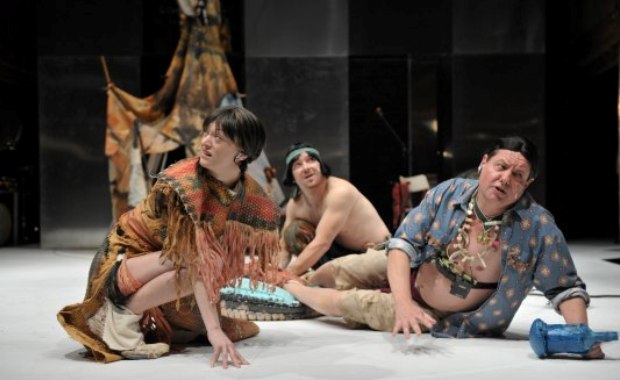
Reflecting this process, it seems fitting to speak separately about each of the competing aesthetics. The first observation that begs to be made about The Wooster Group’s Trojans is that they are fashioned as Native Americans played by a cast of white New Yorkers. This, as a concept, potentially leans on the offensive side of crass (though this isn’t ultimately how I read it) and is as such inherently problematic. The most obvious way of reading this creative choice is as a comment on the besieged nature of Trojan culture, a culture that – as our knowledge of the narrative and that infamous wooden horse tells us – will soon be all but extinct.

Yet there seem to be more layers than this, not least because the playing of these Native Americans has a distinct gloss of the artificial. The actors’ deliberately messy costumes, while demonstrably marking them as Native Americans, also have modern tweaks and are flecked with odd bits of neon. Most bizarrely, the warriors wear on their backs an armour composed of what look like brightly coloured latex variations on classical statues and fight with weapons including – to collective amusement – a lacrosse stick. I’m tempted from these elements to infer something vague and tentative about time and history. Certainly the striking statue-armour (for want of a better description) creates the impression of the performers clawing their way out of the mythical/historical baggage that inevitably comes with tales of Troy. Laden with baggage too is any representation of Native American culture, a difficulty acknowledged by the production.

That bemusing lacrosse stick, meanwhile, immediately makes me think of school – or at least of the kind of school where people play lacrosse, which seems to exist exclusively in Enid Blyton books. There is an inherent childishness to it, which seemed to me to be linked to a wider feeling of childlike play and imitation that infects the Trojan side of the piece; it as though war is a game or a movie, with no real meaning. Talk of movies brings me onto the other startling aspect of The Wooster Group’s staging, which is the use of four screens mounted at the corners of the stage showing various clips of film. It soon becomes evident that the performers are impersonating the actions in these films, often more focused on the screens than on what is happening in the performance space.

This, as a performance technique, is immediately alienating. It is inevitably distracting, rendering the underlying narrative almost secondary, which is possibly one of The Wooster Group’s biggest problems. Having at least a sketchy, half-remembered knowledge of the source narrative and Shakespeare’s text, I was arguably in a better position to enjoy what has been done with these elements than someone approaching this little performed play for the first time. While these acts of mimicry may partially obscure the text, however, they feel simultaneously born from Shakespeare’s play. Troilus and Cressida is in many ways a bitter satire, and in this context the aping of Hollywood romance by the two title characters during the central wooing scene emerges as a biting comment on the nature of their ill-fated love. Romeo and Juliet this ain’t.

The otherness cultivated by all of the above elements is further cemented by the use of mics, into which The Wooster Group’s performers speak in oddly clinical, flattened tones. Their dislocating inflections suggest both an overt element of the performative – again that emphasis on the artificial which I understand is something of a Wooster Group trademark – and a certain blank absence of emotion which, although the opposite of what actors usually hope to convey, seems appropriate to the lack of meaning that pervades the whole. Everything here is about calculated fakery, from the costumes and accents to the absurdly gorgeous downward projections [at least this is what I think they are – happy to be corrected on any technical elements that I may have misremembered] that outline the placement of props on the stage.

For all the strangeness and lack of narrative clarity, I simply couldn’t help being hypnotised by these uniquely odd Trojans. I like that The Wooster Group kept me guessing and refused to offer anything close to thematic resolution, which was perhaps what kept me so hooked. To watch their half of the show with enjoyment demands an oddly paradoxical combination of distinct concentration and a certain detachment from imposing meaning. I was searching for individual readings, but soon understood that any overarching meaning (at least in the way we usually understand meaning) would elude me, and felt surprisingly fine about that.

I feel that I have less to say about the RSC/Greek side, not because I thought the Trojans were necessarily any better, but because they were just so captivatingly strange that it’s difficult not to be more preoccupied with their half of the production, whatever you make of it. But like The Wooster Group, it is the overall look of the RSC’s Greeks that initially makes an impact. They are, with a couple of exceptions, dressed in military uniforms, immediately emphasising that these are the attackers. This aggressive emblem of masculinity, however, is rapidly contrasted with the wounded ineffectuality and/or effeminacy of many of the soldiers.

It struck me that a conventional concept of masculinity and a subsequent stripping away of this masculinity seemed to be one of the main strands of the RSC side of the production. The set, which is built partly on a revolve which spins from Greek to Trojan side, has a dividing wall clad with mirrors on both sides, but it is on the Greek side that these are most apparent, not being hidden as they are on the Trojan side by a teepee. As well as suggesting something interesting about similarities and otherness, this allows for an element of posing on the part of the Greeks, who include a transvestite, wheelchair-bound Thersities and a WWF-style Ajax.

However – and this feels like a strange observation to make given the bizarreness of The Wooster Group’s staging – there is less cogency to the RSC’s vision. Strange as everything on the Trojan side may be, it all feels woven into one aesthetic; an alien aesthetic, perhaps, but one that sort of makes sense in its own weird way. The clashing elements of the half that the RSC and Ravenhill have crafted, however, feel as though they are trying to do too much at once – perhaps trying to compete with their American counterparts, proving that the British can do this experimental lark too. To an extent it succeeds, but when married with The Wooster Group’s creation it is less two competing styles than a messy collision of many.

There was one line, spoken by Zubin Varla’s fantastic Thersities, which seemed to me to function as a banner under which the whole production might sit: “Lechery, lechery, still wars and lechery: nothing else holds fashion”. There is a feeling of futility that infects Shakespeare’s play, a debunking of both romance and heroism that leaves all of the storyline’s driving elements without any real point. It is this feeling that I would argue is compounded by the RSC/Wooster Group’s messy, contradictory treatment of the text, which draws out the perpetual hold of both “lechery” and “war” and their essential meaninglessness.

Reading this back, I realise that despite initially stating my enjoyment of this production, many of my observations could equally be taken as criticisms. The swallowing of narrative by The Wooster Group’s consciously odd aesthetic might easily be considered a crime against Shakespeare; admitting that the performance is messy, eschews meaning and requires a very particular kind of concentration in order to watch it with enjoyment hardly sounds like a resounding endorsement. The more I think about the production, the more potential criticisms arise, yet somehow I can’t shake my enchantment with this parade of strangeness.

So really, apart from making a rather long list of observations and trying, as Andrew suggested, to describe what I think I saw, I’m really just saying “I don’t know”. I’m willing to accept that my intense engagement with this piece of theatre is merely a quirk of my character, and I’m not going to suggest that anyone who walked out at the interval (or wished they had) lacks any vital insight or understanding that I purport to possess. As a critic it is clearly not enough to simply shrug and say, unapologetically, “I just liked it”. But in my self-prescribed role as a spectator, perhaps for once that’s OK.