A Strange Wild Song, Bedlam Theatre

Originally written for Exeunt.

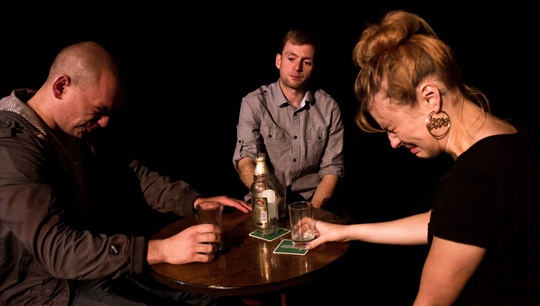
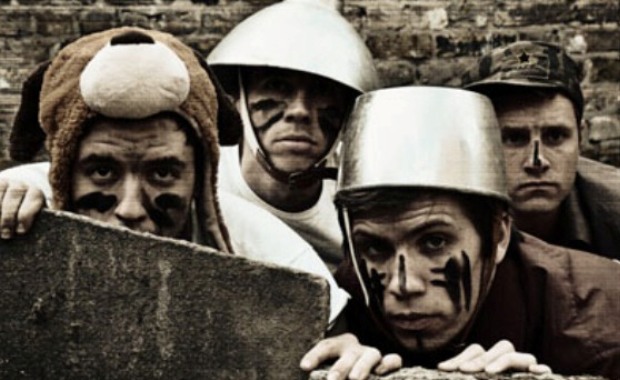
Songs of war provide the background score for this latest addition to Edinburgh’s ever-growing Lecoq contingent, devised by emerging physical theatre company Rhum and Clay. In a piece that delicately shifts between modern day Britain and the bomb-ravaged landscape of France during the Second World War, a man is transported back to the past through the medium of a single roll of film recovered from his grandfather’s wartime camera. What it reveals is an extraordinary and unlikely encounter between the soldier and a trio of abandoned young brothers.

Warfare, dream and play are all intermingled in the scenes between the soldier and the three boys, in which a lost boy aesthetic is thrown like a grenade into the heart of the battlefield. Taking refuge from the horrors of battle, there is a creeping sense of regression into the innocence and imagination of childhood, enhanced visually by the playing of the children by three adult actors. Avoiding many of the hackneyed techniques that often plague dramatic portrayals of children, the performers fully inhabit these young roles with all the clumsy physicality and uninhibited charm of childhood.

For all this charm, however, the piece as a whole feels oddly, uncomfortably exploitative, using the drama lent by atrocity in order to create something indulgently beautiful. The choice of subject matter certainly enables some stunning moments of creativity; in the process of gameplay, a ramshackle aeroplane stutters through the air, given movement purely by the impressively controlled bodies of the performers, while in another beautiful moment a red balloon floats above the rubble, appearing seemingly from nowhere.

But where this gorgeously assembled style soars, it leaves its half-baked plot with its feet fixed firmly to the ground. Ideas about memory, war, childhood and imagination lie scattered like shrapnel, casualties of the painstakingly crafted aesthetic. More than a matter of style over substance, Rhum and Clay’s creation is naggingly problematic due to the very particular historic make-up of the substance it fails to fully engage with.

Clothed in all the now clichéd trappings of Lecoq-inspired theatre that seem to abound at the fringe – physically controlled clowning, inventive use of props, the seemingly obligatory accordion – this all feels a little twee for the environs of war-torn France. Of this spreading rash of physical theatre, Rhum and Clay prove themselves to be among the best, demonstrating exciting potential, but they are in need of a better vehicle for their ingenious visual style. Whimsy and war do not make comfortable bedfellows.

The Shit / La Merda, Summerhall

Originally written for Exeunt.

In the absence of adequate words that it leaves in its wake, it is tempting to characterise Cristian Ceresoli’s searing collection of monologues as one long, piercing scream. Such a description certainly captures the raw, bruising intensity of the piece, an intensity that rips the breath from your lungs. But it also ignores the open tenderness of that same wound, a wound that is scabbed over and viciously picked at in a relentless yet compelling cycle. In Ceresoli’s creation, pain is a constant presence.

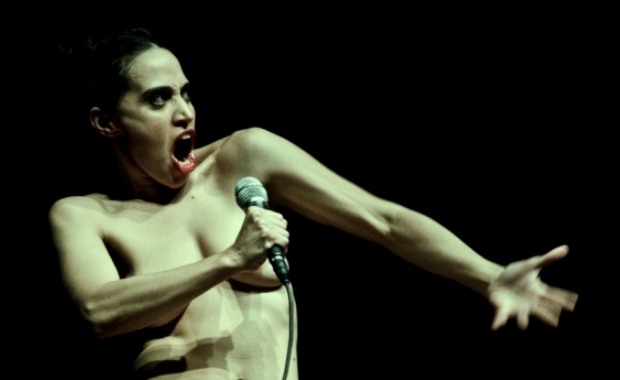
The pain we experience is that of an unnamed woman, perched high on a platform in the centre of Summerhall’s gloomy Demonstration Room. As played by the astounding Silvia Gallerano, she is naked in every possible sense of the word, bare save for a slick of blood red lipstick. Microphone clutched in hand and limbs protectively folded, she speaks with startling directness, nothing to separate or shield her performance from the audience other than the few metres of air in between.

Ceresoli’s equally naked writing has the quality of a symphony, teasing out recurring patterns of notes. The speaker is obsessed by her thighs, by the false idol of fame, by her painfully terminated relationship with her father. Repeated words puncture the text: courage, sacrifice, alone, self. It is a boldly honest exploration of the values we attach to our identity and the ways in which we define ourselves, be that against our family, our nation or the cruel expectations of the media.

In interrogating notions of identity, the piece becomes a fascinating study of what it means to be a woman, as well as what it means to be this specific woman. Although written by a man, this is intensely about female selfhood in a way that is not reductive or – that awful criticism of writing by or concerning women – domestic, but simply, honestly, starkly truthful. No thought is taboo, no impulse censored or diluted. It is the stream of consciousness of Virginia Woolf married with the spitting rage of punk.

Despite the conspicuous lack of stagecraft – all that ever appears in the womb-like space is platform, performer and microphone, simply lit by spotlights – this is as theatrical a piece as is likely to be found at the fringe this year. It is overwhelming proof of the power of the performer, Gallerano holding the audience immovably rapt by her open, direct address, every last muscle seeming to move with the text. Brittle yet achingly vulnerable, her voice has the slightest wavering hint of a tremor even when she cracks jokes, before releasing astonishing intensity when an acknowledgement of selfhood is finally ripped out with convulsing screams: “Me! Me! Me!”

Consumption – and, as the title would suggest, excretion – are at the pulsating heart of the piece. Eating here is a method of control, of sacrifice. Like the octopus at the aquarium that her father tells her can eat its own tentacles, the speaker describes a hunger-crazed fantasy of eating her fingers, an act that she is convinced would usher in the fame she so desperately craves. It is as though by eating her own flesh, absorbing and thus hiding a part of herself, she can transform herself into a tastier morsel for the greedily consuming public. It is, like the piece as a whole, a deeply unsettling comment on society, the female experience and the construction of identity.

One Hour Only, Underbelly

one-hour-only-review_540_306_Crop

Originally written for IdeasTap.

AJ’s mates have bought him a banging present for his 21st birthday – quite literally.

Out of place in a classy London brothel, the gift he ends up with is Marly, a cash-strapped student in her first night on the job, with whom he has more in common than he expected.

This is the somewhat contrived but dramatically fruitful set-up of Sabrina Mahfouz’s new play, a bite-sized meditation on youth, sexual politics and the economics of power. As soon as Marly’s mask slips and it becomes clear that this will be no usual encounter between prostitute and client, the unlikely situation becomes a platform for surprisingly honest discussion and debate between the pair. They might remain clothed, but the conversation is naked.

Marly, who likes sex but likes money more, argues her defence by suggesting that no exchange involving money is ever truly empowering; we are all, to a lesser or greater extent, whoring out our talents. Falling prey to Pretty Woman syndrome, AJ tries to talk Marly out of her morally dubious profession, but Mahfouz’s writing is too clever to allow this to become anything nearing black and white.

Through AJ and Marly, the piece asks questions about ambition, money, knowledge, the nature of modern feminism. There is also an acute observation about the way in which sex is viewed in modern Britain, with the line between casual one-night stands and paid-for encounters growing ever more blurred.

AJ and Marly’s conversational dance, engagingly played by Faraz Ayub and Nadia Clifford, takes place in a naturalistic, clinical hotel room, a naturalism that is offset by a striking back wall of lightbulbs in Francesca Reidy’s design. This simple yet fascinating feature fades and brightens, pulsing with the power games between man and woman, crackling like their obvious chemistry. Although Mahfouz’s intriguing, intelligent piece has yet to quite reach its own lightbulb moment, as the hour ticks past it leaves everyone wanting a few more minutes.

Photo: Jassy Earl

Strong Arm, Underbelly

strong-arm-review_540_306_Crop

Originally written for IdeasTap.

Sporting ambition and athletic excellence are high on the national consciousness as the country continues to ride the wave of Olympic success. When competitiveness goes up a weight class into pure obsession, however, that same determination to succeed becomes altogether more disturbing.

Roland Poland has a lot to prove. Cursed with rolls of fat and a ridiculous name, he finds unexpected strength after visiting Plates, a run-down gym above a butcher’s shop where pumping iron becomes a substitute for emotional fulfilment. Eyes transfixed on the goal of becoming Mr Britain and discovering what Arnold Schwarzenegger calls “The Pump”, Roland guzzles protein shakes and doses up on science, trying every tactic possible to get stronger.

Although entitled Strong Arm, Finlay Robertson’s protein- and testosterone-fuelled play is more concerned with another appendage. Roland, played with humour and granite-eyed determination by Robertson, fantasises about having veins so popped that he resembles a giant penis. He spunks while working out and reels off the names of “hardcore” supplements that have a hint of the pornographic. In a deeply sexualised world, strength seems to be synonymous with virility, offering a deeply critical vision of what it means to prove one’s masculinity.

Much like Roland, Robertson’s writing has more to it than it initially appears. While seeming to promise to be a vaguely amusing one-man show, it teases at our expectations, even offering up the dramatically disappointing possibility of sentimental catharsis before snatching it away again. Although grounded in a recognisable world, there is just enough strangeness to the writing – the unlikely, Dahl-esque names, the vividly grotesque descriptions – to lace the piece with a sense of the surreal and sinister.

The same might be said of Kate Budgen’s direction and James Turner’s design, which each reveal themselves as increasingly clever. The performance space is backed with a set of four mirrors, as rusting and distorted as Roland’s perception of himself, through which coloured strip lights flicker like the neon of strip clubs or of the signs on which Roland dreams of seeing his name.

Because ultimately this is all about self-identity. In a society in thrall to the media, in which outcasts can become superheroes and a bodybuilder is a Hollywood hero, to demonstrate superhuman strength is to gain fame, validation and, most importantly, acceptance.

Photo: Jassy Earl

Glory Dazed, Underbelly

glory-dazed-review_540_306_Crop

Originally written for IdeasTap.

While his friends come home in coffins and wheelchairs, Ray knows that war can make you lose something other than life or limb. Returning to Doncaster with frustrated aggression and tortured memories, the only thing that Ray is any good at these days is fighting. But there’s no memorial service or prosthetic aid for being messed up in the head.

As Ray returns to the local boozer in a misguided attempt to win back ex-wife Carla, the bar becomes a vodka-doused pressure cooker in this new piece from Second Shot Productions, stitched together by writer Cat Jones with help from ex-servicemen at HMP & YOI Doncaster prison. Knocking back shots with Carla, old mate and pub landlord Simon and ditzy barmaid Leanne, the invisible wounds begin to split open and weep.

The production is knotted together by an explosive performance from Samuel Edward-Cook as “wounded lion” Ray. Dripping with sweat and radiating aggression, he is as pathetic as he is dangerous, yet still with a spark in his eyes that hints at former charm. Like Carla, we are unable to fully detach our sympathies, no matter how broken and violent he becomes.

This is not the first piece of theatre, or even the only piece of theatre in Edinburgh this year, to tackle the bitter legacy of the conflicts in Iraq and Afghanistan. Where it demonstrates nuance, however, is in its dissection of the relationship between the world of war and the domestic battlefield. As terrifying and as impossible to understand as warfare may be, Jones does not play down the struggle and drudge of everyday life, a drudge that might just be enough to make someone prefer the danger that war entails.

We are also left staring down the barrel of the bleak fact that no one really cares. The struggle goes on in the warzones and the suburban streets and all we do is sit and watch The X Factor on a Saturday night. In more than one sense, this loaded production departs with the perception that the world is indeed, in Simon’s words, a “fucking scary place”.

Photo: Jassy Earl