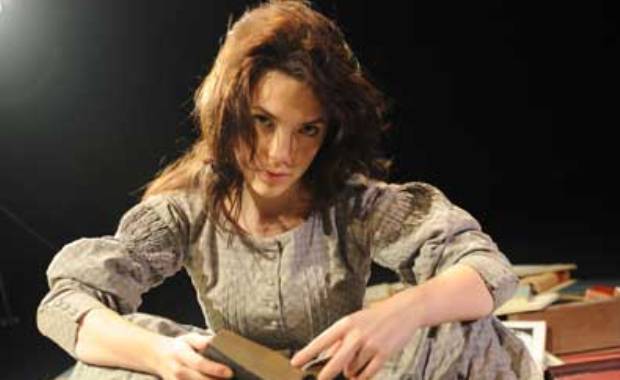
Utopia, Soho Theatre

Visions of Utopia have a knack of falling flat on their face, so it seems only appropriate that this new collaborative theatre project should recruit clowns to conjure its perfect worlds. In this partnership between the Soho Theatre and Live Theatre in Newcastle, six fools fumble through flawed blueprints, searching in vain through all of humanity’s failed efforts for a reliable model of perfection. These blueprints come courtesy both of a long line of thinkers, whose words are revealed to us via projected quotations, and of an assembled group of writers who have all produced their own responses to the central theme.

Which all sounds great on paper, but is underwhelming in its execution. In the hands of joint directors Steve Marmion and Max Roberts and their diverse team of writers, big concepts are rendered bafflingly small and an idea that is fascinating by itself becomes marred by its own realisation. Looked at a certain way, this is all ironically apt given that the piece is dealing with the desire for and impossibility of a utopian world, but this is not quite enough of a justification to excuse what more often than not simply feels like clumsiness and poor scene selection. A frustrated question kept nudging at me as I watched: are these really the most interesting utopian visions we could dream up?

There are admittedly some nice pieces (the word nice chosen here precisely for its very bland variety of praise). ‘The Presentation’, created by Thomas Eccleshare, Josh Roche and director Marmion, is a witty interpretation of perfection in our material culture, showing us Utopia as Steve Jobs might have imagined it, shiny and pocket-sized, but there is little depth beneath the slick cleverness. There is also a startling moment in Chi Onwurrah’s gameshow-inspired ‘Humanity’ when one character unexpectedly reveals the selflessness that human beings are capable of, while Janice Okoh’s vision of a world where medical science has been perfected and death is purely by choice is one of the more compelling scenarios.

One of the most fascinating, thought-provoking and disturbing scenes is not produced by any of the collection of writers, but instead by another dangerous utopian dreamer. Partway through the second half, we are confronted with a rousing election speech stuffed with rhetoric promising a better future – we half expect Obama’s mantra of “yes we can”. But with a startling sideswipe of anti-Semitism, this vision is smashed and it becomes horribly clear just whose words these really are. It is a stark, extreme reminder that one man’s idea of paradise is another’s vision of hell, and also that utopia and dystopia can be just a hair’s width apart.

As this overlong creation nears its end, however, there is the danger that intellectual investigation is abandoned in favour of emotional release. While the regrets of a now elderly ex-politician and the poignant attempts of a widow to “make the best” of her situation with the aid of a bit of over-50s zumba add moments of tenderness, they seem also to dilute the evening’s purpose. Fortunately Simon Stephens’ beautifully simple speech, spoken between the six actors, is suffused with enough grounded normality – the simple dream of drinking without getting a hangover, or of finding the perfect cup of coffee – to stall the decline into trite sentimentality.

Thinking back over the production, my complaints are admittedly not so much to do with this piece of theatre as it stands alone. It is frequently amusing and occasionally intriguing; it draws committed and energetic performances from its cast, particularly a sparkling Laura Elphinstone; it flirts playfully with form; there is a bubble machine, which tends to immediately raise most performances a few notches in my book. It is rather Utopia’s failure to meet the potential of its fascinating premise that makes it such a staggering disappointment. The level to which this wastes a brilliant concept makes me almost angry.

I can’t help but feel that many of the production’s problems arise not from its concept, which is an undeniably intriguing one, but from the way in which it has been assembled. As contributor Eccleshare politely and diplomatically hinted at when I spoke to him a few weeks ago, creating a co-authored show by having those authors each write in isolation is a tricky process. Had I not known about the technique of piecing this together, I think I would still have suspected a lack of dialogue between the writers. Utopia never really feels like a conversation.

I wonder if a truly collaborative approach (by which I mean bringing the contributors together at the writing table and even in the rehearsal room, shaping the piece while writing it) might have produced something far more interesting, as it is often when different utopias collide that the most fascinating discussions occur – a fact that Marmion and Roberts surely recognise, considering their central aim to provoke debate. It seems, then, an odd choice to have pieced together the show in the way that they have done, creating separate entities, smashing these apart and gluing their jagged edges together.

When mixed with the text of historical and literary utopias, the two directors have a deluge of content to channel into a finished piece, which seems partly to be the point but also makes for an inevitably messy production. Marmion and Roberts’ project is still to be admired for its aim and ambition alone; it is a beguiling idea, and one that is given a fittingly democratic treatment by mingling so many voices, if not entirely successfully. Perhaps, just like its subject, any attempt to tackle the concept of Utopia without isolating a single vision of perfection is doomed to fail.

In the end, it all just feels like a bit of a shame. Look at how good we could have made it, Utopia tries to say. Yes, quite.

Borges and I, New Diorama Theatre

This is not quite, as the title might suggest, a play about Argentinian writer Jorge Luis Borges. In Idle Motion’s acquired style, factual inspiration is shaken up and fitted back together into something familiar but new, recognisable yet lightly startling. Here, instead of standing solidly at its centre, Borges instead infects the piece like a ghost – fleeting, insubstantial, but hauntingly present.

Borges’ life story, or at least parts of it, is told through his own words and through those of Alice, a candidate interviewing for a job at the prestigious Bodleian Library. Intertwined with this appropriately elusive and magical narrative is the rather more ordinary story of Sophie and Nick, a couple who meet through the now achingly familiar social set-up of the book club. As might be expected, it is all tea, mild social embarrassment and smiling competitiveness, allowing acres of room for gentle observational humour.

The connection between these two narrative threads initially seems tenuous, stitched together by little more than a love of literature, but as Sophie and Nick progress from tentative, awkward flirtation to tender relationship, the disparate elements become more closely knit, if never quite fully meshed. The proximity of the pedestrian and the extraordinary creates a delicate frisson, the scene transitions reminiscent of that pleasing jolt between the world of the everyday and the fantastical worlds of fiction as a novel first takes its grip on the imagination.

While this is essentially a love story, and an absorbing, quietly moving one at that, the real love affair portrayed by Idle Motion is the one that we entertain with literature. We are told that when Borges learnt that he was losing his sight he returned to his childhood books, implying that, as with any affair, it is the heady beginnings that are the most seductive. Lines are also drawn between literature and immortality; books can be both painfully ephemeral and eternally enduring. Meanwhile, both the devised text and the gorgeous lighting design hint at themes of darkness and illumination, ideas with a dual meaning for Borges and his progressive blindness.

In what is fast becoming Idle Motion’s trademark, but fortunately shows little sign of wearing thin just yet, objects continually take the audience by surprise. Scraps of paper shower from an opening umbrella; books transform into birds, aeroplanes, skyscrapers; a projected tiger dances across rippling pages. The book is fittingly the central prop, with piles of the things littering the stage and stacked up on the set’s two large bookshelves. When the narrative folds back into Borges’ biography, the transfiguring of books into the objects and creatures that populate his life is aptly evocative of the imaginative power of fiction, in which ink and paper are the only physical props needed to conjure vast palaces of the imagination.

Visually, this is a thing of beauty, inventive but unshowy, creating a lot from sparse resources. When I spoke to the company earlier this year, they told me that they actively put “boundaries” on themselves to enhance their creativity during the development process. “If you limit yourself with your use of props,” said company manager Grace Chapman, “it actually increases your flow of ideas”. This method of constraints has certainly worked for them with this piece, inspiring ever more ingenious uses of the books surrounding them. If books are, as Idle Motion suggest, remembered with all the senses, then ours are feasted generously.

Yet for all this creativity and visual flair, Borges and I still feels somewhat slight. It is pretty but slender – a paperback rather than a hefty tome. I was left wanting more, which is no bad thing and says much for Idle Motion’s innovative charm and delicate storytelling, but was ultimately just a little disappointing. Although when I think about it, even that recalls the experience of reading; often those otherwise absorbing books depart with a faint, yearning sigh for something more.

Utopia

utopia1-600x329

Originally written for Exeunt.

What might a perfect world look like? A new and unlikely project conceived through a collaboration between the Soho Theatre and Newcastle’s Live Theatre sets out to ask just this. Utopia is a reaction against the current overwhelming mood of pessimism, both in the world in general and in theatre in particular, charging its team of writers – including Simon Stephens, Janice Okoh and Dylan Moran – with dreaming up a vision of a flawless society.

As contributor Thomas Eccleshare tells me, the Soho Theatre’s artistic director Steve Marmion, who helmed the show together with Live Theatre’s Max Roberts, “wanted to create a piece of political theatre that wasn’t cynical or pessimistic”. Their aim instead was “to challenge people to write a view of the world in a completely optimistic light and to think ‘what would perfection look like?’”

I suggest that it seems a slightly incongruous time to be thinking about perfection, in light of a strikingly imperfect world, but Eccleshare disagrees. His research has revealed that “utopias have often come out of pretty dark places”; it would seem to be human nature that when the gloom is at its thickest we are most intent on glimpsing that faint glimmer of hope for a better future. Eccleshare echoes this: “I don’t think it’s impossible to view the light at the end of the tunnel just because we’re in such a dark place”.

Marmion and Roberts both agree that the timing is important, precisely because of the prevailing atmosphere of doom and gloom. As they see it, people have forgotten political optimism and seem content to accept imperfection. Offering the example of socialism, they contest that a few years ago this concept “wasn’t seen as fantastic but simply as the other option, to be followed and tested and explored. We seem to have lost some of that urge for solving our problems rather than just enduring them.” The directors go on to explain that the project also sets out to differentiate itself from the similarly abundant pessimism in much of today’s theatre. “So much of the theatre that we see nowadays is essentially dystopian with a small chink of hope offered at the very end; Utopia is something very different”.

Unlike Thomas More and other authors of early utopias, however, the writers involved in this project have had to grapple with a pervading atmosphere of cynicism and a generally accepted recognition that there is no one utopia that can satisfy everyone. Conceding this, the directors tell me that “the only option for us as we created this show was to present each writer’s vision truthfully and then celebrate the moments of humanity that shone out in each”. As a result, this is necessarily and perhaps wisely a patchwork of several different, personal utopias rather than one grand, unified vision of a perfect world.

Eccleshare admits that he struggled somewhat with the inherent subjectivity of the idea at this show’s centre. “There’s an awareness of how many people there are in the world and an acceptance, at least in the liberal leaning Western world, that there isn’t one right way of doing it,” he says. “If you’re looking to write about perfection, you inevitably come up against the problem that one person’s perfection is someone else’s imperfection.” As a result, it is a struggle to approach the concept of utopia without a healthy dose of irony, and Eccleshare tells me that, even with the directors’ brief, a lot of the pieces have “a sting in the tail”.

This evening of theatre is also more political than it might appear at first glance. “I think there’s something quite political about the idea in itself,” Eccleshare suggests, going on to ask, “who is imposing this utopia?” His words point to the inherently complex nature of what this project is attempting to do; if one individual’s paradise can be another’s idea of hell, how is it possible to even begin to approach the idea of an overarching utopian ideal without imposing this? The problematic nature of the endeavour has been confronted head on by Marmion, who has inserted a political speech by Hitler as a counterpoint to the plays being presented and, as Eccleshare puts it, as “a reminder of how dangerous utopian visions can be”.

Rather than being presented one by one in a line-up of separate entities, the project’s resulting short plays have been chopped up and sewn together by Marmion and Roberts, all contained within a framing narrative of “six fools creating utopias in a world of blueprints”. These are also intersected with a variety of other wildly different utopian visions, from More to Shakespeare to, perhaps most strangely of all, The Village People. The directors have embraced this ideological messiness, while at the same time acknowledging that what they have produced is only a snapshot: “a show that tried to accommodate all the subjective visions of utopia would quickly become a logistics presentation of town planning and psychotherapy. Instead, Utopia is about the fruitless, stubborn hope that leads us to create such perfect plans in the first place.”

Despite speaking enthusiastically about the way in which this piece has been put together, Eccleshare has personal reservations about projects that ask writers to create work separately and then present that work together, expressing concern that if not done carefully it can become “a bit of a talent show”. Instead of the end result being viewed as a collaborative effort, there is the danger that audiences come along to contrast and compare, to rank the individual elements against one another. “It’s a really interesting form of political theatre,” says Eccleshare, “but whether I think that the best way of reacting to a theme is getting ten writers to work in isolation and create different plays …” He hesitates, before diplomatically adding “that’s a very delicate process”.

Plugging into current debates about new writing and new work, Eccleshare believes that the issue is primarily down to the inflexible definitions that are typically imposed upon British theatre. “The problem is that because the way in which theatre is divided up in this country is so rigid, people will see this as new writing, they won’t see it as a co-authored show,” he explains, his frustration palpable. Eccleshare argues that had this same show been produced by a company who were all in one room together at the same time, it would be seen as an organic whole rather than a mechanical construction of individual parts. He chooses not to dwell further on the point, other than to say that the divide between new writing and new work is “an unhealthy and unhelpful division”.

During our chat about the concept of utopia, what that might mean and how it is investigated through this piece of theatre, Eccleshare muses that theatre itself is a sort of “mini-utopia”. As he goes on to explain, through theatre “we see these impossible visions that are kind of real but not quite real at the same time.” By creating a vision of a perfect society within the essentially ephemeral space of a theatre, Utopia is implicitly recognising both the human capacity to conjure perfection and that perfection’s material insubstantiality. It is telling that the Greek term originally coined by More, which now forms this show’s title, literally means “no place”.

It may be an ultimately unattainable ideal, but Marmion and Roberts believe that the concept of utopia is integral to the human imagination. “Primarily, it is what lies at the end of all our politics and altruism,” they claim. “Without the hope for perfection, or at least the ability to aim for it, our willingness to cooperate diminishes and with that our empathetic relationship to the rest of humanity. Utopia is also the reconciliation of our religious visions with our practical ambitions. It allows us to build Nirvana rather than blindly hoping we will get there someday.”

So what does the project aim to achieve by building these utopias? Acknowledging once again the subjectivity of this concept, Eccleshare’s main hope for the show is that it will inspire debate. “I hope that audiences will be inspired to talk about it afterwards, that they’ll go with friends to the Soho Theatre bar and have a good old discussion about what their utopia is and whether it’s possible to have a utopia now.” Although he recognises that many audience members might simply think “that wasn’t my vision at all”, Eccleshare is confident that it is a positive outcome to get people talking about it at all. “And of course,” he adds with a slight laugh, “I also hope people will say ‘he nailed it’.”

Marmion and Roberts also hope to get their audiences talking. “As theatre producers, we’re at our best when we provoke argument in the bar afterwards. Not necessarily a sectarian, glass-smashing brawl, but a passionate discussion across generations, ethnicities, between strangers or friends, and one that has real content.” Utopia may not come up with any solid answers, but it is asking that vital, challenging question: “how good can we make it?”

Mary Shelley, Tricycle Theatre

“Daughter of Mary Wollstonecraft. Lover of Shelley. Author of Frankenstein …”

The strapline to Shared Experience’s Mary Shelley captures with startling accuracy exactly what stance this play takes on the life of its subject. Just add in a reference to philosopher William Godwin as her father and you’re there. Because what Helen Edmundson’s text does, admittedly rather well, is to define Mary Shelley on the basis of her extraordinary family, the famous poet with whom her autobiography is inextricably tangled, and the novel for which she is remembered. All of this it achieves very well on its own terms, but it’s an approach that feels uncomfortably reductive.

While the strapline may be revealing, the title of Edmundson’s play is somewhat misleading. Encompassing the period of her life between first meeting Shelley and eventually marrying him – the moment at which she technically becomes the figure of the title by taking her husband’s name – this is as much about Mary’s family as it is about her own inner life. Shared Experience show us her and Shelley’s mutual infatuation, the stormy relationship with her father, who refuses to speak to her for many months, and her two dramatically different sisters: the insufferably silly Jane and the more sensitive, serious and reserved older sibling Fanny. We are witness to the various struggles of the family, the constant scrambling for money and the devastating loss of Mary’s daughter Clara.

In the title role, Kristin Atherton makes a sparky Mary, conveying her precocious intelligence and appealing confidence while also occasionally peeling back this outward gloss to remind us that she is just a teenage girl, one who trembles at the thought of the love that consumes her and who is prone to fevered fits of jealousy. We are only given true access to her inner emotions, however, through visually inventive dream sequences, which under Polly Teale’s direction become some of the production’s most memorable moments. William Chubb makes a suitably prickly intellectual as Godwin and it is not hard to see why all three sisters fall for Ben Lamb’s Shelley, but it is Flora Nicholson’s poignant, beautifully understated turn as Fanny which becomes the surprising show-stealer, revealing more about this supporting figure than we ever really learn about Mary.

Near the end of the play, as Mary explains the plot of Frankenstein to her father, it becomes clear what purpose the chosen details of her life are serving, beyond simply presenting us with a fictionalised biography. Mary dreams of the possibility of bringing her child back to life; she struggles to come to terms with the rejection of her seemingly indifferent father; she has been raised in the absence of a mother – the connections between life and fiction are perceptibly and none-too-subtly drawn. It is nothing new to suggest that Mary Shelley’s extraordinary creation was inspired by some of the more distressing aspects of her own experience, but to have such words plainly drop from the author’s lips seems to draw a line under the theory.

But, to borrow a phrase from John Lennard, dimly remembered from one of the university set texts at the back of my bookshelf, “art is not autobiography”. One of the most damaging criticisms to have dogged the writing of women over the years is the suggestion that it is drawn purely from personal experience, incapable of the same feats of imagination as, to take a convenient example, the output of the male Romantic poets. It is just such an argument that caused suspicions that Frankenstein was the product of Shelley’s imagination rather than his wife’s and that has led generation upon generation of critics to point back to the writer’s life. A startling act of invention is devalued to little more than a fanciful elevation of abandonment issues.

With my feminist hat firmly on, Edmundson’s approach uncovers a troubling reduction of a great work of literature. I should perhaps admit at this juncture that Frankenstein is among my favourite novels, but my point has less to do with my personal opinion of the book and more to do with the reception of literature written by women in a wider sense. In a piece that otherwise offers interesting and intelligent windows on the position of women in a patriarchal society, in keeping with the focus on great women seen in Shared Experience’s previous work, the emphasised connection between Mary Shelley’s life and work and the foregrounding of the influence of two strong men in the form of Godwin and Shelley glares out disappointingly.

To be fair to Edmundson and Shared Experience, this is a quibble that largely arises from my own approach to literature and I suspect that most audience members would have no such concerns. Art and autobiography have a long love affair that even Roland “Death of the Author” Barthes failed to fully dissolve, and there is undoubtedly a certain enduring curiosity excited by this group of free-thinking radicals. One of the most interesting aspects of this production is in fact how it treats the problematic intersection of these thinkers’ beliefs and lives, unmasking the hypocrisy and inevitable human frailty that lurk behind genius. For all Godwin’s espousing of unconventional relationships, he cannot reconcile himself to the thought of his own daughter running off with a married man, while Shelley’s fervent belief in an open, experimental “community” looks a lot like self-serving indulgence of his own adulterous impulses.

In a nice nod to Shelley’s Defence of Poetry, Godwin refers to himself, the poet, Mary and her mother as “legislators of mankind”. But what Edmundson’s writing cleverly acknowledges is the tension between a belief in the advancement of humankind and a genuine respect for humanity, the latter of which is often lacking among all the talk of “political justice”. To wheel out a hackneyed phrase, Edmundson seems to be suggesting that here the personal is political. After all, a community of any kind cannot exist without a consideration of the relationships within that community. In neglecting people in favour of ideas, the ideas of these individuals lose some of their sway, and Mary’s gradual recognition of this forms one of the more fascinating developments of her character.

Ultimately, however, little new is revealed about this extraordinary woman, whose life contains enough to fill several plays. In this sense, Edmundson is wise to restrict herself to the space of a few years – the years in which Mary’s character was arguably most shaped – yet there remains something faintly unsatisfying about the approach that she and Shared Experience have taken. In the end, perhaps one of the most effective elements of the production is Naomi Dawson’s design, which hems in the scenes between overflowing bookshelves; a helpful reminder that literature is also a leading character in this drama, but one that too often lurks in the background.

PULSE Fringe Festival

I’m sitting in an orange camper van – the sort of camper van where chintz comes to die and in which families spend weeks of cramped, forced jollity in the British countryside. Perched on a small bench, a performer kneels almost uncomfortably close, her eyes fixed steadily on mine. In a swift one-on-one performance that brings a whole new meaning to theatrical intimacy, I am told a secret.

This is the Campsite, a venue “dedicated to supporting unfeasible ideas and impractical performance work” at the PULSE Fringe Festival in Ipswich. That might also work as a strapline for the festival as a whole, or at least for the little I saw of it over the weekend (2nd-3rd June). While some of the work is being presented in a finished state (though it must be said that much of this finished work is cordoned off from reviews because of Edinburgh Fringe First eligibility guidelines), this is chiefly a space for experimentation and scratch performances, an opportunity for artists to trial their work outside London. As such, there is a messy feel to proceedings – not necessarily a bad thing, but a fact that can make the festival tricky to write about.

Let’s start, then, with the camper vans. There are five in total, each with its own name, as well as a couple of tents pitched up in the small space behind the New Wolsey Studio. It’s impossible to see everything on the Campsite, but I spend most of my time there in the chintz-decked Joni. The brief secret relayed to me in these surroundings is part of Everything You Ever Wanted to Say But Didn’t, a project curated and performed by Rhiannon Armstrong. The title says it all: Armstrong is collecting admissions from strangers, building an anonymous bank of things left unsaid and performing these in intimate settings. In this sense, the camper van works perfectly for her, enhancing the slightly uncomfortable sense that something private is being shared and compressing the usual distance between performer and audience – in this case an audience of one. It is a nice idea, but an inevitably slight one, particularly as the arbitrarily chosen secret I am told is very short. It is difficult to convey much in a couple of minutes.

The cosy intimacy of Joni works even more effectively for Fergus Evans’ gentle piece about the notion of home. For this, four of us pile into the camper van with Evans, where we write our names and the places we call home on stickers. In this home of kinds, Evans speaks surprisingly movingly about his hometown far away in Atlanta, transporting us from drab drizzle to stifling heat with his unshowy yet poetic words. He also implicitly questions our memories of home and how we describe it to others, delicately exposing the lies he tells and by extension the lies that we all tell when wearing the rose-tinted glasses that seem to inescapably accompany thoughts of the place we call home.

In contrast to the intimacy of these pieces, Daniel Bye’s performance lecture The Price of Everything is an exercise in miniaturising something that is usually performed to a crowd of significantly more than the three of us squeezed onto the camper van bench. I can in some ways see how it might work better in a bigger setting, particularly the powerpoint presentation elements, but there is also something powerful about the ugliness of capitalism being brutally satirised mere inches from you. There is certainly no room to escape or ignore Bye’s thought-provoking investigation into the worth of things versus their monetary value.

This, of course, is just scratching the surface of the diverse array of work on offer in the collection of caravans and tents dotted around the site. I was particularly curious about an interactive performance inspired by Where the Wild Things Are, which based on an outside view seemed to mainly involve noisily testing the caravan’s suspension to breaking point, while I was disappointed to miss a hilarious sounding site-wide musical version of Ghostbusters. The variety, while doubtless hit and miss, is all part of the beauty.

Away from the Campsite, which is pretty much a case of rock up and see what’s going on, the shows elsewhere follow a slightly more structured pattern. However, this doesn’t necessarily make them easier to write about. The performances at PULSE often resist being weighed up and judged within any formal structure, not least because many of them are still works in progress (more on that later), but in a slight nod to the traditional review format I’ve collected together some thoughts on each of the individual shows below:

[Where the piece is a work in progress, I’ve indicated this with an asterisk. I also saw Thin Ice and My Robot Heart, but both have review embargoes ahead of Edinburgh.]

Good Boy*

Joseph Mercier’s short work in progress advertises itself as a dance solo, but contains strikingly little movement. For the majority of the twenty five minute piece, Mercier speaks Felix Lane’s text (inspired by Jean Genet) in a strangely haunting monotone from behind a microphone, intermittently lit by mesmerising, pulsing spotlights. The sexually explicit yet poetic language draws primarily on Genet’s portrayals of homosexuality and the idea of being an outcast, confronting uncomfortable taboos with softly spoken words.

The gestures may be minimal, but even the simple clenching and opening of a fist speaks of the guarded harshness and open vulnerability that mingle within the piece. The tenderest moment arrives when a member of the audience dances slowly with Mercier on the stage, suggestive of the delicate connections that can be forged between strangers. The show lacks coherence and unity, but this may be a symptom of its currently unfinished state. Even with its flaws, however, I found myself oddly absorbed without being able to quite pin down why.

Emily’s Very Sad Play*

Despite being one of the roughest, sketchiest performances of the weekend, this was also one of the most fascinating. I’ve already laid out a few initial thoughts on the show, which I’ll attempt to extend a little further here. Starting with the basics, Sara Pascoe’s solo performance is about Emily, a character of questionable sanity who is struggling to separate her own story from all those she has read in books. She lies, plagiarises, continually spouts literature and searches for the truth. It is, as I have already written about, an intriguing and intelligent investigation of the intertextuality of our lives, playing with the literary fabric of the knowledge we gain almost by osmosis, questioning how much of our identity we borrow from books. Emily is an extreme, but none of us are entirely free from the influences that threaten to swallow her whole.

The piece is performed in a stream of consciousness style by Pascoe, an appealingly oddball and often very funny performer. Our ideas of madness are challenged, as Emily tells us that “it’s easy to prove you’re crazy – just say everything you’re thinking”. After all, how sane are any of us really? Another interesting element that I only lightly touched upon previously is the implicit examination of women and madness. Emily’s literary references, from Medea to Ophelia, plug into a recurring literary trope of female madness and hysteria, and it seems significant to this character’s relationship with literature that she is a woman (here my mind immediately leapt to Sandra Gilbert and Susan Gubar’s Madwoman in the Attic). Emily’s obsession with pregnancy is linked to a conception of the female sex as defined by motherhood, while her humorous description of the unrealistic romantic expectations engendered by the likes of Jane Austen hits on an uncomfortable truth. These ideas are not fully fleshed out in this early version of the show, but they open up discussions that I’m keen to see continued.

Tatty-Del Are Making It Work*

… or “can friends make art together?” tatty-del, a collaboration between friends and theatremakers Natalie and Hanna, were in trouble. Last year, Natalie attempted to “break up” with Hanna following multiple artistic disappointments, prompting the pair to go to couples’ therapy and delve into past friendships to try and (you guessed it) make it work. This work in progress is the result of that process, a messy patchwork of memories and conversations that address the nature of friendship and collaboration. These ideas are approached with humour, as the pair take us back through adolescent relationships that prove cringingly recognisable and establish the extent to which our friendships influence who we become.

While the compatibility of art and friendship is a big idea to tackle and one in which few conclusions are reached, almost more interesting is the way in which tatty-del figure our memories of friendship. Once important relationships become amusing anecdotes, told over and over again until they are little more than stories (something that is underlined by the inherent artificiality of repeated performance). It is fascinating to see acted out before us the way in which our past friendships become markers in the story of our lives, exposing the half-fictions we all build around our own identity. In the show’s current bitty and confused incarnation, I’m not quite sure that Natalie and Hanna are making it work, but this certainly feels like the start of something rather than the ending that the duo came so close to.

Legs 11

Tom Marshman, a performer with long, shapely legs and a history of varicose veins, ended up being an unlikely finalist in Pretty Polly’s search for the best legs in the country. This appealingly quirky true story forms the basis for Marshman’s solo show, an odd cabaret-style performance that takes us on a journey through Marshman’s turbulent relationship with his legs and brings in elements of gender identity. There are some striking images that emerge: the piece opens with Marshman in relative darkness, speaking breathily into his microphone, as an almost hypnotising display of synchronised leg movements is projected onto a screen; during the operation to remove his varicose veins, Marshman holds out a blue, plastic surgical gown as a screen behind which his legs are hauntingly silhouetted, all to a soundtrack of waves lapping the shore. There is also some particularly inventive audience participation involving punch, tights and a pair of very long straws (I’ll cryptically leave it at that for you to conjure your own image).

Somewhere during the hour-long performance, however, Marshman lost me. In his opening address to the audience, he suggests that his experiences will have something to say about the wider issue of body confidence, but the only body under the microscope here is Marshman’s. Perhaps my disappointment with the show is partly to do with it not delivering what I was hoping for, in which case its perceived shortcomings are a result of my own subconscious prejudices, but this ultimately seems like little more than a mildly entertaining ego-trip. Marshman may well have overcome his body issues, and should be congratulated for that. The self-congratulation he thrusts upon his audience, however, eventually becomes just plain boring.

Buttercup

Tom Wainwright’s odd little creation was one of the surprise joys of the weekend for me. The eponymous Buttercup is a “fat cow” from Lancashire, an unloved character who finds herself thrust into the limelight when she is selected to take part in a Jamie Oliver show, a brush with fame that leads to a stint on Masterchef and her very own reality show, The Only Way is Lancashire. As might be expected from this description, Wainwright’s is a show that skewers our obsession with reality television and our fetishisation of fame, albeit very amusingly. He also has a good prod at lazy middle-class perceptions of characters such as Buttercup and at a London-centric view of the country.

This sixty-minute show is for the most part riotously funny. Alongside his characterisation of Buttercup, accompanied with spirited stamps and tail swishes, Wainwright proves to be a mean impressionist, switching between uncanny imitations of TV chefs and the “stars” (inverted commas firmly in place) of The Only Way is Essex. The laughs have a harsh edge, however, that elevates this into something far more interesting than an exercise in imitation, while startling moments of emotional truth break through the comedy. Making your audience laugh at themselves and following that with a bitter pill of realisation is quite a skill, and one that Wainwright pulls off effortlessly. Hilarious it may be, but this is comedy with bite.

Goose Party

The weekend concludes, appropriately, with a party. Little Bulb, probably best known for fringe hit Operation Greenfield, present a performance that is more of a gig than anything else. The infectiously energetic group veer from folk to blues to rock, all with equal flair, concluding their schizophrenic musical stylings with the observation that each of us is “a hundred different people”. There is a loose message about identity in there, but this is really about having a good time, which Little Bulb are extraordinarily good at. As the performances ratchet up their energy, we are assaulted with bubbles, glitter, feathers, costume changes galore. There soon remains little option but to grin stupidly and be taken along by it all. To be quite honest, I’m not entirely sure how else to write about Goose Party; it’s tough to distil pure joy.

——–

Alongside assessing the work on an individual, specific basis, I have a few wider questions born out of the weekend that I’d also like to address – or, in some cases, to simply ask. Firstly, this issue of how to write about work in progress. It’s something that Lyn Gardner recently wrote about for the Guardian, in a piece in which she expressed concerns that reviewing work in the early stages of its development might be damaging rather than constructive. That might well be the case within the mainstream media review format, limited to a few hundred words and forced to stamp the piece with a star rating, but is it any different in the online space?

I must admit, I’m not sure. I think that constructive dialogue is an important stage in developing a piece of work, but whether a review is the best way in which to conduct such dialogue is questionable. This possibility of conversation between theatremakers and (for want of a better word) critics is something I’ve been thinking about a lot lately and something that has been influenced by my own recent experience of being invited into a rehearsal room. I don’t have huge confidence in my own ability to help shape a piece of work with my input, but I’m ready to try, whether that be airing my thoughts in a rehearsal room or scribbling them down. While I’m not restricted by word limits in this space, the sheer volume of work at PULSE has caused me to rein in my responses slightly, but if any of the theatremakers involved in the shows I’ve written about above happen to be reading this and want to talk further, then please feel free to get in touch.

Secondly, an intriguing thought occurred to me while watching tatty-del’s show about truth and artificiality in performance. I’m probably not saying anything new here, but I had a slight light bulb moment in connection with the tension in theatre between repetition and liveness. What do I mean? Well, theatre (or at least most theatre) is essentially the same thing night after night; the same lines, the same movements, the same scenes being played out. Yet simultaneously it is a live art form and therefore necessarily shifting and ephemeral. The former brings with it artificiality, because everything is carefully planned and repeated, but the latter implies a sort of truth that is inherent in the liveness and unique to that moment.

These thoughts were prompted by tatty-del because their piece was about emotional truth within their relationship and at the same time about how fake some elements of friendship can be, both of which seemed wrapped up in their style of performing. Which made me think that perhaps in scratch performances, this paradox sits closer to the surface than in most theatre, lending such performances an element of excitement and discovery that has sometimes been ironed out of slick, finished work. Of course, whether a piece of theatre is ever really finished is another question entirely and one that also came up when I recently sat in on rehearsals, but I’ll leave that particular door closed for now.

Even after writing at such length, there’s still lots more to digest and think over. What sort of implications do the experiments taking place at festivals such as PULSE have for the wider dynamic between performer and audience? How do these festivals contribute to the theatre ecosystem as a whole, and where do they sit within that? Is the availability of this work outside London actually having any impact on regional theatre? I had one conversation with a fellow writer and festival-goer about the concern that we are just talking to ourselves; he was worried that the same people attend the same sort of events and that there is no new audience for this work. Looking around at the sparse audiences for some of the shows and recognising the same faces certainly reinforces that concern. Does it matter that this is the case if such festivals continue to support the process of making work? And how do these events engage new audiences? I’m not going to attempt to answer such questions here, but they deserve to be asked.

Finally, in the spirit of honesty, I have to confess that I found the weekend a bit of a struggle. An enjoyable struggle, certainly, but a struggle nonetheless. There is something about work in progress that proves more demanding of an audience than finished work, but beyond the work itself it was also difficult to document it. I had hoped that the festival would be an opportunity to explore new and different modes of theatre criticism, including a range of mediums and immediate responses, but I underestimated the hectic festival atmosphere and my own need to mull things over. While I made some attempts at live-blogging, I discovered that it was tougher than it appears and that perhaps I just wasn’t very good at it.

Before this gets too downbeat, I’m still enthusiastic about the possibilities of digital criticism, I just have to concede that my own brand of digital criticism, like much of the work at PULSE, is still at an embryonic stage. But both are a start.

For my aforementioned fragmented attempts at documenting my festival experience, take a look at my Tumblr blog, my collected tweets from the weekend and my Pinterest festival pin board. I will also be writing a more concise round-up for Fourthwall.