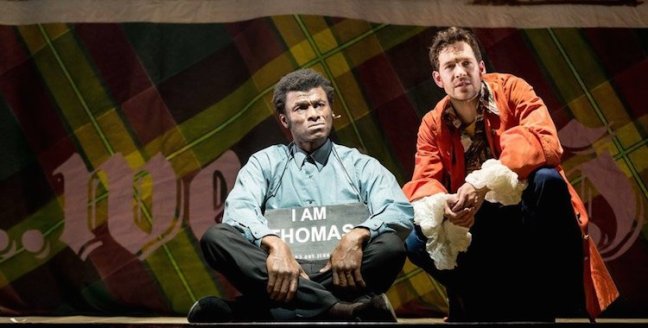
I am Thomas, Wilton’s Music Hall

12719223_962903770467841_5347528997330133367_o_jpg_900x602_crop_q85

Originally written for Exeunt.

When is the right time to speak up? That’s one of the questions lurking amidst the chaos and clutter of Told by an Idiot’s latest show, which tells the story of one person – Thomas Aikenhead – who spoke up at precisely the wrong time. Or at least that’s one way of looking at it. Was this obscure, unlikely hero a champion of free speech, or just a kid who didn’t know when to shut his mouth?

Hearing the name Thomas Aikenhead, audiences might well ask – in the words of one of the show’s many songs – “who the fuck is he?” A footnote in British history, Aikenhead was the last person to be executed for blasphemy in this country in 1697. Just 20 when he died, he was a curious and opinionated student who fell foul of higher powers and paranoias – in particular, those of James Stewart, Lord Advocate of Scotland, who made an example of the hapless Aikenhead.

Of course, this is Told by an Idiot, so it’s no straightforward telling. The company bring their characteristic dark humour and lovable silliness to Aikenhead’s tale, as well as a collection of tunes penned by Iain Johnstone and Simon Armitage. The result is Brecht/Weill musical theatre meets the broad, belly-laughing comedy of the music hall (rather appropriately for the gorgeous surroundings of Wilton’s). There’s also an attempt to highlight the present day resonance of Aikenhead’s fate, putting the game eight-strong company in a dressing-up-box hodge-podge of period and modern costume and framing the central story with a group of Edinburgh officials squabbling over who to commemorate with a new statue in the city.

The narrative, meanwhile, is shot through with glimpses of others who were at odds with or ahead of their time: a Bowie T-shirt, a Sex Pistols record, an Einstein dream sequence. Whether Told by an Idiot are lobbying for a place for Aikenhead in the same line-up, however, is unclear. When he sings with passion and lyricism about the importance of the truth, he becomes a beacon of rationalism and progress. But then elsewhere it’s his ordinariness that’s underlined. Like any inquisitive and gobby student, he’s just trying to make his mark in whatever way he can.

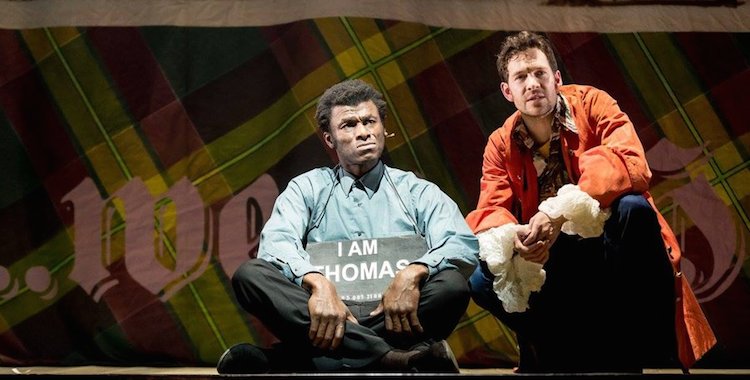
Told by an Idiot seem, at times, to be having their cake and eating it. Take the title, emblazoned across pieces of clothing worn by various members of the cast. The role of Thomas is thus passed around, never resting for too long on any one person’s shoulders. The message is twofold. On the one hand, any of us could be Thomas, an ordinary young man who was just in the wrong place at the wrong time. He’s nothing special. On the other hand, though, “I Am Thomas” is just one step away from “Je suis Charlie” (and barely half a step away at one pointed moment in the show), turning this unlucky, outspoken student into a tragic symbol of free speech.

The show’s aesthetic is no less busy and contradictory. At some moments, it’s a political thriller, with the church’s spies lurking in dark corners clad in trench coats and shades. At others, it becomes a game, commentated on by two Match of the Day pundits (“nice move there from Stewart”; “that’s definitely a yellow card offence”). Pop cultural references are everywhere, from comic-book backdrops to snippets of dialogue from Jaws and The Life of Brian. There is, in other words, a lot going on. Too much, I begin to think. However brilliantly performed by the cast, whose energy doesn’t let up for a moment, the sheer quantity of different skits can become distracting, garnishing rather than actually telling Aikenhead’s tale.

Perhaps, though, it’s right that Told by an Idiot don’t close down this story; that they don’t make it definitively either a celebration of free speech or a simple tale of misfortune. Like the potential statue bickered over by the Edinburgh councillors, figures such as Aikenhead mean different things to different people. He’s available as a symbol of the pursuit of truth and equally as an example of foolishness, just as Stewart can be seen as a great reformer or a bullying authoritarian. Who the fuck is Thomas Aikenhead? Whoever you want him to be.

Photo: Manuel Harlan.

Folk, Birmingham Rep

800x600.fitdown

Originally written for Exeunt.

Music gives lives meaning. It gathers communities; marks the rituals of births, marriages and deaths; soundtracks moments of happiness and heartache. A song can be a solace or a spur, a souvenir or a scar.

For the trio of characters in Folk, it’s the music of the title that lends significance to these individuals’ ordinary existences. Tom Wells’s play is, in many ways, a classic story of unlikely friendships. At its centre is Winnie, a gleefully singing, swearing and smoking nun, whose enthusiastic knowledge of the saints is only matched by her love for a good jig. On Friday nights, she’s joined for a sing-song and a pint of Guinness by her quiet best friend Stephen, a man who never quite got the hang of life. Where Winnie is all vivacity, Stephen is all reserve.

Lobbed into their lives like the brick she sends smashing through Winnie’s window, teenager Kayleigh is the improbable third member of their makeshift folk group. Unfolding over a series of their Friday evening jam sessions, the play slowly envelops us in these people’s lives. Bit by bit, Kayleigh opens up about her problems and worries, while Winnie and Stephen strive to conceal theirs. The supposed goal is an Easter Folk Night at the local church, thrust by Winnie upon a reluctant Stephen and Kayleigh, but really it’s the friendships between the three characters that are gradually built up through their playing and singing.

And that’s it. Folk is a slight little thing, its ambitions as modest as those of its characters, yet it’s sort of exquisite in its own tender, unassuming way. It gives the same measured, compassionate attention to unremarkable people and unremarkable lives as Barney Norris’s gentle, muted Eventide or the plays of Robert Holman. Like the writers of folk songs, Wells has an ear for the everyday rhythms of small joys and sadnesses. These things deserve to be sung about too, he seems to be saying.

In terms of plot, it’s easy enough to see where everything is headed, but at heart this is a piece that’s more about character than it is about story. The attention of Tessa Walker’s unshowy production is likewise firmly fixed on the people at its centre. Bob Bailey’s bare frame of a set, filled with the cosy religious paraphernalia of Winnie’s life, is a scaffold for these lives to hang on, while Walker’s direction creates vital breathing space in which the characters can discover one another. Silence and song say as much as words.

As the irrepressible Winnie, Connie Walker vibrates with constant energy. Even when sat down talking, her legs jitter to an inner beat, and when the music starts up she’s instantly transformed, leaping into jigs that are exhausting just to watch. It’s no wonder weary exasperation seems to radiate in waves from Patrick Bridgman’s Stephen. But there’s warmth and care, too, in her uncompromising, non-stop approach to life. Those sentiments are infectious, thawing gruffly protective Stephen’s initially frosty attitude towards Kayleigh and visibly softening the brittle, seemingly self-sufficient exterior of Chloe Harris’s confused teenager. As they play music together, the distance between these three very different people simply slides away.

Folk music is, as Kayleigh puts it, “centuries of troubles and struggles and not-to-worrys”; it’s tunes that lodge in the head like “little ribbons, half-remembered”. In Wells’s play, those songs become tools for living, at the same time as sounding an empathetic ode to lives half-lived and the stories that are so often left untold.

Photo: Graeme Braidwood.

Men & Girls Dance

2000

Originally written for the Guardian.

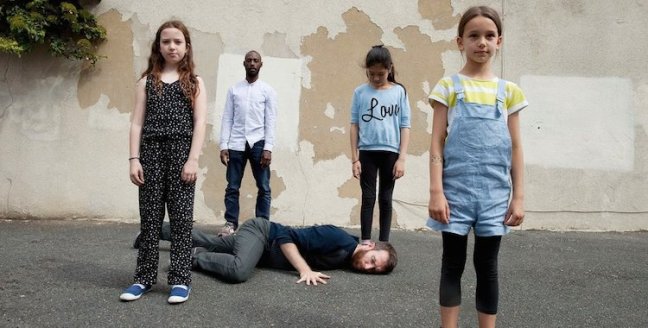
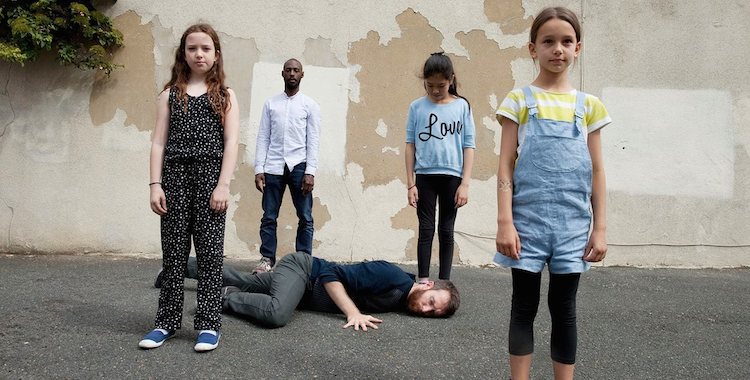
Fevered Sleep’s latest project, Men & Girls Dance, is exactly what its title suggests: adult male performers dancing with young girls. That relationship, though, has been tainted in recent years. Put the words “men” and “girls” in the same sentence and it’s likely to call to mind suspicions of abuse. This is what Fevered Sleep is hoping to challenge.

Men & Girls Dance brings together male professional dancers and girls who dance for fun, recruited through a local call out. The initial impetus was purely aesthetic: artistic director Sam Butler had been to her daughter’s end-of-term ballet show the day before auditioning male dancers for another project and found herself struck by the difference between the two types of performer. “I thought it would be really interesting to make a piece with male contemporary dancers, because they’re big and strong and agile and tall and muscular, and put them next to little girls in pink,” she says.

But during research and development, the company met resistance. “Some of the reactions were quite shocking,” Butler remembers. Questions and concerns (“What does it mean?”, “We don’t like that, it sounds a bit creepy”) were repeatedly raised. “The politics of it became the thing that people had the reaction to, not the aesthetics,” says David Harradine, the company’s other artistic director. So Fevered Sleep set out to tackle those reactions.

The company began with the two groups of dancers and a series of questions: “Is this possible? And is it beautiful? Does it move us?” The answer was, in Butler’s view, “yes, absolutely”. A lot of that is simply to do with the contrast between the two body types. “Incredible things happen when you are choreographing men who are six foot five and girls who are four foot six,” says Harradine. “In terms of the movement potential, it’s really exciting.”

Gaining the trust of parents in each area they visit is crucial to the process and the company has occasionally encountered reluctance. Butler tells me, though, that the outcome of the workshops has dispelled any fears. “The people who have then gone on to see the showings have had their minds changed,” she says. “Everybody has said it is really joyous to be there and witness it.”

Fevered Sleep is known for its work with video installations and digital art, but in Men & Girls Dance everything is stripped back to just the performers – and newspaper. Whether wrapped around the performers or lobbed across the stage, newspaper pages are a constant visual reminder of the relationships between men and girls that we are used to seeing in the media. “It says so much,” says Butler, “we don’t need to say anything else.”

The performance itself, though, is worlds away from the headlines those newspapers invoke. As in many of Fevered Sleep’s shows, play is integral and the spirit is joyful; while two-thirds of the piece is choreographed in advance, the final third is improvised. “A lot of that improvised material is just about the performers being in a space with the audience, looking at each other and being present to each other,” says Harradine. What emerges is a playful and tender celebration of the relationships on stage. And alongside the performances, creating space for conversations is a huge part of the project – there’s an accompanying publication, and discussions before, during and after each residency.

While the title may bring to mind recent headlines, Harradine stresses that the company is not interested in courting controversy to sell tickets. “We’re trying to provoke people to question what society seems to tell us about this relationship. It is provocative and it is political, but there’s nothing controversial about it.”

This year’s residencies mark the culmination of almost three years of development and exploration, but they are not the end of the project. Butler hopes that Men & Girls Dance will travel to festivals or generate pop-up events in the street, leaving “little traces of it here and there so it doesn’t disappear”. They will keep it going, she insists, until it’s no longer needed. “My hope is that at some point we’ll be able to stop doing this piece.”

Photo: Karen Robinson.

X, Royal Court

X-Royal-Court-158-549x357

Originally written for Exeunt.

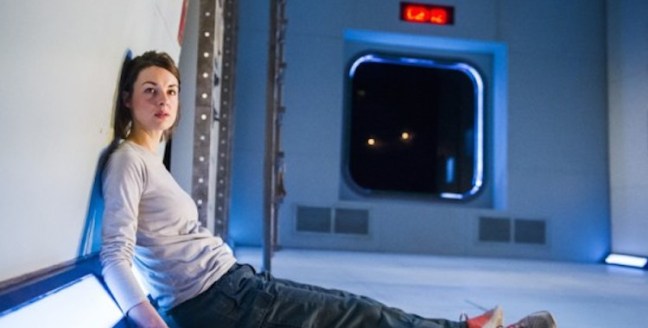
Everything in X is slightly off-kilter. Literally. Merle Hensel’s great grey box of a set is permanently tilted at an angle. The sort of angle that’s just enough to shift your perspective on your surroundings. The sort of angle that’s just enough to start you questioning things.

The same goes for the psychic world inhabited by the characters in Alistair McDowall’s new play. It’s a physical and mental landscape that is out of joint. It’s also out of time. The collection of crew members occupying this bland, functional capsule are billions of miles away from home and the rest of humanity, clinging on at the far reaches of the solar system. The sun is barely a faint flicker this far out; it is, as one character puts it, “one long night”. No days, no markers, nothing to hold onto except technology. And technology can go wrong.

That’s just what has happened as the play opens. Or, at least, something has gone wrong. After an eighteen-month stay, the first scientists to colonise Pluto are due to be picked up and returned to Earth. Except Earth isn’t answering the phone. There’s been no contact for three weeks and the crew at the research base are starting to get restless. “We’re all a bit … fraught,” says second-in-command Gilda (a nervily hair chewing, cereal chomping Jessica Raine), with delicious understatement.

At first, X is essentially a workplace drama – if one with heightened stakes and shrunken surroundings. Imagine being trapped in the same featureless space with your workmates for months on end and you begin to get the picture. The situation is desperate, but also banal. Colleagues bicker over contracts and kill the time with games of Guess Who. There are arguments about who hasn’t done the cleaning. Nerves are frayed.

But then McDowall’s play mutates. Just as it threatens to drag, its pulse – and ours – quickens. Ray (Darrell D’Silva), the captain of the crew and the astronaut who shipped them all out to Pluto, starts seeing things in the empty gloom of the not-quite-planet. Cole (Rhudi Dharmalingam) notices that the clocks have been going back by themselves. There’s a glitch in the system, a ghost in the machine. No one knows how long they’ve been stranded here, and no one is coming to pick them up. Suddenly we’re in the realm of psychological thriller, the confined research base (packed with provisions that will outlast them all) becoming a pressure cooker for the crew’s fears and tensions.

And then things get stranger. And stranger. And stranger. As the display on the digital clock scrambles, so too does time and memory and identity. Ray’s not the only one who’s seeing things. Or is he? There’s a crew member who’s maybe a crew member, or maybe a ghost, or maybe an echo of a memory, or maybe their rescuer. Maybe. False memories multiply and compete. Months or years or decades slip by. Nothing can be trusted. Eventually, even language breaks down, fracturing into single syllables and then just a vomited stream of ‘X’s. All that holds it together at the centre is Gilda, who’s sent spiralling further and further into herself.

It’s baffling and bewildering, but then it’s meant to be. The whole point of X lies in the same ambiguity that characterises its title. X can mean many things. A kiss. An error. The elusive answer to an equation. X marks the spot. In McDowall’s play it is all of these and more. And it’s distinctly, thrillingly theatrical. Sat in our seats at the Royal Court, watching these bodies on stage in front of us, we’re more aware of time passing than we would be behind a screen, where the pause function is always just a tap away. We feel time, which is crucial to this play about time dissolving.

Vicky Featherstone’s production, meanwhile, makes equally canny use of the space of the theatre to tell this fractured narrative. Prolonged blackouts dare us to see our own fears in the enveloping darkness. In between, Lee Curran’s lighting casts a queasy, subtly shifting synthetic glow, under which the characters sweat and squirm. Nick Powell’s sound design, with its nods to sci-fi, gestures towards the cinematic while working with the performances to slowly turn up the tension in a way that only a live art form can. And when things fall apart, Tal Rosner’s video designs transform the dull walls of this enclosed space capsule, twisting the strange world of the stage that bit further out of alignment.

What’s most haunting about X, though, is not the exhilarating theatrical effects or the familiar hint of space horror: the little girl at the window, the spectre of something scary in the deep, deep darkness of outer space. The production is having fun with these elements – and temporarily spooking the hell out of its audience in the process – but what lingers afterwards is the exposed fragility of time and memory. That out-of-joint-ness that doesn’t quite go away after walking out of the theatre and allowing the world to right itself.

Because we might not be on Pluto, but our senses of self are no more robust, really, than Gilda’s. Strip away clocks and relationships and familiar places and things and what are you left with? As McDowall himself has pointed out, in some ways it’s not really all that significant that the play takes place on Pluto; it’s the extreme distance of this place from home and all things known that really matters. And time is both as artificially constructed and as inexorable in its passage for us as it is for this imagined crew. The implicit questions raised – about what we remember, and what we don’t remember, and how we hold onto an idea of who we are – resonate far beyond any sci-fi setting (and the best sci-fi does, after all, have a habit of playing on our deepest fears and preoccupations).

The other thing that haunts is the pervasive atmosphere of loss. X isn’t just a play about being far from home. The home these characters yearn for is one that has already been lost – ravaged for profit and rapidly consuming itself. The snippets of information we gradually glean about this future Earth are horrifically bleak: birds have fallen from the sky, whole continents have been swallowed by the sea, trees have disappeared. It’s ecological crisis writ large. The skill of McDowall’s writing, though, is to imbue these horrors with a chilling normality. This is just the way things are. (And, I sense with a shiver, it is just the way things will be if we continue down our current track of blithe environmental destruction.)

Then again, that’s just one way of seeing it. Tilt your head at another angle and other interpretations reveal themselves. That’s the beauty and the occasional frustration of McDowall’s play, which refuses to narrow possibilities. Like that huge, off-centre grey box, it’s a container for meanings and fears and memories. X, after all, can mean many things.

Photo: Tristram Kenton.

Told by an Idiot

my-perfect-mind-165-700x455

Originally written for The Stage.

If there’s one thing that defines Told by an Idiot, it is collaboration. “I still hold with the notion that theatre is the most collaborative of art forms,” says Paul Hunter, the company’s co-founder and artistic director. “I think theatre’s at its best when it properly collaborates, so that’s always the starting point for us: the idea of collaboration.”

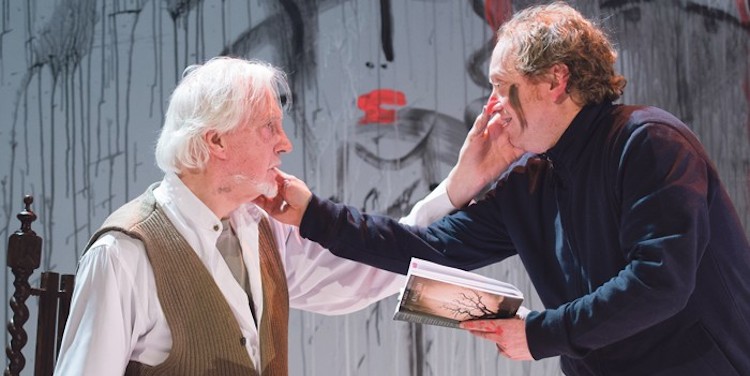
Collaboration, though, has meant many different things over the company’s 22-year life. It began with a focus on the actor, moving on to work with poets such as Carol Ann Duffy and Simon Armitage and writers such as Carl Grose. The 2004 production I’m a Fool to Want You enlisted jazz musicians to capture episodes from the life of French writer Boris Vian, while in 2013 it forged an actor collaboration of a different kind with Edward Petherbridge on My Perfect Mind, a show inspired by Petherbridge’s stroke.

Hayley Carmichael, another of Told by an Idiot’s founders, insists that the shows – while different – all share the same philosophy at heart.

“Even if the starting point is brought to the room by one of us, what happens next is that everyone in the room is a collaborator and takes part in the collaborative process, which for us will always make the end result richer.”

Read the rest of the interview.

Photo: Manuel Harlan.