Someone Who’ll Watch Over Me

someone-over-me

Originally written for Exeunt.

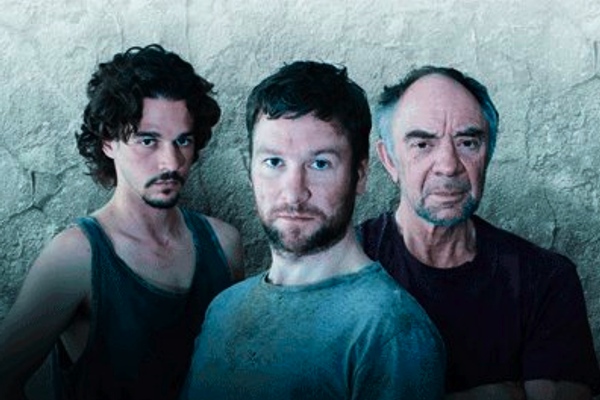
It sounds like the start of a bad joke: an Englishman, an Irishman and an American. This multi-national trio, however, are not walking into a bar, but are instead chained to the wall of a gloomy basement in Lebanon, indefinitely imprisoned by their captors and faced with the all too likely prospect of their own execution. Actor Robin Soans summarises the situation succinctly when he describes the feelings of his character, Michael: “It seems to him that he has awoken in hell”.

This is the premise of Frank McGuinness’ Someone Who’ll Watch Over Me, a play written twenty years ago about the hostage crisis in Lebanon that was then just coming to a close, and which is now being revived by Red Handed Theatre Company and the Southwark Playhouse to coincide with the anniversary. As I chat to the cast in their dressing room at the atmospheric, dungeon-like space under the arches of London Bridge station, Soans admits with a laugh that “you couldn’t find a better space in London to put it on”.

While the action of the play may be rooted in the hostage crisis that gripped Lebanon between 1982 and 1992, during which 96 individuals from a range of different, mostly Western nations were kidnapped and held in captivity, McGuinness’ image of three men trapped in an impossible situation is more notable for its universal resonance. This might, as the actors discuss, be any extreme situation in which the human spirit is pushed to its outer limits. It is the ways in which these three characters deal with their imprisonment and the truths about humanity that emerge through this that provide the true pull of the piece.

“Anyone watching the play could identify with the struggles that these characters go through,” explains Joseph Timms, who plays American captive Adam, the hostage who has been imprisoned the longest of the three. Soans, whose character Michael is an English academic who enters the mix after the other two, agrees: “It’s a universal play and there are situations like this all over the world all the time, even in domestic situations, where people feel locked in or hemmed in”. It does not matter all that much whether these characters are in a makeshift cell in Lebanon or a prison on the other side of the world; what really matters is how they cope.

It is perhaps surprising to learn, as third cast member Billy Carter, who is playing Irishman Edward, tells me, that “the script is heavily layered with lots of humour”. Humour, along with improvisation, role-playing, music and debate, becomes a vital survival mechanism for the three men trapped alone with nothing but their thoughts and one another. Soans emphatically describes laughter as “the greatest tool for survival”, adding that if you don’t make jokes about a hopeless situation “you just collapse, you deflate”. As Timms chips in, “the worst thing to do is to give in and to cry”.

Although the tedium of imprisonment is punctuated with the jokes and play-acting of McGuinness’ script, any production of this play is physically limited by the very situation in which it is staged, with the actors only able to move as far as their chains will allow. This must have been a challenge to keep the performance feeling dynamic? “It doesn’t feel like a static play at all,” Soans protests. “Physically, yes, it’s quite confined, but in every other sense it’s very fluid.” Timms, meanwhile, compares the confined energy of the three men that the actors explore on stage with that of a chained, unpredictable animal.

As Carter goes on to explain, there are tonal shifts between scenes that help to break it up, shifts that director Jessica Swale has used to propel the action forward. Speaking about the dialogue, Carter says, “it’s so sparky and as actors we’ve hit a beautiful rhythm. It’s like a dance.” Continuing the musical analogy, the actors describe each scene as having its own key that needs to be hit, creating something of a challenge for director and cast. To ensure that the necessary precision is achieved, I am told that they have used a method of ‘actioning’ in rehearsals, assigning a transitive verb to each line, which Soans explains was an invaluable process because of the “mercurial” nature of McGuiness’ script.

Also central to the dynamic of the piece is the relationship between the three very different characters, who are thrown together against their will and must learn to support and respect one another in order to survive. Soans describes it as a “pressure cooker version” of any close relationship where people must become accustomed to and absorb one another’s quirks and irritating habits. Such essential, intense relationships demand an atmosphere of collaboration and generosity among the cast, an atmosphere that was actively nurtured by director Swale. This is not a play in which any actor can afford to be greedy.

The result of this closely collaborative effort is one that is intense for both cast and audience. Timms describes the experience of watching this play as that of “watching a human struggling against an inevitability or a darker evil, which we all have in our lives, and we all fight against it and think we’re alone in having to deal with it, but then when you see it on stage it actually gives you a comfort and a strength. It gives you a joy in being alive.” The true aim of McGuinness’ play, at least as the cast see it, is to share something about what it means to be human and the mechanisms that human beings use in order to survive in desperate situations.

Contradicting those who would dismiss the arts as a waste of public money, Soans continues in the same thread as McGuinness by asserting that “drama is absolutely integral to the human spirit”, an assertion that is heavily supported both by the play and by the true accounts of hostages that have informed it. “A number of people left alone will sooner or later make a play,” Soans goes on, “because they want to explore themselves and their predicament. We want self-knowledge, and one of the best ways to get self-knowledge is through drama, through making a paradigm of something similar to your situation”.

Throughout our conversation, what reveals itself as the dominant, uplifting theme of McGuinness’ work, and what has ensured that it remains as relevant and resonant today as at its conception twenty years ago, is the indomitable and endlessly imaginative nature of the human spirit. The play also convincingly positions itself as an argument for the arts, not just as a decorative addition to human life, but as an integral part of our existence. As Soans puts it, with a slight note of triumph, “it’s a very good justification for theatre”.

Reviewing Reviewed: An Attempt to be Honest

I’ve been thinking a lot about honesty. Not in the overall, broad sense of that word and what it encompasses, but in terms of how it relates to my writing and more specifically my writing about theatre. This blog post, therefore, is an attempt to tell the truth, to strip off the usual protective armour that coats the writing I release out into the world and allow myself to be a little more open, a little more vulnerable. What follows may simply be seen as indulgent self-analysis, but I hope that it also connects with bigger debates that are currently taking place about theatre writing and the direction it is being taken in, or should be taken in.

As I say, I’ve been thinking about this question of honesty in theatre criticism a lot and for quite some time, but this attempt to articulate my thoughts was prompted by Jake Orr’s reconsideration of a review he wrote for A Younger Theatre. In an admirably honest and heartfelt follow-up, Jake admitted that the judgement he passed on the production in question (Melanie Wilson’s Autobiographer, which I haven’t actually seen myself) was perhaps unfair, an admission that fed into regrets about how quickly critics must file their review and move on and asked wider questions about the shortcomings of what we might call mainstream or traditional theatre criticism.

This resonated with difficulties that I had personally been experiencing over the last few days. In a possibly foolish move, I went to review the first two of Edward Bond’s Chair Plays at the Lyric Hammersmith on Monday, followed by Making Noise Quietly the next night, effectively giving myself the task of processing five plays in the space of 48 hours – and all at the same time as working my day job. I enjoyed the plays to varying degrees, but they were all teeming with ideas that resisted being pinned down. Tied to deadlines and starved of sleep, I thought and struggled a lot, cobbled together some responses and reluctantly moved on.

But my uncertainty continues to chip away at me. How could these works be reduced to a few hundred sleepily composed words and a hastily slapped on star rating? I do sincerely believe that a review at its best is a thing of beauty and that criticism can be creative in its own right, and for the most part I try my best to strive towards those ideals, but there are also lots of occasions where I fall far short and simply let it go. I sum up a piece of work that has been the product of weeks, months, perhaps even years of hard work and careful consideration in no more than a few hours, using a severely flawed barometer of quality; it seems a ridiculous imbalance.

These thoughts are not entirely new. Theatre criticism, the forms it takes and its inherent limits are all things that I have discussed before, sometimes at length, but looking back self-critically at the reviews I have accumulated over the last couple of years, I can see a disconnect in my thinking. I’ve begun to wonder if I’m failing to practice what I preach and whether the blame for that can be wholly attributed to the restrictions of the traditional 500 word review or if I need to put my own hand up. I think that the answer is probably a bit of both.

I would say that I don’t pretend to be objective, but when I take a closer, harsher look at myself I’m not so sure that’s true. I certainly haven’t made a secret of the fact that I think the concept of critical objectivity is a cracked facade, something that I have explored in my writing here before, yet I wonder whether my reviews themselves contradict this standpoint of honesty. When in a review have I simply admitted ‘this isn’t my cup of tea’? I like to think of myself as fairly open and receptive to all work, but it’s not as though I can eschew personal taste. Similarly, there are certain writers, companies and artists whose work I will inevitably approach in a different way because of my own admiration for them, a fact that is rarely recognised in my finished review.

Beyond the inescapable yet unspoken subjectivity of my writing, I’m aware that I’ve also avoided transparency about my own ignorance. Because, a lot of the time, I do feel fairly ignorant. This is probably to do with being 22 and still feeling like a relative rookie and being aware of how much more there is out there – how much to read, to see, to experience. Constantly meeting others who are far more well-informed than I am, not to mention terrifyingly intelligent, together with being always surrounded by books still to be read, provide continual reminders of my own failings.

When inadequacy or ignorance is admitted by a writer, though, it is seen as a cause of embarrassment for both writer and reader. We are supposed to know everything, or at least think that we know everything, which is often more accurately the case. I don’t expect any of my editors would be particularly happy if I blithely confessed inexperience at the opening of my reviews. No matter how out of my depth I feel, I continue to fumble for a foothold and try to speak from some position of authority, however weak. But there is still that nagging voice at the back of my mind that taunts, ‘who are you to make this judgement?’

Who am I to judge? Who are any of us to judge? Perhaps judgement is not the right word; perhaps we need to rethink the vocabulary of theatre writing. Because I think that what I’m really searching for and what really attracts me to writing about theatre is not cold, calculated judgement, a glib thumbs up or down, but careful analysis, a delicate picking apart of ideas, getting under the skin of a piece of creative work. That’s what also excites me about speaking to theatre makers on the occasions when I am fortunate enough to interview them; I want to pull back the curtain and peek at the inner workings, the beating heart of the piece and its complex, intricate network of veins.

This brings me back to Jake and what inspired this increasingly lengthy blog post in the first place. As a result of some of the thoughts expressed in the piece I have already mentioned, alongside a whole host of other inter-connected thoughts, he and Maddy Costa have launched a project that plans to get closer to what I was beginning to describe above. DIALOGUE, described as a ‘great big playground’ for anyone involved in making, watching or writing about theatre, aims to open up new channels of communication and foster an environment of generosity. As the name suggests, it is intended to start up conversations between those creating theatre and those who usually critique it. It feels urgent, important, exciting.

So, in the adventurous, innovative spirit of Jake and Maddy and all the other theatre writers and makers who are also beginning to question their way of working, I want to do better. I want to engage with a piece of theatre beyond the two hours or so it takes to watch it and the few hours in which I have to hastily formulate a review before work or deadline or both. I want to enter into a dialogue with those who are making the theatre that I consume and to give the act of creating the respect that it is due. I want to avoid falling into lazy assumptions and casual criticisms, even if I am frantically writing away in the early hours running on nothing but caffeine.

Because I’m being honest, I write this in complete anticipation of failure. I will fail. Perhaps my failure will be to a greater or lesser extent, with any luck the latter, but failure is pretty much inevitable. I have other demands on my life, I have a day job and a need to make ends meet, and – dare I say it – sometimes I’m just a bit lazy. I am also bound by the expectations of my writing, which vary from subject to subject and publication to publication. I would say screw it, let’s chuck out the rulebook regardless, but I’m not that brave. Perhaps I’m not that idealistic.

But the one thing I promise is that I will try. I’ll try to connect with the work I see on a deeper level, whether within the restrictive limits of the traditional review format or, as will most likely be the case, through other means. I might write a 500 word review to deadline, but I’ll also try my best to make sure that the work has a life in my thoughts and my writing beyond that. I’ll try to keep questioning what theatre criticism means, or if perhaps we need a completely different terminology to describe the relationship between theatre and what is written about it, even if I don’t have any forthcoming answers. I’ll try to stay alert and open and creative in my thinking.

Most importantly, I will try to be a little more honest.

DNA, Unicorn Theatre

A group of teenagers are in trouble. Big trouble. What began as a playful bit of bullying – ‘a laugh’ – has spun wildly out of control and one of their classmates now lies dead in the woods. The only solution, as it appears to this shocked group of youngsters, is to cover it up. It seems like they might just get away with murder, but the lie that they have fabricated soon becomes bigger than they could have anticipated in Dennis Kelly’s unsettling thriller, originally written for the National Theatre’s Connections programme and now revived by the Hull Truck Theatre.

Unlike some other dramatists targeting troubled youth as their subject matter, Kelly does not patronise his adolescent protagonists, nor does he dwell gratuitously on their violence. The terrible act that binds the group together takes place off stage, as does a subsequent instance of violence, thus refusing to make these shocking events the visual centrepiece of the play. Instead, this incident becomes a springboard to explore this group of teenagers and their relationship to the world and one another, relationships that are heightened by the predicament they find themselves in. The central moral dilemma faced by the teenagers – is it better to come clean or to cover up what they have done for the greater good of the group? – is the hinge of the piece, but is far from the only issue that Kelly is prodding at.

Much of these issues are communicated through the character of Leah, who barely pauses for breath throughout most of the play. In a constant stream of chatter that betrays her brittle insecurity and desperate need to be liked, this waffling yet oddly insightful teenager touches on profound questions of time, meaning and the nature of humanity in a delicately poignant performance from Leah Brotherhead. While the unrelenting talk occasionally verges on the irritating, Kelly has wrapped up in Leah that very teenage contradiction of developing self-awareness and crippling anxiety, and through her seemingly light conversation begins to get close to the truth of what it is to be trapped in the confusion of adolescence.

Leah’s verbal diarrhoea is contrasted with the brooding, indifferent silence of her companion Phil, who seems more intent on his food than on anything she spouts. Crisps, sweets, a waffle meticulously drizzled with jam – rarely has food occupied such a demanding place in centre stage. Despite barely uttering a word, James Alexandrou pulls off the most genuinely disturbing performance of the piece as this determinedly mute yet commanding figure, and when he does open his mouth he formulates a plan to get the group out of trouble with the calm, calculated precision of a psychopath. The most impressive achievement of Kelly’s writing, however, is his lack of condemnation; while we appreciate that what this group of teenagers have done is deeply wrong, we continue to be compelled to care about them and even to an extent to understand the situation that they have backed themselves into. This, we can imagine, is just what a group of panicking teenagers might do when offered what seems to be a way out.

While the young characters themselves are for the most part rendered plausibly – if perhaps a little less foul-mouthed than might be expected under the circumstances – the world that Kelly has created has a nightmarish, surreal quality, with echoes of Lord of the Flies inevitably raising their voices. Before the squirming teenagers know it, they are blocked in behind the bars of their own lie, forced down the increasingly twisting paths of a complex labyrinth of deceit. They have fallen down the rabbit hole and there is no way out. The sense of heightened reality is intensified by the pulsing lights and dazzling projections of this production’s simple but striking design, although the mat of grass that is regularly dragged out for Phil and Leah’s scenes together seems an unnecessary item of clutter in an otherwise effectively minimal set.

For such a darkly atmospheric piece, however, there is a sense in which this feels oddly, paradoxically safe. The description of Adam’s death, while building escalating tension, lacks a chill of horror; we never experience the visceral shiver of shock that ought to accompany the darkening action. This may partly be due to a certain elusive ingredient missing from Anthony Banks’ otherwise impressive production, but I suspect that it might have more to do with the text’s uptake by the GCSE curriculum. I certainly have nothing against introducing schoolchildren to such compelling and challenging work – this is just the sort of thing that we should be encouraging young people to see – but I fear that this revival, which has clearly been created with students in mind, has taken the edge off Kelly’s script. Ironically, it is that very edge that might have really captured the attention of its young audience.

DNA runs at the Unicorn Theatre until 28 April and is then touring until 25 May.

Image: Simon Annand

Why So Shocked? The Art of Unsettling

A nightly explosion is taking place on the stage of Islington’s Old Red Lion Theatre. As Greenhouse Theatre Company’s performance of Mercury Fur enters its devastating, loud and bloody conclusion, audience members alternately lean forwards and recoil; heaving, audible sobs echo around the intimate, claustrophobic space; a couple of theatregoers seem on the verge of complete breakdown. Never have I felt an audience so unified in tension, shock and emotional release.

The visceral punch of Mercury Fur is nothing new. When the play premiered in 2005, it was quickly labelled as Philip Ridley’s most controversial work to date, and Faber and Faber famously refused to publish the playscript on the grounds of its shocking content. It was a reaction that continues to infuriate Ridley. Speaking in an interview with Exeunt’s Tom Wicker, the playwright says, perhaps flippantly but nonetheless incisively, “if I’d reinvented Mercury Fur as a lost Greek tragedy and set it in Thebes, no one would have batted an eyelid”.

It only takes a cursory glance at the canon of Greek tragedy to prove Ridley’s point; Medea, for instance, kills her own children, while Oedipus famously sleeps with his mother and plucks out his own eyes. The significant fact to remember about Greek drama, however, is its origin in myth. The theatre of Ancient Greece was born as a way of exploring the contemporary problems and issues ailing the Athenians, but through a medium that was divorced from the citizens’ everyday lives. We might ask ourselves how much has really changed since the days of Sophocles and Euripides. Do we continue to be more comfortable with depictions of human cruelty when they are one step removed from our immediate experience?

In order to investigate the unique fascination and repulsion provoked by “shock theatre”, as we might label it for the purposes of this blog, it may be helpful to consider this within the wider context of other cultural mediums that also deal with acts of human brutality and the uncomfortable themes of death and decay. Two such genres that seem particularly relevant at present are dystopian fiction and film, which have seen an extraordinary resurgence in the teenage market, and the confrontational art that emerged in the 1990s and is exemplified by Damien Hirst’s current retrospective at the Tate Modern.

Firstly, dystopian fiction may be nothing new, but it is undoubtedly experiencing a fresh renaissance and a new legion of fans. This can in part be attributed to the ubiquity of Suzanne Collins’ Hunger Games trilogy of books, now also a box office smashing film franchise, although this is only part of a larger, thriving teenage market for dystopian narratives. Of course, as proved by the enduring popularity of novels such as 1984 and more recent hits like The Road, it is not only the youngsters with a taste for the post-apocalyptic, but it is the hunger of the young adult market for this challenging fare that has brought dystopia right back to the forefront of the literary marketplace.

In her article for the New Yorker, Laura Miller argues that the appeal of dystopian fiction for younger readers derives from the way in which these novels, however far-fetched, identify with the realities of teenage experience. Miller also points out that the major way in which dystopian fiction differs from its older sibling is in its conclusion: young adult dystopias favour salvation and catharsis, whereas the grown-up version typically ends in crushing despair. But in either case, no matter how gruesome – The Hunger Games hinges around children fighting to the death for public entertainment; in Cormac McCarthy’s bleak novel The Road, a baby is roasted on a spit – readers and viewers, young and old alike, happily gobble it up.

The work of the media-dubbed Young British Artists of the 1990s, meanwhile, is similarly gruesome and provocative, though not as easily accepted. When Hirst first unleashed his formaldehyde creations on the world, the art establishment did not know what to make of them, initiating a stunned disgust that would accompany the rise of Hirst and his peers. There are, in fact, many parallels that can be drawn between the work of these artists and the In-Yer-Face theatre movement that surfaced at the same time and was characterised by the plays of writers such as Ridley, Sarah Kane and Mark Ravenhill, parallels that are helpfully highlighted in Stewart Pringle’s excellent essay for Exeunt. The art, however, has seemingly mellowed with age in a way that the theatre has not, at least in the eyes of onlookers.

As Pringle ultimately argues, the output of the likes of Hirst and Tracey Emin has lost its shock and the “theatrical frisson” that made its name. Visual works of art are crystallized, static, trapped within the moment of their creation, and as such the shock of their reception is dulled by the passing of the years. This is something that Ridley, himself a visual artist as well as a writer, is acutely aware of. As he puts it in the interview with Wicker, “young audiences, families, will go to the Tate Modern and happily walk through sliced up sheep, pickled sharks and unmade beds with tampons on them. But do something like that in a stage play and people are outraged and you’re a ‘shockmaster’.”

It is clear, then, that theatre is still capable of ruffling critical feathers. The most striking recent example of this was Daily Mail critic Quentin Letts’ outraged diatribe against the provocative output of subsidised theatres, which he depicted as profane “gobblers” of public money. Expressing his opinion is one thing, and is after all what he is paid to do, but Letts was also allegedly involved in some shocking behaviour of his own. According to playwright Dan Rebellato, the critic tried to persuade the Lyric Hammersmith’s private donors to withdraw their money after the theatre staged a revival of Edward Bond’s seminal post-war play Saved.

If true, Letts’ actions are disgraceful, but that is a rant for another time, and one that Rebellato articulates far more eloquently than I could hope to. Placing this to one side, it is worth considering just what made Letts so incensed. The critic expresses concern about the decline of “communal decency” and distaste for the prevalence of bad language and violence, both of which are no doubt considered offensive by some theatregoers, in which case they have the choice not to buy a ticket or to leave before the end. We are, like Letts, all entitled to our own opinions and tastes.

Yet Letts’ argument seems to hinge on boredom. He admits that he fell victim to a “huge yawn” during the baby stoning scene in Saved, and states that in today’s theatre, “rape, murder, nudity and profanity have lost their shock value”, becoming “almost de rigueur”. However, his actions, as Rebellato points out, tell a different story. Likewise, the collective reaction to the denouement of Mercury Fur – a reaction which, by all accounts, was typical of the entire run – stands as testimony that the play has lost none of its vicious sting. Theatre such as this has the same bruising impact as it always has, and this is what Letts, beneath his affectation of ennui, seems to object to.

The answer to why theatre retains the ability to shock and to provoke such vehement reactions would appear to lie in the nature of its liveness and immediacy. Or, as Pringle puts it, plays such as Mercury Fur are “revived through the living, in a living space which has grown out of its own era”. It is perhaps not what is actually being portrayed that we struggle to accept as much as the proximity – both physical and psychological. Whether safely enclosed within the pages of a book or behind a cinema screen, or set in a comfortingly distant dystopian wasteland or mythical Greek realm, we can swallow our dose of cruelty when its side-effects seem not to touch us. It is only when these dark imaginings are diagnosed as a very real presence in human nature within today’s society that the cultural arbiters of that society shun it, deride it, even condemn it. Theatre should, in the words of Hamlet, “hold as ’twere the mirror up to nature”, but apparently only when that reflection is not an ugly one.

Reflection is something that Letts also seems to have a problem with in his article. He asks whether we should “take the view that, like Shakespearean court jesters, subsidised thespians are there to hold a mirror to our failings”. The answer, it seems to me even if not to Letts, is yes. Great theatre can also, as Letts suggests it might, aspire to change society in some way, but his belief that theatre makers should “use their power to mend our country instead of simply ‘reflecting’ it” feels like backward logic. Only once we have made the diagnosis can we turn our minds to finding a cure.

As depressing as it may sound, there seems to me little doubt that this shock theatre does reflect a buried, ugly side of human nature. Who was not, like Narcissus, both intrigued and enchanted by their own image when first viewing it in a mirror? I suspect that what disgusts and repels us about disturbing works of art is also what attracts us; we see something of ourselves, or at least of the human condition, in what is presented before us. Dystopian narratives and shock theatre alike speak to an aspect of human nature that is as unsettling as it is irrefutable.

While Elliot’s recollection of riots on the streets in Mercury Fur feels chillingly prescient in the light of the events of last summer, the issues dealt with by this and similar plays are not, as their critics seem to think they are, exclusive to this particular moment in time. Society may currently feel particularly broken, but these are universal, timeless concerns; as director Paul Davies says in reference to A Clockwork Orange – another controversial, dystopian narrative – “civilisation is a veneer”. All that the likes of Ridley are doing is chipping away at that veneer to expose the darkness beneath. And that darkness, as made clear by our ongoing fascination with works of art such as those discussed above, has always been there.

Shivered, Southwark Playhouse

In this latest piece from seemingly ubiquitous polymath Philip Ridley, form does not so much reflect content as it does context. Ridley’s shattered play is a chillingly appropriate response to an increasingly fractured modern society, with casually engendered violence and careless cruelty glinting back at us from each piercing shard of narrative. It is not quite entirely without hope or brief glimpses of redemption, but the dark, nightmarish landscape of Shivered does evoke the sense that, as disillusioned soldier Alec passionately argues, the world is almost incurably sick.

Ridley’s chopped up story takes as its setting the fictional Essex new-town of Draylingstowe, once upon a time a symbol of hope and prosperity, now a post-industrial playground for violent youth. The derelict car plant that once held the town’s promise is now a shady backdrop for drug-taking, suicide and cruel sexual fantasies, while Draylingstowe’s disenchanted citizens find meaning in conspiracy theories, whispers of extra-terrestrial activity and mysterious canal-dwelling monsters. It is a world that hovers somewhere between fairytale, nightmare and grim reality; grubby concrete illuminated by the garish lights and glitter of the fairground.

This semi-mythical world is vividly conjured by Ridley’s assorted collage of narrative snapshots, cutting and dicing the story of two interlinked Draylingstowe families. Lyn’s family is as fragmented as the play itself, shattered by the loss first of her son Alec, who is brutally beheaded while serving overseas in the army, and then the disappearance of husband Mikey, leaving her with only her younger, UFO-obsessed son Ryan. When the fair arrives in town it brings with it the tantalising promise of sexual excitement, as Lyn meets opportunistic showman Gordy and the pair begin to meet in the disused car plant, her son’s favourite haunt. Meanwhile, Ryan’s friend Jack finds escape from the torment of bullies and the daily drudge of caring for his overweight mother in graphic YouTube videos of sex and violence – one of which happens to be a recording of Alec’s horrific execution.

But none of it is quite as simple as this. The above narrative is the one that we as an audience piece together, filling in the blanks between the scattered series of scenes that Ridley presents before us, making almost subconscious links. It is an ingenious, dazzling exercise in plotting, throwing chronology into chaos without plunging the whole into incomprehensible obscurity, but Ridley’s experimental approach to structure is not a mere demonstration of his startling ability as a writer. Central to the play that Ridley has crafted are questions of how we fight to find meaning and explain our own existence, be it through narrative, religion or superstition.

There is repeated talk of ‘illusory contours’: the patterns we find in unlinked objects, like constellations of stars. This same mental process is one that we are unwittingly forced into, as Ridley coaxes us into making connections before throwing these into doubt. Are these collected scenes really linked in the way we imagine them to be, or are we guilty of the same forced, wilful conclusions as Ryan in his determined hunt for UFOs? What, ultimately, can we believe in? In the dark, slowly rotting world of the play, under the haunting spectre of abandoned industrialisation and rapidly unravelling values, the answer would seem to be very little.

The bare, evocatively lit space of the Southwark Playhouse has never seemed more bleak than in Russell Bolam’s stripped down, almost minimalist production. There is nowhere to hide for either writing or actors – or for audience, for that matter. Ridley’s boldly drawn characters jump out at us, sometimes quite literally in the case of Gordy’s fairground act, performed with effervescent showmanship by the buzzing, charismatic Andrew Hawley. There is impressive work too from a fragile yet cuttingly sardonic and sometimes fiercely wounding Olivia Poulet as Lyn and from Robbie Jarvis as her broken son Alec, who is haunted by unnamed ‘monsters’.

Ridley’s strange, disturbing not-quite-dystopia is never as unsettling, however, as when seen through the eyes of its young protagonists, whose twelve-year-old imaginations the playwright has convincingly penetrated. Ryan and Josh retain barely discernible traces of youthful innocence and optimism, but their existence has been permeated by technology and readily available violence, numbing them to the reality of physical aggression and placing a computer or mobile phone screen between them and all of their experiences. These two troubled and troubling youngsters are convincingly portrayed by the outstanding Joseph Drake and Joshua Williams, who are by turns bitingly funny and uncompromisingly brutal – phrases that could well describe Ridley’s play.

Despite a plot which is, when reassembled into chronological order, comparatively slight, this is meaty fare. Ridley dwells on both startlingly contemporary issues, such as our desensitisation to violence and the very real threats of post-industrial society, and timeless, universal questions of how we find meaning in our lives, with vivid dashes of magical storytelling thrown in for good measure. It is, as the playwright himself has described it, a ‘state-of-the-nation dream play’. The dreamlike is always close to the surface here, featuring dialogue saturated with fantastical references to monsters, aliens and other childhood fears. But the real world, as Ridley unflinchingly demonstrates, is so much scarier.

Shivered runs at the Southwark Playhouse until 14 April.