In The Republic of Happiness

In writing about this production, I’ve taken something of a counter-intuitive approach – or if not counter-intuitive, then certainly counter to conventional critical practice. I saw the show before Christmas without any intention of writing about it, subsequently discussed it in a seminar group, read all the reviews I could get my hands on, and feverishly combed my way through the script. Essentially, I pursued my fascination with the piece down every avenue other than writing about it, before deciding (some time after the production closing) that I was going to have to write about it after all. As a result, what follows is at least partly the product of osmosis …

“Happiness is never experienced, only remembered” – Oscar Levant

The above quote, unexpectedly dredged up from the depths of my memory somewhere, seems like a fitting place to start. If happiness is an emotion that can’t be fully experienced in the present, then in today’s society it is a sensation that is not so much remembered as shared. Whether via social media updates, glossily vacuous magazine interviews or the compulsive confessionals of reality television, emotion has become currency, a commodity to trade in the continual search to define one’s identity. It is this obsessive cult of the individual (among other things) that is interrogated, prodded and mercilessly skewered by Martin Crimp’s latest play.

It strikes me that the two key words that frame the piece – ‘republic’ and ‘happiness’ – seem in many ways to be internally opposed. So long as the quest for individual happiness continues to be sold to us as the ultimate goal of our existence, a goal to be pursued at the exclusion of all others, the possibility of cooperation is precluded and the true democracy implied by the concept of the ‘republic’ is rendered impossible. This can be read as the rotten truth buried beneath government happiness indexes and aspirational marketing speak; the tyranny of the individual is not one that frees us at all, but one that traps us in an isolating and self-perpetuating state of immobility, speaking in the same blithely inane circles as Crimp’s empty characters.

The play itself is divided into three distinct sections: ‘Destruction of the Family’, ‘The Five Essential Freedoms of the Individual’ and ‘In The Republic of Happiness’. Before delving into each of these, I’d suggest that the number of scenes feels significant, although the nature of this significance is uncertain. As Andrew Haydon touches on in his review, the number three invites numerous possible readings, with other critics positing the heaven, hell, purgatory trio (though I’d struggle to decide which section might be interpreted as which), while Andrew suggests that past, present and future works just as well. Vaguely linked to that chronological conception of the structure, I might add the traditional three-act play. For a piece that in many ways disrupts and deconstructs theatrical conventions from within, I suspect it’s no accident that it defers to and then explodes this most accepted of stage constructs.

The play also has the intriguing subtitle ‘an entertainment in three parts’, immediately summoning the inform/entertain binary and also begging the question of what exactly we find entertaining. We might further ask whether this production can indeed be classed as entertainment at all – it’s certainly very enjoyable in parts, but it’s hardly the comfortable viewing that we might normally associate with the traditional genre of ‘entertainment’. (As an aside, Dan Hutton interestingly suggests that the production has the quality of a “variety show where the theme is ‘what it means to be happy'”, pointing to the mixture of dramatic styles and the inclusion of songs as displaying a sort of vaudevillian influence)

As another brief preface to my discussion of the three sections, it feels necessary and helpful to set this production within its context. Showing at the Royal Court near the end of Dominic Cooke’s time as artistic director, there are a very specific set of implicit social, economic and artistic referents that frame the piece, which has a distinctly self-reflexive tint. The position of the theatre in Sloane Square’s bubble of privilege, its particular theatrical history and its typical audiences are all variously called to mind, as is Cooke’s frequently cited remit of exploring the position of the middle classes.

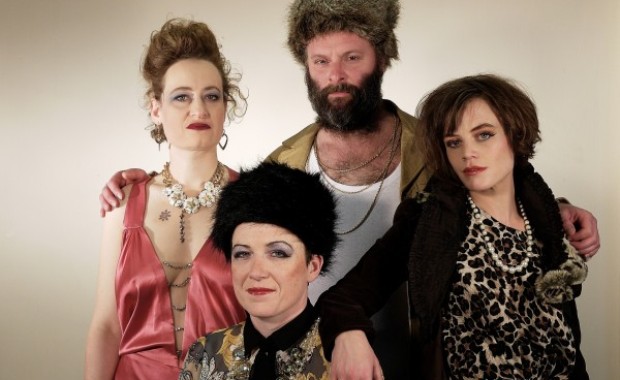
Which leads conveniently into the first section, ‘Destruction of the Family’, with its initial set-up recalling so many of the plays that have characterised Cooke’s artistic leadership of the theatre. At first glance, the scene conjures a typical (if slightly bare and a little unsettlingly red in colour) middle class dining room, furnished with a seemingly typical middle class family. Any notion of the ‘typical’ soon slips away as a superficial naturalism steadily crumbles, but the opening domestic image is quietly clever in its manipulation of audience expectations, as well as convincing me that Cooke (who has directed this piece) might just have a sense of humour about the supposed middle class obsession of his tenure.

The premise of this opening scene is a family Christmas dinner which is interrupted by the arrival of the apparently estranged Uncle Bob, whose appearance violently shatters a naturalism that has been gently eroding from the start. There’s a strain of heightened, compulsive truth-telling to the dialogue early on, quickly setting up a sense of dislocation, while the intrusion of a strange and unsettling song from the family’s two teenage daughters further arouses suspicions that all is not as it seems. Script and production both mark Uncle Bob’s entrance as a caesura, with the character’s assertion that “I thought I would just suddenly appear, so I did” and actor Paul Ready’s startling emergence from an invisible doorway both contributing to the sense Dan Rebellato articulates of this figure being a fictional construction abruptly summoned into being (which of course he is).

This initial aura of meta-theatrical fiction surrounding the character is reinforced later on. Uncle Bob’s reason for interrupting, he tells the family, is to inform them what his girlfriend Madeleine thinks of them all before the pair jet off to start a new life that is “like a pane of glass” – “Hard. Clear. Sharp. Clean”. While reeling off a litany of escalatingly vile insults, Bob says at one point: “you think I get pleasure from having to stay here and repeat what another person has instructed me to say?” While in one straightforward reading he is referring to the string-pulling off-stage presence of Madeleine, it’s hard to shake the feeling that this is not also directed at the creative control of the playwright, an alternative reading that is enhanced in production by Ready’s implicit awareness and acknowledgement of the audience.

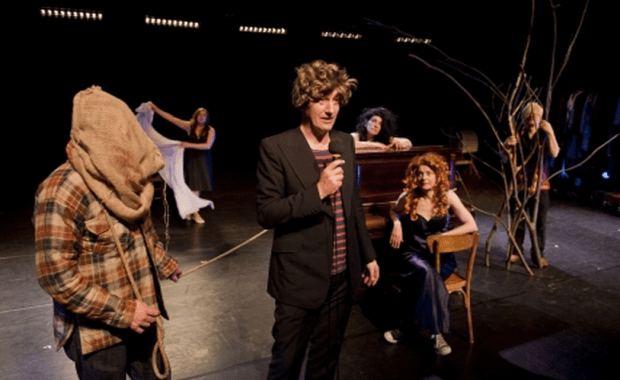
The breakdown of naturalism briefly outlined above, a process of collapse that begins from within, is eventually reflected in Miriam Buether’s design, as the noticeably flimsy walls of the room that contains the first section are pulled away – a visible dismantling. While this happens in the transition between the first and second sections, the cast line up facing the audience and very deliberately remove items of their costume – earrings here, a jacket there. It’s a calculated and conscious move, stripping away certain signifiers of character but letting other vestiges remain. What we are left with are figures who exist somewhere disturbingly between character and actor, acknowledging the ghosts of the characters they have just left behind and carrying these lingering spectres into the second segment of the show.

This is the longest and (at least in my experience) most enjoyable portion of the production. An excoriating satire, the section consists of, as announced in the title, ‘The Five Essential Freedoms of the Individual’: ‘The Freedom to Write the Script of My Own Life’, ‘The Freedom to Separate My Legs (It’s Nothing Political)’, ‘The Freedom to Experience Horrid Trauma’, ‘The Freedom to Put It All Behind Me and Move On’, and ‘The Freedom To Look Good & Live For Ever’. These take the form of a long stream of lines, which I later learned are completely up for grabs among the cast; each of the actors knows the entire thing and each night they were all free to take whichever lines they felt compelled to. This produces slippery and ever-shifting meanings, overlaying the words themselves with an engaging interplay between theatrical signifiers (how does this young female actor taking the line inflect it in a different way to an older male actor? what is the relationship between the words being spoken and the characters from the first act that have just been discarded?).

Crimp’s targets in this long (possibly over-long) section are many and varied: resolutely anti-political individualist rhetoric, the modern obsession with personal wellbeing, the fetishisation of trauma and recovery, the desire to control the story of one’s own life – all peppered with more specific references to modern day phenomena such as airport security checks and child medication, and broken up by a series of songs. It’s difficult throughout this stinging assault to pin down quite where Crimp himself (and by extension the whole production) stands, as the satire is quick to turn on the opposite viewpoint, upturning audience assumptions as fast as they form. (An example: “I don’t say I’m happy to separate my legs so that people who’ve been educated in a certain way or have particular beliefs can sit here in this audience and think that I mean the opposite – no way”. Ouch.)

The staging here, as Andrew suggests, is not particularly revelatory (he dubs it “The Path of Least Resistance”). Tugging at the unifying thread of the individual enshrined at the centre of contemporary culture, the organisation of the stage suggests the television chat show, with the cast lined up on clinical white chairs in front of a screen, while the mic-clutching performance style of the punctuating songs evokes the likes of The X Factor. This in itself might be telling; immediate associations are culturally revealing, in this instance speaking of the ubiquity of celebrity. This implicit context does, however, align readings in a certain way, whereas the lines as written on the page, without any direction or attribution, invite any number of different interpretations; much like seeing the Royal Court’s enjoyable but fairly unimaginative staging of Love and Information and subsequently reading Caryl Churchill’s startlingly open text, I was immediately itching to see someone else get their hands on it.

After thoroughly roasting our self-obsessed modern preoccupations, the middle section gives way to the final, most challenging segment of the production. Via an impressive scene transition during which a large white cube rises from beneath the stage, we return to Bob and Madeleine, who are now in an unspecified, antiseptic republic of which Bob appears to be the head – although it is once again Madeleine who pulls all the strings. Whereas prior to this the production gives us something to grasp onto, even if that something is a convention that cracks beneath our grip almost as soon as our fingers close around it, this concluding scene casts everything into doubt. This state of uncertainty goes right down to the design, which leaves an unsettling gap either side of the white cube in which Bob and Madeleine are standing, exposing the unattractive seams of the theatrical event and situating us in an unstable in-between territory, stranded somewhere that is not quite illusion yet not quite its opposite. Just as the middle section presents us with figures who hover between character and performer, theatrical conventions and signifiers cannot be relied upon.

On first watching it, I honestly wasn’t sure what to make of the closing scene, and I’m still not really sure about it. No characters inhabit the scene other than Bob and Madeleine and the minimal design seems calculated to give as few interpretive footholds as possible. We might assume that they have established the life that they dreamed of in the first scene – “like a pane of glass” – and it certainly seems to fulfil Madeline’s desire for a shallow surface shimmer, clean and shiny but devoid of depth. Though where exactly they are (other than, presumably, the unspecified ‘republic of happiness’) is anyone’s guess; Bob’s demand to know where the world has gone suggests that there might be nothing beyond the clinical cube they occupy, but I don’t have many other guesses to proffer. As has probably become clear, I struggled with this scene, and not necessarily in an enjoyable way. I think I probably agree with Andrew that it’s the sudden shift into total, almost impenetrable metaphor that is most frustrating and baffling about this gear change.

One possible way of reading this conclusion is as a critique of happiness itself. Dan Rebellato suggests that there is “something deeply banal about measuring fulfilment through happiness” and comes at the scene from this perspective, seeing happiness as a shallow category of experience. There certainly seems to be something in this when we look at Bob’s closing song, the ‘100% Happy Song’, an eerie and hollow tune that draws on nursery rhyme but drains the form of all its childish cheer. As Bob joylessly intones his final “oh hum hum hum the happy song”, it’s easy to agree with Dan that this last act “captures the thinness of a purely happy world”.

For me, despite my difficulties with interpreting the scene as a whole, its look and feel crystallized a certain set of ideas that can be identified running through the entire play. With its white finish and the flat, lifeless landscape of green visible through the large window, the set in this final scene has something of the Microsoft Windows interface to it, while the cube’s striking similarity to the design for Love and Information (also Buether’s, incidentally) immediately conjured for me that play’s attention to the digital information onslaught. Throughout In The Republic of Happiness, the characters seem to either inhabit or wish they inhabited a virtual world, one centred on the individual and logically cleansed of all life’s awkward complications – a defragmented existence. Madeleine wants to be able to select Bob’s family and click delete; there is talk of opening the document of one’s life; the lines of the middle section express a recurring obsession with fact, that most beloved item of the information age; the ‘100% Happy Song’ encourages listeners to “click on my smiling face”.

This entanglement with and desire for the digital experience seems wrapped up in the piece’s two other central concerns: the contrast between surface and depth and the pervading obsession with self. The screen is perhaps the ultimate expression of surface; not only shiny, hard and reflective, but also promising an existence that allows the destruction of depth, enabling users to delete files from their lives with just a click. Digital outlets also elevate the importance of the individual, offering each of us the possibility of transmitting a self-edited version of ourselves to the world. This extreme narcissism is most emphatically embodied in the figure of Madeleine, a character so wrapped up in herself that even her dress makes her feel like “I’m zipped into my own vagina”, and whose calculated, self-aware portrayal by the excellent Michelle Terry suggests an individual in love with the performance of her own life. Perhaps, we might conclude, it is the atomising force of our reliance on digital communication in the modern world that has engendered the cult of the individual that the play satirises, though I doubt Crimp’s diagnosis is quite that simple.

Inevitably, there’s a lot more that could be teased out from this production that I’ve barely touched on or that has emerged in reflection over the weeks since seeing it. One recurring element noted by Andrew that I hardly picked up on at all while watching is the repetition of references to child abduction and sexual abuse, though I’m not entirely convinced by Andrew’s suggestion that the structure of the play performs the function of “purging” Uncle Bob of hinted sexual crimes against his two nieces. I also felt the faint but looming shadow of environmental disaster hanging over the piece, lightly alluded to in teenager Debbie’s fear of the future, the family’s energy-saving removal of lightbulbs in the first scene and Granny’s premonition that humanity is on the brink of massive change; more of a background presence than a key concern, but one that has troubling implications for the narcissistic individualism at the play’s core, perhaps suggesting that our atomisation is key to our inability to cooperate in order to avert crisis.

Picking up on Bob’s stubborn insistence that “it goes deeper than that”, Dan Hutton proposes that this play also begs us as audience members and critics to go deeper, peeling away layers of meaning and theatricality. “No matter how much we think we ‘get it’,” he suggests, “we must continue to dig”. So essentially this is me attempting to excavate, to move beyond the surface and dig deeper. Though, despite all my interpretative efforts, it probably still goes a lot deeper than that.

A Love Letter

Love-Letters-Straight-from-your-heart

Last night I fell a little bit in love.

But before I get onto that, there are a few things you should know. Uninvited Guests’ Love Letters Straight From Your Heart sounds, in many ways, like my vision of a nightmare: unapologetic sentimentality, public displays of emotion (emphatically not my thing – I was possibly the sole dry-eyed audience member when I went to see Lovesong) and, worst of all, the premise that in the room of the performance it is always Valentine’s Day. Whether single or in a relationship, the 14th February is a hideously over-commercialised day that I resolutely hate; one of my most vivid Valentine’s Day memories remains digging through stacks of saccharine, heart-studded cards in an increasingly frantic hunt for one to give my then boyfriend of only a couple of months that didn’t declare “I love you”.

Incongruously paired with this cynical, emotionally awkward streak of my personality, I had dangerously high expectations of the show. Everyone I’d spoken to about it had been in raptures, competing to express in superlatives just how much they loved it. And then, on top of all that, I’d been oddly compelled to write reams more than I probably should have done in my dedication (the piece is built around song dedications from audience members to loved ones – but more on that later) and was beginning to squirm at the thought of my nakedly sincere words falling from a performer’s mouth. All in all, the odds were in favour of me hating the whole experience.

And yet, in spite of all the above, I utterly adored it. The idea behind it all is simple enough: in advance of the show, audience members fill out dedications, requesting songs for their loved ones – partners, best mates, family members – and expressing what they mean to them; the performers then read these out and play the songs over the course of the evening, slotting them into a containing structure that gently explores the nature of love. It’s like an odd sort of marriage between participatory performance and Radio 2’s ‘Sunday Love Songs’, but one that strangely, charmingly works.

Entering the space, we’re offered a glass of sparkling wine and invited to take a place at one of two long tables facing one another. The aesthetic is cheap, familiar romance, all red tablecloths and roses, topped off with a glitterball suspended from the ceiling. There’s something of the wedding reception in the layout, an arrangement of the performance space that immediately cultivates the atmosphere of a social event rather than a theatrical one. It’s recognisable, unintimidating – an immediate setting at ease.

Once everyone is seated, performers Richard Dufty and Jess Hoffman take up their places at DJ desks at either end of the two long tables, from which they begin to spar with tunes, lobbing love songs at one another with grins and rolls of the eyes. There’s cheese and passion and raw, piercing heartbreak. But the bared soul of the show, as the songs played by Dufty and Hoffman melt into those selected by audience members, is formed by the dedications of those present. Like me, other audience members (at least on the night I went) seem emboldened by the setting to open their hearts, to share mushy declarations of love or friendship or to wrench out private pain. The company’s description of the atmosphere as something between a wedding and a wake is deeply apt, with both devotion and loss foregrounded, while the space itself shares that loosening of emotions that accompanies these rare events when we allow ourselves to unreservedly feel.

Perhaps surprisingly, given that we are all listening in to the voicing of emotions usually confined to the sphere of the private, Love Letters refuses to cast its audience as voyeurs. There is a sense that we must all give up something of ourselves, all equally drop a barrier that leaves us startlingly level with one another. The most striking way in which this is achieved is through an instruction for audience members to gaze into the eyes of the person opposite them for the duration of Johnny Cash’s ‘First Time Ever I Saw Your Face’, creating an unsettling intimacy that somehow shifts something in the room (if the effect sounds exaggerated, try looking into someone’s eyes for the length of that song; it’s extraordinarily, revealingly difficult). There is, as a result, a sense of the collective, a half-community that will dissolve once we step out of the space but for a brief time reconfigures social rules (again, this looks hyperbolic and cliched as I write it, but I was struck by the way in which people easily spoke to one another after the performance, an ease between strangers that I’ve rarely witnessed in a theatre context).

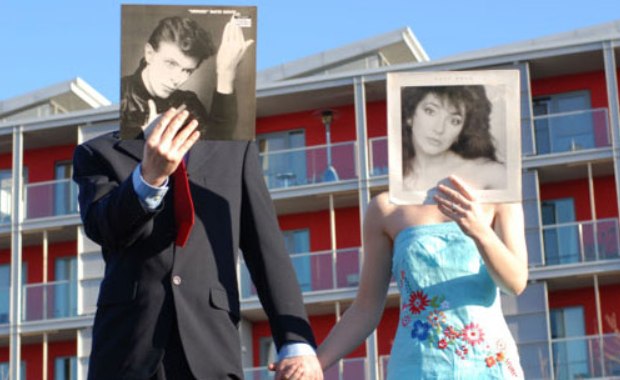
Central to it all is the music. A shifting playlist that changes every night, the songs are intimately tied up with memories, but these aren’t just restricted to the memories of the individual who has made each request. As we listen to The Smiths, Kate Bush, Joy Division, Elvis, Soft Cell, almost every track unleashes a torrent of my own recollections, conjuring other loved ones with the breathless exhilaration of teenage infatuation or the comfort and warmth of the family home. It also made me think of all the other theatrical moments that are inseparably wedded to particular pieces of music (the trio of extraordinary visual snapshots that accompany ‘Wicked Game’, ‘Golden Slumbers’ and ‘The Last Living Rose’ in Three Kingdoms, the techno underscoring of Beats, the glorious, vodka-fuelled rendition of Nirvana’s ‘Smells Like Teen Spirit’ in Benedict Andrews’ Three Sisters, plus lots more I can’t quite summon to mind right now), performance memories that pulse with a soundtrack.

There’s a part of me, that niggling, questioning, slightly cynical part, that wants to problematise what Uninvited Guests are doing; to prod at the notion of sincerity within a theatrical frame that is implicitly supported by insincerity and artifice, to raise a skeptical eyebrow at the idea of “liveness” – a word bound up with so many uninterrogated complexities – uniting a group of strangers in a dimly lit room with a shared promise of love. That part of me, however, is overcome by the urge to surrender to the seduction, to believe in the simple beauty of the piece’s premise. At some point, much like with falling in love, there is a moment of giving in, of trusting. And maybe that impulse to give in is exactly what makes Love Letters the gorgeous, giddy, emotionally puncturing experience that it is.

Pausing the Playlist: Reflections on D&D8

Untitled

Originally written for Exeunt.

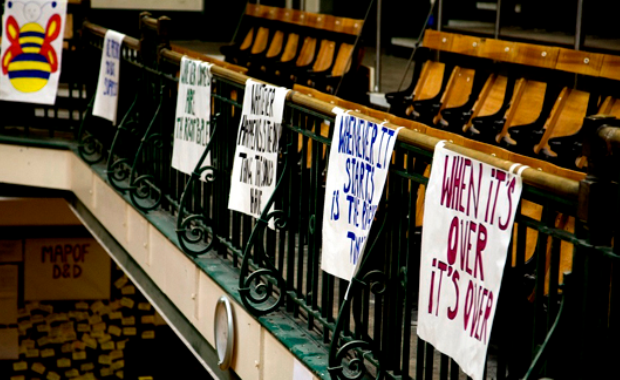
This is a column that almost didn’t happen. Stepping out of the pub far later than intended after my first experience of Devoted & Disgruntled, head full to the brim with provocations and projects, the weekend struck me as impossible to write about. The very set-up of the event, cultivating an atmosphere of gentle, creative anarchy, resists being wrestled into any kind of structure. But one suggestion, voiced in the dying moments of the second day as a microphone slowly passed around the wide circle of people gathered in York Hall, seems a fittingly optimistic place to start. Theatremaker Tom Spencer had the idea of a D&D playlist: a collectively assembled set of songs that inspire us, motivate us, make us want to make things. The spirit of D&D captured and set to a beat.

Thinking about it over the past week, the contribution I’ve finally found myself settling on is ‘This Is Radio Clash’. Partly because I nurture a fierce and long-held love for The Clash, partly because it’s the song that nudges me out of the house in the early morning, blaring through my earphones as I negotiate the commuter-clogged Overground. But also partly for the line that always shouts out loudest: “can we get that world to listen?” Because it feels as though that’s what D&D is about: listening. An exchange in which our opinions on theatre are not simply stated, but involved in a true dialogue, a back and forth that involves as much listening as speaking; more listening, sometimes, for those like me perched sponge-like at the edge of discussions, absorbing different perspectives and ideas.

Beginning with this playlist feels doubly apt, because music repeatedly and perhaps surprisingly interweaved with theatre across the two days that I attended. With dozens of sessions called (the event’s Open Space format allows for anyone to propose a subject for discussion) it’s somewhat futile to trace journeys through the event, as these will differ vastly from individual to individual, each beating their own track. Even to fully retread my own track would take much more than the space I have here. Yet music felt like a recurring comparison, making a refreshingly outward looking reference point against which we in theatre might measure what we’re doing. It’s sometimes vital to remember, equally in practice and in criticism, that theatre exists alongside and in a horizontal relation to other art forms, from which it might feed and learn.

From parallels with the heady joy of discovery on the music scene and how this might be reflected in the variety of the fringe, to touring models and performing at festivals, the comparison became a repeatedly fruitful one over the weekend. Witnessing the crossover with other live culture in this way, it strikes me that it’s worth giving greater thought to the space in which these live encounters take place. As Maddy Costa pointed out in one session, we’re good at shouting about why people should come to the theatre, but we rarely try taking it to them; perhaps we should look instead to the model of live music (and comedy) in pubs and bars, inhabiting a recognisable social space. There was also the appealing suggestion that, in the same way that bands have supporting acts, theatre shows might open with snippets or scratches from emerging companies – though the problematic label of “emerging” was itself a matter of debate elsewhere, as we collectively tussled with the definitions we deploy and the effects these have.

While mired in these and other knotty thoughts from the first day, I happened on Saturday night to read Andrew Haydon’s blog on Marxism and Theatre, in which he too points to a connection with music, specifically in terms of the classlessness implied by the gig. In doing so, he mentions Simon Stephens, whose writing is so often drenched in music, and who spoke in a recent interview about how his love for theatre was born from a realisation that it could incorporate the “edgy live-ness of a gig”. I have my reservations about this idea of “liveness” – it’s a word that we all throw around a lot without really interrogating what we mean by it and that has gained an extra fetishised appeal in a digital world that so often eschews the live, real life encounter – but I can’t help feeling there’s the grain of something truthful in it.

There is, after all, something undeniably appealing about the live, something thrilling enough to entice music fans to part with their money when they could just as easily listen to the same tracks at home for free. What we buy into when we go to a gig is the idea of the unpredictable and the unique, the idea that no other performance will ever be quite like this, that this exact group of people will never again be gathered in the same room together – that there’s something special about simply being there. The best gigs – those not in massive, soulless arenas – also have something of a levelling effect, an effect that I think can be exaggerated and romanticised, but that does go much further in eroding divisions than auditoriums where it’s clear who has paid the most to be there.

Which all sounds a lot like the most exciting and inspiring theatre I go to see. And which also, incidentally, sounds quite a bit like D&D itself; the lack of structure and hierarchy, the element of unpredictability, the mantra that whoever comes are the right people.

This is not to view the weekend from behind entirely rose-tinted glasses. In a world and an industry so often governed by structure and convention, I’ll admit that the free movement and intellectual curiosity fostered by the respectful chaos of D&D can be oddly bewildering. Despite the signs taped up around the room reminding us of the “law of two feet”, it took me most of the first day to acclimatise to the idea that moving on from a session is not a sign of rudeness, in much the same way as I doubt I’ll ever be able to walk out of a theatre show. The freedom to flit from group to group can also be torturously tantalising, offering too many fascinating discussions to settle on one and throwing up missed or half-heard sessions – like those on the notion of artist as parasiteand the desire for more European theatre – that immediately prompt the wish for a time-turner.

But while some sessions felt frustratingly formless – frustrating for me, that is, hence using my two feet to get more usefully involved elsewhere – the overwhelming atmosphere was one of motivation for change, dismissing criticisms that the event is all talk and no action. Perhaps that has something to do with the enforced urgency of the present moment; whatever the reason, session after session that I sat in on over the weekend resulted in solid commitments to begin driving towards the change that was so passionately discussed. And change is, again, tied up with that vital act of listening, of tuning in to another’s rhythm, pausing as we skip through the playlist. Can we get that world to listen? If theatre is to have any hope of getting others to pay attention, it seems essential that we first find a way of listening to one another.

Agency or Entrapment? Audience Interaction & Shunt’s The Architects

2_TheArchitects_SDietz_1-600x433

In Shunt’s labyrinthine new show, the visible maze is just a warm-up. After navigating our way through a bewildering mass of MDF corridors, all chillingly kitted out with surveillance cameras and television monitors, we emerge into what appears to be the monochrome belly of a luxury cruise liner, where we obediently sit at tables and chairs while our bumbling Danish (0r are they?) guides jolt us through a disorientating litany of escalating crises. The heating is broken, someone’s taken a shit by the barbecue and a beast appears to be on the loose, as all the while the band plays frantically on. This ship is going down and there’s nothing we can do about it. But despite this sense of immobile powerlessness, this feeling that we are at the mercy of our none too trustworthy hosts, there is an atmosphere of consent. As one character acknowledges, “we’re all adults here”.

Meatier than it appears at first glance, there’s plenty to dissect in The Architects: the mutation of the central Minotaur myth, the structures and exercising of power, the very nature of spectacle. But as a spectator of Shunt’s latest offering, it was this positioning of the audience that I found myself repeatedly returning to – no doubt coloured by the preoccupations that I brought into the space. When speaking to company member David Rosenberg for Exeunt a few weeks ago, one frank admission of his intrigued me: “the audience don’t actually have a lot of choice in our shows”. He went on to describe spectators as being “imprisoned” within the world of Shunt’s creation, be it a conference, a tennis pitch or, in the case of The Architects, the cruise of a lifetime. We have little to no real agency and the company are not shy of acknowledging that fact.

This way of speaking about the work startled me because it was so divorced from the rhetoric surrounding the majority of theatre that falls within the broad brackets of “immersive” and “interactive” (two slippery, problematic and not necessarily interchangeable terms). This kind of work usually invokes a discourse of action, empowerment and choice; audiences are granted freedom, the accompanying material typically states, given a space in which to play and explore. Though, as one of my fellow MA students pointed out in a recent seminar discussing spectatorship and audiences, having to be told that you are free is something of a paradox. Surely audiences already are active and empowered – a starting assumption much like that suggested by Jacques Rancière in The Emancipated Spectator – and do not need to be granted agency.

Far from the patronising provision of a freedom that should not need to be “allowed”, the knowingly problematic role in which Shunt casts its spectators, particularly in The Architects, presents a far more fascinating, knotty proposition. Within the scenario created by Shunt, there are three hierarchical levels of power: the leering, TOWIE-esque overlords at the top, appearing as a distant video-projected presence that conjures and collides the fickle gods of myth and the grotesquely guzzling modern day elite; our slyly manoeuvring but essentially powerless hosts, positioned as an opportunistic political go-between; and us, the audience, on the bottom rung. Not for the first time, a ship comes to represent a nation, and our role within that sinking nation is all too clear. Seen as part of this rigidly structured and depressingly resonant power dynamic, the imposed powerlessness of spectators is integral to the theatrical metaphor.

While Shunt can to an extent trade on the desirably experiential nature of their performance events, which now inevitably have a currency born from reputation, their very calculated and inherently problematised form of audience restriction seems to present a contrast with the kind of falsely empowering interaction discussed in a recent essay on Culturebot. Discussing the work of Punchdrunk, whose brand of immersive theatre has now become a lucratively sought-after commodity, Agnès Silvestre analyses the hypocritical illusion of agency that the work cultivates, painting its model of spectatorship as one designed to maximise profit rather than to test the boundaries between performance and audience.

It’s hard to argue with the fact that many people find Punchdrunk’s shows an exhilarating experience, and there is not necessarily anything wrong with that in itself. What grates is the promise of freedom in which it is framed, with marketing material that speaks of “roaming audiences” who are free to explore. Audience members might be encouraged to move around more than in “traditional” theatre settings, but as Silvestre points out, they are only “free” so long as they play within Punchdrunk’s set of rules. Those who transgress are silenced or removed.

The Architects also has unspoken rules of engagement, ones subtly laid out by the structure of the piece from the off and obediently adhered to by the spectators around me. But this restrictive framework is engaged in an implicit dialogue with the piece itself, a dialogue that asks us to look at these power relationships from a critical perspective. As already identified, there is inherent consent, making us complicit in our own inactivity. Just as the cruise promises us the opportunity, should we so wish, for a romantic encounter with a dolphin (or other beast of our choice) on the basis that we are consenting adults, we have chosen to be here and it is our choice to get meekly tugged along by this spiralling disaster. And not just to passively endure it, but to actively enjoy the hilarity of the destruction that steadily engulfs us.

After playing along with this power game, the final big reveal – that element of surprise or unveiling that all Shunt fans are eagerly waiting for – has a tinge of disappointment. The concluding image, framed within a raised box, is painful to watch yet loudly demanding of our attention, cultivating the same kind of morbid fascination that compels passersby to crane their necks to look at car crashes. It is repulsive yet disappointing because it simply shows to us what was there all along and what we as good theatrical citizens decided to happily accept. The big reveal is not really a big reveal at all, in that it turns the mirror on something we already half knew about our place within this constructed scenario and within the wider world to which it metaphorically refers.

It’s all there in the name: Shunt build the accepted architectures of power and sculpt our place within those. The realisation, and perhaps from that the resistance, are down to us.

The Coming Storm / Sight is the Sense that Dying People Tend to Lose First

Before I begin (and, incidentally, I hope you’re sitting comfortably) I feel compelled to admit that Friday evening wasn’t the first time I’d seen Forced Entertainment’s latest show The Coming Storm. I first experienced this clowning dissection of the art of narrative some months ago as part of LIFT, and have since read a number of other responses to the show and discussed it with a number of different people. In critical terms, if we’re going to play along with the fallacy of “pureness” and “objectivity”, my reception of this performance was tainted. Yet it feels oddly appropriate, for a piece that plays with the stories we project onto others as much as the ones we hear and tell, that I already brought my own narrative around the show into the room.

The observant among you will also notice that this piece of writing, according to its title, is not just responding to The Coming Storm. I saw it at Battersea Arts Centre alongside Tim Etchells’ new show Sight is the Sense that Dying People Tend to Lose First, a virtuosic symphony of free-association performed by Jim Fletcher. I could have written about these two pieces separately, which might in many ways have made sense, as they do not initially appear to have a great deal in common other than Etchells. But the way in which the pieces were placed in relation to one another, and my experience of them in quick succession, creates a certain response that it feels worth acknowledging. I am, to look at it one way, framing the story.

So, to the beginning. As Terry O’Connor tells us, deadpan into the microphone with the other performers assembled in a line alongside her, “a good story needs a good beginning”. Forced Entertainment’s point of departure is a list, continuing almost to oblivion, of all the elements that make up a successful story: narrative drive, cliffhangers, a love triangle, a death. Immediately, fragments of narrative begin to attach themselves to the performers, who through minuscule gestures take on the role of signifiers. Performers might be implicitly cast as lovers or as enemies. It’s calculated, but pointedly not pointed; the movements of the performers, though suggestive, place the act of projection firmly with the audience. We are the ones who ultimately make the connections.

And this is much how the show continues. Just as it seems Terry’s toneless litany of narrative building blocks might dry up, the microphone is snatched from her, initiating a chain of preposterous, failed or interrupted stories from the rest of the performers. Tales rarely finish – some barely begin. While attempted narratives are breathed into the microphone, the other performers concentrate their energies into chaotic distractions, donning dodgy wigs and masks and underscoring the stories with drumbeats and piano music. Dissonant elements clash and collide. But throughout the pandemonium, the same floating signifiers emerge and dissipate, inviting spectators to make connections that are not there.

Just as each of the individual narratives subverts or fails to fulfil Terry’s initial requirements for a good story, the overall structure of the piece breaks its own lengthily established rules. It meanders, stumbles, defies narrative logic. The cleverness lies in the fact that the show’s very failure (or staging of its own failure, though it doesn’t feel quite that neat) is an affirmation of the need it identifies. If our attention wanders or becomes frustrated, it’s because we’re seeking that narrative to latch onto, a narrative that Forced Entertainment smash apart at the same time as they erase their own creation. The repeated cycle of creation and destruction goes on until the whole collapses in on itself, dropping to its knees, wheezing and exhausted, with a closing note of “melancholy optimism”.

In the midst of this destructive anarchy, the stories themselves can seem irrelevant, random. Their substance is perhaps less important than their form and their (failed) techniques. They borrow from and break convention upon convention, from Hollywood movie (Cathy Naden periodically intervenes in stories to demand which actor would play a particular character) to cabaret confessional, each with an inherent criticism of the flawed ways in which we choose to communicate and share.

Yet their content is not entirely superfluous, at least not to my stubbornly association-drawing mind. There’s something that threads through – or does it? – about aging, about death, about grief and loss. There are also subtle hints at the company’s own history and at the ever-so-lightly hinted idea that (whisper it) they might be getting too old for this. At the evening’s wearied close, the performers seem fed up with what they have created and dissembled, deeply fatigued by their own frenzied effort.

This fatigue extends to the music, which interjects, builds, reaches a crescendo and finally collapses. Introduced as just another distraction, much like the wigs and masks and costumes that are lined up on rails in a nod to the childhood game of dressing up, the music eventually emerges as an integral element that both mirrors and resists the piece’s overall shape. Rhythms are repeated and frustrated; the steady mounting of sound is truncated by a crashing halt. Storms build with the beat of a snare drum and dissolve into monotonous lulls. Even as the chaotic performance limps to a close, Cathy and Claire stand with their backs to the audience tapping out a series of final notes on the piano, notes that are sad yet optimistic.

The “melancholy optimism” with which The Coming Storm concludes seems to bleed into Sight is the Sense – though of course, as already acknowledged, this connection is heavily influenced by seeing the two shows one after the other. Sight is the Sense also feels haunted by the ghost of Gatsby, with whom Jim Fletcher is inevitably associated after the eight-hour theatrical phenomenon of Gatz, and who carries a kind of melancholic weight into the room. The piece itself, however, initially appears to be oddly light and insubstantial. Fletcher stands, scruffy and unassuming, in the bare Council Chamber, reciting a list of statements about the world. And that, in essence, is it.

These statements range from the technical to the banal, the hackneyed to the strangely profound. We’re told that “space is dark emptiness”, “love is a kind of hypnosis”, “laughter is contagious”, “capitalism will probably not last forever”. The associations tumble one after the other, occasionally snagging on their way down. It is time capsule made into text, a collection of proverb, cliche and quotation that feels saturated with the accumulated stuff of modern culture. And just like a time capsule, into which carefully selected objects are dropped, it is necessarily limited. There’s only so much room.

This is deliberately, teasingly slippery theatre. The gathering statements, though simple, are also surprisingly elusive, while neither Fletcher’s oddly mesmerising performance nor the stripped down staging give an audience much to grasp onto. In a sly, knowing move, Fletcher proceeds to tell us that “theatre is mainly pretending” and that “the job of an actor is to simulate thoughts and feelings they do not really have”, remaining all the while blandly expressionless.

This very lack of expression allows Fletcher to become a blank canvas, a generator of words onto whom we project. Meaning is continually displaced, as the lightest wry, world-weary note in Fletcher’s voice is contradicted by the naivety or optimism of his words, which might the next moment become charged with implicit cynicism or sorrow. If this is to be read as a world view, it is a contradictory, undecided one. Which, it might be argued, is the only world view that one can reasonably have in the world as it is.

This confusion and complexity is heightened by the need throughout for objects and concepts to be measured against one another in the attempt to grasp definitions. “Wickedness is the name that people once gave to evil”, or “a mirror is a defective window”. Much like in the frenzied, competitive description of the board game Articulate, lines are hastily drawn between similar or differing ideas, reinforcing Saussure’s assertion that everything in language is based on relations. We are caught in a web of constant references.

But the real beauty of the free-association form that Etchells has appropriated – a sort of distilled stream of consciousness – is that it frees our minds to float between their own associations. My initial use of the word “light” is accurate in a sense, in that the piece brings a certain intoxicating weightlessness to the room. It is in this enabling and unveiling of our own connection-making tendencies that Sight is the Sense finds its affinity with The Coming Storm, freeing our minds to roam while at the same time activating our awareness of these mental processes.

Both pieces also produce a sort of breathlessness – the first weary, the second spellbound. As a pairing, they are unexpectedly complementary in their juxtaposed tone; the crazed energy of The Coming Storm assaults the senses, while Sight is the Sense offers a reviving, hypnotic air of calm. Picking up on my own imprecise, carelessly deployed critical vocabulary, for once the frequently used word “piece” seems entirely apt. Each is a fragment composed of many smaller fragments. Like a story, itself made up of narrative jigsaw pieces, that slots into a wider cultural frame.