Dialogue, Associations and Unfinished Thoughts

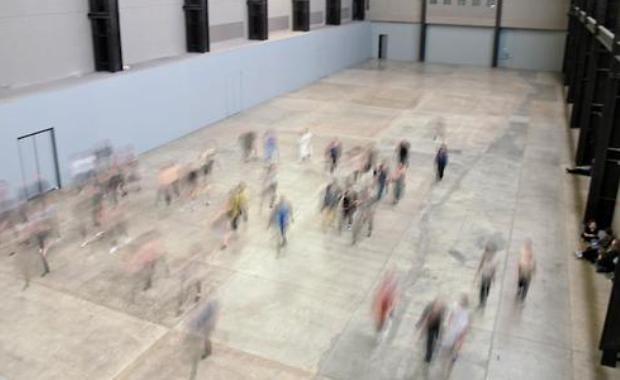
On Tuesday, after week upon week of mentally penciling it into my diary only for it to get scrubbed out by something else that seemed more pressing, I finally spent a bit of time with These Associations, Tino Sehgal’s current Turbine Hall piece at the Tate Modern. The associations that this performance-based artwork conjures, through playing and gentle encounters and the swarming and separating of human bodies, are many and varied. It hints at social associations, of our engagements with others, of their intimacy or conversely their lack of intimacy; it whispers of the parallels we feel compelled to draw between disparate objects or conversations, the chains we link together in our culture of constant game-playing.

The piece was, for me, a beautiful pause in a week that is threatening to swallow me whole. Starting my MA and reaching a startling recognition of the true extent of my ignorance, combined with keeping all my other various plates spinning, is beginning to overwhelm. As a departure from this jittery panic, These Associations offered a mode of contemplation that was somehow simultaneously active and passive, an invitation to play and to watch. Yet I was also intrigued by a thought that was voiced about the work in my seminar the next day: “the potential for engagement is more exciting than the engagement itself”.

I wonder if this uncomfortable observation, made by Hana Tait, might haunt much of the current work that hinges on interaction with its audience. The potential, tingling with possibilities and anticipation, always threatens to outdo the reality. This same observation might also be applied elsewhere; the not yet elucidated, slippery, anticipatory ghost of an idea, perhaps half-spoken or half-thought, is often more captivating than its concrete explication.

This is all a rather roundabout way, by route of a scenic tour around my current state of mind, of getting into some thoughts that I’ve been kicking around between brain, notebook and drafts folder ever since the recent Dialogue event at BAC. I’ve been holding onto those elusive half-thoughts in the belief of their potentiality, almost scared that, butterfly-like, their wings would tear as I attempted to pin them down. Which is a self-consciously poetic way of saying I was worried that the actual words I was managing to wrench out were a little bit shit. They weren’t in any way doing justice to the event, the discussions or the potentially exciting thoughts I’ve been prodding at concerning theatre criticism.

The event I’m talking about, chaired by Maddy Costa and Jake Orr, was an attempt to cultivate conversations around this topic. For a planned three hours that unravelled into four, a room full of people who make, write about or watch theatre – or any combination of the three – talked about theatre criticism, what it means and how it might be done better. Especially how it might be done better.

This session of conversations and provocations was a larger extension of the informal morning I spent discussing similar issues at St Stephen’s, a discussion that made me question the way I was reviewing theatre in Edinburgh at the time but that spat me out onto the cobbled streets buzzing with possibilities. This latest event, by contrast, was a lot more challenging for me. The conversations were no less interesting or urgent, but I walked down to the BAC bar feeling emptied out, exhausted.

Trying to write about it, I’ve also exhausted myself. I found myself attempting to cover too much ground and in summing up countless conversations I got lost in them. Instead I want to play and to watch, to flit between associations. To curate a highly subjective critical curation of discussions that are far too complex and knotty and far-reaching to crystallize here.

My way into this, like Maddy’s way into the afternoon’s discussions at BAC, is a one minute manifesto. Maddy’s manifesto spoke about love, something which she understood as involving respect, admiration and trust, ingredients that should arguably translate into how we write about theatre. My own manifesto, which first tapped me on the shoulder on a walk home from the station in the gathering, bonfire-scented dusk, says a lot about where I feel I am at the moment and goes some way towards explaining my reasons for being at BAC that afternoon.

~

The Power of “I Don’t Know”

I don’t know.

It’s not a phrase that often finds its way into public rhetoric. It is shunned by politicians and by all of those individuals in positions of any little authority. It says uncertainty, indecisiveness, perhaps even stupidity. The gormless refrain of the schoolboy staring listlessly out of the classroom window. An inadequate response.

But sometimes it’s the only reasonable response. Certainty, for all that it is prized, is a dangerous quality. Certainty makes blinkered decisions; certainty doesn’t dream of alternatives. Certainty can be entrenched.

It is uncertainty that often takes the biggest leaps, those bold steps into the unknown. It’s that unfashionable admission of “I don’t know” that prompts questions, that looks around at all the possibilities, that is open to discussion. “I don’t know” is the conversation starter; “I don’t know” is a beginning.

Granted, decisiveness has its place. Decisions do, after all, need to be made. But I’d also like to champion the power of “I don’t know”. I’d like people to look around, to challenge the way things are, to be able to answer the question of whether this is right with an expression of doubt. To examine the status quo with fresh, unblinking eyes and say, with crinkled brow, “I’m not sure about that”.

There are lots of things that I don’t know about. I don’t really know what I’m doing or what kind of person I want to be. I don’t entirely know where my life is going or where exactly I stand on lots of debates. While voices are shouting around me, I’m holding the arguments in either hand and shrugging my shoulders. It can be scary and intimidating and can make me feel small and stupid.

But it can also be exciting. It can hum with a thousand unuttered possibilities or present paths that I’d never have imagined treading. It can also be powerful.

The end. Question mark.

~

I frequently feel horrible about not knowing. It’s a position of ignorance that my age and the relatively brief amount of time I’ve actually spent interrogating theatre and performance make inevitable, but one that has been highlighted to me yet again in the last week or so. But I’d like to turn around that ignorance and uncertainty into a way of looking at criticism, as I pick out the splinters of discussion that had buried their way under my skin and start to think about ways of moving forwards.

I think that perhaps uncertainty and self-examination provide a useful starting point. At the very end of a largely optimistic piece written in response to these same discussions, Andrew Haydon raises the spectre that has recently been haunting me of the critic’s training. He puts forward the fascinating suggestion that the reimagined critic might have a role within the theatre landscape as an ecologist or curator, but questions what level of preparation that responsibility might entail. The problem is that there are no real qualifications as such for being a critic.

Which brings me onto the question of “professionalism”. To be a professional critic essentially involves being paid for criticism, in the sense that Michael Billington is a professional whereas I – at least most of the time – am not. As Andrew begins to go into, this professional status dictates the critic’s activities, as they become absorbed into the economic system under which theatre operates. They are required to pass judgment on productions that are considered “newsworthy”, either driving or dwindling ticket sales. Like it or not, they are a cog in the machine. This kind of criticism requires a certain kind of approach and experience which perhaps differs from the demands on the emergent “critic as curator” role, a role that seems to ask for the kind of knowledge that I’m rapidly trying to acquire at the moment.

For me, training and a different kind of professionalism, one that sits if not completely outside of then on the edge of economic relations, is all about context and connections. Fresh in my mind as I embark on a course that identifies itself as interdisciplinary is the arguably interdisciplinary nature of the way in which we study and understand theatre and performance. Theories borrow and feed from areas such as literature and visual art, as well as less obviously connected disciplines, in the same way that theatre is also flooded with outside influences. As Andrew suggests, there’s something to be said for breadth and for an appreciation of the fact that theatre exists within and is shaped by a wider cultural ecology. If the critic or curator is to undertake any kind of training, it should perhaps be in this. It’s a widening of scope that is also recognised by Daniel B. Yates in his call for theatre critics to engage with other forms of cultural criticism, itself the product of conversations had at Edinburgh and since.

Albeit in a very different way, I feel that the architecture of context could also house some of the “embedded” practices that are currently the subject of much discussion. While there is another function of this role from an artist’s perspective, which was discussed at BAC by Selma Dimitrijevic and which I’m personally very interested in exploring further (a more dramaturgical role is perhaps the best way to describe it), I think there is something to be said for simply gaining an understanding of process. This does not necessarily involve valuing process over end product, which can be dangerous and risks eliding an aesthetic judgment on the work, but rather informs a kind of criticism that is aware of and sensitive to process and which might as a result inspect the choices of a piece more deeply.

Alongside and in addition to this desire for context, in all its many forms, I want to reintroduce Maddy’s idea of love. Criticism is – or should be – an act of love, as Andy Horwitz defines it in his excellent essay on the 21st century critic (essential reading). Stewart Pringle said one of the most brilliant things of the whole afternoon at BAC right at the end when he explained that his relationship to theatre, be that making it or writing about it, is all about showing other people amazing things (I paraphrase, poorly). It was a pertinent link back to the title of the event: For the Love of Theatre. I’m interested in intricate analysis and interdisciplinary connections, but I’m also doing this because I love theatre and I feel compelled to communicate that love to others.

Which is what makes Megan Vaughan’s concept of bottling an aesthetic experience such an attractive idea to bring into this mix of what criticism could or should be. As she does, it’s helpful to bring in some Kant, and I think it’s worth quoting this element of his thinking on aesthetic judgment in full:

If we wish to decide whether something is beautiful or not, we do not use understanding to refer the presentation to the object so as to give rise to cognition; rather, we use imagination (perhaps in connection with understanding) to refer the presentation to the subject and his feeling of pleasure or displeasure. Hence a judgment of taste is not a cognitive judgment and so is not a logical judgment but an aesthetic one, by which we mean a judgement whose determining basis cannot be other than subjective
Critique of Judgment

As well as unveiling the fallacy of objectivity in a way that I find particularly appealing, there is a suggestion within this understanding of aesthetic judgment about how such aesthetic experiences might be communicated, as Megan goes on to explore. How do we share, nurture and sustain a passion for theatre as a whole and for particular pieces of work? A quality within criticism that captures the visceral thrill of seeing a truly stimulating piece (as Megan’s review of Three Kingdoms does better than any of the many, many words I wrote on that same production) is something valuable and vital. I also like Kant’s implication, inserted within parentheses, that this might be married with “understanding”, hinting at a kind of criticism that could conceivably combine the elements I have so far described.

Another way in which these different elements of criticism might be linked is through the idea of conversation that is at the heart of Dialogue’s project. Whether as a way of opening up a productive dialogue between critic and artist or as a starting point for post-show chats in the theatre bar, criticism should be able to get people talking, whatever form that conversation catalyst takes.

Mention of form finally transports me to the point that I made when my turn came at the end of the session at BAC. I didn’t put it particularly well at the time, but chewing over the myriad conversations that had made up the afternoon seemed to throw up a loose connecting thread of the form that criticism takes or could take. My feeling was that a lot of the discussions and indeed the disagreements revolved around different ideas of what criticism should do, who it’s for and what it should look like, three points that are all messily tangled up with one another.

If one thing is clear from the dialogues that have been opened up, it’s that it’s unlikely that we’re all going to agree on any of those three things in the foreseeable future. Which makes me think that the kind of criticism we’re attempting to reframe shouldn’t be a “model” at all (someone else, I can’t remember who, protested against the rigidity of this term) but something more flexible, more malleable, more open to the number of different purposes that criticism can serve. It needn’t even, as Andy Field suggested, take the form of writing at all. Why limit ourselves to just one form of critical expression? I’m not quite sure how, but it strikes me that we need to reconsider and open up our idea of what criticism entails and the many different guises that it might take, guises far more sophisticated and varied than the traditional designation of a “review”.

To attempt some kind of summing up, I suppose that there are four main strands to what I’m rather convolutedly saying: the requirement for the critic to question his/her position, the desire for a greater awareness of the context in which both theatre and theatre criticism sit, the need to express and share an inherent love for theatre in a way that starts conversations, and the suggestion of a more flexible and open idea of how that might be done.

My sketchy vision of the critic is of someone who collects beautiful and/or interesting things (note interesting – that could just as easily mean ugliness with a grain of curiosity), holds them up against other beautiful and interesting things by way of examination, and then communicates those things to others (be those others audiences or artists) in a way that is beautiful in its own right and that opens, channels and curates conversations, together with an awareness of the critic’s self-constructed identity within those conversations. (of course, this vision might just be down to the strange pleasure I take, both in theatre and in writing about theatre, in observing the creation of something beautiful that then turns itself inside out).

So what next? Moving forward involves asking questions, being able to accept the fact that there might not be ready answers and being willing, like Dan Hutton in his response, to set ourselves the task of trying out these new kinds of criticism and very possibly failing. So let’s say “I don’t know”. Let’s ask the questions, let’s look around, and let’s translate that electric current of potentiality into something actual. As Dan says, this could all go tits up, but I figure it’s worth a try.

 

Troilus and Cressida, RSC & The Wooster Group

Surfacing from the much-maligned RSC/Wooster Group Troilus and Cressida with a tingling sense of mild bemusement and dizzying disorientation, my initial and surprisingly strong instinct was “I don’t want to write about this”. Luckily for me, I was under no obligation to wrench out any words; for once I was a plus one, not a reviewer, and my notebook had remained firmly tucked away in my bag throughout the performance. Freshly singed from Edinburgh’s baptism of fire, I was determined that for this theatre trip I would be a spectator and nothing more. And my immediate thought on stepping out of the auditorium was that this determination was a wise one.

Not because I hated the show, which I didn’t. While I had avoided reading reviews, I entered Riverside Studios with an unavoidable awareness of the mass walkouts and the cool critical reception that the production had received in Stratford, prompting curious anticipation as much as trepidation. But when I found myself disagreeing with this general tide of opinion, I was as troubled as I was pleased. I don’t have a problem with veering away from the consensus; instead what disturbed me was a perplexing inability to articulate what it was about the piece that I found so engaging. I felt as though, with my complete lack of reasonable justification or developed critical analysis, I had no real right to state my enjoyment of the production.

I also worry (and some fervent supporters of the production have faced similar accusations) that I am becoming subconsciously entrenched in my tastes. I’m concerned that I have reached a state of mind where experimentation or anything diverging from the “norm” as we conceive of it in British theatre has become synonymous with “good theatre” in my critical vocabulary. I worry that by liking Troilus and Cressida – and particularly by being so evasive about why I liked it – I’m simply fulfilling expectations without really thinking. For all of these reasons, I was glad to be exempt from having to marshal my floating impressions into fixed-down words.

So why am I writing this, you ask? Good question. Well, partly because it’s a challenge, and for that reason alone it’s difficult to resist. To leave this particular challenge untouched would feel like an act of critical cowardice, a weak refusal to stand behind my opinions. And partly because there has so far been a relative dearth of positive critical responses, prompting me to feel that I should at least make an attempt, as feeble as it may be, to pick apart what it was about the production that held me rapt for over three hours (no small feat after being conditioned to accept the Edinburgh norm of one hour shows). While debating with myself about whether or not to write anything, I was also reminded by Andrew Haydon that the process of writing about a piece of theatre doesn’t have to be as complicated as I often make it – in his words: “if in doubt, just describe what you think you saw”.

What I saw was, to employ classic British understatement, a lot. It is easy, from this perspective, to see why it has been dismissed by many as busy and confused. To be completely honest, it kind of is both of those things. Yet this messiness has a logical foundation. I believe co-director Mark Ravenhill has said something along the lines of not wanting to impose any unified meaning on a play that is by its very nature problematic, which seems to make a lot of sense. My memories of briefly studying the text in my first year at university are of a troubling, fragmented play; at the time I far preferred Chaucer’s characteristically humorous telling of the same tale. For a slippery play, it seems apt to employ an equally slippery interpretation.

Also apt is the way in which this collaboration between the RSC and experimental New York-based company The Wooster Group has been carved up. Not really a collaboration at all in the usual sense, the piece has been divided into its Greek and Trojan segments and rehearsed separately on opposite sides of the Atlantic, with The Wooster Group taking on the Trojans under the direction of Elizabeth LeCompte, while the RSC and Ravenhill (replacing Rupert Goold, who engineered the collaboration) have accepted responsibility for the attacking Greek contingent. There is as a consequence a deep chasm between the two halves, a divide of cultures – or perhaps a head-on crash – in multiple senses.

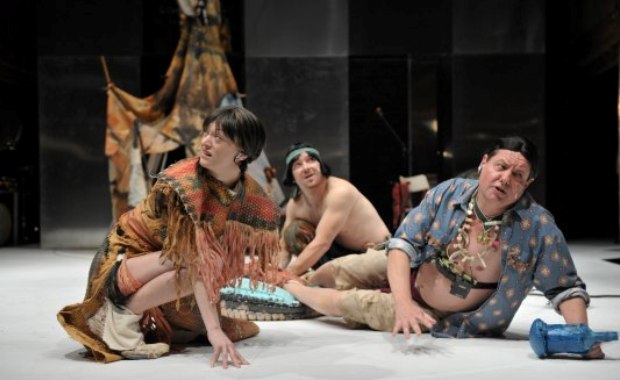
Reflecting this process, it seems fitting to speak separately about each of the competing aesthetics. The first observation that begs to be made about The Wooster Group’s Trojans is that they are fashioned as Native Americans played by a cast of white New Yorkers. This, as a concept, potentially leans on the offensive side of crass (though this isn’t ultimately how I read it) and is as such inherently problematic. The most obvious way of reading this creative choice is as a comment on the besieged nature of Trojan culture, a culture that – as our knowledge of the narrative and that infamous wooden horse tells us – will soon be all but extinct.

Yet there seem to be more layers than this, not least because the playing of these Native Americans has a distinct gloss of the artificial. The actors’ deliberately messy costumes, while demonstrably marking them as Native Americans, also have modern tweaks and are flecked with odd bits of neon. Most bizarrely, the warriors wear on their backs an armour composed of what look like brightly coloured latex variations on classical statues and fight with weapons including – to collective amusement – a lacrosse stick. I’m tempted from these elements to infer something vague and tentative about time and history. Certainly the striking statue-armour (for want of a better description) creates the impression of the performers clawing their way out of the mythical/historical baggage that inevitably comes with tales of Troy. Laden with baggage too is any representation of Native American culture, a difficulty acknowledged by the production.

That bemusing lacrosse stick, meanwhile, immediately makes me think of school – or at least of the kind of school where people play lacrosse, which seems to exist exclusively in Enid Blyton books. There is an inherent childishness to it, which seemed to me to be linked to a wider feeling of childlike play and imitation that infects the Trojan side of the piece; it as though war is a game or a movie, with no real meaning. Talk of movies brings me onto the other startling aspect of The Wooster Group’s staging, which is the use of four screens mounted at the corners of the stage showing various clips of film. It soon becomes evident that the performers are impersonating the actions in these films, often more focused on the screens than on what is happening in the performance space.

This, as a performance technique, is immediately alienating. It is inevitably distracting, rendering the underlying narrative almost secondary, which is possibly one of The Wooster Group’s biggest problems. Having at least a sketchy, half-remembered knowledge of the source narrative and Shakespeare’s text, I was arguably in a better position to enjoy what has been done with these elements than someone approaching this little performed play for the first time. While these acts of mimicry may partially obscure the text, however, they feel simultaneously born from Shakespeare’s play. Troilus and Cressida is in many ways a bitter satire, and in this context the aping of Hollywood romance by the two title characters during the central wooing scene emerges as a biting comment on the nature of their ill-fated love. Romeo and Juliet this ain’t.

The otherness cultivated by all of the above elements is further cemented by the use of mics, into which The Wooster Group’s performers speak in oddly clinical, flattened tones. Their dislocating inflections suggest both an overt element of the performative – again that emphasis on the artificial which I understand is something of a Wooster Group trademark – and a certain blank absence of emotion which, although the opposite of what actors usually hope to convey, seems appropriate to the lack of meaning that pervades the whole. Everything here is about calculated fakery, from the costumes and accents to the absurdly gorgeous downward projections [at least this is what I think they are – happy to be corrected on any technical elements that I may have misremembered] that outline the placement of props on the stage.

For all the strangeness and lack of narrative clarity, I simply couldn’t help being hypnotised by these uniquely odd Trojans. I like that The Wooster Group kept me guessing and refused to offer anything close to thematic resolution, which was perhaps what kept me so hooked. To watch their half of the show with enjoyment demands an oddly paradoxical combination of distinct concentration and a certain detachment from imposing meaning. I was searching for individual readings, but soon understood that any overarching meaning (at least in the way we usually understand meaning) would elude me, and felt surprisingly fine about that.

I feel that I have less to say about the RSC/Greek side, not because I thought the Trojans were necessarily any better, but because they were just so captivatingly strange that it’s difficult not to be more preoccupied with their half of the production, whatever you make of it. But like The Wooster Group, it is the overall look of the RSC’s Greeks that initially makes an impact. They are, with a couple of exceptions, dressed in military uniforms, immediately emphasising that these are the attackers. This aggressive emblem of masculinity, however, is rapidly contrasted with the wounded ineffectuality and/or effeminacy of many of the soldiers.

It struck me that a conventional concept of masculinity and a subsequent stripping away of this masculinity seemed to be one of the main strands of the RSC side of the production. The set, which is built partly on a revolve which spins from Greek to Trojan side, has a dividing wall clad with mirrors on both sides, but it is on the Greek side that these are most apparent, not being hidden as they are on the Trojan side by a teepee. As well as suggesting something interesting about similarities and otherness, this allows for an element of posing on the part of the Greeks, who include a transvestite, wheelchair-bound Thersities and a WWF-style Ajax.

However – and this feels like a strange observation to make given the bizarreness of The Wooster Group’s staging – there is less cogency to the RSC’s vision. Strange as everything on the Trojan side may be, it all feels woven into one aesthetic; an alien aesthetic, perhaps, but one that sort of makes sense in its own weird way. The clashing elements of the half that the RSC and Ravenhill have crafted, however, feel as though they are trying to do too much at once – perhaps trying to compete with their American counterparts, proving that the British can do this experimental lark too. To an extent it succeeds, but when married with The Wooster Group’s creation it is less two competing styles than a messy collision of many.

There was one line, spoken by Zubin Varla’s fantastic Thersities, which seemed to me to function as a banner under which the whole production might sit: “Lechery, lechery, still wars and lechery: nothing else holds fashion”. There is a feeling of futility that infects Shakespeare’s play, a debunking of both romance and heroism that leaves all of the storyline’s driving elements without any real point. It is this feeling that I would argue is compounded by the RSC/Wooster Group’s messy, contradictory treatment of the text, which draws out the perpetual hold of both “lechery” and “war” and their essential meaninglessness.

Reading this back, I realise that despite initially stating my enjoyment of this production, many of my observations could equally be taken as criticisms. The swallowing of narrative by The Wooster Group’s consciously odd aesthetic might easily be considered a crime against Shakespeare; admitting that the performance is messy, eschews meaning and requires a very particular kind of concentration in order to watch it with enjoyment hardly sounds like a resounding endorsement. The more I think about the production, the more potential criticisms arise, yet somehow I can’t shake my enchantment with this parade of strangeness.

So really, apart from making a rather long list of observations and trying, as Andrew suggested, to describe what I think I saw, I’m really just saying “I don’t know”. I’m willing to accept that my intense engagement with this piece of theatre is merely a quirk of my character, and I’m not going to suggest that anyone who walked out at the interval (or wished they had) lacks any vital insight or understanding that I purport to possess. As a critic it is clearly not enough to simply shrug and say, unapologetically, “I just liked it”. But in my self-prescribed role as a spectator, perhaps for once that’s OK.

Monkey Bars, a Not Quite Review

“That is my world,” one of the performers in Chris Goode and Company’s new show gently tells us, candid but shy. She is talking about singing, her favourite hobby. One day, she continues, she just opened her mouth and discovered that this was something she was good at; “I had a voice”.

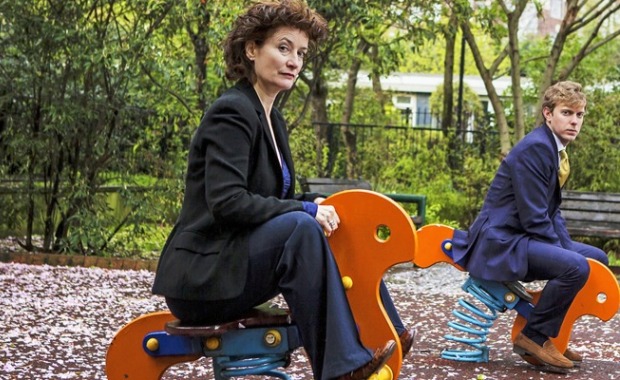
It is a poignant and strangely loaded moment in this gorgeously thoughtful slice of theatre, a gentle hour and fifteen minutes that begs us to look again at children and their view of the world. The performer in question is a middle-aged woman, dressed professionally in a crisp black suit, but her words are those of one of the 72 eight to ten year olds interviewed by Goode’s collaborator Karl James to create this delicate verbatim performance. Her one tentative admission is a reminder, like the show as a whole, that children are too often robbed of a voice, denied the opportunity to speak up.

The playing of child characters by adults is, of course, nothing new. Perhaps taking very seriously the warning never to work with children or animals, many productions feature adults who double up as kids, all too often indulging in snotty caricatures. The adults in Monkey Bars, however, are not playing children. They may be speaking the words of primary school kids, but they are demonstrably, emphatically adults. They dress as adults, they speak as adults and Goode’s production places them in conspicuously adult situations, sipping wine or getting ready for work.

Yet, for all this emphasis on adult activity, there are distinct traces of childhood about Naomi Dawson’s design. The set, with its grass-like floor, is mainly composed of large white plastic blocks that are illuminated from within, a cross between building blocks and night lights. While we usually see the performers in deliberately adult set-ups, they also occasionally sit protectively round-shouldered as they eat from lunch boxes, suddenly collapsing back into kids in the playground. The onstage props include, contrastingly, wine glasses and a bubble machine.

This mingling of the mature and the childish hints at the dizzying cocktail of these qualities in all of us, no matter how “grown-up” we may appear. It often seems as though growing up is really a process of gradually realising that we are all making it up as we go along, perpetually waiting for the moment when it all slots into place. Figured in this way, James’ young interviewees are not all that different to their adult performers or audiences.

But one significant point of difference is their lack of power to make themselves heard. As in the scenario I opened with, the frustration of not being listened to is a recurring theme and a major concern of the piece. One of the most heart-tugging monologues comes courtesy of a girl who feels “all alone in the world” when others don’t listen to her, while another child’s broken arm goes unnoticed by adults who ignore his insistence that he is in pain. The desire for superpowers becomes a motif that intermittently resurfaces, implying a fierce longing to change things without knowing how to make an impact.

Forced to listen as we are by the show that Goode has pieced together from these interviews, it is startling just how much these children have to say. While there are, unsurprisingly, some hilarious moments which verge on Children Say the Funniest Things territory, on the whole the piece reveals just how perceptive these young individuals are. Asked about their ambitions, one child wonders whether he will be a tramp or a banker, satirically remarking that they are essentially the same thing. Another two boys berate their generation in the manner of grumpy old men, tutting at girls who try to grow up too fast. Perhaps most affecting are the repeated protestations against war: “I think people should stop now – game over, you know?”

But this is more than just a vehicle for the opinions of children. As a piece of theatre, Monkey Bars is appealingly self-aware. Neatly side-stepping the issues faced by much verbatim theatre and avoiding the need for lengthy programme notes, Chris Goode and Company simply confront their process head-on. One of the first recordings we hear is that of James explaining the concept of the show to the children he is interviewing, an explanation that also conveniently clarifies the process for the audience. The actor representing James at this point adds, with a playful grin, “we’ll see if the audience finds that interesting”.

There is no doubt about whether the end result is interesting – it’s nothing short of fascinating – but as to the purposes of this piece of theatre and its success on those terms, I’m a little more tentative with my praise. Had the show zeroed in on one aspect of childhood and interrogated that individual angle using this intriguing process, it might come across as more of a complete piece, if not perhaps as meaty. Instead, by speaking to these children about such a wide range of subjects, from families to politics, Chris Goode and Company have created a view of the world that is potentially infinite and open-ended. Not that this is necessarily a bad thing – I like theatre with question marks – but it makes the piece’s process of selection and editing somewhat problematic.

This touches upon one of my issues with verbatim theatre as a form, which is something I’ve been mulling over for a while and assessing more thoroughly since seeing London Road earlier this month. It is, as a method of theatremaking, overtly “truthful”. By which I mean, because the words are purely those of the subjects, it is their truth – verbal stumbles and all – as unmediated as possible without placing them on the stage before us. It might not be a profound, universal truth, but it is truthful to the experience of those interviewees.

At the same time, however, it screams its artificiality. By being so conspicuously “real”, so hammered home with “erm”s and stammers, it simultaneously advertises the fact that these genuine, un-airbrushed words have been uprooted from their source and dumped on a stage, a transplant which implicates its process. In Monkey Bars, this process attracts even more attention to itself through the additional layer of meaning and representation created by the use of adults to speak the words of children.

So, as a result of this odd, dislocating blend of truth and artificiality, I always feel very aware of the hand of the editor. (That might also be something to do with being a writer) In this particular case, therefore, the tiny part of my brain not enraptured by the show was nagging away at me, asking what the guiding intention was behind these particular choices.

Has the material been selected in such a way as to expose how children swallow and regurgitate the opinions and values of their adult counterparts? Has the guttingly profound been favoured over the silly or mundane? Of course, this is a conversation I would need to have with Chris Goode (and one that I’d be more than happy to engage in if broached), but I couldn’t help wondering: why these stories?

Not that such doubts and questions are substantially damaging to the experience of watching the beautiful, surprisingly urgent piece of theatre that Chris Goode and Company have created. Where Monkey Bars functions perhaps most effectively is as a warning, a reminder and a bleak unveiling of the lies we have come to blindly accept with age. We can smile at childish fears and anxieties, but essentially these are smiles of complacent denial. The world is a scary place; we have simply taught ourselves not to notice.

The (not quite) End

– this is where the review proper (if it can even be considered “proper”) concludes, but there are also a few other, messier, more experimental thoughts that I felt compelled to put into words …

One of the moments in the show that most tickled me was the recording in which a girl who writes stories is asked about her writing, rendered in a scene arranged much like a television interview. It made me quietly giggle because it reminded me so much of myself as a child, always dreaming up other worlds and fiercely scribbling away, deadly serious about whatever tale I was currently spinning. Inspired by this, I found myself thinking about the child I once was, with the below result.

A letter to my younger self:

Hi there. Just me. So … this feels a bit weird. Why am I writing to you? Well, it’s a critical experiment. That probably doesn’t make much sense to you now, but it will one day. Which, I know, is one of the annoying things that adults say when they don’t feel like explaining something, but this time it’s true. Maybe I’ll explain it some time, but right now I have a couple of other things that I want to say.

I want to say that I remember that it’s hard, even though sometimes I forget and think that it used to be easy. People will tell you that it only gets harder, and that might be true, but it’s also pretty hard right now. It’s especially hard right now because people don’t always listen, but that will get better, if only by a little bit.

I also want to say that it’s good that you’ve learnt to pretend. Pretending is important. Not just because watching people pretending will one day be among your favourite things to do, but because the pretending never ends, not really. That’s the big secret. We all still feel like kids playing at being grown-up, hoping that no one will catch us out in the act of make believe.

And one day a man called Chris Goode and some of his friends will, through some pretending that isn’t quite pretending, make you realise that it’s not just you who feels that way. And it will be comforting but also a little bit heartbreaking, though you won’t be quite sure why. You’ll try writing about it anyway though, because that’s what you do.

Well … that’s all I wanted to say, really. I know that writing letters is boring and not as much fun as writing stories, but perhaps occasionally you can write back to me and remind me what it’s like to be a kid? I’d like to be reminded of that. Now you probably want to ask me what it feels like to be an adult, which seems like a fair exchange. But the answer is, I just don’t know.

Oddly, to depart on a complete tangent, writing the above reminded me vividly of Gob Squad’s Before Your Very Eyes, a piece of theatre that I think I short-changed slightly on first assessment and that has insistently stayed with me over the intervening weeks. In that show, the child performers address recordings of their younger selves, sadly, ashamedly and sometimes wistfully regarding the people that they used to be.

One of the most heartbreaking moments is one boy’s protestation that “this is not me”. In thinking back to the person I used to be, prompted by Monkey Bars to remember what it was to be a child, I was struck by how I both am and am not that wildly imaginative young person, so much like the little girl in the show who speaks earnestly about her stories. This is not a particularly original thought, but perhaps we are all a long series of different people, simultaneously embodying a number of past versions of ourselves and the person we are in the present moment. The child in us never quite goes away; it just takes an experience like Monkey Bars to be reminded of that.

The reviewed performance was at the Traverse Theatre in Edinburgh. Monkey Bars will continue to tour around the country throughout the autumn – full tour dates here.

New Voices in Edinburgh

As part of the giddy, hectic and slightly insane experience that was my first fringe, I was lucky enough (thanks to IdeasTap) to catch all five plays that made up the Old Vic New Voices Edinburgh season at Underbelly. This is just one example of what seems to be a growing trend towards curation within the uncurated, amorphous bubble of the festival; other models along these lines include those adopted by Escalator East to Edinburgh and Northern Stage at St Stephen’s. While the hit and miss nature of the fringe is part of its quirky charm, there is something quite comforting about having these reliable miniature programmes to retreat to through the haze of clumsy adaptations and misplaced whimsy.

The emphasis of the Old Vic New Voices programme is, unsurprisingly, very much on “new writing”. The pieces are small, with a bias towards monologues and two-handers, but the writing and productions all proved themselves to be solid and often exciting. The whole season was, as Edinburgh goes, a pretty safe bet, though without the safeness of subject matter that implies. The advantage of a curated programme was also in seeing how these different pieces refracted through one another, experiencing them both as standalone plays and as part of a wider context.

If they have a future life, which I suspect they will, it would be fascinating to see these plays reformulated into double bills. Chapel Street and One Hour Only would be my top pick for a pairing, but Bitch Boxer and Strong Arm could also make a fascinating juxtaposition. While Edinburgh can easily become a distorted blur of production after production, seeing pieces whose placement alongside one another actively informs their reception is a refreshing and intriguing exercise. Here are a few more of my thoughts on the programme …

Glory Dazed

While his friends come home in coffins and wheelchairs, Ray knows that war can make you lose something other than life or limb. Returning to Doncaster with frustrated aggression and tortured memories, the only thing that Ray is any good at these days is fighting. But there’s no memorial service or prosthetic aid for being messed up in the head. Read more …

Bitch Boxer

Every fighter has a reason.

That’s the thinking behind this new show written and performed by Charlotte Josephine, taking a particularly timely dive into the world of female boxing. Read more …

One Hour Only

AJ’s mates have bought him a banging present for his 21st birthday – quite literally.

Out of place in a classy London brothel, the gift he ends up with is Marly, a cash-strapped student in her first night on the job, with whom he has more in common than he expected. Read more …

Strong Arm

Sporting ambition and athletic excellence are high on the national consciousness as the country continues to ride the wave of Olympic success. When competitiveness goes up a weight class into pure obsession, however, that same determination to succeed becomes altogether more disturbing. Read more …

Chapel Street

On Chapel Street, “every week it’s shit”.

Same people, same bars, same drinks. Or so we’re told by Joe and Kirsty, both out on a Friday night and each with their own reasons to seek oblivion. Through these two characters, Luke Barnes’ viciously funny and quietly devastating two-hander sketches out a searing, booze-stained portrait of the Pro-Plus generation, grabbing at their next energy kick while putting off tomorrow. Read more …


A Tissue of Quotations: Theatre & Authorship

To state that theatre is an essentially ephemeral art form would seem to be a reiteration of the obvious. The distinct nature of performance lies in its liveness, its specific relationship with a specific set of audience members at a specific moment in time, none of which can ever quite be replicated. At a less specific level, each production is a crystallized present moment, an entity that exists only for the length of its run and is determined by a very particular set of choices and aesthetics. Theatre is, at its heart, a fleeting phenomenon.

Yet we remain, at least in British theatre culture, obsessed with preservation, with legacy, and with the rigidly hierarchical process of pinning a production down to a single authoritative source for the purposes of that preservation. Hence the primacy of the “author”. And I was, initially, as unquestioningly compliant with this notion of authorship as anyone else; it is, after all, easier for the purposes of a review to assume that the content of the piece has been born from the mind of the writer and to conflate all connecting themes, threads and resonances with the intention of the playwright. But such assumptions have been bracingly unsettled by the recent focus on British theatre’s false dichotomy between “new writing” and “new work”, a dichotomy which I would argue has deeply ingrained notions of authorship at its core.

There are many perceived differences underlying this opposition between what has been loosely referred to as text-based and non-text-based theatre, differences connected with narrative, character, aesthetic etc., but it seems to me that the unifying aspect at their centre is the presence or absence of a single author. Text-based work is typically associated with naturalism, linear narrative and a coherent driving “message” because it is supposed to be the creation of one dominant creator, one authorial “voice”, with all other elements of the production harnessed to serve the vision outlined in the text. Non-text-based work, by contrast, is seen as eschewing all of these notions of linearity and coherence because it has been conceived by a devising ensemble and consists of a multiplicity of voices.

Of course, such assumptions are often not the case in practice, but while the moment of performative realisation may be more democratic, it is the author whose name will remain attached to the work long after its production. For this reason, as Kat Joyce eloquently argues in her guest column over at Exeunt, work that does not have a clear hierarchy of authorship and that explicitly depends upon the nature of its liveness risks being obliterated by the very text-based process of historicising, thus perpetuating the supremacy of scripted work. In Joyce’s words:

“At its deepest level, does a system which fixates on individuals and playtexts also radically undervalue the potentials and possibilities of live performance in all its unfixed, unstable, temporary glory?”

It is clear – at least to me – that we need to rethink our rigid definition of authorship if we are not to devalue the moment of performance and neglect a huge swathe of this country’s theatrical output. But this isn’t just about recognising the work of devising companies, because recognition alone does not necessarily smash down the persistent divide between text-based and non-text-based work (undeniably reductive and misleading labels, but ones which are handy for the purposes of this piece). Negotiating that divide and the reasons behind it is much trickier.

It boils down, I think, to an idea of authorship that extends beyond the realm of theatre and performance. We are part of a literary culture which is, as Roland Barthes put it in his seminal essay “The Death of the Author”, “tyrannically centred on the author”. Throughout secondary school, students are encouraged to interrogate texts in order to unveil their “meaning”, as if reading was one long act of detective work, with the author’s intention enshrined at its centre. While university courses in literature explore a much more nuanced approach to textual analysis, there is a general subscription to the prominence of the author in all text-based art forms, an approach that has insidiously crept into understandings of theatre.

Because such an author-centred approach is key to our culture, much talk in theatre has been given over to “serving the text”, “serving the writer”, “staying true to the writer’s intention” etc. Within such a model, all other elements of a production become tools to illuminate the writer’s purpose and the other creatives involved are viewed as little more than vehicles to convey an overarching authorial “message”.

The problems and contradictions inherent in this model can be illustrated by a couple of examples drawn from conversations I’ve had with theatremakers, examples which I’m sure are not unique. Discussing feedback that she’d received about her interpretation of Gods Are Fallen and All Safety Gone, Greyscale’s Selma Dimitrijevic told me that audiences seemed outraged about certain directorial choices that she had made (the most discussed of these being her decision to cast male actors as women) until they became aware that she had also written the play. Apparently directorial interpretation is only acceptable when it originates from the writer. On a slightly different note, Thomas Eccleshare expressed his frustration with the fact that, despite creating work for two years with his company Dancing Brick, it was only when he won the Verity Bargate Award that he earned the label of “writer”, with devised work remaining stubbornly excluded from the narrow category of new writing.

Joyce’s column, which draws partly from her own experiences as the co-artistic director of physical theatre ensemble tangled feet, again expands on the difficulties posed by a culture which places a disproportionate value on the written text, while Hannah Silva has blogged on numerous occasions about the restrictive definition of new writing that prevails in this country and the difficulties of negotiating that definition (I can’t track down the exact piece that I have filed away at the back of my mind, but read her blog for some fantastic reflections and provocations about writing for theatre).

There’s much more to say about how the divide between text-based and non-text-based theatre has been reinforced, particularly through the Arts Council funded new writing drives referred to in Alex Chisholm’s essay for Exeunt, but I’d like to remain focused on this central notion of authorship, its complexities and how it might be reconfigured. Barthes, who I have already quoted, provides one answer to how the false idol of the author might be displaced. He describes the text as “a multi-dimensional space in which a variety of writings, none of them original, blend and clash. The text is a tissue of quotations drawn from the innumerable centres of culture.” In other words, no piece of writing is truly original and all writers are continually quoting their antecedents.

If we accept Barthes’ definition of the text, authorship is at best an act of curation and interpretation – not, really, all that different from directing. In a staunch defence of the writer’s intention in his essay “Interpretation – To Impose or Explain”, playwright Arnold Wesker posited this argument in order to deride it, laughing at the possibility of “interpreting an interpretation”. I would contest, however, that this is not such a ridiculous idea. Not only might a writer produce an interpretation rather than an utterly original source text, but that interpretation might be jointly (re)interpreted by director, performers and entire creative team in collaboration with the writer (or writers), acknowledging that theatre is an emphatically collaborative art form.

It is also worth briefly interrogating the term “text”, which I’ve been carelessly throwing around as if it had one single, fixed meaning. This term is generally interpreted to mean the written text in the form of a conventional script, but it can – and perhaps should – be expanded to include the entire dramatic text, encompassing all elements of a production and its reception, acknowledging a circuit that is completed by the audience. I’m reminded of another discussion with Selma Dimitrijevic, in which there was some consideration of the similarly unstable word “play”; Selma said that she typically interprets this to refer exclusively to the written script, but it is used interchangeably by critics, at some times indicating the script and at other times the whole production.

Bringing critics into the mix flags up their (our?) role in this binary. There is a tendency, conscious or not, to write separately about all the individual elements of a production, isolating writing, direction, design and performance in a sort of criticism by numbers that I know I’ve been guilty of employing. This is often a case of convenience and is to an extent inevitable; without having observed the process, which is another debate entirely, it’s impossible to know who was responsible for each and every creative choice. Yet there is a danger, because criticism again holds a certain lasting currency by virtue of its written format, that a failure by critics to acknowledge the collaborative nature of work will perpetuate the schism. I’m not yet entirely sure how this danger can be overcome, but it’s worth considering.

Having scratched away a little, if only fairly superficially, at the notion of authorship, how might it be possible to rethink the format of the legacising theatrical (written) text? To answer this question, it’s also necessary to answer the question of what a playtext is for. Physical theatre company Square Peg summed it up nicely in a response on Twitter: “Is the script the beginning or the end of a process? A document or an instruction? Can it not be both?” I’d agree that the written element of theatre has a dual role, acting as a (non-fixed) jumping off point and as a form of preservation, though both of these twin roles are slippery.

Some intriguing questions were asked via a recent conversation on Twitter between Bryony Kimmings and Oberon Books, with contributions from others, which was one of the catalysts for nailing down these thoughts. As later blogged by Kimmings, she wanted to explore whether the kind of art she creates could be published as a script, and if so what form that might take. She asked: “How does a live artist that plays in the Cabaret space at Soho Theatre and just did her first stand up gig get her work published … does she need to?”

The need could be quite persuasively argued as a form of documentation and legacy, a way of recording live art in the same way as text-based theatre. The question of format, however, is less easily answered. Would it be a script detailing the original performance, or a DIY kit allowing space for interpretation? It all depends, of course, on whether a work is intended to be produced again. At the risk of banging on about it yet again, here I think it’s interesting to bring in the example of Three Kingdoms (which also, though I won’t discuss it here, provides an interesting challenge to British theatre’s text bias, possibly offering a way to bridge the gap). Here is a playscript that differs so dramatically from Sebastian Nübling’s production that they are really two different texts. Were anyone brave enough to attempt another production, would they start from Simon Stephens’ script or from its collective realisation on stage?

Much more could be written on this thorny issue, but for now I’d just like to bring in one final example that complicates matters even further. In the absence of a space at Edinburgh this year, Forest Fringe have made the fascinating decision to “create a performance space built not of bricks and mortar but paper and ink”. Paper Stages is a book co-authored (again destabilising the concept of a single voice of authority) by a wide range of Forest Fringe artists and made available for festival-goers to perform themselves. There will as a result be multiple dramatic texts, many performed in the absence of audiences and without documentation, giving fluid meaning to ideas of authorship, performance, reception and collaboration.

A script is not fixed or indeed finished until the moment of performance and reception, but perhaps a performance’s documentation is equally unfixed. To come full circle, theatre is ephemeral. While preservation remains an important concern for artists attempting to secure their place within a text-biased culture, there is an argument that to resist the uniqueness of live performance is essentially futile. We should be celebrating liveness, not attempting to solidify it.