Translunar Paradise & Critical Distance

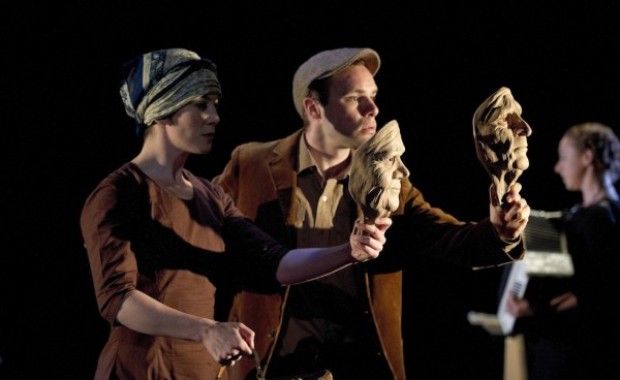
If you’ll forgive the cliché, sometimes less really can be more, as Theatre ad Infinitum prove with their delicate essay on love and loss. The plot is simple, the production accomplished through a blend of simplicity and ingenuity. The elderly male protagonist is coming to terms with the loss of his wife, still taking down two cups from the cupboard instead of one, rifling through suitcases brimming with memories; his wife’s ghost looks on, gently but firmly wrenching herself from his grieving grasp. This is all told, over an hour, with no words. Instead we have the sigh and hum of an accordion, the narrative precision of movement. In a beautifully judged touch, masks are inventively used to convey age, whipped away to transport the couple back to their youth and lightly hinting at the deceptive proximity of these two states.

Through a series of smoothly executed flashbacks, we are given a glimpse into this couple’s life together, from the moment they meet, through their small joys and disappointments, to the little tragedies that touch their existence and eventually wrench them apart. Into this moving story of the lives of one ordinary couple, Theatre ad Infinitum even manage to weave one of the most chillingly evocative visualisations of war and its traumatic psychological scars that I’ve seen on the stage. On real and dreamed battlefields, performer George Mann is pummelled by invisible blasts, painfully contorted, violently tossed about by nightmarish forces. Not all of Spielberg’s mud and gore can quite match it for emotional force.

Speaking of emotional force, while watching I couldn’t help thinking of Lovesong. While these may in many senses be two very different pieces of theatre, there are common elements that immediately leap out: the process of a man coming to terms with the idea of losing his wife, the centrality of physical movement, the melting of past into present. I found, however, that Translunar Paradise was more genuinely moving in its wordless simplicity than Lovesong was in all its none too subtle emotional manipulation. Sobbing is all very well (though not something I’m particularly susceptible to in the theatre, to my immense discomfort as everyone around me at the Lyric Hammersmith sniffed into their tissues) but an excess of tears can blur meaning beyond intelligibility.

While Lovesong sacrificed promising debates about the nature of time in favour of prodding at our tear ducts, here such underlying strands are given more nuanced exploration. Through what is, on the surface, an ordinary tale of two ordinary people, Theatre ad Infinitum delicately investigate the fluidity of time and, linked to this, memory. Form subtly reflects content; the flashbacks emerge as snapshots, flicked through with vivid energy. These elegantly choreographed scenes from the past rather appropriately have the stuttering quality of early film, jumping from action to action, meticulously wrought expression to expression. There is all the frenetic motion of memory and the seemingly speeded up time of youth.

After seeing this moving and beautifully assembled piece, however, I found myself thinking as much about how my impression of the performance had been refracted through my experience of speaking to creator Mann as I was thinking about the show itself. This is not to detract from Translunar Paradise in any way, but perhaps rather to detract from my own abilities and assumptions as a reviewer. As a result, this has morphed from a review into a not-quite-review with a bit of reflection on the distance between theatremakers and critics thrown into the mix.

This issue of distance was not something that had previously worried me. Yes, I sometimes review shows after writing features about those shows, but usually I still feel qualified to form an independent opinion; I don’t know the creators of the theatre well enough from one short interview to be swayed by any personal connection to them, and often there is much about the piece that still remains to be discovered even after discussing it. While it might have put a slightly different slant on those reviews, I hadn’t really thought about it in any great depth until recently.

Then the idea of ’embedded’ critics started getting thrown around. A good place to get started if you’re new to this discussion is Andrew Haydon’s blog, where he has written twice about the idea of embedded criticism, with Daniel Bye’s response making good follow up reading. Distilled down and somewhat simplified, embedded criticism denotes the deeper involvement of the critic in the piece of theatre they are writing about, be that a full immersion in the creative process or more of a surface paddle. There are lots of different ways in which this might function in practice, but the driving idea behind it is that being embedded in the process could provide illumination on both sides: critics bring their outside eye and in return gain insight into the process of making.

I’m not going to discuss embedded criticism and all its benefits and drawbacks here, partly because others have already done so fairly comprehensively and partly because I’m yet to fully make my mind up about it. I’m equally fascinated by, excited about and wary of the idea. Which brings me to the particular wariness I felt while watching Translunar Paradise. I think these concerns arose in relation to this particular production simply because Mann spoke in such eloquent detail about the process of meticulously piecing this show together. Through hearing about creative choices, I felt somehow involved in them, and the end product immediately prompted memories of the process that Mann described to get to this stage. As such, I was unsure whether I could trust my own critical perception of the piece and its effects.

There is always the danger, once you have been told what the intention is behind a certain creative decision, that as an audience member you will be unable to distinguish between whether this decision actually produces the desired effect or whether you are simply reading it in that way because you’ve already been instructed to. There are even occasions, such as I found with Headlong’s confused and frankly bizarre touring production of A Midsummer Night’s Dream last year, when explicit, laboured reasoning is required to explain a production’s concept, which seems something of a failure of the concept itself.

Aware of this danger, doubts insidiously imposed themselves on my reading of Translunar Paradise. Was this really an exercise in precision, or did I simply see precision because I knew about the lengthy creative process? Here I feel fairly confident that yes, Theatre ad Infinitum’s work was beautifully precise, but when it comes to other building blocks of the piece I am less certain. Would I have read quite so much into the choice of accordion accompaniment had Mann not spoken about the importance of an instrument that “breathes”? Would I have picked up on the influences of photography and graphic novels? How much would I have scrutinised the physical embodiment of age had Mann not admitted that it took him a lot of work to perfect the gait of an old man?

But for all my doubts, I also feel immensely grateful for the insight that I gained into the process that made this piece of work. Ultimately I found watching Translunar Paradise a hypnotically captivating experience, which I suspect was a mixture of the show itself and the tiny glimpse I had gained of its loving creation. I also hope that any insight provided by Mann’s words might enhance the experience for other audience members. It’s a lot like the magician and his illusions; magical as it might be to be tricked and dumbfounded, another part of the mind always wants to know how it works, to feel for the cracks. And sometimes being shown the process behind the illusion even makes the illusion itself all the more beguiling.

Image: Alex Brenner

Revisiting Three Kingdoms

Here we go again …

On Saturday, the final night of the run, I went back for a second viewing of Three Kingdoms. Drowning in superb but brain-frazzling criticism and starting to feel, much like Maddy Costa expresses in her wonderfully honest blog, uncertain which thoughts were my own and which I had accidentally borrowed from others, I needed to see it for myself again. I needed another hit of that visceral punch that can only be gained from the production itself (though Megan Vaughan evokes it pretty forcefully for anyone who wasn’t there).

And it was an ecstatic rollercoaster of an experience, even second time round – perhaps even more so second time round. I surrendered myself to the dream and awoke three hours later, dizzied and wondering where all that time had gone. I also realised how utterly stupid my first impressions of the production were and how much I had missed. There is simply so much going on, and a second viewing only compounded the feeling that it would be futile to attempt to write about the production as a whole. This conceded, I’m not going to make such an attempt, but there are a few points that I feel the need to return to.

Critical response – By now it’s fairly clear that, whether or not you believe Three Kingdoms will change the face of British theatre, it has had an extraordinary response. For me the past couple of weeks have been a brain-melting whirlwind, and I’m still not sure I’ve read everything out there on the internet about this show. I personally have never seen such an overwhelmingly vocal response or such a volume of responses to one show – and this is all despite a fairly dismissive attitude from (the majority of) the mainstream press. I can only echo Maddy in hoping that someone will find the time to collate everything that has been written in one space.

As a result, I feel that much of my own response to the show has been bounced off of what other people have said about it. Which isn’t necessarily a bad thing, as I find it valuable to test my own thoughts against those of others and continue to weigh up my reaction to a show for some time after, but it did make me begin to lose sight of what moved me to engage so much with this production in the first place. For that reason I feel as though a repeat viewing is vital, although even now the intervening hours since that second experience of the show have widened the gap once again between the thoughts that are purely my own and the thoughts that are responding to the opinions of others.

But I’m beginning to think that maybe this is what theatre is all about. I firmly believe that objectivity is a fallacy, because the way in which any of us view a piece of theatre is inevitably coloured by our own identity, experiences and opinions no matter how hard we try to discard these, and perhaps the truly individual response is much the same. Unless we are to view and critique a production in complete isolation, without access to any form of marketing material or even so much as the body language of the audience member sitting next to us, we are going to be influenced, however minutely, by those around us. I’m hardly the first to quote Tassos Stevens on this, but it seems appropriate and helpful to recruit his point here:

“The experience of an event begins for its audience when they first hear about it and only finishes when they stop thinking and talking about it.”

Within this extended experience, as Stevens sees it (and I happen to think he’s hit the nail on the head), there are lots of other voices involved. The marketing material that alerts you to the production, the feature or interview you might read in the paper before going to see it, the programme notes, the background buzz of the theatre bar, the conversation with your friend in the interval. No critic can be completely impervious to this trickle of outside influence.

As long as we do not find our own opinions indistinguishably mingled with those around us, which I have felt is a real danger for me with Three Kingdoms, I’m not sure there’s anything particularly wrong with taking on board the opinions of others. Engaging in dialogue afterwards is fast becoming one of my favourite parts of the theatrical experience and I frequently find myself refreshingly challenged by hearing or reading the responses of others. While I sadly don’t have the time or, quite frankly, the mental capacity to respond to everything else that has been written about Three Kingdoms, I can only jump for joy that so much has been written and that so many people are having these conversations. This is, of course, where online criticism comes into its own.

Text and production – Coming back to the production itself after veering off on that slight tangent, I’m still intrigued by this question of how Three Kingdoms has been pieced together. If you can get your hands on a copy of the playtext (which might be difficult as I nabbed the Lyric’s last one on Saturday night – sorry!) then I would strongly recommend taking a look at it. I’ve yet to read it cover to cover, but a cursory skim is enough to establish that this is a world away from the final production. As well as making it clearer which elements have emerged from the collaborative process with Nübling and the rest of the creative team, it has also made me think a lot about the relationship between text and production and playwright and director.

There are many, many differences between the original text and the final production it has morphed into, but two jump out. Firstly, reading the playtext reveals that Ignatius was originally conceived as a bilingual character, a fact that was only changed to adapt to a casting alteration during rehearsals. I was surprised by this, because Ignatius’ deep sense of linguistic disconnection and cultural disorientation felt absolutely vital to the final production; as an audience, we too are enveloped in the surreal sense of dislocation that he experiences. It would not be the same play without it. Which raises questions about the value we put on deliberate design versus happy accident or fruitful experimentation. Is a play ever really finished until it reaches the stage? (Going further, we might ask if it is ever finished even then.)

Secondly, another integral element of the production does not appear in the written script at all. Here I’m talking about the character listed as ‘The Trickster’, the strange, ethereal, white-clothed figure who lopes on and off stage with his microphone and leaps athletically through windows. Stephens writes in the introduction to the playtext that this character, created by Nübling, was inspired by a figure from European myth who “takes many guises and is able to release the subconscious of those he meets and the underbelly of his world”, a description that fits perfectly with his elusive role in the production. While he may seem incidental to the plot itself, he is central to the way in which we understand it and provides a striking demonstration of how script and production are melted together.

But perhaps it is a false division to keep talking about script and production as though they were two divorced entities. Yes, there exists a playtext version of Three Kingdoms that Stephens sat down and wrote and that we can now read, but it was never intended to be performed in this incarnation. It is misleading to talk about Nübling’s treatment in the same way in which we might describe a radical reinterpretation of a classic text by a maverick director, because Stephens wrote this play for Nübling. As Dan Rebellato so effectively hammers home, this was not the director poaching the text of the writer and running amok; Stephens deliberately left room for the direction and actively collaborated in the rehearsal room process. So really, there is nothing but the production.

Structure – One thing that leapt out and slapped me on the face second time round – apart from the production’s extraordinary visuals – was the overarching structure of the piece. It made me wonder how I could have missed so much of it initially (I’m inclined to blame all the deer heads, strap-ons and full-frontal nudity, which have the tendency to be a little distracting). It also made me doubly frustrated at all the mainstream reviews that point to the piece’s meandering self-indulgence, as beneath all the deer heads, strap-ons and naked actors there is a carefully planned play full of eerie symmetries and striking symbolism, from which all of those supposedly self-indulgent elements essentially spring.

I could go into all of this in detail, but Matt Trueman has beaten me to it, comprehensively and analytically picking apart the structure and the symbolic use of deer, wolves and grass. It is (duh!) the food chain, the cycle of life. The idea that “shit doesn’t go away”, graphically illustrated by the faeces smeared on the set, also slots into this natural, cyclical structure and resonates powerfully with the issues that Three Kingdoms is grappling with. We go through every stage of the cycle and cannot escape it, thus being, as I spoke about before, somehow complicit in the sex-trafficking trade being shown on stage. We are all a part of the system in which this trade operates. It is about demand and supply, with sex becoming a commodity that has a demand as stable and constant as that for food and water. As one of the Estonian gang puts it, “the real advantage in our market is that demand is always, has always been and will always be stable”.

One severely neglected area in my previous write-up was the play’s massive inherent criticism of capitalism and market economics, which I touched upon only in relation to the discussion of the market that takes place during the first scene in Estonia. This was mainly because my mind was taken up by other thoughts at that point, but I feel it should at least be mentioned if not fully unpacked. Because this is what is really at the rotting heart of this tale. The industries of pornography and sex-trafficking that are depicted here are symptomatic of a larger problem, facilitated by a world that is dictated by market forces; again, demand and supply.

By watching one of the pornographic films in which the murdered Vera appeared, the two detectives become not only complicit in the abuse of women (more on this below) but also in the commercial circuit that has allowed this industry to thrive in the first place, a cycle reflected by the cyclical nature of the food chain. And then of course the play is also cyclical, with the interrogation of Ignatius by the Estonian police at the end mirroring the opening interrogation of Tommy – this was clear first time around, but the symmetries are even more resonant than I had initially realised. Three Kingdoms is nothing as tidy as a circle, but it does loop back around in a shape that, going back to mirrors, seems to perfectly reflect the content.

Women – This is the biggie. First of all, I’m using the word women and not misogyny because, despite this being raised by a number of separate individuals in relation to Three Kingdoms, misogyny is not a word I ever used myself and I tend to lean towards Andrew Haydon in thinking that this word has a nasty way of closing down discussion, or at least making it difficult to respond. Also, despite the concerns I raised in my initial write-up, I would certainly not want to make the accusation that anyone involved in this production comes from a misogynistic standpoint, because in fact I believe that the opposite is the case.

Even so, this has been one of the most emotive and pressing issues to crop up around the production. Perhaps the most upsetting blog I’ve read on the matter was Sarah Punshon’s, which articulates a very personal reaction to the violence against women that is depicted throughout Three Kingdoms and subsequently made me question my own experience of the play. Yes, I was troubled and felt the need to raise such concerns when writing about the production, but this was more retrospective than anything. Only on reflection did the majority of my worries rise to the surface, and this was in any case influenced by the conversation that I had already read on Twitter between Chris Goode and Stella Duffy. While watching the play itself, a few grating moments aside, I was mostly swept along in the thrill of the production. Where this places me as a woman and a feminist I’m not sure.

So where to begin when addressing the question of how women are portrayed in Three Kingdoms? Firstly, I think we have to accept that some level of violence against women is inevitable when tackling subject matter such as that presented here. To attempt to deal with sex-trafficking without exposing the abuse at its core would be just as much of a betrayal, if not more than, portraying the victims on stage. Diagnosis, after all, is the first step towards cure. Whether or not it has to be portrayed quite in the way it is here is another question, although the violence is nowhere near as gratuitous as it might have been. This production wisely chooses to leave the majority of the brutality to our imaginations, and it is easy to forget amongst all the concern being expressed that we see far worse on our television screens nightly.

I was initially disappointed that we see so little from the perspective of the women upon whom the sex-trafficking trade being depicted most impacts, but now I am less sure how this would fit into the production that Stephens, Nübling et al have crafted. Although it precludes the possibility of a more even gender balance in the cast (that is if we accept that casting must be done along gender lines, which is a whole other question in itself and one that is particularly interesting in relation to a play in which a male actor at one point takes on the role of a female prostitute), it feels vital to the production that this is a male dominated environment. If one or both of the detectives investigating the case had been female it would be a very different play and perhaps a less powerful one; grubby complicity takes on a big role here.

In dealing with this question, on whatever very basic level on which I am able to do that, I’m aware that I owe a response to Chris Goode, who commented on my original write-up as well as on Andrew Haydon’s blog. If I’m honest, I’m still grappling with his distinction between showing and making in theatre. Do we see theatre as simply depicting a situation or do we take that a step further and accept that theatre is also making that situation? This also goes another step further to what we think theatre is essentially for; is it there to hold up the mirror to life, as Hamlet would have it – to show us the state of things as they are – or to offer an alternative? Theatre can be powerful as a tool for exposing disgusting and unjust situations and making us feel that injustice, but if we’re already aware of those situations then what is the function of a further depiction? I’m asking a lot of questions, because I really don’t know.

Separately but related, Chris also suggested the need for a moratorium on the use of the word “exploring”, in response to marketing material that described Three Kingdoms as “exploring human-trafficking”. It all comes back to the idea I touched on previously about the precision of language, something that I sense Stephens is particularly attuned to in his writing. Exploring can mean a lot and suggests something fairly extensive, while it is questionable to what extent any work can fully “explore” the subject matter presented here. Words such as this are dangerous and I wonder if this is tangled up with the problem (if, that is, we perceive it as a problem) of the representation of women. Seen as an all-encompassing “exploration” of sex-trafficking, Three Kingdoms clearly falls short by denying the women involved a voice. If we view it more precisely as pulling apart the driving market forces and male complicity behind this disgusting trade, it seems a lot more successful.

In this argument I’m neglecting the many aspects of Nübling’s direction that confuse gender and representation further. Men frequently play women (although, as others have asked, why not vice versa?); a male corpse provides the backdrop for the scene in which Vera’s decapitation is graphically described; red herrings are dropped left, right and centre. I’ve also failed to mention that, though they might be outnumbered by men, there were of course women involved in the creation of this production. To simplify it all to the extent to which I am in part guilty of seems to be missing the point somewhat. Nothing in Three Kingdoms is simple, as my aching, slowly unravelling brain can attest to.

Despite the time I’ve given to the above, which is something I feel I should address as it’s become such a big issue and my earlier write-up was pointed to by others in relation to this issue, I worry that it is a reductive argument. This is undeniably an important element of the production and one that deserves our consideration, but not above and beyond everything else that’s going on in Three Kingdoms. It seems deeply unfair to everyone involved that this is what has grabbed arguably the most attention when, as I’ve said before, there is so much going on here. I only wish I had time to address it all in the detail it deserves, although I suspect that would require a book (or several).

[note: since writing the above, Exeunt have produced a much more thorough and intelligent discussion about the gender politics at play in Three Kingdoms, which I’d recommend anyone interested in this issue to have a read of]

~

I realise that this has mostly been a lengthy, meandering failure to articulate and work through thoughts that have been troubling me for the past few days, and that I have no solid answers. All I can say is that certainty is overrated. But I hope it’s clear that Three Kingdoms has got me thinking, thinking harder than I have in a long time, and it’s got plenty of others thinking too. If there is one thing to be certain about, it’s that this is not the end. If this production leaves no other legacy, which is hopefully not the case, it will at least have set a lot of minds into motion. And that alone seems worth celebrating.
 

Three Kingdoms: New Ways of Seeing, Experiencing, Expressing

If it is possible for one piece of theatre to be an argument against the traditional model of theatre criticism, then Three Kingdoms makes that point rather comprehensively over its messy, anarchic, thrilling three hours. Despite wrenching the obligatory, paltry 400 words out of my still slightly dazed brain, a part of me wants to go back smash them apart again. Simon Stephens’ latest play actively resists being weighed up and judged with a neat star rating within a tidy word limit; it sticks two fingers up, as it were, to the well made review.

To be completely honest, I left the Lyric Hammersmith on Tuesday evening in a state of confusion, disorientation and uncertainty. It was as though I had been submerged for three hours in a strange and baffling yet oddly captivating dream, one that frustrated at some turns and delighted at others. If someone had asked me, in the immediate moments after I vacated my seat in the auditorium, whether I liked Three Kingdoms, I would have struggled to answer them. “Like” strikes me as a word from a completely different vocabulary to the one in which this piece of theatre operates. In fact this whole production, directed by Sebastian Nübling in an extraordinary British, German and Estonian collaboration as part of World Stages London, seems to speak a different language to the one we are accustomed to in British theatre.

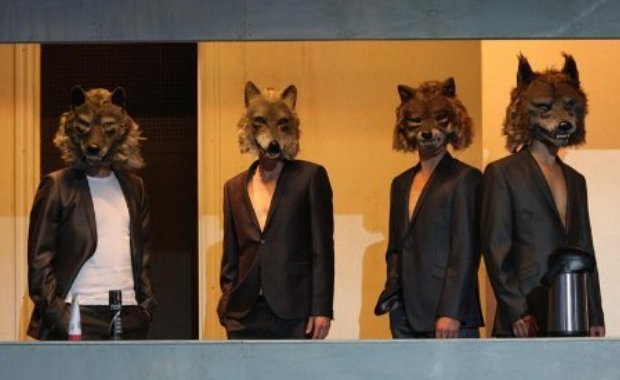
The strange irony of describing Three Kingdoms as dreamlike – which is the closest I can get to evoking its loopily surreal quality – is that I did in fact dream about the production in anticipation of seeing it. Yes, I was that excited. But my subconscious was incapable of creating anything as bizarre, visually imaginative and downright bonkers as what appeared on the stage of the Lyric Hammersmith. As in the image above, women don deer heads and are pursued by wolf-masked men; a gang of boxers violently pummel the soiled set; a strangely haunting, white-clad figure sings chilling pop song accompaniments; there is more lurid sexual content than you can shake a strap-on at.

I should perhaps point out that within the hallucinatory kaleidoscope of images there is a plot of sorts, and a detective plot no less, but this is far from your average whodunnit thriller. We begin in the middle of a police interrogation, as detective duo Ignatius and Charlie question a young man who has inadvertently thrown a severed human head into the River Thames. The forensic evidence points back to Europe, where the decapitated sex-worker has been trafficked from. With odd suddenness, the two detectives follow the trail back to the pimps and pornographers of Berlin and later – with Charlie inexplicably disappearing from the scene – to an Estonian sex-trafficking gang.

Without knowing much about European theatre – a lack of knowledge that I’m keen to remedy off the back of this – I would ignorantly speculate that the style and tone of the production shifts appropriately with the geographical location. Never is the writing more central than in the early London-based interrogations, reflecting the new writing culture of British theatre, with more than an echo of Pinter in the detectives’ swift back and forth of dialogue. As the action moves to Germany and later to Estonia, we are offered increasingly audacious visual imagery and an escalating physicality, as performers tumble through windows and spring startlingly from suitcases. It certainly feels many miles from British theatre, and bracingly so.

In this way, Nübling manages to create a disorientating visualisation of the dislocation of foreign travel, immersing us in cultures that are strikingly different to our own through the conduit of Ignatius, a man severely lost in translation and persuasively, energetically portrayed by Nicolas Tennant. In this sense, the perplexing surreality of the production is a resonant metaphor for the clash of cultures in an increasingly globalised world, where Europe is both sister and other.

Through the piece, Stephens and Nübling make us aware of our own strangely separate and insular status as an island nation, a culture that is supposedly part of Europe and yet distinctly divided from it. Our perceptions of this continent, and particularly of the still largely alien society of Eastern Europe, are both channelled and challenged. While the practice of sex-trafficking may be this play’s overt subject, the relationship between East and West demands an equally prominent place on the stage.

Related to this, language is another key concern, perhaps surprisingly in a production so anchored by the sensory. The very experience of having to read surtitles for much of the evening already puts a different slant on how this play is received, with the audience having to do the mental leg-work of reading and connecting both spoken and physical language. Translation also throws up its own issues, particularly as Ignatius is forced to rely solely on what German-speaking Charlie chooses to tell him, a potent illustration of the power of words and the fluidity of their meaning. Even when we are dealing only with English, words are important. Ignatius and Charlie verbally play with synonyms before finding the right fit, while a sentence such as “they sawed it not sliced it” (in relation to the woman’s decapitation) is an excruciating demonstration of how a slightly different word can have a vastly different effect.

While Nübling has clearly transformed Stephens’ script into a theatrical creation that is as much his own as it is the playwright’s (the word collaboration here feels fully justified), the words still dazzle on their own. There is a sharp precision to Stephens’ writing, conjuring an incisively perceptive vision of the world that emerges most powerfully through the short monologues that various characters speak. One character’s description of the market economics of sex trafficking is brutally wounding in its calculated logic; the analogy of a toilet to convey the message that “shit doesn’t go away” is a painfully apt one.

Dealing with Stephens’ script also brings me onto the relationship between writer and director, which is here figured strikingly differently to how we are used to it in this country. The respective places of the writer and the director in British theatre demand a whole other blog post, but it is worth briefly pointing out the extraordinary free rein that Stephens has given to Nübling, placing huge levels of trust in the director’s hands. Anyone interested in this area should read Alex Chisholm’s excellent essay for Exeunt, in which she questions the imposed division between “new writing” and “new work”. It is certainly worth considering whether the model posed by Stephens and Nübling could provide a way to bridge this gap in British theatre.

Moving on, in the multi-lingual environment that Stephens has created, pop music emerges as a common language. This clearly reflects Stephens’ own interests, but it also seems an appropriate demonstration of the wide-reaching penetration of some elements of culture and not others. There is a sinister irony to the way in which music is used, with romantic lyrics often clashing with the global commodification of sex and sexual violence that is being portrayed. One particularly haunting rendition of the Beatles’ Golden Slumbers still has yet to release its grip on me.

As heart-pumpingly exhilarating as this production may be, however, I cannot quite offer Three Kingdoms my wholly unfettered praise. My main problem with the piece is the way in which it treats its female victims (a word I use with caution). Is silence the way to give these women a voice? Before criticising, I can wholly appreciate and understand the perspective of this production, which is itself a primarily male product. (To briefly digress, the word “product” here feels significant. As in the sentence I have just written, products are actively created by men – the product is the object, the men the collective subject – while women in this play are referred to by the Estonian sex traffickers as the passive “product” that they trade.)

On one level, it makes perfect sense. Three Kingdoms is shocking in its treatment of women, thereby shocking us as a result. The women in the piece are largely silent because the women they represent are living in enforced silence; it seems appropriate, authentic (another word that is tainted through its particular, unsavoury use by Stephens – see my earlier point about the importance of language?).

But doesn’t this just compound the problem? Here I’d like to refer you to an exchange on Twitter between Chris Goode (@beescope) and Stella Duffy (@stellduffy) that caught my attention before I had even seen the show myself and that sums up pretty comprehensively what I’m trying to get at:

@beescope: Three Kingdoms is hugely impressive, a near-perfect match (collision?) of writer, director and intrepid actors. Still frustrating though that nobody wanting to work in those modes wholly within the British system would ever get past the gatekeepers. Also wish it didn’t revel quite so much in the misogyny it’s describing.
@stellduffy: @beescope the difficulty of representing that which we’re trying to counteract/deal with.
@beescope: @stellduffy Yeah, for sure. But it’s extra troubling when the work so completely reproduces the malaise that there’s no critical leverage. If you make the victims essentially voiceless you can come awfully close to appearing not to have noticed there’s a problem.
@stellduffy: @beescope women are abused in life. re-creating a problem is not the same as creating an alternative. sigh.

(Apologies for the awful formatting of the above, I couldn’t get a decent screenshot)

There is something to be said for exposing an issue in all its brutal ugliness, but it is disturbing and worrying that it is so rarely exposed from the perspective of those upon whom it most impacts. Women are rendered speechless throughout, either by language barriers or by fear. In one of Nübling’s many powerful images, a half-clothed female figure silently irons in the background while men watch porn on a phone screen; another woman is unable to even communicate with the men who viciously insult her.

The production also seems to revel somewhat in the sexual violence it portrays, which is upsetting and troubling on the one hand but intriguing on the other. Such is the level of dazzling visual spectacle that we are invited to become complicit spectators; Stephens and Nübling recruit the audience as a living example of the dark forces within human nature that drive the acts they are depicting. Thought of in such a way, Michael Coveney’s protestation that anyone to enjoy this experience must be “debauched beyond redemption” takes on a slightly defensive air.

Also complicit are the two detectives, whose common gender – while it may exclude greater involvement from female characters – becomes darkly significant. At the same time as doggedly pursuing their case, they are implicit participants in the industries responsible for this murder. In a chilling scene in which they watch a recording of the young woman’s beheading, they become tainted spectators, and their attitude towards the women they encounter on their investigation hints at deeper problems. The concluding twist, which I am still wrapping my head around, seems to enhance Ignatius’ guilty complicity in what he is attempting to destroy; there are no heroes here.

Another potential criticism is the plot’s gradual descent into incomprehensibility, as we are assaulted with unfathomable image upon unfathomable image in a hedonistic Estonian finale that becomes increasingly hard to follow and digest. This frustrates the very British aim of getting to the bottom of what a play is “saying”, but perhaps it is the critical approach that is at fault rather than the production. We can be determinedly blinkered as a theatrical culture and have nurtured a sort of suspicion towards theatre that asks its audiences to feel and experience as much as it asks them to think.

The very lack of meaning here seems to create a new kind of meaning. Stephens has said that Nübling never asked him what he was trying to say in his script, and perhaps we should not ask either (I am aware of the hypocritical irony of making this statement several hundred words into a piece of writing that it is, on some level, doing just that). This is theatre that demands a new way of watching and I found myself feeling hampered by the nagging knowledge that I would have to write a formal review, pestered by the panic-inducing question of how I was going to critique it. I almost wish that I could have experienced this production without the critical handcuffs binding me.

Value judgements are usually, at least by the standards of the conventional review and the purpose it serves, what make a piece of critical writing. Readers want to know whether the reviewer thinks it is “good” or “bad” theatre (note the inverted commas); they want to know whether or not they should buy a ticket, which is a valid expectation to have from a review. In this case, although I obviously did give one in the form of a star rating, I felt to an extent incapable of offering my value judgement, my thumbs up or down. But as for whether others should go to see the show, I can only offer a resounding YES. This is theatre that needs to be consumed on an individual basis, and I suspect that it may be divisive, but it should be experienced. It is made to be experienced.

As if to prove my opening point about Three Kingdoms‘ inherent challenge to mainstream theatre criticism, the majority of the mainstream press have struggled with it and, in some cases, condemned it. This style of theatre is clearly not to everyone’s taste, but it saddens and frustrates me that many of the reviews do not even attempt to engage with it on the most basic level. Instead, there has been a startling dichotomy between the verdicts of what we might call the traditional critics and the response that the production is receiving through Twitter and online critical outlets. Perhaps this heralds the realisation that we need new ways of seeing, of experiencing, of expressing. And perhaps that isn’t such a bad thing.

For some other interesting approaches to Three Kingdoms, try taking a look at reviews by Andrew Haydon and Daniel B. Yates. And for anyone wanting a more visual impression of the production (as only seems appropriate), see the Lyric’s trailer below:

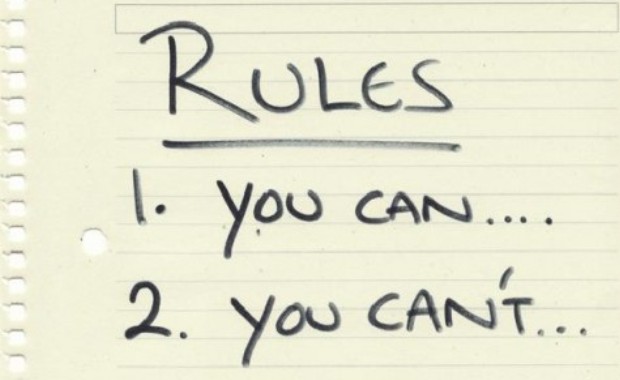
Breaking Rules

We all know that rules are important. Unless you’re hugely optimistic about human nature, most of us accept that as a species we are unlikely to all harmoniously coexist in a state of complete anarchy. I am also, in everyday life, a sucker for rules. As a child, the very thought of breaking even the pettiest of rules had my palms sweating; on the few occasions I participated in the depressingly stereotypical teenage ritual of underage drinking in the local park, I was in a state of anxiety nearing hyperventilation. But perhaps there are some rules that are meant to be broken.

The Stage recently published a piece offering five essential rules for aspiring reviewers, written by Susan Elkin in response to reading and judging entries to a student theatre reviewing competition. I don’t doubt that these serve a perfectly good purpose for those just starting out and looking for some basic pointers, but I’m always slightly wary of any rigid guidelines for reviewing. I was in fact alerted to the piece thanks to a tweet from Matt Trueman, who followed the link with the statement that “all of these need breaking”. Despite my history as a rule following goody-two-shoes, I find myself inclined to agree.

Having recently read Lisa Goldman’s No Rules Handbook for Writers, which takes all those common “rules” of creative writing and if it does not quite throw them out the window, at least tells writers how to bend them, I’m feeling in a similarly anarchic mood towards this list of reviewing dos and don’ts. The full piece can be read here, but I’ve quoted the main points below:

  1. “The best possible training for any sort of writing is to read as many examples of the genre written by experienced people as you can.”
  2. “As a reviewer, your first task is to assess it as a piece of theatre.”
  3. “Reviewing is a form of journalism.”
  4. “Never use a long word if a short one will do.”
  5. “Get your punctuation right.”

Of course, this is not the first time someone has tried to set out a formal framework for the art of theatre criticism. Whole books have been written on the subject, while each reviewing publication will have its own list of style guidelines and critics themselves have laid out their own opinions on the matter, such as Jo Caird’s blog for What’s On Stage. As I’ve already mentioned, such pointers can be useful to an extent, and the five points above have their obvious applications. No one wants to read a piece that defies all sense through incorrect punctuation, employs malapropism after malapropism and lacks any understanding of theatre as an art form.

But I worry that this culture of rules will fence criticism in. It can already be frustrating enough to work within word limits and star ratings, but when emerging reviewers are made to feel as though they must obey a strict structure of guidelines there is a danger of producing bland, parroting reviews. It was a trap that I found myself falling into when I first started reviewing theatre not all that long ago and one that still occasionally snags me now. When I look back at those lifeless, formulaic reviews, I lose all enthusiasm for theatre criticism as a form.

So I would perhaps add my own cautionary, freeing notes to the rules provided in The Stage:

1. “The best possible training for any sort of writing is to read as many examples of the genre written by experienced people as you can.” – This is a rule that I don’t have too much of a problem with, as it’s something of a no brainer that to get better at writing you must be willing to read, and there are some very skilled critics out there whose writing has certainly provided me with direction and inspiration. A note of warning, though: don’t play copycat. Reading too much by one particular critic can make you subconsciously begin to write like them, which stifles individual voice. I can also affirm from personal experience that an excess of reading can produce a version of what Harold Bloom dubbed “anxiety of influence”, paralysing your writing with the fear that you can never be as good as those who precede you and who you look up to.

2. “As a reviewer, your first task is to assess it as a piece of theatre.” – Again, this piece of advice has its obvious merits. Reviewing a piece of theatre is not the same as reviewing a piece of writing; this is live performance, and to ignore the performance aspect is to miss the point. But on the flip side, reviews that are too focused on this purpose of assessment can become a tediously formulaic checklist: direction – check, acting – check, set design – check. I’m as guilty of writing these uninspiring reviews as anyone else.

Elkin goes on to discourage reviewers from getting too sidelined by the themes and issues of a piece of theatre, but in my opinion such investigation of the ideas at play, particularly when reviewing new writing, represents one of the biggest strengths of great criticism. Someone once advised me not to be afraid of trying to get under the skin of what a piece of theatre is doing or trying to say, and it is one of the most liberating writing tips I’ve ever received. The specifics of the performance are important, but I also want to think more deeply about the shape, purpose and inspiration of a piece.

3. “Reviewing is a form of journalism.” – The point of this rule is that thought should be broken up in a review in the same way as it would in any other piece of journalism, separated into easily digestible sentences and paragraphs. There is a lot to be said for this advice – a long, dense block of text is immensely off-putting as a reader – but there should still be a level of flexibility within this. Complex and varied sentence structure is not always a bad thing, and if theatre can experiment with form then why can’t the writing that is responding to it do the same?

4. “Never use a long word if a short one will do.” – This one is taken from George Orwell and will be very familiar to most writers. It is of course worth remembering that commanding a wide vocabulary does not automatically make you a good writer, but neither are long words automatically bad. The one thing to always make sure of is that a word is used in the correct context and that its definition is fully understood (I’m a compulsive user of dictionaries for this very reason), but two synonyms do not convey exactly the same meaning and a longer word may sometimes be necessary to fully, effectively communicate a certain thought.

5. “Get your punctuation right.” – Punctuation is clearly important, and nothing enrages me more than a misplaced apostrophe. This is the rule that, as a bit of a grammar geek, I find it the most difficult to disagree with, but there are instances where there is room for creativity with punctuation as long as the meaning is not impaired.

As I stated at the beginning of this discussion, rules are important and they are usually there for a reason. In this particular instance, they are certainly worth knowing – as Goldman puts it in her book, you have to know the rules before you can break them. But at a time when writers are reconsidering what it might mean to be a theatre critic and opening up exciting new possibilities (more on that another time), it feels limiting to be shackled to strict guidelines. While rules have their purpose, it is vital that we do not let blinkered adherence to these rules hamper a form that has the potential to be exciting, inspiring and creative in its own right.


Reviewing Reviewed: An Attempt to be Honest

I’ve been thinking a lot about honesty. Not in the overall, broad sense of that word and what it encompasses, but in terms of how it relates to my writing and more specifically my writing about theatre. This blog post, therefore, is an attempt to tell the truth, to strip off the usual protective armour that coats the writing I release out into the world and allow myself to be a little more open, a little more vulnerable. What follows may simply be seen as indulgent self-analysis, but I hope that it also connects with bigger debates that are currently taking place about theatre writing and the direction it is being taken in, or should be taken in.

As I say, I’ve been thinking about this question of honesty in theatre criticism a lot and for quite some time, but this attempt to articulate my thoughts was prompted by Jake Orr’s reconsideration of a review he wrote for A Younger Theatre. In an admirably honest and heartfelt follow-up, Jake admitted that the judgement he passed on the production in question (Melanie Wilson’s Autobiographer, which I haven’t actually seen myself) was perhaps unfair, an admission that fed into regrets about how quickly critics must file their review and move on and asked wider questions about the shortcomings of what we might call mainstream or traditional theatre criticism.

This resonated with difficulties that I had personally been experiencing over the last few days. In a possibly foolish move, I went to review the first two of Edward Bond’s Chair Plays at the Lyric Hammersmith on Monday, followed by Making Noise Quietly the next night, effectively giving myself the task of processing five plays in the space of 48 hours – and all at the same time as working my day job. I enjoyed the plays to varying degrees, but they were all teeming with ideas that resisted being pinned down. Tied to deadlines and starved of sleep, I thought and struggled a lot, cobbled together some responses and reluctantly moved on.

But my uncertainty continues to chip away at me. How could these works be reduced to a few hundred sleepily composed words and a hastily slapped on star rating? I do sincerely believe that a review at its best is a thing of beauty and that criticism can be creative in its own right, and for the most part I try my best to strive towards those ideals, but there are also lots of occasions where I fall far short and simply let it go. I sum up a piece of work that has been the product of weeks, months, perhaps even years of hard work and careful consideration in no more than a few hours, using a severely flawed barometer of quality; it seems a ridiculous imbalance.

These thoughts are not entirely new. Theatre criticism, the forms it takes and its inherent limits are all things that I have discussed before, sometimes at length, but looking back self-critically at the reviews I have accumulated over the last couple of years, I can see a disconnect in my thinking. I’ve begun to wonder if I’m failing to practice what I preach and whether the blame for that can be wholly attributed to the restrictions of the traditional 500 word review or if I need to put my own hand up. I think that the answer is probably a bit of both.

I would say that I don’t pretend to be objective, but when I take a closer, harsher look at myself I’m not so sure that’s true. I certainly haven’t made a secret of the fact that I think the concept of critical objectivity is a cracked facade, something that I have explored in my writing here before, yet I wonder whether my reviews themselves contradict this standpoint of honesty. When in a review have I simply admitted ‘this isn’t my cup of tea’? I like to think of myself as fairly open and receptive to all work, but it’s not as though I can eschew personal taste. Similarly, there are certain writers, companies and artists whose work I will inevitably approach in a different way because of my own admiration for them, a fact that is rarely recognised in my finished review.

Beyond the inescapable yet unspoken subjectivity of my writing, I’m aware that I’ve also avoided transparency about my own ignorance. Because, a lot of the time, I do feel fairly ignorant. This is probably to do with being 22 and still feeling like a relative rookie and being aware of how much more there is out there – how much to read, to see, to experience. Constantly meeting others who are far more well-informed than I am, not to mention terrifyingly intelligent, together with being always surrounded by books still to be read, provide continual reminders of my own failings.

When inadequacy or ignorance is admitted by a writer, though, it is seen as a cause of embarrassment for both writer and reader. We are supposed to know everything, or at least think that we know everything, which is often more accurately the case. I don’t expect any of my editors would be particularly happy if I blithely confessed inexperience at the opening of my reviews. No matter how out of my depth I feel, I continue to fumble for a foothold and try to speak from some position of authority, however weak. But there is still that nagging voice at the back of my mind that taunts, ‘who are you to make this judgement?’

Who am I to judge? Who are any of us to judge? Perhaps judgement is not the right word; perhaps we need to rethink the vocabulary of theatre writing. Because I think that what I’m really searching for and what really attracts me to writing about theatre is not cold, calculated judgement, a glib thumbs up or down, but careful analysis, a delicate picking apart of ideas, getting under the skin of a piece of creative work. That’s what also excites me about speaking to theatre makers on the occasions when I am fortunate enough to interview them; I want to pull back the curtain and peek at the inner workings, the beating heart of the piece and its complex, intricate network of veins.

This brings me back to Jake and what inspired this increasingly lengthy blog post in the first place. As a result of some of the thoughts expressed in the piece I have already mentioned, alongside a whole host of other inter-connected thoughts, he and Maddy Costa have launched a project that plans to get closer to what I was beginning to describe above. DIALOGUE, described as a ‘great big playground’ for anyone involved in making, watching or writing about theatre, aims to open up new channels of communication and foster an environment of generosity. As the name suggests, it is intended to start up conversations between those creating theatre and those who usually critique it. It feels urgent, important, exciting.

So, in the adventurous, innovative spirit of Jake and Maddy and all the other theatre writers and makers who are also beginning to question their way of working, I want to do better. I want to engage with a piece of theatre beyond the two hours or so it takes to watch it and the few hours in which I have to hastily formulate a review before work or deadline or both. I want to enter into a dialogue with those who are making the theatre that I consume and to give the act of creating the respect that it is due. I want to avoid falling into lazy assumptions and casual criticisms, even if I am frantically writing away in the early hours running on nothing but caffeine.

Because I’m being honest, I write this in complete anticipation of failure. I will fail. Perhaps my failure will be to a greater or lesser extent, with any luck the latter, but failure is pretty much inevitable. I have other demands on my life, I have a day job and a need to make ends meet, and – dare I say it – sometimes I’m just a bit lazy. I am also bound by the expectations of my writing, which vary from subject to subject and publication to publication. I would say screw it, let’s chuck out the rulebook regardless, but I’m not that brave. Perhaps I’m not that idealistic.

But the one thing I promise is that I will try. I’ll try to connect with the work I see on a deeper level, whether within the restrictive limits of the traditional review format or, as will most likely be the case, through other means. I might write a 500 word review to deadline, but I’ll also try my best to make sure that the work has a life in my thoughts and my writing beyond that. I’ll try to keep questioning what theatre criticism means, or if perhaps we need a completely different terminology to describe the relationship between theatre and what is written about it, even if I don’t have any forthcoming answers. I’ll try to stay alert and open and creative in my thinking.

Most importantly, I will try to be a little more honest.