Alistair McDowall has written an Escher staircase of a play. Or perhaps a spiral, looping around to almost but not quite the same point. Or perhaps it’s the M60 ring road at night, circling the city under the orange glow of the streetlights. Round and round.
Pomona is a nightmare. A thriller. A game. A mystery. A trip down the rabbit hole. A journey into the desert of the real.
Ollie is looking for her sister. She hopes to find her in Pomona – a desolate concrete wasteland just minutes from the centre of Manchester, a yawning void at the heart of the city. This place is also at the heart of McDowall’s tangled plot, the shadowy secret it hides offering the answer – or at least an answer – to his characters’ fearful questioning. Whether they want to see it, however, is another matter.
Layered on top of and bleeding into the real Pomona and the horrors it contains is another world, one of imagination and gameplay. Somewhere else in the city, sweetly enthusiastic nerd Charlie has found an unlikely friend in Keaton, the mysterious girl who joins in with the game of his own invention. Only the game has terrifying echoes of reality. Or is it the other way round?
Both McDowall’s writing and Ned Bennett’s adrenalin-pumped production are soaked in popular culture, further blurring the lines between fiction and reality. Indiana Jones.H. P. Lovecraft.Dungeons and Dragons. Horror movies and internet detritus. Chicken nuggets. It’s all distraction, all surface, as fleeting as the flash of the lights that flicker on and off between scenes.
This is theatre that worms its way inside the 21st-century state of mind, nestling itself amid internet memes and junk food. Pomona depicts a world where we can find out anything at the swipe of a finger. Information is endless, as one character articulates, so we have to choose. And if we choose what to know, then we also choose what not to know.
Pomona is about what we choose not to know. It is a play populated by all the things that lurk beneath: the monsters under the bed, the ghosts hiding in the shadows, and the murky, underground world that we all wilfully ignore. The dark, rising tide of urban myths.
Everything about Bennett’s production heightens the lingering sense of unease. In designer Georgia Lowe’s sunken playing space, transforming (together with Elliot Grigg’s eerie lighting) the Orange Tree Theatre into a grimy subterranean landscape, the inhabitants of McDowall’s play scrabble around in the gutter, sucked inexorably towards the drain at its centre. There is no escape.
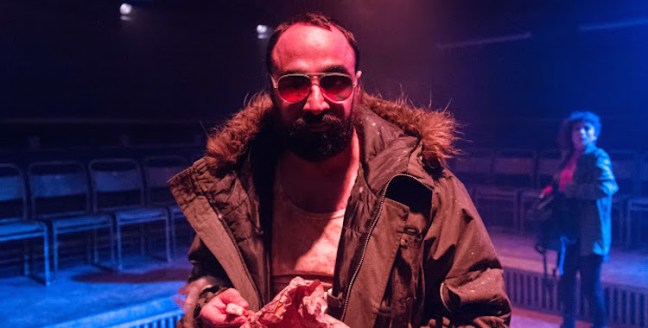
The characters, meanwhile, all have hints of the uncanny. Guy Rhys’ Zeppo, a man with an approach of studied ignorance towards the shady figures he deals with, leaps out of the show with cartoon-like detail, stealing the first scene with his lengthy, animated retelling of Raiders of the Lost Ark. Ollie, played by the shape-shifting Nadia Clifford, seems not to be what she first appears. Even endearing, innocuous Charlie, getting most of the laughs in the capable hands of Sam Swann, has a murkier aspect. And most unsettling of all is Sarah Middleton’s precise, controlled Keaton – sometime girl, sometime monster.
But the terrifying thing is not the fiction, not the squid-headed creatures from the deep. The truly monstrous side of Pomona is to be found in the ugly, urgent truth its many tentacles prod at. As Zeppo puts it, “you go deep enough, you’ll find all this stuff, the detritus of our lives, it’s all built on this foundation of pain and shit and suffering”. That foundation usually sits, festering, at the edges of our consciousness; McDowall drags it to the centre. And when we find ourselves inside the game once again, there is a queasy feeling that this is a container for the all the things we can’t quite look in the eye. We need places to dump all the nastiness, places like Pomona.
We’re back to where we began. But wait – not quite. Is this game or reality now? Where are we? Haven’t we been here before?
In Stage Fright, Animals and Other Theatrical Problems, Nicholas Ridout writes about the moments when theatre breaks down. His book investigates all those glitches – the stutter, the laugh, the unexpected interruption of a creature on stage – when the theatrical machinery temporarily halts and we see the true nature of the event unfolding before us. In Ridout’s words, “something of our relationship to labour and to leisure is felt every time the theatre undoes itself around the encounter between worker and consumer”.
Dmitry Krymov’s take on A Midsummer Night’s Dream – or more accurately, on its play within a play, Pyramus and Thisbe – looks a lot like Ridout’s thesis writ large. This is not really about love or fairies or Shakespeare; this is about theatre. Theatre in all its pretending, its failure, its illusion, its beauty, its exquisite silliness.
It is also theatre as work. It is more than just comedy that has drawn Krymov and his company to the Mechanicals in Shakespeare’s play; they also represent, as their collective title suggests, the labour that goes into stage illusion. In a programme note, Krymov says that he couldn’t see himself in either the courtly or the magical worlds of A Midsummer Night’s Dream. “I am not a fairy,” he explains, “I am a craftsman.” Theatre is not magic conjured from thin air – it is craft.
And yet …
Recently, while interviewing playwright Alistair McDowall, we talked about the idea of theatre as magic trick. We agreed that the reason this particular analogy works so well is that it suggests both the thrill of illusion and the strings that make everything work. As audience members, we at once want to see the workings – the workings that we know to be there in the background – and to be taken in by what we see before us. To contradict myself, theatre is magical, but magical in the sense of a magic trick; we know that skill and work goes into it.
As in the usual staging of the play within a play in A Midsummer Night’s Dream, Krymov’s production positions us both as the audience of Pyramus and Thisbe and as external observers of another audience: the courtiers the Mechanicals have been charged with entertaining. In this imagining they are haughty and distracted, checking messages on their smartphones and interjecting with their derision, disapproval and occasional outrage. If we see a picture of ourselves, it’s not a flattering one.
As for the players, they’re a suitably ragtag bunch, trussed up in scruffy black tie like children playing dress-up. Their set and props, meanwhile, are crudely thrown together, even down to the sawdust coated scaffold on which their audience are directed to sit. There’s no forgetting that these are labourers and that the show they (eventually) present is as much a construction as their wonky, makeshift auditorium.
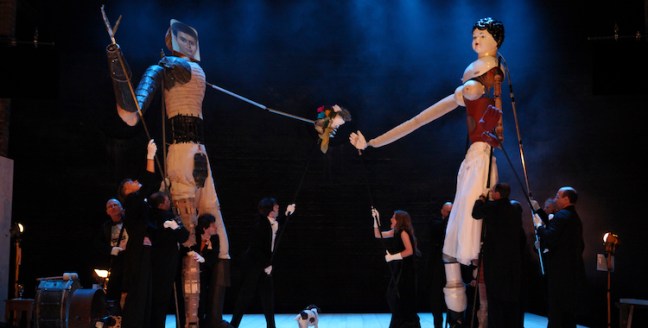
So it’s all the more extraordinary when we do, by some strange theatrical alchemy, get drawn into the tale being told. After a lengthy introduction, lightly touching on ideas of art, entertainment and intention, Krymov’s Mechanicals finally get around to the story of Pyramus and Thisbe, who take the form of two towering, mismatched puppets. Pyramus has a portrait for a head; Thisbe balances precariously on one ballet shoe and one boot. They are fragile and ridiculous – not all that different from their human operators, then, or the theatrical event itself.
At first, what charm us are the tricks. Acrobats balance and somersault; the Mechanicals’ dog – the indisputable star of the show – even turns a backflip. We are at the circus, operating in an economy of gasps and giggles, occasionally ruptured by an interjection that causes a stumble, a mistake. Then something unexpected happens. Under just the right light, with just the right musical accompaniment, there is something incredibly tender about this pair of ungainly figures, and something happens that pretty much never happens in other Dreams: we feel for these star-crossed lovers. But these moments are brittle – easily snapped.
One sequence from a long procession of images stands out. In the glow of their initial ardour, Pyramus and Thisbe dance. This is no effortless waltz; the meeting of the two puppets’ bodies is a frenetic feat of manoeuvring, requiring a large team of performers. Watching the rickety figures spin around the stage, two opposing things become simultaneously true: the moment is both beautiful and oddly moving, and at the same time conspicuous in its feverish craft. Labour and illusion at once – the magic trick.
“This is the nature of theatre,” Krymov states elsewhere in the programme, “this is how theatre is created.” Precisely.
To be completely honest, I’m not really sure how to write about KARAOKE. The first time I saw Sleepwalk Collective’s haunting, hallucinatory show was in Edinburgh, where I was emotional and sleep-deprived and found the whole thing quite mind-alteringly trippy. At one point in the show, the karaoke machine at the centre of it all describes the audience as “sort of woozy and credulous and sad”. Seeing it on the Fringe, I thought: yep. Yep, that’s me.
Inevitably, seeing it in the course of life’s more regular rhythms lends the show a different impact. It’s not quite so woozy, but no less strangely compelling. The central conceit is there in the title: performers iara Solano Arana and Sammy Metcalfe read aloud and obey instructions from a karaoke machine, all of whose text is projected onto a large screen at the back of the stage. They remain trapped throughout in some kind of nightmarish limbo, condemned to read from the tyrannical machine until the text stops – if it ever does.
There is, of course, a big old metaphor for text-driven theatre embedded in the form of the show. And at first, with its self-referential nods to audience and performance space, it seems like KARAOKE is just more theatre about theatre (not that I don’t love theatre about theatre). But at some point this meditative, deadpan, stealthily intoxicating show expands into something more. It is also about life and death and meaning and chaos and love and sex and birth and legacy and time and media and screens and pop culture and machines and catastrophe and apocalypse. The future is already written. Everything is inevitable. Read on.
The space that KARAOKE inhabits is somewhere in the join of things, in the cracks between the paving slabs. It highlights the gap between thought and feeling, between imagination and reality, between text and performance, between instruction and action, between the real and the performed. For the length of the performance, we too float somewhere in that space, text and images flashing relentlessly before our eyes. Time twists and warps and meaning feels like quicksand.
There is no singing in KARAOKE. But it shares with the best pieces of music that extraordinary, slippery ability to completely alter the mood of its audience. And as with songs, it’s impossible to pin down exactly what it is that’s so powerful. Somewhere between the deadpan delivery and the low hum of background music, between the coloured lights and the cloud of mist that cloaks the stage, the show takes hold and won’t let go. We, like the performers, are at the mercy of the karaoke machine. Read on.
—
P.S. Meg Vaughan and Mary Halton both played blinders on this one, so go and read their (much more interesting and inventive) responses.
P.P.S (and also *SPOILER ALERT*) Can those of us who have seen the show just pause a moment to appreciate that kiss?
“I would like to talk to the capitalists about money, but they only wanted to tell love stories”– René Pollesch
For as long as I’ve been an adult, I’ve been pretty independent. Less in a loud, Destiny’s Child, “throw your hands up” way, more in a quiet, fairly content, getting on with it way. Most of the time, I think I’m OK with the idea of being alone. Yet still there’s this voice socially hardwired into the back of my brain somewhere that periodically shouts “OH HOLY FUCK IF I DON’T SETTLE DOWN SOON I’M GOING TO DIE ALONE SURROUNDED BY CATS”. And no matter how coolly indifferent I think I am to it, I can never completely silence it.
—
There’s a scene in Alice Birch’s brilliant Revolt. She said. Revolt again. which articulates all of my ambivalence about marriage in ways that I hadn’t even articulated to myself before seeing it. In it, a woman responds to her boyfriend’s marriage proposal with meticulous logic, picking apart the ideology knitted around this institution thread by thread. What her boyfriend has actually just said that he wants, she concludes, is to turn her into “a thing to be traded”.*
—
I’m thinking about both of these things as I’m watching Oh, I Can’t Be Bothered, RashDash’s latest show. About that culturally embedded demand to MATE NOW WHILE YOU STILL CAN and about the idea that marriage, this state we’re all taught to aspire to, is essentially about ownership. I’m not particularly comfortable with either idea. No, more than that: as a feminist, I feel I should probably reject both – the voice and the institution.
But it’s not quite as easy as that, as RashDash recognise. Oh, I Can’t Be Bothered is about those conflicting desires to be independent and to be secure; about what we really ask of one another in modern relationships; about whether we should be asking something different, something more. It’s about different kinds of love and how our culture values them. It’s about the idea of “The One” and it’s about every love song you ever heard on the radio.
Bea and Dee are best friends. They love each other. They used to live together, but now Bea has left to live with her boyfriend. Dee misses her. Dee wants her back. Why can’t they just stay together forever?
Representations of female friendship are nothing new, but RashDash dramatically shift the ground on which this one stands. Bea and Dee are no pale imitation of Carrie Bradshaw and her mates in Sex and the City, dissecting relationships over brunch while sporting the latest pair of Manolo Blahniks. RashDash even dare to suggest (*gasp*) that female happiness might rest on more than footwear and fornication. Why do romantic pairings have to be the relationships that define our lives?
There’s something at once bracing, optimistic and sadly resigned about the central suggestion that the two women bind their lives together – not as lovers, but as partners nonetheless. The whole in sickness and in health thing, as Dee puts it. Right from the start, however, it’s clear that this experiment is unlikely to succeed. The hopeful gesture of a new way of relating to one another is balanced by the social and cultural pressures that make it unthinkable. That voice that screams “GET MARRIED OR DIE ALONE”.
RashDash tell this story with a blend of blunt dialogue and striking physicality. In one moment, performers Abbi Greenland and Helen Goalen are rubbing their heads against one another, nuzzling like animals. In the next, they are rolling and jumping, flinging one another around the space. The struggles of their friendship and the pressures of the surrounding world are played out physically, the challenges and disagreements unmistakable in their bodily collisions.
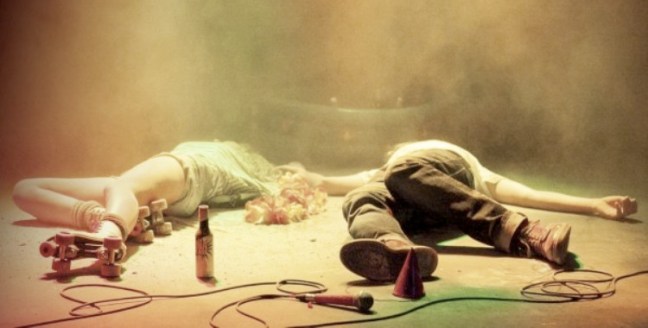
And although the speech exchanged between the two women is sharp and often funny, the most powerful moments play out in the visual and the abstract. In one hilarious yet heartbreaking scene, Greenland yells song lyrics into a microphone (“You’re still the one I run to, the one that I belong to”; “If you’re not the one then why does my hand fit yours this way?”) while Goalen runs blindly and fitfully around the stage, covered in a plastic sheet that is wedding veil, suffocation device and shroud all at once. It’s hard to imagine a more powerful visual metaphor for the stifling demands of romantic love, as shouted out from every love song, every romcom, every thoughtlessly saccharine Valentine’s Day card.
Andy Field and Ira Brand’s put your sweet hand in mind – which I fell giddily head over heels for – was originally born from the desire to make a show about love “in which no one falls in love”. In the end the piece that they made, while it was also about other loves, didn’t quite fit that initial bill. Somehow, somewhere along the line, romantic love crept in. It’s hard to keep out.
In Oh, I Can’t Be Bothered, Dee and Bea make a similar discovery. Turning one’s back on the promise of romantic love and the fiction of “The One” is no small feat. Given that it seeps into every last corner of our culture, it’s unsurprising that we find it so hard to get away from. As Field once put it, “love turns everything into a love story”.
But voicing the desire for a way of living that is not solely constructed around a romantic partner feels important, both in the context of feminism and in the simple sense of how we relate to one another. If we can uncouple our sense of identity and wellbeing from an inward-looking dependence on one other human being, perhaps we can begin to look outwards to each other, our communities, the world we live in. We can take joy in other kinds of love, kinds of love that aren’t bound up in a lucrative commercial package.
At the moment, however, it remains difficult to imagine. If Dee and Bea fail, and if put your sweet hand in mine fails, then the real failure lies with the society that plants that nagging voice in our heads.
*Incidentally, Alice Birch is currently working with RashDash on two new projects, which is very good news indeed.
I’m sitting on a cushion, knees drawn protectively to my chest, feet covered by the edges of a massive duvet. In a small room in a block of flats somewhere in Edinburgh, I am listening to James Leadbitter (aka artist-activist the vacuum cleaner) share his experiences of mental illness and activism, while medical assessments and police records flash up on a overhead projector. He talks about depression and anxiety. He talks about being suicidal. And I listen, arms curled around legs, biting the inside of my mouth, tears prickling at my eyes.
—
Ordinarily, I’m not particularly prone to crying – especially in public. So often I emerge dry-eyed from films or shows or exhibitions at which everyone around me is audibly sobbing, feeling oddly shamed by the chorus of sniffles and sighs. Is it that I simply don’t feel as much as them? Or that the public nature of the theatre auditorium or art gallery is too exposing a place to reveal emotion? Or, perhaps, that I feel inhibited as a critic, conscious of my responsibility to be rational rather than emotional?
One piece of criticism that I keep returning to, acknowledging again and again its impact on me, is academic Jennifer Doyle’s reflection on Franko B’s I Miss You. Oddly, it is a piece of art that I never saw. What I’m struck by, though, is Doyle’s emotional response to the piece and her attempts, through this piece of writing, to work through that emotion. The provocation of the unexpected tears elicited by I Miss You expands into a much wider discussion about art, emotion and the position of the critic, who has been encouraged to treat crying with suspicion and disdain.
Two suggestions made by Doyle catch at my mind every time I read them. The first is that, in the space of the gallery or classroom (to which I mentally add the theatre), the act of crying “can leave us feeling a bit naked”. The second is the idea that the impulse of the critic is not unlike “the boundless narcissism of the lover who loves in vain”; that the critical presentation of feeling masked by restraint might be compared with “the lover’s need to have his struggle to hide his feelings acknowledged”. In other words, we can’t admit to naked emotion, but we are desperate for readers to acknowledge the garments in which we have clothed it.
This year at the Edinburgh Fringe, an environment in which emotion is so often heightened and laid bare, I found myself wondering again about the role of emotion in criticism. Not least because my own emotions were frequently tapped in a way that startled me, leaving eyes and cheeks damp to the cool Edinburgh air. Talking to friends and fellow critics, I joked – in that way that everyone knows is not really a joke at all – about what a weepy festival I was having, to the extent that the slightest hint of sentimentality could set me off. No dry eyes now.
But how, as a critic, is it possible to render those tears on the page? Do they contaminate criticism, blurring thoughts like ink on paper, or just offer another lens through which it’s conducted? The answer is … I’m not sure. I have huge admiration for the way in which feeling suffuses the prose of others’ theatre writings – most notably (and brilliantly) Maddy Costa and Megan Vaughan – but it’s a different matter entirely when it comes to tapping out my own emotions on my computer keyboard. I feel far more comfortable with analysis and reflection, whereas I often wince when I see my own feelings held at one remove, suddenly appearing trite and artificial in unforgiving black and white. In a culture saturated with emotion, a culture fed on sob stories and Hollywood romance and X Factor montages, feeling feels cliched.
There’s one section in Ross Sutherland’s Standby for Tape Back-Up that I remember vividly from the work in progress I saw last summer and that jumps out at me again when I see the show for a second time in Edinburgh. Sutherland is recalling the death of his grandfather, a moment in his life that frames the whole piece, and talking about his emotional response. All he can think of as he tries to comprehend the enormity of this loss is the way in which people react to death in films and television programmes. His bereavement is filtered through pop culture, through all of the possible behaviours he has experienced through the screen. It’s a state of emotional uncertainty and paralysis so familiar it hurts. Is this really how I feel, or is this how I’ve been told I should feel?
Another moment that punches me in the stomach with its familiarity and somehow – paradoxically, uncannily – with its unfamiliarity arrives towards the end of Men in the Cities. Chris Goode is telling the story of Brian, just one of the many broken, contorted men who populate his play. Brian is drunk and grieving and heartbroken, walking through the busy streets of London surrounded by the pre-Christmas crush of shoppers. Until suddenly a singing voice breaks through the crowd and the whole piece lurches in a furious new direction. Goode is vomiting an extraordinary stream of text, words that break and fall over me and half of which I don’t really comprehend until I read the script later. In the moment, all I’m aware of is the pure, throbbing, exquisite anger of it all.
People are crying, but this is one of the moments I don’t feel close to tears for a change. Instead I feel emptied out, as though my insides have angrily leapt up on stage with Goode, as though every murmur of rage I’ve ever felt and tuned out has been ear-splittingly amplified. In life, I’m bad at being angry. But like the glorious noise of #TORYCORE, Men in the Cities is angry for me – though not with any of the passivity that suggests. It transforms my anger into something external, something shared. I look at this anger, this hurt that is at once recognisable and alien, and it is nothing like the emotion relentlessly beamed from screens.
—
I don’t cry during Men in the Cities. I do cry during Clara Brennan’s monologue Spine, though less for the human relationship at its core than the intertwining of this very personal story with the play’s angry, energised and tentatively hopeful politics. I leak a quiet couple of tears during Bryony Kimmings’ new work in progress at Forest Fringe. My eyes well up as my heart thumps during Greg Wohead’s small but beautiful Hurtling. Countless other shows lead me to the brink of tears, sometimes with the profound and sometimes with the painfully banal. One morning, I almost cry while queuing to buy coffee, staring hard at a display of croissants until my eyes clear.
Not all those tears are bitter. Sometimes, like in Hurtling, they are little beads of relief and gratitude. But the show that really feels like a gift, that triggers all the right emotions at just the right time, is Every Brilliant Thing. Those occasions when a piece of theatre feels as though it has been created precisely for you to encounter in the particular parcel of time in which you encounter it are rare. Every Brilliant Thing, on one of the few sunny mornings of the festival, is one of those precious occasions.
My response to Duncan Macmillan’s play is hardly unique. The packed audience on the day I see it is all sniffs and smiles; a collective outpouring of joy and anguish. At one point the show uses, I think, the phrase “happy-sad”. It’s a simple contraction of two simple words – so simple that they conjure emotions little more complex than line drawings of faces with the mouth upturned or downturned – yet it’s somehow just right. Every Brilliant Thing is happy-sad, in the same way that so many moments in life are stained with the feeling of their opposite. Ecstasy is laced with sorrow and despair is pierced with hope.
It’s that heady cocktail of all the brilliance and heartache of simply existing in the world that intoxicates me. Sitting in the beautifully sociable space of Paines Plough’s Roundabout auditorium, I laugh and cry with relative decorum, but if left alone I would be heaving great, shoulder-shaking sobs, a stupid grin plastered on my face and tears rolling down my cheeks. There is no way in which Every Brilliant Thing turns away from the realities of depression and the bitter impossibility of making others happy, but still it is somehow joyous.
And so back to the cushion, the duvet, the tears gathering at the corners of my eyes. I find myself profoundly affected by Mental, Leadbitter’s almost-too-intimate show. This is another facet of depression, not entirely shorn of the optimism that tempers Every Brilliant Thing but certainly with more jagged edges. It is raw and painful and personal. At times I find it incredibly hard to watch, in part out of concern for Leadbitter and what he is forcing himself to revisit every time he performs this show, and in part for a hundred tiny other reasons entirely my own. Reflecting on the piece in the minutes, hours and days afterwards, I struggle to think about it in a way that isn’t deeply coloured by that emotion and difficulty. I wonder if that’s a problem.
—
Since returning from Edinburgh, and as part of an ongoing effort to make more time in my life for thought and reflection alongside the endless work I foist on myself, I’ve been listening to some of the conversations that Alex Swift has been recording and uploading to his website (if you have some time, do yourself a favour and check them out). In one, artist Harry Giles talks about how politics feels. It’s not something that usually gets raised (at least not explicitly) in political discourse, which tends to be steeped in ideology or, in the case of party politics, policy and spin. But really, when you stop and think about it, the feelings tied up in politics are what tend to have the most impact on our lives and opinions.
I’m not going to add my voice to the debate about Scottish independence – mainly because, being English, it’s not really my voice that matters. But what is astonishing and exciting about the impending referendum, particularly in recent days, is the way in which it has truly engaged a huge range of people in political discussion and how that political discussion has been vitally inflected by feeling. There is a passionate sense that this really matters. Not only that, but it matters not just in terms of the economic arguments that have dominated headlines; it matters at the level of identity and democracy.
In all thought, be it critical or political (and of course those two things are so often intertwined), emotion contains both danger and potential. Feeling in art has a tendency to be equated – often rightly – with catharsis, escapism and conservative sentimentality. But there is also another kind of catharsis to be found in art, one in which emotion is politically charged and straightforward sentiment is replaced by radical collective feeling. It is this collective feeling which Giles emphasises when he discusses how politics feels. And, though far from all of my tears in Edinburgh were provoked by this kind of emotion, it is a similar collective feeling that the space of the theatre is able to hold. When our bodies tense during Men in the Cities or we cry at the end of Spine, our emotions meet in the room, however fleetingly. We feel together.
—
I’ve now been wrestling with this unwieldy piece of writing for so long that its meandering train of thought is no longer clear to me. I’m not quite sure how I’ve travelled from Jennifer Doyle to tears to the Edinburgh Fringe to the Scottish independence referendum. What I’m clumsily grasping towards is something about emotion, art, criticism and politics; something about how feeling is provoked, experienced, processed and harnessed; something about crying in the theatre and what that really means.
The other night, with complete disregard for my own once again fragile feelings at that precise moment in time, I re-read Men in the Cities. Experiencing it again on the page, a good month after seeing it in Edinburgh and with more space in which to think about it, I was bowled over a second time by just what an extraordinary piece of art it is. It’s fucking stunning. And this time, tears did begin to pool in my eyes. It was these words, directed at the audience, that got me:
“I know. I know. Can we not just put it all down. Aren’t you tired of it all. Aren’t you just tired.”
That’s exactly how it’s written – no question marks. And if I’m remembering the performance correctly, those questions never really felt like questions in the moment either. If they were questions, if it were a genuine invitation to put “it” – anger, violence, hatred, the thousand tiny ways in which we hurt one another – down, then the catharsis would be too complete. It would be a bit of a cop-out, for theatre-maker and audience. Instead, in a world where we can’t (at least not yet) “put it all down”, this possibility is suggested and denied. Emotion is provoked, but never fully released.
—
In lieu of any real conclusion, I leave you all (or, rather, the handful of poor souls who have made it this far) with this, because a) it’s what I’m listening to this afternoon and b) Secret Theatre’s A Series of Increasingly Impossible Acts is the best barometer I know of how I’m feeling each time I revisit it.



 Catherine Love