Jack Thorne: Everyday Heroism

590x494.fitandcrop

Originally written for Exeunt.

Jack Thorne has a habit of apologising. “I’m so sorry,” he says again at the end of our phone call. “I hope you don’t have to transcribe this, because if you do it will just be a load of ‘ums’ and ‘ahs’. It’s just the way my mind works.” Conversation with the writer travels at the swift pace of his thoughts, hopping rapidly from one idea to another, peppered with insistent “you know”s. Listening back to the feverish speed of Thorne’s speech, I can begin to understand the personality that drives him to write for ten hours a day, six or seven days a week. “Sorry, I’m not very eloquent,” he interrupts himself to say at another point. He prefers writing, he explains.

Although Thorne’s addictive passion for writing was born partly out of a frustration with talking – “I think I started writing plays as a way of expressing the things that I couldn’t say,” he writes in the introduction to his first volume of plays – his characters often suffer with a similar struggle to say what they mean. Bookending his Plays: One, both When You Cure Meand Mydidae revolve around relationships in which the right things are never quite said; in the collection’s two monologues, Stacy and Bunny, the protagonists’ alienation is compounded by their inability to talk honestly to those around them. Even in Thorne’s most recent play Hope, whose cast of local councillors spend most of their lives talking to the community they serve, the right words are not always forthcoming.

“I feel I spend most of my life feeling quite guilty about things I should have done or things I should have said,” Thorne says, suggesting that this guilt colours all of the plays in his first collection. The other theme that these plays share, he posits, is that of help and everyday heroism. “I am someone who wants, as we all do, a better world, and I’m constantly looking for people that will lead me there; I’m a follower, not a leader. So I think my plays tend to be about someone looking for that: looking for heroes, looking for help, and what help means.”

In When You Cure Me and Mydidae, both close studies of bruised individuals trying and frequently failing to help one another, that theme is explicit. “If they could only be different people then they could be OK,” Thorne says of the characters, “but they’re not, they’re stuck with being the people that they are.” The lone speakers of Stacy andBunny, meanwhile, are people who desperately need help and aren’t getting it. Thorne describes Rob in Stacy, one of the most unsettling characters he has written, as “someone that’s drowning and is constantly looking for help from anywhere and is destroying himself and others in looking for it”. But for Katie, the mixed up eighteen year old at the heart of Bunny, he holds out more hope. “I think Rob’s pretty lost, Rob’s not going to get there. I think he’s screwed. Whereas I hope she’s on the way to getting somewhere.”

After the microscopic and self-declaredly personal focus of these earlier plays, it’s easy to seeHope, with its more ambitious and expansive look at local British politics and the state of the Labour Party, as a gear change. For Thorne, though, the play made him feel “more personally on the line than I ever have with anything in my life”. Thorne has been a member of the Labour Party since 1996 and grew up in an environment where politics formed an important facet of everyday life – “I spend a lot of time amongst political people,” he explains – making the subject matter closer to the heart than might immediately be obvious. Thorne was also nervous about Hope, he adds, because politics is a topic that naturally provokes disagreement.

“When you’re writing something that’s quite small and set in a bedroom and you’re just going ‘this is how I feel about the world’, people can’t really deny you your right to do that. Whereas when it’s about the state of a political party and how it works locally and all that stuff then you feel people can, because everyone’s going to have a different opinion of that and everyone’s going to have a different experience of that, so you feel very vulnerable.”

That perhaps explains why, despite the strong presence of politics throughout his life, Thorne has tended to avoid explicitly political subject matter in his plays. The other exception is 2nd May 1997, which Thorne describes as “a play about political people” rather than a political play per se. It follows the night of New Labour’s landslide victory through a triptych of two-handers: a Tory politician and his wife facing election defeat; a drunken post-Lib Dem party liaison; and two teenage Labour supporters blinking in the light of a new political future. “It felt for me like there were personal stories to be told from that night,” Thorne says, adding, “I’m always as interested in the personal as the political.”

Hope, which featured in the Royal Court’s “revolution” season at the end of last year, might be read as the bitter sequel to the anticipatory final act of 2nd May 1997. In spite of its title, it’s a play with an awful lot of pessimism about the current predicament of both local government and the Labour Party. But when I suggest that my stubbornly optimistic reading of the final scenes is just a product of my own tendency towards idealism, Thorne protests. “No,” he says, “you’re a romantic. I’m a romantic, I like that.” He admits, however, that getting the ending of the play right was “a real struggle”, and that he’s still not sure if the closing injection of hope is justified. “Would you really want him to be the dawn of a new age?” Thorne asks of Jake, the precocious, outspoken councillor’s son who offers a shred of optimism at the end of the play. “I’m not sure you would, because he’s a pretty messed up kid. So I don’t know. I like things that end with a question mark and not necessarily a full-stop.”

Jake in Hope is just one in a long list of confused and often troubled teenagers in Thorne’s work: Rachel and Peter in When You Cure Me, the schoolboys in the final scene of 2nd May 1997, Katie in Bunny – not to mention his screenwriting work on shows such as Skins, The Fades and Glue. What is it that the writer finds so compelling about the teens? “It is a time when people are made,” Thorne says, “and that feeling of looking at that making of a person is a really exciting feeling as a writer.” His perspective on adolescence, however, has changed since he was a teenager himself, reflecting the gloom of the current political moment. “Generations have spent their lives feeling like they’re on the edge of doom. I think the thing that makes this generation specific is there’s so little optimism, it seems. So little optimism personally as well as politically. I meet young people and their expectations of life are so low.”

His fascination with teenage life is something that Thorne shares with Simon Stephens, who taught him on the Royal Court Young Writers’ Programme. Discussing Stephens’s influence on a whole generation of British playwrights – Thorne laughingly characterises him as being “like a giant Buddha” – the younger writer remembers the party that was thrown when his mentor left the Royal Court in 2005. “It was an impressive bunch of young people there,” Thorne recalls. “Playwrights never go to any parties ever, they avoid parties like the plague in my experience, but it was full of people who just wanted to say thanks to him.”

Also like Stephens, Thorne relishes the collaboration offered by theatre as an art form, but he prefers to limit his contact with the rehearsal process. “What I don’t like is being in rehearsal, I’m not really a rehearsal type of writer,” he says, describing himself as a “very unhelpful” presence in the room. “I don’t write books because I like collaborating, but I’m a better silent partner than I am a vocal partner.”

One of the other reasons Thorne tries to remove himself from the rehearsal room, he tells me, is because he has such a clear and detailed picture of each play in his head. Only by stepping back can he allow other collaborators to put their stamp on it. Encountering the texts inPlays: One for the first time on the page – I have to admit to Thorne that I’ve only seen performances of his later work – this detail is immediately clear. Although he has “a lot of admiration” for writers who are spare with their stage directions, Thorne describes his approach as “trying to present as many pictures to the world as possible”. “Which I suspect makes reading them easier,” he says, “but I’m not sure makes staging them easier.”

In the past, Thorne has spoken about how he finds writing for the theatre much more of a challenge than writing for the screen. When I ask why, he suggests that it comes back to his interest in the small. While he stresses that screenwriting isn’t easy either – “it still fucking makes my hair fall out” – in film and television “there are always ways of getting dynamism and beauty and all those things you need technically in order to be able to tell a story”. In the theatre, on the other hand, “capturing that slightness on stage is a really tricky thing to do and I frequently fail at it in a way that I don’t with screen as much”.

“I’m constantly trying to think larger,” Thorne adds, but he keeps finding himself drawn back to the small and intimate. “That tends to be my fetish as a writer,” he says, musing that it might once again have something to do with help and heroism. “Heroism is often in the small, isn’t it?” he says, sounding pleased with the idea. “Capturing those tiny moments when someone’s life changes – that is the thing that excites me.”
The Life & Loves of a Nobody, The Albany

Life-and-Loves-Rachael-Walton-credit-Marcus-Sarko-600x399

Originally written for Exeunt.

Anyone can be famous these days. Even a nobody. At least, that’s (part of) the premise of Third Angel’s new show, which wraps an unremarkable story in a skin of media lampooning. The problem is that The Life & Loves of a Nobody, like its double-layered structure, seems to be about two quite separate and not entirely reconciled things.

Here’s one way of looking at it. The Life & Loves of a Nobody is just what its title suggests, relating the humdrum story of unseen protagonist Rachel. Rachel is normal, or ordinary, whatever those words mean. She’s 36, we’re told, with a family and a job and a romantic history that are all more or less familiar. Aged 18 she tried to run away with the circus and ended up flipping burgers, which says all you need to know about the pattern of her life. She’s a thwarted dreamer, her eyes on the stars while her feet remain firmly on the dull, grease-splattered ground.

But that perspective ignores the telling and the reasons for it being told at all. Because we never hear from Rachel herself; instead, her narrative comes to us via Rachael Walton and Nick Chambers’ slick and slightly unsettling presenters. It’s established early on that we are the audience in some kind of controversial media spectacle – so controversial, in fact, that there are protesters apparently hurling shit outside. And at the centre of this contentious televised stunt, Rachel is what she’s always wanted to be: the star.

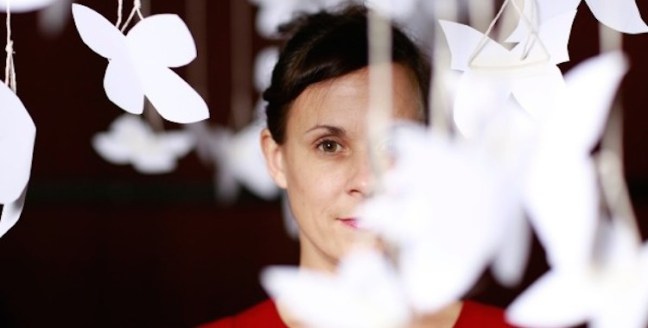
Her life up to this point, then, is framed as an X-Factor style backstory. Except it’s shown through sweet and slightly wonky storytelling rather than cannily edited video montage. It’s here that the whole concept starts to wobble a little, as the style and its ends sit awkwardly alongside one another. Just what are the motives of our two hosts? The presentation of Rachel’s life is by turns tender, mocking and disinterested, not to mention burdened by all sorts of pretty but cumbersome visual devices – a swarm of paper butterflies or a miniature, blinking tower block window. What’s the game here?

The show might hold its cards close to its chest, saving the big, explanatory reveal for the final moments, but the hand it produces fails to fully justify what has come before. Without giving everything away, the question asked is essentially: to what lengths will we go to achieve fame? And, fast on the heels of that, is it better to lead a life that is unremarkable and unremarked upon, or to sacrifice it all in pursuit of “immortality”?

A recent article in Aeon suggested that “what we perceive when we are reproduced in the cultural sphere” – be that as a statue, a name in the history books, or a face on TV – “is a kind of magical act of creation”. Just like so much that masquerades as magic, though, that promise of immortal fame is pretty flimsy when you actually take a look at it. The point is implicitly made at one point in Patti Smith’s book Just Kids, as she recalls the untimely demises of “27 club” members Jimi Hendrix and Janis Joplin in autumn 1970 in a matter-of-fact, grief-tinged tone. Their deaths are not romantic; they’re just wasteful.

The Life & Loves of a Nobody, however, gives only glancing attention to such ideas. Its interest feels torn, between the insidious influence of the media and the desire for fame on the one hand, and the question of whose stories get told on the other. Both are resonant, particularly the latter under a political elite determined to grind down and silence “ordinary people”, but they don’t fully align. The sensationalising media culture being clumsily skewered is all about elevating the ordinary, selling a populist ideal of stardom that is unattainable except for the very few. Whereas the spotlight pointed on Rachel’s life feels more aimed at an affirmation of all human experience, validating the extraordinary and mundane stories of everyone. Even the nobodies.

Object Love, Vault Festival

ObjectLove_600w450h1 15.36.56

Originally written for Exeunt.

We invest objects on stage with a strange sort of magic. Just ask anyone who saw Kris Verdonck’s Dancer#3 and cooed over a jumping piece of metal (honestly, I defy you to watch the video without a single “aww” escaping your lips). In the same way as a person can stand in for something or someone else, objects take on a representational charge.

Which makes the theatre an interesting place for Chloe Mashiter’s examination of objectum sexuality. Hang on, objectum whatnow? Chances are, those two words won’t mean a lot to you. What if I say “the woman who married the Eiffel Tower”? Or “the man who has a thing for cars” (and not in a Jeremy Clarkson kind of way)?

That’s part of the problem that Object Love attempts to prod at. Those who identify as objectum sexual – OS for short – are generally either sidelined or mocked, made into exhibits by the tabloid press and the circus freakshow strand of documentary television. Mashiter, by contrast, approaches her subject matter with delicate yet curious compassion. The whole piece sighs with a frustrated desire to understand, balanced by an implicit recognition of the huge distance it is attempting to bridge.

Drawing on interviews with a number of OS people, Object Love tentatively explores what it is to be in love not with a person but with an object – a building, a musical instrument, a camera. The “love” part of its title is essential: as portrayed by Mashiter and her small cast of three, these are not people with a snigger-worthy sexual fetish, but individuals who are head over heels for the objects they have chosen to spend their lives with. A teenage girl embracing her toy train is just as giddy as another might be with her first boyfriend.

But, you may quite reasonably ask, how does it work? How can that relationship be considered at all reciprocal? How do you have physical intimacy? And what do you say to people when they want to meet your partner? Mashiter anticipates all these questions and countless more, leaving room for puzzlement alongside empathy. No, says one character, I don’t have something wrong with me. No, I’m not going to talk about my sex life, another chips in. These are the moments when the piece is at its strongest, as the three OS characters bat away multiple unspoken queries about their orientation, always running out of time to explain themselves. Meanwhile, paper accumulates on the walls and floor, hinting at the reams of extra information that it is impossible to include.

Because – let’s be honest – a lot of what intrigues about Object Love is the unusual nature of its subject matter. It may be framed more sensitively, but Mashiter’s show is courting just the same kind of curiosity that draws viewers to the documentaries that Object Love‘s characters are so bruised by and scornful of. This is acknowledged, turning our inquisitive gaze at least partly back on ourselves, while at the same time recognising the limitations of theatre as a forum to discuss this. There’s only so much that can be done with some interview material and an hour of stage time.

For all its tender attempts at understanding, however, the piece still feels a little strained. Directness, in contrast to the manipulative techniques of documentary makers, is what works best, but still Mashiter feels compelled to break the startling openness of this style of address to stage small scenes from the characters’ backstories. Object Love might do better to simply confront us with the human beings and relationships it is interested in, daring us to understand.

Islands, Bush Theatre

©-Helen-Murray_9937-2000x1333-600x399

Originally written for Exeunt.

Two weeks, two shows about the grimy underside of capitalism, two bullfight metaphors. Bull, Mike Bartlett’s cutthroat dance of competition between employees facing the chop, embodies the bloody sport in its very form, depicting two corporate matadors at their most deadly. In Islands, the tax haven satire devised by Caroline Horton and her company, there’s an extended riff on the same theme. “Mankind’s extraordinary,” Horton concludes her gory description of the ritual, “don’t you think?”

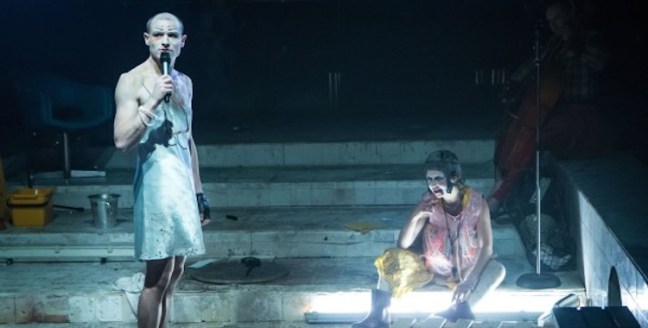
But where Bull is all brutality, Islands is all display. Horton and co’s mucky allegory speaks a visual language of grotesque, glittering excess – an apt enough, if not particularly subtle, vision of the tax-dodging economic elite, who have pumped an estimated $18.5 trillion into tax havens. Despite all the research that has gone into the piece, Islands’ approach is not a documentary one. Instead, it mashes up cabaret, satire and bouffon, casting Horton as a grinningly repulsive god lording over Haven, an island that has broken free of the blighted ‘Shitworld’ below. Along for the ride are gurning sidekicks Agent and Swill and aspirational proles Adam and Eve (geddit?), all intent on protecting their hoard from the outreached hand of the taxman.

If the synopsis sounds baffling, it’s no less perplexing in performance. There’s certainly an argument that money has achieved the status of a deity in the 21st century, with capitalism as the new global religion, but aside from that not-so-shocking insight, Horton’s Biblical references gain little purchase (pun intended). As the all-powerful Mary, Horton herself more resembles the fickle, guzzling gods of ancient Greek mythology, feasting on cherries and indulging in the endless pursuit of pleasure. The ‘fall’ that Adam and Eve experience from this superficial land of bliss, meanwhile, is a decidedly topsy-turvy one.

The metaphors Islands seizes on to make its points are just as confused as its central conceit. Some, like the cherries that Mary hoards, are powerful on their own. They of course stand in for money – everyone wants a piece of the cherry pie – but they also suggest forbidden fruit, loss of innocence (“popping your cherry”), and their punctured flesh drips like blood. Elsewhere, though, imagination comes at the expense of any coherence. It’s all as clear as the muck that surges up from below, mixing religion, gameshow, cabaret, bullfight and, of course, relentless waves of scatalogical humour. After a while, shit jokes are just shit.

As sheer aesthetic, Islands can be briefly, grubbily captivating. Oliver Townsend’s design is gorgeous in a squalid, gaudy kind of way, his sunken swimming pool set suggesting the filth and emptiness sitting just beneath the fantasy of escape, while the talented cast revel in the grotesquerie. But it all seems to obscure rather than illuminate. Reality – in the voices of Thatcher and her present day spawn – intrudes only in splintered fragments, so small as to just enhance the bewilderment of those not already clued up on the subject matter.

There’s more promise in the closing scenes, when it becomes sickeningly clear that even the fallout of economic crisis will leave Mary and her cronies unsullied by the shitstorm down below. Realising they’ve got away with it, Haven’s inhabitants tentatively call for something to “mark the occasion”. What starts out as modest self-congratulation quickly escalates into unbridled gluttony and hedonism – champagne, hookers, “a really small private jet”. There’s no one to stop them.

The trouble is, even in moments like this, the irony and glitter are spread so thick that the critique struggles to peek through. The anger that is the only conceivable response to the situation absurdly depicted by Horton and her cast is finally allowed to break the surface but is itself undermined, leaving few directions available. There’s half an eye throughout on the audience – the people – but our complicity is only cursorily courted. In the end rage, instead of boiling, cools to a sort of helplessness.

Photo: Helen Murray.

Upper Cut, Southwark Playhouse

Upper Cut - Juliet Gilkes Romero - Southwark Playhouse - 14th January 2015Director - Lotte Wakehamcast includes Emma Dennis-Edwards, Akemnji Ndifornyen, and Andrew Scarborough

Originally written for Exeunt.

How do you make politics – or any sphere, for that matter – representative of the population? Do you focus on creating opportunities for minorities? Do you hope that the success of the few will simply inspire the many? Or do you positively discriminate, bringing in quotas and limiting application processes?

There’s also another, specifically theatrical question about representation. In staging just such a debate as the one started above, within the specific context of black representation in British politics, Juliet Gilkes Romero runs into a problem. Factual accuracy and clarity of argument, so important in any other attempt to tell a neglected history, often come at the expense of dramatic dynamism. All exposition and no action rarely makes for compelling theatre.

The difficulty is, there’s a hell of a lot of background to cover before Upper Cut can even begin to land its blows. Gilkes Romero’s play is about the struggle for black MPs in the Labour movement, a battle that threatened to split the already embattled party in the 1980s, and which for that very reason was sidelined in the attempt to get elected under leader Neil Kinnock. Subsequently, the account of that struggle and the Black Sections movement that initiated it has itself been marginalised in the telling of recent British political history. Gilkes Romero’s play is an attempt to remedy that.

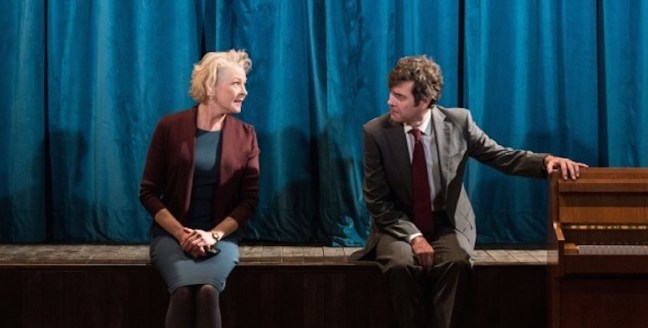
Upper Cut goes about addressing this history in reverse, beginning on the eve of Barack Obama’s re-election in 2012 – a handy springboard for discussing how far (or not) we’ve come in terms of representation – and gradually rewinding back to 1986. The arguments in question are dramatised through black activists Michael (Akemnji Ndifornyen) and Karen (Emma Dennis-Edwards); the former, when we first meet him, has gone on to become a career politician and deputy Labour leader thanks to his willingness to compromise, while the latter’s staunch dedication to racial equality has seen her pushed out by the party. Acting as both supporter and antagonist is Labour strategist Barry (Andrew Scarborough), who is more interested in the health of the party than he is in its racial make-up.

Gilkes Romero’s play never makes the mistake of being as simple as black and white, but neither do its varying shades of grey wholly convince. After becoming involved with Black Sections at the same time, Michael and Karen each experience a change of heart – if in different directions – but we are never given enough emotional insight to fully appreciate the weight of these tough political decisions. The suspicion is that these reversals serve the debate rather than the characters, whose motivations are murky at best. Gilkes Romero’s main concession to drama, meanwhile, is a sharp-edged love triangle between its three characters, which does little to animate either the human or the political.

Directing this dramatised editorial, Lotte Wakeham does little to raise the emotional stakes. In a nod to the play’s boxing metaphor, Rachel Stone’s minimal, cardboard box dominated set puts the actors on a raised stage for the duration, but little else about the production gets close to capturing the visceral cut and thrust of the boxing ring or the political arena. The rawness of betrayal and the sting of compromise are never fully felt; there’s plenty of fight, but Upper Cut fails to quite make contact.

Photo: Bob Workman.