The Chronicles of Kalki, Gate Theatre

The-Chronicles-of-Kalki-at-the-Gate-Theatre.-Photo-credit-Helen-Murray-11-600x400

Originally written for Exeunt.

If God did not exist, according to the well-worn Voltaire quote, it would be necessary to invent him. Deities – real or imagined – are at the heart of Aditi Brennan Kapil’s play, which takes Voltaire’s statement as a starting point of sorts. In today’s world, what need have we for divine beings?

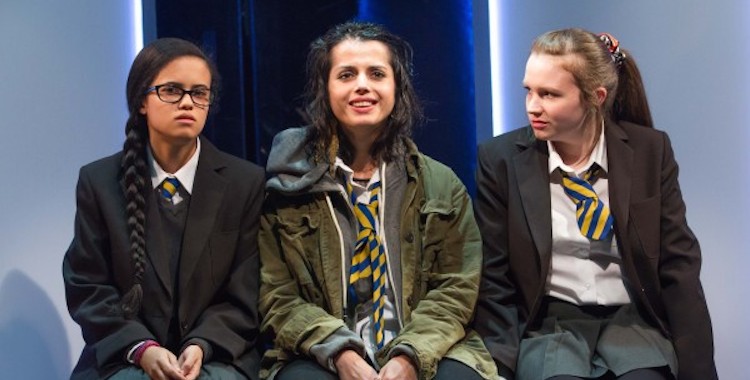
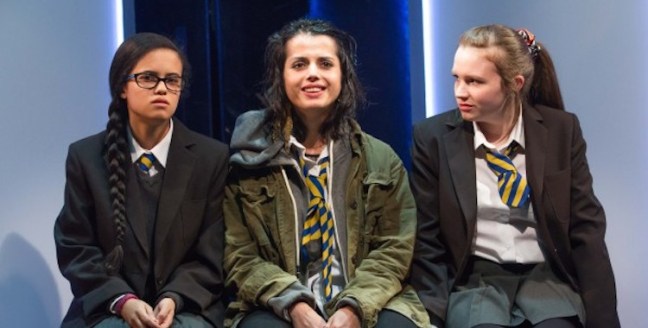
Told in flashback, Kapil’s plot also borrows from the good old dramatic tradition of the newly arrived outsider. Kalki turns up, swift and unexpected as the rainstorm that accompanies her, right in the middle of a religious studies class. Just as rapidly, she befriends two bickering schoolgirls – known only as “Meat” and “Betty”, the nicknames Kalki christens them with – and throws their lives into temporary, gleeful chaos. Then, like the rain, she evaporates. The only difference with this new girl is that she might just be the 10th incarnation of the Hindu god Vishnu.

All this is revealed in snatches, as Kalki’s best friends are questioned by a cop apparently on the hunt for the mysterious girl-cum-god. It’s a play – and a production from Alex Brown – that peels itself back bit by bit. Not given to brevity, Angela Terence and Jordan Loughran’s evasive classmates slowly flesh out their fleeting acquaintance with Kalki, from house parties to cinema trips to schoolyard spats. The drab, bureaucratic surroundings of Madeleine Girling’s set are repeatedly and startlingly split open, as coloured lights usher in Kalki’s dazzling presence.

The teasingly unravelled narrative drops frequent – and not too subtle – hints about the identity of its elusive protagonist. But Kapil’s vision of this final avatar of Vishnu, foretold to destroy all evil at the end of time, seems just as indebted to the comics read eagerly by Kalki’s companions as it is to Hindu scripture. Instead of arriving on a white horse, this harbinger of the apocalypse is an arse-kicking bad girl in ripped jeans and heavy eyeliner – the daydream alter ego, in other words, of every bored and bullied teenage girl.

Ultimately, Kapil’s play feels less about religion and more about the visceral, life-and-death experience of being a teenager, when every day might herald the end of the world. The supposedly life-shattering cosmic force that is Kalki is less vivid than the brutality and asphalt of the school playground. For “Meat” and “Betty”, both cruelly spurned by the cool kids, school is nothing less than a battlefield. Who wouldn’t want a god on their side in that relentless war?

Terence and Loughran make brilliantly believable teenagers, each an endearing mess of bravado, hormones and vulnerability. The problem is that alongside their all-too-earthly confusion, Amrita Acharia’s Kalki comes across as a flat if shimmering mirage of a girl. Not quite human, not quite divine, neither Brown’s production nor Acharia’s performance seems fully convinced by this immortal trickster. Just what are we supposed to make of Kapil’s creation?

The answer never quite arrives. Just as Voltaire’s words hang in the air, so too does the unexplained significance of Kalki’s sudden appearance. Kapil’s play has a certain appealing strangeness – how often do you see teenage angst bumped up against visiting gods? – but its extended riff on fantasy, religion and adolescence fades as quickly and enigmatically as its protagonist.

Photo: Helen Murray.

The Talented Mr Ripley, New Diorama Theatre

Talented-Mr-Ripley

Originally written for Exeunt.

All the best monsters are consummate performers. Think Shakespeare’s Richard III, stylishly murdering his way to the throne, or the deadly flair of Goldberg inThe Birthday Party. Tom Ripley, the brilliant sociopath created by Patricia Highsmith 60 years ago, is no different. He lives or dies on his ability to impersonate, relying on his quick-thinking skill as a performer to quite literally get away with murder.

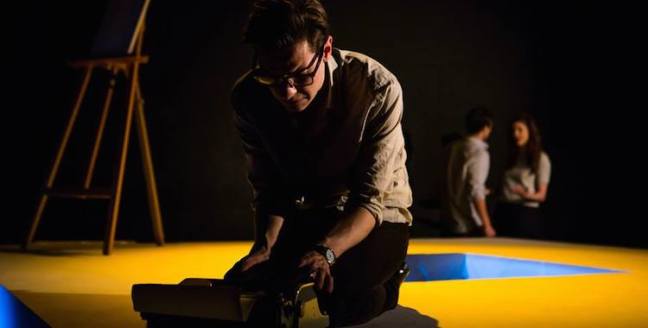
The Talented Mr Ripley, then, makes for compelling stage material. Tom is essentially a showman, if an awkwardly intense one. We first meet him in a New York bar, head twisting over his shoulder, convinced he’s being watched. It turns out he is, but not by who he expected. Instead, a wealthy businessman offers to pay Tom to bring his son Dickie home from Italy, where he’s run away on an extended European jaunt. Snatching at the opportunity, Tom soon finds himself in idyllic Mongibello, where jealous obsession with charming, carefree Dickie (an effortlessly suave Adam Howden) turns an increasingly murderous shade of green.

The Faction and director Mark Leipacher have wisely fastened on the narrative’s more performative qualities in their new adaptation. Tom, played with fidgeting intensity by Christopher Hughes, is forever trying on new roles, testing a new sweep of the hair or trick of the tongue. We are first of allhis audience, the crowd of attentive eyeballs that he fears and desires in equal measure. The more immersed Tom becomes in his performance, adopting Dickie’s identity bit by bit, the more he revels in the display. As an actor thirsts for the adrenaline rush of the stage, Tom is hooked on pretending.

This emphasis also lends a distanced, theatrical gloss to the protagonist’s cool and unrepentant acts of violence. To him, as to us, the murders he carries out are little more than dramatic punctuation marks. In one intriguing but slightly clumsy device, Leipacher repeatedly positions Tom as the star of his own (presumably imagined) movie, cutting and reshooting crucial sequences in his trajectory. While jarring, it hints economically at Tom’s emotional dislocation from reality; a brutal murder might as well be a thrilling plot twist.

The language of economy is one that characterises The Faction’s storytelling. Their streamlined version of Highsmith’s novel is loathe to waste so much as a second, rattling over the plot’s terrain at sometimes breakneck speed. The upside is that we move at the same pace as Tom’s nervously frenetic mind, seeing the world through his rapidly blinking eyes. Such furious velocity, however, also makes it easy to miss things. Peripheral characters zoom past and the kaleidoscope of European cities in the second half becomes a dizzy haze.

But for those familiar with the often adapted tale, The Faction offer an engaging enough take on this durable material. As ever, the ensemble manage to do a lot with a little, transforming the stylish, stripped back design – just a raised white rectangle, supplemented by Christopher Withers’ evocative shafts of light – into countless different settings. It’s when the focus is on storytelling rather than speed, though, that The Talented Mr Ripley is most absorbing.

Photo: Richard Davenport.

Destruction and Renewal

manuel-harlan

Originally written for Exeunt.

A cacophony of voices drowning each other out. A pulverised culture retelling its stories. An ear-splitting scream of sound. A beautiful howl of despair. A giant subterranean drain. A devastating downpour of blood. Oddly, sounds and images of destruction dominate a year that has been characterised – theatrically if not otherwise – by reinvigoration and renewal. Often the most thrilling theatre I’ve happened to experience has also been the bleakest in its take on where we are right now.

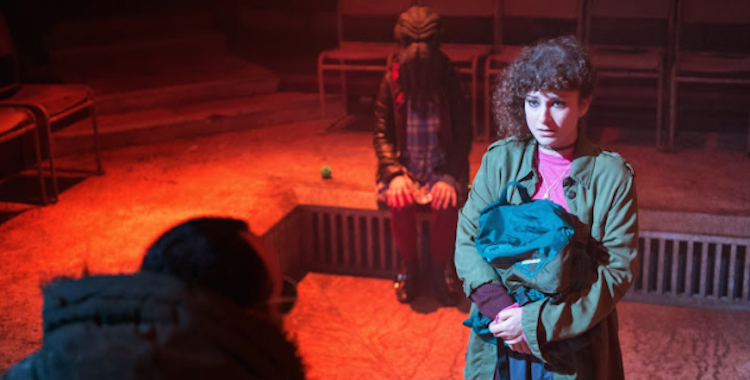
Pomona, with its stark diagnosis that “everything bad is real”, epitomises this strand of shows. Alistair McDowall’s Escher staircase of a play was exhilarating, it was intelligent, and it was pitch black in its outlook on the modern world. Sending a violent jolt through the Orange Tree Theatre, it dazzled with both its ambition and its swirling mind-fuck of a plot, tangling up fiction and reality in a way that was at once disorientating and unsettlingly familiar. Here was a dystopia of a distinctly uncanny flavour.

The dark undertones of Pomona echoed a mood that had already established its hold on the year’s theatre. In The Body of an American – an early highlight of my theatregoing year at the Gate – the devastation was found in faraway warzones and much closer to home. Alice Birch’s blistering Revolt. She said. Revolt again. ripped up both patriarchy and the rulebook, suggesting flawed and angry responses to a broken world. And two parts of the great “Chris Trilogy” (completed by Chris Thorpe’s knotty Confirmation), the beautifully furious Men in the Cities by Chris Goode and Chris Brett Bailey’s mind-blowing, eardrum-destroying This Is How We Die, offered two different but equally excoriating critiques of late capitalism.

Then there’s master of bleakness Beckett, whose swirling, cyclical monologue Not I – most famously performed by the late great Billie Whitelaw – was given a mesmerising (and astonishingly speedy) new rendition by Lisa Dwan at the Royal Court at the beginning of the year.

While much of the new work I saw in the last 12 months was unsurprisingly shadowed by dismal visions of the world, the attitude also stretched into some of the year’s best revivals. Ivo van Hove’s production of A View From The Bridge scratched decades of dust and school assignments off Arthur Miller’s 20th-century classic, transforming it into a muscle-clenchingly tense tragedy, Jan Versweyveld’s black and grey design matching the gloom of its dramatic atmosphere. Katie Mitchell’s version of The Cherry Orchard – paired with a scrape-your-jaw-off-the-floor gorgeous design by Vicki Mortimer – was exquisite in its quickening decay. And two Ibsen productions at the Barbican – Thomas Ostermeier’s An Enemy of the People and Simon Stone’s The Wild Duck – wrenched the playwright’s work devastatingly into the 21st-century.

Another of 2014′s great revivals was Our Town at the Almeida, in a US-imported production from David Cromer. It arrived billed as a bold reimagining, but much of what made it work was – apart from the stunning final reveal – determinedly ordinary. Thornton Wilder’s characters appeared to us as unremarkable yet remarkably real, making their everyday sufferings all the more heartbreaking. There was a similar sort of quality to Robert Holman’s Jonah and Otto, a play that made a quiet art out of conversation. Both productions gently asked us to pay attention.

Other shows demanded the attention of their audiences rather more forcefully. Dmitry Krymov’s Opus No 7, visiting the Barbican as part of this year’s LIFT, had me from the first of its giddying procession of images. The same director’s wonky take on A Midsummer Night’s Dream was perhaps not as beautiful to look at, but just as enchanting, capturing something of the strange alchemy of theatre. In the National Theatre’s newly reopened Dorfman (i.e. the theatre formerly known as the Cottesloe), meanwhile, glittering new musical Here Lies Love relentlessly swept me along with it even in its naffest moments. Most recently – and in spite of its flaws – the dazzling to look at Golem made me understand all the fuss around 1927′s wittily precise animation.

One of the aesthetic offspring of 1927 is Kill the Beast, a company who marry visual detail with grotesque narrative flair. This year their latest show, He Had Hairy Hands, had me roaring along twice to its tale of werewolves, cops and arse-kicking monster hunters, as well as offering hands down the best gag of the Edinburgh Fringe. It’s also up there grappling for most jofyul theatregoing experience of the year, in a close-fought tussle with Secret Theatre’s A Series of Increasingly Impossible Acts. The latter just about snags the prize, stealing my heart over and over with its flailing hopefulness – and its joy-drenched rendition of “Proud Mary”.

A Series of Increasingly Impossible Acts is also, in part, about how we tell stories. There were lots of stories about stories this year. Coincidentally running at the same time, Mr Burns at the Almeida imagined how our culture might be passed on after a future apocalypse, while Ellen McDougall’s production of Idomeneus playfully traced the same process of narration and mutation over previous centuries. The dangers of narrative appropriation were disturbingly outlined in Tim Crouch’s multi-layered, head-scratching Adler & Gibb; in Wot? No Fish!!, storytelling was a simple source of charm and love.

Along with all the theatre that filled me with joy, plenty that I saw this year also left me filled with tears. Spine‘s double-whammy of the personally and politically emotive forced those tears to spill over, as did James “the vacuum cleaner” Leadbitter’s overwhelmingly intimate Mental. After the small but exquisite experience of Greg Wohead’s headphone piece Hurtling, I walked the streets of Edinburgh with heart thumping and eyes stinging; ditto Hug, Verity Standen’s “immersive choral sound bath” (there’s really no better way to describe it than she does). Then there was Kim Noble’s brash but bruised You’re Not Alone, which took a long time to relinquish its haunting hold.

Elsewhere it was the lulz that stayed with me. That giant ballpond and the IRL memes in Teh Internet is Serious Business. The smart silliness of funny women Sh!t Theatre and Figs in Wigs, turning their humour to Big Pharma and online narcissism respectively. The funny-sad sequence of cheesy song lyrics in RashDash’s Oh, I Can’t Be Bothered. The sheer joy of watching Jamie Wood and Tom Lyall clown around with what appeared to be an alien haggis in Chris Goode’s remounted Longwave. Chris Thorpe and Jon Spooner being punk rockers in their pants in Am I Dead Yet? (the most funny-yet-thoughtful show you’re likely to see about kicking the bucket).

With the requisite predictability of the end-of-year round-up, no survey of 2014′s theatre can seem to get away without a mention of King Charles III. Mike Bartlett’s concept – a future history play in iambic pentameter – sounded like a potential disaster, but turned out to be a slice of genius. It was thoughtful, it was witty, and it was as much about our theatrical heritage as it was about the traditions of monarchy. And to top it all off, it was designed by the brilliant Tom Scutt, who once again came up with one of the designs of the year with his dizzying visual concept for the Nuffield Theatre’s excellent revival of A Number.

Now from the big to the small. I’m still unapologetically head over heels for one of the most intimate shows I saw this year: Andy Field and Ira Brand’s fragile, heart-fluttering put your sweet hand in mine. Seating its audience in almost uncomfortable proximity to one another and to the two performers, it gently prodded at closeness and distance and love in all its different forms. Just gorgeous.

Also small – in staging if not in ideas – was Barrel Organ’s debut show Nothing. This series of intertwined monologues, performed in a newly improvised order each night with no set or props, was just as bleak in its way as some of the year’s more explicitly dark offerings. For a confused 20-something, it also terrifyingly captured the anger, uncertainty and disconnection of a whole generation. It feels like one of the real discoveries of the year, as does Chewing the Fat, Selina Thompson’s glittery but difficult look at weight and body image.

After opening with destruction, I want to end on a slightly more hopeful note. For all the darkness and devastation, few pieces of theatre have stayed with me quite so insistently as Duncan Macmillan’s not-quite-monologue Every Brilliant Thing, which was indeed brilliant. For once, cliched claims of “it’ll make you laugh, it’ll make you laugh” were entirely justified, as I giggled and sobbed – sometimes at the same time – throughout.

Quite how a show about suicidal depression can be so life-affirming I’m still trying to fathom. It probably has a lot to do with the irresistible warmth of performer Jonny Donahoe, without whom I suspect it wouldn’t be half as good. But it also plays, as many of the best shows of the year have done, to theatre’s strengths: the unpredictability of live performance, the thrill of proximity, the possibilities of all being together, now, in the same space. Here’s to more of the same in 2015.

Photo: Manuel Harlan.
Nicobobinus

Screen-Shot-2014-12-22-at-15.02.59-600x393

Originally written for Exeunt.

’Tis the season for baddies, goodies, magic, adventure, fantasy, mythical creatures, song and dance … DumbWise and Red Ladder’s musical version of Terry Jones’s children’s book has them all, minus a chorus of “he’s behind you” but plus a whole host of narrative ingredients. Few family Christmas shows are quite so packed with plot.

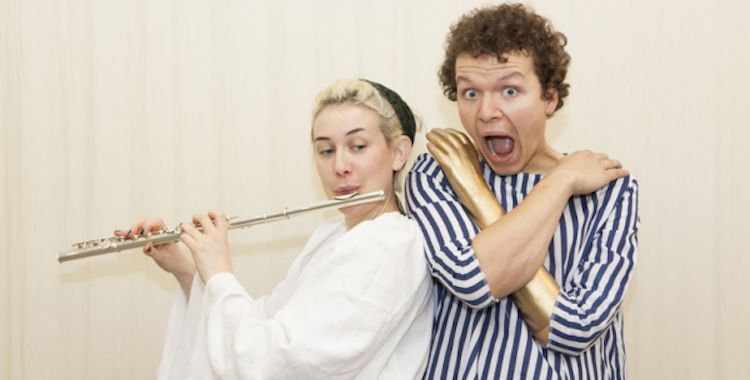
Our mouthful of a hero is Nicobobinus (Nico for short), a Venetian boy who can do anything – or at least so his best mate Rosie believes. These abilities are put to the test when his arm is turned to gold and he and Rosie set out on a quest to find the cure, following in the good old tradition of the magical voyage. Jones’s plot, though, is a whole lot more meandering than your average fairytale. Along the way, Nico and Rosie encounter pirates, gardeners, monks, kings, dragons, magical ships, moving mountains – the list goes on.

As in the fictional worlds of Roald Dahl, the adults we encounter are invariably greedy and vile, while it’s the kids who have the last laugh. From kidnapping pirates to hypocritical monks, everyone wants their share of Nicobobinus’s valuable limb, the covetous glint in their eyes rivalling its golden glimmer. These baddies are most definitely bad, but in a fashion that seems much closer to our own greed-led world than to that of cackling, crackpot villains. Think fantasy meets social critique.

The counterpoint to these grasping grown-ups is found in the friendship between Nicobobinus and Rosie, which is equal, guileless and loyal – and, of course, wins out in the end. Rosie (full of playful energy in Samantha Sutherland’s performance) is a gift of a female protagonist, given most of the guts and nearly all of the mischief in the pairing, while Nico (an equally enthusiastic Max Runham) cheerfully bounds headlong into the madcap adventures she sets them off on. And brilliantly, they both rescue each other; there are no damsels in distress here.

There is, however, almost every other fairytale element you can think of. While the page might be able to accommodate these many jostling characters, on stage it all feels a bit too busy, with a relentless “and then, and then” quality to the racing narrative. The songs inserted by Eilidh deBonnaire and performed by the cast of actor musicians, though often charming, only add to the cacophony.

If John Ward’s adaptation hesitates to bring out the scissors, it does capture something of the storybook in bringing Jones’s novel to the stage. The show is at its best when fiddling with the mechanics of storytelling, its performers doubling up as both narrators and characters. At moments, it is deliciously playful in its sly acknowledgement of the narrative tradition it slots into, offering plenty of arch looks to the audience and implicitly asking even the youngest of its viewers to think about how we share stories.

Kate Unwin’s simple but flexible set, meanwhile, contributes to the improvisatory feel of the performance, quickly being adapted – like the ragtag contents of a dressing-up box – for new uses in the twisting and turning narrative. Little is added, though, by ropey projections, which offer visual elaboration of what could more effectively be left to the imagination. Again, DumbWise and Red Ladder’s show suffers from a surfeit. And it’s here, despite its gleeful subversion of many tired tropes, that Nicobobinus might learn something from the fairytales it borrows from: sometimes simple is best.

Photo: Ellie Kurttz.

Arrest That Poet/Pete the Temp vs Climate Change

pete-1-600x3371

Originally written for Exeunt.

Theatre about climate change is fast becoming a genre all of its own. Just this month I’ve seen three separate shows on the subject: 2071 at the Royal Court and now a double bill of climate-activism-spoken-word (how’s that for a niche sub-genre?) at the Free Word Centre. Their approaches, however, couldn’t be further apart.

2071, a collaboration between director Katie Mitchell, climate scientist Chris Rapley and writer Duncan Macmillan, opted for lecture-as-theatre. Mitchell seated Rapley to one side of the stage, against a backdrop of scientifically vague and increasingly soporific projections, and got him to talk about the facts behind climate change. And that was it.

In comparison with the static, dramatically inert set-up of2071, performance poets Danny Chivers and Pete the Temp inject the topic with an invigorating shot of dynamism. Both are responding to climate change from a position of intense involvement – not as scientists, but as activists. Chivers’ show Arrest That Poetcharts his various run-ins with the police, recalling how he became an unlikely criminal in the pursuit of climate justice, while Pete the Temp pits himself (and his mouth) against the huge changes that threaten our planet.

Unlike 2071, which tackled an emotive subject from a position of cool, dispassionate distance, these two shows are soaked in feeling. While this could be problematic, short-cutting the facts with an appeal to emotion, it is instantly more engaging. These two men clearly care about what they’re discussing – and they have the criminal records to prove it. There is no pretence at objectivity (which is, in any case, always impossible) because they are deeply, subjectively invested in this cause. They have chained themselves to railings and staged stunts at energy conferences.

Given the context, however, perhaps this isn’t such an issue. It doesn’t feel particularly controversial to suggest that people who book tickets to see shows about climate change are probably already concerned about climate change. Unless the content is smuggled in under the guise of something else, it will attract a self-selecting audience. In which case, it may be more useful to galvanise audiences and arm them with the tools to create change rather than painstakingly relaying science whose conclusions they are, most likely, already aware of. Instead of using creativity to inform, why not harness it to act?

This is exactly what Chivers and Pete the Temp do. Similarly to Daniel Bye’s How to Occupy an Oil Rig or Mark Thomas’s Cuckooed, they transform protest and direct action from something intimidating into something joyously angry and engaged. Bookish, floppy-haired Chivers exploits the incongruity of his criminal convictions and his innocuous, middle-class, Guardian-reading persona, making us believe along the way that pretty much anyone could end up atop a power station fighting for a better planet – even if, like Chivers, your only skill is a way with words. And words themselves become weapons in this battle, using the mutability of meaning and intention (along with a cheering boost of people power) to upend the language of corporations and government.

Pete the Temp vs Climate Change is a little knottier in its handling of the same subject matter. The title itself is quickly undermined, as Pete recognises the inherent ridiculousness of one individual resisting a vast network of climatic and corporate forces. He also recognises the flaws of various different tactics, from charity campaigning to “armchair activism”, which is dismissed with particular disdain. The implication is that in reality we can only begin to change anything when we act together. If Pete the Temp is sometimes blunter and bleaker in his approach, it is tempered with the same rage-inflected humour that Chivers uses to such great effect. Activism can be both funny and fun – neither of which are words that came to mind while sitting in the stalls at the Royal Court the other week.

But the greatest contrast with 2071 – at least for me – is in the impact made. I left2071 feeling gloomy, small and pretty narked about the quantity of carbon that had been burned in order for me to sit through its sluggish hour and a bit, whereas I left the Free Word Centre’s double bill feeling angry and inspired and galvanised. When I walked out of the Royal Court, about the only thing I was ready for was a moan. But when I walked out of the Free Word Centre, it wouldn’t have taken much to convince me to occupy a power station.