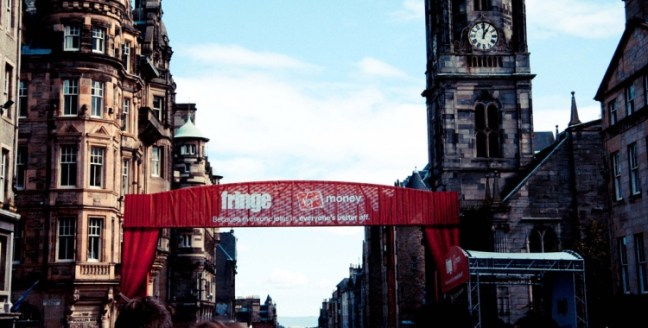
Edinburgh 2014

6063489676_ac7fbb4508_b (2)

To save inundating this site with new posts, I’ve collected below links to all of the many pieces of writing I’ve produced over the last month at the Edinburgh Fringe. Happy reading!

Fest:

Radical Stories (feature)
The Initiate
The World Mouse Plague
Unfaithful
Notoriously Yours
My Uncle’s Shoes
My Luxurious 50 Square Feet Life
Dear Mister Kaiser
Prelude to a Number
Red Riding Hood
Great Artists Steal
Guess Who: Meinzeye or Cold Corner?
Somebody I Used to Know
Mush and Me
The God Box: A Daughter’s Story
Conflict in Court
Land of Smiles
Symphony
Domestic Labour: A Study in Love
The Future for Beginners
The Eradication of Schizophrenia in Western Lapland
Jamaica Farewell
#MyWay
Early Doors
The Time of Our Lies: The Life and Times of Howard Zinn
The Ruby Dolls: Fabulous Creatures
Janis Joplin: Full Tilt
On the Upside Down of the World
Crazy Glue
Watching You (feature)

Exeunt:

True Brits
Every Brilliant Thing
Sister
Guinea Pigs on Trial
The Hive
Are You Lonesome Tonight?
Mmm Hmmm/Hug
Show Off
Return to the Voice
I Promise You Sex and Violence
Forest Fringe: You Must Sing (group article)
A Series of Increasingly Impossible Acts (group review)
More Fringe Things (group article)
Men in the Cities (group review)
Fringe Things (group article)

WhatsOnStage:

Edinburgh Fringe highlights
Beats North
Pioneer
Lungs
merry christmas, Ms Meadows
Wingman
Standby for Tape Back-Up
Kim Noble: You’re Not Alone
Our Teacher’s a Troll
No Guts, No Heart, No Glory
Blind Hamlet
Edinburgh Fringe Diary #3
Lippy
Hiraeth
Sirens
Silk Road
Freak
Dead to Me
Edinburgh Fringe Diary #2
Broke
He Had Hairy Hands
Spine
Chewing the Fat
Britannia Waves the Rules
Play Dough
Edinburgh Fringe Diary #1
The Fair Intellectual Club
Confirmation

Blog:

SmallWar
Light

Photo: Laura Suarez.

Beyond Caring, The Yard

Beyond Care

Originally written for Exeunt.

We all know the basic facts about zero hours contracts: the headlines, the numbers, the controversy. Wisely, Alexander Zeldin and his cast don’t attempt to repeat any of this. Instead, this knowledge flickers in the background of the piece they have devised together, its political intent very much implicit but no less furious for it.

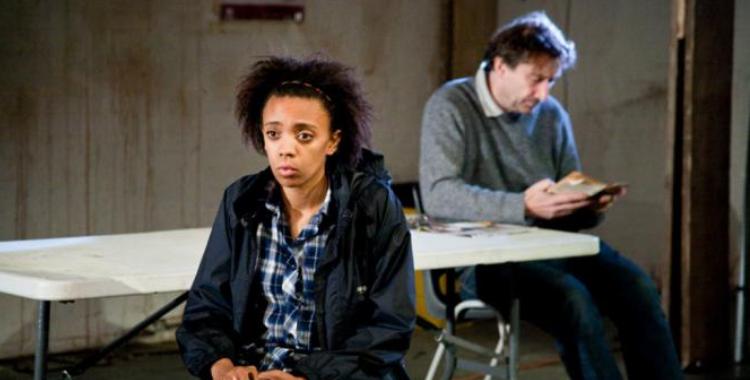
Beyond Caring depicts just five individuals caught in the ruthless cycle of modern employment and unemployment. Three women arrive for a fixed term cleaning contract at a factory, carelessly dispatched by temp agencies. One has been forced into work by Atos; it is hinted that another might be homeless. Working alongside them each night as they scrub down floors, walls and machinery is full-time cleaner Phil and boss Ian, who compensates for the disappointment of his job with small and occasionally cruel displays of power.

In presenting us with these determinedly ordinary characters, Zeldin asks us not to watch as audience members, but to look on as fellow human beings. It’s a subtle but crucial distinction. It’s also a form of spectatorship that takes a while to settle into. The punishing night shifts of the play unfold in uncompromising hyper-naturalism; silences, stutters and stumbles are all preserved, presenting us with human interaction in all its awkwardness and inarticulacy. Harsh, anaemic fluorescent strip lighting illuminates both audience and stage, thrusting us into the same drab and unforgiving world as that inhabited by these workers.

Falling into step with this sluggish, unpolished delivery demands an initial outlay of concentration, but it’s an approach that cumulatively builds in its power. By stripping away theatricality as we are accustomed to it, Zeldin focuses an audience’s attention; deprived of the dramatic conventions of naturalism, we are temporarily disorientated and made to look – really look – at these seemingly undramatic scenarios. While most stage realism aspires to a tidied up version of reality, this aspires to reality itself, jolting it out of its usual trappings and slamming it down in front of an audience.

As the piece goes on, repeating the relentless routine of shift after shift, the fine, accumulating detail becomes quietly devastating. Each performance is minutely textured, slowly amplifying the nuance of every last shrug and smile. A single gesture becomes infused with tragedy, while the corporate absurdities of a staff appraisal (“I am absorbed with ideas – agree or disagree?”) are as crushing as they are comic. Layered with Josh Grigg’s excellent sound design, which like the performances builds to an almost shattering intensity, the effect is one of blackening despair.

And yet. Somewhere in amongst the desperation and the drudgery and the alienation, there are still traces of tenderness. The title – at least in one sense – turns out to be something of a red herring; far from being beyond caring, these are individuals longing to care. The state might not give a shit, but they painfully, heartbreakingly do. And perhaps it’s there, in the foolish optimism and fleeting moments of connection, that we begin to glimpse just the tiniest splinter of possibility.

Wot? No Fish!!, Battersea Arts Centre

Wot-No-Fish-2_Credit-Malwina-Comoloveo-600x399

Originally written for Exeunt.

History. It’s just one fucking thing after another, right? Wrong – at least if Danny Braverman has anything to do with it. In Wot? No Fish!! Braverman depicts history as a helix: spiralling steadily upwards, seeming to return again and again to the same place, only to discover that in fact the world has changed. The past can be present, but never in quite the same form.

The same goes for the art that sits at the centre of Braverman and director Nick Philippou’s show. Wot? No Fish!! tells the story of Braverman’s Great Uncle Ab, a Jewish shoemaker raising his family in the East End of London. Ordinary enough, you might think. What is extraordinary about this particular family history, though, is the astonishing document of his life that Ab left behind. For almost 60 years, Ab drew weekly pictures on his wage packets for his beloved wife Celie; love letters in another form, sketching both the ecstasies and tragedies of their life together.

Wot? No Fish!! is their story, played out against the tumultuous backdrop of the early to mid 20th century, and the story of Braverman discovering these images decades later. As Braverman sifts through Ab’s wage packets, the past is located in the now, revealing that what we are so often looking for in history – particularly family history – is a trace of ourselves. The way in which Braverman shares these drawings with us, pointing out details and making gentle speculations, makes the piece about him and about us just as much as it is about Ab and Celie. With so much of this relationship inaccessible to us, we like Braverman are left to colour in around the edges.

The drawings themselves are tiny yet oddly exquisite. As Braverman shows them to us one by one, we can observe Ab developing as an artist, starting with basic doodles of kitchen utensils and graduating to acutely observed scenes of domestic life. We see Ab and Celie as newlyweds in the 1920s and then as the parents of two sons; we see them battle through the relentless anxiety of the war years; we watch as they grow old together, Celie barely ageing a day in Ab’s loving depictions of her. And perhaps most extraordinary is the compulsive honesty of Ab’s art, which is as likely to show heartache as joy.

Given the huge scope of Braverman’s inheritance, this show can only ever be a fragment – a partial image, like Ab’s drawings. But the care taken in the selection and crafting of the piece is palpable. Braverman welcomes us warmly into his family history, making the audience feel like family by extension. We could all be part of one massive Friday night dinner, trading anecdotes over the fish balls (yes, contrary to the exclamation of the title, there is fish). Community, a quality that theatre so often reaches for, is created simply and unfussily.

Like two strands of a double helix, simplicity and complexity are bound together. Yes, on one level this is just about one family, laughing and crying and struggling like us all. But through this one family and the particularities of their everyday life, Wot? No Fish!! opens out into ideas that are much bigger than itself: love, the value of art, the movement of history, the finding of meaning and hope in narrative, and how, even when the path stretches treacherously ahead of us, we find the optimism to go on.

Photo: Malwina Comoloveo.

Stories About Stories

Mr-Burns-2-resized-for-web-by-Manuel-Harlan-600x399

Originally written for Exeunt.

In my first year of studying English at university, we were all enrolled on a course titled ‘Literary Transformations’. The blurb on the website mentioned the story of Troy, literary tradition, The Iliad, mediaeval literature. I was less than enthusiastic. In the end, it turned out to be one of the best courses I took in three years of my undergraduate degree. Because actually, more than any of those things on the website, it was about the ways in which we tell and retell stories.

I was reminded of that course twice recently at the theatre. The first occasion was during Mr Burns, which over the course of 80 odd years in the wake of an imagined global catastrophe mutates an episode of The Simpsons through a similar series of transformations to that undergone by the Troy legend. The second was at Idomeneus, a playful exploration of the fate of the eponymous Cretan king after travelling back from war in Troy. And in between I saw Adler & Gibb, a piece about narrative appropriation of an altogether more disturbing character.

These shows are all stories about stories about stories; stories that are at once about the centrality, instability and dangers of narrative. We need stories, but stories can curdle and corrupt just as easily as they can comfort.

Much of the critical response to Mr Burns has fastened on playwright Anne Washburn’s use of The Simpsons as the cultural foundation of a fledgling new human civilization. Some shook their heads at the thought that pop culture would survive over great literature, while others suggested that an intimate knowledge of the television show was required to appreciate the play. There is a certain cultural snobbery to these criticisms, as Mark Lawson has pointed out, but they also miss the point spectacularly.

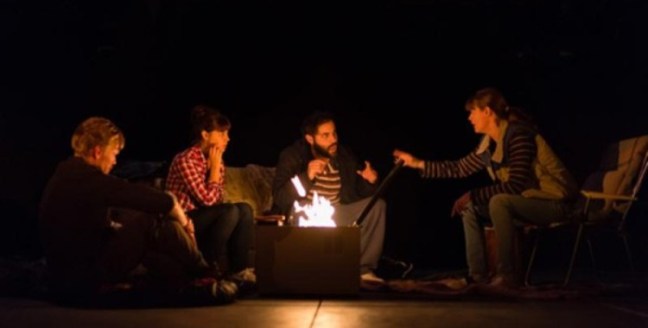
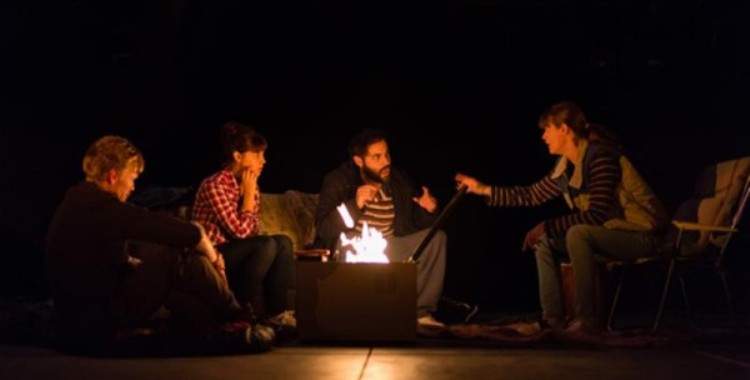
The reason The Simpsons works so brilliantly as the focal point of Washburn’s game of post-apocalyptic Chinese whispers is because it is already a gleeful mash-up of different cultural references. The Cape Feare episode that gets retold in each act (first as campfire tale, then as primitive performance, and finally as a gloriously gaudy opera) is a parody of the Robert De Niro film Cape Fear – which was itself a remake of an earlier film – and also contains allusions to numerous other sources. What better starting point to demonstrate how humans recycle and repurpose culture? There is also the suggestion that our cultural inheritance is as much a product of mistake and reiteration as anything else – a troubling thought for some, perhaps, but also a liberating one. Suddenly the behemoths of high culture look a little less indestructible.

For evidence that this habit of narrative borrowing and transformation is as old as the idea of civilization itself, just swap one Homer for another. The story of Troy that we see a partial glimpse of in The Iliad and that has filtered down through Western culture over thousands of years in countless different forms is perhaps one of the most mutable myths we have. In its intelligent, multi-layered retelling of one small facet of this myth, Idomeneus – both Roland Schimmelpfennig’s script and Ellen McDougall’s playful production – is sensitively attuned to the processes by which stories become solidified and then dissolved again into countless possibilities.

As realised by McDougall, the whole thing is an inventive modern riff on the Chorus of Greek tragedy. A collection of awkward, displaced strangers wander onto the stage and begin to tell us about Idomeneus, a Cretan king and general who has been away for years fighting the Trojans and has made a terrible bargain to ensure his safe homecoming. But where tragedy usually presents us with fate and inevitability, here the story is told in all its shaky contingencies, pausing and rewinding to offer an audience all of its possible permutations. This is no longer one story, but many, the once firm outlines blurred over the centuries. And now, Idomeneus appealingly implies, we have the choice to tell it how we like; we can change the outcome.

But there is a darker side to the playful, potentially democratising stories of Mr Burns andIdomeneus. In the recovering society of Washburn’s ravaged near future, an embryonic form of capitalism is driven by the desire for stories. Half-remembered lines of old television episodes become commodities to buy and sell, while competition between storytellers is cutthroat. And there is an even more crucial way (only lightly touched upon by Mr Burns) in which the stories that provide the foundation for a new civilization can shape what that civilization eventually becomes – for good and for bad.

The danger circling the multiple stories of Idomeneus is more elusive, only occasionally glinting beneath the grins and giggles of its mischievous players. Violence – conveyed in striking visual metaphors of water, ink and chalk – always sits just underneath the narrative, insistently saying something about how we tell stories of conflict. There is an implicit comment on the insidious ability of stories like this to rile and rouse, with their undercurrents of glory, honour and destiny – an ability that is unsettled, but remains exposed.

In Adler & Gibb, which is much more critical of our storytelling strategies than either Mr Burns or Idomeneus, narrative is both a tool for manipulation and a commodity to be traded. Tim Crouch’s knottily self-referential play shows us a pair of actors representing (at first cursorily, and then increasingly naturalistically) another actor and her coach, who are preparing to make a film about a fictional pair of contemporary artists, the eponymous Adler and Gibb. Supposedly on the hunt for authenticity, they break into the house shared by the two artists in their later years, only to be confronted by an ageing Gibb. This is all framed by another story in another time, as a nervy student delivers a presentation on the lives and work of the artists. Got that?

Throughout the show, Crouch repeatedly aims his fire at the ways in which artworks and the stories surrounding them are commodified by a fiercely acquisitive capitalist economy. Scorn is poured on the art dealers, critics, journalists, filmmakers and obsessive fans who all want a bit of Adler and Gibb – not just their work, but them as individuals, or at least the romanticised story that has been cultivated around them. Everybody wants a scrap of the myth.

There is also an important comment on the shapes that our stories take. Extending the focus on theatrical form that has characterised all of his work with co-directors Andy Smith and Karl James, Crouch needles once again at representation. Throughout the first half, dialogue is directed blankly out at the audience, while two young children disrupt the workings of the theatrical machine, standing in for various elements of the narrative and substituting props – a spade for an inflatable bat or a gun for a lobster (one of many sly nods to modern art). From this base, the piece moves progressively through realism towards a kind of Hollywood hyperreality, asking difficult, brow-furrowing questions about our artistic efforts towards “truth” and “authenticity”.

In one of the show’s crucial moments, we see a screen wheeled onto the stage and witness the first kiss between Adler and Gibb cruelly snatched for the sake of cinema – or, as the actor would insist, art. “Is this the way you want your stories?” Crouch finally seems to ask, as we watch brutality in the flesh morph into high definition passion on the screen. And the answer, uncomfortably, is “well, yes”. The high stakes drama and hyperreal film that emerge in the second half of the evening are far more gripping than the cool, distanced intellectualism of the first – a high risk but brilliant strategy from Crouch, Smith and James. If we stick out the frustration of the opening scenes, we get our pay off, but at a mind-twisting price.

In all of these stories about stories, there is a further comment to make about the presence or absence of irony – one of the most familiar characteristics of the way in which we mould our narratives in the 21st century. In his chapter in Vicky Angelaki’s excellent collection Contemporary British Theatre: Breaking New Ground, Dan Rebellato intriguingly suggests that a “turning away from irony” characterises a certain strand of British drama in recent years, pointing to examples such as Mike Bartlett’s Earthquakes in London and the work of Simon Stephens. He argues that in these plays, irony has been replaced with “a self-consciously naive sincerity”, or “radical naivety”.

While the cultural bricolage of Mr Burns might share many traits with postmodernism, what struck me about the play’s central retellings was their sincerity. Here are a group of survivors, completely without irony, piecing their world back together through the recovery of pop culture. Even the final act, with its knowing blend of references, is played remarkably straight. Irony is not exactly removed from Idomeneus, but again there is often a startling sincerity in the possibilities that the performers put forward for the characters whose story they are telling. And while it is difficult to know what to grasp onto in Crouch’s slippery play, the postmodern irony that suffuses so much contemporary art is given a ribbing at the same time as its strategies are appealingly deployed, leaving it in a problematic place. In these stories, are we turning, finally, to a new mode of sincerity?

Taken together, what these three pieces of theatre amount to is an ambivalent affirmation of storytelling. Ambivalent because stories emerge as slippery, dangerous things, as capable of betrayal as redemption. Affirmation because their very existence performs once again the importance of stories to human culture and their inherent possibility. Perhaps it’s all in the telling.

Photo: Manuel Harlan.
The Ted Bundy Project, Ovalhouse

Greg_Woheadmain1

Originally written for Exeunt.

The title of Greg Wohead’s show would have us believe that it is about Ted Bundy, the notorious American serial killer. And, in a way, it is. Wohead relates details from Bundy’s life, reproduces his confession tapes, teases out tiny details around the murder and decapitation of one of his victims.

But really, The Ted Bundy Project is about Wohead and about us.

At first glance, it might seem like an odd pairing of performer and subject matter. Wohead is so warm, so genial, so smiling. But then so, apparently, was Bundy. Wohead tells us that he was known for being a nice guy – or appearing to be, at least. He lured in his victims by quickly building up trust. He was handsome and friendly. He seemed … normal.

Wohead too seems normal, friendly, trustworthy. He opens the show by welcoming and thanking his audience, telling us a bit about Bundy, diffusing the tension with some nervous laughter. We hear a few details about Bundy’s life: his childhood, his education, all the familiar details of an unremarkable existence. And then Wohead comes sharply to the point.

“I guess you want to hear the juicy stuff.”

This desire for “the juicy stuff” is the real focus of Wohead’s show. He repeats and interlaces a number of different narrative strands: the murder of one of Bundy’s victims, the killer’s confession tapes, Wohead’s experience of listening to those tapes, a seemingly innocent memory of summer camp. By weaving together facts about Bundy and personal recollections, Wohead increasingly blurs the line between the two, gradually exposing the submerged violence in him and in his audience.

The whole thing is a dare to our dark side, a teasing appeal to the Ted Bundy in all of us. How much do you want to see? How much gore are you willing to stomach? How many of the gruesome details is your mind luridly colouring in? Like the complicity of imagination created among the audience in The Author, Wohead cannily leaves it up to us to manufacture the nastiest of the images he describes. On stage, there is not so much as one drop of blood, but our minds are bathed in horror.

Two devices are particularly striking. One is the density of fact and speculation surrounding the crime scene that Wohead constructs around one particular murder, blandly repeating the phrases “what we know is …” and “what we don’t know is …” It’s the precise, careful language of police investigations, but also the language of curiosity, of meticulously combing through details. It leaves us disgusted and yet fascinated, morbidly eager to hear more.

The other is a “reaction video”, a genre familiar to anyone who has spent a bit of time on YouTube. The video being reacted to is provocatively titled “one lunatic, one icepick”. You can probably guess the rest. But what Wohead smartly achieves by repeatedly projecting this reaction video – which shows a group of young men recoiling, covering their eyes and mouths, and in one case vomiting – is to hold a mirror up to his audience. The attraction to images of extreme violence is one we can all recognise, whether it comes from bestgore.com (visit at your peril – though I guess that’s the point) or movies like Saw and The Human Centipede.

In the end, it’s up to us to turn away or to keep on looking.

Photo: Alex Brenner.