Mr Burns, Almeida Theatre

Mr-Burns-77-the-cast-by-Manuel-Harlan-FB

Originally written for Exeunt.

Remember the one with Cape Fear? The parody of the film – the one with Robert De Niro, not the other one. There’s something about a tattoo. Maybe two tattoos? And a court case, there’s definitely a scene in a courtroom. Anyway, the Simpsons end up on a houseboat. They’re running away from something … Bart is receiving death threats, that’s it. They’re written in blood – no, tomato ketchup. Sideshow Bob is trying to kill him. Or is it Mr Burns?

This is the kind of stuttering, stumbling salvage that forms the patchwork fabric of Anne Washburn’s play, which mutates one iconic episode of The Simpsonsthrough a game of post-apocalyptic Chinese whispers. It’s cultural memory as mash-up. Gilbert and Sullivan by way of Bart and Lisa.

In the aftermath of an unspecified, civilization-splintering disaster – the hints suggest part pandemic, part nuclear catastrophe – a group of survivors are clustered around a fire. For comfort, they turn not to religion, but to pop culture. As flows and eddies of misinformation swirl around them, The Simpsonsbecomes a collective life raft. Memory is salvation.

Seven years later, as society is starting to wonkily slot itself back together, the television programmes (and commercials) of Before are big business. The characters we met in the first scene are now a makeshift theatre troupe scratching a living from the sale of nostalgia – and competition is fierce. Arguments erupt about which wine is most unchallengingly evocative (Chablis, apparently) and which pop hits to include in the ad-break music medley.

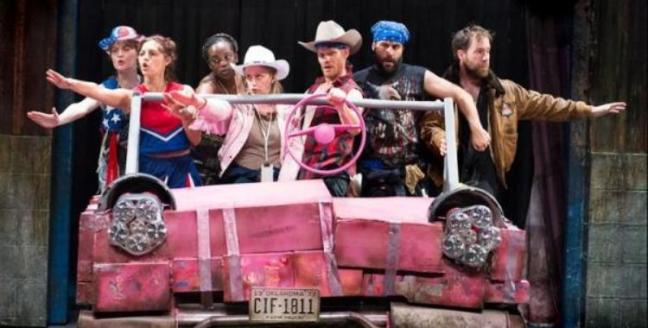
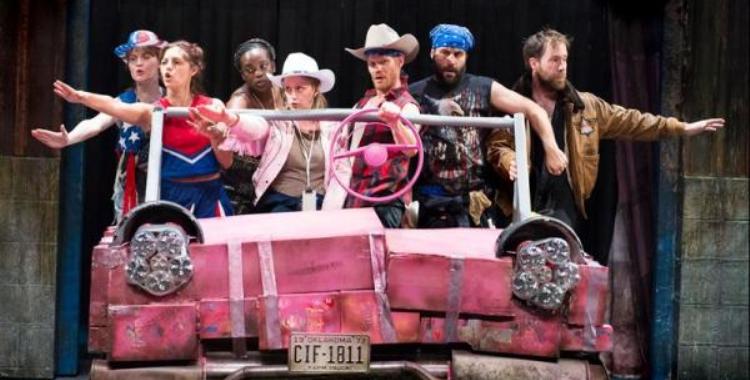
By the final act, which fast forwards another 75 years, the campfire story has gone through countless iterations and its batshit crazy telling has become a giddy whirl of cultural fragments. Director Robert Icke and designer Tom Scutt construct a teetering edifice of narrative and aesthetic bric-a-brac, from tattered scraps of Americana to oddly distorted movie allusions. Opera bleeds into Livin La Vida Loca. Eminem meets Britney. It’s blink-and-you-miss-the-reference fast, equal parts dazzling and disorienting. Where was that snippet of a melody from? Was that a nod to Peter Pan? How does the rest of that line go?

This kind of chaotic cultural bricolage will be familiar for 21st century viewers, but here it receives a crucial twist. Mr Burns is, as per its subtitle, post-electric rather than post-modern. There is no irony; this is a society earnestly retelling its founding cultural myth. And while some may shake their heads at the idea that it is The Simpsons rather than Shakespeare that survives the fall of civilization, Washburn has found a canny focus for teasing out the ways in which humans recycle and repurpose stories – a habit as old as the species. It’s just another kind of Homeric epic.

And there’s some intellectual weight behind the cultural cutting and pasting. Washburn’s imagined post-apocalypse is both a hymn to and an uncomfortable indictment of the artistic detritus that resiliently endures. Civilization, Mr Burnssuggests, is built on stories – but so is commerce and exploitation. Narrative sells.

It’s a thread that could be stretched further in Icke’s production, which sometimes gets distracted by its surface. The overwhelming range of references can obscure the fascinating cultural mutation at work, while the closing act is so shimmeringly strange that it is easy to get lost amid the woozy throng of pop culture. But while it may be a head-rush of a show, its ideas remain fizzing away for long after.

Photo: Manuel Harlan.

33, New Diorama Theatre

33

Originally written for Exeunt.

When I last saw The Wardrobe Ensemble, they were scrapping for flat-pack furniture, energetically retelling the story of a riot in a newly opened Ikea store. For their latest outing, they have fastened once again on fascinating real life inspiration, imagining the ordeal of the Chilean miners trapped underground for 69 days in 2010. Engaging in one long game of Chinese whispers, the company explore the events of those 69 days from the fictionalised perspectives of the miners and their families, the media frenzy forming on the surface, and the people all over the globe who found a strange sort of hope in the crisis.

Again, however, The Wardrobe Ensemble’s focus does not match their energy and invention. By taking on so many different viewpoints, the company find themselves moving frenetically from one to the next, failing to invest any one element with the attention it needs. In the mine itself, the trapped men struggle with the physical and mental pressures of their confinement, while also contending with a controlling psychologist who censors the letters from their loved ones; in the world outside, media and public alike get drunk on the story of miraculous survival. The lightly sketched scenes that these locations offer us are all enjoyable enough, but rarely achieve the impact of clearly delineated outlines.

At the outset of the show, the company admit that theirs must be a shaky reconstruction, continuing the sort of speculation that abounded during the crisis itself. But to acknowledge this continuing chain of information and misinformation without interrogating their own act of appropriation is either disingenuous or naive. The ravenous vultures of the world’s press are vividly captured here, frantically waving papers and yelling headlines, but surely The Wardrobe Ensemble themselves are guilty of a similar act of narrative theft and manipulation. The potentially problematic implications of this, however, remain underexplored outside of their prologue.

Oddly, one of the most fascinating and effective strands of the show is not set around the mine at all. Thousands of miles away, a man alone in his apartment in the middle of the night watches beaming Chilean faces on his television screen, the sound and brightness turned right up, and can feel the hope seeping into him. One by one, others join him – strangers united in their shared feeling for a group of people they will never meet. It is this overwhelming global response that feels as though it is the real heart of the piece, prodding gently at ideas of contemporary alienation and disconnection, as well as beginning to hint at the company’s own motivations for seizing on this widely documented subject matter.

Despite the frustrating distraction of the piece, as the narrative reaches its heady climax the diffuse elements come briefly together, demonstrating once again the company’s promising aesthetic. As in Riot, The Wardrobe Ensemble have a thrilling ability to use their bodies in surprising ways and are often at their best in the show’s more physical sequences. Objects, too, are used economically but inventively, building a whole world from scant resources. The company just need that visual ingenuity and instinct for intriguing material to be moulded into tighter dramaturgical shape.

Così Fan Tutte, London Coliseum

6371

Originally written for Exeunt.

How to solve the silliness and dodgy sexual politics of Mozart and De Ponte’s comic opera? Director Phelim McDermott’s answer is to embrace and subvert both at the same time, while gleefully transplanting the whole thing to the fairground. In this new ENO production, created in partnership with Improbable, the two pairs of lovers are vacationing in 1950s Coney Island, surrounded by the vivid swirl of the carnival. In this environment, where nothing is quite as it appears, it hardly seems surprising that the two men would reappear to their beloveds in the guise of teddy boys in the plot’s central test of fidelity. Here, the usual rules are suspended and all bets are off.

This colourful framework established, the concept allows McDermott and his creative team to riff playfully on their theme, balancing invention upon invention. From its joyfully witty curtain-raiser onwards, this Così Fan Tutte is a dazzling sideshow of visual ingenuity. Tom Pye’s stunning design, complemented by beautifully evocative lighting from Paule Constable, is every bit as enchanting as Mozart’s music – all brilliant colour, twinkling fairy lights and dramatic sunsets. McDermott’s direction has fun with the pliable playground that Pye has created, finding cheeky solutions to the story’s subtext. The lovers bounce euphemistically on carousel horses, while the revolving chambers of the motel where sisters Fiordiligi and Dorabella are staying hint mischievously at the women’s fickle passions.

The performers, too, inject an infectious sense of fun into Da Ponte’s story of love, confusion and deceit – none more so than Mary Bevan, whose sparkling Despina is deliciously manipulative in her nudging of the two women being cruelly tricked by their fiancés. Christine Rice’s spirited Dorabella is wonderfully unapologetic in the swift transferral of her desire, while Fiordiligi’s eventual submission to her feelings is made all the more affecting by the journey that Kate Valentine takes us on. The men lag behind both vocally and in the vividness of their characterisations, although Marcus Farnsworth and Randall Bills both attack the seduction sequences with energy and brio, and it’s a neat touch to have Roderick Williams’ charismatic Don Alfonso as the scheming ringmaster of the ensemble of circus performers.

But it’s not all about the fun of the fair. Beneath the amusement and allure, there is a grubby underside to the Coney Island setting, offering a necessary counterpoint to the candyfloss silliness of the plot. There’s an uncomfortable sleaziness sitting under the opening scene between Don Alfonso and the officers, hinting lightly at the misogyny implied in the opera’s central wager. Improbable’s skills ensemble, meanwhile, provide a brilliant visual commentary on events from their hovering presence in the background of scenes. As Fiordiligi and Dorabella expressively grieve and swoon, stall-tenders roll their eyes and chew gum; the saccharine romance of the seduction scenes is offset by sword swallowing and bearded women.

The function of this constant undercutting is to question the normalised wooing and manipulation deployed by Guglielmo and Ferrando and prevent the main thrust of the plot, which is gorgeously funny in this telling, from becoming a mere harmless comedy of disguises. There is certainly an emphasis on the lighter, more amusing aspects of the opera in McDermott’s production, enhanced by the sparkling wit of Jeremy Sams’ English translation, but the use of contrast also points up the ridiculousness and cruelty of the central plot device. In the fairground workers and sideshow performers, we find a foil and an alternative.

And the fairground itself, like one of Shakespeare’s forests, acts as a liminal, magical space – an arena in which anything can happen. Just as we delight in the surface humour and beauty of McDermott’s production, we might relish the escape that this space can offer, but grey, complicated reality always waits just around the corner.

Wolf Hall / Bring Up the Bodies, Aldwych Theatre

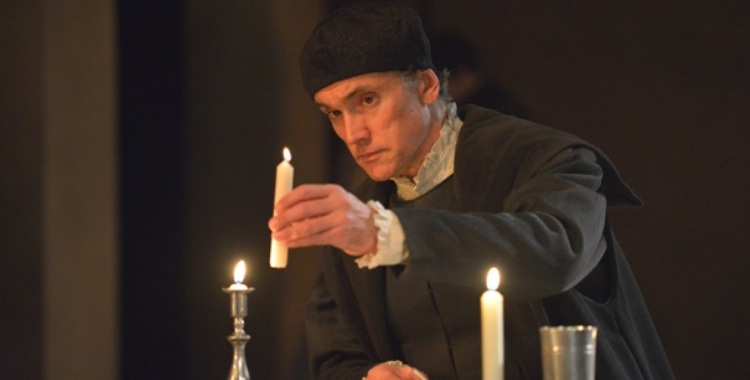
WOLF HALL. Ben Miles (Thomas Cromwell).  Photographer Keith Pattison.

Originally written for Exeunt.

Hilary Mantel begins her literary study of Thomas Cromwell with her protagonist on the ground, his face in the mud. The Royal Shakespeare Company open their version with a dance. On stage, Wolf Hall and Bring Up the Bodies are all delicate political manoeuvring; sly sidesteps covered with graceful flourishes, punctuated by frequent changes of partner. Condensed into six hours of scheming and seducing, what emerges most powerfully from Mantel’s historical narratives is the relentless tension of a world in which putting a foot out of place can mean the end. Murderous games clothed in courtly manners.

What is lost with the jettisoning of Mantel’s potent opening scene is a tangible grasp of Cromwell’s cruel, murky past, and with it the spur for his tireless social climbing. Inevitably, the transfer to the stage has sacrificed an element of the novels’ subjectivity, instead allowing us both inside and outside the protagonist’s mind at once. As he survives the downfall of his patron Cardinal Wolsey to rise steadily to Henry VIII’s side, eventually becoming the King’s most powerful advisor, Cromwell’s position is ever ambiguous. Is he the ultimate working class boy done good, using his influence to do what he can to ensure England’s stability, or just a ruthlessly ambitious bully?

The intricate deals and intrigues of Mantel’s novels, unfolding over some 1,000 pages, are played out with astonishing speed and dexterity by adaptor Mike Poulton and director Jeremy Herrin. The backdrop of Cromwell’s rise inWolf Hall – and arguably his window of opportunity – is the King’s long mission to annul his first marriage to Katherine of Aragon and wed Anne Boleyn; Bring Up the Bodies, no less tumultuously, charts the bloody decline of Henry’s second wife. In both, we see Cromwell clinging onto power with the dirtied tips of his fingers, doing what he must to both satisfy Henry’s fickle desires and secure his own position.

The narrative economy of Poulton and Herrin’s adaptation intensifies the teetering delicacy of Cromwell’s political balance. Solutions must be manufactured in the space of a breath, remedies administered in the sweep of a cloak that divides one scene from the next. Remarkably, however, the action rarely feels rushed. The storytelling of several pages becomes the work of a moment: Cromwell’s wife poignantly slips from his grasp, her death told in a single image; elsewhere, the sight of a row of squabbling advisors stopping to cross themselves at the appearance of a statue of the Virgin Mary succinctly captures the fearful hypocrisy of the age.

While story translates smoothly – some unavoidable streamlining aside – the rich, immersive world of Mantel’s novels is not so easily adapted. For anyone who has read them, the memory of the books’ sumptuous prose colours the gaps left by the narrative juggernauts of the plays, which motor steadily forward. David Plater’s sculpting shafts of light do their best to offer some of the atmosphere that is so vivid in the novels, as does the evocative music and sound design of Stephen Warbeck and Nick Powell respectively. The minimal stone and fire of Christopher Oram’s imposing set design, meanwhile, provides a fitting crucible for the passions of Henry VIII and his courtiers, loomed over at all times by the ghostly presence of the cross.

It is not only religion that haunts in this pair of plays. Poulton and Herrin offer us supernatural visitings of all kinds, rendering the ghosts of Cromwell’s mind visible on the stage. The return of the dead in this way, their figures occupying the same space as the living, hints at the accumulating layers of history – history that, by Cromwell’s hand, can be easily swept aside or manipulated. Often, however, their arrival jars with the action, heralding awkwardness rather than ill omens. If the opening scenes of Hamlet should have taught us anything by now, it’s that ghosts on stage are perilously difficult to pull off.

Although the adaptors have done well in preserving much of Mantel’s narrative and wit, the same cannot always be said for her nuance. Several of the lesser characters are little more than ciphers here, while a complex awareness of the historical debates surrounding the Tudor era is swapped for classroom fact-dropping and occasionally laboured exposition. At times, thanks to the continuing cultural ubiquity of the Tudors, it feels as though an audience are being offered bonus points for historical knowledge and the smug advantage of hindsight. The bleated “I’m nobody, just Jane Seymour” is greeted with a collective, self-congratulatory chuckle, while Wolsey’s confident pronouncement that he has seen the last of Anne Boleyn raises one of the biggest laughs of the afternoon (surpassed only by a comment about the fresh country air in Stoke Newington).

But ultimately, whatever its other strengths and flaws, any version of Mantel’s novels was always going to rise and fall on the shoulders of its Cromwell. Fortunately, Ben Miles is an inspired choice. While we might not get the full picture of his humble origins (repeated cries of “blacksmith’s son” do not a back story make), Miles’ Cromwell is a brilliantly realised charmer, as compelling as he is shrewd. Intelligence, humour and cold calculation all glitter behind his dark eyes, which also occasionally flash with the instinctive violence bred of his days as a soldier. But just as we find our sympathies helplessly aligning with this smoothly pragmatic politician, Miles sharply pivots, unsettling any easy interpretations of Cromwell’s motives.

The rest of the cast shape-shift around him, the majority of performers confidently taking on a collection of different roles. As the King’s successive queens, Lucy Briers, Lydia Leonard and Leah Brotherhead are suitably stubborn, seductive and shy respectively, while adding touches of complexity to the archetypes that history has moulded these women into. Leonard in particular underlines Anne’s sharpness and fatal arrogance with a shade of insecurity, while Brotherhead’s initial, squeaking nervousness gradually mutates into meek but assured grace. And if Nathaniel Parker’s Henry VIII is not quite as dangerously charismatic as history has taught us to expect, his mercurial personality certainly drives those who circle cautiously around him, hoping to keep their place in the precarious dance of power.

Photo: Keith Pattison.

Thebans, London Coliseum

6208-600x397

Originally written for Exeunt.

Sophocles’ trilogy of Theban plays, charting the fall of Oedipus and his doomed offspring, carry their fair share of cultural baggage. They are now more historical documents than dramas, presenting a challenge to modern adapters seeking to inject them with new life, yet the turmoil and tragedy of Oedipus’s famous fate continues to fascinate and inspire.

Julian Anderson’s first opera seizes on this material and gives it a shake, achieving an impressively fresh rendering of this trio of tragedies. Anderson and librettist Frank McGuiness have condensed and reshuffled Sophocles’ three plays, transforming them into three swift acts and disrupting their chronology. First, under the subtitle “Past”, we see the familiar revelations of Oedipus the King, before being catapulted into the “Future” in the second act to witness Antigone’s destruction at the hands of Creon. Finally, the action rewinds to the “Present” and Oedipus’s death at Colonus, closing on an anguished note of lamentation from the daughter soon destined to come to her own bitter end.

Dramaturgically, the episode at Colonus offers a much more satisfying conclusion than that of Antigone, allowing the action to end on a shattering howl of grief. But beyond this dramatic effect, Anderson and McGuiness’s rearrangement of chronology offers an intriguing examination of fate, at times enhancing and at others unsettling the inexorability of events. Themes and emotions periodically resurface, creating the impression less of a tragic slide to destruction than of a viciously repeating cycle. Score and libretto also contain interesting internal tensions, the tussle of voice and music reflecting a struggle throughout between will and destiny.

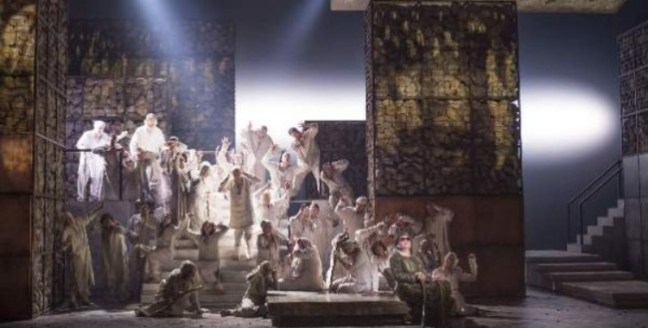
Despite distinct resonances across the acts, Pierre Audi’s production strikingly shifts mood for each episode of the trilogy. The curtain first rises on a classical scene, the white-draped bodies of the chorus held still like statues against Tom Pye’s simple but imposing stone-grey design. White gives way to black in the tense second act, as a militaristic state has been established under Peter Hoare’s Creon (as smoothly persuasive in voice as in politics), its discipline outlined in the sharply uniform movements of its subjects. Colonus, in the final scene, is an other-worldly wasteland, eerily echoing with the disembodied voices of the chorus – for whom Anderson has written by far the strongest part.

It is in its narrative economy, however, that Thebans disappoints. Anderson and McGuiness have hacked away plenty of dead wood from Sophocles’ tragedies, but with it too has gone some of the essential foliage. Shorn down to its bare essentials, the plot loses any prelude to tragedy, failing to forge a connection with the protagonists before their fortunes violently plummet. In the succinct second act especially, character is sacrificed to atmosphere, with Antigone dead before we are offered any opportunity to feel her misfortunes. McGuiness’s libretto, meanwhile, is direct to the point of bluntness in its trimming of Sophocles.

Anderson’s score cannot quite compensate for these gaps in character, rarely communicating the full tragedy and despair of Oedipus’s downfall. It is better instead at conveying unease, be it through the disquieting bass tone of Tiresias’s prophecies or the mounting tension of the second act. Only in the closing moments, as Julia Sporsén’s bereft Antigone devastatingly grieves for her father, does the impact of events finally land its punch – by which time, it is too late.