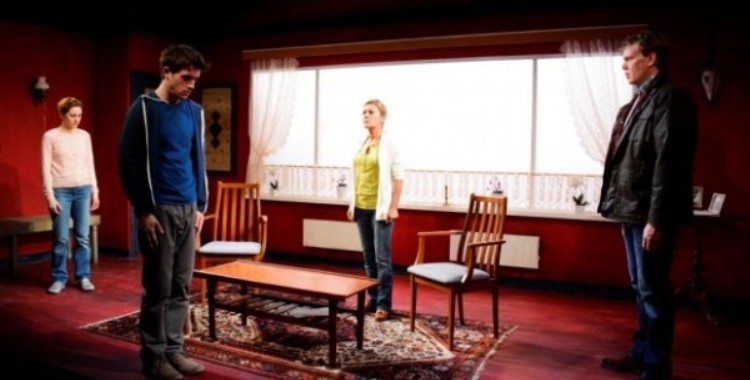
Transform 14: This Building is Full of Secrets

Originally written for Exeunt.

???????????????????????????????????????????????????????????????????????????????????????????????????????

A journey through a door marked “no entry”. A road trip that covers hundreds of miles without moving an inch. A game in which there are no winners. A dream. A plunge into darkness. A constellation of stories.

The statement of intent running underneath the West Yorkshire Playhouse’s fourth annual Transform festival, emblazoned on the front of its attention-stealing pink and purple brochure, is “reimagining what theatre can look like and what it can do”. The varied festival programme is true to this intent, incorporating everything from off-site interactive performance to small-scale storytelling; from intimate audio tours to late-night cabaret and live art. Some of the work is finished, some of it is embryonic. Around the edges of the festival, meanwhile, there are installations and conversations, inserting art into surprising places.

As festival producer Amy Letman explained to me last year, each event to date has had its own distinct identity. When I was in this same theatre 12 months ago, a little patch of the outdoors had been brought into the bar, suggesting the permeability of theatre and city. While last year’s festival was very much about Leeds, this year’s focus seems to be much more on Transform as a recognisable entity in itself. There’s an appealing sort of swagger, both in the bold colour scheme – volunteers in loud pink T-shirts are dotted around the Playhouse, making the festival impossible to ignore – and in the programme.

This confidence is perhaps most evident in the Playhouse’s foyer and bar, where the festival has occupied the space and become a throbbing hive of activity, drawing in curious audience members as they spill out of the Quarry Theatre. On Friday night, a band plays until late and the area around the bar is packed with bodies. It might have taken a few years, as a number of those who have been involved since the beginning admit, but Transform feels at home here now.

Play the game.

As anyone who has ever had to claim Jobseeker’s Allowance will know, the Job Centre can feel like something of a farce. It is this strand of absurdity that artist Selina Thompson has seized on, creating a new piece of interactive theatre that is as fierce as it is funny. It Burns It All Clean, commissioned by the West Yorkshire Playhouse specifically for Transform, is a silly, satirical trip through a new kind of job centre, with the grand prize of £56.80 for the players who come out on top.

Speaking about her research, Thompson tells me that what was most striking about the conversations she had with jobseekers was the number of people who talked about “playing the game”. Arriving to it from the outside, the benefits system can seem like a labyrinth of unspoken rules, which Thompson has deliberately reflected in the structure of her show. As players in a surreal, constantly shifting game, it is impossible to gain a solid footing.

While taking part in the show – which is just as entertaining as it is troubling – I was also made painfully aware of my urge to perform. This may not be a surprising reflection for a piece of interactive performance, which has a tendency to make its audiences think about their role within the work, but it also prompted me to consider the damaging ways in which the unemployment system might demand people to perform their worthiness. All too quickly, I found myself eager to please – to play the game.

I am interested to hear that Thompson hopes to develop the work further following its outing at Transform. In its current state, It Burns It All Clean feels like an intriguing starting point more than anything else; a striking initial provocation. Its power lies in the transition between contained, involving silliness and the quiet, reflective space it offers as an epilogue to its climax. This is political anger with a smiling face, slowly peeling off the mask.

It is apt that this is playing at Transform alongside Gym Party, Made in China’s anarchic critique of the competition that drives capitalist societies. The show, which I saw in various stages of development last year, enacts a similar movement to It Burns It All Clean, containing a simmering rage beneath its shiny exterior. It is also, like It Burns It All Clean, about games – and about winning. In a system that makes losers of so many of us, it would seem that we still can’t resist playing.

This building is full of secrets, whispered into cracks in the wall. Around hidden corners, dreams surge against the rocks. This building is the product of your imagination.

Backstage spaces, however tatty, always hold a strange kind of magic. It is this thrilling, intangible charge that Hannah Bruce & Company exploit in their new piece, the second of this year’s Transform commissions. The Claim is essentially an audio guide with a performance element, but with the added appeal of leading audiences out of bounds, behind “no entry” signs and through closed doors. These spaces in the bowels of the West Yorkshire Playhouse are not just hidden away; they are secret, forbidden, kept closed off to prying eyes.

While the illicit frisson of trespassing is tempered by a framework of permission – each audience member is always part of a group, accompanied by an usher – there is still an undeniable excitement that comes hand in hand with being offered access to these secret spaces. The journey, which takes place along different tracks for difference audience groups, is constructed with care. It begins in the auditorium of the Quarry Theatre, a familiar area of the Playhouse, but offers us a view of this eerily empty space from different angles. Peeking in from its thresholds, we catch glimpses of dancers moving through the sea of seats, while the stage behind is viewed in fragments.

Max Jones’ gorgeous, evocative set for current Quarry show Of Mice and Men provides a beautiful and occasionally haunting backdrop for these early sequences, its canopy of lightbulbs dimly glowing above us. It is when the piece guides us further away from the stage, however, that it becomes most compelling. Its revelatory moment arrives when we are guided into a vast, shadowy cavern beneath the theatre; it is the one moment in which a real connection with the building’s past and the housing complex that used to sit on its site is felt.

The Claim suffers a little from the usual challenges of audio works, struggling at times to integrate the instructions that guide us around the building and the enticing calls to our imagination. Distractions impede the fluid movement it seeks, never allowing an audience to get truly lost in memories and musings. There is, as with much interactive theatre, an invitation to engage that is not quite seen through.

That said, the piece manages to render these backstage environments truly magical, at the same time as offering an intriguing sideways look at the world. As we are released into the cool afternoon air, I walk away thinking about everyday spaces and the hidden traces of beauty and memory that might cling to them.

“We invite into the room as much – of everything – as the room can help us to hold.”
Chris Goode

There is an intoxicating sort of calm to Chris Goode’s rehearsal rooms. On stepping over the threshold of the wide, airy third-floor space, I feel that perpetual knot of anxiety somewhere in my chest loosen a little, while the relentless ticking away of the minutes seems to temporarily pause. Melting into a chair on the edges of the action – I prefer to be a quiet, unobtrusive presence in the room – I instantly relax, settling quickly into absorbed observation.

I am here to watch Chris Goode and Company work on Albemarle, a new project about dreams, hopes and utopia. As I will be missing the sharing on Sunday, the company are offering me a snatched glimpse of rehearsals. The experience is enthralling but all too brief. The company are mostly weaving together two separately developed strands, as actors and dancers are united for the first time this week. The group share a series of prepared gestures, which are oddly captivating in themselves, before these are placed within the context of a movement sequence.

For a few minutes, with music playing in the background and later overlaid with a piece of text read aloud by Goode, the performers navigate a grid that has been outlined on the floor in tape. As they move carefully along its lines, they freely deploy the series of gestures, which range from hugging to waving to kneeling. These gestures can be either solitary or communal, but is fascinating to witness the urge to mirror and embrace; as it evolves, the sequence seems to become more and more about encounters between the individual bodies. I am reminded of Tino Sehgal’s These Associations in the Tate Modern’s Turbine Hall, with its swirl of moving bodies and fleeting engagements.

After my peek into the rehearsal room, I have lunch with Goode, during which we talk about the project, the festival and the context of work in progress sharings. The Albemarle sharing has been framed as a “sketchbook”, which is doubly apt. More than the woolly “work in progress” tag, it suggests unfinished fragments, delicate outlines that still need to be filled in. It also hints at the presence of artist Lou Sumray in the room, whose gorgeous line drawings capture the movement and energy of rehearsals far more effectively than any usual method of documentation.

The difficulty with festivals such as Transform, as we discuss, is how to talk about the work that they encompass, as well as drawing meaningful links between the festival line-up and the rest of the theatre’s programme. It has been observed that Transform now feels much more like an integral part of the Playhouse’s life than when it began three years ago, gradually making a home for itself within the programme and feeling more closely associated with the theatre’s identity in the city. It’s all about connections.

I am also short of time for Ring, David Rosenberg and Glen Neath’s unsettling “sound journey” in the pitch black, which I experienced last year at Battersea Arts Centre. I do, however, get to take a second trip to Cape Wrath, Third Angel’s charming and intimate storytelling piece. The show, which takes place in a minibus parked up outside the Playhouse, recalls two journeys: that of Alexander Kelly’s grandfather to Scotland’s most north-westerly point and the retracing of that journey by Kelly over 20 years later. It is gentle, enchanting and absorbingly told by Kelly – everything you want from a story.With a wonderful sort of irony, I run out of time for Abigail Conway’s installation Time Lab, which invites visitors to dismantle a wristwatch and create something new from its remains, reclaiming and recycling the minutes that usually dictate our lives. The closest I get to it is a brief conversation with artist and performer Ira Brand on the way to It Burns It All Clean, during which she describes the desire to spend longer with the piece, to get absorbed in the intricate care of the activity.

Stories are also at the heart of Fast Cuts and Snapshots, the Inua Ellams rehearsed reading that is presented by Fuel on Friday evening. Ellams’ new play takes a barber shop for its static setting, positioning this space as a focal point for the many characters who revolve around it. These loquacious customers discuss everything from politics to football, often reflecting on the situation in their native African states and their experiences of living in the UK. The action is frenetic, cutting swiftly from scene to scene, while the characters’ wide-ranging ruminations occasionally feel contrived. As it settles down, however, the piece becomes quietly compelling, sketching a vivid portrait of this lively social hub.

There are other fragments of the festival that I miss in my hurried two-day visit. I never manage to sit down for a conversation with Sonia Hughes, who is inviting strangers to join her for a cuppa and a chat in the Playhouse’s foyer, though I do fall into conversations with several other festival-goers over the two days. I miss two shows about love – Love Letters Straight from Your Heart and put your sweet hand in mine – and one about death: Unlimited Theatre’s new piece Am I Dead Yet? And it is a bit of a wrench to leave before the Transform Variety Night, hosted by self-described “light artist” Scottee.

Reflecting on the festival a year ago, I noted its “intoxicating, transitory buzz”, wondering how this might extend into something more permanent. That buzz remains, as do odd traces of the festival’s spirit in the Playhouse’s main programme. Vincent Dance Theatre’sMotherland – with one of the boldest and best posters I’ve seen in a long time – is following fast on the heels of Transform, while the theatre’s Furnace strand continues to support artists such as RashDash. As artistic director James Brining puts it, “by getting more artists creating, exploring, experimenting within the building – and that doesn’t necessarily just mean the walls, it’s in the bloodstream of the theatre – we are animating the metabolism of the theatre”.

Photo: Richard Davenport.
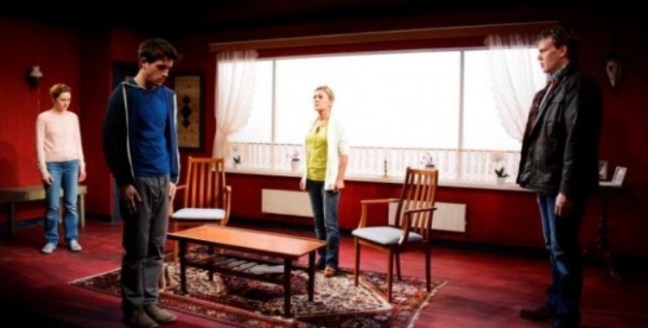
The Dead Dogs, The Print Room

dead-dogs-600x319

Originally written for Exeunt.

There is a lot of “yes” in The Dead Dogs. Peppered throughout the circling, repetitive conversations of Jon Fosse’s characters, the affirmative is used not just to answer questions but to introduce, to punctuate, to evade. This sharp, deceptive syllable takes on the character of Pinter’s pauses, standing in for communication and connection. What is nominally acquiescence instead comes across as refusal; an apparent positive is scrubbed out by its bleak opposite number.`

This is characteristic of a drama in which deliberately bland language acquires sinister, unsettling overtones. In the Norwegian playwright’s opaque tale of a family pushed to breaking point, dread creeps up like fog off the fjords. Its first hints come in the form of a missing dog, whose eventual fate might be guessed from the title. Its owner, an isolated and blankly uncommunicative young man living alone with his mother, refuses to go out and look for it; his mother is more concerned about stocking up on coffee for the arrival of her daughter, who is making a rare visit with her husband.

As the lines of this family are sketched with broken speeches and anxious glances, the suspicion of something rotten begins to pervade the unhurried drama. Why is the young man so deeply attached to his dog? Why has his childhood friend suddenly returned? What keeps his sister away? And why is there such hostility towards her husband? These questions and countless others dissolve almost as soon as they are formed, forcing an audience to keep guessing. As one character observes, “there’s something that’s not quite right”, but the precise nature of this wrongness is stubbornly elusive.

The taut, promising tension of early scenes, however, is allowed to fall limp in Simon Usher’s tentative production. Seemingly uncertain about how to stage Fosse’s puzzle of a play, his lacklustre, uneven interpretation gives in to bewilderment. On the page, Fosse’s spare dialogue – all shorn sentences and punctuating pauses – has a spiky sort of poetry. In this version, though, its unfinished statements and looping repetitions become cumulatively deadening, relieved only by long, lingering silences.

The tone is part domestic turmoil, part surreal, heightened discomfort. It is as though a naturalistic family drama has lost its way and found itself in a scorched Beckettian wasteland, unsure of how to proceed. Certain performances, such as Jennie Gruner’s delicate portrayal of the sister, cling fast to emotion despite the alienation of the dialogue, packing each last look with unspoken meaning. Danny Horn’s young man, on the other hand, is oddly compelling in his withdrawn silences, becoming an uncanny presence, while there is a jagged edge of desperation to his increasingly fraught mother in the hands of Valerie Gogan.

A similar sense of confusion haunts Libby Watson’s design, which places clunky, outdated furnishings against garish red walls. The colour choice is almost painfully loud; paired with the bright, blank white light glaring in from the large window, it makes for an eye-watering sort of purgatory, immediately gesturing towards the play’s uneasy psychological landscape. But its textures, like those of the performances, clash in a way that is ultimately more frustrating than it is interesting. There is more than a hint of fascination in Fosse’s odd, perplexing play, but this production makes it increasingly difficult to fasten upon.

Chewing Gum Dreams, National Theatre

chewinggum-600x432

Originally written for Exeunt.

The image of chewing gum is a vivid, evocative primer for Michaela Coel’s miniature powerhouse of a monologue. It’s sweet, insubstantial, the stuff of adolescence; its bubbles, like the dreams of Coel’s teenage protagonist, are light as air. But they are also fragile and punctured at the lightest touch, leaving behind little more than a sticky mess, swiftly discarded and trodden underfoot.

14-year-old Tracey Gordon, Coel’s spiky, outspoken narrator, is the sort of girl who teachers roll their eyes at and adults edge away from on the bus. She passes the journey into school mercilessly taunting her cousin and whiles away maths lessons with talk of tits and condoms. Yet for all her swagger and gobbiness, she is also just a teenager, smarting from the world’s cruelties and buzzing with the experiences it offers up. Life is the sharp slap of a hand and the melting gaze of a boy.

Coel’s giddy, fast-paced narrative is a jumble of contrasts. In one moment, a friendship that has been built over years crumbles in seconds; in the next, a crush explodes into life with firework intensity. These violent shifts in tone, far from derailing Coel’s play, beautifully convey the instability of adolescence and its hormone-fuelled careering from ecstasy to despair. Likewise, Coel is adept at realising the internal contradictions of her young characters, capturing with razor-sharp accuracy both the vicious cruelty and fierce loyalty of teenagers.

The vitality and charm of Coel’s performance more than matches the observational flair of her writing. The central figure of Tracey is sketched with detail and compassion, while the cast of supporting characters are inhabited with a vividness that simultaneously brings them to life in their own right and suggests Tracey’s own talent for mimicry and delight in performing. With her mean turn of phrase and killer comic timing, Coel’s teenager clearly relishes her position in the centre of attention.

What ultimately makes the piece, however, is the vulnerability and lack of self-worth that peeks through the bolshy exterior. Young, black and trapped in a cycle of poverty, Tracey has no illusions about her position in life: “I’m not smart enough to be someone; I’m just smart enough to know I’m no one”. Beneath the broad comic strokes of Tracey’s anecdotes, Coel colours in a world of abuse, neglect and withheld opportunities, where aspirations are barely whispered. Told by her boyfriend that she should aim higher, Tracey responds with blinking incomprehension.

Despite this bleak injection of reality, the dead-end despair is tempered with humour, friendship and a fragile note of optimism. It is rare that a piece of theatre can wear its social critique so lightly and yet with such fierce, damning intent. Coel never lets her targets off the hook, but her characters continue to embrace life in spite of its injustices, stubbornly and good-humouredly getting by. As Tracey would say, chin raised defiantly, “life goes on, innit”.

Playing the Fool

NTTAH-48-3097586146-O-2-600x399

Originally written for Exeunt.

There is a common misconception about the origin of Told by an Idiot’s name. Most people tend to assume – “quite understandably”, co-artistic director Paul Hunter admits – that it is a quote from Macbeth. Instead, it acts as a gesture towards the company’s perspective. The Idiots aren’t interested in typical heroes; they prefer to look at narratives from the edges, picking up the fools who usually provide the comic relief and dumping them right in the centre of the action.

This skewing of narrative focus says a lot about Told by an Idiot’s approach. The company, who are this year celebrating their 21st anniversary, are committed to their own distinctive brand of theatrical anarchy, one that walks a giddy tightrope between the silly and the serious. Using comedy as a vital tool, they bring clowning to dark or cerebral topics in a way that makes their theatre accessible without sacrificing intelligence.

“I don’t think theatre should be elite,” insists Hunter. “Not to say that you still can’t do difficult, interesting, profound things, but you can do that in such a way that lots of people can engage in it.”

Their current production, Never Try This At Home, is a case in point. The show, which playfully prods at the dark underbelly of 1970s children’s TV, was born out of a provocation from Birmingham Rep’s artistic director Roxana Silbert. Asked to work on a show rooted in the city, Birmingham born and bred Hunter lighted upon a memorable childhood appearance on Tiswas, the chaotic Saturday morning magazine show that was recorded in Birmingham’s ATC/Central television studios. Although Hunter and the company were always interested in exploring the uncomfortable edge of the behaviour exhibited on such shows, real life events soon overtook the piece they were working on.

“When we started two years ago, none of this was in the news at all,” says Hunter, alluding to the Operation Yewtree revelations that now form an unavoidable backdrop for the show. While Hunter insists that this cannot be hidden or ignored, he was keen that the show remained “robustly comic” and operated on its own terms, rather than becoming a vehicle for exploring the scandals unfolding in the news.

“For a show that’s incredibly anarchic, we were very rigorous about how we presented the material,” Hunter explains, adding, “I was very clear that I wanted a completely fictitious world.” Their fabricated Tiswas equivalent is Shushi, a show that was abruptly cancelled in the seventies following an escalating series of catastrophes broadcast live on air. While there are certainly parallels with real behaviour and situations, Hunter stresses that the show’s power lies in its lack of specificity. “As soon as it becomes specific, it becomes too small,” he argues. “Because theatre’s a metaphor, for me it doesn’t hold a lot of water when you become too literal.”

Watching back old footage of Tiswas and its like during the research and development of the show has been an eye-opening experience for the company. “Even stuff that’s seemingly innocent, you go wow, I can’t believe they’re doing that,” says Hunter. This contemporary vantage point is reflected in the staging of the piece, which is framed with a modern day documentary looking back at Shushi’s demise. This structure allows audiences to challenge the habitually misogynistic and racist attitudes they see in the seventies segments, Hunter explains, but also to question the behaviour of the 21st century presenter, whose prejudices are “more insidious and more subtle”.


The bold discomfort of the piece – “there are moments when it’s literally buttock-clenching” – is layered with Told by an Idiot’s characteristic humour and anarchy. The chaos, confusion and custard pies of shows like Tiswas have all been retained, while brave front row audience members are being ominously equipped with plastic macs. “It sort of explodes off the stage,” warns Hunter.

While Never Try This At Home stops just shy of direct audience involvement in the action, Told by an Idiot have always believed in the importance of acknowledging an audience’s presence; “we never ignore them,” Hunter emphasises. This awareness of the live theatrical situation, he believes, is central to the work’s success, and is what it can offer audiences over film and television.

“We want the feeling that we are making it up,” Hunter says simply. This, he recalls, was the primary impetus behind Told by an Idiot’s formation in the early nineties: “Initially it wasn’t about starting a company, it was about doing a show, and it was about doing a show that was ours, that we had made up”. After the success of that first show, On The Verge of Exploding, the company quickly settled on another driving creative principle for their work: not doing the same thing twice.

As if to demonstrate the variety of their output, the other show that Told by an Idiot have coming up this year is a world away from the custard pies and casual sexism of Never Try This At HomeMy Perfect Mind, returning for a second run at the Young Vic in September, intertwines the story of classical actor Edward Petherbridge’s recovery from a stroke with text from King Lear, the title role of which Petherbridge was rehearsing for at the time of the stroke. The show is performed by Petherbridge and Hunter; a Lear and his fool.

It is, in many ways, an improbable pairing. “On paper, the notion of me and Edward Petherbridge as a double act is very unlikely,” Hunter concedes. But Told by an Idiot have a habit of seeking out challenging and surprising collaborations, from working with poet Carol Ann Duffy to being commissioned by the Royal Shakespeare Company. Typically, these partnerships are the result of a gut instinct on the part of the company. “I use the word hunch a lot,” says Hunter. “It’s just a feeling about something.”

While on paper My Perfect Mind’s premise is absurd, in practice Hunter’s hunch pays off. Petherbridge’s theatrical anecdotes and acerbic asides are delicately balanced by Hunter’s zany tomfoolery, just as the tragic poetry of Lear is offset by the clowning that surrounds it. Here, in the marriage between the solemn and the ridiculous, is where Hunter and Told by an Idiot have drawn the creative inspiration that has kept them going for the last 21 years. “That’s what interests me, that you can have those moments of comic ludicrousness right up against some of the most extraordinary writing ever written.”

I’d Rather Goya Robbed Me of My Sleep Than Some Other Arsehole, Gate Theatre

goya-600x339

Originally written for Exeunt.

If stress is the number one modern malady, sleeplessness might just be a close second. Distracted by technology, preoccupied with work and perpetually pumped with caffeine, it is harder now than ever to get a good night’s kip. This is certainly the experience of Rodrigo García’s restless narrator – hence the cumbersome title of this slender, slippery monologue. Railing against the tedium of insomnia and the spectres of capitalism that keep him up at night, García’s unnamed protagonist is adamant that “you have to do something”.

His idea of doing something is blowing his life’s savings, shipping over a fashionable philosopher and breaking into Madrid’s Prado museum out of hours to gaze at Goya’s Black Paintings. An unlikely brand of rebellion. Along for the ride are his two young sons, who in Jude Christian’s bold production take on a startling, scene-stealing form. Joining lone actor Steffan Rhodri on stage are two small, cute and surprisingly loud piglets, greeted with a ripple of excitement from the audience. Immediately, we are in surreal territory.

Like the piglets, who wriggle and squeal in Rhodri’s arms, García’s play is difficult to get a grip on. The furious, fidgety stream of thought goes round in circles – or, perhaps more accurately, spirals, as we never return to quite the same place as before. The narrator is at crisis point, that much is clear, his words a wounded howl against the plastic deities of Coca-Cola and Disneyland. There are hints at a fractured family and a lifetime of disappointments, but all we can be certain of is an underlying queasiness towards the modern world. As our protagonist succinctly puts it, “life’s a bloody mess”.

If modern existence is a cesspit, then we are all rolling in the filth. This is perhaps the point of the piglets, who also stand in for the animal urges and images of gluttony that crop up periodically in García’s text. When the animals’ unpredictable bathroom habits play momentary havoc on stage, it seems apt that Rhodri is literally cleaning up shit. But beyond these obvious associations, the piglets also have a distancing effect, enhancing the protagonist’s dislocation from his sons, the world around him, and possibly even his own existence.

The strange inner world of García’s narrator is strikingly drawn out by Christian’s production, which has created a captivating visual and aural landscape. The show opens with Rhodri’s tall form crammed into a grubby miniature kitchen mounted on the back wall, which suddenly begins to turn on its axis; the world is off-kilter and the protagonist is a hamster trapped inside an ever-turning wheel. This visual fluency is characteristic of Fly Davis’ design, which hems Rhodri and the piglets inside a clinical white space, surrounded by toys as brittle as the happiness they promise. Adrienne Quartly’s uneasy sound design, meanwhile, presses in on an already beleaguered mind with a tumult of heartbeats, ticking clocks and blaring sirens.

At the centre of this bewildering, claustrophobic world, Rhodri makes a compellingly embattled anti-hero. In spite of the anger, self-destruction and unsavoury streak of misogyny glimpsed in the character written by García, Rhodri renders him surprisingly sympathetic – more of a bitter lost soul than a listless misanthrope. There is also a sense, supported by the visual language of the piece, that his response to the modern world is the only one left available; even if his pursuit of Goya ultimately lacks meaning, it’s better than the Disneyland his sons would prefer. García’s short monologue might be a frustrating, evasive slip of a thing, but this arresting production makes its searching, impotent fury feel uncannily resonant.