Naturalism, Optimism and Donuts

WEB-superior-donuts-rehearsals-019-21

Originally written for Exeunt.

Ned Bennett is telling me a story about the back wall of the Royal Court, a fixture held in reverential affection by a good chunk of the theatre community. During preparations for The Ritual Slaughter of Gorge Mastromas, the ordinarily black wall – which was visible for portions of the show – had to be made to look like exposed brickwork. Instead of stripping the paint back to the bricks beneath it, Bennett explains, the black surface was painted over with brick-effect artwork. Bricks painted to look like bricks.

This small absurdity is oddly apt for both the postmodern commentary of Gorge Mastromas, in which surface is everything, and for the self-mythologizing urges of the Royal Court. Few theatres are quite so invested in their own history. Bennett emerges fresh from this environment, having just finished a year as trainee director with the theatre, in twelve months that spanned the departure of Dominic Cooke, the arrival of Vicky Featherstone, and the whirlwind festival of Open Court. It was nothing if not a baptism of fire.

“It was certainly demystified in no small way,” Bennett admits, agreeing that there is a potentially intimidating aspect to the building’s status within modern British theatre. “It’s funny, though,” he goes on, “you go in being aware of all the history … and it feels like it’s very important to acknowledge the history, then kind of leave it at the door, as it were, and see what’s happening next.”

Despite the demystification, Bennett clearly still holds a fierce affection for the theatre and the projects he worked on during his time there, which ranged from directing a production that toured around schools to being right in the thick of Open Court. “I’d always admired, respected, loved the theatre,” he says, “but what never ceases to amaze me about the building – and this is proper gushy – is how uncynical it is, how uncynical a place to work it is. It is all about trying to create the most interesting, most urgent, most exciting plays, and they’re a very cohesive bunch who all are pulling in the same direction.”

Open Court, the summer festival during which Featherstone handed the keys to the theatre’s writers and the building hosted a staggering range of different events, was clearly a highlight for Bennett. “It was amazing to be going from rehearsing one weekly rep and putting that into tech, and then starting that day on the next weekly rep, and working with a really versatile, exciting rep company of actors. It felt like with Open Court we discovered a lot about what direction the theatre was going to go in from then onwards.”

It was during Open Court that Bennett and I first met, while he was assisting on Anthony Neilson’s Collaboration project. Neilson too was an important feature of Bennett’s time at the Court; as well as being involved with Collaboration, he assisted earlier in the year on Narrative. Neilson’s process, which involves working closely with actors while developing a new play, is one that fascinates both of us. We discuss the openness of his rehearsal room, in which Bennett says “play and curiosity become part of the lifeblood of the room”, and the trust he places in both the actors and the collaborative process.

“What I got from Anthony that I thought was amazing was his perseverance in exploration, rather than immediately wanting to get results then and there,” Bennett tells me. “So if it wasn’t ready, it wasn’t ready; we’d just keep exploring, keep going and keep trying out different things.” This closely tallies with my own experience of Neilson’s rehearsal room, where ideas were gently pushed in new directions and input was welcomed from all directions. “Simply, he creates a non-hierarchical room, and then you get such surprising results.”

Bennett’s year at the Royal Court followed hot on the heels of his explosive revival of Philip Ridley’s Mercury Fur at the Old Red Lion, a show that was 2012’s unexpected hit of the fringe. When I mention that the production with which Bennett made his breakthrough was almost two years ago, he shakes his head in smiling disbelief. He is still a little disbelieving, too, about the show’s success; “we were really, really surprised,” he says of the overnight impact it made. Fuelled by astonishing word of mouth, Mercury Fur quickly sold out at the Old Red Lion, earning itself a transfer to Trafalgar Studios that same summer.

Ridley’s play is set in a dystopian near future, where London is a lawless wasteland and addictive hallucinogenic butterflies are eroding the memories of those still scratching out a living. Bennett’s startling, visceral production for Greenhouse Theatre Company created an electric charge in the tightly packed space of the Old Red Lion, drawing out both the play’s infamous power to shock and the surprising humanity of its characters and their love for one another.

“I was just so struck by the relationship between the two brothers, Elliot and Darren, and this big question of what would you do for those that you love,” Bennett says, getting right to the heart of his interpretation. He describes Mercury Fur as a “modern masterpiece”, explaining that when he was given the script to read by Greenhouse’s Henry Lewis and Joel Samuels it immediately became his favourite play. Even with this faith in the material, however, he was blown away by the response it received. Bennett attributes some of this to the production’s appearance in the wake of the 2011 riots, which lent Ridley’s play a haunting prescience, but he is clear that his version did not set out to make this connection. For Bennett, it was all about the characters.

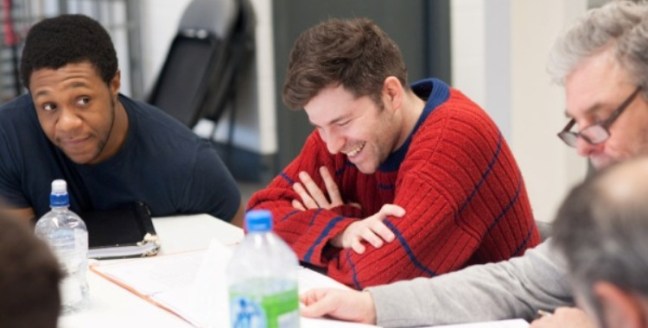
It is character once again that has attracted Bennett to Tracy Letts’ Superior Donuts, the UK premiere of which he is currently directing at the Southwark Playhouse. It is being presented by the same company behind Mercury Fur, who have newly reinvented themselves as The Trick. Bennett is a “huge fan” of Letts and is excited to get his hands on this script. “I always found that his writing – as with Ridley – has such a visceral complexity to it,” he explains the fascination.

Superior Donuts is set in a donut shop in Chicago, telling the story of the man who runs it and the people who pass through every day. “You’ve got these nine fantastic characters, aged 21 to 72, all endowed with such depth and humanity,” says Bennett. “I found it profoundly moving and hugely optimistic. It just felt like the right play to do, and it couldn’t be more different from Mercury Fur.”

While Bennett describes the play as a “naturalistic piece”, he is interested in ways of pushing that naturalism in his production. “We didn’t just want to build a donut shop,” he explains. “The brilliant Fly Davies has come up with an incredible design that allows us to represent the off-stage world in a non-literal way in the space.” He quickly adds that they are “not doing some big expressionistic production of it”, but it is clear that his production hopes to test what can be done within an ostensibly naturalistic framework.

When I ask how Bennett feels about naturalism as a director, he wrestles a little with the question. Referring to projects such as Narrative, which clearly departed from naturalism, he suggests that his own position is somewhat ambivalent, before adding, “I don’t think there is an either/or”. We end up discussing Secret Theatre, which offers an intriguing marriage of a more naturalistic, character-based British tradition with continental influences that are less interested in realistic representation.

“One of my biggest interests is definitely character,” Bennett says, “but I think – as things like Secret Theatre’s Streetcar showed – you can still create, represent, express amazing characters, but not necessarily be pinned down to some kind of naturalistic context. I sort of feel like I’m just exploring what that means.” For now, he is happy to remain on the fence and keep exploring.

Photo: Ben Broomfield.

A Trio of Tragedies

thebes-2-600x400

Originally written for Exeunt.

In this year’s rep season from The Faction, there are a hell of a lot of corpses. Across the span of the trio of tragedies – Hamlet, Thebes and The Robbers – the body count is staggeringly high. If one were to characterise the company’s third season of work in a few words, dark, violent and bloody immediately jump to mind.

Reductive as this is, there is something about death, both as an abstract idea and a concrete reality, which haunts all three productions. When I spoke to The Faction’s artistic director Mark Leipacher about this new season, he explained that the company did not have any overarching theme or narrative in mind when they put together the programme; their priority was simply to find work that engaged and excited them. Still, the simple placing of these plays alongside one another invites a dialogue between them, a dialogue which is repeatedly preoccupied with mortality.

There is perhaps no more famous theatrical consideration of life and death than Hamlet’s “to be or not to be” soliloquy. Hamlet’s fame and familiarity are often albatrosses to sling around the shoulders of new productions, all of which must fall under the burden of the play’s reputation. The Faction’s interpretation, directed by Leipacher, suffers a little from this predicament. Compared with previous productions of theirs, there is an uncharacteristic timidity to their approach; few moments match the visual boldness of their best work, and there is the sense that each actor is deeply aware of the weight of the words falling from their lips.

That said, there are some intriguing touches to this Hamlet. The characterisation of the procrastinating protagonist himself is perhaps the most striking departure, as Jonny McPherson plays the Dane less as a conflicted hero and more as a whining egotist. Amidst tentative attempts to wrench something new out of the play, this comparatively brave choice stands out, offering novel and occasionally unexpected resonances to Shakespeare’s words. The ever-compelling Derval Mellett, meanwhile, makes a fascinating and nuanced Ophelia, adding vivid colour to a role that can often feel lightly sketched.

The season really hits its stride, however, with Thebes, Gareth Jandrell’s ambitious attempt to slot together the full story of the Oedipus dynasty from the plays of Sophocles and Aeschylus. It stands out as the clear highlight of this year’s programme, offering this most famous of classical sagas in a form that makes it feel thrillingly fresh. What adds the sense of urgency and momentum is primarily the production’s shift of focus; as signalled by the title, it is the city and its beleaguered people who become the heart of the narrative. This city is both Thebes and nowhere, The Faction’s non-specific updating dislocating it from time and place and positioning it instead as a potent metaphor for power, corruption and revolution.

Following the template established by McPherson’s moody Hamlet, The Faction are unafraid to highlight the tragic flaws of their privileged but doomed characters, who are increasingly detached from the seething masses they rule. Lachlan McCall brings arrogant swagger to the ill-fated Oedipus, while his two sons are suitably vile, self-centred and ruthless in their competition for the throne. This is an elite who are either blindly wrapped up in their own problems or coldly fixated on power. Cary Crankson – another performer who impresses across all three productions – epitomises this calculated power-grabbing with his Creon, a supremely slippery politician who soothes with one hand as he snatches with the other.

The pulse of the piece, however, lies firmly with the people. In Rachel Valentine Smith’s production, the Chorus are transformed into a writhing, revolutionary mob, variously whispering, sighing and stamping at the edges of the action. When gathered together in this crowd, the ensemble move fluidly as one, exploiting the physical vocabulary that they have developed over years of working together. This is where the muscularity of previous work returns in force, creating a population to be reckoned with and a sparse but captivating visual aesthetic to match Jandrell’s lyrical, punchy script.

Following the epic scope and revolutionary fire of Thebes, the scrappy, overblown drama ofThe Robbers feels like a significant step down. This is a remounted production for The Faction and forms a key part of their project to stage the complete works of Schiller, but it is far from the playwright’s best, lacking the tense political machinations of Mary Stuart and Fiesco, which were showcased in The Faction’s last two rep seasons. Here, instead, the drama is centred on a father and his two sons, the younger of whom attempts to usurp his older brother. It is all blood and passion, heightened to the extent that it frequently tips over into melodrama.

There is still the muscular approach of The Faction’s preferred aesthetic, alongside some inventive visual devices. Chalk is a key material, used first to compose the letters that seal the fate of cast out older brother Karl and later by Karl’s band of rebels to strikingly tally up the men they kill on their numerous rampages. It is in the scenes between these eponymous robbers that the production is at its strongest, once again playing on the group’s strength as an ensemble to build a convincing sense of camaraderie. At their centre, overshadowing conflicted Karl, is Crankson as the cocksure, rebellious Spiegelberg. Yet even Crankson’s undeniable charisma flags in the final scenes, as the bodies stack up and the overwrought emotion becomes wearing in its relentlessness.

After the slightly more cluttered sets of last year, this season wisely reverts to The Faction’s bare, stripped back minimalism, using the New Diorama’s black box studio and their own bodies as canvas and paint. The bare black wall is particularly well used, whether seemingly being held up by the defending soldiers of Thebes or treated as a giant blackboard in The Robbers. In this largely empty space, the brilliant work of lighting designers Chris Withers (Hamlet and Thebes) and Matthew Graham (The Robbers) is crucial in carving up the scenes, skilfully offering both shape and atmosphere. Light spills in from offstage, casting interesting shadows, or glows dimly from a single, dangling light bulb. In line with the morbid subject matter, gloomy visual landscapes abound.

This is now the third year in a row that I have attended The Faction’s annual rep season, allowing a line to be traced through their work over that time. In many ways this year feels like a return to the company’s essential aims and aesthetics, focusing on the kinds of text and staging that most enthuse and inspire them. There is also, of course, the return to one of their landmark productions with The Robbers, but this fails to match up to the best of what they have created since. It is instead in Thebes, arguably The Faction’s most ambitious work to date, that the company’s aspirations and strengths are found in their purest form: a bare but thrilling staging, an approach to classics that makes them feel like they were written yesterday, and an unshakeable faith in the power of the ensemble.

Photos: Richard Davenport.

Blurred Lines, National Theatre

blurred-lines-600x374

Originally written for Exeunt.

Back in November of last year, myself and others were questioning the underrepresentation of female playwrights in the National Theatre’s 50th anniversary gala – and in its programming more broadly. Now, only a couple of months later, the fierce final scene of a new show with an all-female cast and a majority female creative team boldly critiques the venue’s gender inequalities from within its very walls. It’s nowhere near a solution, and one self-reflexive show in the theatre’s smallest, most risk-friendly space is no reason to get complacent, but it feels like a start.

The context for Carrie Cracknell and Nick Payne’s new show is right there in the title. Robin Thicke’s misogynistic song and accompanying video were just the most visible tip of the iceberg in a year that outdid itself in terms of casual sexism and media objectification of women. But 2013 was also a year in which feminism was very much part of the public discourse, a discourse that Blurred Lines continues. It is less a play than a theatrical conversation; an ongoing discussion about insidious, background sexism in its many mutating forms.

The show, devised by the company with Cracknell and Payne, promises to interrogate all areas of gender politics, from the media to the workplace to the home. It’s a big ask. To tackle these myriad forms of sexism, the piece deploys what are perhaps best described as a series of sketches. We see, for instance, a conversation between a married couple about the husband’s visits to prostitutes; the repeated shooting of a television scene in which a woman is assaulted; an office confrontation in which it is made clear that success for a few individuals does not translate into equality for the many. Given the force with which that latter point was made in Top Girls in 1982, it’s telling that it still needs to be reiterated.

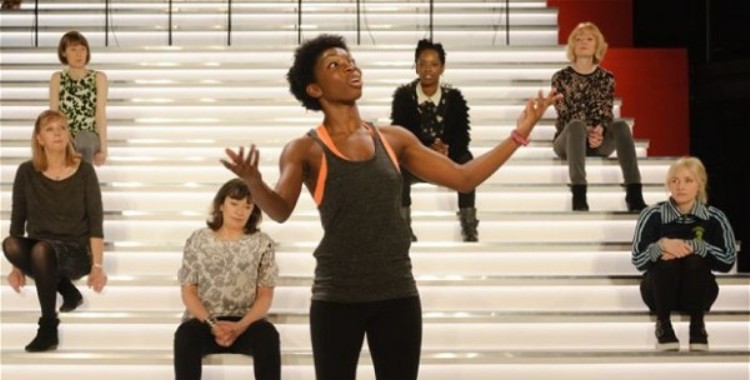
These swift, punchy scenes, punctuated with performances of songs that cheekily and sometimes explosively critique the depiction of women in popular music, are all played out on the huge white staircase of Bunny Christie’s design. This installation, complete with colour-changing lights, boldly thrusts out into the Shed’s modest performance space, itself acting as a sort of intervention. It frames the female performers in ways that at times reflect the objectifying aesthetics of music videos and advertisements, but at others set up an uncomfortably close confrontation with the audience, while the steps themselves are suggestive of the distance that we still have to climb.

But what Blurred Lines is perhaps most successful at exposing is the sexism that remains rife within theatre itself. The piece opens with a series of statements spoken in turn by the performers: “girl next door”, “single mum”, “Northern blonde, bubbly”. It soon becomes clear that these are roles, referring at once to casting types, dominant cultural perceptions and the desperately restrictive boxes that women are expected to fit into in everyday life. This critique of what roles women are allowed to play remains implicit throughout, coming to a head in the final scene. While this powerful conclusion risks being something of a theatrical in-joke, alienating those who might not catch its shrewd self-referential nods, it is an important move towards theatre owning up to its own failings when it comes to gender (in)equality.

Representation is also at stake in other ways. Throwing together a cacophony of female voices, the piece is careful never to directly speak for or represent any one woman. When an individual’s story is told, as in the narrative of a teenage girl who is sexually assaulted by her partner, it is transmitted through multiple voices and in a fragmented structure. Straightforward portrayal of anyone who might be construed as a victim – perhaps most prominent among the roles available to women – is deliberately avoided. This also points, though obliquely, at the persistent tendency to take one woman as a representative for her entire sex, a tendency that the company stubbornly refuse.

On another, simpler level, the very fact of an all-female cast does interesting things to the staging of sexism. Every male character in the piece is, necessarily, played by a woman. This inversion makes an intriguing contrast with, say, Three Kingdoms, which despite sharply skewering misogyny, still placed it – potentially problematically – in the mouths of men. In this production, the exchange of misogynistic expressions between an all-female cast furiously underlines them, while managing to subtly subvert these views at the same time as reproducing them.

Yet women are still, with unsettling frequency, seen as victims here. That ranges from victims of violence to victims of workplace prejudice, but time and again they are rendered voiceless and frustrated. The intention is understandable; like the Everyday Sexism project, the piece attempts to unmask the latent sexism that pervades our society, often going unnoticed and unremarked upon. The bitter familiarity of many of these scenes provokes both recognition and discomfort, but it leaves us mired in our current situation rather than looking towards any solutions.

Of course, the very existence of this production and its team of talented women is a form of action in itself, and perhaps it is apt that we are left to continue the conversation and fight ongoing injustices. To downplay the scale of inequality and let the audience off the hook would be irresponsible. Nonetheless, there is something a little disheartening about a piece of theatre with such fire in its belly that insists on simply presenting and representing all too familiar portraits of sexism and victimhood.

The Pass, Royal Court

pass-600x398

Originally written for Exeunt.

Following Thomas Hitzlsperger’s decision to publicly come out, renewed focus has fallen on the prejudice still faced by gay footballers, bestowing something of a mixed blessing on the Royal Court’s latest offering. On the surface of it, John Donnelly’s play is “about” a premiership footballer struggling with his sexuality, which he stubbornly refuses to define or discuss. But it also touches on lots of other things – fame, money, friendship, competition –which get slightly elided in the wake of its sudden topicality.

The play, following a familiar trajectory, traces the journey of footballer Jason (the ever-excellent Russell Tovey) from early promise through to the giddy zenith of fame, plotted out via three pivotal moments in three different hotel rooms. Its first scene, while slow to develop, offers plenty to relish. Jason and best mate Ade (Gary Carr) are killing time on the night before the biggest match of their lives – two tensely coiled springs in close proximity. Their relationship and its silent undercurrent of mutual attraction are believably and wittily sketched, as laddish banter gradually gives way to compelling tenderness.

Cut to seven years later, when Jason has gained fame and fortune but lost the puppylike glimmer of mischief that so animated him on his first appearance. This is where the piece begins to slacken its initially confident grip, taking a long time to get anywhere. The scene’s encounter between Jason and table dancer Lyndsey (Lisa McGrillis), though enjoyable, feels convoluted and contrived for the sake of a plot point that could be achieved with much less meandering. The swagger returns after the interval, as Jason and Ade are reunited for a hedonistic night that crackles with danger and desire, but it’s hard to shake the suspicion that this is a script in need of some tightening.

Alongside the main thrust of the plot, there are also some more ambitious shots which – though on target – rarely hit the back of the net. Buried within the classic tale of fame’s empty promises is an implicit critique of the parameters of success in modern society, most of which rest on money. Competition, in life as in sport, also receives a bit of a battering; the sense is that this, more than anything else, is what drives a wedge between Jason and Ade, while Jason’s desire to win leaves him cripplingly lonely. But these avenues are left frustratingly underexplored.

Despite its weaknesses, however, Tovey holds the piece together in a remarkable central performance. From his first youthful grimaces of self-congratulation, furiously skipping to the imagined roars of the crowd, to the hunched husk of a form that he becomes in the final scene as he bends determinedly over his exercise bike, Tovey’s every last muscle is employed in fleshing out the character of Jason. Astonishingly, he seems to age physically as well as emotionally, subtly transfiguring himself before our eyes as he progresses from enthusiastic newcomer to hardened veteran. One imagines that he behaves on the football pitch as he does in life – dodging, sprinting, pulling off slick manoeuvres without breaking a sweat, yet all underscored with a faint attitude of desperation.

This is reflected in John Tiffany’s production, which marries polish with uncertainty, machismo with vulnerability. There are also brilliant outbursts of playfulness, Jason and Ade’s gleeful trashing of the hotel room in the final scene being one of the most entertaining, though these do not always sit comfortably with the rest of the action. More could perhaps be made of Laura Hopkins’ clean, slick design, capturing both the attraction and the cold impersonality of the hotel room setting. It’s a canny choice of location, at once encapsulating glamour, escape and loneliness. I’m particularly struck by Lyndsey’s loaded observation that “tomorrow someone will come in and clean this all away”; a simple factual statement that resonates deeply with Jason’s transitory, unfulfilled existence.

As the piece closes, however, it leaves the nagging sense of something lacking. Ultimately, the main disappointment of The Pass is that it fails to add anything significantly new to the discussion it engages with, leaving my opinions on its subject matter little altered or challenged at the end of two and a bit hours, in spite of many intriguing turns along the way. But this is, perhaps, less a failure on its own terms than on the terms of the media discourse surrounding it. Timeliness, it seems, is something of a double-edged sword.

L’Après-Midi D’un Foehn, Platform Theatre

photo1

Originally written for Exeunt.

A plastic bag, a pair of scissors, a circle of fans. These are the modest opening ingredients for the surprise hit of last summer’s Edinburgh Fringe, a new version of which is now being shown as part of the London International Mime Festival. The buzz around Compagnie Non Nova’s show in Edinburgh was improbable to say the least. The show, described in a tone of breathless yet ridiculous wonder by those who were lucky enough to stumble across it, essentially involves a chorus of dancing plastic bags. Not the most auspicious of premises.

But the giddy superlatives thrown at L’Après-Midi D’un Foehn in Edinburgh turn out to be wholly justified. It is rare, as an adult and particularly as a regular theatregoer, to be truly knocked out with wonder, but Compagnie Non Nova achieve this feat with the least likely of materials. Plastic bags, fluttering in the bare branches of trees or skittering along the pavement with leaves and cigarette butts, have become almost emblematic of rubbish. A symbol of throwaway consumer culture – the ultimate trash. So it is doubly surprising how beautiful they are rendered by Compagnie Non Nova’s ingenious transformation. Floating, falling, spinning in balletic poses, the flimsy stars of L’Après-Midi D’un Foehn are absurdly gorgeous to look at.

The show opens with performer Cécile Briand alone in the gloomy circular space, slowly and meticulously cutting and sellotaping a pink plastic bag into a vaguely humanoid shape. Briand’s unhurried precision is oddly captivating in itself, inspiring a still hush of expectant attention. So quiet and unapologetically dawdling is this beginning that when the plastic bag that Briand has carefully placed in the centre of the stage begins to rustle, billow and finally pirouette, the magic and delight are all the greater. Gasps and giggles ripple through the audience as this delicate plastic figure leaps and twirls, later joined by partners, playmates and antagonists, all of whom dance enchantingly to the strains of Debussy’s ‘Prélude à l’après-midi d’un faune’.

The piece feels so beautifully effortless that it is easy to underestimate the artistry involved. Thanks to some cleverly directed gusts of air (huge credit to Pierre Blanchet’s “wind design”), these plastic bags take on movement, grace and even emotions, inspiring the same sort of gooey, irrational affection as Tom Hanks’ ill-fated volleyball companion in Castaway. The combination of simplicity and ingenuity is remarkable; never did I think I would be able to say that I was emotionally invested in the fortunes of a plastic bag. As well as demonstrating the skill and invention of Compagnie Non Nova, this is equally testament to the extraordinary ability of music to invest the simplest of scenes with compelling drama, and to the inspiring power of the imagination.

There is, of course, the danger that – despite its undeniable beauty – this all becomes as insubstantial and throwaway as its fluttering protagonists. After all, how many different ways is it possible to manipulate plastic bags with just one performer and a few fans? There are a handful of moments in which the wonder begins to fade and the piece sags a little, but the company pull out just enough surprises to keep their audience enraptured, while the short running time is cannily judged. Carried on the undulating currents of the piece, my mind skips throughout between themes such as imagination, love, power, the creation and fragility of life – all lightly hinted at by Compagnie Non Nova’s fleeting images before being lightly blown away. The enduring impression, however, is of the beauty that art is capable of finding in the most unlikely of places.