Beginnings and Endings

Show_3-600x399

Originally written for Exeunt.

Let’s start with a beginning.

Sitting in the stalls of the newly plastic-swathed Lyric Hammersmith this September, I’m not sure I’ve ever felt such palpable anticipation in the moments before a show. As suggested by the words “Secret Theatre”, most of us in the audience did not know quite what to expect. The curtain was eventually raised to reveal the performers in a line at the back of the stage, dressed in plain white shorts and vests. Accompanied by a sinister, clinical voiceover, these figures rushed forward to drink from bowls of water, scrambling over one another in a desperate, animalistic struggle. What followed might not have been the best show of the year, but it is hard to think of a more memorable opening.

As I attempt to craft some sort of assessment of the year in theatre, the Lyric Hammersmith’s Secret Theatre project feels like an apt emblem for the change that is slowly pressing in on multiple sides. This time last year, writing another of these deeply subjective round-ups, I reflected that 2012 felt like a year of “small tectonic shifts”. While those shifts might not have precipitated a violent eruption of change across the landscape of British theatre, the last 12 months have nonetheless seen ripples of movement – just more gradually than perhaps anticipated.

Unlike the noisy, thrilling arrival of Three Kingdoms last year, the changes of 2013 have been subtle and structural, hinting more at future promise than present fulfilment. Chief among these changes is the exciting wave of new artistic directors who have either taken up post or been announced: Vicky Featherstone at the Royal Court, Rupert Goold at the Almeida, Rufus Norris at the National Theatre, Lorne Campbell at Northern Stage, Sam Hodges at the Nuffield. Whether these appointments will really offer the shake-up they hint at is still to be seen – though the early signs of Featherstone’s tenure are encouraging – but the collective urge for new ways of working is clear.

The impetus towards change is also characteristic of one vein of work that has particularly stayed with me this year. The phrase “political theatre” always feels like a misnomer – isn’t all theatre political in some way? – but a clutch of angry, thoughtful and passionate productions in 2013 have dealt specifically with ideas of political change and protest. How to Occupy an Oil Rig playfully explored the demonstration (in every sense), while Hannah Nicklin’s A Conversation with my Father offered a decidedly personal perspective on protest – almost reducing me to tears in the process. And another kind of activism is at the heart of Bryony Kimmings’ bold and brilliant Credible Likeable Superstar Rolemodel project, which twice bowled me over with both its raw emotion and the galvanising ambition of its aims.

Elsewhere, the potential for future change was more lightly hinted at. At this year’s Edinburgh Fringe, Dan Hutton and I noted the theme of hope that threaded its way through several of the productions we saw, complicatedly paired with both critique and irony. Contrived as this narrative perhaps is, it is one that has retrospectively haunted many of this year’s shows, inflecting my way of watching and thinking about theatre. From its very explicit presence in what happens to the hope at the end of the evening to its troublesome ghost in The Events, the question of hope has been a key feature of much of the most interesting work I’ve seen over the past 12 months.

Chris Goode's The Forest and The Field ©Richard Davenport

Closely linked to hope is the idea of community, which is often vaunted as being at the heart of theatre as an art form. We share the same space in the theatre, after all, so we must be a community of sorts, right? This was tested in various ways by much of the best theatre of 2013, be it the stunning yet gentle intellectual interrogation of Chris Goode and Company’sThe Forest and the Field or the joyously communal celebration of The Strange Undoing of Prudencia Hart – which arguably nailed the whole thing by staging itself in a pub and throwing in some song and dance for good measure.

Similarly to Prudencia Hart, music was a key ingredient of the fleeting community forged night after night in Edinburgh by The Bloody Great Border Ballad Project; food took the same role in Only Wolves and Lions, reminding me of the simple community we build when we cook and eat together. It’s not insignificant that that last example was part of Forest Fringe, a gorgeous instance of transitory artistic community in the midst of this summer’s Edinburgh Fringe. This community also offered up countless other small scale theatrical highlights of the year, among them Ira Brand’s delicate contemplation on ageing, a consideration of our addiction to virtual communities in I Wish I Was Lonely, and Deborah Pearson’s haunting The Future Show.

One show that managed to be both small and epic was Grounded, the absolute standout production of the Fringe for me. The remarkable Lucy Ellinson once again looms large over my theatregoing memories of the year after her compelling delivery of George Brant’s tightly written, blistering monologue, all the while imprisoned within the striking grey cube of Oliver Townsend’s design (as an aside, cubes seemed to be big this year – see Chimerica). Ellinson also dazzled, though very differently, in #TORYCORE, a deafening, devastating scream of rage against the destructive policies of the coalition government.

And it was not only the politicians of today who found themselves criticised in theatres this year. Following the death of Margaret Thatcher, a number of pieces have already directly or obliquely approached her legacy. Theatre503’s quickfire offering of short plays produced a decidedly mixed bag, although Margaret Thatcher Queen of Soho’s glorious drag queen rendering of the Iron Lady has deservedly lingered in my memory. The difficulty of discussing Thatcher’s legacy was addressed in all its complexity by Mars.tarrab’s brilliantly titled The Lady’s Not for Walking Like an Egyptian, while perhaps the most striking visual representation of Thatcher came courtesy of Squally Showers, a show that touched on her and her politics only indirectly. Yet somehow, in the image of a performer in a Thatcher mask holding aloft an inflatable globe while surrounded by the detritus of a wild party, Little Bulb wordlessly directed a powerful judgement at the world left to Thatcher’s children.

Little Bulb's Squally Showers

Squally Showers also provided plentiful helpings of sheer joy, a theatrical quality not to be underestimated. Alongside the charming eccentricity of Little Bulb’s latest show, the Edinburgh Fringe also offered the utterly bonkers but irresistibly endearing Beating McEnroe,which will forever leave me with the glorious memory of Jamie Wood pretending to be a tennis ball. An equally joyous moment to imprint itself on my mind this year emerged from Peter McMaster’s Wuthering Heights, in which I screamed with laughter at the four male performers’ move by move recreation of the dance in the Kate Bush music video, while the final scene of rain-drenched anarchy in the RSC’s As You Like It topped off a production that was a delight from start to finish. And no assessment of theatrical joy in 2013 would be complete without pausing to remember Zawe Ashton’s frankly inspired rendition of ‘Where Are We Now?’ in Narrative, a show that achieved the rare feat of being both absolutely hilarious and intellectually meaty.

While it may not fit neatly within the thematic threads I’m attempting to loosely weave through my overview of the year, any consideration of 2013 has to include a mention for Headlong. The company has had a ridiculously successful 12 months, encompassing the slick, stylish storytelling of Chimerica, a bold and theatrically astute new interpretation of The Seagull and – best of all in my opinion – the complete headfuck of Duncan Macmillan and Robert Icke’s stunningly intelligent adaptation of 1984. I’ve missed out on American Psycho,but from the outside it appears to offer a striking end to a fairly extraordinary year for Headlong.

As averse as I am to naming any one production “best”, when looking back over the year I find my mind dragged time and time again back to Mission Drift. For many this hardly counts as a “new” production, having first been seen at the Edinburgh Fringe in 2011, but this summer’s run at the National Theatre’s temporary Shed space was my first opportunity to see The TEAM’s dizzying trip through 400 years of American capitalism. Fast-paced, sexy and beautiful to look at, Mission Drift can also justifiably be described as epic, an adjective that I rarely find myself applying to theatre. Its scope, energy and excitement has become my personal benchmark against which to measure the year’s theatre, and very little in the subsequent months has equalled it.

As I opened this narrative with a beginning, I might as well close with an ending. Looking ahead to 2014, February will see the dismantling of The Shed, whose garish red silhouette on the South Bank has come to stand for vitality and experimentation at the heart of an institution often associated with tradition – as the narrative it spun to celebrate its 50th anniversary did little to challenge. One can only hope that The Shed’s spirit of innovation, together with that of Secret Theatre and Vicky Featherston’s Open Court festival this summer, finds a way to continue into the next 12 months.

I also contributed to a collective look back at 2013’s theatre with the rest of Exeunt’s writers.

The Nutcracker, Nuffield Theatre

nutcracker2-600x400

Originally written for Exeunt.

As Chris Thorpe acknowledged while discussing Northern Stage’s Christmas show, there is something about this time of year that feels intimately tied up with stories. Whether it is fairytales, stories of Santa or the tale of the nativity itself, the festive season is drenched in narrative. The story chosen for this year’s family show at the Nuffield Theatre is one so familiar that it has become part of the cultural fabric of Christmas, but the creative team have approached it from a slightly less familiar angle. A play with songs rather than the well known ballet, this is a Nutcracker with no Sugarplum Fairy and rather more back story, taking its lead from ETA Hoffman’s original tale.

Unfortunately, the story is the very element that lets this production down. Here, young Clara’s journey into the Land of Sweets and the central battle between the Nutcracker and the Mouse King occupy only a fraction of the stage time, the greater portion of which is taken up by exposition and scene-setting. The darker elements of Hoffman’s short story are welcome antidotes to what can be a queasily saccharine tale, but their incorporation into Hattie Naylor and Paul Dodgson’s script is decidedly laboured. We find out plenty about the curse of the Nutcracker and how he came to be the enemy of the wicked Mouse King, but all in a series of scenes that play out like an extended prologue. The first act ends beautifully, with an image to send chills down the spines of the children in the audience, but there is a niggling feeling that it is only just getting to the heart of the narrative.

This adaptation is also one that suffers from something of an identity crisis. The conventions of audience interaction are called upon early on, as the performers enter through the auditorium and talk to the kids on the way, but from this point onwards the piece is torn between fourth wall storytelling and pantomime style involvement. The narrator figure is an odd fit with the rest of the show, while the recruiting of the audience to hurl foam balls during the battle scene – while undeniably great fun – jars awkwardly with the action that has preceded it. Neither simple storytelling exercise nor riotous panto romp, The Nutcracker wants to be both at once, but struggles to knit the two genres successfully together.

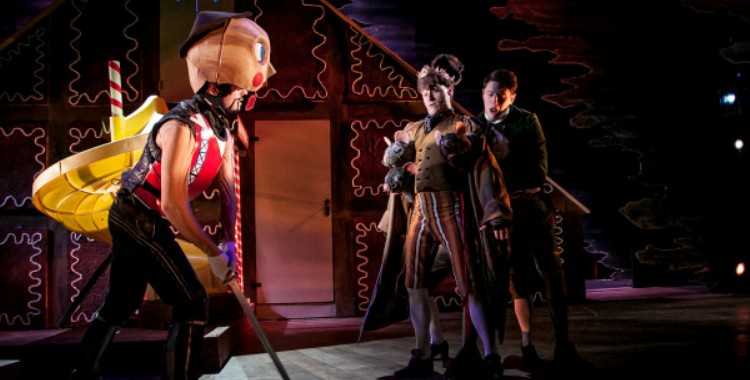
There is, however, a fair sprinkling of magic in Blanche McIntyre’s production. The opening scene is a delight, pulling out all the tricks of the stage to establish a mood of enchantment and wide-eyed wonder, while raising several gasps from its young audience in the process. These moments of dazzled awe are the most rewarding, reminding adults as well as children just how magical theatre can be. Rhys Jarman’s design does a lot of the legwork, offering a series of charming transformations, while the cast bring an infectious energy to the range of roles they are asked to adopt throughout the twisting narrative.

The production is at its best when playful, whether that is the deliciously hammed up villainy of the Mouse King or the cheekily self-aware conclusion. At the end, the characters leave us deliberately in doubt about the nature of what we have seen, embracing the more uncertain and dreamlike qualities of Hoffman’s tale. Implicit in this ending is a question about stories themselves – why we tell them, what they mean to us, and when they become real. It is only a shame that it takes this long for the storytelling to come into its own.

The Night Before Christmas, Soho Theatre

Craig-Kelly-Craig-Gazey-and-Navin-Chowdhry-Photography-Sheila-Burnett-600x400

Originally written for Exeunt.

Recent years have produced countless claims to the “alternative” Christmas show, promising respite from glitter, jingle bells and cries of “he’s behind you”. Soho Theatre’s offbeat contribution is one of the few to really deliver on this promise. Sure, all the hallmarks of the festive season are here, but this is no cosy, tinsel-decked affirmation of the sentiments we hear spouted from all directions at this time of year. Anthony Neilson and Steve Marmion’s show, while pumping out the laughs at a breathless rate, also recognises that – whisper it – Christmas can sometimes be a bit shit.

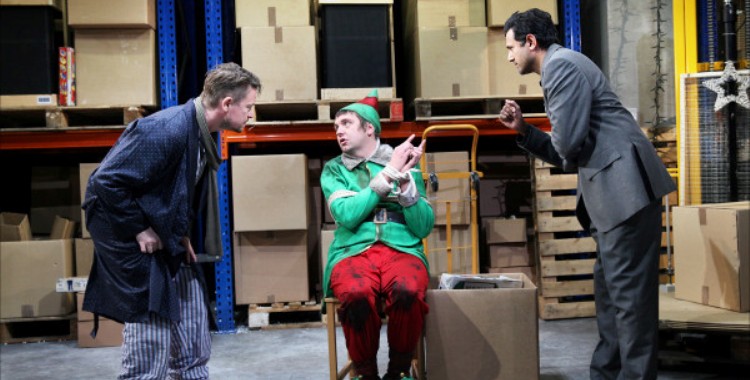
This is a bitter recognition for Gary, a one-time City boy who is now flogging knock-off toys and spending Christmas Eve alone in his warehouse. Or at least he was alone, until a man claiming to be an elf broke in, pleading innocence and begging to return to his sleigh. As Gary is joined by old mate and fellow substance abuser Simon and single-mum prostitute Cherry, the unlikely trio apply scepticism, snark and suspended disbelief to the problem of the red and green clad man tied up alongside the fake Furby Booms and dust-gathering Gary Glitter outfits.

Every last detail of this Crimbo car crash is a calculatedly crappy alternative to the festive magic promised by parents and advertisers alike. Snow is replaced by showers of polystyrene packaging; fairy dust is swapped for cocaine; instead of a red-faced, rotund Santa, we get an elf with track marks up his arms. Yet, for all the detritus of broken dreams and long lost childhoods, Neilson and Marmion still tease us into believing. Against logic and evidence, we’re desperate to tell ourselves that this dishevelled figure in his pointy hat is not a quick-thinking junkie but a bona fide resident of the North Pole.

This is thanks to the stubborn ambivalence of tone that is courted throughout, repeatedly upending an audience’s expectations. Craig Gazey’s “Elf” is a lesson in ambiguity, answering the interrogations of his captors with responses that are by turns assured, desperate and downright bonkers, yet always governed by reasoning that somehow makes a strange sort of sense. Elves don’t deliver the presents, apparently – they “enhance” them. Remember how much fun you had as a kid with all the cardboard boxes and wrapping paper on Christmas Day? That would be because the elves’ magic won’t work on synthetic materials; the plastic presents confounded them, so they enhanced the packaging instead.

Touches like this demonstrate all the surreal ingenuity of Neilson’s writing at its best, complemented by the wacky, determinedly shoddy songs he has written with composer Tom Mills. The lyrics are all clumsy festive schmaltz, the singing unapologetically atrocious. And it’s oddly brilliant, slicing right through the queasy sentimentality that reigns elsewhere. But even with the satire, we are rarely on solid ground. The myth of Christmas is dismantled, the magic of childhood abandoned, and still this production manages to inject a surprise dose of that addictive Christmas feeling.

The result of all this tonal variation, however, is a number of sharp and sometimes jolting handbrake turns. While the pace of the first third is zippy and sitcom-esque, throwing out joke after joke, cracks begin to appear when the emotional tenor shifts. Neilson turns out to be a gag-machine to rival the best panto writers, but the momentum of these early exchanges is tricky to maintain and the show visibly flags somewhere around the middle – a bit like Christmas Day itself.

Despite its flaws, though, the dark humour and brilliantly bizarre flourishes ultimately rescue the piece, just about keeping it on that tightrope between worn cynicism and childlike delight. For anyone who has ever suspected, like me, that Christmas as an adult is two parts nostalgia and one part alcohol, The Night Before Christmas nails both the joy and the disappointment that the festive season can involve.

Photo: Sheila Burnett

Dark Magic

11174612045_bb6efdf774_b

Originally written for Exeunt.

No jingling sleigh bells or yells of “he’s behind you” at Northern Stage this Christmas. Dark Woods, Deep Snow, the theatre’s main stage Yuletide show, is certainly festive, but perhaps not in ways that theatregoers have come to anticipate at this time of year. Think less Santa, more magic. “It’s not what an audience will expect coming into a Christmas show,” admits director Lorne Campbell, “but also it’s got all the things that an audience can and should expect coming into a Christmas show; they’re just a little bit in disguise.”

Dark Woods, Deep Snow is Campbell’s first main stage production at the helm at Northern Stage, testing the new artistic director’s commitment to staging work that is large scale, exciting and powerfully local. While his debut might be a family Christmas show, typically seen as a low risk staple of the yearly programme, for Campbell this is the perfect challenge to create a theatre that is at once “populist and sophisticated”.

“We’ve tried to do something really ambitious,” he tells me. “The production is massive, it’s non-naturalistic, it’s visually – I think – absolutely stunning.” For the show, Campbell has brought together a group of artists, including writer Chris Thorpe, designer Garance Marneur and choreographers and performers RashDash, whose “spirit of experimentation” he wanted to free from studio theatres and unleash on a bigger stage. The hope was to retain the mischief and ingenuity, but expand the scale.

This marriage of experiment and scale, tradition and reinvention, is immediately evident at the level of the show’s plot. Charged with creating a narrative that was rooted in this time of year without conforming slavishly to Christmas show conventions, Thorpe was immediately drawn to the idea of stories. He was intrigued by “why there’s this urge in us to get together at this time of year, when the nights are the darkest, and try and turn things around and tell each other stories”.

Captivated by the image of tales shared at the fireside, and drawing inspiration from the story gathering project undertaken by the Brothers Grimm, Thorpe dreamed up a group of characters who live at the edges of the human world, in the “infinitely large forests outside of the human reality, where the stories go after we’ve told them to each other”. Here, they collect the narrative refuse of human society, piecing together the once upon a times and happily ever afters.

“The idea is that there’s a group of characters who have been engaging with these stories for as long as humanity has been telling them,” Thorpe explains, “almost behind the scenes of our reality, and they have observed the way that we tell them, but they themselves aren’t necessarily human. I think that’s a really interesting perspective to have on it.”

As an audience joins this group of characters at the start of the show, human stories are under threat from an external force that wants to rob these narratives from our universe, setting up a classic scenario of conflict and peril. Campbell describes it as a “big, exciting, what’s-going-to-happen-next adventure”, with a “big heart of narrative underneath it”.

While driven by a strong central narrative, however, the show simultaneously operates on a number of levels. As Thorpe explains, his invention has allowed him to incorporate both the familiar and the surprising, as fragments of well known stories meet the strange world of the characters he has created. “And also, because you’re not just retelling old stories in a show like this, it allows you to bring a whole bunch of people into the theatre and ask the questions that theatre is really about,” he goes on. “It’s really focused on everyone coming to the theatre and having a brilliant time, but it’s nice that it also links into what the theatre is there for year round; this place where we can all come and we can all share an experience that isn’t replicable in any other medium and we can all ask questions.”

11174670734_fa03bf90aa_b

These subtle layers equally apply to Marneur’s set design, which couples the recognisable, magical aesthetic of the forest with other unexpected, dazzling and occasionally dark elements. “Our styles are all quite dark,” Marneur says of the creative team. “They appear very beautiful at first, but once you dig a little bit deeper there’s always a second layer, a third layer that gets you to ask questions and provokes you. So the forest is the magical forest of a Christmas show, but it’s also diving into one’s subconscious. And of course that’s a beautiful place to be, but it’s also a very scary place to be. As a festive performance, one might not want to go into those dark places. So keeping the high vibe of the Christmas show with such heavy content and such existential questions being asked was my biggest challenge.”

This begs the question of what a Christmas show really needs. When I put this to Campbell, he pauses for a moment. “Joy, scale, chaos, irreverence,” he eventually answers. Thorpe also points to the spirit of Christmas theatre rather than its explicit themes or imagery, referring to a “feeling of coming together at this time of year to do something celebratory and exciting”. While insisting that he’s not trying to “de-Christmasify” the Christmas show, he adds that “it’s not necessarily about saying ‘hey kids, it’s Christmas’, because the entire world is saying ‘hey kids, it’s Christmas’ at this time of year”.

Getting away from the iconography of Christmas might not have been difficult for Thorpe and his fellow theatremakers, but creating a theatrical language that speaks to both old and young has proved to be more of a challenge. Thorpe, who is more accustomed to writing for adult audiences, is adamant that it is not about adjusting down to the children in the audience – “there isn’t a down, there isn’t a hierarchy”. It is instead about “simply and honestly just saying what you think” and finding common ground.

One way to do this is to recapture the thrill and imagination of childhood for all members of the audience, an aim that was essential to Marneur’s design. She describes her set, an otherworldly maze of towering white trees, as a “flexible playground” for the performers to explore. It is also a playground that can be transformed through the art of projection, allowing Marneur to “play with the audience’s perception of the forest” and conjure some of the magic of the fairytale – a form that translates across all ages, just as the show hopes to.

“It’s hopefully a very accessible family show,” Campbell stresses, “but simultaneously it’s a very sophisticated bit of theatre that’s taking its aspiration very seriously, while being irreverent and ridiculous and funny and fantastical and all of those things at once.” None of this, he adds, is specific to Christmas; as always, they are “just trying to make a really great, exciting bit of theatre”.

There is, however, a certain responsibility that the creative team acknowledge towards audiences who might only attend one show a year at Christmas. Realising that this is the first contact many children have with theatre, Thorpe emphasises that “you’ve got to make that count for them”. He and his collaborators also recognise the unique opportunity they have to attract and engage new audiences by demonstrating that theatre is something they can enjoy all year round. Convince them at Christmas, and they might keep coming back.

“It’s for life,” says Thorpe, “it’s not just for Christmas.”

Gastronauts, Royal Court

700x650.fit

Originally written for Exeunt.

Anything that addresses its audience as “intrepid eaters” asks to be approached with a touch of apprehension. Gastronauts, dreamed up by April de Angelis, Nessa Muthy and Wils Wilson, is teasingly tight-lipped in its marketing material, explaining only that the show will offer a range of tastings for its “brave dinners”, along with the details necessary for them to make informed choices about what they eat. Probably not for fussy eaters or the squeamish, then.

Led into a dimly lit holding chamber in the upstairs theatre and instructed to drink from glasses of lurid Alice in Wonderland-style potion, the automatically tentative stance seems justified as we prepare to throw ourselves headlong down the rabbit hole. But for all the uneasy mystery and foreboding hints, the Royal Court’s surreal theatrical dining experience lacks the bite it so tantalisingly promises.

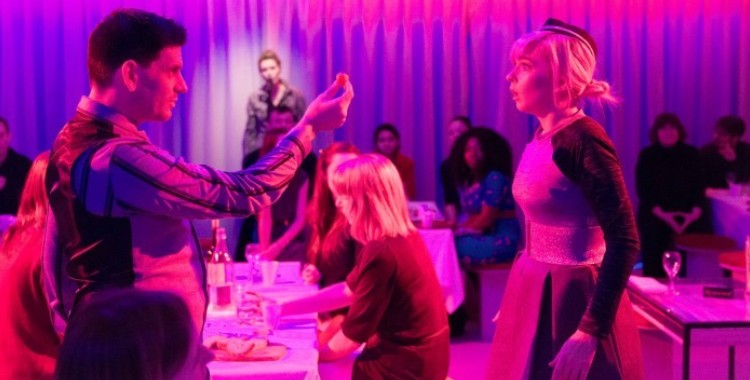
The basic concept of the show is contained within its title: we are travellers, embarking on a flight towards the flavours of the future. Once seated at our tables on board Lizzie Clachan’s futuristically reconfigured performance space, the cast of four gamely point out the nearest exits, while Alasdair Macrae as our pilot and maître d’ is a deliciously oddball host, at once strange, charismatic and lightly threatening. He reassures us, with a twinkle in the eye, that “nothing here will harm you – in the normal sense of the word”. His introduction, as it turns out, is a fitting primer for the show itself: quirky, kooky and charming, laced with just a dash of menace.

In keeping with the modest courses brought out one by one to delight our taste buds, the show itself is divided into small, bite-sized portions. The performers slide in and out of their roles as waiters to present short sketches on everything from derivatives trading to family dinnertimes, punctuated with Macrae’s brilliantly wacky songs. The audience watch all of this from our tables, eating and drinking throughout. There are, as one expects, a few surprises served up on our plates, but none that are particularly unpleasant or challenge our consciences too taxingly. Even one seemingly unappealing dish ends up being surprisingly innocuous, the tense frisson prompted by its arrival quickly settling into grinning relief.

And herein lies the problem. As a novelty dining experience, Gastronauts ticks most of the boxes: idiosyncratic waiting staff, eccentric host, a range of dishes that assault and confound the senses. As a meditation on our species’ messy relationship with food, however, the Royal Court’s creation is disappointingly uneven, movingly clumsily from madcap comedy to cutting critique while trying too hard to cover all bases. One impetus for the show was the recent horsemeat scandal, which brought the question of where our food comes from right to the fore of the public consciousness, offering more than enough material to chew on. Rather than focusing attention here, however, the show distractedly casts its gaze in all directions, also offering nods to eating disorders, food banks and the communal ritual of eating together.

Taken – like the menu – as a set of tasters, there is plenty to relish. Visions of food crisis offer a bitterly entertaining satirical portrait of the unappetising future we are potentially heading towards, while there is a mad, hallucinatory joy to watching the cast don cow masks and sing about how we’re all fucked. But for all its playfully provocative statements, the appetite for probing critique is left unsatisfied, even if our hunger is appeased. Instead of making us think twice about what we blithely gobble down, Gastronauts hands us a spoon and urges us to dig in.

Photo: Johan Persson