People Show 121: The Detective Show, Old Red Lion

detective-600x355

Originally written for Exeunt.

In The Coming Storm, Forced Entertainment’s latest offering, some critics saw an even greater self-reflexivity than usual; it was suggested that the show was in some way concerned with the company’s legacy and with deconstructing its familiar dramaturgical strategies. In the new piece from The People Show, an experimental company with a considerably longer history, there seems to be a similar focus. People Show 121: The Detective Show (the sheer accumulation of work indicated by the title alone is quite extraordinary) is as much a reflection on the company’s own techniques and its far-reaching influence as it is a dissection of the much-loved detective genre. It’s less whodunit, more how was it done.

Having been around since the 1960s, it’s hardly surprising that The People Show’s influence has rippled out to countless other theatremakers over the years. Now, however, the company is faced with the strange dilemma of being placed alongside the work it has spawned, much of which has caught up with – if not overtaken – its taste for experiment. As a way of acknowledging and negotiating this, People Show 121 makes no attempt to ignore or overcome the company’s history, which is immediately hinted at on stage by the presence of tireless original member Mark Long. Their techniques are flagged up, exaggerated, even lightly mocked for being hackneyed. As one performer apologetically explains, they are – like so many of the companies who were inspired by them – “just trying the postmodern thing”.

Here, the “postmodern thing” proves to be a knowing deconstruction of both detective narratives and the mechanics of theatre. In the rambling, charmingly chaotic plot, a hapless jobbing actor falls for an Agatha Christie obsessive with a dangerous secret to hide – a secret that soon sees her sprawled out inside the cartoonish chalk outline on the floor. Within the frame of this murder mystery, the structure of the show also manages to support a surreal game of Cluedo, a dancing Poirot and a hilariously hammy Italian waiter, along with plenty of over-the-top mime and some deliberately self-conscious narration.

It’s an intentional shambles, riffing on familiar detective genre tropes to generate laughs, while at the same time nodding to the now popular technique of presenting failure on stage. Performers Long, Gareth Brierley and Fiona Creese bicker between scenes, undermine each other’s performances and at times almost bring the whole piece crashing down around them, only to pick up the fragments of the show and carry on. It’s deliciously silly fun, effectively skewering a tactic of contemporary performance that has now become so prevalent it is danger of congealing into cliché.

Belonging to one of the generations created under the influence of The People Show rather than having direct exposure to the first shocks of its innovative approach, my perspective on this work is inevitably coloured by coming to it through its theatrical progeny. For me, however, the postmodern mickey-taking of People Show 121 – for all its undoubted fun – ultimately lacks any real bite of its own. Instead of offering the sort of bracing, experimental approach that has made them such a force over the years, The People Show attack an aesthetic that is all too familiar.

The Events, Young Vic

events-600x336

Originally written for Exeunt.

“It’s important to turn dark things into light,” says Claire, the anguished figure at the heart of David Greig’s new play, not quite convincing herself. The Events,Greig’s response to his conflicted feelings about the Norwegian massacre committed by Anders Breivik, is driven by a similar desire and tempered by similar doubt. As much as its protagonist, The Events searches for understanding, redemption, hope. What it finds is nothing so straightforward, but it is all the more compelling for the complexity it excavates on stage.

While sparked by a discussion between Greig and director Ramin Gray following the Breivik atrocity, this is not about what happened in Norway in July 2011. Instead, the events of the show have ripped apart a small, unspecified seaside community, where a boy has shot and killed several members of a local multicultural choir. Claire, the leader of the choir and a survivor of the massacre, is searching for answers. How did this happen? Why did it happen? Did the perpetrator have a reason, or must his actions be put down to “evil”?

Through the character of Claire, played with compassion and complexity by Neve McIntosh, the play prods at the insistent human desire to understand. Without understanding, Claire’s rage is impotent, directionless. In search of either an object for her hatred or an explanation that might pave the way to forgiveness, Claire hunts everywhere for answers, interrogating in turn the murderer’s father, his schoolmate, the leader of the right-wing political party whose ideology he laid claim to. But the more details are added to the sketch, the more the picture is obscured.

The succession of individuals questioned by Claire in her search for the truth are all played by Rudi Dharmalingam, who also represents the perpetrator of the central atrocity. This canny choice by Greig and Gray can be read in a number of ways. On the one hand, Claire seems to be seeing the face of the murderer in every place she looks, unable to escape him even in the embrace of her lover. The playing of all other roles by one actor also creates an intriguing quality of slipperiness; the killer is both everywhere and nowhere, inhabiting each last crevice of her consciousness while at the same time taunting her with his elusiveness. The ambiguity is enhanced by Dharmalingam’s performance, which meets Claire’s desperation with a refusal to emotionally engage, delivering each line with the same blank, lightly mocking intonation.

The impression we receive is that of a woman caught in a self-constructed labyrinth of questions, finding herself more and more lost with each new turn. There’s a certain disjointedness to the scenes, an apt sense of confusion and dislocation that hints at the incomprehensibility of what Claire is trying to piece together. Claire is a woman unmoored; unmoored from her faith, from those around her, from a previously solid sense of reason and logic. Buffeted by the currents of grief, rage and an utter failure to understand, she is alone in a sea of uncertainty.

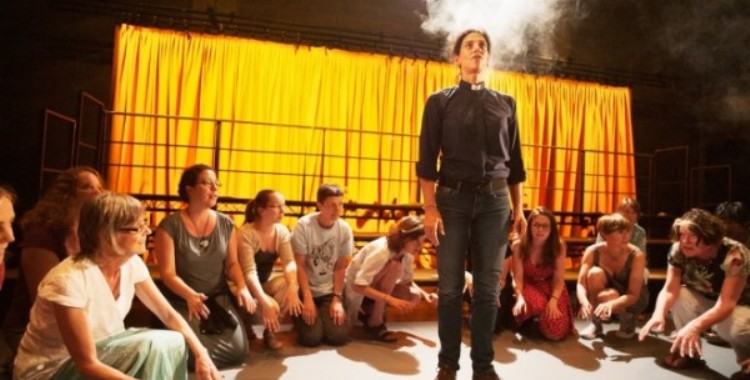
Claire’s struggle is reminiscent of certain strands in Chris Thorpe’s There Has Possibly Been an Incident, both in the subject matter – Thorpe’s play also features a massacre with hints of Breivik – and in its staging. In There Has Possibly Been an Incident, individuals are isolated down to the level of voice, which speaks against the blank, bland backdrop of Signe Beckmann’s minimal design. Here, Chloe Lamford’s set is similarly, masterfully simple. The stage is relatively bare, furnished only with a few rows of benches, a garish orange curtain, a piano, stacks of plastic chairs and tables loaded with teacups. The visual cues that this design offers are all painful reminders of the choir rehearsal room, but more important is the yawning empty space in its middle. In this space, McIntosh’s tormented Claire searches for ways to fill the gap, not just investigating but also acting, playing out different outcomes and solutions.

Sharing the sparsely furnished stage with McIntosh and Dharmalingam throughout the show is a local choir, different every night. This touch, which on paper has the sound of a gimmick, is in fact the production’s masterstroke. On the level of the play’s narrative, their role is one of haunting, suggestive of how something – the soul, God, the accusatory whispers of the dead – can remain present even in its absence. The choir’s presence and the songs they add to the piece also nod towards the potentially redemptive and community building power of music, which at first has a flavour of bitter irony, but eventually sweetens into something like hope.

On the level of the production, meanwhile, the choir does something even more interesting. Arranged on a bank of seating directly opposite that in which the audience is arrayed, the singers act as witnesses; mirroring the audience, they struggle alongside us to grapple with the questions the play poses. Their lack of slickness or preparation also adds a vital roughness, a slightly messy and unpredictable edge that makes the piece all the more truthful and affecting. At one moment during the performance, I notice one of the choir members raise a hand to her mouth, an involuntary but striking movement that focuses my attention on the theatrical dimensions of the event – the fact that we are sharing a public space and collectively processing this effort to understand.

In his introduction to the playtext, Gray writes that “Every act of theatre revolves around a transaction between two communities: the performers onstage and the improvised community that constitute what we call an audience”. His choice of the word community is no accident. The Events is all about communities – or “tribes” – with no small amount of tension contained in that notion. Community in the sense encapsulated by Claire’s choir is overwhelmingly positive, yet it is also in the name of community, or of protecting a certain community, that atrocities like this are committed. Greig’s intricate, finely tuned arguments have a habit of sharply pivoting, challenging our assumptions and once again subjecting everything to knotty ambivalence.

In the end, how these events and their wounding repercussions read is down to each of the individuals in our improvised community, the audience. It is easy to take despairing doubt from what we are presented with, but it’s equally possible to seize on hope. Near the end, a crucial moment in the narrative is suddenly ruptured by the intervention of a choir member, who reads from a script explaining the different between chimps and bonobos. While chimps solve conflict with violence, bonobos prefer sex to aggression, greeting their enemies with embraces. Humans, we are told, share exactly 98% of our DNA with each species. Which, therefore, do we most resemble? The implication, like that of the whole production, is that it for us to decide.

Photo: Stephen Cummsikey
Macbeth, Little Angel Theatre

macbeth1-600x525

Originally written for Exeunt.

Ever pushing gently at the boundaries of what puppetry can and can’t do, the Little Angel Theatre’s latest challenge is a puppet adaptation of one of Shakespeare’s best known and bloodiest plays, opening this year’s SUSPENSE Festival of Puppetry. Challenge is the right word, as this is no easy feat to pull off, but somehow, with typical tenacity, the Little Angel just about manages it.

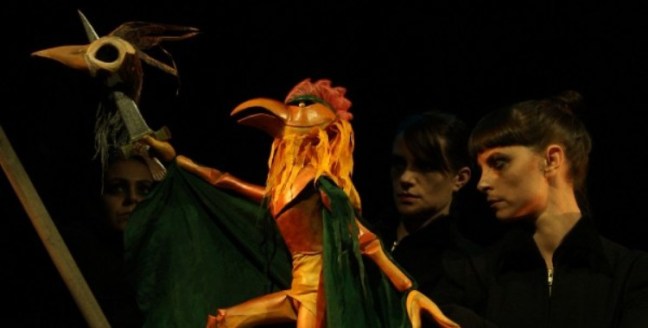
At the centre of this pruned-down reimagining of the play is a concept that casts all of Shakespeare’s characters as birds. The rank-climbing Macbeth is a proud cockerel, as are Banquo and Macduff, with Lady Macbeth as a preening chicken; King Duncan and his sons have been transformed into regal swans; the witches are recast as ethereal yet vicious carrion birds. Unexpectedly, this choice is borne out by the text, in which mentions of crows and other feathered creatures suddenly leap from the dialogue. There is also something in the pecking of the chicken and the swooping of the vulture that seems oddly appropriate for Shakespeare’s tragic portrait of grasping ambition, which comes across as all the more mean and ridiculous as a result.

Perhaps unavoidably, director Peter Glanville’s production is at its most successful when visual language dominates, flagging a little during the wordier sequences. It’s challenging to keep a soliloquy engaging when it spouts from the mouth of a puppet – even Lyndie Wright’s brilliantly animated designs can only suggest so much expression. The decision to use a pre-recorded soundtrack, however, is a canny as well as a practical one, adding an aptly unsettling sense of disembodiment to the dialogue that is at its most powerful during Macbeth’s encounters with the genuinely chilling witches.

In the captivating wordless scenes, the usual enchantment of the Little Angel’s offerings is swapped for an altogether more haunting variety of magic. In one spellbinding sequence, a doomed King Duncan is offered the graceful illusion of flight, while in another a battle is suddenly transformed into a thrilling, feather-shedding cock fight. The dark atmosphere, reflected in Peter O’Rourke’s gloomy set design, is also aided by James Hesford’s original score of ominous melodies and discordant notes.

Wright’s colourful array of beautifully crafted puppets are all operated by skilled puppeteers Claire Harvey, Lori Hopkins and Lowri James, dressed from head to toe in black. Rather than disappearing behind their puppets, these three figures take on a sinister significance within the performance, hovering omnisciently over the action like the circling witches and unceremoniously disposing of the mounting corpses. Playing with the manipulation that is a necessary ingredient in puppetry, this production delicately draws out themes of fate and pre-destination, leaving us in no doubt about the unseen hands guiding the action.

The Light Princess, National Theatre

LightPrincessNT3©-Binkhoff-Mögenburg_2-600x399

Originally written for Exeunt.

There can be little doubt by now that fairytales are a fertile source of artistic inspiration. And, as Angela Carter brilliantly proved with The Bloody Chamber,they are certainly not just for children. The long-awaited musical by Tori Amos and Samuel Adamson attempts to follow in this line of interpretation, adding considerable narrative and thematic padding to the 1867 tale by George MacDonald. Unfortunately, the result is less innovative than it is wedded to convention and archetype – not so much reinventing fairytale tropes as giving them a light prod.

The premise itself is intriguing. Althea, played by Rosalie Craig in a dazzling central performance, has no gravity. The princess hovers perpetually above the earth – not flying, but floating – unable to keep her feet or her thoughts rooted to the ground. Following the death of her mother, Althea’s head is in the clouds in more ways than one; she is buoyant in spirit as well as body, living in a fantasy of her own construction and incapable of taking anything seriously. Her opposite number is another motherless royal, Prince Digby, who reacts to grief not with escapism but with unrelenting sorrow. Thanks to the warring of their two nations, Lagobel and Sealand, the two are quickly set on a collision course – one that any fairytale fan can see will end in romance.

From the initial lengthy exposition onwards, the musical teeters uncertainly between straightforward fantasy and impish irreverence. In its most enjoyable moments, it is knowingly playful, referencing and occasionally sending up its fairytale heritage. Matthew Robbins’ animations, which lend a hand with the early storytelling, have an appealing picture-book quality, while the “once upon a time” framing of the narrative by Amy Booth-Steel and Kane Oliver Parry offers glimpses of arch wit. Elsewhere, however, the show slides all too smoothly into established patterns. There is nothing essentially wrong with conforming to fairytale conventions – they haven’t endured for hundreds of years for nothing – but The Light Princess never seems quite sure what it is doing with these inherited devices.

Equally, Amos and Adamson’s flimsy plot makes a cursory and often clumsy attempt at feminist revisionism. Mentions of Angela Carter in the programme notes – known, of course, for her own feminist appropriation of fantastical narratives – raise hopes that the piece itself all but dashes. Yes, Althea’s characterisation is a bit more complex than your average Disney princess, and yes the final tying up of loose ends raises a couple of cheers for strong women, but on the whole the storyline is hardly subversive. Even in the supremely capable hands of Craig, Althea is not a patch on one of Carter’s heroines.

Despite these flaws, however, there is a fair amount of enchantment in Marianne Elliott’s inventively staged production. Rae Smith’s design occasionally veers towards the indulgently saccharine, but at its best it conjures the spirit of heightened, wide-eyed wonderment that is at the heart of all good fairytales. There’s also some charming puppetry and a series of giddying acrobatics to create the illusion of Althea’s weightlessness – so giddying, in fact, that the sheer awe they inspire can be distracting. Craig, meanwhile, is stunning in the central role, achieving Althea’s floating physicality with an apparent effortlessness that must in fact be extremely effortful, while lending her belting voice to Amos’ surprisingly unmemorable score.

But just as the production seems about to sweep us off our feet – as during the aerial stunts of the unapologetically romantic first encounter between Althea and Digby, or in an altogether darker scene that finds its heroine suddenly earthbound – it struggles to maintain the flight that is so natural to Althea. Caught between playful subversion and faithfully rendered magic, The Light Princess fails to deliver on either.

Photo: Binkhoff Mögenburg

The Planet and Stuff, Polka Theatre

planet-001

Originally written for Exeunt.

How do we solve climate change? As opening questions go, it’s a biggie. It’s also a question loaded with optimism and arguably childlike naivety; it implicitly makes the assumption that climate change can be solved, and that humankind is capable of a collective effort to do so. But Tonic Theatre’s new children’s show is far from blindly optimistic.

The set up is simple: “volunteers” Joe and Becci, played by Felix O’Brien and Sarah-Jane Scott, are given half an hour to explain what is causing climate change and work out what we can do to solve it. The format is a gleeful mash-up of TED talk, kids’ documentary and Blue Peter-style demonstrations – complete with “here’s one I made earlier” fossil fuels. There’s also playful interaction from the audience and just a dash of good old panto conventions; whenever a big sign lights up, for instance, we can yell at the two performers to “get on with it!”

The show begins in fairly predictable if entertaining style, explaining global warming using jumper and blanket metaphors and recruiting the audience to throw around paper planes. Familiar explanatory techniques are deployed and people are plucked from their seats to recap what we’ve learned. This is smarter, however, than your average Newsround segment. Once the initial explanations are out of the way, a tension quickly emerges between optimism and pessimism, staging a latent debate about how best to present these ideas. Should we face up to the impending disaster we are wreaking on our planet, as Joe’s litany of catastrophes suggests we should, or should we stick with Becci and keep things fun? Is fear enough to make us change, or do we need to remain stubbornly positive despite the odds?

Similar tensions rear their head when we reach the solutions half of the show, which proves much harder than simply getting across the facts. The responses of world leaders are lightly hinted at in a section entitled “the blame game”, while Joe and Becci echo all our secret, selfish reactions to the suggestion that we might need to change. Complexity is embraced rather than skirted around, as possibility follows complication follows possibility. Each solution that is proffered is countered with a disadvantage, refusing to underestimate its young audience’s grasp of these thorny questions.

Variety, however, ends up being one of the show’s greatest strengths – in more than one sense. Aesthetically, the piece is colourful and richly textured, brushing off any residue of tedium that might have attached itself to the lecture format. The pace is brisk and the tools of performance are abundant, from sound to video to audience interaction, ensuring that the attention of young (and older) audiences is not allowed to dip for a second. Multiplicity also ends up being the vital saving grace of the ever more desperate answers that Joe and Becci throw at us. Each can be undermined, but we also have the choice to make these changes, to do what we can no matter how small, and – most importantly – to try.

Perhaps unsurprisingly, the central question is never quite answered. Climate change comprises a complex web of different causes and is – as this show reminds us with remarkable simplicity – symptomatic of the systems that order our lives. To suggest that there is a miracle cure would be patronising, misleading and ultimately irresponsible. Instead, there are multiple different answers, which it is up to us to wade our way through. Rather than imagining their future for them, the show asks its audience to imagine a different future for themselves. And therein, perhaps, lies its power.

Photo: Robert Workman.