SPILL National Showcase

walking-holding-Rosie-Healey

Originally written for Exeunt.

Stepping into the thick, warm embrace of darkness, soft earth shifts underfoot. Ahead, an anaemic shaft of light slices through the blackness, casting murky shadows across the faces of fellow audience members as we instinctively gather into a ragged circle. Sounds of water and birdsong spill into the space, unsettlingly enhanced – a hyperreal evocation of nature in a contained corner of Toynbee Studios, an elsewhere that drifts between dream and forest.

In Madeleine Botet de Lacaze’s piece The Shell, contact – the central theme of this year’s SPILL Festival – is promised then denied. Pacing the earth around the huddled audience, her bare body visible in dim snatches, de Lacaze steps close to each of us in turn, her face directed towards ours yet shrouded in the gloom. We share the same tight circle of space for suspended moments, before de Lacaze’s audible intake of break punctures the encounter, snagging on the brief possibility of intimacy and immediately snatching it away. These encounters come one after the other in full sight of other audience members, heightening anticipation with every pause, each offering up a connection that is quickly severed.

The other form of contact within the piece is that between de Lacaze’s body and the projected image of her body, a visualised division of self that is played out on the artist’s skin. The two bodies – real and projected – turn, bend, wash and scrub, at times together and at times apart. It is in the tension between these two images of the self, in the moments of simultaneity and slippage, that the piece finds its oddly captivating power. Through precise and beautifully judged use of the projection technology, these two bodies enter a jostling dialogue with one another, only fleetingly settling, butterfly-like, on moments of togetherness.

A similar tension pervades Jo Hellier’s 97 Years, though here the tension is between age and memory, the things we can briefly capture and the things that are irrevocably lost. It’s a tension that is mirrored in the arrangement of the space, as audience members are gradually recruited to hold the installation together, required to hold strings taut to keep pouches of apples suspended in the air before the large screen onto which Hellier projects video of her grandfather and his beloved garden. The apples themselves, more of which are arranged neatly in a row on the floor, are at various stages of decay, sweet yet rotting, hinting at the joys and sorrows of the ageing process that Hellier observes her grandfather experiencing.

The atmosphere cultivated by Hellier is one of delicate tenderness, an aura of gentleness that is ruptured by the violence of the piece’s audio manipulation, as the recorded words of her grandfather are spliced and distorted, looped on repeat or drowned out with white noise. The snatches of conversation that Hellier has gathered, together with the video footage, are markedly ordinary and everyday, but through her interventions they become distanced and alien, disrupted and repeated. It is we as audience members who are offered partial control of the audio distortion, our raising and lowering of the apples at the end of our string signalling the shifts in sound. Although the communality can feel contrived, Hellier’s gentle presence irresistibly invites engagement, while our physical connection to the piece through the strings – an almost umbilical link to the artwork – creates an immediate investment in it. We are the ones holding the piece, in the sense of both cradling and suspending it.

Holding, as might be expected, is also at the heart of Rosana Cade’s Walking: Holding. A tour through the busy, sun-drenched streets of East London with our hands slipped inside those of a series of strangers, Cade’s gorgeous embrace of a piece forms a meditation on intimacy and difference, offering the attractive promise of a pause within the constant noise of the urban space. I begin holding hands with Cade herself, a warm, quiet presence, who then passes me on to the first of a number of strangers, each of whom lead me through the city hand in hand. It’s a simple but startling premise. The activity of hand-holding, somehow so much more intimate than many other forms of physical contact, is made alien yet safe; participants are invited to examine their own relationship with intimacy while engaging in a kind of intimacy that is controlled, set out within clear rules and limits.

I’m surprised at how quickly I become accustomed to the feel of another’s hand in my own, just as a still, extended silence at one point in the walk shifts from initial awkwardness into tranquil comfort. Despite such moments of quiet reflection, however, the piece is far from an escape. As well as interrogating intimacy from a personal, internalised perspective – what does hand-holding mean to you? how do you understand love? – Walking: Holdingalso takes an external view, inviting participants to look at themselves and their series of partners, often from a position of difference. With this purpose, the walk deliberately incorporates several reflective surfaces, literal instances of the way the city is used as a mirror. How does this mirror reflect me when holding hands with another woman, or with a man dressed in drag? What eventually emerges from the experience, on a personal level, is a spirit of quiet defiance, of refusal to be deterred by others’ looks or opinions. One of my companions on the walk describes holding hands as existing in a bubble populated by just two; it is a small tragedy when that bubble is punctured by enforced self-consciousness.

After Walking: Holding, my hand empty and exposed to the cool April air, Paul Easterbrook’s durational performance HardBoiled? is a curiously distant spectacle. Pushing his body to its physical limits, Easterbrook pounds sledgehammer against metal, crushes objects between the teeth of a vice, hurls heavy containers of liquid against brick walls, their brightly coloured contents spilling across the stone floor. The critical dialogue with conventional images of masculinity is at once apparent, with the effort of Easterbrook’s strained body simultaneously revealing both strength and vulnerability, the futility of his arbitrary demonstrations of physical might hinting at the arbitrariness of masculine signifiers. Yet it never quite hits with the force it promises, its critique – at least in the section I saw – stopping slightly short. In the brief snapshot I experience of this year’s National Showcase work, the contact that achieves greatest impact is not the violent, but the disarmingly gentle.

Photo: Rosie Healey.

Ubu Roi, Barbican

UBu-600x424

Originally written for Exeunt.

Few plays have a more intoxicatingly, misleadingly chronicled history than Alfred Jarry’s bourgeois-taunting phenomenon Ubu Roi. Mythologised as a violent break in theatre tradition, the moment at which the well-heeled patrons of the boulevard theatre clutched their breasts in shock and the avant-garde was born, the play is remembered above all for sparking a riot at its premiere in 1896, causing it to subsequently be banned from the stage. The truth, as so often when divorced from the sensationalism, is a lot less dramatic: Jarry himself in fact paid a group of friends to cause a ruckus during the performance, intent on provoking a scandal. He certainly succeeded.

It’s the sort of gleeful, calculated trouble-making that recalls the stubborn anarchism of adolescence, an association that Cheek By Jowl have taken and run with in their new version of this problematic play. Picking up on Ubu’s own roots in the teenage imagination – the character was initially a grotesque caricature of one of Jarry’s teachers, created for the entertainment of his schoolmates – director Declan Donnellan has negotiated the text’s crude extremes by framing it as fantasy. Here, Ubu’s depraved, monstrous acts become the cruel and frustrated Oedipal imaginings of a teenage boy with a video camera, a fierce psychological shattering of his parents’ stiflingly spotless middle-class existence.

Nick Ormerod’s design swathes the Barbican’s Silk Street Theatre in a tyranny of beige and cream; a modern show home dream, its pristinely laid dining table a picture-perfect lesson in entertaining. Père and Mère Ubu are expecting guests, fussing over outfits and re-arranging coffee table nibbles, while their teenage son – a scruffy grey blot on the otherwise unspoiled living room – skulks around with his camera, offering the audience a glimpse into the rest of the gleaming Ubu home. In an intriguing but over-long opening, the eye of the camera lens takes us on a voyeuristic tour of the house, zooming in on even the most immaculate of surfaces to reveal tiny, tainting traces of human filth: a single dark hair buried in the bedclothes, a smudged lipstick stain on the rim of a glass, a slender speck of dirt on the shiny white toilet seat. As the creator of Ubu well knew, you can never quite banish the muck of human life.

Once the production has laboured to provide us with this frame, the action as we know it can begin, the infamous opening “merdre” spluttered out in an extended frenzy of anticipation. With Ubu’s story of ruthless, inane power-grabbing underway, its grotesquely cartoonish excesses are given free rein, all the while skewering the empty social rituals of the familiar dinner party environment it punctures. Christophe Grégoire’s increasingly monstrous, gurning Ubu might be the gargoyle everyone expects, but the precise physical detail put into the performances by Cheek By Jowl’s excellent French ensemble elevates the ridiculous spectacle of the anti-hero’s rise and fall. There is also room for some witty added touches; a jibe at bankers allows the audience to titter without losing the accusatory sting that Jarry was first aiming for, while the medium of the video camera allows for a few grinning sideswipes at Hollywood’s stylistic clichés.

Even as precisely and intelligently handled as here, however, Ubu Roi remains a heavy burden to heft onto the stage, and after more than an hour of clowning its brashness begins to grate. But it is the main narrative’s framing mirror image that – as well as producing the greatest laughs – becomes increasingly disturbing throughout the play’s descent into mess and depravity. With their magnolia haven in tatters around them, Ubu’s disruptive work done, the dinner guests sit serenely in the midst of the destruction, their small talk blithely continuing. Knowingly placed as it is at the heart of London’s financial district, it is hard not to read this fatal stasis as a bitter metaphor. Perhaps the savage power of Jarry’s play now lies not in its supposed ability to start a riot, but in the fact that no riot is breaking out.

Photo: Johan Persson

Hattie Morahan

Originally written for Exeunt.

Never was a door slam so deafeningly resonant. The escalating dramatic action of A Doll’s House hinges – quite literally – on the moment that Nora finally shuts the door on her husband and children, walking away from a life that has hemmed her in. It’s a climactic moment that has been variously read as a statement against stifling patriarchy, as the shocking action of an uncaring and irresponsible mother, as an inescapable tragedy. But for Hattie Morahan, who is just about to return to the role of Nora in Carrie Cracknell’s production at the Young Vic, the play’s famous culmination is just one of its many facets.

“One is aware of that whole phenomenon and I can totally understand it, but it’s a phenomenon that’s built up around a single act,” she says of the debate surrounding the play’s conclusion, going on to describe readings that focus on that act as “incredibly reductive” ways of looking at Ibsen’s masterpiece. “It’s quite an incredible arc to go on from the start of the action to the end, and I think if it’s all geared towards the door slam then that actually distorts what the play is,” Morahan continues. “The play is about a marriage and it’s about a particular family. I think the more you can honour the detail and the particularities of those individuals and the mess that they’ve made of their lives, the more that her leaving will resonate in whatever way it does with the people who see it.”

This approach lends a richly detailed texture to Morahan’s Nora, a woman perpetually caught between ringing laughter and crushing despair. As she juggles her husband, her young children and the creditor knocking insistently at the door, small moments are repeatedly on the cusp of betraying her carefully hidden turmoil – a flutter of the hands, the startled catching of a reflection. Like Ian MacNeil’s elegantly revolving set, this Nora glides swan-like through the play, all composure on the surface, while frantically churning the water beneath. She also emerges as frequently spoilt and manipulative, a slyly wheedling flirt with a fragile strain of naivety.

“I’ve never really found I have any trepidation about making characters unlikeable,” Morahan reflects on her interpretation of the role. “If anything I’m far more drawn to people’s flaws and when they behave badly than someone who’s heroic or pious – I’ve got a weird reflex against that. I think my gut instinct is to try and reduce heroism and make it human.” She also believes that to do justice to Nora as written by Ibsen, a character with “such a skewed view of the world and her place in it”, it’s necessary to draw out the less palatable aspects of her personality. “She behaves really appallingly,” says Morahan, “and it’s only through the action of the play that you discover why that is.”

It’s a role that demands overt performance, both in the central theatricality of Nora’s dancing of the tarantella – here a display of sensuality that collapses into distracted frenzy, an arresting physicalisation of Nora’s desperation played out under a twitching spotlight – and in the unrelenting performance of her marriage to Torvald and the display she feels compelled to put on for other men. “The performative element, as I understand it, seems to have come right from when she was a child,” says Morahan. “There’s a shame or an inappropriateness associated with just being herself; she’s always got to be what pleases other people – specifically men.” When this audience dissolves, as Morahan explains, Nora is left with a yawning gap in her identity.

“I think that’s one of the most terrifying things she realises at the end. Her marriage has been such a stressful time that she’s had not a moment to really breathe or consider who she is or what it means to be happy, or if she is happy. One of the shocking realisations at the end is that when all that is taken away, underneath the performance she doesn’t know who she is – there’s a sort of void. She’s never been given the self-worth or the self-esteem to value herself as an entity when it’s not in a pleasing shape for men.”

Morahan explains that the aim shared by Cracknell and designer MacNeil was to somehow replicate the play’s original sense of accusatory familiarity for its bourgeois audiences: “yes it’s nineteenth-century, and yet half-close your eyes and you could be in a shabby chic apartment in West London”. She also gives much credit to Simon Stephens’ new version of the script, which “seems to have one foot in the nineteenth century and one foot in now, without ever drawing attention to it”. It is not a self-conscious, pointed updating, yet like the design it applies a light contemporary gloss. “It’s sort of miraculous,” says Morahan. “The words, as you’re saying them, feel of their time and yet utterly now. It’s very deft.”

This evocation of the now within the context of the past immediately raises the much asked question of what A Doll’s House has to say to us today. What the freshness of this interpretation raises is how many of the difficulties that are grappled with in the play remain sadly relevant in the twenty-first century, particularly in relation to female experience. “The gender politics are weird,” Morahan muses on this topic, “because in so many respects things have utterly transformed in terms of the independence that women have nowadays, but equally, in terms of a kind of insidious sexism – when we’re not talking about wage differences or glass ceilings or third world gender problems – I think there are still these same tensions.”

These tensions and the delicate balancing act that many modern women find themselves negotiating today were also explored in the short film Nora, made through a collaboration between the Young Vic, The Guardian and The Space, and sitting alongside and in dialogue with the production. Taking inspiration from the premise of A Doll’s House on what Morahan calls “a very crude level”, it is instead more of a probing meditation on contemporary motherhood and what glossy women’s magazines have enshrined as “having it all”.

It’s a now ubiquitous phrase that Morahan uses wryly: “On appearances you’re having it all – your mothers have won all the battles and here you are. The questions the film asks are to do with happiness and to do with satisfaction and what this is all for – what have we actually gained? It was fascinating to do, because it did make me think about how roles have changed and how expectations have changed, but we’re still trying to work out what that balance is. Whatever it is, it’s going to be messy; there are no perfect answers.”

For now, Morahan is back in rehearsals with the rest of the company, rediscovering the play after several months away from it. “It feels a bit backwards,” she says of the experience of returning to a production, with a role that was fully formed but now needs to be re-excavated. There is also added pressure for this run, as Morahan goes back to the role that won her the Evening Standard and Critics’ Circle awards. She admits that this enhanced level of expectation has caused some anxiety, but for the most part she describes this second rehearsal period as “liberating”, an opportunity to truly inhabit the play and make new discoveries.

“It’s a bit like knowing you have to jump into a really freezing cold swimming pool,” Morahan laughs. “You know it will be fine when you’re in.”

Photos: Johan Persson

Purple Heart, Gate Theatre

Purple-Heart-600x400

Originally written for Exeunt.

It’s no accident that in the taut domestic space of Bruce Norris’ play the clocks are being turned back. First produced in Chicago in 2002, the piece rubs at one of the sorest wounds of recent American history – the Vietnam War – in the aftermath of another that is only just beginning to scab over. Now receiving its UK premiere at the Gate Theatre, it’s impossible not to read this searing acid burn of a play through the lens of conflicts sparked by 9/11, implicitly asking the unsettling question of whether the world is simply caught in a relentless cycle of rewind and replay.

While Vietnam is the scar that Purple Heart concerns itself with, its approach is a glancing one. In a Midwest living room in 1972, a setting realised with gaping spaces at either side that might as well be the holes blasted by loss, Carla is agonisingly caught in the process of grieving for a violent, unfaithful husband. Suffocated by condolences and stuffed with sympathetic casseroles, her strained relationships with attention starved twelve-year-old son Thor and overbearing mother-in-law Grace are shown at breaking point when soldier Purdy breaks unexpectedly into this poisonous space. It’s a classic, almost clichéd dramatic device furnished with freshly sharpened claws, tearing through the fraying fabric of the family’s worn out existence.

Not unlike the mysterious intruder in early Pinter plays, Purdy is a figure half-explained and oddly, indefinably sinister. Trevor White lends this stranger an almost disturbing stillness, an upright, static quality that is physically at odds with Amelia Lowdell’s restless, frenetic, maniacally laughing Carla. As startlingly candid dialogue bounces sharply between the pair, there is a marked rupture to the naturalism of the piece, an almost painful heightening of the situation until it reaches the piercing pitch of Grace’s faulty hearing aid battery. Acerbically funny and flooded with an acute sense of the ridiculous, the believability of the scenario – a visit from a soldier who met Carla in a military hospital and who may or may not have been friends with her late husband – is less important than its grim power to compel.

The world that Christopher Haydon’s production wrenches us into is one of laughs gulped down with horror, of love mashed up with violence and kids enraptured by stories of torture and aggression. It’s important, though, that the worst is never seen and even its spoken references are spare; structured in this way, the Vietnam War is a constant, queasy backdrop, like the patterned yellow wallpaper pasted on the walls of Carla’s suburban prison. Within this retrospective frame, the specific conflict in question, like the desperate relations of these characters, is only symptomatic of a wider, never fully specified sickness.

Intelligently framed, too, is Simon Kenny’s canny design for the small space of the Gate, placing the audience in banks on either side of the family’s dissected living room. This configuration forces us to look quite literally through the play and see ourselves almost mirrored on the other side; a reflection, perhaps, of an ugliness that Norris’ broken characters fail to submerge. It is this penetrating ugliness, despite an occasional heavy-handedness in the approach, that ensures its unrelenting assault pummels audience as much as characters. It may be grimacingly entertaining, but it is never easy to watch.

Photo: Hugo Glendinning

The Yellow Wallpaper, Schaubühne Theatre

wallpaper-600x398

Originally written for Exeunt.

Regularly and repeatedly claimed by feminist critics, Charlotte Perkins Gilman’s nineteenth-century story The Yellow Wallpaper is not a text that begs to be updated. Synonymous with the oppressive patriarchy of its time, which condemned women such as the story’s narrator to a diagnosis of “hysteria”, the piece holds a central place within feminist literary histories – a place that might itself be an intriguing site for contemporary investigation. Instead, this new version from Lyndsey Turner and Katie Mitchell drags Gilman’s story into the present day, making explicit the then unrecognised post-natal depression that seems to be hinted at by the narrative. It’s both a fascinating and a frustrating move.

Transplanting Gilman’s troubled, restless narrator from a nineteenth-century American summer house to the German countryside of the present day, this dramatic reimagining very deliberately refracts the tale through later psychological lenses, rendering it into a modern study of depression. The originally nameless protagonist, now identified as Anna, is listless in the house her husband has brought them to for her recuperation, often in bed during the day, yet plagued at night by a conviction that something – or someone – is moving behind the wallpaper.

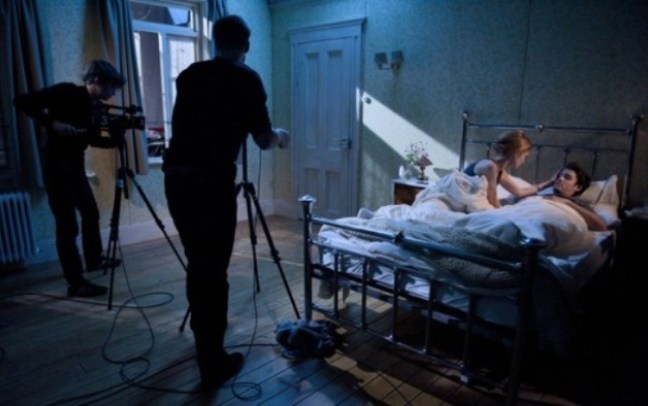
Mitchell’s approach to this story is a meticulously deconstructed one, breaking down her intricate, technically dazzling production into its individual components. The Schaubühne’s wide stage is dissected into three segments, above which a large, attention-stealing screen hosts projections of film being captured live by an intrusive crew of camera operators. Two of these divided sections of the performance space are given over to precisely detailed, almost identical renderings of the room in which the protagonist of the piece is confined, while the third is a closed-in box fronted by a large window, in which foley artist Cathlen Gawlich visibly creates the sounds that ripple through the production – footsteps, scraping, knocks at the door. Meanwhile a similar, smaller space encloses actress Ursina Lardi, a lone, starkly lit figure speaking into a microphone.

Through these mechanisms, the production depicts protagonist Anna’s anguished descent into madness in close-up, punishingly claustrophobic detail. From the moment she arrives at this room in a remote country house – and even before her entrance – every element of the place is heightened. The disturbingly enhanced sound effects, produced before our eyes, assault the ears, while the vivid wallpaper itself takes on a strangely disquieting pallor under Jack Knowles’ evocative lighting. As a psychological device, Mitchell’s technique is unnervingly effective. Not only does this approach give the audience startlingly intimate access to Anna’s own crisis; every dismantled element of the production repeats the feeling of being trapped, from the tightly enclosed space in which Lardi voices Anna’s thoughts, to the close, intruding presence of cameras, to the screens that periodically slide down to cut off sections of the stage.

In its technical allusions to thriller and noir, genres with which the piece thematically shares a number of features – the creepy house, the scent of mystery, the escalating urgency – the overwhelming presence of film amplifies this sense of unease. Throughout the production’s most disturbing sequence, as Anna tears frantically at the wallpaper, a camera pressed close while the intensified sound of scratching floods the auditorium, we might be trapped inside a psychological horror movie. Yet perhaps there is more to this technique than pure atmosphere. In addition to the live film being recorded and projected throughout, bookending the production are two pre-recorded film segments, self-consciously styled as home videos. This juxtaposition makes more visible the concern with representation that persists throughout, implicitly asking how we perceive ourselves and how we choose to present ourselves to others, particularly in the context of a mediatised modern culture. Is this not, like Gilman’s original narrator and perhaps even Gilman herself, a woman struggling with how she is seen in the world?

The question of gender, however, is oddly muted, as is the feminist genealogy that has wrapped itself around Gilman’s text. As a non-German speaker with no access to the script, it’s impossible to muse on any insights that Turner’s textual reworking might offer, but the half-informed eye – when not darting between the multiple facets of Mitchell’s intriguing staging – catches a sense of something missing. Beneath the technical accomplishment and the queasy shiver of unease, there is the nagging suspicion of a certain hollowness. Disturbingly, devastatingly acute as the psychological portrait might be, its significance remains elusive.

Photo: Stephen Cummiskey