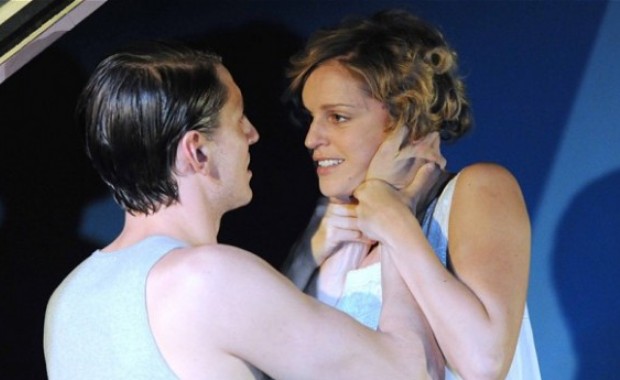
Ross Sutherland – Every Rendition on a Broken Machine


Originally written for Exeunt.

Man shapes creation in his own image; creation is unruly, rebels, behaves in ways not calibrated by man; man and creation become enemies, locked in a struggle that can only be terminated by death. It’s the stuff of cultural myth, a mutation of Genesis that persists in fiction from Frankenstein through to The Matrix. We are perpetually sowing the arrogant seeds of our own destruction.

In a hyper-connected world, the modern receptacle for such anxieties is, unsurprisingly, the machine. It is these anxieties that poet Ross Sutherland has channelled in his own confrontation with the uncanny capabilities of artificial intelligence, an intelligence with the amassed knowledge of the world at its disposal. Our one comfort in our encounters with these omniscient bundles of wire and code is the certainty that, for all their factual knowledge, they lack the emotional sensitivities that distinguish humanity. But if a computer is capable of writing poetry, the enshrined output of the soul – Wordsworth’s “spontaneous overflow of powerful emotions” – then where does that leave the human spirit?

Sutherland has been collaborating with a machine throughout his career as a poet, from his gleeful seventeen-year-old attempt to mutate Wordsworth’s ‘Daffodils’, to digitally tinkered versions of Yeats and Plath. Filtered through various different languages via the mediator of a digital translator, his resulting poems are the distorted offspring of their iconic parents, barely recognisable riffs on famous lines. It is this process that he explores in his film Every Rendition on a Broken Machine, an exploration of man’s animosity with the machine, the developments of digital translation, and the possibility that a computer might just be a better poet than a human being.

Presenting this documentary accompanied by his own live commentary – a wry nod to the conventions of the DVD – Sutherland adds another knowing dimension to this stand-off between computer and human. Standing next to a screen, it is Sutherland versus the computer multiplied by two. The film also acknowledges throughout the role of the computer in its own creation, tacking together YouTube clips and webcam recordings. As Sutherland states, it as though human and machine have become somehow enmeshed in modern society, the former often indistinguishable from its reliance on the latter.

Through his technique of distorting and remoulding poetry via a process of translation and retranslation, Sutherland speculates that poems might just be “computer programmes of a different order”; what he is embarking upon is a project of transforming technological glitches into something beautiful. There is also something gloriously honest about this process, which lays bare the inescapable fact that writers are always engaged in some level of plagiarism. Preceded by a vast literary history that has seeped, conscious or not, into our cultural identity, writing must necessarily involve quotation and acquisition. This is once again reflected in the form of Sutherland’s film, which borrows from sources as eclectic as J.G. Ballard and Clarissa Explains it All.

Behind everything Sutherland is doing is a series of ingrained cultural assumptions about the nature of poetry. As rigid as the patterns of rhyme and rhythm may be and as meticulously calculated as the craft of poetry often is, there persists a notion, perpetuated by Romanticism’s shrine to the imagination, that this is an art form that somehow offers a window onto the human soul. Perhaps at the root of our natural repulsion to the sort of collaboration Sutherland is proposing is not a fear for the computer’s destruction of the poetic muse, but a fear that the creative potential of the machine will reveal that this worshipped muse never really existed.

Yet there is something inherently creative about Sutherland’s strange craft. While the original words may be those of another poet and it is the computer that is doing the translating, this process is ultimately shaped by Sutherland’s hand; acting as a sort of sculptor, these elements are his materials and tools respectively. As artificial intelligence is sold to us in ever more “organic”, sexy packages, the threat of the machine garbed attractively in smooth lines and pseudo-friendly marketing speak – even given a human voice – that line between us and our gadgets becomes increasingly blurred. But beneath the screens and the apps and the iPoetry, the initial creative catalyst is always wonderfully, fallibly human.

A Change of Scene

Originally written for Exeunt.

Sitting folded origami-like in my seat in the balcony of the Royal Court, I can’t fight a certain nagging irritation at the peripheries of my perception. Captivating as its disconnected scenes are, there’s something distracting about Love and Information, Caryl Churchill’s new piece about the knowledge onslaught of the digital age. Or, more accurately, it’s the lack of distraction that becomes distracting in itself. Staged in Miriam Buether’s open-sided white cube of a set, each of Churchill’s 57 miniature plays is punctuated by a blackout, during which cast members and props are swiftly, invisibly switched. Each scene is surgically removed with such precision that not even a scar remains.

It’s a dizzying feat of stage management, but in its very invisibility it attracts attention. Doing away with the creaking, carefully ignored dragging on and off of props by stage hands and cast members, the production instead leaves a gaping black hole into which our latent anxieties about the craft of the stage are helplessly sucked. It might be seen as an inversion of the effect of Mike Leigh’s Grief at the National Theatre last year, in which tiny tweaks to the meticulously naturalistic set were made with unapologetic conspicuousness. Only when pronounced in either its presence or absence, it would seem, does the inherently awkward scene change impinge on the audience’s consciousness.

The scene change, as a convention, is a culturally conditioned blind spot in the illusion of representational theatre, an unseemly blip that we as an audience collectively ignore. We can handle a table being spirited in by black-clad figures in semi-darkness, or characters suddenly, inexplicably transporting chairs off with them upon their exit; this is all part of a game whose rules we are smug in the knowledge of. We know how this works. It’s the disruption of those rules and thus the unveiling of the game that causes discomfort, a discomfort that might fall under theatre academic Nicholas Ridout’s diagnosis of the “ontological queasiness” that theatre is capable of producing.

Much like Ridout’s description of the unsettling experience of a face-to-face encounter during a performance, a break in the conventions of the scene change can cause an uncertain lurch, a disconnect between the accepted illusion and the reality behind it. We’re aware not only that this isn’t real, which we knew all along even if we’d suppressed that knowledge, but that we have been willing participants in the illusion. What we’d ignored is suddenly impossible to ignore, either in its overt interference or its glaring absence. To take the resulting discomfort a step further, it might be suggested, to stick with Ridout, that our blushing reaction is caused by an acknowledgement of the economic relations at play: we’ve paid for people to shift the set around and agreed an unspoken contract to pretend that they’re not there.

So we could just see these odd dislocations as inadvertent slip-ups, of over-efficiency in the case of Love and Information and of sheer clumsiness in Grief, slip-ups that throw open the true nature of the economic exchange upon which theatre is based. But the more I think about these two examples, the more I wonder if there might be more to the simple scene change than a necessary movement of props that can choose to either conceal or expose its seams.

While at the time of watching Grief the constant to-ing and fro-ing of stage hands was a frustrating distraction and the small changes it was all in aid of seemed to be a hint that Leigh had become more accustomed to the cutting room than the stage, in retrospect it acquires more significance. Why construct such a perfectly observed sphere of naturalism, down to the last precisely placed photo frame, just to smash that illusion apart with the intrusion of backstage mechanisms?

Assuming, as I think good criticism should, that creative choices have been made for a reason, it is perhaps more productive to think of these intrusions as a deliberate jolting of the hermetically sealed suburbia in which Leigh’s protagonists exist. The changing of a vase of flowers or the tidying of a pile of newspapers, alterations so small they are laughable, could in this context be read as a comment on the essentially unchanging atmosphere of this household, a decaying stasis that is at the heart of the piece. These tiny adjustments mock the fatal lack of any real transformation. Scene change, if interpreted thus, is thematically enmeshed with scene; stagecraft reflects the content of the stage.

Likewise, the dazzling smoothness of Love and Information’s transitions would seem, when investigated in conjunction with the piece as a whole, to have a guiding rationale. Buether’s minimal container of a stage, with its clinical white glow, recalls the screen of a computer or smartphone; as actors and props appear and disappear with a magically seamless lack of fuss, the experience of viewing is strikingly similar to the experience of clicking through videos or apps. What we are witnessing is a series of downloads in an age of unlimited digital information.

These are striking but certainly not solitary examples. It would be naive and potentially insulting to suggest that no more creative thought is invested in the transition between scenes beyond which piece of furniture needs to be shifted where. But perhaps from a critical perspective, when we encounter the humble scene change, we ought to start considering this seemingly unremarkable feature of the stage as something that might alter more than just the props or signified location – as something that has the power to truly change and shape the situation being presented.

Desire Under the Elms, Lyric Hammersmith

Originally written for Exeunt.

Property is a flimsy, fleeting, yet enduringly seductive object of desire. There is a bitter irony contained in an object over which lives are lost but which, as attested to by proverb, you can’t take with you. This empty basis on which possessions possess is laid startlingly bare by the Lyric Hammersmith’s new revival of Eugene O’Neill’s lust-laden study of ownership and desire, claustrophobically bound within the confines of a farm both built on and fought over with sweat.

The farm in question is under the disputed ownership of Ephraim, an aging but tough espouser of hard work whose joyless mantra is that “God’s hard, not easy”. As elucidated by O’Neill’s script in a laboured collection of expository scenes, this farm has become the subject of squabbling between his three sons, the youngest of whom, Eben, eventually buys out the stake of his two brothers. It is only when Ephraim returns, with pretty but fiercely acquisitive new wife Abbie in tow, that the friction between conflicting desires – material and physical – begins to emit sparks.

While O’Neill’s text is laden with words, lilting to a lazy rhythm that seems born from the slowly emanating heat of the earth, it is the visual landscape of the Lyric’s stage that seduces our attention. Ian MacNeil’s gorgeous design has realised the house at the centre of the characters’ alternately violent and petty disputes as a tellingly insubstantial structure, a plywood skeleton that dismantles into a series of self-contained domestic spaces. Its deliberately flimsy cladding and the abandonment of any pretence to cover its inner workings speak of both fragility and artificiality; the prize at which Ephraim, Eben and Abbie are all grasping is as creakingly hollow as it is ephemeral.

There also seems to be a recognition within Sean Holmes’ intelligent staging of the labour on which this coveted property has been founded, a labour that its “purdy” exterior would seek to elide. The wooden shells that house the various scenes are wheeled around the stage by figures in overalls, pointing to an act of labour by which the inhabitants’ comfort – or discomfort – is secured, an exposure of economic relations which in turn highlights the uneasy exchange that Denis Gough’s increasingly desperate Abbie is engaging in. As she initiates an inevitable affair with Eben, the acquisition at stake might shift from property to love, but payment must still be made.

Recurrent threads around these themes are insistently sewn by O’Neill and plucked at by Holmes’ production: the creeping threats of cold and poison, a “lonesome” chill that creeps through the house, the greedy, lingering promise of “gold in the sky”. The air of O’Neill’s world is as heavy with imagery as it is laced with desire – too heavy, it often seems, for his narrative to support. The melodramatic tint of the unfolding drama allows Gough to tear herself apart in a blistering, ferocious performance, but something in this strange, overburdened play seems to be torn along with her.

This House, National Theatre

Originally written for Exeunt.

The opposing benches in the House of Commons are placed at a calculated distance of exactly two swords’ lengths apart; it is an arena which was, from the very first, built with confrontation in mind. It is also an arena which, conveniently for the purposes of theatre, is no stranger to performance. The focus of James Graham’s new play, however, peels back the overtly theatrical space of ministerial speechifying to take a peek backstage, at the applying of the warpaint and the cracking of the whip.

His subject is a chapter of parliamentary history in which that largely invisible behind-the-scenes discipline was pivotal. The phrase “you couldn’t make it up” – avoided by Graham’s script but ever implicitly present in the farcical political wranglings presented on stage – is arguably more applicable to the parliament of 1974-9 than to any other period in recent political history. With little to no majority, Labour’s precarious position of governing rested on a “tug of war”, determined by who could exert the strongest pull on the “odds and sods” and the wavering backbenchers.

Placed in the heart of this parliamentary battlefield, Jeremy Herrin’s production constructs a compromised version of immersiveness, in which the audience are decidedly located within the sphere of the Commons but at a remove from its machinations. We are privileged observers, but never actors – a lack of agency that forms a fitting reflection of the average citizen’s place at the sidelines of politics. Rae Smith’s design has transformed the Cottesloe into parliament in miniature; the stage is flanked by those familiar, aggressively arranged benches, while the performance space itself is sharply divided into the government and opposition whips’ offices, the scene of scheming, dealing and ruthless backstage manoeuvring. No consensus politics here.

While the padded green benches on which we sit and the near-constant presence of the bewigged Speaker provide the perpetual visual backdrop of the Commons, the power games and posturing at play here might just as easily be taking place in the office or the schoolyard. This latter reference is brought to mind by the blackboard that haunts the government whips’ office, its chalked up political allegiances like marks against Labour’s governing. The schoolboy atmosphere of insecurities and one-upmanship extends into the spiritedly boisterous performances of the largely male cast, dominated by rival deputy whips Philip Glenister and Charles Edwards, who clog the air of both offices with frustrated testosterone.

As fascinating as this bizarre slice of politics is, the production seems also to be engaged with wider concerns. Primarily through the rivalry between Glenister’s and Edwards’ characters, Graham suggests that human nature is both the downfall and the triumph of politics, what gets in its way and what propels it forwards. It is an intriguing idea, but one that is not quite given room to be fully unpacked amid everything else at play. What This House does achieve with smiling clarity is a precise portrait of the foibles of the British political system, a system encumbered with idiosyncratic traditions and described as “creaking” and “diseased”, but a system that is at the same time implicitly compared with the giant clock in whose shadow the seat of power lies; both old, but still ticking away.

While Graham has delicately patched together an intricate and frequently compelling account of this curious caesura in twentieth-century politics, the complexities of these slippery deals and the very nature of the parliamentary stalemate that is its subject form something of a barrier. In the words of one frustrated MP, “this isn’t parliament, it’s a fucking purgatory”. Though at the end of the impasse, as Margaret Thatcher’s disembodied promise of “hope” echoes around the Cottesloe, this production makes it hard not to feel that this state of limbo might have been better than what was to follow.

No Place Like Home

Originally written for Exeunt.

In the immortal, celluloid-enshrined words of a ruby-slipper-tapping Dorothy, there’s no place like home. Or at least, even if our birthplace is somewhere from which we run kicking and screaming at the first opportunity, the place we come from inevitably shapes and defines us in some way, as do all the other places we subsequently call home.

So what does our local theatre say about us or about the community it is born from? Growing up in something of a cultural grey zone whose sole theatrical offerings seemed to be incessant tours of Grease and the obligatory ABBA sing-along, my loyalties as a theatregoer were aligned to London almost by default. It is a city I have yet to actually live in, but to which I feel inextricably bound by my connection with its culture. My personal experience, which I suspect is partly down to my hometown’s relative proximity to the huge variety of theatre available in the capital, is thankfully not indicative of the state of regional theatre on the whole. But even in areas with a thriving theatre scene, how much of the work is really wedded to its surroundings?

There is, of course, an immediate flipside to this argument. Just as the dearth of roles for women is not necessarily addressed by female writers, who are often wary of confining themselves to female experience for fear of being shoved in the box labelled “feminist playwright” and never allowed back out, regionality can be shunned by artists operating outside the capital. “Regional” is a tag that risks being used to imply something limited, something insular and blinkered, perhaps even something quaintly pastoral. As Daniel Bye’s column about Northern Stage at St Stephen’s suggested, it is easy for a national theatre culture still largely centred on London to pinpoint regionality as a basis for criticism.

What Bye also proposed, however, is that we should ultimately be proud of where our theatre comes from. In his words, the programme at St Stephen’s was “marinated in its distance from the cultural centre”; whether consciously “regional” or not, work made away from London is inevitably coloured by the site of its origin, as much as London-based theatre is arguably lent a certain quality by its position in the capital. So why are we reluctant to celebrate these regional differences?

As with anything, there are startling exceptions to the picture of regional theatre that I have – admittedly very roughly – begun to sketch above. Chris Goode’s 9, for instance, programmed at the West Yorkshire Playhouse as part of the Transform Festival earlier this year, worked with local people to create a series of solo performances, crafting a piece of theatre fused to its place of origin through tangible human links. Remaining in Yorkshire, Invisible Flock’s Bring the Happy chose to investigate the concept of happiness through the very specific focus of Leeds, while their current project Sand Pilotexplores an equally specific relationship with the natural environment in Morcambe Bay. In a slightly different approach to regionality, Joel Horwood’s  Peterborough was commissioned by Eastern Angles with the brief of responding to the city of its title, a place referred to by the Arts Council as a “cultural cold spot”.

Many other examples could doubtless be cited, but what British theatres often lack is a truly regional aspect to their overall programming. Compared with the system in Germany, for example, where the dramaturgy departments of individual institutions set themes for each season based on a mix of wider social issues and subjects of particular local resonance, the UK model makes a striking contrast. Thanks to the touring structure, London is frequently either the source or the desired end point for work, generating an influx of shows geared towards the capital and casually indifferent to their location. When people complain that the theatre on offer in their local area has no relevance to them, it is easy to appreciate this perspective.

A couple of weeks ago, Lyn Gardner bravely lit the touchpaper in the ever fiery arts funding debate by suggesting that subsidy should be channelled away from major institutions and instead invested into “the bottom of the pyramid”. While this takes us into complex and thorny territory, one vital point that Gardner makes is about the participatory nature of the arts. As she stresses, for those who end up working in this industry, nearly all have found their initial point of entry through involvement of some kind, often no doubt through their local institution.

If such institutions were more attuned to their surrounding area, maybe more of those “ghost” artists that Gardner writes about would recognise the relevance of theatre to them and be able to realise their potential. A more local focus might also enable the feeding of funds into the grassroots, supporting emerging artists in the immediate region in a way that could allow major organisations and smaller companies to happily and productively co-exist.

To distil a piece of theatre down to any one element is of course reductive, ignoring the myriad influences that help to shape it. But to pursue the opposite extreme and discount location entirely is to also ignore something, something beautiful and idiosyncratic and married with a sense of community that is all too often missing from our theatres. As new artistic director Roxana Silbert’s spearheading of Birmingham REP’s centenary season recognises, theatres and artists have a vital role in serving their communities, be that through responsive programming or local engagement. And through this engagement maybe, just maybe, they can secure themselves an integral place for the future.