Two Man Show

twoman-600x360

Originally written for Exeunt.

On the evening I see RashDash’s new show, the internet is still ablaze with Donald Trump’s “grab her by the pussy” comments. And let’s be clear about those comments: the man who might (oh please, please no) become the next leader of the most powerful nation in the world thinks of women as passive trophies and of consent as something trifling and optional. In his words, “you can do anything.”

But wait. It’s just locker room talk. It’s just what men say. It’s just a bit of banter. Isn’t it?

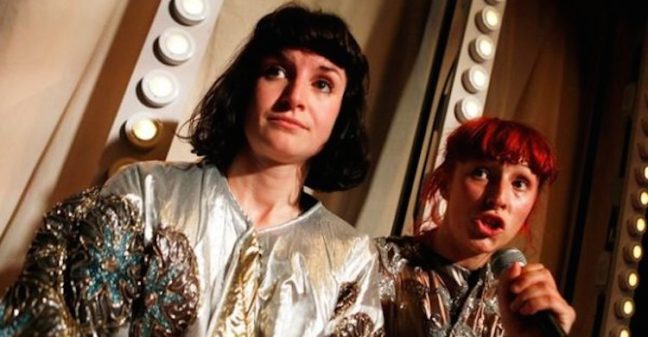
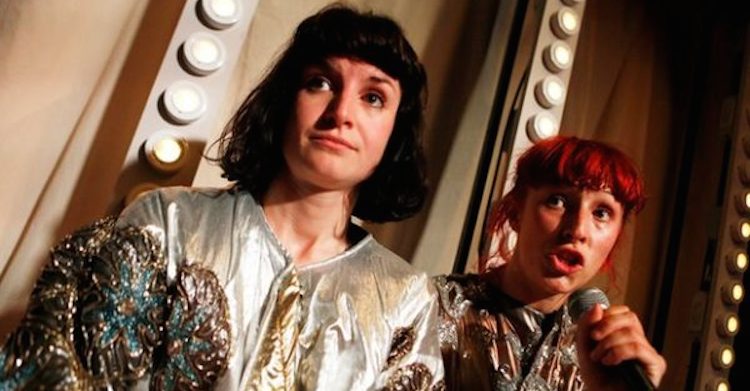
Two Man Show is “about” the contemporary crisis in masculinity. But, like most RashDash shows, its stated subject is only part of the story. Two Man Show is a takedown of the patriarchy; it’s a fearsome howl of anger; it’s a punk-rock feminist anthem; it’s a dance with the impossible; it’s spiky and beautiful and wounded and joyous.The show falls, roughly speaking, into three acts (a warped mirroring of the well-made play that is, I suspect, no accident). Warning: spoilers lie ahead. In the first act, Helen Goalen and Abbi Greenland come on stage with musician Becky Wilkie and proceed to correct everything we think we know about historic gender relations. First there was equality, then women were the goddesses, then the men – threatened and afraid – learned the tricks of dominance. Squeaky voiced and decked in silver and gold, Helen and Abbi are exaggerated portraits of both femininity and power – and playful with it.

The second act, which accounts for the greatest portion of the show, switches between two distinct performance modes. In one, Helen and Abbi shrug on remarkably convincing male personas, in a deliberately familiar (yet brilliantly written) soap-opera-esque narrative of two estranged brothers. Unschooled in the language of emotion, the two men enter an awkward, strained intimacy in the final days of their father’s life. Between these sort-of-naturalistic scenes are dance sequences typical of RashDash’s aesthetic, in which the two performers fling one another around the stage, often naked or partially clothed.

And then, in the final act, the pattern we think we’ve mastered is suddenly torn apart at the seams. Every doubt or question or criticism that might have flickered through our minds throughout the show is voiced by “John”, Abbi’s male character, who firmly asserts his presence on the stage, abruptly cutting short the next “dance bit”. What’s with the dance anyway? he demands. And when did being a man become synonymous with being a cunt?

It’s hard, if not impossible, to pin Two Man Show down. RashDash occupy and appropriate. They deconstruct and smash apart. Traditionally “masculine” forms – history, with all its reassuring certainty, and the sturdy male dialogue of the social realist play – are turned inside out. Dramaturgically, the piece moves from a place of unshakeable confidence (“we know everything,” Abbi and Helen grin at us, dressed as prehistoric goddesses) to one of radical uncertainty. “I can’t pretend to be certain,” Helen tells us in her final speech, after “John” and Abbi have had their say. I’ve always struggled with that too. But maybe certainty is politically dangerous. Maybe uncertainty is underrated.

If Two Man Show is rife with uncertainty, it also has plenty of space for confidence and assertion, not least in the ways RashDash present themselves on stage. Watching Abbi and Helen move through the space, oscillating in the movement sequences between traditionally “masculine” and “feminine” physicalities, what strikes me most of all is the strength of their bodies. Strength, like so many other things, has been socially and culturally constructed as masculine, but these women are so so strong. And in the space they hold open, nudity becomes power. Yes, they’re playing with the dynamics of the male gaze, particularly during a sequence in which Abbi moulds Helen’s pliable body into a series of familiar poses. But the way in which these two women display their bodies also feels controlled and empowering and really fucking badass. At certain points, I almost wanted to throw off my clothes and leap on stage with them, beating my chest and howling with righteous rage. (And as anyone who knows me can attest, I’m far from an exhibitionist)

But this isn’t only about what it is to be a woman in a patriarchal society. Men are also oppressed by patriarchy, also hemmed in and squashed down. RashDash’s two brothers are slack-shouldered and somehow shrunken, inches suddenly slashed off the magnificent height that Abbi and Helen had just moments earlier as they paced the stage. Without erasing the privilege their gender lends them, these characters’ complaints are given real weight. There’s an implicit criticism of mansplaining, but also an acknowledgement that it’s hard for men to know how to be in a world that both encourages and punishes the traditional markers of masculinity.

I’m saying all this like RashDash’s show is an essay on contemporary gender relations, when really it defies simple analyses and easy explanations. Two Man Show performs its own deconstruction, as if to turn around and say “you didn’t think it would really be that straightforward, did you?” Like in We Want You to Watch (though more powerfully here), RashDash point to and pick away at their own failures, which they’re acutely aware of, while simultaneously unsettling the very standards of success and failure.

Andrew Haydon read the piece as a critique of British theatre’s drive towards communication and “well-balanced arguments”. But I think the attack on meaning and reason and legibility goes further than that. It came across, to me, as a scathing commentary on the ways in which – in so many different public arenas – men pick apart the statements of women, deride them if they don’t meet some imagined standard of “reasonableness”, laugh that they must be “on their period” in the same way female anger was once diagnosed as hysteria (but hey, it’s just a joke, right lads?).

By the end, Two Man Show is gloriously, brilliantly messy. In their final monologues, Helen and Abbi throw everything at us: all the different ways of being a woman or a man or of rejecting gender entirely. There are no answers, only questions and frustrations. But for all the fury, that concluding mess – the tangle of unresolved and perhaps irreconcilable contradictions – feels to me like a sigh of relief. Yes, this is complicated and knotty, and no it can’t be unravelled by a polite, reasonable, well-made play. Just being able to say that, being able to put that mess on the stage, is one of the most liberating acts of the whole piece. We can know what we’re against – “locker room talk”, mansplaining, the laughter that casually envelops an endemic rape culture – without necessarily being able to articulate what we’re for.
Emergency Festival

emergency_maelstrom-theatre_land-of-the-giants_image-credit-david-forrest

Originally written for Exeunt.

It’s hard to imagine a better festival venue than Z-arts. A labyrinth of corridors and rooms, it seems to twist off in every direction, promising still more stairs and spaces. Just inside the entrance, a walkway curves around a wide atrium – an open auditorium, flooded with light. This is a place for play, too: usually a theatre for children and families, the corners are stuffed with toys and games and small humans in search of adventure.

Emergency, a free day of non-stop performance, occupies the building with an apt sense of playfulness. The shows and installations might not be for kids, but still there are stories, games, a spirit of exploration. As I walk in, the atrium is temporarily home to a group of men moving in ever-tightening patterns, stuck in a repeating loop of constriction and collision. Peter Jacobs’ performance installation No Man Is An Island is suggestive of the restrictions of patriarchal society, which hems in men as much as it does women. But it also looks a lot like a game – one whose rules, perhaps, we can change.

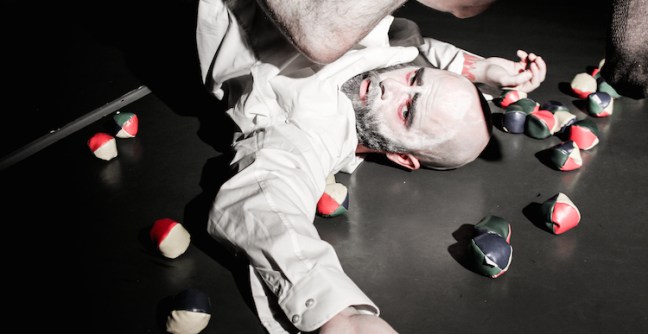
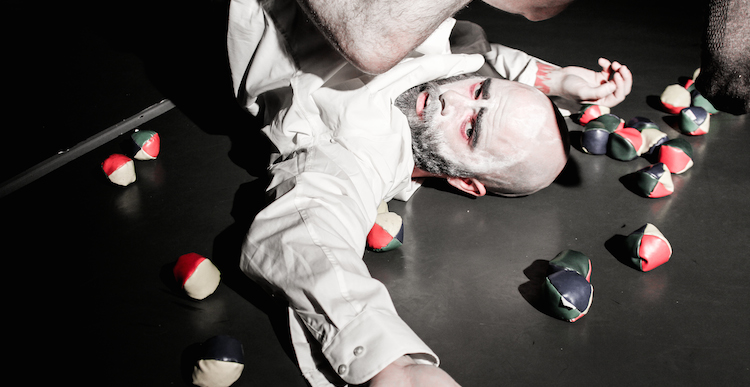
There’s another twist on a familiar form in Maelstrom Theatre’s Land of the Giants, the first of the afternoon’s sit-down shows. The short piece, created and performed by Anthony Briggs, is littered with juggling balls. Dozens of the things, scattered across the floor and flying through the air. Briggs himself, in clown-face, shirt and boxer shorts, looks like something out of a bad dream – one of those dreams where you find yourself, half dressed, required to give a speech you haven’t prepared for. Or a performance you haven’t rehearsed.

There’s a familiar – perhaps too familiar – vocabulary of failure to Briggs’ performance. Balls are juggled, dropped, gathered up, dropped again. Briggs shoots embarrassed, apologetic glances at us, while a pre-recorded voiceover haltingly relates his everyday struggles. Yet the show’s potent evocation of awkwardness and unease lifts it out of a well-worn performance idiom. Briggs looks genuinely uncomfortable in his own skin, his squirming movements suggesting an effort to shrug it right off. And I’m not sure I’ve ever seen such an affecting representation of social anxiety as Briggs’ frozen form, sweating under the harsh stage lights, juggling balls clutched precariously in his arms as a buzz of voices rises louder and louder and louder.

The movement and visual storytelling of Land of the Giants is immediately contrasted with the table-bound simplicity of Transfigurations. Company Ding & sich takes its name from Kantian philosophy: ding an sich refers to the impossibility of knowing a thing-in-itself. One of the preoccupations of Transfigurations is thingness, including the thingness (or otherwise) of human beings. The show – delivered by Annie Lord and Simon Bowes from behind a table, lit by angled lamps – is many things at once, even in its short twenty minutes. It’s a story of a couple; it’s a meditation on what it means to be human; it’s an exploration of language and metaphor; it’s a composition of rhythm, syllables, sounds and silence.

Implicit in Ding & sich’s delicate, precise bit of storytelling are the questions – about who we are, what we are, what happens to us – that hover somewhere between two people with different views of life and death. Similarly searching questions are asked in much more direct and playful form in Paper People Theatre’s brilliantly titled Do Geese See God? Posing the conundrum of how we really distinguish fact from fiction in a world where facts are always being changed or replaced (the cannily selected example offered by the company is the downgrading of Pluto from planet to not-quite-planet), it’s a scattershot but consistently engaging exploration of what we know – or don’t know – and how we explain the world to ourselves. And while the tone is light and teasing, the show’s interrogation of our attitude towards facts has a dark undertow in the wake of the EU referendum and the “facts” thrown about during the campaign.

Language is again under investigation in Sync., Ryan O’Shea’s strange mix of lip-sync, pop music and verbal acrobatics. Teasing at the edges of words, O’Shea – looking like an intergalactic backing dancer in his foil hotpants, metallic make-up and conspicuous headset – somehow moves throughout the course of the twenty-minute performance from Teletubbies and phonics to sex and violence. It’s often baffling but always oddly fascinating. I’m also reminded, as a young member of the audience giggles unselfconsciously at O’Shea’s deliberate struggles to form his mouth around syllables, of how strange and funny our attempts to communicate can be.

Dotted throughout the building, away from the more formal and separated spaces of the theatre and the studio, are various more intimate encounters. Audiences can get in bed with one performer and interview another; they can talk about how they feel or join in with a vocal installation. I spend some time in the music room, feeling a little like an intruder among the silent, black-clad women recreating the lost hand gestures once performed by the workers in Lancashire cotton mills in I have never been anywhere so long. It’s history as muscle memory; ghosts intriguingly and perhaps problematically embodied by present day performers.

There’s plenty more designed to be dipped in and out of, hiding in various nooks and crannies of Z-arts’ sprawling complex. While initially overwhelming, the bursting-at-the-seams programme offers audiences a variety of routes through the day. It is, if you like, a Choose Your Own Adventure storybook of performance.

My own, self-curated festival ends in a tiny, cupboard-like space with Jamil E-R Keating’s Asteroid RK1. Intimate and informal, it’s a gentle piece of storytelling that crashes together rough sleeping and interplanetary objects. Looking up at the night sky and down at the city streets, Keating shares a narrative that’s both deeply personal and deeply political – especially at a time when homelessness is on the rise. Like the day as a whole, it asks us to look and listen with just that bit more care.

Photo: David Forrest.

A Streetcar Named Desire, Royal Exchange

maxine-peake-as-blanche-dubois-in-a-streetcar-named-desire-photo-manuel-harlan-8-549x357

Originally written for Exeunt.

Drama thrives on too-small spaces. Pressure-cooker rooms, where conflicts simmer, are the stage for everything from Pinter’s comedies of menace to Alistair McDowall’s domestic-scale sci-fi in X. And in A Streetcar Named Desire, Tennessee Williams adds real to metaphorical heat. It’s a play in which climate is crucial, as the three central characters stew in the stifling humidity of a long New Orleans summer.

The Royal Exchange, with its stage tightly enclosed by the audience, should be the perfect arena in which to evoke the sticky claustrophobia of Stella and Stanley’s two-room apartment, the precarious sanctuary of vulnerable visitor Blanche DuBois. Yet the spatial dynamics of Sarah Frankcom’s production are oddly inconsistent. The stage, partially divided by white fluorescent strip lamps, presents a space of fluid boundaries. The only actual wall, separating off the bathroom where Blanche sequesters herself for much of her stay, is a transparent glass partition. Privacy co-exists with exposure. Inside and outside become tangled up in one another.

It’s a gesture, perhaps, towards the dissolving boundaries of Blanche’s mind and the regular intrusion of past into present – as well as a choice that ushers the wider world into the space of the Kowalskis’ apartment. Because of course Williams’ narrative is not only about this one troubled character; Blanche’s experience resonates with much bigger questions about mental health and sexual politics, both of which remain the subject of heated public discussion.

What this loose spatial interpretation sacrifices, though, is the tension that drives the plot. The suffocating Southern heat of the play need not be portrayed realistically – after all, Williams himself was interested in pushing at the edges of stage naturalism. Productions like the Lyric Hammersmith’s Secret Theatre version (the memory of which is hard to shake) have managed to reject any attempt at creating the illusion of Stella and Stanley’s cramped home while maintaining the same taut tension beneath a new theatrical metaphor. But Frankcom’s production struggles to find a substitute for what it jettisons. When Stanley first explodes and violence ruptures the play, it feels choreographed and clinical rather than charged with real threat, a pattern that is repeated with other moments of conflict. We never really feel the heat or the menace.

The production teems with choices that are intriguing but somehow a little unsatisfying. The smooth green carpet of Fly Davis’ set is evocative of the poker table, lending the same air of chance and risk to the narrative as that of the game Stanley and his friends gather to play in the apartment. This could be read as a world ruled by the whims and gambles of men, although this is more a gentle suggestion than a bold interpretation. The same goes for the haunting Day of the Dead-style apparitions that linger intermittently at the edges of the stage, seen only by Blanche. There’s a distinct air of decay about these figures, clad in black and garlanded in funereal roses, as well as a troubling hint of exoticism. Other than acting as a symbol for the death that Blanche has seen so much of, though, their role remains unclear, and stylistically they feel at odds (perhaps intentionally) with the rest of the aesthetic.

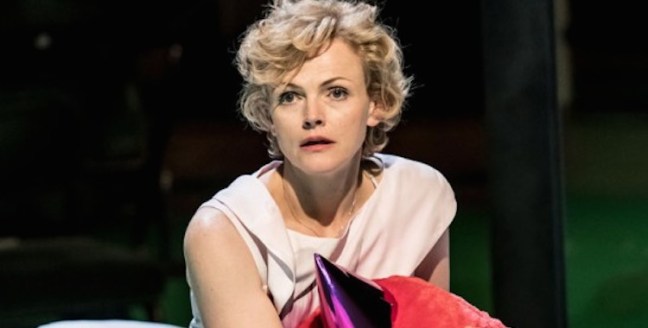
Maxine Peake’s Blanche, like the production around her, is rich with contradictions. The complexities and ambiguities in her performance, though, add nuance rather than clutter. Lesser interpretations can cast Williams’ tragic heroine as a fragile, eyelash-batting Southern belle, always on the trembling brink of breakdown. But this Blanche is capable of being as cold and cutting as she is vulnerable. Dismissing Eunice on her arrival, or trying to persuade Stella to leave Stanley, her drawl drips with irony and scorn. Only the slight quiver of her hands – never overplayed – hints at the emotional turmoil she disguises with liquor and furs.

It’s fascinating to witness the hardness as well as the romance in this imagining of Blanche. We see a woman who, although forced to ask for help and rely on others, has long been fighting a solitary battle for survival. She’s tough, in her own way, even if her toughness takes the form of floral dresses and calculated flirtation. This drive to keep going, though, is at war with her inability to let go of the past. Peake plays Blanche with a brittle poise, the unshakeable ghost of aloof gentility and pretended primness. Even her clothes locate her in a different era from her shorts and vest-clad hosts.

Making up the central trio, there are also surprising touches from Sharon Duncan-Brewster and Ben Batt as Stella and Stanley. While the rendering of their relationship lacks something – that electric pull that Stella talks about doesn’t entirely convince – each interpretation finds new facets in the character. Duncan-Brewster is a disarmingly chirpy Stella, her vast reserves of optimism bolstering her turbulent relationship with Stanley. There’s also a strong sense, though lightly conveyed, of her shared past with Blanche – and a suggestion, in just the hint of a rolled eye, of sibling rivalry and resentment. Batt’s Stanley, meanwhile, is most striking at his most desperate, almost wringing out sympathy as he howls Stella’s name, wrenching up the two syllables from the depths of his gut.

But really, to deploy a tired yet entirely apt phrase, this is Peake’s show. There are moments, towards the end, when even her carefully judged performance veers towards the hysterical – an all-too-familiar choice in Streetcar’s closing scenes. Save that one misstep, though, hers is a compelling and impressively fresh take on an iconic, baggage-laden role. She’s a performer who inhabits a character with every last muscle; sometimes, watching her, you’d swear even her hair was acting. Emotion is conveyed as much by a flicker of the fingers as by a tremor in her voice. It’s hard – as Frankcom’s production, despite all its interest, demonstrates – to discover convincing new stage metaphors for such a well-worn play. Peake, though, finds a way to present Blanche to an audience as if we’d never seen her before.

Photo: Manuel Harlan.

Anthony Neilson: “Most theatres won’t fully agree to let me work this way”


700x650-fit_-1

Originally written for Exeunt.

Anthony Neilson is keen on one-word titles. Normal, Penetrator, Stitching, Realism, Relocated, Narrative. And now, his latest play at the Royal Court, Unreachable. It feels apt, given the way of working that Neilson has developed over the years. Typically, the playwright arrives on day one of rehearsals without a finished script – or any script at all – and writes during the process. Those one-word titles, vague but packed with connotations, are perfect for shows whose shape is yet to be decided on.

These plays have fragile beginnings. At the start of making Unreachable, Neilson came into rehearsals with just one solid thing: “the idea of a director obsessively pursuing this light”. Other than that, all he had was a loose idea of what the form of the piece might look like. From those scant ingredients, he and the cast have spent the past few weeks improvising, talking, questioning and – in Neilson’s case – writing.

Neilson’s process is not devising, exactly. Between rehearsals, he goes away and writes independently, often late at night or at the crack of dawn. New scenes and ideas are brought in each day for the actors to perform and explore, before the writing process starts all over again. Improvisation forms a significant part of the rehearsals, but it’s not as straightforward as the actors creating material that Neilson then simply transcribes.

“The actors have a huge impact but more by way of who they are – as performers and people – than in terms of what they create,” Neilson explains. “As many new ideas are created in down-time as when we’re actually improvising. I also allow the actors to pretty much work out their own performances, costumes etc and only intervene if I feel it’s detrimental to the central thrust of the play. This all allows me to approach the material from viewpoints very different to mine.”

I’ve seen this process in action before, during the Royal Court’s Open Court festival three years ago. Over two weeks, Neilson led a series of workshops that encouraged other writers to explore this way of working in partnership with six actors (among them Jonjo O’Neill and Richard Pyros, who have returned for Unreachable). It was largely a process of unlearning, as the playwrights let go of protectiveness and self-censorship in their writing. But it was also fascinating to see how tiny moments in improvisations or conversations in tea breaks metamorphosed into elements of the short plays produced at the end of the fortnight.

In this process, everything’s up for grabs. That’s exhilarating, but also tricky – especially for theatres with rigid production schedules. It’s tough for the rest of the creative and technical team to do their work around a relatively unknown entity, let alone for the marketing department to sell something that’s not yet been made. Plenty of independent theatre-makers work in this way, of course, but it’s a challenge to large organisations with long-established internal structures. Perhaps understandably, not many venues are willing to take the risk.

“Most theatres won’t fully agree to let me work this way,” says Neilson. “They’ll do workshops and even ‘showings’ but few will commit to just scheduling a show. Which is understandable, but difficult for me.” Fortunately, the Royal Court’s artistic director Vicky Featherstone is interested in stretching the definition of what it means to be a “writers’ theatre”, which includes more unusual commissions like Unreachable. “Without a sympathetic patron at the Court, you probably wouldn’t see much of me,” Neilson adds.

For the actors, as well, this process challenges what they’re used to. “It’s hard to shrug off years of orthodoxy,” says Neilson, “and some manage better than others.” For Unreachable, Neilson is working with performers who are mostly new to this way of working, generating some anxieties. During the morning I spend in rehearsals, nervy glances are exchanged and there is, at times, a palpable frustration at the absence of certainties. The performers are eager for answers, while Neilson wants to ask questions.

So where does this process fit? Neilson describes his method as “somewhere in between” conventional playwriting and devising practices. He wants the input of performers and the challenge and unpredictability of making the show as they go, but the idea of playwright as individual artist remains important to him. Neilson believes that theatre “benefits from a strong, singular vision”, and therefore isn’t about to relinquish the mantle of author. “That [vision] can sometimes be achieved in a devising process, if everyone’s very in tune with each other,” he adds. “But I’d imagine there’s always someone at the centre, be it a writer or director or whoever. Also, I do this to express myself. I just like to have other influences in there as well.”

At the root of all great work, Neilson suggests to me during rehearsals, is an obsession: an itch that won’t go away. That’s the root of authorship, as he sees it, and one of the reasons he holds so tightly to the idea of an individual signature. Obsession as an idea also threads through Unreachable (or so it seems when I pop into rehearsals – but then, nothing’s fixed). The protagonist, played by Matt Smith, is on a hunt for the perfect light, while the film he’s shooting is the realisation of an idea sparked many years previously. In scenes between the director and his lead actress, meanwhile, the pair compulsively rehearse emotions that they distance themselves from in everyday life. There’s something in there about voyeurism, perhaps, or the feeling of being an outsider. As ever with Neilson’s rehearsals, it’s hard to tell.

Neilson has frequently called on theatre to be less boring. Writing in the Guardian in 2007, he declared that “boring an audience is the one true sin in theatre”. The antidote to boredom, he’s suggested, is a sense of liveness and theatricality, which much theatre too often neglects. The riskiness and responsiveness of Neilson’s process keeps that liveness in sight – not to mention creating the very real possibility that come opening night the play will be unfinished. It’s seat-of-the-pants stuff, for sure, and that always comes with the potential for failure. Rarely, though, can it be accused of being boring.

Translating Theatre: Trial and Error

jamiesmithphoto-1503_1_orig

Originally written for Exeunt.

On my way into rehearsals for Denise Despeyroux’s play Ternura Negra (Black Tenderness) on Thursday morning, I stop by the polling station. It’s the day of the EU referendum and I put a cross in the ‘Remain’ box. By the time of the play’s rehearsed reading the following afternoon, the UK has voted for Brexit and both the nation and the continent are reeling.

In that context, Translating Theatre’s project of intercultural dialogue feels more important than ever. The project, a collaboration between the University of Kent and producers Firehouse Creative Productions, combines research and practice. It aims to explore and extend what Lawrence Venuti has called a “foreignising” approach to translating plays into English – hopefully sparking discussions about the ethics and politics of translation along the way. Why do we choose to translate so little (only 3.2% of the 2013 British theatre repertoire consisted of translations according to the British Theatre Consortium’s survey)? And how do we decide what to translate and how?

“Foreignisation”, according to Venuti, is a translation strategy that resists the transformation of difference into familiarity in the process of moving a text from one cultural context to another. It’s the opposite of “domestication”, a form of translation that is arguably dominant in British theatre culture. There are still plenty of questions and concerns about Venuti’s theory – how do you balance foreignising strategies with the need for clarity? when does foreignisation nudge into the problematic territory of exoticisation? – but the point of Translating Theatre is to investigate these in practice.

At this stage, it’s about trial and error. “We’re trying to find the rules,” says Margherita Laera, lecturer in Drama and Theatre at the University of Kent and project leader. Despeyroux’s play, originally written in Spanish, is the first of three translations that the project is testing out (the other two are from French and Polish). Touching on ideas of truth, reality and fiction, the play injects a strange dose of the paranormal into a narrative about a theatre director and two actors rehearsing a play about Mary Queen of Scots. There’s at once a familiarity and an unfamiliarity to it.

Sitting in rehearsals, I scribble down a sudden thought in my notebook: “making the process of translation legible in performance”. I add a tentative question mark. What does that even mean, I wonder.

In the rehearsal room, Simon Breden’s translation continues to evolve in collaboration with the research team, director Tara Robinson and the three performers. I’m told that the few days of workshopping the play together have involved as much discussion about the aims of the project as they have practical work. On the day I observe rehearsals, there’s more of this uncertain conversation around the edges of the play. It’s a process that’s exploratory rather than decisive.

Still, discussion in the rehearsal room keeps finding its way back to those elusive “rules”. Robinson and the actors worry, for example, about consistency of approach. Is it OK to use a British idiom here but not there? At one point, the creative team go through a scene of the translated text line by line, agonising over word choice and sentence structure. Change the structure of the thought, someone points out, and you also change the character. That raises the question of what it is precisely that’s being translated – especially in a medium that’s transformed again in performance.

Pursuing the theory of foreignisation in theatre, of course, means finding a foreignising performance language as well as a foreignising verbal language. At this stage, given the end point of rehearsed readings, that language is still some way off, but it’s a useful question to have in the room. At the same time, there’s a necessary balance between exploring the parameters of the project and finding pragmatic performance solutions – a balance that perhaps characterises all translations.

To complicate matters, Ternura Negra is a comedy, and humour can be stubbornly resistant to translation. What makes us laugh is more often than not culturally and linguistically specific; even across cultures that speak the same language, comedy can differ vastly. This is one of the biggest problems that Robinson and her team have to grapple with. Despeyroux’s text plays on Spanish stock characters that mean very little to British audiences. How, then, to get the humour to transfer?

Venuti writes about “produc[ing] humorous effects that both imitate those of the foreign text while maintaining their differences for readerships in the receiving culture”. There’s a tension here: recreating humorous effects – in other words, getting laughs – requires some degree of translation into the receiving culture’s comedic conventions. What Venuti is cautioning against, however, is the use of an equivalent that blots out any and all difference. Laera uses the example of the National Theatre’s One Man, Two Guvnors, which she argues straightforwardly traded the Commedia dell’arte style of Carlo Goldoni’s play for a very British brand of slapstick.

In the rehearsal room, Robinson and the actors play around with the oddness of the three characters, which itself generates a fair few giggles. There’s also occasional comedy in the awkwardness of their way of speaking (at least to our ears) – but is it exploitative if that makes an audience laugh? If these characters are seen to be funny because of their difference, then foreignisation is just a hair’s breadth away from reinforcing national stereotypes.

Reflecting on this process and the theory behind it after the rehearsed reading, some of the most fascinating and revealing insights come from Despeyroux. After hearing the creative team talk at length about the oddness of the characters and their speech, she says that they are meant to be odd. What could be taken as an effect of foreignisation is actually an intention of the original Spanish. Despeyroux also recalls an experience with a BBC Radio producer, who pulled a play of hers because of worries that the translation would still be too “foreign” and therefore “difficult” for British listeners. But foreign and difficult are not synonyms, just as strangeness does not equal foreignness.

This presents another tension. Finding a distinctly “British” solution to every problem presented during the process of translation assumes that audiences cannot receive or process difference (though what “British” even means, particularly given recent events, is a whole other discussion). Yet so-called “foreignising” strategies have their own dangers. It’s easy, as Despeyroux identified, to fall into the trap of thinking that anything odd or challenging is therefore “foreign”. It’s also easy, especially in applying Venuti’s theory to performance, to seize on the superficial external signifiers of other cultures in attempting to communicate difference, thus perpetuating divisive national caricatures. No culture – and no theatre culture, for that matter – is homogenous. Even British theatre, which we risk talking about as a rigid monolithic entity in processes like this, is incredibly complex and diverse.

Ultimately, the first phase of this project has triggered a whole series of further questions. How do we avoid erasing difference without simply othering? Is the term foreignisation useful in fostering intercultural dialogue, or does it unhelpfully reinforce what divides us rather than what we have in common? In attempting to converse and collaborate across different cultures, how do we move beyond reductive, surface ideas of what those cultures represent?

None of these are easy or straightforward to answer. But if theatre really is a place where we think about ourselves, our society and our place in the world, then these are questions that have renewed force in a shaken post-referendum landscape. Celebrating what we have in common, without flattening or ignoring difference, has never felt more urgent.

Photo: Jamie Smith.