Bottleneck, Pleasance Courtyard

Originally written for Exeunt.

Greg is almost fifteen, almost a man. For him, manhood means a moustache and a swagger; it means John McClane in Die Hard, not taking shit from anyone. It’s nearly his birthday, and despite a lack of cash and the best efforts of his dad, he’s going to find a way to watch the Liverpool match. The world, full of girls and footie and best mates, is out there waiting for him. But sometimes the experiences that really mark the transition from youth to adulthood are also the experiences that scar for life.

Luke Barnes’ latest play is packaged as coming-of-age tale, but unwraps into something far more devastating and complex. The writing is nuanced and intelligent enough to keep its devices hidden and its direction obscured, until the destination suddenly appears on the horizon with gut-ripping inevitability. Without undoing that nuance, it is enough to say that its shattering denouement treads familiar ground, walking along a recognisable narrative with unblinking new insight. In its careful use of history, the piece can rely on the structure of the audience’s collective knowledge to hold its fragments together, while simultaneously smashing that scaffold apart.

Unlike other pieces that insist on reopening old wounds, Bottleneck feels urgent, fresh, full of rage. This is partly down to Barnes’ razor-sharp writing and partly down to a blistering performance from James Cooney, whose every coiled muscle seems to hum with barely controlled aggression. He is constantly hopping from leg to leg, never still, channelling the nimble footwork of Greg’s red-shirted heroes. Resisting any idea of the solo show as static, Steven Atkinson’s direction is ever moving, ever generating and radiating energy.

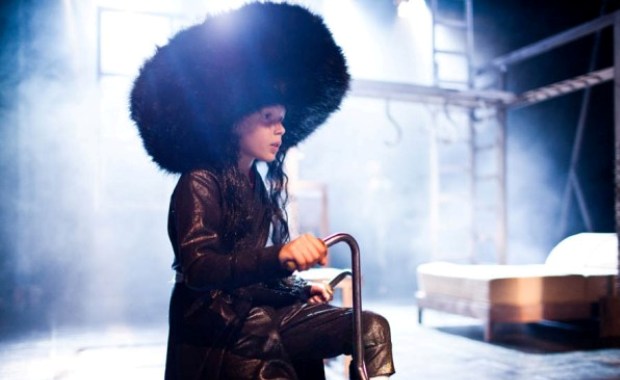
In this production’s appropriately bare presentation, the monologue is played out in an empty performance space below two glaring floodlights, which alternately flicker, die and burst blindingly into life. As well as effectively conjuring the space of the sport with which Greg so closely identifies, the stark quality of this lighting has the effect of the laboratory microscope, an unforgiving illumination under which this tortured specimen struggles and squirms.

As microscopic as Barnes’ focus appears, however, this muscular piece is not limited in its ambition to the singular narrative of its protagonist. Greg, as intensely drawn as he is, emerges as just one symptom of a wider problem. As youthful optimism becomes steadily jaded, the creaking escalator of social mobility shudders to a halt and Greg’s story becomes yet another instance of a life being determined by the inescapability of birth. If you come from the wrong place, this furious snarl of a play argues, then you’re fucked.

Photo: Bill Knight
A Strange Wild Song, Bedlam Theatre

Originally written for Exeunt.

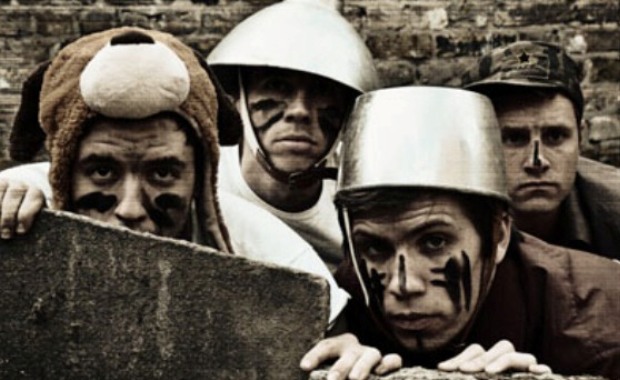
Songs of war provide the background score for this latest addition to Edinburgh’s ever-growing Lecoq contingent, devised by emerging physical theatre company Rhum and Clay. In a piece that delicately shifts between modern day Britain and the bomb-ravaged landscape of France during the Second World War, a man is transported back to the past through the medium of a single roll of film recovered from his grandfather’s wartime camera. What it reveals is an extraordinary and unlikely encounter between the soldier and a trio of abandoned young brothers.

Warfare, dream and play are all intermingled in the scenes between the soldier and the three boys, in which a lost boy aesthetic is thrown like a grenade into the heart of the battlefield. Taking refuge from the horrors of battle, there is a creeping sense of regression into the innocence and imagination of childhood, enhanced visually by the playing of the children by three adult actors. Avoiding many of the hackneyed techniques that often plague dramatic portrayals of children, the performers fully inhabit these young roles with all the clumsy physicality and uninhibited charm of childhood.

For all this charm, however, the piece as a whole feels oddly, uncomfortably exploitative, using the drama lent by atrocity in order to create something indulgently beautiful. The choice of subject matter certainly enables some stunning moments of creativity; in the process of gameplay, a ramshackle aeroplane stutters through the air, given movement purely by the impressively controlled bodies of the performers, while in another beautiful moment a red balloon floats above the rubble, appearing seemingly from nowhere.

But where this gorgeously assembled style soars, it leaves its half-baked plot with its feet fixed firmly to the ground. Ideas about memory, war, childhood and imagination lie scattered like shrapnel, casualties of the painstakingly crafted aesthetic. More than a matter of style over substance, Rhum and Clay’s creation is naggingly problematic due to the very particular historic make-up of the substance it fails to fully engage with.

Clothed in all the now clichéd trappings of Lecoq-inspired theatre that seem to abound at the fringe – physically controlled clowning, inventive use of props, the seemingly obligatory accordion – this all feels a little twee for the environs of war-torn France. Of this spreading rash of physical theatre, Rhum and Clay prove themselves to be among the best, demonstrating exciting potential, but they are in need of a better vehicle for their ingenious visual style. Whimsy and war do not make comfortable bedfellows.

The Shit / La Merda, Summerhall

Originally written for Exeunt.

In the absence of adequate words that it leaves in its wake, it is tempting to characterise Cristian Ceresoli’s searing collection of monologues as one long, piercing scream. Such a description certainly captures the raw, bruising intensity of the piece, an intensity that rips the breath from your lungs. But it also ignores the open tenderness of that same wound, a wound that is scabbed over and viciously picked at in a relentless yet compelling cycle. In Ceresoli’s creation, pain is a constant presence.

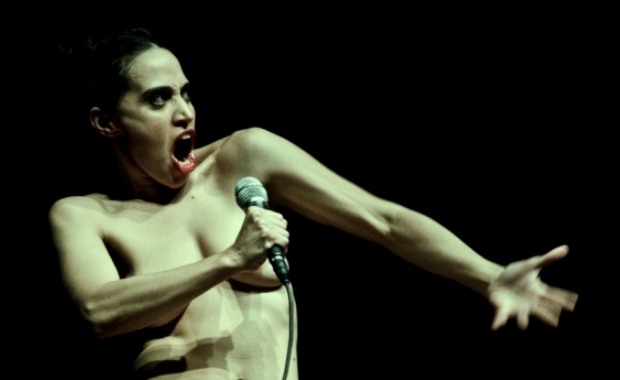
The pain we experience is that of an unnamed woman, perched high on a platform in the centre of Summerhall’s gloomy Demonstration Room. As played by the astounding Silvia Gallerano, she is naked in every possible sense of the word, bare save for a slick of blood red lipstick. Microphone clutched in hand and limbs protectively folded, she speaks with startling directness, nothing to separate or shield her performance from the audience other than the few metres of air in between.

Ceresoli’s equally naked writing has the quality of a symphony, teasing out recurring patterns of notes. The speaker is obsessed by her thighs, by the false idol of fame, by her painfully terminated relationship with her father. Repeated words puncture the text: courage, sacrifice, alone, self. It is a boldly honest exploration of the values we attach to our identity and the ways in which we define ourselves, be that against our family, our nation or the cruel expectations of the media.

In interrogating notions of identity, the piece becomes a fascinating study of what it means to be a woman, as well as what it means to be this specific woman. Although written by a man, this is intensely about female selfhood in a way that is not reductive or – that awful criticism of writing by or concerning women – domestic, but simply, honestly, starkly truthful. No thought is taboo, no impulse censored or diluted. It is the stream of consciousness of Virginia Woolf married with the spitting rage of punk.

Despite the conspicuous lack of stagecraft – all that ever appears in the womb-like space is platform, performer and microphone, simply lit by spotlights – this is as theatrical a piece as is likely to be found at the fringe this year. It is overwhelming proof of the power of the performer, Gallerano holding the audience immovably rapt by her open, direct address, every last muscle seeming to move with the text. Brittle yet achingly vulnerable, her voice has the slightest wavering hint of a tremor even when she cracks jokes, before releasing astonishing intensity when an acknowledgement of selfhood is finally ripped out with convulsing screams: “Me! Me! Me!”

Consumption – and, as the title would suggest, excretion – are at the pulsating heart of the piece. Eating here is a method of control, of sacrifice. Like the octopus at the aquarium that her father tells her can eat its own tentacles, the speaker describes a hunger-crazed fantasy of eating her fingers, an act that she is convinced would usher in the fame she so desperately craves. It is as though by eating her own flesh, absorbing and thus hiding a part of herself, she can transform herself into a tastier morsel for the greedily consuming public. It is, like the piece as a whole, a deeply unsettling comment on society, the female experience and the construction of identity.

It’s Not You, It’s Me

Originally written for Exeunt.

Six days, countless cups of tea and two free mojitos into my first fringe, it might be a tad early to start making any valuable observations about the small phenomenon that gobbles up Edinburgh for a few weeks every summer. One thing that is difficult to ignore, however, is the small army of reviewers who colonise the place, stamping our presence with ratings and pull-quotes as fast as they can be frantically stapled onto flyers. An exploded version of the national theatre ecosystem, the fringe is a beast that is fed and bloated by the star system.

So it feels strange to be sitting in a room, in Edinburgh, questioning what this is all in aid of. I’m at St Stephen’s, the theatrical haven crafted by Northern Stage within the stonework of the old church, participating in something of an experiment. This is the first excursion of Dialogue, Maddy Costa and Jake Orr’s project to cultivate and curate discussions between critics and theatremakers. Making a change from the endless tapping at my laptop keyboard, I’m here not to write but to talk.

The loose theme of the morning is the things that we, as critics or as theatremakers, don’t tell one another. While the discussions open in a fairly free-form structure, with individuals posing questions about preparation, objectivity and expertise, this later moves into a series of provocations. In a striking display of honesty, Maddy and Unfolding Theatre’s artistic director Annie Rigby each write down and then read aloud the statements that they don’t talk about, statements that I’m forced to hastily read before running off early to get to a show, but that stick to me like barbs.

Despite emerging from the artist’s perspective, many of Annie’s points strike potently at my own concerns about how I approach and write about theatre. They speak not of anger or antagonism, but of an aching disappointment that we don’t do this better.

“How long do you spend writing a review? How soon after a show do you write it? Are you happy with this?”

“Can we make some space to talk about what you got right and wrong? Like, if you could rewrite one review, what would it be?”

“I’m giving your review 3 stars. Don’t be disheartened. 3 stars is a good review.”

“I know you’ve got a word limit, but now we’re together it would be great to talk about that sentence you wrote.”

But the statement that lodged itself most firmly in my mind was Maddy’s: “it’s not you, it’s me”. Much as it made me laugh, this also seemed to me like a bold and stark unveiling of a widely accepted lie within criticism, an extension of the fallacy of objectivity that I found myself speaking about earlier in the morning. Because sometimes, amongst all the other unacknowledged baggage that finds its way into the auditorium, a critic just isn’t in the right frame of mind to productively respond to a certain piece of theatre.

In Edinburgh this, as with everything else, is heightened. Schedules are tighter, word limits are shorter, synapses are more impaired. With perhaps as little as an hour to wrench out a review and slap on a star-rating, carefully considered analysis begins to lose its foothold. More and more superfluous stuff finds its way into the performance space: fatigue, an awareness of where to rush off to next, a creeping dread of the mounting backlog. It’s not a popular admission to make, despite the evidence of the voluminous bags under our eyes, but sometimes we’re just tired. It’s not the fault of the work, it’s a simple fact.

One of the few certainties that I do have at this early interlude in my fringe experience is a hopeless, head-over-heels, bad-poetry-writing love for the intense, bubble-like intimacy of Edinburgh at this time of the year. I love bumping into people I know, having the conversations about theatre that we usually put off, stumbling into real-life, in-depth discussions with people who I usually only engage with in bite-sized snippets of electronic communication. All of this I adore. It is only the writing, or rather my own writing and its occasional rushed inadequacy, that I am in danger of falling a little out of love with.

So there we are. It’s not you, it’s me. But I’m not ready to give up on this particular relationship just yet. Perhaps we can take a break, or maybe we can still be friends. Perhaps, as I felt in that room at St Stephen’s smashing down barriers and facing difficult truths, we can even start over.

Puppet. Book of Splendor, Summerhall

Originally written for Exeunt.

The title of neTTheatre’s hypnotic physical theatre show is a little misleading. There is, throughout this compelling hour and twenty minutes, a distinct scarcity of puppets. Instead, channelling the work of Tadeusz Kantor and excavating dense Jewish scripture, this is a non-linear, disorientating journey through the realms of life and death. Viewing the human condition through the lens of cabalism, director Pawel Passini’s creation is a contorted compendium of dreams, desires and nightmares, as captivating as it is bewildering.

We are given a road map of sorts, a projected schema studded with words such as “beauty”, “justice” and “understanding”, through which the performance can be refracted but never quite clearly seen. This, we are warned, is to be expected. In one of several deft nods to the artifice of theatre, the knowing voice of the director cuts in to tell the audience that we will probably struggle to follow what we are about to see and that we might not enjoy it; this is “sit down tragedy”, not “stand up comedy”.

The piece, however, is as visual as it is intellectual. Rich and sometimes ridiculous images compete for attention, from dreamlike projections to a host of angels in white wigs and hipster glasses. In the midst of Passini’s assault on the eyes, it is the alternately graceful and vicious physicality of neTTheatre’s performers that captures the gaze. A man and woman, cast as Adam and Eve figures, move fluidly as one body, arms hemmed together inside the same shirt; another woman spits the Hebrew alphabet, the letters bodily wrenched from her diaphragm as her torso spasms.

The screaming succession of startling images summons questions, tumbling feverishly one after another. Who is the silent artist figure, seeming to paint the world into creation around him? What is reality and what is dreamed? Does the gaping emptiness of a figure made from clothes – one of the production’s few instances of puppetry – suggest that God too is just a void clothed in empty faith?

Questions, however, are deflected by both text and performance. We are told that “to know is to pose questions”; questions breed questions in the same way as Passini’s baffling imagery, with none of those insistent “why’s” bringing us any closer to understanding or satisfaction. The answers that we seek are repeatedly evaded. In this way, neTTheatre grasp us by the hand and roughly guide us to the relinquishing of linear logic that is required to experience their performance as intended – as an experience.

And as an experience it is exhilarating and exhausting. There is perhaps too much going on, certainly too much to fully absorb both the surtitles and the stage language, but this seems to be the point. A fraction of enlightenment is all that we can hope for. But understanding is not everything. As a Rabbi in the show says of the young daughter who insists on reading from cabalist teachings, “she understands nothing, but it pleases me”.