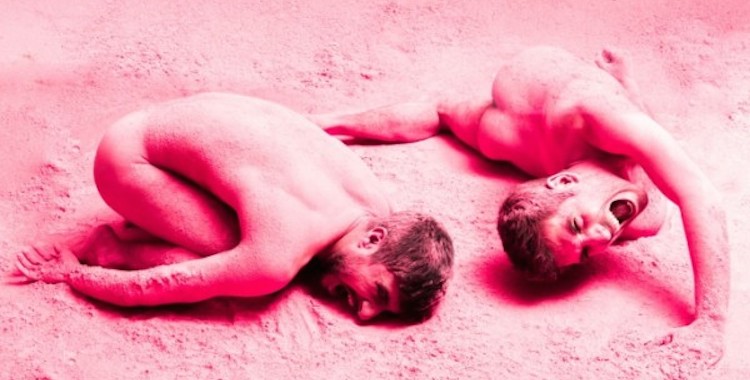
And Now: The World!, Hackney Showroom

unnamed4

Originally written for Exeunt.

“We’re getting used to a new way of being alone together. People want to be with each other, but also elsewhere, connected to all the different places they want to be.”

I write this with my phone sat next to me. With the slightest move of my arm, I can pick up a call, check for notifications, see if the little email icon is nagging me to clear my inbox. So far today I’ve communicated over phone, text, email, WhatsApp, Twitter, Facebook. Skype is open on my laptop, along with a noisy crowd of different web browser tabs and three separate Word documents. All the information I could ever want is just a click away.

Like.

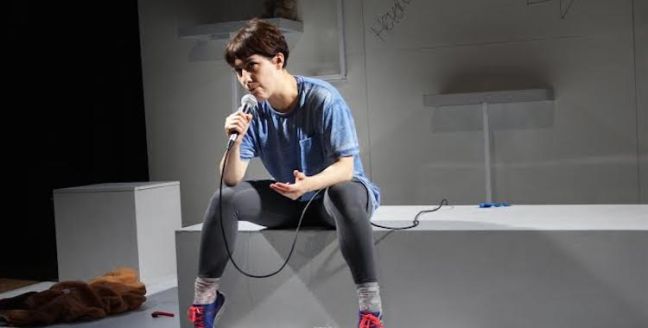
This is the sort of hectic, always-on digital existence thatAnd Now: The World! depicts. A slab of text by Sibylle Berg (here translated by Ben Knight), the play itself is a bit like the overwhelming data streams of the internet, there to be accessed – as the note at the beginning, read aloud, makes clear – by one voice or many. In director Abigail Graham and dramaturg Clara Brennan’s version, this anxious, almost hyperactive stream of consciousness is all spoken by Jennifer Jackson, moving restlessly around Sarah Beaton’s sleek, white, MacBook-style set. Her thoughts – about herself, about the world – are constantly punctuated by beeps and chirps; a distracting digital cacophony of alerts.

Share.

The unnamed speaker of And Now: The World! is sharing. Oversharing, some might say. She’s broadcasting her life (literally to us, virtually to the many eyes and ears of the internet), but with the fear that no one is listening. This is what the internet offers us: both an audience and a gaping void; a desperation to share, yet a feeling that our words and thoughts and emotions are simply entering a vacuum. Breaking repeatedly through Nick Powell’s crowded sound design, and eventually played at length, Sherry Turkle’s famous “alone together” TED Talk acts as a sort of half-mocking key for this production, the protagonist a living demonstration of Turkle’s aphorism “I share therefore I am”.

Favourite.

In narrative terms, the show doesn’t really go anywhere. The monologue loops, repeats, spirals off into transgressions, all separated into social media style nuggets. As delivered by Jackson, the whole thing pulses with anxiety: FOMO writ large. The speaker assiduously avoids venturing out into the world, yet she feels the need to check in with it constantly – if only to shower it with her disillusioned disdain. Zumba, baking, consumer culture – all are met with wry scorn, dismissed as distractions from a dying planet. The critique, though, is a knowingly empty one, delivered by a speaker who prefers to lock herself away from the world with the comforting chorus of her technology. She used to vent her rage by beating up young men in the streets, but now she just sits in her room, selling fake viagra on the internet.

Instagram. #nofilter

In a recent piece in the LRB, Rebecca Solnit describes digital communication as positioning us between solitude and communion, “a shallow between two deep zones, a safe spot between the dangers of contact with ourselves, with others”. We are never truly on our own and yet never truly withanother person, part of us always elsewhere. This is certainly true for Berg’s speaker, who is not content alone or with others. She instead chooses to communicate with all the people in her life electronically – by Skype, by text, even by the now nostalgic digital communication channel of MSN Messenger – but that communication only seems to cause stress. For such a seemingly contained, introverted piece, though, this production is incredibly physical and dynamic. Frantically responding to messages across different electronic platforms, Jackson leaps athletically around the set – a physical manifestation of the mental acrobatics required by today’s atomised forms of sociability. We might be stuck, but we’ve never had to do quite so much moving.

Retweet.

Little about And Now: The World! offers up particularly new insights. The lost, disconnected, screwed-over generation that its speaker represents is now all too familiar on stage, depicted most powerfully in shows like Barrel Organ’s Nothing, while the implicit critique of digital communication finds echoes in pieces such as I Wish I Was Lonely by Chris Thorpe and Hannah Jane Walker. The speaker’s paradoxical blend of anger and apathy, together with the ambivalent portrayal of digital media’s effects on our lives, is very recognisable, as are the many swipes made at shallow, hypocritical twenty-first-century society. For all that familiarity, though, Graham’s production still has some bite. “We’re shattered,” writes Solnit of the impact of today’s technology. “We’re breaking up.” And Now: The World! depicts that shattering in process.

https://embed-ssl.ted.com/talks/sherry_turkle_alone_together.html

Photo: Flavia Fraser-Cannon.
Beasty Baby, Polka Theatre

Screen-Shot-2015-10-27-at-10.32.52

Originally written for Exeunt.

As anyone who’s spent time in the company of a bawling newborn will know, babies are complicated little creatures. That, essentially, is the premise of Theatre-Rites’ brilliantly simple new show for three to six year olds. Sweetly, amusingly, unhurriedly, Beasty Baby offers a series of snapshots of everyday life with these (sometime) bundles of joy, lurching from the adorable to the maddening and back again.

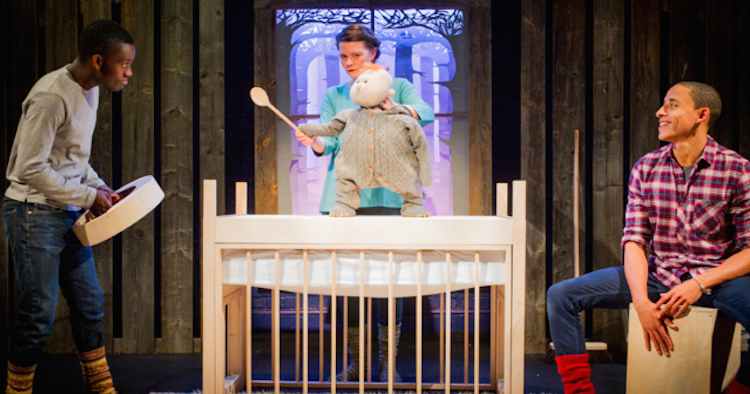
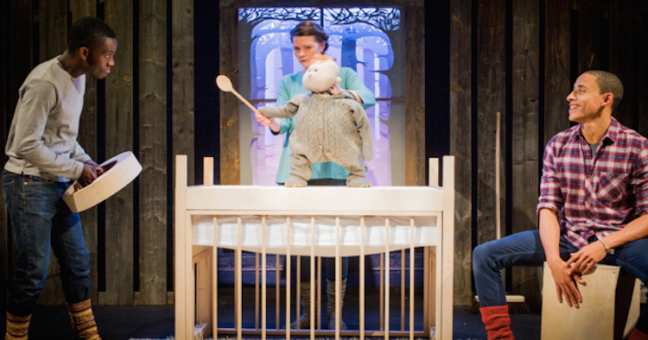
The baby in question is a handheld puppet, deftly manipulated by Theatre-Rites’ cast of three. Isolated in the middle of a wintry landscape, the trio suddenly find themselves landed with this temperamental infant’s care and do the same as all new parents: make it up as they go along. They cradle, they sing, they even do acrobatics trying to keep their new charge happy. As time passes, the unpredictable sprog throws up new challenges, with the grown-ups forever running (often quite literally) to catch up.

It works, then, for adults as much as for kids. Little ones giggle at the cheeky demands of the tiny tyrant, while parents make noises of weary, affectionate recognition. While little really happens, cycles of repetition and change keep the show moving forward, often driven by the seamlessly incorporated live music. Routines are established, repeated and disrupted, accompanied by a playful soundtrack. It’s all carefully calibrated to the attention span of its target audience, while achieving the double feat of keeping us bigger kids captivated at the same time.

Simplicity and clarity extend to every area of the production. The Ikea-esque wooden furniture of Verity Quinn’s design unfussily evokes both home and obstacle course, while there’s a fairytale glow to the landscape of trees and snow beyond the set’s single window. Days melt into nights melt into days again with the aid of Chris Randall’s lighting and the company’s graceful choreography of daily rituals: playing, feeding, burping. Change, as so often in life, sneaks in slowly.

It might not sound like much, but the skill of Sue Buckmaster’s deceptively straightforward production lies in finding both the sublime and the ridiculous in the familiar acts of child-rearing. Over the course of one long night, performer John Leader’s attempts to lull the mewling baby to sleep become a sort of dance, as he tiptoes, pirouettes and eventually levers himself athletically into the cot, infant in hand. The baby itself, meanwhile, is a brilliant comic creation, given cutely gabbling voice by Sian Kidd. As infant becomes toddler, both the noise level and the laughs increase, the naughtiness striking just the tone with the young audience.

In the end, though, the beastliness turns out to be worth it for the beauty – especially in the gorgeous, utterly enchanting finale. Beasty Baby is, ultimately, a celebration of all the chaos wrought by the arrival of a little one, animating for parents and kids alike the complicated joy of what it means to be a family.

Measure for Measure, Young Vic

12049405_10153575696093346_2716225082814279593_n-600x401

Originally written for Exeunt.

From the moment the house lights fall at the Young Vic, there’s no doubting that this Measure for Measure is about sex. The curtains – plastic, wipe-clean – part to reveal a writhing orgy of blow-up dolls, painted mouths stretched wide, from which the cast emerge. At the show’s opening, Vienna is soaked in sin. The tight fist of the law has slackened and the people are running amok. In one sense, Shakespeare’s prickly, problematic play is one long tussle to reinstate discipline and restraint. Trouble is, sex – like those miniature mountains of blow-up dolls – is impossible to ignore or deny.

In Joe Hill-Gibbins’ production, everything about the characters can be read from the way they deal with this tangle of plastic limbs. Zubin Varla’s “old fantastical duke of dark corners”, dishevelled and wide-eyed, proclaims to “love the people” in the same movement as trampling his inflatable citizens underfoot. He wants to restore order, but he doesn’t want to be the one to do it. Instead, he appoints Angelo, a man who “scarce confesses / That his blood flows”. Prim as a village priest, Bible tucked under his arm like a comfort blanket, Paul Ready’s unlikely leader picks his way carefully through the debauchery, careful to at once ignore and avoid it. Revelling subjects, meanwhile, throw the dolls from hand to hand, finding pleasure wherever they can.

Then there’s Isabella. The first time we see her, Romola Garai’s nun-in-training wearily pushes all relics of earthly temptation out of her way, murmuring reverent words of prayer as she does so. No hanky-panky for her, nor seemingly any desire for it. When her brother Claudio (Ivanno Jeremiah) is to be executed as an example – his pre-marital sexual exploits here caught on tape in a sly nod to surveillance culture – she finds her voice, making a persuasive petition to Angelo. Garai’s Isabella might be forbiddingly austere, but she’s also steely and impassioned, positively spitting out the words “man, proud man”. Although she’s trapped in what is still, for all the modern dress, overwhelmingly a man’s world, she is not a woman to underestimate.

This is a Measure for Measure full of fascinating if sometimes incongruous character interpretations. Ready’s Angelo is a preening, cowardly tyrant, preaching with new-found vanity one moment and shrinking into corners the next. Overcome by desire for Isabella, he grasps uncertainly at one of the pillars enclosing the stage, desperate for something to hold onto in this new world of dissolving morals. For all his seeming meekness, though, the proposition he puts to Isabella is doubly unsettling for its tentative, insidious abuse of power – an abuse that is still painfully resonant. This Angelo could just as well be a smarmy businessman making advances on a young female employee.

On the side of the more open sinners, unapologetic pimp Pompey (Tom Edden) seems to have arrived in Vienna straight from the streets of New York, conning his way out of trouble with fast-talking, ad-libbing wit. His regular client Lucio, on the other hand, is a cynical and surprisingly clear-sighted transgressor in John Mackay’s aggressive performance, pursuing the disguised Duke with dogged suspicion. Stripping the text down to a slender two hours, Hill-Gibbins and dramaturg Zoë Svendsen have cut or minimised many of Shakespeare’s minor, comedic characters, rolling bumbling constable Elbow into Hammed Animashaun’s uniformed Provost and keeping brothel owner Mistress Overdone offstage. Instead, we see this side of Vienna via a brilliantly daft – if possibly superfluous – pastiche of 90s hip-hop videos, as drug- and sex-fuelled anarchy reins in open mockery of Angelo’s new regime.

There are lots of these bold but silly touches in Hill-Gibbins’ production, some more successful than others. When Cath Whitefield’s spurned Mariana rocks out to Alanis Morissette, it’s hard to know whether to read it as an ironic comment on the angry-woman-wronged trope or just a gag designed for easy laughs. Other stage images, like those ever-present inflatable bodies, are both absurd and articulate, making a statement on the play at the same time as revelling in their own strangeness and audacity.

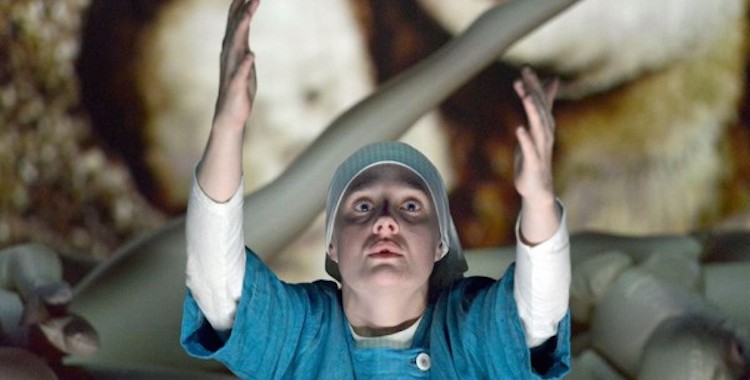
Aside from all the dolls, the most striking aspect of Miriam Buether’s design is its allusion to the fiery and fantastical imagery of medieval religious painting. The back wall of the performance space, periodically sliding aside to reveal the police cell where justice is clumsily meted out, is laid out in three panels like a triptych altarpiece, projected both with scenes from Christian paintings and live streamed video of the performers (now something of a European-flavoured Hill-Gibbins trademark). In one scene, we see a close-up of Claudio’s desperate, pleading face; in another, a cackling painted devil.

And like those paintings, Hill-Gibbins and Buether draw out both the excess and the religiosity – hypocritical or otherwise – of Shakespeare’s play. For all their holy intent, artworks like Hans Memling’s The Last Judgement or Hieronymus Bosch’s The Garden of Earthly Delights are a riot of colour and bodies and flames, as ridiculous in their own way as the piles of plastic flesh on the stage of the Young Vic. There’s no reason why the bizarre shouldn’t knock up against the Biblical.

Crucially, Hill-Gibbins and his team don’t attempt to solve the problem at the heart of Shakespeare’s play. Their interpretation embraces strangeness and ambiguity, its swirling soup of religious and pop cultural references never subsiding into a neat pattern. This is a dark play, for sure, but it’s also sexy and transgressive and funny and ludicrous. As the final scene awkwardly arranges the characters into their unlikely (and likely unhappy) pairings, that spiky contradiction that runs right through the play is slammed – like the dolls – centre stage.

Photo: Keith Pattinson.

A Room for All Our Tomorrows, The Place

Igor-and-Moreno-photo-bby-Alicia-Clarke-600x337

Originally written for Exeunt.

How often do we really listen to the sounds humans make? Not words. Sounds. Groans, moans, sighs, gasps, screams, howls, screeches, murmurs. All the miniature, half-acknowledged ways in which we communicate without stretching our lips around language. All the daily slips of our vocal chords, bodies betraying what our minds try to conceal.

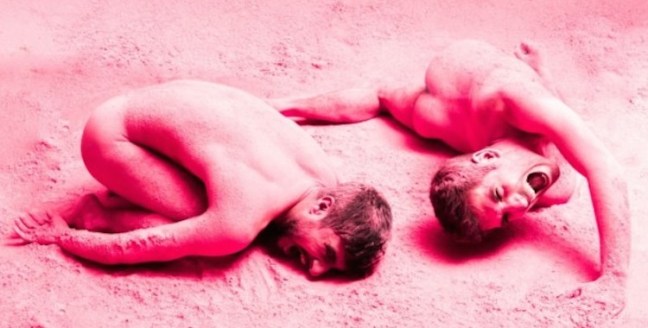
Igor and Moreno make us listen. For at least half of A Room for All Our Tomorrows, the auditorium is flooded with their wordless cries. They burst into the performance space whirling and screaming, voices shredding the air. And they keep going. And going. The shouts are relentless, subjecting us to the kind of sound we never really hear over any sustained period of time – and certainly not in the theatre. It’s astonishing and beautiful and unbearable all at once.

But the cries are far from uniform. One moment they suggest agony or despair, the next surprise or the sharp shock of pain. Igor and Moreno’s impressive repertoire of noises spans grief, excitement, heartbreak, longing, relief … Together and then apart, their yells tussle and enter into dialogue and briefly harmonise. They say everything while saying nothing.

All through the screaming, Igor and Moreno put their bodies through the exaggerated motions of everyday actions: turning, reaching, stumbling, and – most strikingly – drinking scalding cups of espresso, fresh from the coffee-maker plonked centre-stage atop a wide wooden table. It’s as though this daily ritual has been stretched out of shape, suggesting both the strain and the absurdity of these things we construct as the flimsy scaffolding of our lives. Eventually, as coffee spills across the pristine white floor, the construction collapses; something new emerges.

There’s something about effort in Igor and Moreno’s work. In Idiot-Syncrasy, the two men basically just jump up and down for an hour, calf muscles straining and sweat blooming in patterns on their T-shirts. A Room for All Our Tomorrowsputs the same strain on their voices, as they heave up these unrelenting, guttural cries. The movement, too, riffs on struggle and repetition, the same motions enacted again and again. The exertion is palpable, there in the perspiration beading on Igor and Moreno’s faces and in the occasional audible gulps of air between screams. This is fucking hard work.

So why do it? For me, the effort hints at the attempt, however small or seemingly silly, to change something. Igor and Moreno vaguely but appealingly describe A Room for All Our Tomorrows as “a performance and a place to imagine how things might be other than the way they are”. The show is as abstract and open to interpretation as the statement; it’s performance you feel through, not think through. But there’s something in those repeated cries, those repeated gestures of trying, reaching, falling. The same thing again and again and again, until suddenly, somehow, it’s transformed into something different. Things might be other than the way they are.

Fuck the Polar Bears, Bush Theatre

image12-600x337

Originally written for Exeunt.

Humans are terrible at heeding warning signs. In Pompeii, people saw the smoke spewing from Vesuvius for days before it erupted. Few ran. Today, the alarm bells of climate crisis are ringing all around us, yet still we carry on as normal, exploiting the environment for every last penny. What’s future destruction compared to a few extra quid in your pocket today?

At least that’s the starting point for Tanya Ronder’s new play, which pits climate change against straightforward, self-destructive human selfishness. Her protagonist, Gordon (Andrew Whipp), has just been offered the job of CEO with one of the energy giants, a position that comes with dirty money – and lots of it. His wife, Serena (Susan Stanley), has her sights set on an exclusive riverside pad and London’s best prep school for their young daughter Rachel. The price? Only the planet they live on.

“I just want us to enjoy our lives,” says a stress-frazzled Gordon to his unfulfilled, fitness-obsessed wife. Money clearly hasn’t bought happiness for this couple, but still they grasp desperately at the climate-destroying possessions they feel they’ve earned. Their high-energy lifestyle, meanwhile, finds its contrast in their frantically recycling Icelandic au pair Blundhilde (Salóme R. Gunnarsdóttir) and in Gordon’s recovering drug addict brother Clarence (the ever-excellent Jon Foster), who has found refuge in a simpler life. Around them all, things start to fall apart.

Fuck the Polar Bears’ bludgeoning symbolism is about as blunt as its title. Lights flicker. Rubbish mounts. There’s a problem with the water. And Rachel’s toy polar bear is missing, nowhere to be found. In Caroline Byrne’s production, the building chaos of Gordon and Serena’s home is climate crisis in microcosm, everything spinning (literally, thanks to Chiara Stephenson’s sleek revolving stage) out of control. It’s not hard to see where this is going, or what it’s none-too-subtly pointing to.

As an idea, folding the predicament of the planet into a tightly focused family drama is a promising one. It’s often the small-scale that drives home the impact of the large. Here, though, everything is made unnecessarily explicit, while the tone teeters awkwardly between comic, surreal and earnest. Some sharp images jump out from Ronder’s text – Blundhilde’s description of Gordon as a necrophiliac “screwing a dying world” is one hell of an insult – but it does far too much explaining and debating, especially in later scenes. As so often with climate change plays, it all begins to sound a lot like a Guardian editorial.

These are vital discussions to be airing, especially as this winter’s climate change summit in Paris fast approaches. Humanity is on a deadline – if indeed the deadline has not already passed. But I wonder, as I wondered when watching 2071 last year, if this is really the forum for it. As with 2071, Fuck the Polar Bearsis hardly carbon neutral, and also as with 2071 it’s likely to attract a crowd who are already concerned about the issues it addresses. It’s hard not to ask, as Ronder’s characters fruitlessly circle her subject matter, “what’s the point?”