Transform Festival 2013

CRWD13_Transform-D1_168-940x626-600x399

Originally written for Exeunt.

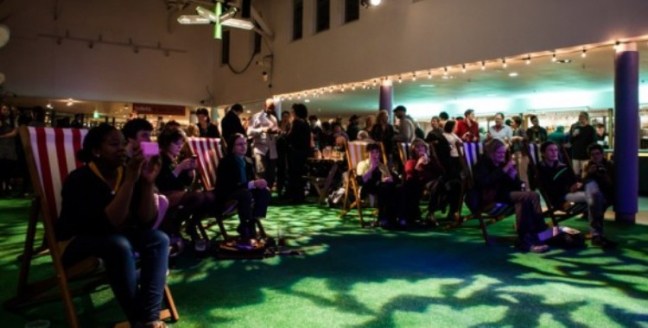
I’m folded into a striped deckchair, grass at my feet and a glass of wine in my hand, watching a performer in a bear costume drag a tied-up man onto a bandstand decked with fairy lights. At the end of my first day in Leeds, this is the unlikely scene in which I find myself in the buzzing foyer of the West Yorkshire Playhouse, suitably reimagined for the theatre’s third annual Transform Festival. I’m in the Park, a slice of the English summer transplanted into the Tardis-like building. The brief for designer-in-residence Hannah Sibai, I’m told, was to bring a bit of Leeds into the Playhouse, creating a welcoming space where visitors can relax, drink, stumble upon some art.

It’s a dialogue with the city that characterises Transform, which this year carries the strapline “my Leeds, my city”. Distinctive among other theatre and performance festivals in a similar mould, many of which host the same nomadic work and artists, Transform is injected with the unique flavour of Leeds as a place. Sites are important, as are people. When I grab coffee, cake and a quick chat with festival producer Amy Letman, she tells me that the programme grew from a scribbled map of the city, a neater version of which now appears in the Transform brochure that sits open on the table between us. Tracing her hands over the different areas of Leeds as she discusses the work, Letman talks me through the connection of each piece and each artist to the city, explaining the desire to take work out of the Playhouse and into unexpected locations.

One of these unexpected locations is the Royal Armouries Tiltyard, an impressive outdoor space situated in the middle of an over-developed ghost town – all sleek apartment blocks and yawning open spaces. Audiences are led here from the West Yorkshire Playhouse – the connecting “hub” of the sprawling festival – via a meandering audio walk through the city’s streets. Navigators, a piece created by Leeds University students following workshops with artists Invisible Flock, is well meaning but hindered by the disruptions and limitations of its physical surroundings, less in dialogue with its site than tussling with it. The evocative collage of voices pumped into our ears has to compete with traffic and early evening urban bustle, its delicate spell too easily broken by the intrusion of today’s city into the mental images it conjures of Leeds’ history.

The piece of theatre that occupies the outdoor space we eventually arrive at, situated at a dynamic nexus between Leeds old and new, is Slung Low’s The Johnny Eck and Dave Toole Show. A show that is mostly about trying to make a show, Dave Toole’s achievements as a dancer and performer are contained within a meta-theatrical structure that attempts to sidestep Toole’s own gruff modesty, while Toole himself just wants to tell the story of American freak show performer Johnny Eck; a show within a show within a show. The strange spectacle of the freak show in this circus-like space is also central to the conceit, complicating the gaze of the audience and the deliberate naivety of the humour. There’s always a slight jagged sense of unease.

With the afterglow of the Paralympics now faded to the stony cold reality of slashes to disability benefits, Slung Low are necessarily unflinching about the reality of ongoing prejudice faced by the disabled community. As well as being playful and celebratory – and, ultimately, uplifting – the piece unleashes an accusatory sting, sneering at the supposed “changing of perceptions” that was achieved by the Paralympics in London. By demonstrating the parallels with Eck’s prejudice-tainted experiences back in the 1930s, the piece suggests that not so much has changed after all. But the show is also about Leeds, about its inhabitants’ own particular brand of self-deprecation and eschewal of “fuss”, about the landscape of past and present that forms the show’s twilit backdrop. It’s a celebration for a city that doesn’t like to shout about its achievements.

Back in the Park space for that night’s Live Art Bistro, what’s striking – other than the heartening numbers turning out for performance art on a weekday evening – is the mix of people in the room. There are students, Playhouse staff, audiences who have wandered in after another show, and a wide range of artists, many of whom are involved with the festival in some way. As several of the individuals I speak to note, the transformation (forgive the pun) of this space has turned it into a place where artists want to linger and chat, immediately forming a relationship with the building through simple proximity. As Letman puts it, Transform has “ignited the enthusiasm of artists in the city”, forging links with the wider artistic community that might not otherwise exist.

The benefits of these links for both artists and theatre are immediately evident in the events taking place around the edges of the festival, including last week’s scratch programme and Emerge night and the playful live art interventions that now dance around the groups drinking and chatting on the surrounding deckchairs and picnic tables. Alongside the bear, there’s a story archive collecting narratives of Leeds; a witty, knowing take on food and gender stereotypes from The Souvenirs; a series of statements about the world punctuated by the knocking back of drinks. Just before I reluctantly leave this indoor bubble of summertime to make my way back to my hotel, one of the lightly swaying performers on the bandstand stage gulps down another shot. One for the road.
rage-600x399

As artist Ellie Harrison recognises, there’s a lot to be angry about right now. On the morning of my journey to Leeds for the Transform festival, Maria Miller delivered her first keynote speech as culture secretary, in which she insisted on the need for artists to make the argument for their economic value. I avoided reading the speech in full, mainly for my sanity and the sake of my fellow train passengers, but the news stories emerging from it and the stream of rage bursting from my Twitter feed were enough to get me riled. So it’s with this sense of political anger – a simmering background frustration that keeps erupting in response to more and more outrageous policies – that I enter Harrison’s installation The Rage Receptacle.

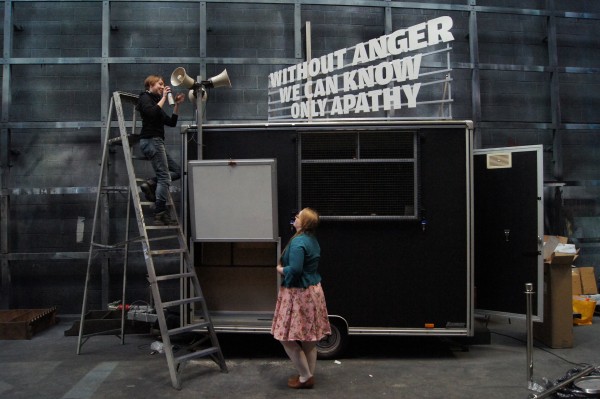
The piece, housed in a compact black box up the road from the West Yorkshire Playhouse on Eastgate, is a lightly playful exploration of the things that make us angry and how we might deal with them. Almost mimicking the automated phone systems that are themselves a regular cause of wrath, recordings offer each participant a series of options and choices, gently prodding at the causes of our everyday frustration. Harrison, who I catch up with in the foyer of the Playhouse, describes The Rage Receptacle as a piece made for “accidental audiences”, those who might wander in off the street with a bit of spare time and curiosity. She speaks of the value of work that offers participants a pause, that gives us the opportunity to step out of our increasingly hectic lives and take a moment for contemplation.

At first glance, The Rage Receptacle seems like a fairly shallow investigation of a complex, knotty emotion, but in fact its unassuming simplicity is one of its greatest strengths. It’s more of an invitation than anything else, providing the questions and leaving the answers up to its audience. How often do we pause to consider our emotions, the stimulus they respond to, and how we choose to cope with them? The Rage Receptacle forms part of Harrison’s longer sequence of work The Grief Series, each of the seven segments exploring a different facet of bereavement in collaboration with different artists, but as much as all of those emotions are ever relevant, anger feels particularly timely. Still only in R&D at the festival, at an embryonic stage in its lifecycle, this particular piece offers up the promise of an intriguing evolution in response to its site and its “accidental audiences”.

One thing that Harrison draws my attention to during our conversation is the prevalence of site-based work in Leeds. This is a city where art happens on the street, where performances aren’t necessarily confined to theatres. Much of this is pragmatic; since the closure of the Leeds Met Gallery and Studio Theatre, artists making work that falls outside the traditional remit of the city’s other theatres have found their projects essentially homeless. With what I’m told is a typical Leeds attitude of “let’s just bloody do it” – another woman I speak to has mounted projects including an underwater exhibition in a swimming pool, while Slung Low characterise their driving force as a “can do” approach – the work has embraced its enforced nomadic status, finding new temporary habitats around the city.

It’s from this large body of site-based work that Transform seems to take its cue. As festival producer Amy Letman explains to me on my first day, another of the areas that the Playhouse identified as a location they wanted to make work with and for was Burmantofts, a community just across the bridge from the theatre but one that the building has previously had little connection with. The piece emerging from this, Burmantofts Stories, takes place in the heart of this community, relating its narratives from within its own space. Drawn entirely from residents, the show is pieced together from the conversations and workshops initiated by theatremaker Pauline Mayers with people in the local area and is performed by seven of the participants.

Burmantofts is a community “mapped with voices” and held together by ritual. Hinting at ancient pagan ceremony and the age-old practice of telling stories around the campfire, the show’s arrangement seats audience members on benches forming a ring around the outdoor performance space, encircled by a string of fairy lights. In the piece itself, repeated, oddly graceful movements gesture to the reiteration of everyday activities, while the drinking of coffee – of particular importance to one of the men involved – is a core ritual bringing members of the community together. Through a careful use of sound, stories and songs drift in and out, sometimes overlapping, sometimes isolated. It can be messy, but no more so than life.

Alongside the narratives Mayers has gently teased out of participants – “I just love people,” she smiles as she describes the process of tirelessly hitting the streets and speaking to residents – her own story is quite extraordinary. With no real prior connection to the theatre, she first encountered Transform in the festival’s first year, when she won a free wristband on Twitter and dropped into Chris Goode’s Open House. By the end of the first day she was deeply embroiled in the process; two years later, Mayers is now an associate artist of Chris Goode & Company. Her interest, similarly to Goode, is in people and their stories; she describes this project as a way of “reframing the human condition”, reminding us that we all have stories worth telling.

Mirroring Mayers’ journey, Transform itself has seen a clear progression since its inception. Letman explains that in the first year the focus was on simply finding work to programme, while a year on the intention was to work more closely and collaboratively with the artists involved; now the circle of collaboration has widened even further, encompassing audiences and the city itself. One of the major impacts of this third festival is the possibility of those itinerant artists mentioned by Harrison finding a longer term home in the Playhouse, as new artistic director James Brining looks to bring various strands together into a varied but connected programme. The festival as an event is naturally exciting, its context inviting an intoxicating, transitory buzz. The real challenge is incorporating that ephemeral sense of artistic community into something wider and more permanent.

A Stroke of Genius

my perfect mind-171 (2)

Originally written for Scout London.

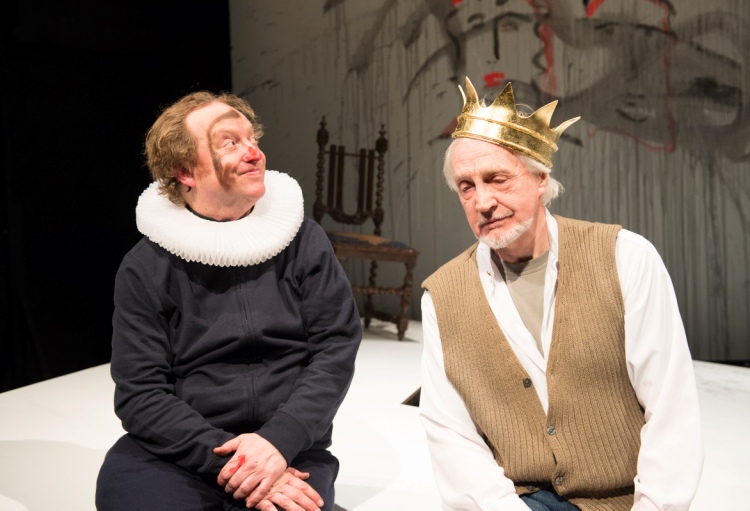
“I suppose circumstances have conspired to make some kind of happy ending,” actor Edward Petherbridge reflects, a smile in his voice. It’s an unlikely comment, given that Petherbridge is discussing the major stroke that he experienced while rehearsing for a production of King Lear in New Zealand in 2007. One day he was preparing for one of the greatest tragic roles in the theatrical canon; the next, he was barely able to move.

Petherbridge describes the “episode” – he rarely uses the word stroke – as “completely unexpected and swift and sudden”. But while the stroke initially left him physically debilitated, unable to even move his thumb and index finger together, he soon discovered that the role of Lear was still stubbornly lodged in his mind, word for word. It was this extraordinary discovery, paired with a continuing fascination with the part he was robbed of, that eventually led to Petherbridge’s “happy ending” in the form of a show in which he finally gets to play Lear – sort of.

“I said to Paul Hunter in an idle moment when we were doing The Fantasticks together that I thought we could take a two-man Lear to the Edinburgh Festival,” Petherbridge explains. “He said, ‘well I might have a better idea than that, which is a show about you not doing Lear’.” The final product, emerging from a process of improvisation and devising, is My Perfect Mind, currently on tour ahead of a run at the Young Vic. Marrying Petherbridge’s experience with chunks of text from King Lear, co-deviser and performer Hunter describes the piece as a “strange, dreamlike journey through Edward’s brain”. Petherbridge plays himself and Lear, while Hunter single-handedly takes on all the other roles, from Petherbridge’s doctor to Lear’s fool.

“I don’t think either of us knew quite what the show would be that we might come up with, and I’m still rather amazed at what it is,” Petherbridge admits. Despite the trauma of the stroke, he tells me that there was little hesitation in taking Hunter up on his initial suggestion and mining those difficult experiences for theatrical material. This surprising lack of trepidation might even have something to do with the consequences of the stroke itself. “I heard on the radio not long after the stroke that the synapses that generate regret are often disabled by the brain damage that comes with it,” Petherbridge says by way of explanation.

While the nightly re-enactment of such a painful episode might sound challenging and emotionally exhausting, Petherbridge plays down these difficulties, turning again to Lear. “Someone asked me last night whether I found it at all painful or difficult,” he says, “but it’s no more painful than Lear’s much more gargantuan difficulties; mine pale into invisibility when compared with his.” He pauses for a moment, before adding, “and if acting isn’t a pleasurable experience, why do it?” This joy for acting and the theatre, which has clearly driven Petherbridge’s long and successful career, seems to have had an almost medicinal effect in the aftermath of the stroke and throughout the process of making this show. Indeed, Petherbridge refers to it fondly as “doctor theatre”.

Despite Petherbridge’s openness to chronicling his experiences for the stage, however, dealing with such personal subject matter has not been unproblematic. Hunter is frank is about the occasional discomfort of his own position in the process, saying “I’d be lying if I said there weren’t moments when I went ‘is this OK?’” He also speaks about the “responsibility” of what they are doing in grappling with this topic, but he emphasises the importance of comedy in the piece. “I think the thing that was really key was the sensitivity around the stroke, because Edward was very clear that he didn’t want to dwell on that too much or in any way to become maudlin or sentimental, and I think we’ve avoided that by treading quite lightly around it.”

The result, told in the absurd and madcap style characteristic of Hunter’s theatre company Told by an Idiot, is dreamlike and ever-shifting, rapidly jumping between Petherbridge’s life and the fictional world of Lear. As Petherbridge puts it, “it’s like a kaleidoscope of different bits of my life that Paul has shaken up”. There’s an evident connection between content and form, narrating the brain’s complex recovery from trauma in a way that reflects the extraordinary and often unexpected quirks of the human mind.

“To see the show might be like going to a seminar on Lear when you’ve taken a dose of LSD,” Petherbridge goes on to suggest, with evident glee at the comparison. “I know nothing about LSD firsthand,” he continues, “but I believe there are good and bad trips. I am hoping that the experience of seeing the show is a good trip.”

Photo: Manuel Harlan

Is not Money the Bond of all Bonds?

????????????????????

Originally written for Exeunt.

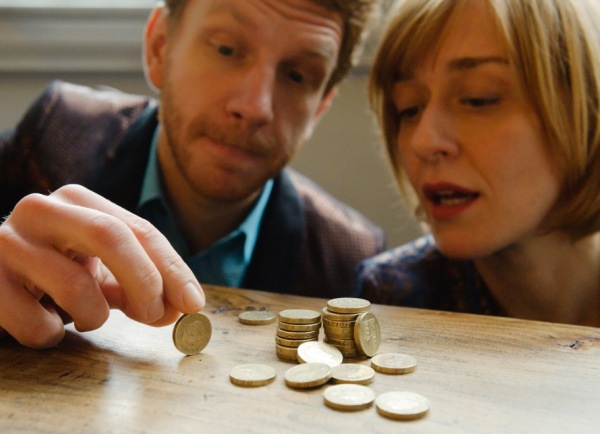
“I really love that they’re the colour of gold.” Writer and director Clare Duffy is speaking about the 10,000 pound coins that she will soon be bravely putting on the stage of the Bush Theatre for MONEY the Gameshow, a piece asking meaty questions about money, the financial crisis and how we understand value. Deliberately eschewing the familiar image of floods of crisp bank notes, Duffy thinks there is something even more profoundly seductive about the materiality of pound coins, something deeply rooted in the way we think about money.

“Why aren’t they purple?” she grins at me across our table in the Bush cafe. “Why aren’t they striped? It’s so interesting how profound that symbolism is, because although we all know it’s not real gold, we like the fact that it’s gold coloured and shiny; it hearkens back to a folk memory of gold standard, when money was directly linked to a standardised value.”

Putting those 10,000 round, shiny objects on stage has a history and a whole host of problems. The idea first arose from an earlier play of Duffy’s, in which a couple put a pound coin in a jar for every day they spend together and are then faced with splitting the amassed sum after their break-up; when it was performed, Duffy placed 500 pound coins in the centre of the playing space, prompting the realisation that this immediately shifted the way in which these objects signify. “What happens when it becomes a prop?” Duffy ponders. “Does it still feel like it has that value? And what kind of performances does it demand from the audience?”

When she won the Arches New Director’s Award in 2011, Duffy identified a way of posing these questions, deciding to put the £6,000 prize on stage and use it to tell the story of the financial crisis. Through the experience of presenting scratches of the piece and developing it again for the Bush, Duffy’s feeling that the environment of the theatre changes the nature of the money on stage has only intensified. While money typically relies on a shared belief in its value, Duffy observes that “when you put it inside a theatre, which is a place of make believe, it sort of becomes something else”. How does an object that is already engaged in a mimetic act – standing in for a value that it does not embody but only represents – transform under another layer of representation?

The money on stage is also influenced by the necessary mechanisms that surround it; as the £10,000 used in the show is a loan, the theatre has had to install CCTV cameras and a security guard to ensure that no audience members are sneakily slipping coins into their pockets. Rather than considering it an irritating practicality, however, Duffy has creatively seized on these intrusions, describing them as “both real and not real at the same time”. It is through such external structures, she believes, that the central notion of money is upheld. It follows that perhaps through revealing and disturbing such structures we might be able to interrogate and displace that notion.

This process of interrogation and displacement is just what MONEY the Gameshow sets out to achieve. Led by two hedge fund managers turned performance artists, played by Lucy Ellinson and Brian Ferguson, the audience are divided down the middle and given the piles of pound coins to gamble with, placing bets and competing to win. The purpose of this involvement, Duffy explains, is to draw the audience into the adrenalin-drenched world in which such individuals operate and to make them complicit in that irresistible excitement.

“You’re given a stake in the risk of the story,” Duffy continues, “aligning the risk of the games with the risk of the story. Because that’s what the story is about, it’s about playing a game and winning or losing.” The story that runs alongside these games is the story of both the former hedge fund managers and the entire financial crisis, tracing the factors that led to collapse and the state of extended resuscitation that has followed, stubbornly reviving what Duffy calls a “zombie economy”. We have all played a losing hand, but we’re still trying to hold onto our chips.

Duffy believes, however, that the current crisis is as much of an opportunity as it is a disaster: “What’s exciting about now and about talking about money now is that anything’s possible and the most crazy ideas should be talked about”. Throughout the process of making the show she has spoken to a number of individuals from the world of finance that she is depicting and has been surprised by the openness of some of their attitudes. “Politically we’re probably coming at these things from very different points of view, but there’s a convergence point,” she says, suggesting that this location of convergence is born from our present state of crisis. “Interestingly, it creates a space where people from really radically different points of view and walks of life can actually meet and talk.”

Getting people talking is, as Duffy recognises, the first step towards any change, but there are a number of barriers to that conversation. As Duffy observes, the financial industries are constructed to keep people out, fenced with technical jargon and barbed with complexities. “It seems to be to be so important and yet so little understood,” she says, admitting to her own ignorance prior to the research undertaken for the show. Her hope is that, as well as shifting audiences’ perceptions of money and value, she can simply make them feel more comfortable talking about it.

The idea of talking about money inevitably leads us into the territory of how money is discussed within the arts. This is a thorny subject, particularly in an atmosphere dominated by cuts, where the effort to defend the arts is often weakened by internal disagreements about the rhetoric in which that defence is to be mounted. Duffy is of the opinion that those working in the arts should take up all the arguments at their disposal.

“I think you just have to make the argument every which way you can, as much as you can,” she says. “I think there’s a lot of value in making as watertight an economic argument as you can. There’s an expression: making your argument in your master’s language. Sometimes you have to make the argument in terms that the people in power will understand or accept. However, at the same time you have to realise that you’re seeding power when you do that, so you have to be making that argument in another way. You have to fight on as many fronts as possible.”

The concern, as I say to Duffy, is that the eloquent economic arguments that are being put forward by some will be at the expense of the arts’ intrinsic value. If we succeed in binding the arts to measurable economic outcomes, this monetary worth quickly becomes the only value that can be ascribed to them. Duffy sees it, however, as a distinction between short term and long term solutions. “Short term sometimes it’s worth making that argument, it feels appropriate to make that argument, but at the same time you have to be making the more important point,” she suggests. Proof of economic worth might win the battle, but it is the search for a non-monetary language about value that is key to the longer term struggle.

“And that is what the show is really passionate about,” Duffy persuasively concludes. “It’s about asking the question: what is money?”

Photo: Simon Kane

Downloading Drama

Untitled

Originally written for Prompt Magazine.

“In the spirit of trying to capture something, you’re trying not to affect or change it.” These words from Digital Theatre’s co-founder Robert Delamere are something of a manifesto for the company, which has been attempting to faithfully capture the theatrical experience on film since 2009. Through its online library of downloadable recordings, Digital Theatre offers audiences the opportunity to engage with productions without needing to be in the same room – or even the same country – as the performers on stage. The initial aim, as Delamere and founding partner Tom Shaw tell me, was to capture live performance in the best way possible.

“It had been done before, but usually very poorly,” Delamere says, his frustration palpable. Shaw agrees, observing that video recordings of theatre often insert a damaging distance between viewer and performance, with all the action taking place “over there” and being filmed by just one or two cameras. The solution that Delamere and Shaw applied to this problem was to bring film language into the theatre, using multiple cameras and shots to create a recording that they claim is “a very true representation of the performance”.

These questions of proximity, quality and fidelity to the live experience are ones that have dogged recent developments of videoing techniques in British theatre. Inspired by the success of the Metropolitan Opera’s use of live-streaming, which it first launched in 2006, over the last few years the recording of performances has become more than just a matter of archival documentation. Increasingly, theatres and companies are viewing video as a vehicle for reaching and expanding audiences. How to grow these audiences without compromising the quality of the content, however, has proved to be a persistent issue.

“You’re trying to capture the connection between audience and performer,” Delamere explains, identifying the central difficulty that video recording faces. “There is something very tangible and alive about that.” Alongside Digital Theatre’s application of film language, a process of discussion and collaboration with the creative teams involved in the productions they are filming has been key to the way they have approached this difficulty. “I think if you address something by working with the intentions of the performers and the whole creative team, you can’t exactly replicate it, but you can get quite close to the spirit of it,” Shaw suggests.

I receive a similar response from George Bruell, Head of Commercial Development at Glyndebourne. The Festival has been among the most forward looking performing arts organisations in this area, having first streamed its operas live to cinema audiences back in 2007. In 2013 it will be streaming the entire Festival for the first time, making this content available both in cinemas and online through the Guardian website. For Glyndebourne, quality is everything.

“It’s very easy, even if you’ve got the best quality material on stage, to not do justice to it unless you’ve got the best people filming it and it’s done in a collaborative way with the creative team,” says Bruell, placing a heavy emphasis on artistic collaboration. Decisions about which operas to film will be made months in advance, he tells me, and the teams filming the performances will be involved throughout the rehearsal process. While Bruell identifies audience growth as a major impetus behind Glyndebourne’s decision to stream its operas, he asserts that this is “secondary to the quality of the experience”.

Assessing whether the audience growth that is at the heart of these projects has actually been achieved forms a large part of their ongoing development. While the audience research currently available is limited, the numbers seem to suggest that an audience is there and that it is expanding. Digital Theatre, for instance, records between 50,000 and 60,000 visitors to its website each month, while Glyndebourne’s 2012 season was viewed online by over 100,000 people through the Guardian website. Another significant player in this field is National Theatre Live, which at the beginning of its fourth season of live cinema streamings boasted a global audience of one million who had seen its broadcasts.

Other than total viewing figures, the audience insight that these companies have managed to gain is largely anecdotal, but the early signs are encouraging. Delamere and Shaw are insistent that there is an “amazing appetite” for the content that Digital Theatre is providing, speaking of the many emails they have received from users of the site. Glyndebourne, meanwhile, has found that audiences are just as keen as the Festival organisers to authentically replicate the live experience. Bruell recalls one particularly memorable photograph sent in by an audience member showing a table set for two with champagne and candles in front of a laptop playing the live opera broadcast. “Whoever sent in that picture had, in their own little way, been trying to recapture some of the magic they’d be getting at Glyndebourne.”

Part of the “magic” that Bruell talks about also comes down to the choice of material to live stream or make available to download. As he explains, “a lot of thought goes into the make-up of the Festival; our artistic colleagues are thinking about the balance and mix, so that people coming to Glyndebourne can have a choice between different periods of history or different styles of production”. This process of selection is no different for online or cinema audiences, and for the 2013 Festival a large part of the artistic consideration has involved selecting the range of operas with these audiences in mind as much as those physically attending at Glyndebourne.

Similarly, the choice of productions to film and make available formed a major part of the early decision making behind Digital Theatre. “We were very keen to ensure that what we were doing was a mirror of the living theatre,” says Delamere, “that it wasn’t just the most commercial piece of work out there or what was coming from the biggest producing houses.” In line with this aim, their selection of recordings range from the acclaimed West End production of All My Sons to Clare Bayley’s The Container, a claustrophobic performance for an audience of just 28 inside a shipping container. “We’ve talked to a lot of producing houses all across the UK trying to find the right kind of content,” Delamere continues, describing it as “a very egalitarian principle”.

Throughout this decision making process, Digital Theatre’s relationships with theatres and companies have been key to its strategy. Shaw emphasises that “from the very beginning it was going to be built in conjunction with theatres and in conjunction with the industry”. This is reflected in the company’s initial range of partners, which included the Royal Shakespeare Company, the Royal Court and the English Touring Theatre. “It’s about trust really,” Shaw continues, “it’s about them letting us into their space. It’s very much a collaboration.”

Digital Theatre is now working to extend these relationships, as it provides a platform for quality content from theatres such as Shakespeare’s Globe through its new Collections catalogue and begins to seek out more collaborative working models. “We have started to go into co-producing partnerships where there is some sort of investment from the producing house,” Delamere explains, suggesting that such an approach creates “a potentially more interesting deal and a more engaged experience” for theatres.

For now, these developments primarily offer theatres an opportunity in terms of audience reach rather than in terms of profitability. National Theatre Live, for example, is just beginning to turn a profit on some of its broadcasts after substantial internal investment alongside funding and sponsorship from sources such as the Arts Council, NESTA and Aviva. Where the potential to make a profit from these ventures might lie, however, is in the growth of live as well as online audiences. Far from the cannibalisation of live theatre that was feared might come as a consequence of digital video streaming, both Digital Theatre and Glyndebourne point to evidence that the availability of this material online and in cinemas is in fact attracting new audiences to experience the productions first-hand.

Digital Theatre has come to realise that, rather than thinking of video recording as a substitution for or threat to theatre and live performance, it might occupy a different category entirely. “One of the things we asked was ‘what is this?’” says Shaw, speaking about the audience research they have conducted at recent screenings of their recordings. “Is it film or is it theatre? The majority of people said it’s neither, it’s something in between.”

Although this new category may widen access and attract new audiences, none of the emerging players in this field are suggesting that the opportunities afforded by digital are about to supplant traditional theatregoing. As Bruell is keen to emphasise, whatever the developments enabled in this area by advances in technology, it is never going to be a true substitute for the live experience. “It will always play second string to the experience of the auditorium.”

Telling Stories: The Year in Theatre

_64849962_endofworld624_thinkstock

Originally written for Exeunt.

As anarchically demonstrated by Forced Entertainment in The Coming Storm, stories are fragile, false and shifting objects. In the hands of the frantically competing performers, these narratives falter, clash and implode, truncated by interruption upon interruption. Yet still we insist on telling them. Any narrative of the year in theatre is condemned to the same failings; it is inevitably partial – both in the sense of being incomplete and in the sense of being subject to an individual bias – and its trends are essentially arbitrary, collapsing in upon themselves. And still, stubbornly, the fashion persists.

While my own personal look back at the last twelve months is just that – personal – there is a more widely acknowledged feeling that 2012 has found itself situated at a cultural tipping point, though whether the shifts that have been felt this year do rock us over that precipice into whatever might lie below is still to be seen. It is a year in which, driven largely by the Olympic effect, different theatrical cultures from around the globe have converged and collided, in which spectacle has been celebrated and questioned, in which theatremakers have reached for new vocabularies to explore political themes in an extraordinary and often farcical climate. It has felt like a year of small tectonic shifts, but maybe that’s just me.

The central point around which my own theatregoing year has pivoted is the small phenomenon of Three Kingdoms, a production in which global politics, cultural identity and aesthetic virtuosity all violently and thrillingly met. It was here that I first felt the tipping point, as both British theatre and British theatre criticism met with a challenge that could potentially mutate their future form. In this hallucinatory, boundary-crossing tour through a repulsive yet visually dazzling web of human trafficking and capitalist exploitation, understandings of Europe were stretched and pummelled, while audiences became grubbily, voyeuristically complicit with the crimes being depicted. This was watching as implicit consent, spectacle as political.

Spectacle itself, most vividly conjured by the potent emotive force of the Olympic and Paralympic Opening Ceremonies, felt partly reconfigured by the forms it found in the past year. Eschewing the traditional national narrative, Danny Boyle’s inclusive – if not entirely unproblematic – variation on patriotic spectacle offered an appealing vision of a cosmopolitan Britain. Elsewhere, the idea of theatrical extravagance was startlingly realised through language in Gatz’s breathtaking indulgence in prose; the already spectacular space of the Tate Modern’s Turbine Hall morphed from canvas to stage as Tino Sehgal’s mesmeric These Associations took up its fleeting, dynamic residence; and most recently, Shunt delighted and frustrated audiences in equal measure with the offer of a baffling spectacle in which they were passively trapped, providing a fitting if disturbing metaphor for the state of the nation.

At the opposite end of the theatrical scale, retreats to the simple or intimate offered up equally striking visions of the world. Ryan Van Winkle’s Red, Like Our Room Used to Feel, a gentle one-on-one poetry performance,provided a nostalgia-tinted pause at both the Edinburgh Fringe and the Battersea Arts Centre, while a similar interlude from Fergus Evans punctuated my hectic visit to this year’s Pulse Festival. Rewinding to the beginning of the year, one of the unexpected triumphs of the London fringe was Greenhouse Theatre Company’s visceral, emotionally skewering revival of Mercury Fur, administering an electric jolt of theatrical power each night in the tiny space of the Old Red Lion, transformed into a claustrophobic dystopian wasteland.

The small also fared well in Edinburgh, where many of the most memorable shows were two handers or solo offerings. These included an impressive pair of plays from Luke Barnes, the Pro Plus-fuelled Chapel Street and the raw rage of Bottleneck, and Charlotte Josephine’s muscular yet moving Bitch Boxer. Unexpectedly, one of the most powerful episodes of my Fringe experience didn’t take place in a theatre space at all, but in the bar of the Traverse Theatre, where I was almost reduced to tears in the mid-morning by Rosie Wyatt’s unembellished, barely rehearsed reading of Spine, Clara Brennan’s short response for the latest incarnation of Theatre Uncut – an unshowy but quietly extraordinary pairing of script and performer.

While a focus on the individual threatens to elide the multiple arts involved in theatre-making, the virtuosic performance was a recurring feature of my year. Scott Shepherd turned recall into an art with his seemingly effortless memorising of the entirety of The Great Gatsby, while Jim Fletcher followed up his unobtrusive turn as Gatsby with an astonishing performance of Tim Etchells’ free falling monologue Sight is the Sense That Dying People Tend to Lose First. The ever-compelling Lucy Ellinson repeatedly dazzled inTenetOh the HumanityA Thousand Shards of Glass and The Trojan WomenKate Tempest charged the air of the Council Chamber at BAC, conjuring modern day gods and kebab shop heroes; Hattie Morahan tapped out an increasingly frantic dance as Nora in the Young Vic’s new version of A Doll’s House. Eclipsing all of these, however, was the astounding Silvia Gallerano, a performer stripped literally and metaphorically bare inThe Shit, Cristian Ceresoli’s open wound of a monologue.

Performances are not short of recognition in both awards and annual round-ups, but one less celebrated component is design – an element with the potential not just to enable but also to excavate a production. Many have listed Constellations among their favourite plays of the year, but for me Tom Scutt’s beautiful design of clustered balloons – hinting at hope and fragility, floating possibilities and punctured moments – was the piece’s greatest strength. Likewise, Desire Under the Elms falls far short of my 2012 highlights, but I was utterly seduced by Ian MacNeil’s set design and the way it flirted with the coveted yet fragile nature of property, in much the same way that he subtly married the naturalistic and the conceptual in his revolving design for A Doll’s House. Mention too must go to Ene-Liis Semper for her visually stunning work on Three Kingdoms and, of course, those now iconic deer heads.

The space of the political within a theatre context was also, to an extent, redesigned. Storytelling, a form as old as humanity, was injected with not just the invigorating pulse of techno music but also with a vital shot of political impetus in Kieran Hurley’s Beats, a narrative of the 90s rave culture and an ode to the subversive power of the collective. Another surprising rendering of the political came courtesy of Greyscale in Tenet, an exploration of the radical in both mathematics and society that united the unlikely figures of Evariste Galois and Julian Assange. Questions about the ethics of historical narratives were brought into painful collision with current issues around disability and political correctness in Back to Back Theatre’s fearlessly provocative Ganesh versus the Third Reich, while in an inversion of the political sphere and its rhetoric of the public, In the Republic of Happiness brings the present cult of the individual under the satirical microscope.

In attempting to make a list of the productions that stood out for me over the past twelve months, memory upon memory soon came tumbling from the fog. Those neglected above include Monkey Bars’ gently profound exploration of childhood experience; Headlong’s startlingly youthful revamp of Romeo and Juliet; the vodka-drenched anarchy of Benedict Andrews’ take on Chekhov in Three Sisters; the appropriately quiet but tender triptych of Making Noise Quietly at the Donmar Warehouse; the audio and visual inventiveness of Sound&Fury’s Going Dark; irresistibly playful, inclusive fun in The Good Neighbour at BAC; the tender father-son relationship poetically and often hilariously captured in I Heart Peterborough; fallible global narratives in What I Heard About the World; the baffling, divisive but somehow compelling clash of the Wooster Group and the RSC in Troilus and Cressida; the grit and glitter of Shivered, Philip Ridley’s fragmented and typically strange new offering; love, loss and hard drives in Tom Lyall’s Defrag.

It feels appropriate to end on a production from Camden People’s Theatre’s Futureshock season, a programme of work offering theatrical visions of what might be still to come. At this point in the narrative it’s customary to look forward, to offer predictions for the year ahead, but for now I’ll restrict myself to the past and present. After all, it’s always better to be surprised.