The Coming Storm

10959678_897667936943924_3104337664882259698_n-600x400

Originally written for Exeunt.

Droplets of rain hammering the floor, at first light and then deafening.

Clouds of mist rising, obscuring, shifting the landscape.

Bodies finding shelter in one another.

Enter the storm.

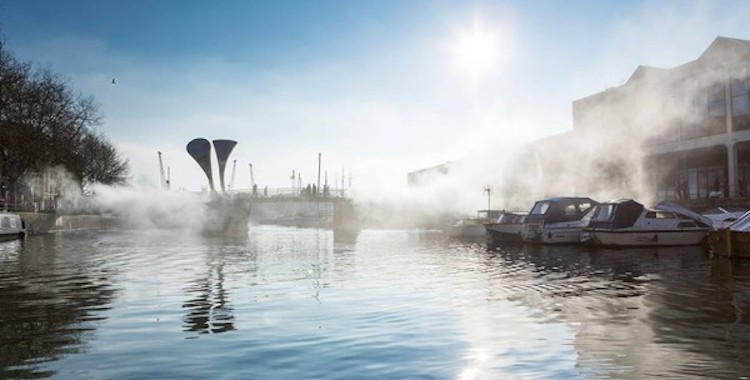
It begins on Pero’s Bridge, a slender strip of metal suspended over the water at Bristol’s harbourside. At intervals, Fujiko Nakaya’s fog sculpture envelops the bridge and the surrounding water, billowing in whichever direction the wind catches it. From a distance, figures hover insubstantially, as though walking on clouds; stepping across feels like a small act of trust, as the mist blurs the view ahead.

Mostly it’s an interruption in the architecture of the city, an instance of surprising, unexpected public art. Passersby pause to take photographs, while others linger in the fog that clings to hair and clothes. It’s a novelty, an attraction, an invitation.

Placed in the context of Bristol’s status as European Green Capital, however, it acquires more significance. Considered alongside the potentially catastrophic changes occurring to our climate, Fog Bridge feels anticipatory, its delicate beauty foreboding. It might be fog today, but what will it be tomorrow?

This is just the calm before the storm.

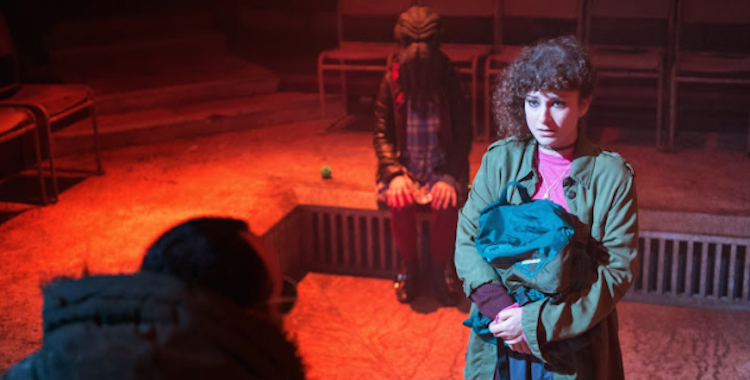
Teenagers are often seen as something of a gathering storm themselves, anarchically brewing trouble. But Canadian company Mammalian Diving Reflex ask us to see them – and ourselves – differently. On Saturday evening, following a coach journey into the dark, a group of teens lead us on a sprawling and chaotic roam through streets and fields, powerless to do anything but follow them. The usual power dynamic is flipped.

As with Fog Bridge, there’s a sense of event. Our large group of walkers swells through the streets, observed by curious figures through parted curtains. It’s an unruly disruption, but not of the kind we’re used to associating with urban teenagers. Nightwalks with Teenagers is rebellious but gentle, riotous yet tender. We are instructed to hold hands, to hug one another, to gather close. From the beginning, a fragile sense of community is created.

This begins to break apart as we trundle through suburban streets and along treacherously muddy paths. The audience is large and spread out, inhibiting the intimacy that the event seems to be reaching for. It’s full of individual moments, though, that are both striking and bizarre: a panoramic view of the city laid out below us, lights twinkling in the gloom; an invitation to dance; a rowdily improvised bit of storytelling; and, perhaps strangest of all, a detour to a house with a Mini Cheddar-loving pet duck. Our adolescent guides revel in it all, taking up the reins with glee.

If this generation are the coming storm, then bring on the downpour. 

Rumblings of thunder shudder through True West, Lone Twin’s unique take on and around Sam Shepard’s domestic play. Gregg Whelan and Gary Winters are Shepard’s pair of brothers, locked in bitter and often absurd rivalry, while a chorus sat around a table stand in for all the other roles. It’s small and low-fi, but somehow oddly explosive.

There are gloriously naff sound-effects, showers of multi-coloured confetti, overflowing cans of beer and a brilliant moment with a golf club and an ill-fated toaster. For all the stuff, though, it feels more like a story about stories: how we tell them, who tells them, how our culture has encouraged us to shape them. Delivered deadpan by Whelan and Winters, lines from the “authentic” Western one brother is writing leap out in all their ridiculous beauty.

In their programme note, Lone Twin describe True West as a “cover version” of Shepard’s play. It’s an appealing way of describing their relationship with the text, which is as irreverent as it is admiring, riffing playfully on Shepard’s lines. It’s also apt, as music – country pop specifically – threads its way through the piece. It’s there throughout the festival too, right down to the listening recommended in the programmes, offering space to think and feel and explore. The curious are welcome here.

Music also throbs throughout O, as lightning repeatedly threatens to strike. There’s a suspended feeling of discomfort all the way through Project O’s show, leaving us braced for the storm to break even as we laugh in our seats. Performers Alexandrina Hemsley and Jamila Johnson-Small ask us to watch and to notice ourselves watching, unsettling us with the anticipation of how our responses might be turned back around. It’s our collective gaze that really feels under the spotlight.

The two Os most in question here seem to be objectification and othering, both of which are obliquely referenced by Hemsley and Johnson-Small’s alternately playful and aggressive dance moves, which in turn reflect the reductive presentation of black female bodies in popular culture. It’s often funny, very funny, but laughs escape only uncertainly and in the knowledge that the whole thing could flip on its head any moment. With small gestures, the mood suddenly changes; the weather shifts.

The storm clouds converge on Saturday night over The Old Fire Station. A tornado of pulsing music and flashing lights rages at the heart of the festival, along with showers of glitter and the occasional crash of thunder. 

The festival party, framed as an immersive club night, sits alongside Fog Bridge as one of the most public-facing aspects of this year’s In Between Time. Festival regulars are joined by hundreds of fabulously dressed party-goers, decked out as clouds, lightning bolts, poncho-clad stormchasers. It’s a real event. Peppering partying with art, it shows how this kind of work can connect with a wider local audience, who seem to be largely absent from the festival’s daytime offerings.

How can that invitation be extended even further?

After the storm, the flood. There’s a post-apocalyptic flavour to Jo Hellier’s Flood Plans, which hints at an all too probable weather-ravaged future. Rather than narrative, though, it relies on feeling and evocation. Submerged in darkness, we’re pelted with deluges of sound: rain falling, waves crashing, wind howling. The volume rises and rises until the noise rattles through each last sinew of the body.

The aural onslaughts are punctuated with moments of human fragility, survival and connection. Isolated on the bare, black stage, Hellier and fellow performer Yas Clarke appear brittle and insubstantial, voices whistling weakly into the void. It is those bodies, though, that offer the most memorable and affecting moments. Hellier and Clarke first struggle and then embrace, their limbs surprising us with all the new ways two people can fit around one another. Against the force of storm and flood, they wrap themselves together.

There’s a different sense of aftermath to Ishimwa’s Niyizi, which takes on the character of searching. History, culture and identity both intertwine and clash, as the performance tests out ways of reconciling self and heritage. Through the separation of video and live performance, Ishimwa suggests both dislocation and simultaneity, his movements in the room frequently mirroring those on the screen, but always just the tiniest fraction of a second out of time.

In the first filmed dance sequence, blown up on the big screen at the back of the stage, Ishimwa sits in profile, twisting and turning. He writhes as if in an effort to crawl out of his own skin, a skin that he then – like the series of dresses he wears – gets more and more comfortable in. There’s a sense of struggle to it, but also of ritual and finally of celebration.

Peter McMaster’s 27 is ritual too, at times morbid and at times joyous. It offers two visions of the post-storm world: one of death and one of hope. These two forces tussle throughout the performance, as the experience of getting older and finding one’s place in the world veers between destructive despair and a liberating gesture of letting go.

The title is a reference both to McMaster’s age and the age at which Jim Morrison, Janis Joplin, Jimi Hendrix, Brian Jones, Kurt Cobain and Amy Winehouse – whose music weaves its way through the show – all died. Death, whether in the skeleton bodysuits that McMaster and Nick Anderson open the show wearing or the ash that is scattered ceremonially over floor and bodies, is thus a constant presence.

While there are moments when it stutters, the whole piece is so open and tender that it begs forgiveness for any flaws. If anything, the flaws feel necessary, colouring its heart-aching sincerity and vulnerability. Stripped bare, both literally and figuratively, McMaster and Anderson share with us their bruises. And as in Flood Plans, bodies interact in unexpected ways, resisting, embracing, leaning against and catching one another.

There is a storm coming, no doubt about it. But perhaps the response, as 27 begins to intimate, lies in the connections we are able to forge.

Photo: Max McClure.
Destruction and Renewal

manuel-harlan

Originally written for Exeunt.

A cacophony of voices drowning each other out. A pulverised culture retelling its stories. An ear-splitting scream of sound. A beautiful howl of despair. A giant subterranean drain. A devastating downpour of blood. Oddly, sounds and images of destruction dominate a year that has been characterised – theatrically if not otherwise – by reinvigoration and renewal. Often the most thrilling theatre I’ve happened to experience has also been the bleakest in its take on where we are right now.

Pomona, with its stark diagnosis that “everything bad is real”, epitomises this strand of shows. Alistair McDowall’s Escher staircase of a play was exhilarating, it was intelligent, and it was pitch black in its outlook on the modern world. Sending a violent jolt through the Orange Tree Theatre, it dazzled with both its ambition and its swirling mind-fuck of a plot, tangling up fiction and reality in a way that was at once disorientating and unsettlingly familiar. Here was a dystopia of a distinctly uncanny flavour.

The dark undertones of Pomona echoed a mood that had already established its hold on the year’s theatre. In The Body of an American – an early highlight of my theatregoing year at the Gate – the devastation was found in faraway warzones and much closer to home. Alice Birch’s blistering Revolt. She said. Revolt again. ripped up both patriarchy and the rulebook, suggesting flawed and angry responses to a broken world. And two parts of the great “Chris Trilogy” (completed by Chris Thorpe’s knotty Confirmation), the beautifully furious Men in the Cities by Chris Goode and Chris Brett Bailey’s mind-blowing, eardrum-destroying This Is How We Die, offered two different but equally excoriating critiques of late capitalism.

Then there’s master of bleakness Beckett, whose swirling, cyclical monologue Not I – most famously performed by the late great Billie Whitelaw – was given a mesmerising (and astonishingly speedy) new rendition by Lisa Dwan at the Royal Court at the beginning of the year.

While much of the new work I saw in the last 12 months was unsurprisingly shadowed by dismal visions of the world, the attitude also stretched into some of the year’s best revivals. Ivo van Hove’s production of A View From The Bridge scratched decades of dust and school assignments off Arthur Miller’s 20th-century classic, transforming it into a muscle-clenchingly tense tragedy, Jan Versweyveld’s black and grey design matching the gloom of its dramatic atmosphere. Katie Mitchell’s version of The Cherry Orchard – paired with a scrape-your-jaw-off-the-floor gorgeous design by Vicki Mortimer – was exquisite in its quickening decay. And two Ibsen productions at the Barbican – Thomas Ostermeier’s An Enemy of the People and Simon Stone’s The Wild Duck – wrenched the playwright’s work devastatingly into the 21st-century.

Another of 2014′s great revivals was Our Town at the Almeida, in a US-imported production from David Cromer. It arrived billed as a bold reimagining, but much of what made it work was – apart from the stunning final reveal – determinedly ordinary. Thornton Wilder’s characters appeared to us as unremarkable yet remarkably real, making their everyday sufferings all the more heartbreaking. There was a similar sort of quality to Robert Holman’s Jonah and Otto, a play that made a quiet art out of conversation. Both productions gently asked us to pay attention.

Other shows demanded the attention of their audiences rather more forcefully. Dmitry Krymov’s Opus No 7, visiting the Barbican as part of this year’s LIFT, had me from the first of its giddying procession of images. The same director’s wonky take on A Midsummer Night’s Dream was perhaps not as beautiful to look at, but just as enchanting, capturing something of the strange alchemy of theatre. In the National Theatre’s newly reopened Dorfman (i.e. the theatre formerly known as the Cottesloe), meanwhile, glittering new musical Here Lies Love relentlessly swept me along with it even in its naffest moments. Most recently – and in spite of its flaws – the dazzling to look at Golem made me understand all the fuss around 1927′s wittily precise animation.

One of the aesthetic offspring of 1927 is Kill the Beast, a company who marry visual detail with grotesque narrative flair. This year their latest show, He Had Hairy Hands, had me roaring along twice to its tale of werewolves, cops and arse-kicking monster hunters, as well as offering hands down the best gag of the Edinburgh Fringe. It’s also up there grappling for most jofyul theatregoing experience of the year, in a close-fought tussle with Secret Theatre’s A Series of Increasingly Impossible Acts. The latter just about snags the prize, stealing my heart over and over with its flailing hopefulness – and its joy-drenched rendition of “Proud Mary”.

A Series of Increasingly Impossible Acts is also, in part, about how we tell stories. There were lots of stories about stories this year. Coincidentally running at the same time, Mr Burns at the Almeida imagined how our culture might be passed on after a future apocalypse, while Ellen McDougall’s production of Idomeneus playfully traced the same process of narration and mutation over previous centuries. The dangers of narrative appropriation were disturbingly outlined in Tim Crouch’s multi-layered, head-scratching Adler & Gibb; in Wot? No Fish!!, storytelling was a simple source of charm and love.

Along with all the theatre that filled me with joy, plenty that I saw this year also left me filled with tears. Spine‘s double-whammy of the personally and politically emotive forced those tears to spill over, as did James “the vacuum cleaner” Leadbitter’s overwhelmingly intimate Mental. After the small but exquisite experience of Greg Wohead’s headphone piece Hurtling, I walked the streets of Edinburgh with heart thumping and eyes stinging; ditto Hug, Verity Standen’s “immersive choral sound bath” (there’s really no better way to describe it than she does). Then there was Kim Noble’s brash but bruised You’re Not Alone, which took a long time to relinquish its haunting hold.

Elsewhere it was the lulz that stayed with me. That giant ballpond and the IRL memes in Teh Internet is Serious Business. The smart silliness of funny women Sh!t Theatre and Figs in Wigs, turning their humour to Big Pharma and online narcissism respectively. The funny-sad sequence of cheesy song lyrics in RashDash’s Oh, I Can’t Be Bothered. The sheer joy of watching Jamie Wood and Tom Lyall clown around with what appeared to be an alien haggis in Chris Goode’s remounted Longwave. Chris Thorpe and Jon Spooner being punk rockers in their pants in Am I Dead Yet? (the most funny-yet-thoughtful show you’re likely to see about kicking the bucket).

With the requisite predictability of the end-of-year round-up, no survey of 2014′s theatre can seem to get away without a mention of King Charles III. Mike Bartlett’s concept – a future history play in iambic pentameter – sounded like a potential disaster, but turned out to be a slice of genius. It was thoughtful, it was witty, and it was as much about our theatrical heritage as it was about the traditions of monarchy. And to top it all off, it was designed by the brilliant Tom Scutt, who once again came up with one of the designs of the year with his dizzying visual concept for the Nuffield Theatre’s excellent revival of A Number.

Now from the big to the small. I’m still unapologetically head over heels for one of the most intimate shows I saw this year: Andy Field and Ira Brand’s fragile, heart-fluttering put your sweet hand in mine. Seating its audience in almost uncomfortable proximity to one another and to the two performers, it gently prodded at closeness and distance and love in all its different forms. Just gorgeous.

Also small – in staging if not in ideas – was Barrel Organ’s debut show Nothing. This series of intertwined monologues, performed in a newly improvised order each night with no set or props, was just as bleak in its way as some of the year’s more explicitly dark offerings. For a confused 20-something, it also terrifyingly captured the anger, uncertainty and disconnection of a whole generation. It feels like one of the real discoveries of the year, as does Chewing the Fat, Selina Thompson’s glittery but difficult look at weight and body image.

After opening with destruction, I want to end on a slightly more hopeful note. For all the darkness and devastation, few pieces of theatre have stayed with me quite so insistently as Duncan Macmillan’s not-quite-monologue Every Brilliant Thing, which was indeed brilliant. For once, cliched claims of “it’ll make you laugh, it’ll make you laugh” were entirely justified, as I giggled and sobbed – sometimes at the same time – throughout.

Quite how a show about suicidal depression can be so life-affirming I’m still trying to fathom. It probably has a lot to do with the irresistible warmth of performer Jonny Donahoe, without whom I suspect it wouldn’t be half as good. But it also plays, as many of the best shows of the year have done, to theatre’s strengths: the unpredictability of live performance, the thrill of proximity, the possibilities of all being together, now, in the same space. Here’s to more of the same in 2015.

Photo: Manuel Harlan.

Divorced, Beheaded, Died

wolf-hall-news-reviews-mainimage-537x291

Originally written for the RSC’s Bring Up the Bodies programme.

Henry VIII remains one of the most compelling leaders that history has to offer us. The charismatic monarch can lay many claims to fame: his break with the authority of the Pope and the Catholic Church, the Dissolution of the Monasteries, his passion for eating and drinking. But what Henry VIII is perhaps best remembered for is his fickle matrimonial record and the six women he infamously wed.

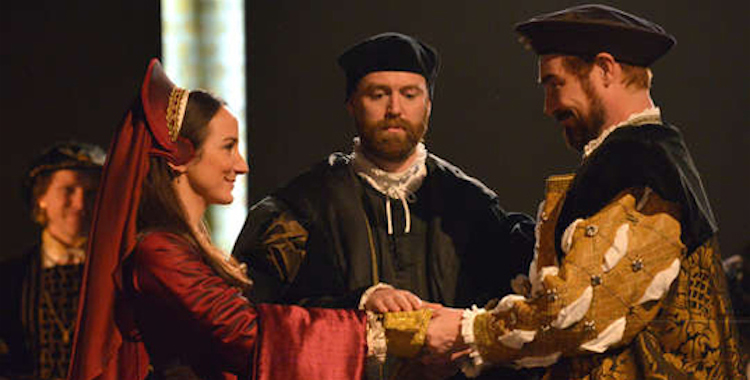
Hilary Mantel’s Man Booker Prize-winning novels Wolf Hall and Bring Up the Bodies only feature the first three of the King’s unlucky spouses: divorced, beheaded, died, as the mnemonic reminds us. According to actors Lucy Briers, Lydia Leonard and Leah Brotherhead, playing Katherine of Aragon, Anne Boleyn and Jane Seymour respectively, you would struggle to find three more different women. “If Anne was someone who was going to make a grand entrance through the front door, Jane would be the person who came through the back door,” says Brotherhead, contrasting the fatal arrogance of Henry’s second wife with the quiet diffidence of his third. Continuing the metaphor, Briers suggests that Katherine, a politically powerful Queen who was unwaveringly assured of the divine right of her position, “would be flown in by helicopter”. Whatever their differences, however, there is little doubt that these were three extraordinary historical figures.

Katherine of Aragon, often relegated to a prologue in the juicy tale of Anne Boleyn’s rise and downfall, was a fascinating figure in her own right. Born into royalty and power, the daughter of Queen Isabella I of Castile and King Ferdinand II of Aragon was assured of her place in the world and knew from a young age that she was destined to be Queen of England – first as the wife of Henry VIII’s short-lived older brother Arthur and then as Henry’s first spouse. “She has absolutely no qualms about her status and her predestined right to be where she is,” explains Briers, “which is why what happens to her is so horrific to her and so appalling. It not only breaks laws of the land and religious laws, but it’s her entire moral framework being taken down in front of her.”

Katherine was married to Henry for over 20 years – more than the King’s five subsequent marriages put together. Their union was put to an end by a combination of Katherine’s inability to offer Henry the male heir he so desperately desired and the King’s infatuation with Anne Boleyn. Anne, meanwhile, has had her fair share of infamy in the history books – “every lurid accusation in Europe was flung at her,” Leonard points out – making her a “gift of a role”. This was a woman who held Henry’s interest for six years before he was finally able to marry her, but who was executed within three years of their wedding day. “It’s interesting watching her lose control,” says Leonard. “She starts off very much in control, and as that grip loosens it’s sort of like watching a car crash.”

Jane Seymour, in contrast to her two predecessors, is careful, quiet and modest. “I’ve not quite made up my mind on how ambitious Jane is or how much of a pawn she is,” Brotherhead reflects on her role. “A lot of historians made the decision that because Jane was so quiet and mild-mannered, she was meek and a bit stupid, whereas Hilary doesn’t think that’s what Jane’s like at all; she’s quiet and incredibly observant.”

It would be easy to assume, given the precariousness of their position, that the three Queens were helpless to their fates. Briers, Leonard and Brotherhead, however, suggest that each of these women was powerful in her way. “Katherine is incredibly manipulative in terms of power playing because she was born into it and she understands it,” says Briers. “She understands the theatricality of power.” This political power is lacking in Anne, but Leonard points out that “she has an incredible power over Henry”. Jane, meanwhile, has a “quiet kind of power about her” according to Brotherhead: “she is incredibly brave, but in a very stoic and subdued way”.

In the process of getting to know the three Queens, each of the actors has forged a powerful connection with their role. “They’re amazing women, all three of them, and you can really connect with all of their decisions,” says Brotherhead. Faced with the pressure of not only doing justice to Mantel’s novels, but also capturing three of the most famous women in history, all three actors are dealing with this in different ways. “I feel more of a responsibility to the person I’m playing than anybody else,” says Briers. “I want to honour her.” Leonard, on the other hand, feels the weight of the books more keenly: “I personally feel more of a commitment to playing Hilary Mantel’s Anne Boleyn, because that’s what’s going to make this whole story turn.”

Mantel herself has been involved throughout the rehearsal process, offering extensive character notes and answering detailed questions about the period. “It was like having somebody from Tudor times time travelling to our rehearsal room,” Leonard laughs, acknowledging the meticulous research that went into the novels and has provided much of the material for shaping these three roles. “Rarely do you work with such amazing novels,” she adds. “Everything’s there.”

The Tudor era, as Mantel has demonstrated, is itself the source of continued fascination. Discussing the time in which these historical narratives are set, all three actors suggest that it is the heightened, theatrical quality of this period that captures the imagination. “There’s so much game playing and with so much at stake,” says Brotherhead. “I think that’s what’s so intriguing.” Considering Anne’s fate, Leonard adds that “the way that sex and politics are so totally linked together is juicy and powerful”. For Briers, however, and clearly for Mantel as well, it is the personalities who hold the greatest interest.

“It’s these people who just create ripples of change and revolutions, good or bad, that people want to keep re-examining.”

Photo: Keith Pattison.

Chimera: The play about the twin inside

Chimera suli holum

Originally written for The Guardian.

We all have moments when we don’t quite feel ourselves. For some, though, fragmentation of the self is a biological as well as a psychological fact. Chimerism describes the medical state of having two sets of genetic material; it means, in other words, containing your own twin inside you.

This rare medical condition provides the unsettling premise for Deborah Stein and Suli Holum’s collaboration Chimera, which opens at the Gate theatre in west London this week. The show, written by Stein, performed by Holum and co-directed by the two women, tells the story of Jennifer Samuels, a scientist and mother who learns that she possesses two sets of DNA. Shaken by the discovery, Jennifer struggles to hold her splintered self together, while coming to terms with the idea that – genetically at least – her son is actually her nephew.

While Jennifer may be fictional, her crisis of identity stages an experience that is real. “The condition of being a medical chimera literalises something that I think is a pretty universal feeling,” Stein suggests, discussing the multiple versions of ourselves that we try to integrate on a daily basis. She was introduced to the science by Holum, who was intrigued by a true story she heard on the radio about a woman who discovered that her sons did not share her DNA. The pair decided to pursue the idea because, as Holum puts it, “neither of us could figure out immediately how it could be a play, how we could take this phenomenon and theatricalise it”.

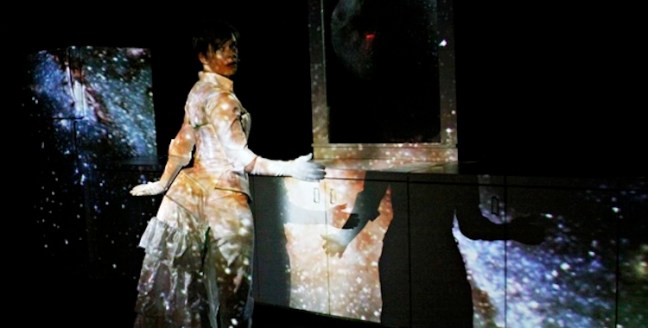
Stein and Holum found their answer in a close weaving of form and content. As the show’s sole performer, Holum inhabits multiple characters, including Jennifer and her 19-year-old son Brian, while projections dance over her body and the smooth surfaces of the kitchen set. “Meaning is created by having these multiple voices in one body,” Stein explains, “because it’s about the condition of being more than one person, and one person, at the same time.” The kitchen, meanwhile, allows for “an exploration of surfaces and what lies beneath,” at the same time as suggesting and disrupting the traditional domestic sphere of the mother. “We do all kinds of surprising things with something that looks very simple and mundane,” says Holum.

The use of technology in Chimera, meanwhile, is an extension of the show’s central idea that “science and technology have got to the point now where they are showing us things that we have no framework for understanding”. Stein goes on to compare the way in which technology disrupts the lives of the play’s characters to how it has forced her and Holum out of their comfort zone as theatre-makers. What she has come to realise, however, is that the contradiction she initially perceived between the live theatrical experience and digital technology does not really exist. “Theatre is about being in the now, in the present moment, and our present moment has so much to do with screens and video and computer technology.”

What Chimera doesn’t do, its creators insist, is offer any answers to the scientific, moral and philosophical questions it throws open: questions about how far science and technology can define our existence, and the extent to which, if our sense of self is torn in two, we can be held accountable for our own actions. “We realised as we were working our way through the questions the play raises that we weren’t making something that answered those questions,” says Holum. “We realised we were working with questions big enough that they couldn’t be satisfactorily answered – and what we were creating was an event that didn’t tell the audience how to feel or think about something, but rather invited them to begin thinking about something and then carry that conversation forward after the event is over.”

“It sits in this really uncomfortable place of asking the audience to actually think and talk about things that we don’t usually get to think and talk about,” Stein adds, describing the play as a “stew” of ideas that we rarely consider alongside one another. “There’s pretty hard science in it, and then there’s also this story about a mother who doesn’t want to be a mother.”

This investigation of motherhood, it turns out, has been more provocative than the science, suggesting that Stein and Holum have hit on a collective raw nerve. In post-show discussions, the pair explain, it is Jennifer’s attempted flight from her responsibilities as a mother which has attracted the most debate. In this way, Chimera has travelled from the chilling but faraway realm of rare scientific phenomena to the more close-at-hand experiences of the theatre-makers and their audiences.

This journey is typical of the pair’s process, Holum tells me. “We start with research material, then we very quickly branch out pretty far afield from the original sources as we dive deeper and deeper into the process to unearth really what it was that drew us to the material.”

The questions they have arrived at are questions about identity, about motherhood, about the philosophy of science. But most of all, Holum suggests, Chimera asks what we believe in and where we find meaning.

“In the end we’re all searching for meaning, we’re all searching for a way of making sense of it all.”

Photo: Stephen Schreiber.

Village Halls, Village Voices

unnamed-2-600x395

Originally written for Exeunt.

A robin perches, quivering, on a line of barbed wire. Sun dances across the snow. Uniformed men run, smile, play football and shake hands; one slips a bar of chocolate into the pocket of another. And a message flashes up on the screen: “Christmas is for sharing”.

“Everything looks great in that Sainsbury’s advert,” says playwright Rory Mullarkey, voice stained with a mixture of anger and disbelief. We’re chatting in a corner of the pub in Tirril, our conversation drifting towards the familiar iconography that has been rolled out for the centenary of the First World War. This advert, Rory comments wryly, represents the “Disneyfied” version of the conflict. It’s not an image that he or his play Each Slow Dusk – which we’re in Tirril to see – is interested in.

“I feel like there’s a perceived World War I narrative that you can see from War Horse all the way through to the Sainsbury’s advert,” says Rory, naming all the tropes that we’re familiar with from our stages and screens. “You’re not ever getting any closer to what the First World War actually was, you’ve just experienced a traditional narrative except that the obstacle has been the First World War.” To get underneath that perception, to scratch away at what the legacy of that war actually means, he suggests that it’s necessary to move beyond this sanitised remembrance. The real picture, of course, is far from beautiful.

“It was mud, it was blood, it was guts, it was horror.”

The sky is a brightening grey when I arrive in Tirril earlier the same day, wan sunlight just tickling the edges of the clouds. The darker grey and black of the Reading Rooms stands out against it, the inscription “1914” on the building’s facade eliciting a little shiver. Talking to local promoter Jimmie Reynolds once inside, he explains that the coinciding of the hall’s 100th birthday with the centenary of the First World War was one reason for wanting to bring in Each Slow Dusk. And it’s important for people to think about these things, he adds later over a cup of tea.

Tirril, a small village at the edge of the Lake District, is just one of the many rural areas Each Slow Dusk is visiting on its tour with Pentabus. The piece has been designed specifically for village halls, from the initial commission to the direction and design. Rachael Griffin, Pentabus’s managing director and my guide for the weekend, explains that this process allows the company to tailor the shows they produce for rural venues and audiences. Pentabus sketch the initial outline, then the writer is given freedom to fill it in. For Rory, the constraint is a creative one.

“It sounds like a slightly mystical thing to say, but I believe that the piece of work or the play is always out there somewhere and it’s my job to make a series of decisions to allow it to come to me and be present. If you know something like how many actors it is, how long it has to be or whatever, that’s a parameter that can significantly aid your creative thinking.”

As part of the writing process, Rory also visited some of the village halls the show might tour to – an opportunity to “imbibe” their atmosphere. The village hall as a building has a distinct identity, one caught up in history, community and nostalgia. Stepping into Tirril’s chilly, high-ceilinged Reading Rooms, I’m immediately hit by memories of my own village hall growing up: Christmas fairs, bring and buy sales, bad discos spent slugging Panda Pops.

The get-in is almost a performance itself. After a much-needed cup of tea – problems on the road have contributed to the company’s general exhaustion – rigging, lights and set are swiftly hauled out of the Tardis-like van. A month into the tour, this is a slick operation by now, but still one involving a precarious amount of kit to be installed on the hall’s compact stage. On the first night, one of the actors tells me in the pub later, it took a good few hours to dismantle everything after the production; now it requires just one.

When I grab a few minutes to talk to Jimmie, he explains that Each Slow Dusk is a relative risk for the Reading Rooms, which is more likely to receive music and live entertainment. People just want a good night out, he says. There’s also a danger, given the outpouring of art to mark the centenary, that audiences have “First World War fatigue”. Speaking to Rory later in the afternoon, though, I have a feeling that Each Slow Dusk may well challenge the narrative with which we’ve all become so familiar over recent months.

“I thought I would try and write the most open thing I possibly could,” Rory tells me, just a couple of hours before I see Each Slow Dusk. On the page, the first act barely even looks like theatre. Rather than dialogue, it consists of a long series of poetic stage directions. All action, no talk. It’s easy to see both how it represents a risk for promoters like Jimmie and how it fulfils Pentabus’s aim, articulated to me by Rachael, to bring rural audiences work which is ambitious in form and content.

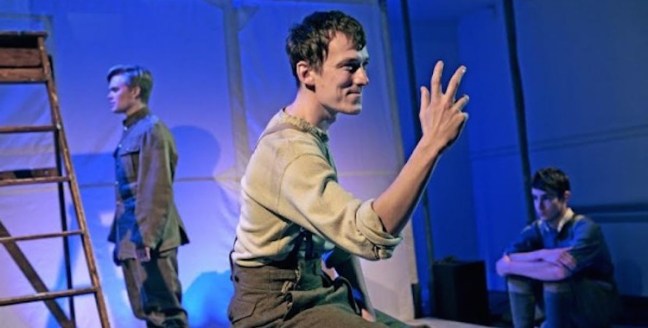
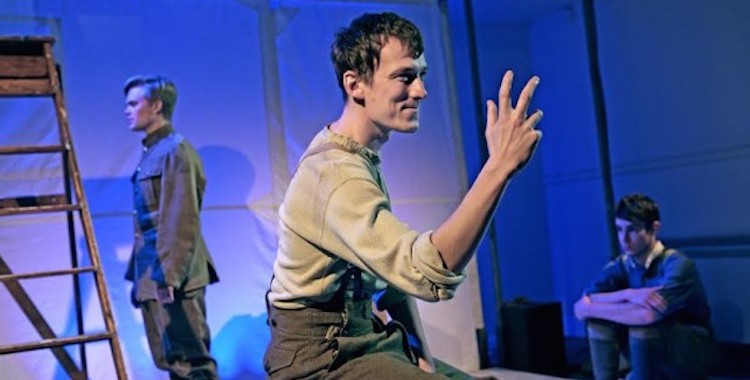
Staged, however, it soon makes perfect sense. The actions belong to three different soldiers: a Captain, a Corporal and a Private, played by David Osmond, Lee Rufford and Sam Heron respectively. All are the same age – nineteen and a half – and all have been sent out on night patrol. The Captain is reluctant, the Corporal pumped with excitement, the Private terrified but determined to prove he’s not a “fucking coward”. Not directly interacting with one another, the three performers instead direct their lines to the audience, describing their actions in the present tense. The style takes a while to settle, but then it grabs a firm stranglehold on the audience.

The writing is more prose than drama and might at first glance be dismissed as novelistic. Yet it soon becomes clear that there is something intensely theatrical about both the rhythm of the lines and the terrible forward movement of the actions they describe. Despite the simplest of stagings from Elizabeth Freestone, subtly enhanced by Adrienne Quartly’s sound design, there’s something incredibly dynamic about it all. And, problematically, it’s kind of thrilling. The play asks us, guiltily, to acknowledge that there might be something exciting about the heat of conflict, even in the midst of all its undeniable horrors.

The three unnamed soldiers also offer a complex picture of the First World War and those who fought and died in it. The absence of names plays with the way in which soldiers have been “loaded with the freight of social commentary,” in Rory’s words, while at the same time refusing to allow each of these characters to be reduced to the mere symbol of “soldier”. The Corporal in particular challenges our collective idea of the First World War soldier as saintly victim. Here is a soldier who revels in what he does, who is proud of his skill in fighting and killing, and who would happily take the battlefield over a lifetime of picking potatoes.

“There are as many kinds of soldier as there are kinds of person,” says Rory, skewering – as his play does – the popular image of identical, “lovely lads” sent off to be slaughtered. “Those ‘lovely lads’ were just exactly the same as any lad is nowadays; they were just as likely to swear, just as obsessed by sex, just as violent, just as moody. They were human beings, and it felt like it was important to write something which didn’t cast them in the mode of victim the whole time – that they had agency and dignity.”

As the audience move around the hall during the interval, chatting to neighbours and buying raffle tickets, there’s a definite sense that we are in their space. This is first and foremost a place for community rather than one for theatre, and it shows. The size and warmth of the audience – a far cry from small-scale tours which often struggle to fill half the seats in a studio theatre – feels like a vindication of the idea that you really get theatre to talk to people’s lives by taking it to them. But entering an audience’s midst rather than extending them an invitation requires a different creative thought process.

“You’re making a very different kind of statement if you’re going to someone’s home with a show and you’re bringing it to them,” Rory suggests, stressing that he wanted to write a play that “would feel generous and warm and alive to a village hall audience”. So while Each Slow Dusk might be challenging in lots of ways, it was important for everyone involved that it speaks to the audiences it is going out to.

Rachael and Rory talk about the directness that feels right for these village hall spaces, but there is also something around proximity. The actors are right there, barely separated from the audience, and available for a chat in the small gap between the end of the performance and the get-out. On this particular night, the presence of the playwright adds an extra ripple of excitement and Rory finds himself, to his slight bemusement, signing playscripts.

Before I leave the following day, a cup of tea and a chat with Sue Hayward – the seasoned promoter in nearby Arnside – sheds some more light on the programming of this and other events. Many of her comments confirm what I see during the interval: audience members relish the intimacy, the opportunity to have professional performers come right to their doorstop and hang around for a conversation afterwards. Theatre is demystified.

One thing that I hear about repeatedly is the level of loyalty that rural audiences have for their village halls. In a way that most venues can only dream about, they trust in and care about the space and will attend performances more for the location than the specific offer. This then allows the volunteer promoters, who are often embedded at the heart of the communities they programme for, to take risks. Sue can take a punt on contemporary dance, inviting Compagnie T d’U to Arnside for the first time next year. And Jimmie can welcome Pentabus to Tirril, where a full audience sit rapt for an hour and a half in front of Each Slow Dusk.

“We’ve got a real remembrance industry,” Rory observes during the course of our conversation about the First World War. The second half of his play, fast-forwarding 100 years, takes us to the heart of that industry: the battlefields tours of France. We are now addressed by a female speaker (Joanna Bacon) who is grappling with the meaning of remembrance in the same way as those of us in the audience. How do you come to terms with the events of a century ago? How are you supposed to feel about the distant dead?

“I was sad when I thought about them, I don’t know,” says the (again unnamed) speaker. “I was sad, I guess.” Her uncertainty is our uncertainty; her ambivalence reflects every time the two minutes silence has felt like an empty obligation rather than a meaningful act of remembrance. As she speaks, showing photographs of her trip across the battlefields, I think not just of the monolithic memorials flashing up on the screen, but also of the sea of poppies surrounding the Tower of London. I think about how the act of remembering has become distanced, abstract and aestheticised, utterly divorced from the mud and blood and entrails so vividly described in the first half of the play. It has also become big money: the tourist routes, the themed cafes and restaurants, and, yes, the Sainsbury’s advert.

Once again, appearances deceive. The second act seems at first like a major departure from the first, but eventually the two halves meet as echoes resonate across the interval. Together, the two acts acknowledge how, whenever we look back at the First World War, we are inevitably seeing it through the lens of the present. And Each Slow Dusk demands that we think about that present as much as we think about the past. Or, as this contemporary speaker asks, “Where are we now?”

Photos: Richard Stanton.