All Change Festival

???????????????

Originally written for Exeunt.

Within minutes of arriving at the Lyric Hammersmith, I’m climbing into bed with a stranger. Not quite the start I anticipated my Fun Palaces weekend getting off to, but it’s indicative of the playfulness embedded at the heart of the All Change Festival. As Eve Leigh, one of the directors of the festival, tells me, they are interested in work that acknowledges and plays with its own theatricality, exploring the boundaries between genres and forms.

The bed and the stranger are part of The Sleep Project, a one-on-one performance currently being developed by Theatre Absolute. Within moments of awkwardly sliding under the duvet, my bedfellow begins to talk about his chronic insomnia, a sleeplessness that seems to be symptomatic of a broken world. It begins as a monologue, but the edges of the theatrical contract shift and blur, eventually making space for an airing of my own insomniac tendencies. As we’re already sharing a bed, it seems oddly churlish not to be frank in my replies.

It’s a tiny little sliver of a performance, lasting only a few minutes and imparting the same sort of fleeting yet haunting thoughts that occupy that hallucinatory territory between waking and sleep. Theatre Absolute might not smash down any boundaries when it comes to intimate performance – and the way in which they make space for the responses of their solo audience members could still do with a little work – but it’s a gentle introduction to what can be for many an alien and intimidating form.

The same goes for other offerings at the festival. Taking up the philosophy of Fun Palaces, the programming has set out to appeal to as wide and varied an audience as possible, taking in everything from magic tricks to storytelling to a (sadly soggy, as it turned out) bouncy castle. Often, as with genre-defying late night offerings from Patrick Simkins and MiM and Gideon Reeling, a sense of the event is built into work that is part theatre, part music and lots of other parts besides, with the hope of bringing in and surprising new audiences.

On Friday night, the collaboration between artist Patrick Simkins and music producer MiM attempts to cultivate the atmosphere of a gig or club night, using a thumping and occasionally euphoric soundtrack to underscore a comment on the digital culture of sharing. As projected social media images flash up on a screen of paper, audience members are invited to trace over the outlines, which change faster than we reluctant artists can move our sticks of charcoal across the surface. Our overlapping scrawls create two improvised pieces of art that speak messily but eloquently to the compulsive online documenting of our lives.

Interactivity is also key to Tablesale, Gideon Reeling’s offbeat piece on the second night of the festival. In this case, however, the mashing up of different genres and elements leads to confusion – not least about the role of the audience. There’s plenty of standing up, moving around and cheering, as well as some fun with chocolate mice and shots of unidentified alcohol, but it doesn’t quite add up to the promised immersive experience. The show itself, meanwhile, lampoons too many targets at once, leaving everyone in a bit of a muddle. But at least we all go home with a prize.

Back in time to Friday evening, the Lyric cafe. Hastily eating a packet of crisps in lieu of dinner, I watch the space begin to fill up as darkness falls outside. Waiting for the start of Josh Coates’ Particles, it begins to feel for the first time that day that we really are part of a festival, rather than just a clutch of individuals wandering from attraction to attraction around the Lyric. Staging work in the cafe helps too, taking it out of a strictly theatrical space and into a social, informal one.

Particles works perfectly for this setting. Coates’ show is part theatre, part storytelling, part stand-up, all held together by little more than his own ability as a performer. Luckily, Coates is all ease and warmth, lightly switching from careful narration to freewheeling audience address. At the centre of it all is a repeated tale about one man and his seemingly small decisions, opening out into musings on everything from chaos theory to British politics. It feels light while touching on weighty subject matter and somehow, somewhere along the way, it cheerfully battles apathy with optimism.

Given that Particles is all about people and possibilities (and particles, of course), it seems absolutely fitting that it should be performed in these surroundings, where all that is required is speakers and listeners. It follows another storytelling piece, Ingrid Who Quarrelled with Nøkken, with a less successful approach. Storyteller Kristen Blakstad is not short of talent, but her Norwegian folklore inspired tale feels calculated more to showcase her huge range as a performer than to envelope us in the narrative. There’s plenty of physical invention, but to what purpose?

Then again, there doesn’t always need to be a reason for telling stories. On Sunday afternoon, I’m persuaded to join a story making session in a corner of the Lyric cafe, where a small group of us make up ludicrous tales through a process of play. The game involves a title as a starting point and then a free choice of yes or no questions from all participants, yielding increasingly ridiculous narrative twists. It’s like a deliciously silly, extended version of Consequences and has me laughing more than anything else at the festival. It feels like a game Joan Littlewood would approve of. Everyone a storyteller.


“What’s art without a bit of wank?” quips Hofesh Shechter. The choreographer, who has spent the last 45 minutes or so of this rainy Saturday afternoon talking about the challenges and intricacies of his creative process, also has the good humour to laugh about it. Yes, this is serious, but it’s a little bit wanky too. And that’s OK.

This conversation, which delves into fascinating depth in its discussion of how Shechter works (apparently it’s a lot like being a tennis player – the isolation, the need to motivate oneself without external assistance), represents one end of the wide spectrum that Leigh and fellow organisers Rachel Parish and Cristina Catalina have curated. At the other end, it’s refreshing to see popular forms given a slight twist and, on the most basic of levels, done well. After long hours I’ll never get back watching excruciating improv comedy on the Edinburgh Fringe, it’s a delight to see Nelson David and Chris Rowe do improvisation so effortlessly and often hilariously in Unexpected Human in Bagging Area on Friday evening.

Similarly, I’d be unlikely to see an illusionist under normal circumstances, but Philipp Oberlohr completely wins me round on Saturday night. Chatting to Megan Vaughan afterwards, she suggests that Fun Palaces is doing as much to ground and confound art snobs as it is to coax others into new cultural experiences. As for the latter, it’s hard to tell whether All Change succeeds in that aim of the Fun Palaces manifesto. Family oriented events during the day seem to hook in a larger, more varied audience, whether it’s to gasp at giddying Parkour from the Urban Playground Team or lie in a hammock watching the world go by as part of the Institute for Crazy Dancing’s Lifeboat, but in the evening the participation seems to thin, leaving more of the usual suspects.

One event for which the space is bursting at the seams, however, is the Chris Thorpe and Barrel Organ double bill in the rehearsal room on Saturday night. Both prove – more so than Vacuum Theatre’s messy, muddled Something for Nothing the following day – that sometimes you don’t need much more than bodies and voices in a room to make astonishing theatre. Thorpe once again works wonders with just text, voice and microphone, telling a meandering and many layered tale in High Speed Impact. Test Number One. Thoughts and associations fold into one another, making this short piece much more complex and knotty than it might initially seem.

Barrel Organ’s Nothing, meanwhile, encompasses a huge amount while using very little. It’s now the third time I’ve seen this collection of interlaced monologues, but again it offers new facets, new links to trace between the separate speeches. And because the piece is performed from within the audience, with a newly improvised structure each night, there is always an edge of the unexpected. In this setting, it sends tangible ripples through the audience each time a new performer speaks from among the crowd, completely fitting the formally playful bill outlined by All Change.

Central to the Fun Palaces ethos is making work with the local community as well as just for them. Daytime workshops aside, All Change is arguably a little light on this, but offerings from Fleur Alexander and Hannah Nicklin put the stories of local people at their centre. Alexander’s Wagging Dog Tales takes us away from the Lyric and out into the surrounding streets of Hammersmith, on a walk punctuated with stories shared by local dog walkers. The concept is simple, but it’s the form that really lifts it. In the same way that dogs act as a connection between people, sparking rare conversations between strangers in a busy, atomised city, all of us on the walk are soon chatting easily between stories. Sometimes all it takes is the invitation.

The invitation to offer stories, however, can be harder to accept. As I talk to Alexander on the way back to the Lyric after Wagging Dog Tales, she tells me that many of the people she met were reluctant to speak to her at first, and when they did they often felt that they had nothing to tell. It reminds me of similar experiences that Nicklin has shared in the past. As she puts it, capitalism has stolen our stories to sell them back to us, leaving us with the sensation of being empty handed. What of worth could we possibly have to say?

Songs for Breaking Britain, the piece that Nicklin closes the festival with, defies the media’s lucrative monopoly on our narratives. This punk storytelling show weaves together stories that Nicklin has collected in Bradford, Stockton, South London and now Hammersmith, putting them to music and demanding that we listen to them. It’s funny, compassionate, heartbreaking and very, very loud. I’m reminded a little of the angry, ear-splitting blast of sound that is #TORYCORE, but here the righteous rage – rather appropriately following an open invitation to rant – is just one layer.

“It’s hard to be human, isn’t it?” That one line, uttered by a woman Nicklin spoke to in Stockton, lodges somewhere in my chest during the show. There is lots that is difficult in the show; the voices that Nicklin has collected speak of unemployment, of despair, of fear and lack of inspiration. But there is also joy and hope and huge generosity. This extends to the gig style performance of the piece, which gathers audience members around Nicklin and her band at the centre of the room. And it feels absolutely in keeping with the spirit of both Fun Palaces and All Change. Yes, it’s hard to be human. But it’s that little bit easier when we try being human together.

Photo: Aenne Pallasca.

Engaging with Disappearance

DSC_0080-600x401

Originally written for Exeunt.

So much of theatre is about ephemerality. At least as far back as Peggy Phelan’s famous statements in Unmarked, live performance has been associated with disappearance; it exists just once, in the moment, and then disappears (almost) without a trace. So what happens when you try to recapture that moment?

It’s a question that Chris Goode and Company are currently attempting to answer. Thanks to recommission, an initiative run by touring network house, they are returning to Goode’s 2006 show Longwave and remaking it for a new tour. The same team has been reunited, with the aim of jointly excavating a piece that was last performed seven years ago. There was no script, no available video recording, just a jumble of different notes.

“In a way it’s a process that’s about theatricality,” Goode suggests, explaining that “what we’re engaging with all the time is disappearance, the ways in which certain things leave a trace and others don’t”. It has also been a process of detective work, deciphering notes from various different sources and comparing the memories of those in the rehearsal room. Luckily, the shape of the show has been recovered more easily than Goode anticipated.

“It’s been so interesting feeling our way back into it,” he reflects partway through the process. “What really fascinates me is that there are some things that we just knew straight away back in the room on day one, there were things that we remembered very clearly, and then there were other things that only came out of our heads again on day eight. It’s been really interesting the way that those things re-emerge and how often actually we find ourselves thinking through a problem and then remembering that we made exactly the same decision last time. Just recalling the same bumps in the road. Which is nice because it suggests there’s a certain logic to how it all fits together.”

Goode admits that he would have been unlikely to revisit Longwave without the opportunity presented by recommission, but he believes that this is the right piece to return to. “It was just recent enough to know that it was still part of our current work or our current thinking,” he says. Another reason he was keen to recreate this particular show was because it is completely without dialogue, adding another layer of difficulty to the challenge that he and his collaborators have set for themselves.

In the absence of words, Longwave’s narrative is communicated through the gestures of performers Tom Lyall and Jamie Wood and the broadcasts playing from the radio that is their characters’ only window onto the outside world. Stuck together in a shed and surrounded by a hostile environment, the two men perform experiments, entertain one another and squabble over the radio – which eventually takes on a life of its own.

“One thing that intrigued me was that it’s so much about the relationship between Tom and Jamie,” Goode says, pointing to this as another reason for returning to the show. He describes the “brilliantly exciting dynamic” between the pair and the desire to see what new insights they would bring to the piece after seven years of honing their separate practices as theatre-makers. “There was a sense of us in the present dancing with us in the past a little bit and seeing what that kind of duet was,” Goode explains, quickly adding, “not quite a duet, it’s more complicated than that.”

This process of recovery could have been a laborious one, but instead Goode has been surprised by the pleasures of retracing old paths. “In a pretty narcissistic way I think we’ve been rather delighted by a lot of the choices that we made before and quite pleased with ourselves,” he says. “It’s very difficult to imagine that anything you were doing that long ago can possibly have been any good. We kind of knew it was, but it’s been really nice to meet ourselves coming back and find that we made some really delightful decisions.”

Despite the joys of recreating Longwave, however, Goode remains ambivalent about returning to previous work. “I feel so invested in the idea that theatre disappears and that you make a thing that speaks to its moment, that speaks to a time or a cultural moment, a conversation that seems to be happening, and that it should then disappear,” he says. He suggests that the promise of recovery and recreation contained in printed scripts is “a little bit of a red herring”, but recognises its appeal nonetheless.

“There’s an instinct in us to want to crawl back. I think there’s something really interesting in the challenge that theatre puts to us, which is to continually try to be in dialogue with the present rather than indulging our very human instinct both for nostalgia and for the idea of improvement, the idea of going back and making something better. I’m not sure that either of those things are what I think the live spirit of theatre is about.”

Goode’s answer to this “retrospective impulse” is to put a personal stipulation on returning to old projects: there has to be a conceptual reason for revisiting it. “You want it to be conceptually rich and interesting in itself rather than simply getting something out of the freezer and putting it in the microwave because it’s been successful before,” he insists. “If the original thing was speaking to a particular moment, then maybe a different moment comes along that feels like it can shine a different light on that work.”

Goode is also careful to avoid “over-decorating or over-elaborating” what was a seductively simple show, emphasising the importance of “a real feeling of space” in the piece. Most importantly, the show has to feel as alive to Goode and his team as it will to the new audiences encountering it for the first time. “It has to feel like a task of invention in the room still. It can’t only feel like a historic re-enactment society.”

See the person, not the age

Home Sweet Home-6583

Originally written for The Stage.

“How can we grow old being valued and respected?” asks David Slater, artistic director of participatory arts company Entelechy Arts. In a country with an ageing population, this is an issue that is set to become ever more urgent.

Home Sweet Home, the new community project that Entelechy has produced in collaboration with Freedom Studios, hopes to begin answering just that question. It takes an honest look at the realities of getting old, discarding media stereotypes and talking to older people themselves about the experience of ageing.

“We wanted to find out about what the experience of being older in contemporary Britain is and how we might interpret that as artists,” explains Deborah Dickinson, creative producer at Freedom Studios in Bradford. The company had previous experience of participatory work from 2011 production The Mill – City of Dreams, but turned to Deptford-based Entelechy Arts for their expertise in working with older people.

While a show was always the intended end point of this partnership, process was just as important as product. Over two years, both organisations ran workshops and interviews with older people from their respective cities. It was also vital that writer Emma Adams and director Tom Wright were involved throughout the journey, allowing them to draw from the experiences being gathered.

“They were absolutely critical in informing the way that we made the piece of work,” Dickinson says of the project’s many participants. “You always end up compromising to a certain extent, but those people’s voices are very much there in the writing.” With work of this nature, there is a question around who really has ownership over the material. Slater admits that “it’s a delicate line to tread,” but one that he believes Home Sweet Home has succeeded in doing.

One priority was to challenge popular perceptions of old age. “A lot of it is to do with the way that other people see you,” says Dickinson, a realisation that led them to adopt the phrase “see the person, not the age”. Slater adds that it was vital to keep the experiences of older people central. “Every other week you pick up a newspaper and you read about the latest crisis to do with neglected older people,” he says. “It’s rarely that you hear their voices at the centre of the discourse.”

For Wright, it was important to bear in mind the potential preconceptions of audiences. “My role has been about imagining myself as that audience member and thinking how can we take them literally by the hand and take them on a journey where they come out the other end having laughed, cried and stamped their feet and dealt with some very difficult issues in a way that was fun and enjoyable.”

The research, which included speaking to academics at Newcastle University and Kings College, London, has also turned up surprises. While many of us think of ageing as an inevitable process, scientists now believe that there is no prescribed way of getting older and that social interaction plays a considerable role in our experience of ageing.

“If we see everybody as a potential agent of change and capable of contributing to society right to the end, then people can carry on being just that for much longer,” explains Wright, adding that the production’s chorus of older community performers are an onstage demonstration of this capability.

81-year-old chorus member Florence Remmer is a perfect example. Explaining that she had always wanted to perform but never had the opportunity, she describes how being involved in the project helped her to engage with the community again after losing her husband. “I never knew anything like that existed,” she says. “It’s opened my eyes.”

The show that has emerged from this two-year process of research and development is designed with older people in mind at every level. As well giving voice to older characters, its staging is intended to be as welcoming and accessible as possible to audiences of all ages. Wright describes it as “a cross between somebody’s living room and the theatre”.

Home Sweet Home will now be performed in both Bradford and Deptford, as well as at ARC in Stockton, which also has an impressive record for including older people in the life of its building. As pensioners make up more and more of the population, this will increasingly become a key consideration for arts centres across the UK.

“The Arts Council has said that they want great art for everyone and I don’t think there is enough work done for the everyone,” suggests Dickinson, referring to both older people and other groups who often feel excluded from theatres. Wright agrees that theatres and arts centres “should be a place for the whole community to come and meet”.

Slater, meanwhile, is unequivocal about the necessity of making work with and for the growing population of older people. “This is something that we have to address as a society. The theatre is one of the places where we’re able to do that.”


Stories About Stories

Mr-Burns-2-resized-for-web-by-Manuel-Harlan-600x399

Originally written for Exeunt.

In my first year of studying English at university, we were all enrolled on a course titled ‘Literary Transformations’. The blurb on the website mentioned the story of Troy, literary tradition, The Iliad, mediaeval literature. I was less than enthusiastic. In the end, it turned out to be one of the best courses I took in three years of my undergraduate degree. Because actually, more than any of those things on the website, it was about the ways in which we tell and retell stories.

I was reminded of that course twice recently at the theatre. The first occasion was during Mr Burns, which over the course of 80 odd years in the wake of an imagined global catastrophe mutates an episode of The Simpsons through a similar series of transformations to that undergone by the Troy legend. The second was at Idomeneus, a playful exploration of the fate of the eponymous Cretan king after travelling back from war in Troy. And in between I saw Adler & Gibb, a piece about narrative appropriation of an altogether more disturbing character.

These shows are all stories about stories about stories; stories that are at once about the centrality, instability and dangers of narrative. We need stories, but stories can curdle and corrupt just as easily as they can comfort.

Much of the critical response to Mr Burns has fastened on playwright Anne Washburn’s use of The Simpsons as the cultural foundation of a fledgling new human civilization. Some shook their heads at the thought that pop culture would survive over great literature, while others suggested that an intimate knowledge of the television show was required to appreciate the play. There is a certain cultural snobbery to these criticisms, as Mark Lawson has pointed out, but they also miss the point spectacularly.

The reason The Simpsons works so brilliantly as the focal point of Washburn’s game of post-apocalyptic Chinese whispers is because it is already a gleeful mash-up of different cultural references. The Cape Feare episode that gets retold in each act (first as campfire tale, then as primitive performance, and finally as a gloriously gaudy opera) is a parody of the Robert De Niro film Cape Fear – which was itself a remake of an earlier film – and also contains allusions to numerous other sources. What better starting point to demonstrate how humans recycle and repurpose culture? There is also the suggestion that our cultural inheritance is as much a product of mistake and reiteration as anything else – a troubling thought for some, perhaps, but also a liberating one. Suddenly the behemoths of high culture look a little less indestructible.

For evidence that this habit of narrative borrowing and transformation is as old as the idea of civilization itself, just swap one Homer for another. The story of Troy that we see a partial glimpse of in The Iliad and that has filtered down through Western culture over thousands of years in countless different forms is perhaps one of the most mutable myths we have. In its intelligent, multi-layered retelling of one small facet of this myth, Idomeneus – both Roland Schimmelpfennig’s script and Ellen McDougall’s playful production – is sensitively attuned to the processes by which stories become solidified and then dissolved again into countless possibilities.

As realised by McDougall, the whole thing is an inventive modern riff on the Chorus of Greek tragedy. A collection of awkward, displaced strangers wander onto the stage and begin to tell us about Idomeneus, a Cretan king and general who has been away for years fighting the Trojans and has made a terrible bargain to ensure his safe homecoming. But where tragedy usually presents us with fate and inevitability, here the story is told in all its shaky contingencies, pausing and rewinding to offer an audience all of its possible permutations. This is no longer one story, but many, the once firm outlines blurred over the centuries. And now, Idomeneus appealingly implies, we have the choice to tell it how we like; we can change the outcome.

But there is a darker side to the playful, potentially democratising stories of Mr Burns andIdomeneus. In the recovering society of Washburn’s ravaged near future, an embryonic form of capitalism is driven by the desire for stories. Half-remembered lines of old television episodes become commodities to buy and sell, while competition between storytellers is cutthroat. And there is an even more crucial way (only lightly touched upon by Mr Burns) in which the stories that provide the foundation for a new civilization can shape what that civilization eventually becomes – for good and for bad.

The danger circling the multiple stories of Idomeneus is more elusive, only occasionally glinting beneath the grins and giggles of its mischievous players. Violence – conveyed in striking visual metaphors of water, ink and chalk – always sits just underneath the narrative, insistently saying something about how we tell stories of conflict. There is an implicit comment on the insidious ability of stories like this to rile and rouse, with their undercurrents of glory, honour and destiny – an ability that is unsettled, but remains exposed.

In Adler & Gibb, which is much more critical of our storytelling strategies than either Mr Burns or Idomeneus, narrative is both a tool for manipulation and a commodity to be traded. Tim Crouch’s knottily self-referential play shows us a pair of actors representing (at first cursorily, and then increasingly naturalistically) another actor and her coach, who are preparing to make a film about a fictional pair of contemporary artists, the eponymous Adler and Gibb. Supposedly on the hunt for authenticity, they break into the house shared by the two artists in their later years, only to be confronted by an ageing Gibb. This is all framed by another story in another time, as a nervy student delivers a presentation on the lives and work of the artists. Got that?

Throughout the show, Crouch repeatedly aims his fire at the ways in which artworks and the stories surrounding them are commodified by a fiercely acquisitive capitalist economy. Scorn is poured on the art dealers, critics, journalists, filmmakers and obsessive fans who all want a bit of Adler and Gibb – not just their work, but them as individuals, or at least the romanticised story that has been cultivated around them. Everybody wants a scrap of the myth.

There is also an important comment on the shapes that our stories take. Extending the focus on theatrical form that has characterised all of his work with co-directors Andy Smith and Karl James, Crouch needles once again at representation. Throughout the first half, dialogue is directed blankly out at the audience, while two young children disrupt the workings of the theatrical machine, standing in for various elements of the narrative and substituting props – a spade for an inflatable bat or a gun for a lobster (one of many sly nods to modern art). From this base, the piece moves progressively through realism towards a kind of Hollywood hyperreality, asking difficult, brow-furrowing questions about our artistic efforts towards “truth” and “authenticity”.

In one of the show’s crucial moments, we see a screen wheeled onto the stage and witness the first kiss between Adler and Gibb cruelly snatched for the sake of cinema – or, as the actor would insist, art. “Is this the way you want your stories?” Crouch finally seems to ask, as we watch brutality in the flesh morph into high definition passion on the screen. And the answer, uncomfortably, is “well, yes”. The high stakes drama and hyperreal film that emerge in the second half of the evening are far more gripping than the cool, distanced intellectualism of the first – a high risk but brilliant strategy from Crouch, Smith and James. If we stick out the frustration of the opening scenes, we get our pay off, but at a mind-twisting price.

In all of these stories about stories, there is a further comment to make about the presence or absence of irony – one of the most familiar characteristics of the way in which we mould our narratives in the 21st century. In his chapter in Vicky Angelaki’s excellent collection Contemporary British Theatre: Breaking New Ground, Dan Rebellato intriguingly suggests that a “turning away from irony” characterises a certain strand of British drama in recent years, pointing to examples such as Mike Bartlett’s Earthquakes in London and the work of Simon Stephens. He argues that in these plays, irony has been replaced with “a self-consciously naive sincerity”, or “radical naivety”.

While the cultural bricolage of Mr Burns might share many traits with postmodernism, what struck me about the play’s central retellings was their sincerity. Here are a group of survivors, completely without irony, piecing their world back together through the recovery of pop culture. Even the final act, with its knowing blend of references, is played remarkably straight. Irony is not exactly removed from Idomeneus, but again there is often a startling sincerity in the possibilities that the performers put forward for the characters whose story they are telling. And while it is difficult to know what to grasp onto in Crouch’s slippery play, the postmodern irony that suffuses so much contemporary art is given a ribbing at the same time as its strategies are appealingly deployed, leaving it in a problematic place. In these stories, are we turning, finally, to a new mode of sincerity?

Taken together, what these three pieces of theatre amount to is an ambivalent affirmation of storytelling. Ambivalent because stories emerge as slippery, dangerous things, as capable of betrayal as redemption. Affirmation because their very existence performs once again the importance of stories to human culture and their inherent possibility. Perhaps it’s all in the telling.

Photo: Manuel Harlan.

Sketches of Love

wot-no-fish-ab-and-celie--013

Originally written for The Guardian.

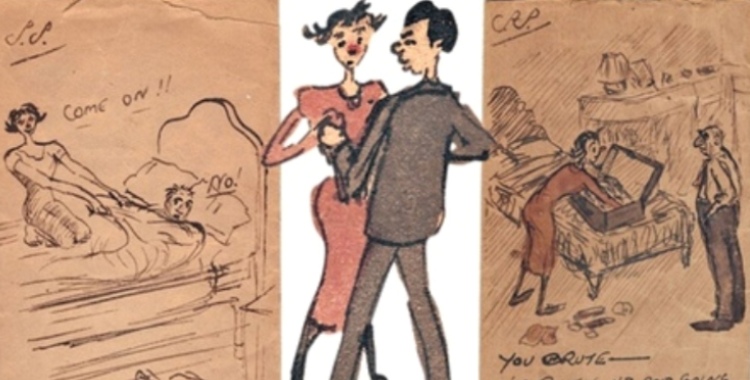
It’s hard to imagine a more complete depiction of a relationship than the one that Danny Braverman unearthed in a dusty shoebox five years ago. Laid down over almost 60 years, the 2,500 or so images were the work of Braverman’s great uncle Ab Solomons, a shoemaker who started scribbling pictures for his wife, Celie, on the back of his weekly wage packets in 1926.

Beginning in London’s East End, where Ab worked and lived, the drawings trace the evolution of a marriage, as flirtation gives way to bickering and domestic contentment is ruptured by painful events. There are bedroom scenes where Ab jokes about his snoring; and others where the quarreling couple are locked in stalemate. One is annotated with the telling words, “I can be as obstinate as you can.” We see the growth of Ab and Celie’s two sons, and the growing spectre of illness. Celie is a constant presence, pictured forever as she was when the pair married.

There is an extraordinary honesty in Ab’s refusal to skip over the agonising episodes in his life with Celie. “These aren’t cartoons; this isn’t being funny,” Braverman says. “As an artist, he had a compulsion to tell the truth.”

“I challenge anyone to find a more comprehensive picture of one person by another person,” agrees Nick Philippou, the director who helped Braverman bring Ab and Celie’s story to the stage. “It’s so vast and so relentless.”

Flickering away in the background is the social history of the 20th century, from blitz to boom to bust. Not surprisingly, anxiety pervades the drawings made during the war years. “It’s so monumental, it becomes like a Greek tragedy,” Philippou says. “And, like a Greek tragedy, it talks of all the things we can’t avoid: birth, life, death.”

Braverman, a writer and performer, shares his great uncle’s story in Wot? No Fish!!, which is about to begin a run at Battersea Arts Centre. Somewhere between a lecture and a performance, the show is delivered by Braverman himself, sifting through his surprising inheritance. Of the many questions the piece asks, Braverman highlights the way it prods at notions of high and low art. “What is the value of art in our lives?”

Philippou breaks in: “And who’s allowed to make it?” Both men describe the wage packets as an example of outsider art, but they are adamant that Ab is an artist by any standards. “Whenever anyone uses the word doodle I say no,” Philippou insists. “It is art, and it’s fantastic art.”

The outsider emerges as a recurrent theme of Ab’s art and of the show. As the son of Jewish immigrants, Ab was something of a marginal figure himself, with antisemitism casting a shadow over several of his drawings. In a Britain where immigration is once more the subject of fierce public debate, this is where the show’s subtle but insistent politics is located.

There is also, I suggest, a modern resonance to Ab’s compulsive sharing. What he depicted in art, we now publish on social media. In the same way that Ab’s drawings give equal space to death and trivia, as many Twitter posts are devoted to the serious as to the silly.

“It’s very different,” counters Philippou. “What you do in a tweet is you spend 10 seconds doing it; what you do with a work of art is you make it. You don’t make a tweet.” What has been lost, Philippou and Braverman suggest, is craft and care. “It does make you wonder about that mode of communicating – where is it now?” asks Braverman.

The answer, perhaps, is in the theatre. Wot? No Fish!! is not one but two stories, Braverman says. “There’s the story, and then there’s the story of the story. There’s the story Ab draws, but also the story of my discovery and my connectedness to it. It is about history in the present.”

“Somebody said the show is an act of love,” Philippou recalls. “I think that’s probably true, but it’s only true because Ab’s work was an act of love. The best way to love somebody is by not looking away. It’s continuing to look.”