Arts and Older Audiences

???????????????????????????????

Originally written for The Stage.

When attempting to improve engagement with theatre, focus often falls on the young. It is of course vital for the survival and reinvigoration of the art form that new generations come into our theatres, both as artists and audiences, and are inspired to keep coming back. But what are theatres doing at the other end of the scale?

Over the last few years, the problems raised by an ageing population have been firmly on the political agenda, raising questions about how this growing group of older people can be catered for in society. In a report commissioned for Parliament in 2010, it was found that over 10 million people in the UK were over 65 years old, a figure that was expected to have nearly doubled by the middle of the century.

This age shift is reflected in cultural attendance. According to the latest statistical release from the Department for Culture, Media and Sport, there has been a significant increase in arts engagement among adults aged 65 and over since 2005/06, but adults aged 75 and over still have lower engagement rates than other age groups – arguably due to barriers that limit their access.

In recognition of this demographic movement, the Arts Council has now begun implementing strategic measures to boost engagement among older people, in line with its promise of “great art for everyone”. Last year, it launched a £1 million grant jointly funded with the Baring Foundation, intended to widen access to the arts for older people in residential care.

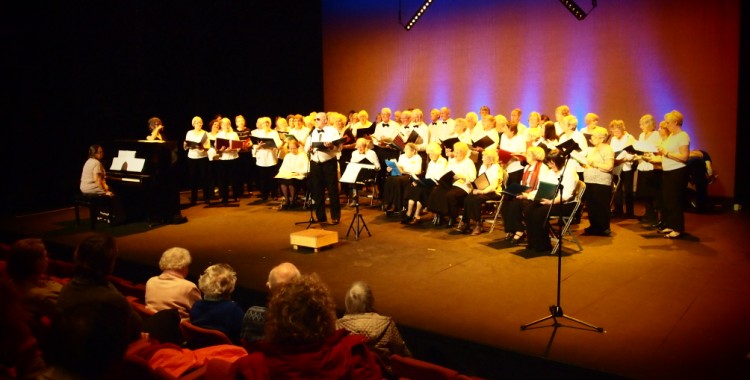
One of the successful recipients of funds from this initiative was The Courtyard Centre for the Arts in Hereford, which in recent years has been firmly committed to working with older people and those with dementia. Penny Allen, the Arts and Older People project manager at The Courtyard, explains that their programme involves a mixture of long and short term projects, ranging from a poetry project for people with dementia to a regular over 60s choir. The arts centre is also committed to becoming a “dementia friendly” venue and is the first organisation of its type to join the Dementia Action Alliance.

“Art has the power to reach people who may no longer be able to communicate as they once did,” says Allen. “By making arts accessible to all older people, be it in our venue, or in community venues or even residential settings, we are helping improve the quality of people’s lives and that is a powerful, wonderful thing.”

Inspired by the work being done at the Courtyard, Farnham Maltings in Surrey is taking similar steps to make its building welcoming for people with dementia, as well as offering events such as relaxed cinema screenings and tea dances aimed at older audiences. Director Gavin Stride insists that “if we are serious about audience development then we need to respond to the changing shape of our communities”. He hopes that in time “it will be an everyday occurrence to have elders and those with dementia accessing and contributing to our building and programme”.

Annabel Turpin, chief executive of ARC in Stockton, similarly sees the venue’s work with older people as part of its aim to connect with the whole community. “That’s the key thing,” Turpin stresses, “we want to connect people.” ARC’s Silver programme now regularly welcomes around 160 older people, who get involved with everything from ukulele lessons to iPad workshops. Crucially, the programme has been shaped in response to what its participants want.

The Albany in South London has equally built its Meet Me at the Albany programme around the older people it hopes to reach, as well as in collaboration with its resident artists, such as participatory arts company Entelechy. Activities in the programme range from poetry to circus skills, interspersed with board games and refreshments. Artistic director Gavin Barlow hopes that the work they are doing can pose “a real challenge to the way we think of things like social care for the elderly”, as well as creating a long-term programme that involves true artistic risk.

Both ARC and The Albany are involved in a new collaboration with Entelechy and Freedom Studios in Bradford, culminating in a joint touring show. Home Sweet Home, written by Emma Adams, draws on the experiences of over 200 older people from Bradford, London and Stockton, and explores the transition that many experience from home to care home. It demonstrates just one way in which this participatory work intersects creatively with the work of professional artists.

As well as connecting artists and participants, many of those working with older people emphasise the importance of intergenerational engagement. West Yorkshire Playhouse’s Heydays programme, which has been running for 24 years, is currently the largest regularly run project of its kind. Community development officer Nicky Taylor says that the work they do with older people “feeds back into the fabric of Playhouse, ensuring it’s a diverse, multi-generational creative space where people feel valued”.

Intergenerational work has also been an integral component of the work done by London Bubble Theatre Company, based in South London. Elders are often central to the process of gathering and shaping material for London Bubble’s intergenerational shows, working closely with participants of all ages. More recently, the Creative Homes project has taken London Bubble’s workshops to those who might not otherwise be able to attend, running groups in local sheltered housing schemes.

Creative Homes, like many of these projects, is still at a relatively early stage in its development. What it does, however, is pave the way for others. Taylor at the West Yorkshire Playhouse has the message that “you can make real and significant change in your venues with only a few small steps”. Barlow, meanwhile, claims that Meet Me at the Albany has demonstrated “massive potential” for work of this kind.

For all of these projects, the aim is ultimately about opening out the arts to the whole community – young and old. As London Bubble’s creative director Jonathan Petherbridge puts it, “Our aim is to open up the joys of theatre making to all-comers. We want to weave it into the every day – a creative action, like whistling and doodling.”

Photo: West Yorkshire Playhouse.

The Roof: Free-running Meets Gaming

image

Originally written for The Guardian.

In an age of screens, avatars and online anonymity, David Rosenberg and Frauke Requardt’s latest collaboration performs an intriguing reversal. The Roof, which is part of the London international festival of theatre, explodes the video game out of the screen and into the open air. In a car park opposite the National Theatre, audiences are invited to look on as a three-dimensional hero runs, jumps and fights his way through level after level. Virtual meets real.

Surprisingly, neither Rosenberg nor Requardt are big gamers. The concept of gaming as a structural and visual reference point emerged from the idea of an audience inhabiting a single character at the same time as being able to observe that character’s actions from an external perspective – the relationship between gamer and avatar, essentially. The resulting show is, according to Rosenberg, “a bit of an out-of-body experience”, in which audiences invest in an avatar whose movements they have no control over.

This unsettling dual experience is created through the use of headphones and binaural technology, harnessing immersive sound to transport audiences to the heart of the action. But while each audience member is offered an individualised, isolated experience through the soundtrack being pumped into their ears, Rosenberg and Requardt insist that it is vital to observe the piece as a group. “We want to create an environment where the audience feel that they’re part of a mob and there is something gladiatorial about the perspective that they have on the action,” says Rosenberg. As a group, spectators can watch, but not intervene.

“We never set out to create an interactive experience where an audience can determine an outcome,” Rosenberg explains. He compares the helpless experience of both inhabiting and watching a character to how we live our lives “through a collection of mainly random events and attempt to attach our own agency onto those events”. As Rosenberg and Requardt discuss, the clear parallels between gaming and life – progression, growth, levels – invite an audience to draw such connections.

“We were interested in taking the structure from gaming because the structure holds the audience through the show,” Requardt adds, suggesting that the “predictability” of this structure helps to give shape to a piece which relies more on movement than on words. Layered over this simple logic, Requardt’s choreography has been able to access a more abstract language, exploring “existential things about what it’s like to be alive”.

Despite this abstraction, Rosenberg and Requardt are also interested in some of the concerns particular to gaming – violence chief among them. The Roof may not explicitly address this issue, but Requardt believes that “there’s a question about violence which is raised, just because it’s a live performance and it’s not a game”.

The implications of this might have as much to say about the culture from which those games arise as the games themselves. After all, as Rosenberg reflects, “there aren’t many video games where you get rewarded for altruism or empathy”.

Photo: Paul Hampartsoumian.

Hitting the Right Note

82138

Originally written for The Stage.

For Danielle Tarento and Thom Southerland, it’s all about location. The producing and directing duo, who have found a rich seam in small-scale, stripped back musicals at fringe venue Southwark Playhouse, are always conscious of making the right match between show and theatre. “We’re very much about being respectful of the space you’re putting something in,” Tarento explains, “not just whacking it in because we happen to have a slot.”

We are chatting in the freshly refurbished bar of the Southwark Playhouse’s new home in Elephant and Castle, recently named The Stage’s Fringe Theatre of the Year, where Tarento and Southerland have found the perfect partner for their shows. The vast warehouse space has been utterly transformed since the theatre moved in, offering a main stage space that the pair find particularly inspiring. “To be in a 220-seat theatre that feels like a 600-seat theatre, yet to be no more than five rows away from the action, is extraordinary,” says Tarento.

The theatre’s strong track record with musicals, however, stretches back to its previous venue under the arches of London Bridge Station. Southwark Playhouse is now readily associated with musical theatre, but it was only three years ago that Tarento, armed with experience from fringe musical powerhouse the Menier Chocolate Factory, convinced artistic director Chris Smyrnios to put on the theatre’s first musical: a new version of Stephen Sondheim’s Company. Although he needed some persuading, in the end Smyrnios “couldn’t resist programming it”.

It was during the run of Company that the seeds of Tarento and Southerland’s working relationship were sown. Having previously encountered one another while Tarento was working at the King’s Head, Southerland “accosted” the producer in the bar after the show to discuss a new potential project. “I’ve sort of not been able to get rid of him since,” Tarento jokes, quickly adding, “thank God.”

Their first production together at the Southwark Playhouse in 2011 was Jason Robert Brown’s Parade, an unlikely musical rendering of a famous American legal case from 1913, which Southerland staged in traverse in the theatre’s Vault space. Unlike the sumptuous production that had been seen at the Donmar Warehouse just four years previously, this new version emphasised the grit of the story by working with its surroundings. “There’s nothing comfortable about sitting in the Vaults at Southwark Playhouse and watching an injustice happen right in front of your eyes,” says Southerland.

A damp, dingy railway arch is hardly the most auspicious setting for musical theatre, but the Southwark Playhouse’s atmospheric venue offered rich inspiration for Tarento and Southerland. Reflecting on Company, Smyrnios suggests that “the juxtaposition between the show and the space seemed to enhance the work rather than detract from it”. For subsequent shows such as Parade and Mack and Mabel, meanwhile, the Vault theatre was central to the aesthetic.

In the case of Mack and Mabel, which had been a famous flop in the past, Southerland is convinced that their version worked precisely because of its gloomy environs. “It doesn’t belong in a proscenium,” he insists. “This show is about being dirty and people not having any money, and scrounging to make a buck but wanting to create art, and it’s set mostly in a disused film lot. It needs to be vast, but it needs to feel uncomfortable and claustrophobic as well.”

Despite the gains, working on this scale also brings its challenges. “Every challenge is a benefit,” Southerland insists, but Tarento quickly breaks in with “that’s the director speaking – the producer will say something quite different”. She concedes, however, that the difficulties of producing a musical on the fringe do open up new creative possibilities: “the minute I say no, they have to find another way, and sometimes those other ways end up being far more interesting”.

“If there were too many challenges, we’d just go ‘let’s find somewhere else’,” Tarento adds. She suggests that the secret of their continuing partnership is that Southerland “creates the sort of theatre that I want to create”, which is heavy on story and light on “stuff”. “The stuff is lovely, some shows need a bit of stuff, but I think if you’re talking about things that are true, or things that require the audience to actively engage and have an opinion, just tell the story, don’t cover it up with stuff.”

So why is it important that this kind of work exists on the fringe? Firstly, as both Tarento and Smyrnios point out, it makes musical theatre affordable to those who might not be able to access it in the West End. But beyond that, Tarento says, they “give people the opportunity to see a different kind of theatre”. Smyrnios adds that venues like the Southwark Playhouse “provide the opportunity to revisit noted musicals, try out new ones and explore established ones in new ways”.

It is the implicitly trusting partnership between venue and producer that has enabled these kinds of risks to be taken. “They give us ownership of the building,” says Tarento. “They take ownership of the show. It feels like it’s an in-house producing house and we’re just working here and we’re doing the next show. That is unbelievably rare.”

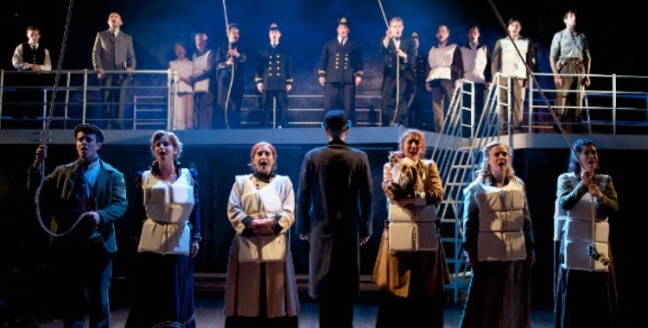
The new building in Elephant and Castle, which the Southwark Playhouse moved into in May of last year, demands a new approach. Southerland raves about the new theatre’s “height and scale”, explaining that “you can do epic without losing any intimacy”. It was this mixture of the epic and the intimate that allowed the director to stage his version of Maury Yeston and Peter Stone’s Titanic, which he is preparing to transfer to New York when we speak.

Thanks to Tarento and Southerland’s success, the doors at the Southwark Playhouse are now open to musicals from other producers, such as Floyd Collins, The A-Z of Mrs P and upcoming show In the Heights. “There is now an audience who will come and see the next thing regardless of what it is or who has produced it, because they trust,” says Tarento. “That’s every venue’s dream, to have an audience who will come and see everything.”

For Smyrnios, although plays are still the Southwark Playhouse’s priority, musicals are becoming an increasingly important ingredient of the theatre’s programme, with space regularly set aside for them. As for the relationship with Tarento and Southerland, it has “gone from strength to strength”. “From the start there seemed to be a naturally productive working balance between producer and venue,” he says. “It’s been a relationship that has been fruitful for both of us and one we hope to continue.”

Tarento and Southerland have similar hopes, already mapping out future plans for the venue. Despite pursuing projects elsewhere, Tarento is confident that the relationship with Southwark Playhouse is one that the pair will keep returning to. “I think wherever we go and whatever we do, we’ll always end up coming back here.”

Photo: Annabel Vere.

Return to the Globe

Untitled

Originally written for The Stage.

By now it is a truism that Shakespeare’s plays explore universal themes, but the Globe has taken this idea further than most. From its riverside base in London, the theatre has increasingly attempted to live up to its name and showcase Shakespeare’s work on an international level, both by touring its own productions and bringing in companies from around the world.

The pinnacle of the theatre’s international ambition to date was the 2012 Globe to Globe Festival, which invited productions of all 37 of Shakespeare’s plays in different languages, performed by companies from all over the world. Festival director Tom Bird describes the feat as a “huge, ambitious and difficult thing to pull off”.

The first challenge was to decide which countries and languages to include, which Bird and his team tackled by choosing to focus first and foremost on communities living in London. The other starting point was the desire to make the programme as varied as possible – “we always wanted to mix it up”.

The resulting festival attracted a diverse range of audiences, made up of regular visitors to the Globe and a huge influx of new theatregoers who came to see Shakespeare performed in their native languages. Bird quotes the astonishing figure that 81% of Globe to Globe audiences had never been to the Globe before, far exceeding the festival’s targets. The programme also “confounded expectations of what we think we can do with those plays”.

Following the festival’s success, the Globe has made a commitment to continuing this international strand and is once again bringing back three Globe to Globe companies this year: Indian company Arpana, Fundación Siglo de Oro from Spain, and Deafinitely Theatre, whose work uses British Sign Language.

Sunil Shanbag of Arpana, who will be bringing back their Gujarati version of All’s Well That Ends Well, describes the chance to perform at the Globe as a “once in a lifetime opportunity” – or twice in a lifetime, in their case.

“It’s a very giving space,” he says. “It’s the kind of place where audiences feel welcome; there was a lot of generosity. It’s a very different kind of relationship that you share with an audience at the Globe, so as I keep telling people, it’s very hard to fail at the Globe.”

For Shanbag, the priority was to make the play work for Gujarati audiences, but he has been overwhelmed by the response beyond the Gujarati community, especially from Shakespearean academics. He suggests that Arpana’s version, which drew on popular street theatre aesthetics, worked because “the very powerful emotions that run through Shakespeare’s plays – of love, hate, betrayal, loss – these are elements that are very similar to the elements that you find in Indian storytelling”.

Similarly, Fundación Siglo de Oro’s Rodrigo Arribas notes similarities between Shakespeare’s plays and the theatre of Spain’s Golden Age. After presenting Henry VIII in 2012, this year the company are performing Lope de Vega’s Punishment Without Revenge, which Arribas says shares Shakespeare’s “profound capacity for dissecting the psycho-emotional nature of human beings with their desires, ambitions, perversions, doubts”.

For Deafinitely Theatre, who presented their version of Love’s Labour’s Lost at the 2012 festival, Globe to Globe brought different challenges. “Our language is very dependent on eye contact and really focusing on each other,” says artistic director Paula Garfield, “but with the Globe you can’t do that. You have to focus on the whole audience, which is surrounding you, so it’s about projecting outwards, upwards, across.”

The company have found that the festival had a positive impact on their audiences, continuing their project of bridging the gap between deaf and hearing theatregoers. They hope to continue this with their new version of A Midsummer Night’s Dream this year, which has been chosen to be as accessible as possible.

Never shy of a challenge, the Globe’s latest international project involves touring Hamlet to every country in the world over the next two years, coinciding with the anniversaries of Shakespeare’s birth and death. Explaining the impetus, Bird says, “we wanted another huge ambitious project to really get our teeth into and to reflect the relationships we had all around the world”.

The project recently received criticism from Amnesty International for its decision to visit North Korea as part of the tour, but Bird insists that “every single country means every single country”. He explains, “we want to be inclusive and not exclusive and to have conversations with as many people as possible”.

As for Shakespeare’s ability to translate across cultures, can any play be truly universal? “We feel that there’s probably nowhere in the world that won’t enjoy engaging with Hamlet in some way,” Bird says. “The play is such an extraordinary story that we really feel like anyone can enjoy it.”

Photo: Ellie Kurttz

Home is Where the Art Is

Caroline-Sabins-Lifedeath-011

Originally written for the Guardian Culture Professionals Network.

What value do you attach to a community art exhibition? How do you assess a conversation on a funding application? Is it possible to put a price tag on a space that allows young people to feel that the art inside belongs to them?

Responding to Arts Council England’s recent report on arts funding,Towards Plan A, some commentators suggested that arts organisations might be better off formulating a funding plan B. It’s clear that pleading the economic case for the arts is failing to have the desired impact with the government, while equally failing to take into account the many other, less tangible ways in which the arts produce value.

The alternative proposed by a recent article on the Guardian is to transform cultural organisations into vital, cherished hubs of their local community, making their disappearance unthinkable. This is not a new idea; many organisations are already buzzing hives of community activity – think of the local classes and workshops at Battersea Arts Centre, or the Albany’s commitment to open its doors to the people of south east London.

But it’s beyond London, where the funding climate is harsher, that such initiatives might have the greatest impact. This is certainly the hope of Annabel Turpin, chief executive of the ARC in Stockton, who insists that “arts centres have a much bigger part to play in the lives of local people”.

It’s her aim to open up the organisation as much as possible to its community: “giving people permission to come in and use the building.” Alongside its artistic programme, the ARC hosts activities that cover all demographics, from children’s dance classes to an extensive programme for older people. “It’s a very broad spectrum, and that allows us to attract people from right across the community,” Turpin explains.

The same discovery has been made by mac Birmingham, which can boast high levels of engagement with its local community. “What’s important is the range of what we do because we are a multi-artform centre,” stresses artistic director and chief executive Dorothy Wilson. The centre aims to take visitors on a journey, offering various points of entry and leading them to unexpected destinations, be that a contemporary theatre show or a craft workshop. Its mantra is that the community are all artists. As Wilson puts it: “We encourage people to feel that this is a place for them.”

One of the greatest assets held by arts centres is their space. This is something that has been recognised by Chapter Arts Centre in Cardiff and Farnham Maltings in Surrey, the latter of which has offered much of its space over to its local community. “For us to thrive – to be truly popular – we needed to become relevant to more people and improve our usefulness,” says director Gavin Stride.

The difficulty, however, can be getting people over the threshold. “I don’t think we make enough of the fact that it’s free to come into an arts centre,” suggests Turpin. As public space shrinks, arts centres remain some of the only places that can be enjoyed without necessarily having to buy anything, a fact of which local people are not always aware. It is for this reason that mac Birmingham, for example, invests heavily in “free at the point of access opportunities” for those who might just stumble across the venue.

As well as throwing their doors open, some venues have gone further in their attempts to hand ownership over to local people. Matt Fenton is a passionate advocate for involving audiences in programming, an idea that he first tried out at the Nuffield Theatre in Lancaster and has now taken to Contact, Manchester, where a group of young people from the area have a key role in how the venue is run. He argues that audiences today expect more of a “two way conversation” and that the best way to target new, more diverse audiences is to represent their voice from within an organisation’s decision making structures.

“If arts organisations are genuine about a desire not just to reach more people but more broadly across the spectrum of their communities, then they’re going to need to think about how open they are, how engaged they are, as organisations,” Fenton insists.

The anecdotal support for these approaches is backed up by some compelling statistics. Contact’s commitment to young people has resulted in audiences that are 70% under 35, while mac Birmingham achieves 30-65% crossover audiences across its arts programme. Chapter boasted 800,000 visits in 2013, two-thirds of whom attended non-core activities and, as all of these organisations are keen to emphasise, none of this is at the expense of making great art.

Convincing as this model may be, however, the organisations that have committed to it all stress that such changes cannot be made purely in the service of self-preservation during difficult times. As Fenton puts it: “Arts organisations, especially publicly funded ones, should be doing this anyway.”

Photo: Chapter Arts Centre.