School Links Are Proving an Education

DSC_0298 (2)

Originally written for The Stage.

In straitened times, collaboration is a word that seems to be constantly on the lips of those working in theatre. While this is no reason to drop the fight for arts funding, financial challenges have had the silver lining of producing a number of surprising but fruitful partnerships, be they between fellow artists, artists and venues, or across organisations.

Among these collaborations, some of the most creative and supportive are those that have developed between theatre makers and higher education institutions. This is not a new link, as universities and drama schools have long nurtured the next generation’s theatre makers, but now several organisations are looking at how to strengthen, build and innovate these connections, offering benefits that go both ways.

In many cases, such partnerships are born out of financial necessity. Clean Break, for example, have a 14-year, “multi-faceted” relationship with Royal Central School of Speech and Drama which was originally part of a funded education initiative, but their more recent partnerships with institutions including the University of the Arts and Rose Bruford had “an economic imperative” alongside the broader goal of widening participation. Director and writer Vicky Jones, meanwhile, admits that a real advantage of DryWrite’s partnership with Oxford School of Drama is that they do not have to raise funds for the projects they collaborate on.

Although higher education institutions are also facing cuts, universities and drama schools usually still have more resources at their disposal than independent artists – resources which are increasingly being shared. James Stenhouse, one half of performance duo Action Hero, explains that a great benefit of their relationship with the University of Chichester is the opportunity this affords them to make work in a well resourced environment, an opportunity they might not otherwise have.

Often the starting point for more extended partnerships is a simple teaching relationship which then develops into something deeper. Practitioners from Clean Break regularly deliver lectures for Central, while the foundation of DryWrite’s relationship with Oxford School of Drama is the company’s collaboration on the students’ third year show, which forms a cornerstone of their course. DryWrite now work to deliver a “unique and bespoke” final piece with third year students, bringing in playwrights such as Patrick Marber, Penelope Skinner and James Graham.

However, as Stenhouse is keen to point out, independent theatre makers do not necessarily have to take on regular teaching posts in order to make a living. Despite Action Hero’s long relationship with the University of Chichester, neither Stenhouse nor fellow artist Gemma Paintin are on the staff, and Stenhouse stresses the danger of getting “caught in a loop where we’re training the next generation of artists to teach the next generation of artists”.

In an attempt to break this loop, several of the organisations nurturing such relationships point to their vital role in bridging the gap between higher education and the reality of the theatre industry. At the most basic level, theatre companies working in partnership with higher education organisations can offer work experience for students, but often relationships extend much further than this.

Paul Hunter of Told by an Idiot, whose relationship with RADA was the product of “completely artistic reasons”, explains that the school’s principal Edward Kemp was “very interested in the notion of actors making more of their own work”. As a result, Told by an Idiot have begun developing work with students right from its earliest stages, a practice that they hope to build on. Similarly, one of the crucial aims of the University of Chichester’s relationship with Action Hero – and, more recently, with artists’ collective Forest Fringe – is to offer their students a real sense of what it means to be a working artist.

While most of these relationships have developed through a combination of necessity, accident and artistic curiosity, the longstanding partnership between Accidental Collective and the University of Kent has roots that go back as far as the company’s inception. When co-artistic directors Daisy Orton and Pablo Pakula decided that they wanted to make work together after graduating, the university offered them the opportunity to become their first supported graduate company, acting as “guinea pigs” for a new initiative to retain theatre makers in the region.

The company have since taught at the university, collaborated with academics on a number of research projects, events and publications, and established Pot Luck, a performance platform supporting contemporary theatre makers in Kent. “It’s set us on a very particular path,” says Pakula, recognising how rooted they now are in the local area. “Our practice has been strongly shaped by the region, and by our position between the university and the region. We have, in some ways, acted as a bridge.”

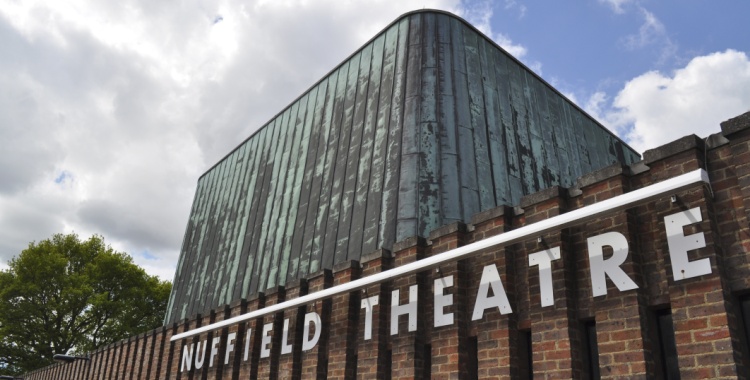
For Sam Hodges, the new artistic director of the Nuffield Theatre, it is important that the theatre’s relationship with the University of Southampton – on whose campus it sits – stretches further than just its arts departments. Since taking the reins he has been working simultaneously on a number of new initiatives, many of which link the activities of the theatre with the university’s leading science and engineering departments, with the aim of creating a “pooled vision and strategy”.

“It makes sense that in a bid to perfectly reflect and embody the qualities of its environment, the theatre should create work that is provocative and intellectually stimulating, provide opportunities of training and professional development, and develop a profile and reputation which reaches well beyond Southampton into the national and international field,” Hodges explains.

Perhaps the most exciting element of these emerging partnerships is their potential to create unique and unexpected outcomes, often through the collision of different artistic approaches. Hodges’ attempt to bring together art and science is one such instance, while the pairing of Told by an Idiot’s highly visual aesthetic with the more traditional actor training of RADA is another prime example. These unanticipated benefits can even have international reach, as with the cultural exchange that the University of Chichester have helped to establish between Action Hero, Forest Fringe and a group of artists in San Francisco.

The real opportunity of these new collaborations, as Hunter recognises, is to open up both artists and students to new possibilities. “Sometimes I think you can learn and be provoked more by going to a place that feels different, rather than aligning yourself always with people who feel familiar.”
Creative Constraints

Theatre-Ad-Infinitum-Ballad-of-the-Burning-Star--Alex-Brenner-please-credit-_DSC8291

Originally written for Exeunt.

Ballad of the Burning Star, the latest show from chameleonic theatre company Theatre Ad Infinitum, opens with a bomb warning. It’s an explosive statement of intent from a group of theatremakers who were last seen wordlessly exploring love and loss in gentle mime showTranslunar ParadiseBallad, a blistering satirical cabaret that provocatively examines the Israeli-Palestinian conflict, is about as far away as Theatre Ad Infinitum could get from the moving tale of a grieving widower which propelled them to worldwide success. As co-artistic director Nir Paldi says of the company, “it would be very hard to say ‘ah, they do this’”.

Ballad is very much Paldi’s project; as he explains, he and fellow artistic director George Mann take it in turns to lead the company’s shows. The group of Lecoq graduates “want to constantly be doing different things and different styles”, boasting a back catalogue that ranges from reinventions of classical myths to creative explorations of depression and love. Ballad, however, is by far and away their most ambitious production to date. It emerged as a result of Paldi’s need to find a way of talking about his experiences of growing up in Israel and took a number of years to find its current form. The difficulty, as Paldi quickly discovered, was in finding a theatrical metaphor that could contain the many sensitive complexities of the political situation in Israel.

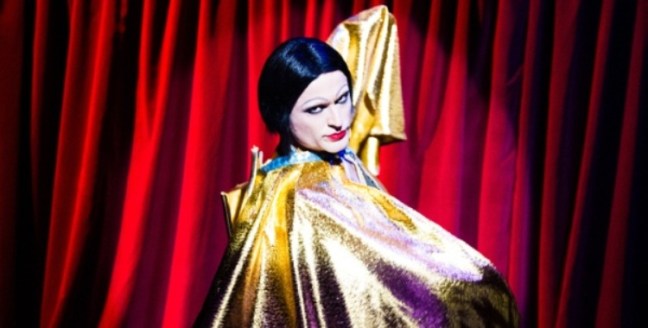
“I really felt that I needed some mechanism to distance it from myself and to make it clear to the audience that as a theatremaker I’m conscious of the complexity in quite a declarative way,” Paldi explains carefully. The show began life as a straightforward autobiographical monologue, but both Paldi and Mann sensed that the material needed a different vehicle. This arrived in the form of drag, an instinctive artistic choice that Paldi says he simply thought “would be really fun”, but which developed into a multi-layered theatrical device. Paldi thus occupies the centre of the show as the larger-than-life Star, a fabulous but bullying cabaret host, supported by a troupe of dancing “Starlets”.

“The nuances were found later as the metaphor became clearer and clearer,” Paldi reflects. “The relationship between Star and her co-performers; how she occupies the stage; how she occupies her co-performers and bullies them and manipulates them against each other; how she treats the audience. The metaphor that started appearing – this is not necessarily what the audience perceives, but it’s what I was working with – is the audience as judges judging the two parties, Star and her Starlets, Israel and Palestine being played by these two bodies in the space. It was a discovery; it wasn’t a decision that was made.”

Discoveries of this kind often emerge from the stylistic decisions imposed on Theatre Ad Infinitum’s creative process. The first thing the company looks for when starting to research a show is a form that will work for the subject matter in question – mime for Translunar Paradise, cabaret for Ballad. This then establishes the limits of the piece, allowing the work of making the performance to take place within those limits. “It’s a constraint, but actually it’s a creative constraint, so that’s the thing that allows you to start working,” says Paldi, echoing the words of co-artistic director Mann.

In the case of Ballad, however, the company was also working with other creative challenges. Chief among these was the dilemma of how to begin exploring such fraught political terrain. “The story that I wanted to talk about and the theme that I wanted to raise in this piece were fairly clear,” Paldi tells me, “it was just how the hell do you do that, how do you speak about it without sounding banal and obvious or very one-sided?”

In resolving this question, the role of work in progress showings and audience feedback in Theatre Ad Infinitum’s process became more vital than ever. Paldi is enthusiastic about the virtues of testing work on audiences during its development, explaining that “it just gives you such a strong image of where you are”. It was these early audiences who pushed Paldi and his creative team to go further with the piece, encouraging them to make the show increasingly provocative. With this in mind, Paldi meticulously researched the viewpoints and arguments from both extremes, daring to make Ballad potentially inflammatory but determined to avoid becoming one-sided.

Of course, no show as provocative as Ballad of the Burning Star could expect to emerge unscathed. The production’s Edinburgh Fringe premiere, while attracting critical acclaim and winning the ensemble an award from The Stage, also faced its fair share of censure. What Paldi was encouraged by in these attacks, however, was the even balance of the anger directed towards the show. “After one show I would be encountered by two different people, sometimes at the same time, and they would tell me ‘that felt really one-sided towards Israel’, or ‘that felt really one-sided towards the Palestinians’, and these conversations would happen almost every day.”

The intensity of these responses vindicates Paldi’s feeling that this is a subject that needs to be talked about – “the whole point was to talk,” he says emphatically. When it comes to his own role in these discussions, however, he is more ambivalent. “I still sometimes find it very hard to …” Paldi trails off, pausing for a moment. “It’s so complicated, so it’s very hard for me to hold a very firm opinion.” He insists that he does not want to be speaking directly to audiences about politics, adding, “I’m not a politician, I’m not very good at it.”

While he is pleased that Battersea Arts Centre and Dialogue will be running discussions alongside the event when it comes to London, Paldi does not necessarily feel that it is his responsibility to offer a space for these conversations to take place. “I don’t know if I see it as my responsibility to provide the place for discussion; it’s more to provoke the discussion,” he explains. It is more important to Paldi that his art speaks for itself: “I’m making a piece and this is what I think.”

As Theatre Ad Infinitum also begin work on their new show – the company are nothing if not multi-taskers – they are still keen to “reinvent ourselves every time”. Light, which will premiere at this year’s Edinburgh Fringe, is different again from Translunar Paradise andBallad of the Burning Star. This new piece, which Paldi describes as “George’s baby”, is inspired by Edward Snowden’s recent revelations about the NSA and by a dream of Mann’s about a “totalitarian, futuristic society”. Drawing on sci-fi influenced aesthetics, it will examine “what happens when technology is being misused by human beings and it falls into the wrong hands” – all without words.

As a commission from the London International Mime Festival, the creative decision to turn once again to mime is appropriate, although the challenge of tackling these complex ideas wordlessly is a formidable one. Paldi explains that the company have been encouraged by the early responses of audiences, who have told them to trust the power of their storytelling, allowing the bulk of the show to develop within the self-imposed “creative constraint”. The question that Theatre Ad Infinitum are now grappling with is the one that continues to guide their work: “how can we say the most interesting and provocative and complex things with this form?”

Photo: Alex Brenner.

The Rep Tide Turns

-C2-A9RWD10-20Faction_The-20Robbers_-36

Originally written for The Stage.

Repertory theatre might just be staging a comeback. While the Lyric Hammersmith undergoes major building work, the Secret Theatre company is occupying the untouched auditorium with a year-long programme of work driven by the ensemble. Elsewhere, Vicky Featherstone began her Royal Court tenure this summer with a festival featuring an ambitious weekly rep programme, while English Touring Theatre is exploring a repertory structure with Tonight at 8.30, its upcoming production of one-act Noël Coward plays.

The freshly vaunted advantages of the rep model will come as no surprise to The Faction. The company, which recently celebrated its fifth birthday, has been working towards this model from the moment of its conception, guided by artistic director Mark Leipacher’s passion for ensemble theatre and muscular versions of classical texts. The company’s ambition is bold but simple: a permanent ensemble, a home venue and a rolling repertoire.

While many have mourned the decline of the great British repertory theatre, which acted as a fertile training ground for the likes of Judi Dench, Ian McKellen and Derek Jacobi, The Faction looks to the continent rather than to the past for its chief inspiration. The company’s model is drawn from that of German theatres like the Schaubühne in Berlin, where a large repertoire of plays is presented by a resident ensemble.

“The idea for The Faction was always an ensemble theatre company following the model of a German theatre,” Leipacher explains. “Because it doesn’t really exist over here; even when rep was alive and well, that’s not the format that our rep model had in the UK.”

What The Faction’s ensemble approach does share with the old British rep model, however, is its focus on the actor. At a recent conference, playwright Simon Stephens – who is currently working as a dramaturg for the Secret Theatre ensemble – suggested that the UK’s freelance culture “can stifle bravery in acting performance”. This is just what The Faction hopes to reverse.

“Any director will tell you it’s a requirement to try and make the rehearsal room a safe place,” says Leipacher, “so that an actor can arrive without the need for ego, without inhibitions, and have the confidence in order to experiment and to play. I think with an ensemble that’s inbuilt.”

Although The Faction is still some way from its ultimate aim of a permanent ensemble performing a repertoire of plays all year round, this will be the third consecutive year that the company has presented an eight-week rep season at the New Diorama Theatre. Leipacher tells me that these rep seasons are “essentially a small model of how we want to work full time”, with the plan being to slowly extend these towards a year-long programme. He admits that it’s a “gradual process”, but the final aim is unwavering.

This year’s programme represents a blend of old and new for the company. It is remounting its Peter Brook Award-winning production of Friedrich Schiller’s The Robbers, which Leipacher describes as a “quintessential Faction show”, as well as returning to Shakespeare to tackle Hamlet for the first time. Completing the season is Thebes, an audacious attempt to weave together Sophocles’ and Aeschylus’ accounts of the Oedipus dynasty. Unlike the more defined thematic threads of previous rep seasons, Leipacher says that “the only condition this year was that they had to be plays that really excited us as directors, as a company – meaty, big, epic material that played to our strengths, that pushed us into new areas.”

Epic is the key word there. This sense of scope – both in terms of narrative and emotion – is what keeps The Faction returning again and again to classical plays. Leipacher insists that “there is no better material”, citing the plays’ timelessness and “universal themes” in contrast to new writing’s preoccupation with the zeitgeist. “It’s much more about human experience, about jealousy, about love, about responsibility,” he continues, “something that’s applicable to everybody and to any time. The purpose of doing the productions now is to do them for this time.”

As much as Leipacher enthuses about what excites The Faction as artists, the company is equally focused on its audience. Leipacher is adamant that repertory theatre offers a richer experience for theatregoers, with whom the company is able to “extend a dialogue” over a longer period. Audiences also have the opportunity to see the ensemble in a range of different roles, which Leipacher argues allows them to “enjoy the craft of the production and the ethos of the company as part of their theatregoing experience”.

Geoff Colman, Head of Acting at Royal Central School of Speech and Drama, is in agreement with The Faction about the advantages of the rep model for both theatre makers and audiences, describing it as “a place of experience, experiment, continuing development and trust”. He is also optimistic about the potential for bringing back rep under a new guise, adding, “I am convinced that other theatre makers will be looking at this reinvention of rep very closely”.

Discussing the experiments in ensemble theatre that are cropping up across British theatre, Leipacher says that “any movement towards that European model here in the UK is exciting”, but stresses the importance of longevity. It remains to be seen whether projects like Secret Theatre will go on to create longer term change, but Leipacher hopes that the Lyric and others will make the same commitment to ensemble theatre that is central to The Faction’s ethos. “Hopefully it’s the beginning of a tidal shift.”

Beginnings and Endings

Show_3-600x399

Originally written for Exeunt.

Let’s start with a beginning.

Sitting in the stalls of the newly plastic-swathed Lyric Hammersmith this September, I’m not sure I’ve ever felt such palpable anticipation in the moments before a show. As suggested by the words “Secret Theatre”, most of us in the audience did not know quite what to expect. The curtain was eventually raised to reveal the performers in a line at the back of the stage, dressed in plain white shorts and vests. Accompanied by a sinister, clinical voiceover, these figures rushed forward to drink from bowls of water, scrambling over one another in a desperate, animalistic struggle. What followed might not have been the best show of the year, but it is hard to think of a more memorable opening.

As I attempt to craft some sort of assessment of the year in theatre, the Lyric Hammersmith’s Secret Theatre project feels like an apt emblem for the change that is slowly pressing in on multiple sides. This time last year, writing another of these deeply subjective round-ups, I reflected that 2012 felt like a year of “small tectonic shifts”. While those shifts might not have precipitated a violent eruption of change across the landscape of British theatre, the last 12 months have nonetheless seen ripples of movement – just more gradually than perhaps anticipated.

Unlike the noisy, thrilling arrival of Three Kingdoms last year, the changes of 2013 have been subtle and structural, hinting more at future promise than present fulfilment. Chief among these changes is the exciting wave of new artistic directors who have either taken up post or been announced: Vicky Featherstone at the Royal Court, Rupert Goold at the Almeida, Rufus Norris at the National Theatre, Lorne Campbell at Northern Stage, Sam Hodges at the Nuffield. Whether these appointments will really offer the shake-up they hint at is still to be seen – though the early signs of Featherstone’s tenure are encouraging – but the collective urge for new ways of working is clear.

The impetus towards change is also characteristic of one vein of work that has particularly stayed with me this year. The phrase “political theatre” always feels like a misnomer – isn’t all theatre political in some way? – but a clutch of angry, thoughtful and passionate productions in 2013 have dealt specifically with ideas of political change and protest. How to Occupy an Oil Rig playfully explored the demonstration (in every sense), while Hannah Nicklin’s A Conversation with my Father offered a decidedly personal perspective on protest – almost reducing me to tears in the process. And another kind of activism is at the heart of Bryony Kimmings’ bold and brilliant Credible Likeable Superstar Rolemodel project, which twice bowled me over with both its raw emotion and the galvanising ambition of its aims.

Elsewhere, the potential for future change was more lightly hinted at. At this year’s Edinburgh Fringe, Dan Hutton and I noted the theme of hope that threaded its way through several of the productions we saw, complicatedly paired with both critique and irony. Contrived as this narrative perhaps is, it is one that has retrospectively haunted many of this year’s shows, inflecting my way of watching and thinking about theatre. From its very explicit presence in what happens to the hope at the end of the evening to its troublesome ghost in The Events, the question of hope has been a key feature of much of the most interesting work I’ve seen over the past 12 months.

Chris Goode's The Forest and The Field ©Richard Davenport

Closely linked to hope is the idea of community, which is often vaunted as being at the heart of theatre as an art form. We share the same space in the theatre, after all, so we must be a community of sorts, right? This was tested in various ways by much of the best theatre of 2013, be it the stunning yet gentle intellectual interrogation of Chris Goode and Company’sThe Forest and the Field or the joyously communal celebration of The Strange Undoing of Prudencia Hart – which arguably nailed the whole thing by staging itself in a pub and throwing in some song and dance for good measure.

Similarly to Prudencia Hart, music was a key ingredient of the fleeting community forged night after night in Edinburgh by The Bloody Great Border Ballad Project; food took the same role in Only Wolves and Lions, reminding me of the simple community we build when we cook and eat together. It’s not insignificant that that last example was part of Forest Fringe, a gorgeous instance of transitory artistic community in the midst of this summer’s Edinburgh Fringe. This community also offered up countless other small scale theatrical highlights of the year, among them Ira Brand’s delicate contemplation on ageing, a consideration of our addiction to virtual communities in I Wish I Was Lonely, and Deborah Pearson’s haunting The Future Show.

One show that managed to be both small and epic was Grounded, the absolute standout production of the Fringe for me. The remarkable Lucy Ellinson once again looms large over my theatregoing memories of the year after her compelling delivery of George Brant’s tightly written, blistering monologue, all the while imprisoned within the striking grey cube of Oliver Townsend’s design (as an aside, cubes seemed to be big this year – see Chimerica). Ellinson also dazzled, though very differently, in #TORYCORE, a deafening, devastating scream of rage against the destructive policies of the coalition government.

And it was not only the politicians of today who found themselves criticised in theatres this year. Following the death of Margaret Thatcher, a number of pieces have already directly or obliquely approached her legacy. Theatre503’s quickfire offering of short plays produced a decidedly mixed bag, although Margaret Thatcher Queen of Soho’s glorious drag queen rendering of the Iron Lady has deservedly lingered in my memory. The difficulty of discussing Thatcher’s legacy was addressed in all its complexity by Mars.tarrab’s brilliantly titled The Lady’s Not for Walking Like an Egyptian, while perhaps the most striking visual representation of Thatcher came courtesy of Squally Showers, a show that touched on her and her politics only indirectly. Yet somehow, in the image of a performer in a Thatcher mask holding aloft an inflatable globe while surrounded by the detritus of a wild party, Little Bulb wordlessly directed a powerful judgement at the world left to Thatcher’s children.

Little Bulb's Squally Showers

Squally Showers also provided plentiful helpings of sheer joy, a theatrical quality not to be underestimated. Alongside the charming eccentricity of Little Bulb’s latest show, the Edinburgh Fringe also offered the utterly bonkers but irresistibly endearing Beating McEnroe,which will forever leave me with the glorious memory of Jamie Wood pretending to be a tennis ball. An equally joyous moment to imprint itself on my mind this year emerged from Peter McMaster’s Wuthering Heights, in which I screamed with laughter at the four male performers’ move by move recreation of the dance in the Kate Bush music video, while the final scene of rain-drenched anarchy in the RSC’s As You Like It topped off a production that was a delight from start to finish. And no assessment of theatrical joy in 2013 would be complete without pausing to remember Zawe Ashton’s frankly inspired rendition of ‘Where Are We Now?’ in Narrative, a show that achieved the rare feat of being both absolutely hilarious and intellectually meaty.

While it may not fit neatly within the thematic threads I’m attempting to loosely weave through my overview of the year, any consideration of 2013 has to include a mention for Headlong. The company has had a ridiculously successful 12 months, encompassing the slick, stylish storytelling of Chimerica, a bold and theatrically astute new interpretation of The Seagull and – best of all in my opinion – the complete headfuck of Duncan Macmillan and Robert Icke’s stunningly intelligent adaptation of 1984. I’ve missed out on American Psycho,but from the outside it appears to offer a striking end to a fairly extraordinary year for Headlong.

As averse as I am to naming any one production “best”, when looking back over the year I find my mind dragged time and time again back to Mission Drift. For many this hardly counts as a “new” production, having first been seen at the Edinburgh Fringe in 2011, but this summer’s run at the National Theatre’s temporary Shed space was my first opportunity to see The TEAM’s dizzying trip through 400 years of American capitalism. Fast-paced, sexy and beautiful to look at, Mission Drift can also justifiably be described as epic, an adjective that I rarely find myself applying to theatre. Its scope, energy and excitement has become my personal benchmark against which to measure the year’s theatre, and very little in the subsequent months has equalled it.

As I opened this narrative with a beginning, I might as well close with an ending. Looking ahead to 2014, February will see the dismantling of The Shed, whose garish red silhouette on the South Bank has come to stand for vitality and experimentation at the heart of an institution often associated with tradition – as the narrative it spun to celebrate its 50th anniversary did little to challenge. One can only hope that The Shed’s spirit of innovation, together with that of Secret Theatre and Vicky Featherston’s Open Court festival this summer, finds a way to continue into the next 12 months.

I also contributed to a collective look back at 2013’s theatre with the rest of Exeunt’s writers.

Dark Magic

11174612045_bb6efdf774_b

Originally written for Exeunt.

No jingling sleigh bells or yells of “he’s behind you” at Northern Stage this Christmas. Dark Woods, Deep Snow, the theatre’s main stage Yuletide show, is certainly festive, but perhaps not in ways that theatregoers have come to anticipate at this time of year. Think less Santa, more magic. “It’s not what an audience will expect coming into a Christmas show,” admits director Lorne Campbell, “but also it’s got all the things that an audience can and should expect coming into a Christmas show; they’re just a little bit in disguise.”

Dark Woods, Deep Snow is Campbell’s first main stage production at the helm at Northern Stage, testing the new artistic director’s commitment to staging work that is large scale, exciting and powerfully local. While his debut might be a family Christmas show, typically seen as a low risk staple of the yearly programme, for Campbell this is the perfect challenge to create a theatre that is at once “populist and sophisticated”.

“We’ve tried to do something really ambitious,” he tells me. “The production is massive, it’s non-naturalistic, it’s visually – I think – absolutely stunning.” For the show, Campbell has brought together a group of artists, including writer Chris Thorpe, designer Garance Marneur and choreographers and performers RashDash, whose “spirit of experimentation” he wanted to free from studio theatres and unleash on a bigger stage. The hope was to retain the mischief and ingenuity, but expand the scale.

This marriage of experiment and scale, tradition and reinvention, is immediately evident at the level of the show’s plot. Charged with creating a narrative that was rooted in this time of year without conforming slavishly to Christmas show conventions, Thorpe was immediately drawn to the idea of stories. He was intrigued by “why there’s this urge in us to get together at this time of year, when the nights are the darkest, and try and turn things around and tell each other stories”.

Captivated by the image of tales shared at the fireside, and drawing inspiration from the story gathering project undertaken by the Brothers Grimm, Thorpe dreamed up a group of characters who live at the edges of the human world, in the “infinitely large forests outside of the human reality, where the stories go after we’ve told them to each other”. Here, they collect the narrative refuse of human society, piecing together the once upon a times and happily ever afters.

“The idea is that there’s a group of characters who have been engaging with these stories for as long as humanity has been telling them,” Thorpe explains, “almost behind the scenes of our reality, and they have observed the way that we tell them, but they themselves aren’t necessarily human. I think that’s a really interesting perspective to have on it.”

As an audience joins this group of characters at the start of the show, human stories are under threat from an external force that wants to rob these narratives from our universe, setting up a classic scenario of conflict and peril. Campbell describes it as a “big, exciting, what’s-going-to-happen-next adventure”, with a “big heart of narrative underneath it”.

While driven by a strong central narrative, however, the show simultaneously operates on a number of levels. As Thorpe explains, his invention has allowed him to incorporate both the familiar and the surprising, as fragments of well known stories meet the strange world of the characters he has created. “And also, because you’re not just retelling old stories in a show like this, it allows you to bring a whole bunch of people into the theatre and ask the questions that theatre is really about,” he goes on. “It’s really focused on everyone coming to the theatre and having a brilliant time, but it’s nice that it also links into what the theatre is there for year round; this place where we can all come and we can all share an experience that isn’t replicable in any other medium and we can all ask questions.”

11174670734_fa03bf90aa_b

These subtle layers equally apply to Marneur’s set design, which couples the recognisable, magical aesthetic of the forest with other unexpected, dazzling and occasionally dark elements. “Our styles are all quite dark,” Marneur says of the creative team. “They appear very beautiful at first, but once you dig a little bit deeper there’s always a second layer, a third layer that gets you to ask questions and provokes you. So the forest is the magical forest of a Christmas show, but it’s also diving into one’s subconscious. And of course that’s a beautiful place to be, but it’s also a very scary place to be. As a festive performance, one might not want to go into those dark places. So keeping the high vibe of the Christmas show with such heavy content and such existential questions being asked was my biggest challenge.”

This begs the question of what a Christmas show really needs. When I put this to Campbell, he pauses for a moment. “Joy, scale, chaos, irreverence,” he eventually answers. Thorpe also points to the spirit of Christmas theatre rather than its explicit themes or imagery, referring to a “feeling of coming together at this time of year to do something celebratory and exciting”. While insisting that he’s not trying to “de-Christmasify” the Christmas show, he adds that “it’s not necessarily about saying ‘hey kids, it’s Christmas’, because the entire world is saying ‘hey kids, it’s Christmas’ at this time of year”.

Getting away from the iconography of Christmas might not have been difficult for Thorpe and his fellow theatremakers, but creating a theatrical language that speaks to both old and young has proved to be more of a challenge. Thorpe, who is more accustomed to writing for adult audiences, is adamant that it is not about adjusting down to the children in the audience – “there isn’t a down, there isn’t a hierarchy”. It is instead about “simply and honestly just saying what you think” and finding common ground.

One way to do this is to recapture the thrill and imagination of childhood for all members of the audience, an aim that was essential to Marneur’s design. She describes her set, an otherworldly maze of towering white trees, as a “flexible playground” for the performers to explore. It is also a playground that can be transformed through the art of projection, allowing Marneur to “play with the audience’s perception of the forest” and conjure some of the magic of the fairytale – a form that translates across all ages, just as the show hopes to.

“It’s hopefully a very accessible family show,” Campbell stresses, “but simultaneously it’s a very sophisticated bit of theatre that’s taking its aspiration very seriously, while being irreverent and ridiculous and funny and fantastical and all of those things at once.” None of this, he adds, is specific to Christmas; as always, they are “just trying to make a really great, exciting bit of theatre”.

There is, however, a certain responsibility that the creative team acknowledge towards audiences who might only attend one show a year at Christmas. Realising that this is the first contact many children have with theatre, Thorpe emphasises that “you’ve got to make that count for them”. He and his collaborators also recognise the unique opportunity they have to attract and engage new audiences by demonstrating that theatre is something they can enjoy all year round. Convince them at Christmas, and they might keep coming back.

“It’s for life,” says Thorpe, “it’s not just for Christmas.”