Tom Scutt: Deceptive Minimalism

Constellations-Duke-of-Yorks-credit-Geraint-Lewis-2-600x428

Originally written for Exeunt.

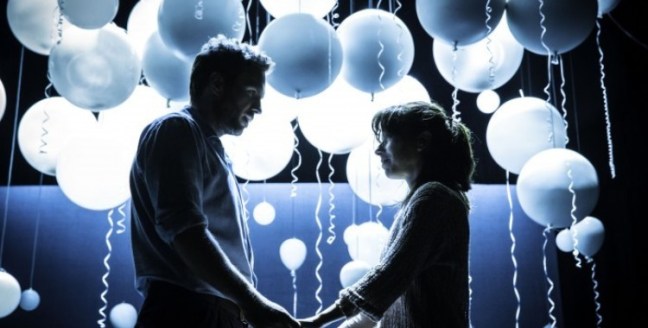
Watching Constellations, Nick Payne’s delicate exploration of love and the multiverse, I struggled to keep my eyes off the balloons. Like a birthday party run riot, Tom Scutt’s design was full of the things – white, weightless, hovering above the stage. Throughout the show, these floating objects spoke continually to Payne’s themes, lightly hinting at atoms, at possibilities, at easily punctured hope. In a similar way, 13 was refracted through the huge black box that dominated the stage of the Olivier, its nightmarish presence suggesting everything that was so disquieting about Mike Bartlett’s vision.

“It’s just a black box; it’s just a load of white balloons,” Scutt says when we chat in the Royal Court bar, acknowledging the simplicity of these designs with a smile. He goes on to describe his design for The Djinns of Eidgah, currently running in the Court’s upstairs theatre, as “just a load of string”. This simplicity, however, often contains within it great complexity. While Scutt’s portfolio features an impressive range of work – from the minutely detailed pub of The Weir to the magical landscape of Narnia in The Lion, the Witch and the Wardrobe – it can usually be characterised by an intellectual depth that belies its surface charm.

When I suggest that the deceptive minimalism of the sets for Constellations and 13 is what makes them work, Scutt nods, but jumps in to qualify the uncluttered clarity of these concepts. “You can tell when simplicity is simplicity because of ease and when simplicity is simplicity because of something that is constantly feeding the audience,” he explains carefully. For Scutt, design is always about feeding the audience, about offering them something beyond a straightforward setting for dramatic action.

As in Constellations and 13, Scutt’s designs have a habit of excavating something within the plays they contain. This is perhaps a result of Scutt’s process, which tends to involve more reading and writing than it does drawing – a “dirty confession” for a designer. “I can’t really design unless dramaturgically I know what’s going on,” Scutt tells me, revealing that his process is “very argy-bargy with other people’s roles in the team”. While he shies away from the term “collaborative”, which he feels is over-used, Scutt is keen to dissolve some of the misleading distinctions between creative roles, explaining that “it’s a completely fluid affair when I’m working with a director”. When he first worked with Natalie Abrahami, for example, she brought in a set of storyboards, while he arrived armed with a heavily annotated script.

Scutt’s way of working, which he describes as a “really rigorous process of elimination of ideas”, also means that the design often takes shape relatively late into the process. But when it does finally fall into place, he knows that it’s right: “I don’t know what anything is going to look like for so long, and then suddenly it just lands and it makes sense.” Despite the dramaturgical rigour of his process, however, the designs that Scutt has been most satisfied with have all been born from instinctive ideas that “won’t fuck off”. “It’s intuitive,” he says, “the gut just goes ‘this is right’.”

This was certainly the case with 13, which was “there all the time; I just couldn’t get it out of my head”. The monolithic revolving cube was “tonally right” for the play, Scutt explains, rather than drawing on one particular theme. The image of the box represented “science and religion in one, it was Pandora’s Box, it was nightmares, it was an alarm clock, it was an iPhone and a laptop, a black hole that you stare into, it was 2001 Space Odyssey, it was the blue box in Mulholland DriveA similarly multi-layered collage of ideas informed the design for Constellations, which alluded to “synapses in the brain and atoms and sperm and weddings and parties”, while at the same time combining great beauty and profundity with something “shit and basic and sort of mundane”. In both instances, the design seized on something in the metabolism of the play without taking any literal inspiration from the text.

Although these conceptual designs might be some of the most rewarding, they are also some of the hardest – “it always scares the bejeezus out of me,” Scutt laughs. “It’s what Carrie Cracknell would call hard good,” he continues. “It’s really satisfying, it’s really crunchy and you really have to get your head round it.” But, for all his enthusiasm for the minimal and conceptual, Scutt also makes a vital clarification about his more realistic designs. “When I do a ‘naturalistic’ design, or a perceived naturalistic design, it’s actually not at all,” he says, expressing frustration at readings of his work which underestimate the work being done just below the surface. Whether it is the wild, playful quality of the taxidermy that cluttered No Quarter in the upstairs space at the Royal Court, or the fractured, schizophrenic tone of his design for Cracknell’s production of Wozzeck for the ENO, there is always more to Scutt’s designs than immediately meets the eye.

“There’s way more thought that goes into these things than people understand,” Scutt says, referring as much to other designers as to himself. We discuss Ian MacNeil’s hauntingly elegant designs for A Doll’s House and Desire Under the Elms, while I later think of the seemingly stripped backed simplicity of Chloe Lamford’s set for The Events and the amount of work it is quietly doing in that piece. Scutt suggests that the nature of the theatre culture in this country means that some audiences – and particularly some critics – are not “visually astute”, and that the expectations of naturalism often lead to a misreading of ostensibly realistic designs. “If someone sees a chair, they go ‘ah, I know where I am’, and so they quantify it in terms that they can relate to,” he explains.

As well as falling foul of misunderstandings about how design enters into dialogue with a show, Scutt thinks that designers suffer from a rigid and often inaccurate distribution of creative roles by critics and commentators. This is highlighted particularly by awards, which sharply divide recognition into job titles – something with which Scutt and the whole creative team felt uncomfortable when Constellations was showered with nominations. “We all felt really weird that anybody could be split up in that way,” he remembers. “We made a thing; it wasn’t a play with a design, it wasn’t something that you could just whack on stage and it just happens that everything else is really nice. It was a thing, and it’s only what it is because of all the tiny little things that come together in a weirdly relevant way.”

Scutt’s suggested solution, as well as demystifying the roles of various different individuals in the theatremaking process, is to break down perceived hierarchies of creation. “We should all be as unimportant as each other,” he says, grinning at this idea. “I think that’s when it’s really exciting, because everyone’s opinion is valid and nobody’s opinion is wrong.”

This goes some way towards explaining Scutt’s latest challenge. He has recently been announced as one of the associates joining new artistic director Sam Hodges at the Nuffield Theatre in Southampton – a rare instance of a designer being offered a position of this nature. As part of a team that includes playwright Adam Brace and directors Blanche McIntyre, Natalie Abrahami and Michael Longhurst, Scutt will be offered an equal hand in decision making, marking a move away from the traditional division of roles.

“It feels like a really healthy and interesting step for me to be involved in decisions when it comes to programming and casting and the building, rather than just necessarily the designs,” Scutt says, adding that he is embracing the experience as a chance to learn and evolve as an artist. One of his first projects will be a reunion with Constellations director Longhurst to work on a new version of Caryl Churchill’s A Number, which is due to open in February.

The structure of a building and Hodges’ flexible approach to creative roles, meanwhile, might offer Scutt the space to continue following his gut. Because when design works best, Scutt suggests, it comes from instinct rather than intellect. “That’s how I feel design should work, that it works intuitively,” he reflects. “You don’t have to justify it; it just sort of happens.”

Photo: Geraint Lewis.
Sharing Space: Kieran Hurley

Beatspress1

Originally written for Exeunt.

Kieran Hurley has a confession to make. The writer and performer, whose shows include HitchBeats and Chalk Farm, wishes he was in a band. As we chat over the phone about the love for music that has suffused so much of his work, he laughingly describes himself as a “frustrated bass player”. It’s not a unique frustration; playwright Simon Stephens has spoken of his youthful ambition to be a songwriter and once described himself, Sebastian Nübling and Sean Holmes as “three middle-aged men who all wish we were in the Clash”. Hurley even suggests that this band mentality is somehow inherent in collaborative forms of theatremaking:

“I was speaking to someone about this, a fellow theatremaker, and he said that any of us who have ever made theatre in a kind of devised way were just people who wanted to be in a band at school but weren’t really musical. I think there’s a way in which that maybe comes across in some of the work that I make that I perform in.”

This is certainly evident in Beats, the rave-meets-storytelling show that Hurley is about to bring to the Soho Theatre following a second run on the Edinburgh Fringe. For the show, which narrates the coming-of-age story of a young boy in Scotland against the backdrop of the 1990s rave movement, Hurley is joined on stage by a DJ, blending his words with a pulsing score of techo tunes – or, to be more accurate, “mid-90s ambient electronica and a bunch of acid house”. As Hurley explains, the music was an integral part of the piece from the word go.

“With Beats it felt really obvious straightaway that this was going to be a piece that was going to be performed by me and a DJ,” he says. The process of making the show began with Hurley and DJ Johnny Whoop in a rehearsal room together, listening to records and teasing out the narrative. Hurley remembers that there were times when he would find himself “writing to the music”, steering the narrative to meet the emotional pitch of a particular track – “the two were really symbiotic”.

It was also music that provided the first seed of an idea for the show. Hurley recalls thatBeats was born from an interest in the Criminal Justice Act of 1994 – a piece of legislation outlawing public gatherings to listen to music that consists primarily of “the emission of a succession of repetitive beats” – and an intriguing statement included in the sleevenotes of Autechre’s Anti EP. In this note, the group explains that the track ‘Flutter’ has been deliberately programmed to contain no repetitive beats; under the prescriptions of the new law, it could still be legally played at public gatherings.

“I just thought this was a really creative, playful, mischievous response to a really absurd law,” Hurley says. He was equally intrigued by the political echoes of the rave movement and its offspring, which started as a hedonistic movement but became increasingly politicised in the wake of the Criminal Justice Act, feeding into the direct action of Reclaim the Streets and the party protest movement. Hurley therefore describes the impetus behind Beats as a marriage between “a kind of interest in rave culture alongside an interest in direct action activism”.

Although the setting of the show might have attracted some initial doubts – “people were like, ‘why are you doing a show set in the 90s?’” – this choice to focus on the recent past has proved artistically fruitful. As Hurley recognises, there is something fascinating about a time that is not far enough in the past to be considered historical, but is also decidedly divorced from the present. “Certainly that kind of distance is interesting,” he reflects. “It allows you to look at a time and get stuck right into it in a particular way, in a way that’s not always as easy to do with what’s going on immediately around you.”

As well as looking at a particular cultural moment, one that Hurley insists is “ripe for further mythologizing”, Beats uses the context of the rave as a way of exploring ideas of shared space. For Hurley, the show is about “young people claiming space and what that might mean, even when it’s not politically framed” – a theme that he also identifies in Hitch andChalk Farm, which are about an anti-capitalist protest and the London riots respectively.

“The discussion of rave culture is a vehicle for a discussion of sharing space communally – the political power of being able to share space together and look each other in the eye,” Hurley continues. “And theatre is a wonderfully analogous form for exploring the power of community and shared space, because it’s what it is.”

For this reason, the context of the theatre space is vital to the dynamic of the show. “I am dead, dead clear that this has to be a theatre show and happen in a theatre,” Hurley says. “The reason the DJ is interesting, the reason the form is interesting, is because it’s happening in a theatre.” Within a theatre space, there is a certain tension between the real and the imaginary that does not exist at a live music event, a tension that Beats exploits. As Hurley explains, “what the piece can’t do is recreate in real terms the particular type of collective attention that a live music event or even a rave might contain, which is its own beautiful, amazing thing, but what it can do is gesture towards a description of that with a kind of collective attention that we have in the theatre”.

While Hurley might be emphatic about the necessity of performing Beats in a theatre context, the piece has nonetheless – as intended – attracted a young and often non-theatregoing audience. Seeing the show last year during its brief run at the Bush, my thoughts turned to A Good Night Out and John McGrath’s call for a popular theatre. Although his demands, which were in many ways specific to the context of writing in 1979, are not directly translatable to now, there is something in the atmosphere of the gig or the rave that seems to at least partly transcend class boundaries. Perhaps the very attraction of the band for theatremakers like Hurley is that popular music has a way of cutting across divides that theatre often struggles with.

Hurley is clear that it is the music in Beats that is bringing in a broader demographic, arguing that simply the presence of a DJ gives people “a hook to hang something on”. However, this new audience and its differing expectations has brought with it new difficulties for Hurley, difficulties that he is determined to grapple with. “If I’m going to be serious about saying ‘I like the fact that this show might appeal to people who might not normally come to the theatre’, then I have to be able to contain their presence in a way that’s not just about chucking them out because they’re shouting throughout the whole show. That’s been a really interesting challenge.”

In being mindful of his audience, Hurley is also deeply conscious of how his politics translate into his work. He says that he’s “not really that interested in a kind of agit-prop polemic”, although he is adamant that “all theatre is inherently political”. Instead of pursuing a model of theatre as manifesto, the politics in Hurley’s shows finds its expression through storytelling, a form that he confesses to being a little obsessed with.

“I’ve got a whole bunch of opinions about stuff,” Hurley says, “but my work isn’t just a vehicle for me to lecture on that; it’s got to be about a deeper, more complex point of connection and exploration, I think. So that’s where the whole human story comes in.” In a piece like Beats, which is ultimately a personal story about one young boy and his experiences, the narrative is “shot through with some political thinking about the world, but it’s not trying to be polemical”.

While nodding to the long tradition of storytelling – “I think that we, human beings, have always needed stories” – Hurley is firm in refuting any idea that the story form is conservative. The linear storyline is often associated with naturalism, but as Hurley points out, stories are not restricted to this one limiting incarnation. “I don’t think that stories have to be bound up with particular forms,” he says. “What sometimes happens is that narrative and story get conflated with stage naturalism, so people might feel that to reject naturalism is to reject stories.”

This rejection is one that Hurley refuses. Instead, as Beats emphatically proves, storytelling can take various different forms, feeling at once ancient and astoundingly new. Or, as Hurley puts it with typically eloquent simplicity, “stories can look like lots of different things.”

Photo: Niall Walker.

Kate Tempest

Kate-Tempest-02-Katherine-Leedale

Originally written for Exeunt.

When Kate Tempest takes to the stage to perform Brand New Ancients, audiences are offered a transformation. As she smiles a few words of welcome, the poet and performer is charmingly awkward, shy even. But from the moment she launches herself headfirst into her narrative, she is suddenly electric. Tempest is a shape-shifter; a small, unassuming figure in jeans and T-shirt, capable of making the air crackle. Ordinary and extraordinary all at once – just like the characters whose stories she so compassionately tells.

Brand New Ancients is all about looking at people differently. Shifting the focus of mythical narratives from unreachable gods in the sky to the ordinary individuals we walk past every day, Tempest asks her audience to see “real heroes in really normal people”. Her gods are at the bar and in the betting shop, smoking a fag in the street or eating a kebab after a night out. Fighting the false idols of manufactured fame and fleeting celebrity, Tempest argues that everyone is worth our attention.

“This thing about noticing people …” Tempest trails off during our phone conversation, pausing in search of the right words. “You walk around among people all the time without really noticing that they’re other human beings. It blows my head off every time I go anywhere; just looking at people, taking a minute to slow down a bit.”

In keeping with this focus on people, Tempest explains that it was the characters in Brand New Ancients who came to her first, with the form of the piece following as she wrote it. “I’m quite used to thinking about what it is now as a finished piece, but right back at the beginning I don’t think I quite had a handle on knowing what I wanted it to be,” she says. “I just had all these loose narrative threads about these characters.”

These threads eventually became the interweaved stories of two families, whose tale Tempest tells through a fusion of storytelling, poetry and rap. She explains that the finished piece was unlike anything she had done before and is in some ways her most ambitious show to date, featuring the longest sustained narrative and mixing a wide range of artistic influences. In a masterstroke, Tempest’s captivating performance is also accompanied by a soaring live score composed by Nell Catchpole, allowing wordless pauses for “your brain to recover from that onslaught and let the music do the talking”.

Given all these different, overlapping elements to her work, it is almost impossible to pin Tempest down to one genre. While the poetry world has recognised Brand New Ancients with the Ted Hughes Award, the inclusion of the show in the Traverse Theatre’s programme during the Edinburgh Fringe – where it is appearing as part of the British Council Showcase – would also seem to cement Tempest’s association with theatre. It was only last year that Tempest wrote her first play, Wasted, at the same time as continuing to make work by herself and with her band Sound of Rum. Speaking about her experimentation with different art forms, Tempest explains, “I’m now starting to have an idea and be able to choose whether that idea is a story or a play or a rap or a novel.”

The thought of not having a stab at new genres when the opportunity arises seems to be one that has not occurred to Tempest. And when it comes to the risk of failure, her attitude is remarkably relaxed. “Until you’ve got something really wrong you can’t get anything really right,” she reasons. “You’re not quite engaging with the decisions you make unless you’ve made a really bad one.” There’s also a steely streak of determination to Tempest’s character and a formidable work ethic beneath her laid-back persona. She’s particularly emphatic about the need to be constantly moving out of her comfort zone: “Push yourself, do something that’s hard work, do something you’re petrified of.”

It’s certainly a mantra that Tempest has lived by in recent years. As well as continuing to write for theatre, she tells me that she has just finished the first draft of a novel, at the same time as making a new record. And her latest project, from which she is taking a break when we chat, is a musical. Even Tempest sounds a little surprised about that one. “It’s very different,” she says, quickly adding, “and hopefully not shit. That’s all we can ask of any of it – please don’t let this be the thing that’s shit.”

For all the variety in her work, however, Tempest is dismissive of the idea that she might be innovating or crossing boundaries. “It is what it is because it’s what I’ve been doing,” she says simply. “I’ve read novels all my life and I’ve listened to rap music all my life and I love being told stories and I love the people in the place that I’m from, so it’s just very natural; of course it happens like this.”

At the heart of it all is an overwhelming love for stories. Tempest talks with enthusiasm about discovering her characters, about the stories that she and her family and friends are always telling one another, and about her recent trip to a writers’ festival in Sydney, where she met fellow writer and “the most amazing storyteller” Daniel Morden. “There’s just something that I react to, which is the narrator,” she attempts to explain her belief in the power of storytelling. “It’s comforting and it’s like the ultimate form of trust; trusting somebody that they’re not going to lie to you.”

“Here’s a story that Daniel Morden told me, right,” Tempest suddenly bursts out excitedly, abandoning the point she is halfway through making. She recalls a simple but beautifully told narrative about a visit that Truth pays to a town where no one will listen to him. After a few days, Tempest continues, a stranger arrives dressed in extravagant clothes and the townspeople all gather round him to hear what he has to say. When Truth asks the stranger what his secret is, he replies that he is clothed in stories, because “the naked truth is too much for people to bear”.

Falling into her distinctive rhythm, Tempest concludes: “So from that time to this, Truth has gone around dressed in the clothes of stories, and it’s easier for people to hear about themselves.” It feels like a fitting philosophy for the invention, enthusiasm and compassion of Tempest’s work. In the end, it’s all just stories.

Photo: Katherine Leedale.

Lorne Campbell

Lorne-Campbell-cr-Topher-McGrillis-3

Originally written for Exeunt.

As I talk to Lorne Campbell about Northern Stage and this year’s programme at the Edinburgh Fringe, one word keeps stubbornly recurring: “conversation”. The theatre’s new artistic director, still only five weeks into the job, shows a profound understanding of the role of organisations such as Northern Stage in the many current dialogues around theatremaking – dialogues about funding, about politics, about artistic practice. As a key regional producing theatre, Campbell believes that Northern Stage has a responsibility to engage in, respond to and act as a catalyst for those conversations.

“The theatre is a regional theatre,” he says, “and for me that’s about connecting to all of that region. The theatre’s identity is a conversation with all of those multi-faceted communities and identities, rather than a clear thing that you can point a finger at.” When I ask about the importance of a theatre like Northern Stage reflecting its locality, Campbell pauses. “I think that’s quite a complicated question,” he eventually answers. “I think if a theatre like this isn’t local in profound and complicated ways then it’s completely irrelevant, so we have to find a way that our work is of the city and is of the region.”

At the point at which Campbell is taking the reins at Northern Stage, this conversation and these understandings of regional identity are particularly urgent. As he explains, “everything’s on slightly shifting sands”; the organisation is currently coping with cutbacks from the city council and Arts Council England, at the same time as bracing itself for further slashes to its funding. “In the face of all of that, it’s about trying to find the most dynamic and optimistic model you can, but it’s quite difficult to plan into the medium term,” Campbell admits.

While the necessity of protecting the theatre in the short term makes longer term visions difficult at this stage, Campbell makes it clear that Northern Stage’s community of artists is a key priority. “I’ve arrived at a very interesting moment where there is a hugely exciting cohort of artists and companies and writers and actors all coming through in the North East,” he explains, “so a big challenge for us is how we not only protect that generation of artists, but continue their momentum.” He describes the present as a “really potential-filled, optimistic moment”, but he’s under no illusions about how easily that potential could be wasted if the theatre is not able to continue supporting the development of those artists.

Another repeated word in Campbell’s vocabulary, despite the difficult times that Northern Stage and other organisations currently face, is “optimism”. He remains hopeful about the theatre’s ability to harness its resources in support of the artists it has discovered and nurtured over the years, as well as about the potential of the main stage. “We need to make more work on it,” he states, firmly and unequivocally. “More of our own work and work which tells exciting, contemporary stories about not only the present of the North East, but also the future.” He imagines this stage as “a political space, sort of inspired by Joan Littlewood and John McGrath”.

“So much of it is about exercising community,” Campbell explains as he outlines his approach. He smoothly segues into talking about St Stephen’s, the Edinburgh Fringe venue that Northern Stage first occupied last year under previous artistic director Erica Whyman, and the range of different communities surrounding that project. Linking together artists from across the North of England in an ambitious curated programme, St Stephen’s offers an overlap between different areas, companies and artistic practices, as well as opening a dialogue with other venues and with the communities of both Edinburgh and the Fringe.

Stressing the importance of engaging with the people of Edinburgh as much as with the festival as a separate entity, Campbell insists that this balance is “absolutely vital”. “I think it’s one of the great ignored truths of the Fringe,” he says. “The majority of tickets are sold to Scots who come to the festival; the tourist ticket buyers are still in the minority. So if you don’t connect to a local audience, you’re going to have a very hard time.” Having been brought up in the city and worked at the Traverse Theatre earlier in his career, Campbell has an obvious advantage here. “It feels like an old biorhythm waking up,” he laughs, adding, “it’s going to be lovely to be embedded in it”.

One way in which Campbell is facilitating this dialogue with the local area at St Stephen’s is through The Bloody Great Border Ballad Project. The driving impulse behind this project, he explains, was born out of what he felt was a divide between English and Scottish artists. “I was really struck last year by the real functioning sense of community within the artists at St Stephen’s, but I was also aware that there wasn’t a huge amount of conversation with a very similar group of Scottish artists who were also in the city.”

“I wanted to try and find a project that brought those communities into contact with each other,” Campbell continues, “to talk about something in the political zeitgeist, but also to exchange practice and to be in the same room together.” His unique artistic solution was inspired by border ballads, “a narrative folk tradition that belongs as much to Northumbria as it does to the Scottish lowlands and the borders”. Campbell has commissioned six artists to write their own versions of what a border ballad might look like today, while throughout the festival another epic ballad will be composed by a range of guest artists contributing a new verse each night.

“That ballad begins with a foundling babe being discovered in a Moses basket floating down the River Tweed on the night of the dissolution of the act of parliaments between England and Scotland,” Campbell tells me, “and then the poem will tell the next 95 years of that child’s life and the next 95 years of an imagined non-United Kingdom.” Incorporating a diverse mix of artists with a range of different political views, Campbell hopes to open a lively debate about Scottish independence, which he suggests is “much more than a question about whether Scotland should be an independent country or not”. As he continues, “it’s a question about how optimistic or pessimistic we feel about the potential of our political future”.

The Bloody Great Border Ballad Project is not alone in addressing such meaty questions. Elsewhere in the programme – which Campbell explains was mostly put together by creative associate Mark Calvert before his arrival – a certain shared political impetus animates a wide and varied range of work, from Hannah Nicklin’s very personal meditations on protest to Daniel Bye’s more openly provocative How to Occupy an Oil Rig. “It feels like there’s much more of a zeitgeist running through the project this year,” Campbell notes. “You can see lots of conversations about dissent, about forms and modes of protest, about how you question where you are as an individual in relation to a system. I think it will be very exciting to see how all those bits talk to each other.”

Another strand to this dialogue within the programme is Make. Do. And Mend, a one day event that aims to gather a wide range of voices in theatre to discuss problems and implement solutions. Feeling the need to create an event that acted as well as just talking, Campbell and the team at Northern Stage “wondered what would happen if we tried to create an event which actually resulted in immediate action that day”. Campbell is determined that “you can’t just repeat” and hopes that this gathering will prevent the talking in circles that we are all too good at.

This particular event is being organised in partnership with Forest Fringe, who are back in Edinburgh this year in a new venue on the same side of the city as St Stephen’s. This in itself shifts the context in which Northern Stage’s project sits, providing yet another overlapping community. Campbell is positive about this development, saying that “the geography and gravity of having more on that side of town is great”. He also comments on the growth of curated programmes this year in resistance to the commercial drives elsewhere, stating his belief that that work “doesn’t go away, it just moves, it finds another space on the fringe of the Fringe”. If nothing else, the presence of another artistically driven venue in Edinburgh this year adds another voice to the dialogue. “It’s all part of the conversation.”

Photo: Topher McGrillis.

Cush Jumbo

cushjumbo

Originally written for IdeasTap.

Actress Cush Jumbo has appeared in a wide range of stage and television roles, including Lois Habiba in Torchwood. Her latest project, Josephine and I, is a one-woman show that tells the extraordinary life story of Josephine Baker. She shares her tips on training, research and how to cope with pressure…

How important do you think it is to train as an actor?

I really loved my training experience. I think it probably depends on the kind of person you are and what your plan is; what kind of career you’d like to have. I was very interested in learning the technical aspects of my job; the craft of it, the voice, the movement and how to actually do this job day to day. That’s the bit that I think you can be taught. The other bit is the raw talent part, which you can’t be taught. I personally found my training really useful and I’ve continued to find it useful since graduating.

Was there a point at which you felt your career really took off?

I didn’t have a rocket launch of a start. For the first couple of years I really was a jobbing actor and I had to deal with all the strain and the pressure of having absolutely no stability. I think after I did Torchwood things changed a lot, but for me it’s been a gradual process. It’s only really in the last two years that I have been booked up with work.

There’s something positive to be said for both ways. It’s nice to be constantly in work, but it also has an impact upon your life because you can’t fit anything else in – you can’t take a holiday, you can’t go to a friend’s wedding, you can’t make plans. Sometimes when you have those gaps you can do those things.

Did you feel any pressure when you were cast in Torchwood?

I don’t recall thinking that at the time, I recall being ecstatically happy that I could pay my rent for the next three months! In a way, actors thrive on pressure. Part of our job is about being able to take on stress and pressure, deal with it and turn it into another kind of energy. Things can change every day, nothing stays the same, lines get cut, lines get added, jobs get taken, you get rejected. You have to thrive on pressure and on the ability to change. If you sat there and thought about pressure then you’d never get any jobs done.

What advice would you give for coping with the pressure and instability of acting?

At drama school, nobody really talks about how to deal with the mental anxiety of being out of work. It can put you in a very lonely, very low, very blue, very depressed state. One way of dealing with that is to remember that there is always going to be somebody else who’s going through that same stage and that you should talk to people about it. Don’t let it get to the stage where you’re feeling so low that you feel completely alone. Otherwise, when that audition comes up, you’re not on top of your game. You need to be ready to go.

It’s a brilliant idea to give yourself your own routine. So you’re doing your boring day job, but you’re still trying to go to classes, you’re still trying to learn accents. Get together with a group of other actors and run lines from a play, or do a bit of writing, or go to a gig – try to take in as much artistic stuff as you can, because working in a job you hate is going to kill your soul. You need to find ways of keeping the creativity running so that when that phone call comes for that audition you’re at your peak.

In Focus: Researching Josephine and I

I’ve always been interested in Josephine Baker since I was a kid. She has an unbelievably fascinating life; it’s so mythic. I read a lot of books and biographies, I watched a lot of movies. I had a really good idea in my head by this point of who this woman was – although the fabulous thing about her is that she can be played a million different ways because she was always changing herself, she was always changing her identity. It’s great to do her in a one-person show because you can be all those different people and all the other characters, but somebody else could do this show and play her in a completely different way.