
How could technology change theatre criticism for good?

Originally written for The Guardian.

Discussions about the future of theatre criticism seem to be evergreen. It is a debate that continues to impassion bloggers, and one that arose again at the latest instalment of Devoted and Disgruntled back in February, in a session challenging the barrier traditionally erected between theatremakers and critics. One linked but relatively neglected aspect of the conversation, however, is how criticism might fully explore and exploit the growing possibilities allowed by digital developments.

When it comes to digital, I think we’re all still fumbling around in the dark. In the world of theatre comment, this has manifested itself in recurring, sometimes ugly debates between mainstream critics and the blogging community. But what if the technology at our disposal offers more than occasion for conflict? While words alone can create a rich tapestry of critical response, imagine how much richer this might be with the addition of images, video, audio, geotagging, experimental forms such as Pinterest – the list goes on. Despite having such options at their fingertips, the majority of those writing theatre criticism for the web remain trapped in the conventional print review format: a block of text that often tries to avoid spoilers. Myriad possibilities are there, but it seems we’re slow to adopt them.

This is not to dismiss all theatre writers as luddites. Some bloggers and critics are embracing the possibilities of digital criticism and experiments are beginning to take shape. Twitter, for instance, has opened up instant discussion, allowing theatregoers to share their thoughts from the moment they step out of the auditorium. Luke Murphy has taken the trend to another level by aggregating such reviews on one feed – an intriguing idea, but one arguably limited by the tweet’s inherent brevity.

Matt Trueman, meanwhile, played with structure in his clickable review of Constellations earlier in the year, an experiment that had its flaws but asked fascinating questions about how the form of theatre criticism might reflect the form of the theatre being critiqued. A rich and ever-increasing variety of digital formats offer the opportunity to go even further. Might we begin to see purely visual responses to theatre through platforms such as Pinterest, or more video responses along the lines of blogger Eve Nicol’s refreshingly enthusiastic YouTube reviews?

Beyond experimenting with form, and returning to the discussions initiated at Devoted and Disgruntled, the digital space even has the potential to set out a whole new model for how critics might engage with the theatre they write about. Theatre writers Jake Orr and Maddy Costa are beginning to do just this through the creation of Dialogue, an online playground where theatre makers, writers and spectators can open up new conversations. Thanks to the flexibility allowed by online criticism, where page space is not an issue and responses can go further than words, the role of the critic could in future go beyond reviewing to play a greater part in the space between theatre, creator and audience.

The possibilities raised by digital technology pose more questions than they answer, but these are questions that beg to be thrown open for wider debate. How might digital experimentation impact upon mainstream criticism? How can we play with form and structure to create the theatre criticism of the future? And, crucially, what implications does digital innovation have for the evolving role of the critic?

Photo: Julian Stratenschulte/EPA
The woman’s part: is single-sex casting sexist?

Originally written for The Guardian.

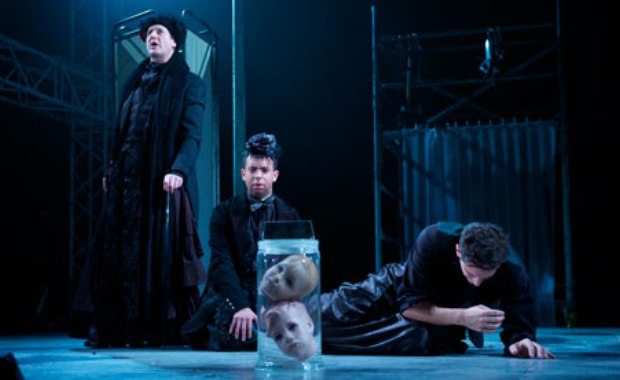
At a performance before Christmas of Propeller’s Henry V – not the funniest of Shakespeare’s works – theatregoers, including myself, were in stitches. The source of our mirth was the scene in which the French princess Katherine and her maidservant attempt to polish their English – a good old-fashioned language gag. But the riotous laughter owed less, I suspect, to the script than to the fact that Katherine had a five o’clock shadow.

Men on stage in dresses, it would seem, hold an eternal fascination. The pantomime dame has become as quintessentially festive as mince pies and tinsel, cross-dressing comedians can raise a belly laugh without even opening their mouths, and all-male casting exercises continue to tickle, intrigue and divide audiences.

Propeller’s decision to be an all-boys’ club has, of course, good historical precedent. Shakespeare wrote with male actors in mind, a fact that becomes relevant to the playful gender games initiated when women disguise themselves as men.

There is, of course, one major drawback to putting men in corsets, even in Shakespeare. As pointed out by Jo Caird in a blog for What’s On Stage, all-male casting filches some of the few great roles written for women. Citing the “chronic under-representation of women on the British stage”, she considers Propeller’s casting policy to be unjustifiable, an argument that carries a lot of clout.

It is difficult to imagine, however, similar objections being raised against exclusively female casts. All-female casting has become almost as common a practice as its male counterpart and is often credited with producing illuminating re-examinations of gender. Just think of Theatre Delicatessen’s exploration of the ways women contort themselves into prescribed roles in their all-female interpretation of A Doll’s House, or the Globe’s experiment a few years back in balancing its all-male productions with The Taming of the Shrew and Richard III performed by casts consisting solely of women.

But if all-female productions can be hailed as delving deep into the tangled gender politics of classic texts, surely the same can be argued of any cross-dressing production. Whether conceived as radical re-interpretation or mere giggle-inducing gimmick, I can’t help but feel that any production that makes a decision so extreme is inherently playing with gender, even if that’s not the primary purpose.

If nothing else, this technique is oddly alienating. In Propeller’s bloody take on Richard III, director Edward Hall and his cast made few concessions to femininity, with not a wig in sight and female attire that was cursory at best. The production’s hulking men in skirts consequently provoked an almost Brechtian jolt, roughly picking up the audience and putting them back down at one remove from the scenes on stage.

By making the familiar unfamiliar and levelling gender differences, single-sex casting can make us look afresh at plays that have become an accepted part of our cultural fabric. This allows audiences to reassess not only the gender relations in these classics, but also the ways in which men and women still treat one another in today’s society.

With Mark Rylance preparing once again to don his petticoats as Olivia in the Globe’s production of Twelfth Night, the theatrical gender-bending shows no sign of waning. It might not always be entirely fair, but single-sex casting remains one of the most effective ways of opening up the gender politics debate in classic plays. Perhaps it’s necessary to be exclusive in order to call for a more inclusive society?

Photo: Manuel Harlan