Carmen Disruption, Almeida Theatre

image

Carmen Disruption had me at the bull.

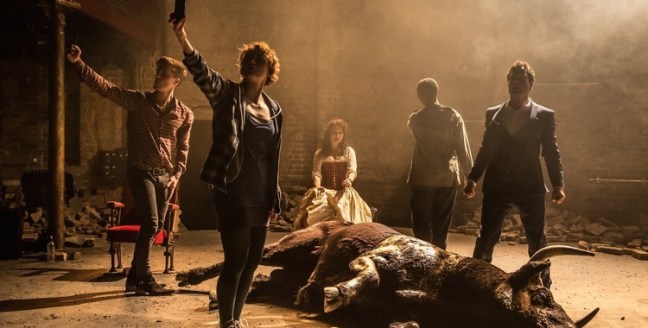
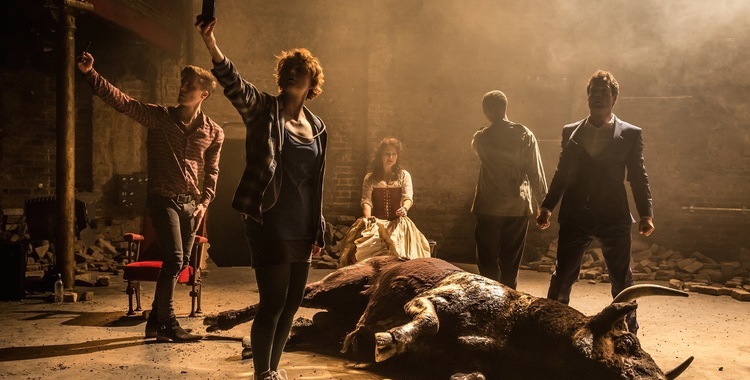
Entering the once again reconfigured Almeida auditorium, those of us with seats in the stalls are directed through dingy backstage corridors, emerging onto a rubble-strewn stage. We’re in a crumbling opera house, winding our way past the huge stricken bull that dominates Lizzie Clachan’s design. It remains there in the centre of the stage – hulking, symbolic, breathing its last – as the fractured lives of Simon Stephens’s play circle it, step over it, snap photos of it on their ubiquitous, glimmering smartphones.

The bullfight metaphor has mileage. In Mike Bartlett’s Bull it provides the entire form for the play, as two suited-and-booted matadors savage their doomed colleague. In Islands, the violent ritual is once again symbolic of capitalism, described in extended, gory detail by a grinning Caroline Horton. Here, the dying animal oozes tar-like blood across the stage, an ever-present image of devastation.

It’s also a reference to the bullfighting backdrop of Bizet’s opera, which Carmen Disruption explodes and pieces back together. There’s a moment right at the start of Michael Longhurst’s production – discordant strains of cello, darkness pierced with splinters of light – which somehow feels like a shattering of glass. The rest of the play is spent gathering those shards, fingers bloodied, jagged reflections glinting off the multiple shiny surfaces. It’s Carmen smashed, Carmen refracted, Carmen disrupted.

At the play’s centre – if it can really be said to have a centre – is an unnamed Singer (Sharon Small). She arrives at an unnamed airport, travels through an unnamed European city, arrives at an unnamed opera house sat on the edge of an unnamed river. All she really knows is that tonight she’s singing Carmen, the role she has performed in multiple productions in multiple cities, each shading into the next. And as she traverses this strange yet familiar urban landscape, the opera becomes more real than the faces and buildings sliding past her, imposing itself on the contours of the city.

Carmen becomes Jack Farthing’s swaggering rent boy, all leather jacket and sex appeal. Don José (the quietly astonishing Noma Dumezweni) is a driver for a shady character, trying to pay off old debts and right old wrongs; Escamillo (John Light) has traded bullfighting for investment banking, with a huge bet riding on the canned beef market in China, while Micaëla (Katie West) is a lost, lonely student. Their lives overlap, intertwine, glide past each other, as they all catch glimpses of a mysterious woman with long, curly black hair.

It’s a lot to take in. Longhurst’s direction is swift and sharp; miss a sentence and you won’t get it back. But while these intersecting stories are occasionally hard to follow, you can’t miss the distinctly 21st-century loneliness that throbs through all of them. Instead of speaking to one another, the broken individuals of the play talk out to us. As in Pornography, or in the never-quite-connecting monologues of Barrel Organ’s Nothing, Carmen Disruption offers a portrait of atomisation. The only respite from solitude and heartache is found in the glowing rectangles of smartphones – “should I look it up on my phone?” Small’s floundering Singer keeps asking, eyes darting wildly – while fleeting identity is invested in the things people buy: shirts, espressos, opera tickets.

There’s a thick vein of alienation and global dislocation running through Stephens’s more recent plays. The Singer is Paul in Birdland. She’s Iggy in Three Kingdoms. The world has fallen away from her, sloughed off by countless airport departure lounges and identical hotel rooms, disappearing along with any sense of self. Directors tell her where to stand and how to move her arms, but “they never tell me who the fuck I’m meant to be”. There’s a line repeated from Birdland: “none of this is real”.

That’s one way of reading Carmen Disruption. None of this is real. But that loss of reality is less to do with the Singer’s disorientated mental state and more to do with the identical, antiseptic spaces of late capitalist cities; the global simulacra of hotel rooms and lobbies and shopping centres. It doesn’t feel real because there’s nothing distinct about any of it. We might as well be anywhere – and in Longhurst’s production we are. This is a shadowy world, one eschewing the shiny coloured surfaces of Carrie Cracknell and Ian MacNeil’s Birdland in favour of the crumbling alternate reality of the opera. Theatre has become more real than life, but even that illusion is dissolving at the edges. The only constant is the low hum of electronic alerts, a peripheral stream of information scrolling on the surtitle screen mounted in the back corner of the stage.

The result is smashed-up and bruised and bloody, but breathlessly beautiful nonetheless. There’s a murky, eroding grandeur to Clachan’s design, with occasional bursts of glitter and dust, while the disjointed monologues are laced with echoes of Bizet’s score courtesy of the two onstage cellists. As that other, shadowy Carmen, glimpsed out of the corners of characters’ eyes, Viktoria Vizin is a haunting presence, her voice layering gorgeously over everything else. In the programme, she’s listed simply as Chorus, and there’s something about her constantly observing presence that seems to anticipate the Almeida’s upcoming season of Greek tragedies.

This tragedy, though, is not one of a fallen individual, but perhaps of a falling continent. No matter what the unspecified country we are in, this is clearly a Europe in crisis, its people worshipping at the feet of money and technology while failing to engage with – or even see – one another. The sadness that seeps into every pore of this production speaks of a wider malaise, a crisis that might be averted if only we were capable of reaching out to one another. There’s an insistent humanity to this scattered collection of characters, who yearn for intimacy while shunning it in the same movement. Again and again, they can’t connect. The tragedy is collective, but the pain is isolated.

Photo: Marc Brenner.

Operation Magic Carpet, Polka Theatre

Screen Shot 2015-04-13 at 11.57.34

Stories matter. So often they form the very substance of human communication, allowing us to define who we are both for others and for ourselves. They are our window onto what has come before and what lies ahead. They are how we see the world, how we shape it, sometimes even how we change it. And they’re certainly not just for children.

In Operation Magic Carpet, inherited stories are not just told, but retold. Samantha Ellis’s play is about where we come from and where we are now; about roots, journeys and destinations. It’s a story about stories and it’s a story written for children, though the ideas it’s gently tussling with are far from childish.

It’s a story with a heroine: curious, imaginative, no-nonsense Nomi. The British child of Iraqi immigrants, what Nomi wants more than anything is a story of her own. She’s stranded in a second generation no man’s land, struggling to lay claim to the narratives of Iraq and reluctant to accept those of Britain. Her father urges her to embrace their new home – “you’re lucky to be born in this country with its moderate climate, moderate people and moderate politics” – while her mother and uncle yearn for the country they have left behind, their wistful remembrances shutting Nomi out. Where does she fit in?

Her answer comes via a genie in a bottle, a ride on a magic carpet, and a daring adventure through the streets of Baghdad. When an unlikely sidekick pops out of her parents’ mango pickle jar, Nomi is granted her wish of going to Iraq, but the country she finds is one more familiar from the Thousand and One Nights than from television news reports. Once there, she encounters shooting stars, a proverb-spewing caliph and Sinbad the, erm, Merchant (he doesn’t like it when he’s called Sailor). She goes in search of her mother’s lost heart but, as in all good old-fashioned adventure stories, things get a little complicated along the way.

Sadly, the magic of the story doesn’t always translate to Rosamunde Hutt’s well-behaved production. Mischief, rather than being unbottled, too often feels controlled. Some pleasingly boisterous post-interval audience interaction aside, the performance hovers just short of the playfulness really needed to captivate its target audience of six to eleven year olds. Even in a climactic fight sequence, the action lacks the verve to fully transport its young spectators, its audacious series of magical transformations somehow failing to enchant.

As a piece of theatre, though, its real value lies in its reframing of familiar narratives. Without being overtly political, Operation Magic Carpet is a challenge of sorts. Its strong female protagonist challenges the insidious gender stereotypes of so many stories for children, which quietly influence how both girls and boys see their place in the world. It challenges media narratives of Iraq, refusing to ignore the nation’s turbulent recent history but at the same time recovering its thrilling, magical past. And at a time when immigration is at the top of the political agenda, it celebrates the condition of belonging to two places at once, exposing the shallowness and lack of imagination of an insistence on “British values”.

Like I said, stories matter. And so does this one.

The Father, Trafalgar Studios

95088

Originally written for Exeunt.

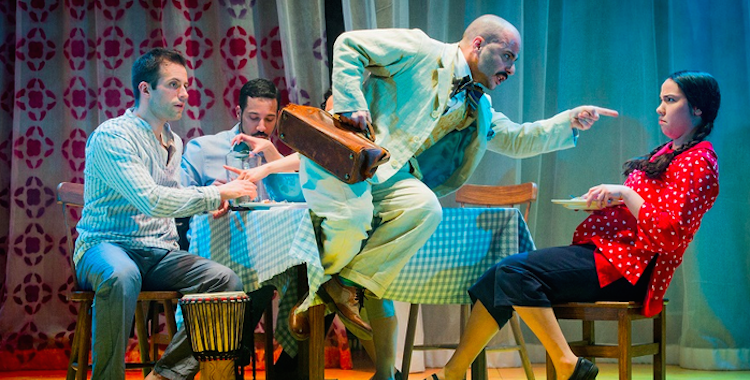
For August Strindberg, love is war. It’s apt then, that the protagonist of The Father is an army Captain, a man who can only see marriage in military terms. His wife – all women, in fact – is the enemy, and married life is a series of conflicts, long campaigns broken up with sudden assaults. The Captain and his spouse Laura are “natural antagonists”, locked in a brutal Darwinian battle. Only the fittest can be allowed to survive.

In Abbey Wright’s swift and taut new production at Trafalgar Studios, we get an action close-up of this battleground. Crowded around three sides of the small studio space – sparsely populated in James Turner’s design other than the mocking Christmas tree – the audience is claustrophobically close to a play more usually seen on bigger stages, lending extra spark to the dramatic pyrotechnics. When the Captain explodes, we can taste his rage and see the gleaming whites of his eyes.

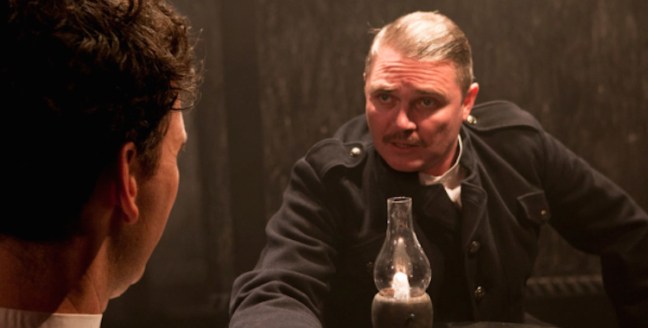
Strindberg’s play captures a family in breakdown. The Captain and Laura’s marriage, under strain for years, finally splinters apart around a pre-paternity test dilemma. How, the Captain begins to ask himself, can he be sure that he is the father of his daughter? With no Jeremy Kyle to solve the mystery, this doubt begins to sour, and Alex Ferns’ bullish, shouty Captain – face dredging up nasty memories of his run as EastEnders baddie Trevor – slowly falls apart, his straight-backed military arrogance gradually unravelling over the course of the action.

While the Captain is at the black heart of the tragedy, there’s a tougher task for Emily Dobbs as slippery, scheming Laura. Although the programme notes are keen to absolve Strindberg of out-and-out misogyny, it’s definitely Laura who comes out of this worse. The Captain might attempt to keep his wife on a tight leash, but it is Laura who intercepts his mail, convinces their new doctor that he is going mad and plants insidious doubts in his mind about the paternity of her daughter Bertha, the helpless bargaining chip shunted between the two. Both partners might be unpleasant, but it seems clear whose side the play is ultimately on.

Dobbs plays Laura as manipulative but frustrated, a caged creature who will do anything to get out. There are moments when she lends the role real bite, as when she furiously retorts “I’m not supposed to want anything, am I?”, but more often she appears as the snake her husband paints her as. It’s problematic, no doubt, and though Wright’s direction, together with Laurie Slade’s new version, creates a certain tension around Strindberg’s often misogynistic portrayals of his female characters, it shies away from confronting these difficulties head on.

Trouble is, to complain that it’s ugly is to miss the point. Strindberg’s players aremeant to be ugly, and no one escapes with an unstained character. Still, though, it’s painful to watch. Wright’s production lightens the mood by drawing out some of the plot’s more ridiculous aspects, with the action even feeling faintly farcical at moments, but it’s hard going nonetheless. Like so many of Strindberg’s characters, these aren’t people you feel inclined to spend much time in the company of, and when the curtain call arrives – as at the end of a wearying battle – it brings with it a slight exhalation of relief.

WINK, Theatre503

WINK-Theatre503-10-March-4-April-courtesy-of-Savannah-Photographic-6-600x399

Originally written for Exeunt.

What if you could become somebody else? As part of Battersea Arts Centre’s Scratch Online programme, artist Deborah Pearson is currently working on a digital project called Another You, which asks just that question. For one participant, the artwork offers a glimpse into an alternate life; a digital collage of paths not taken and things that might have been.

WINK explores a similar possibility. Phoebe Eclair-Powell’s debut play incorporates two generations of digital natives: the twenty-something teacher, who measures his life through his Facebook profile, and the teenage student whose after-school existence is lived almost entirely online. John is already discontented and nostalgic, indulging in a miserable affair and clicking through photographs from his university days. Mark just wants to get away, away from school and family and the grief that seeps poisonously through his home life.

These two characters’ lives, connected only in the most superficial of ways, come crashing together online. Jealous of what he believes to be his teacher’s perfect lifestyle – job, girlfriend, holidays – Mark invents a toned and loaded Facebook alter-ego: the brilliantly (and perhaps knowingly) named Tim Walker, lover of cat memes, Banksy and The Inbetweeners. Believing the fabricated Tim to be everything he isn’t, John accepts him as a friend on his girlfriend’s Facebook account and proceeds to pose as the woman Mark fantasises about. Without knowing it, both men are talking to lies.

Eclair-Powell and director Jamie Jackson have John and Mark tell their stories directly to the audience, only occasionally acknowledging one another’s presence on the small stage. Each is alienated from the other and from the outside world, to a dangerous and unpleasant degree in the case of Leon Williams’ laddish and frequently unlikeable John, while the disconnection of Sam Clemmett’s Mark has a lonely, mournful edge. For both of them, the online world is becoming more real than its physical counterpart. Their desire for intimacy is palpable but frustrated.

As ever, the internet proves difficult to represent on stage. Plenty have tried to engage theatrically with this shaping force of 21st-century life, but too often these attempts are strained and quickly dated, while those that do succeed tend to eschew technology altogether and rely on theatre’s analogue qualities – think Chris Goode’s Hippo World Guest Book. Jackson’s production turns to choreography, recruiting movement director Isla Jackson-Ritchie to conjure an abstract virtual environment with just the bodies of the two performers. Inside Bethany Wells’ sleek, white, Apple-esque design, Williams and Clemmett twist and turn, arms swiping through an online cornucopia of content.

At times, this device is striking. In a moment of online confrontation, each character concealed inside an internet alias, the choreography pulses with aggression; later, as Mark encounters the internet’s uglier side, Clemmett reels from imaginary punches, the online world delivering invisible body blows. More often, though, the movement feels separate from the rest of the production, tacked on rather than integral. There’s occasionally a similar feeling of effort in the text’s allusions to the online world, as though Eclair-Powell were racking up points for each social network or internet craze given a fleeting mention – Twitter, Facebook, Instagram, Tinder, Snapchat.

In the end, it’s all just a little too contrived, neglecting both character and plausibility in order to make its points. The play’s climax, instead of providing the high drama it’s so clearly aiming at, feels overblown and unlikely. In trying so hard to be about the internet, WINK – like John and Mark – loses its way in the online labyrinth.

Peddling, Arcola Theatre

peddling-facebook-ad

Originally written for Exeunt.

Harry Melling has an ear for the poetic and an eye for the gritty. His debut play has a little of both. It opens with him swinging from a lamppost, body straining upwards while coloured lights pulse around him. A moment later, he’s on the ground and in the dirt, gathering up the detritus of the night before. These two images capture in miniature the existence of Melling’s nineteen-year-old door-to-door salesman: a boy reaching upwards but forever pushed down. 

Peddling is a slippery, shimmering thing, its wordy, meandering text requiring concentration but rewarding the attention it demands. There are moments when both rhythm and language are briefly reminiscent of Kate Tempest, with that same delicate skill of spinning lyricism from the urban and everyday. Melling’s pedlar boy, a young offender set to work hawking j-cloths and loo rolls (“life’s essentials”), could be a brand new ancient; a trampled god of 21st-century London, flinging poetry and unexpected wisdom into the unheeding night air.

Inside the gauze walls of Lily Arnold’s set, the action of Peddling appears hazy, as if trapped behind the gloom and smog and anonymity of a city seething with people. Traipsing through London with his wares – “professional doorstep-hopping” – Melling’s protagonist bears witness to a stratified urban landscape, where the cosy, affluent households of Hampstead and Muswell Hill sit in stark contrast to those who come knocking on their doors. For all the fancy postcodes he names – those telling little combinations of letters and numbers, freighted with social significance – in Steven Atkinson’s production the Boy (he’s never named) stamps in circles around the same sorry patch of earth. Round and round.

In one of those comfortable houses with its comfortable postcode, the Boy comes across a ghost in the form of a woman in the form of a social worker. She doesn’t recognise him, but he recognises her. This sudden, destabilising encounter offers opportunity for destruction, answers and redemption, with the Boy seeking out a little of each. Melling has us follow him as night melts into day and day melts into night, tracing the winding path he takes on the search to understand his past, his present and his future.

What Melling is strongest on is the sheer, crippling indignity of not being recognised as a fellow human being. His protagonist is denied a name and a place to lay his head, cast out onto the uncaring streets with just a badge on his chest and a box of items for sale. His life is reduced to transactions. He knocks on doors. He sells dishcloths and buys fags. He receives the sum of his life in a box full of papers, thrust into his arms with the words “this is you”. Just a series of notes and records, the traces of his long exchange from hand to hand, institution to institution; “a long list of yesterdays”. When he begs for his name to be acknowledged, crying “I am something made of flesh and blood”, it rings out with rage and desperation.

Elsewhere, though, Peddling can be a little heavy-handed with both its points and its symbolism. When we get a glimpse of the Boy’s childhood, the loss-stained memory of innocence feels all too familiar, recalling a trope seen many times before. A long interlude describing a dream, meanwhile, shows the strain of reaching for profundity in a way that the rest of the play doesn’t need to, leading the attention to drift. The real poetry here is in the pedestrian, its power generated by a distinctly and devastatingly everyday despair. And through it all Melling’s restless, intermittently explosive protagonist prowls like a caged thing, stamping down the dirt and blinking up at a city sky that has swallowed all the stars – “a punishment for not taking good enough / care of one another”.